Resin Transfer
Molding
KAMLESH JAKHAR
Introduction
Resin transfer molding in which fiber preform or dry fiber reinforcement is packed
into a mold cavity that has the shape of the desired part and then supply the matrix
material to form the product.
Resin transfer molding is a closed molding process.
It is also knows as liquid transfer molding process.
Molding unit has two halves namely upper half mold (core) and lower half
mold(cavity).
In this technique, resin is transferred over the already placed reinforcement.
Raw Materials
Reinforcing materials:-
Glass fiber, carbon fiber, aramid fiber, natural plant fibers
(sisal, banana, nettle, hemp, flax etc.)
- These fibers are used either individually or in combined form (hybrid) as a woven
mat, unidirectional mat or copped strand mat.
- Minerals fillers may also be added to improve surface finish, Fire retardants,
Accelerator, U V stabilizers, Release agent.
Matrix:-
Thermosets :- Epoxy resin, Methyl Methacrylate, polyester, polyvinyl
ester, phenolic resin, polyurethane resin, silicone, alkyd, thermoset
polyamides.
Thermoplastics :- Nylon, PP, PE, Styrene resin, Thermoplastic polyester,
fluoropolymer, Liquid crystal polymers and thermoplastic
elastomers.
Resin transfer molding procedure
• Reinforcement in terms of either woven mat or strand mat form is placed on
the surface of lower half mold.
• A release gel is applied on the mold surface for easy removal of the
composite.
• The mold is properly closed and the mold halves clamped together.
• The resin is pumped in by repeated stroking of the metering cylinders until
a predetermined volume has been delivered into the mold.
• Air is displaced through other vents.
• The uniformity of resin flow can be enhanced by using a catalyst as an
accelerator and vacuum application.
• After curing, the mold is opened and composite product is taken out.
Process
Process
• There are two separate containers for resin and catalyst.
• Resin container is larger than the catalyst container.
• Both the containers have separate outlets which pass through pumping
unit and opens in mixing chamber.
• Pumping unit transfers the resin and catalyst to the mixing chamber.
• Resin and catalyst is mixed thoroughly(properly) in the mixing chamber.
• Resin injector is used to inject the mixture to the mold cavity.
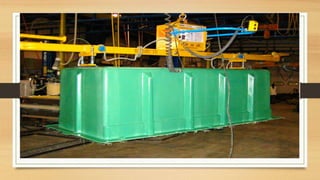
• Molding unit has two halves namely upper half mold and lower half mold.
• Heating arrangement is integrated with molding unit.
• Vents are provided to release the gases in the mold cavity during
clamping.
• End of process the molding unit is open and eject the product.
Components
Resin and catalyst container
Pumping unit
Mixing chamber
Resin injector
Molding unit like lower halves and upper halves.
Controlling Parameter
Resin viscosity
Injection time
Injection pressure
Temperature in the mold
• The viscosity of the resin plays an important role in resin transfer molding
process.
• Injection time depends upon viscosity of the resin.
• If viscosity of resin is high, high pressure is required which may cause
displacement of fibers knows as fiber wash.
Application
Complex structure can be produced.
Automotive body parts, big containers, bathtubs, helmet etc.
Vehicle panels
Boat hulls.
Wind turbine blades.
Aerospace parts.
Advantage
• Good surface finish on both surface of the product.
• Fast cycle time can be achieved through temperature control device.
• Higher production rate is associated with process automation.
• The process does not require high injection pressure.
• Wide range of reinforcement.
• Process can be manual control, semi-automatic or highly automated.
• Ability to incorporate insert and other attachment into molding.
• Parts are easily painted.
• Composite part thickness is uniform which is determined by the mold
cavity.
• Low capital investment.
Disadvantage
• Limited to smaller components.
• Tolling cost expansive.
• There is limitation on reinforcing materials due to the flow and resin
saturation of fibers.
• Mold maintenance is high than compression tools.
• It is produce higher volume waste because of a large pad with sprues.
Resin Transfer Molding (RTM)

Resin Transfer Molding (RTM)

  • 1.
  • 2.
    Introduction Resin transfer moldingin which fiber preform or dry fiber reinforcement is packed into a mold cavity that has the shape of the desired part and then supply the matrix material to form the product. Resin transfer molding is a closed molding process. It is also knows as liquid transfer molding process. Molding unit has two halves namely upper half mold (core) and lower half mold(cavity). In this technique, resin is transferred over the already placed reinforcement.
  • 3.
    Raw Materials Reinforcing materials:- Glassfiber, carbon fiber, aramid fiber, natural plant fibers (sisal, banana, nettle, hemp, flax etc.) - These fibers are used either individually or in combined form (hybrid) as a woven mat, unidirectional mat or copped strand mat. - Minerals fillers may also be added to improve surface finish, Fire retardants, Accelerator, U V stabilizers, Release agent.
  • 4.
    Matrix:- Thermosets :- Epoxyresin, Methyl Methacrylate, polyester, polyvinyl ester, phenolic resin, polyurethane resin, silicone, alkyd, thermoset polyamides. Thermoplastics :- Nylon, PP, PE, Styrene resin, Thermoplastic polyester, fluoropolymer, Liquid crystal polymers and thermoplastic elastomers.
  • 5.
    Resin transfer moldingprocedure • Reinforcement in terms of either woven mat or strand mat form is placed on the surface of lower half mold. • A release gel is applied on the mold surface for easy removal of the composite. • The mold is properly closed and the mold halves clamped together. • The resin is pumped in by repeated stroking of the metering cylinders until a predetermined volume has been delivered into the mold.
  • 6.
    • Air isdisplaced through other vents. • The uniformity of resin flow can be enhanced by using a catalyst as an accelerator and vacuum application. • After curing, the mold is opened and composite product is taken out.
  • 7.
  • 9.
    Process • There aretwo separate containers for resin and catalyst. • Resin container is larger than the catalyst container. • Both the containers have separate outlets which pass through pumping unit and opens in mixing chamber. • Pumping unit transfers the resin and catalyst to the mixing chamber. • Resin and catalyst is mixed thoroughly(properly) in the mixing chamber.
  • 10.
    • Resin injectoris used to inject the mixture to the mold cavity. • Molding unit has two halves namely upper half mold and lower half mold. • Heating arrangement is integrated with molding unit. • Vents are provided to release the gases in the mold cavity during clamping. • End of process the molding unit is open and eject the product.
  • 11.
    Components Resin and catalystcontainer Pumping unit Mixing chamber Resin injector Molding unit like lower halves and upper halves.
  • 12.
    Controlling Parameter Resin viscosity Injectiontime Injection pressure Temperature in the mold
  • 13.
    • The viscosityof the resin plays an important role in resin transfer molding process. • Injection time depends upon viscosity of the resin. • If viscosity of resin is high, high pressure is required which may cause displacement of fibers knows as fiber wash.
  • 14.
    Application Complex structure canbe produced. Automotive body parts, big containers, bathtubs, helmet etc. Vehicle panels Boat hulls. Wind turbine blades. Aerospace parts.
  • 17.
    Advantage • Good surfacefinish on both surface of the product. • Fast cycle time can be achieved through temperature control device. • Higher production rate is associated with process automation. • The process does not require high injection pressure. • Wide range of reinforcement.
  • 18.
    • Process canbe manual control, semi-automatic or highly automated. • Ability to incorporate insert and other attachment into molding. • Parts are easily painted. • Composite part thickness is uniform which is determined by the mold cavity. • Low capital investment.
  • 19.
    Disadvantage • Limited tosmaller components. • Tolling cost expansive. • There is limitation on reinforcing materials due to the flow and resin saturation of fibers. • Mold maintenance is high than compression tools. • It is produce higher volume waste because of a large pad with sprues.