Objective: Evaluate the Process of
Communication
Use communication skills that contribute to positive relationships.
( Maryland Family and Consumer Sciences Voluntary State Curriculum) (FCSNS 13.3)
The Process of
Communication
A Process is:
 A set of steps leading to a desired
result
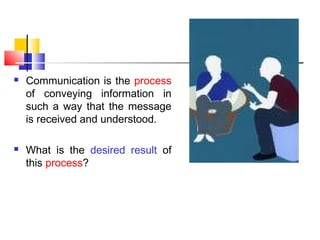
 Communication is the process
of conveying information in
such a way that the message
is received and understood.
 What is the desired result of
this process?
 "I know that you believe you
understand what you think I said, but
I'm not sure you realize that what you
heard is not what I meant."
Robert McCloskey
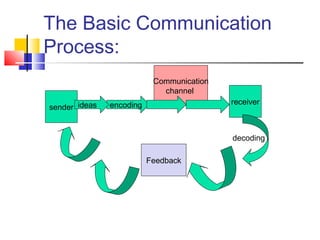
The Basic Communication
Process:
sender
receiver
Communication
channel
Feedback
encodingideas
decoding
Elements of Communication
Process
Communication may be defined as a process
concerning exchange of facts or ideas between persons
holding different positions in an organization to
achieve mutual harmony. The communication process
is dynamic in nature rather than a static phenomenon.
Communication process as such must be considered a
continuous and dynamic inter-action, both affecting
and being affected by many variables.
(1) Sender:
The person who intends to convey the message with
the intention of passing information and ideas to
others is known as sender or communicator.
(2) Ideas:
This is the subject matter of the
communication. This may be an opinion,
attitude, feelings, views, orders, or suggestions.
(3) Encoding:
Since the subject matter of communication is
theoretical and intangible, its further passing
requires use of certain symbols such as words,
actions or pictures etc. Conversion of subject
matter into these symbols is the process of
encoding.
(4) Communication
Channel:
The person who is interested in communicating has to
choose the channel for sending the required information,
ideas etc. This information is transmitted to the receiver
through certain channels which may be either formal or
informal.
(5) Receiver:
Receiver is the person who receives the message or for
whom the message is meant for. It is the receiver who
tries to understand the message in the best possible
manner in achieving the desired objectives.
(6) Decoding:
The person who receives the message or symbol
from the communicator tries to convert the same in
such a way so that he may extract its meaning to
his complete understanding.
(7) Feedback:
Feedback is the process of ensuring that the
receiver has received the message and
understood in the same sense as sender meant
it.

The process of communication

  • 1.
    Objective: Evaluate theProcess of Communication Use communication skills that contribute to positive relationships. ( Maryland Family and Consumer Sciences Voluntary State Curriculum) (FCSNS 13.3)
  • 2.
  • 3.
    A Process is: A set of steps leading to a desired result
  • 4.
     Communication isthe process of conveying information in such a way that the message is received and understood.  What is the desired result of this process?
  • 5.
     "I knowthat you believe you understand what you think I said, but I'm not sure you realize that what you heard is not what I meant." Robert McCloskey
  • 6.
  • 7.
    Elements of Communication Process Communicationmay be defined as a process concerning exchange of facts or ideas between persons holding different positions in an organization to achieve mutual harmony. The communication process is dynamic in nature rather than a static phenomenon. Communication process as such must be considered a continuous and dynamic inter-action, both affecting and being affected by many variables.
  • 8.
    (1) Sender: The personwho intends to convey the message with the intention of passing information and ideas to others is known as sender or communicator.
  • 9.
    (2) Ideas: This isthe subject matter of the communication. This may be an opinion, attitude, feelings, views, orders, or suggestions.
  • 10.
    (3) Encoding: Since thesubject matter of communication is theoretical and intangible, its further passing requires use of certain symbols such as words, actions or pictures etc. Conversion of subject matter into these symbols is the process of encoding.
  • 11.
    (4) Communication Channel: The personwho is interested in communicating has to choose the channel for sending the required information, ideas etc. This information is transmitted to the receiver through certain channels which may be either formal or informal.
  • 12.
    (5) Receiver: Receiver isthe person who receives the message or for whom the message is meant for. It is the receiver who tries to understand the message in the best possible manner in achieving the desired objectives.
  • 13.
    (6) Decoding: The personwho receives the message or symbol from the communicator tries to convert the same in such a way so that he may extract its meaning to his complete understanding.
  • 14.
    (7) Feedback: Feedback isthe process of ensuring that the receiver has received the message and understood in the same sense as sender meant it.

Editor's Notes

  • #2 http://www.rttworks.com/images/PowComArt.gif
  • #3 http://www.wallpaper.net.au/wallpaper/other/Communication%20by%20Isabelle%20Cardinal%20-%20800x600.jpg