Unit 1
Introduction
Megharaja E N
⁂Communication is a Latin originated word, meaning of which is sharing.
Communication means sharing or exchanging information, news, ideas,
etc. with someone.
⁂ The communication is said to be perfect only when the receiver
understand the information send by the sender effectively. Then the
receiver interpret the information that is expected by the sender.
⁂ Communication is a systematic and continues process of Telling,
Listening and Understanding (TLU)
• According to Megginson said, “Communication is the process of
transmitting meanings, ideas and understanding of a person or a
group to another person or group.”
• According to Newstrom & Keith Davis said, “Communication is
the transfer of information form one person to another. It is a way
of reaching others by transmitting ideas, feelings, thoughts, facts
and values.”
• According to Theo Haiman, “Communication means the process
of passing information and understanding from one person to
another.”
Nature of Communication
• 1. Two-way process
• 2. Continuous process
• 3. Dynamic process
• 4. Pervasive (It takes place at all levels (top, middle, low) in all functional areas (production,
finance, personnel, sales) of a business organisation)
• 5. Two people
• 6. Exchange
• 7. Verbal and non-verbal
• 8. Mutual understanding
• 9. Goal-oriented
• 10. Foundation of management
• 11. A means, not an end
• 12. Human activity
• 14. Inter-disciplinary
Types of Communication
Based on means of
delivering the message
Based on purpose of
communication
Based on levels of
communication
Based on pattern of
communication
 Verbal communication
 Non verbal
communication
 Formal communication
 Informal communication
 Intrapersonal communication
 Interpersonal communication
 Transpersonal communication
 Small group communication
 Public Communication
 Organizational
Communication
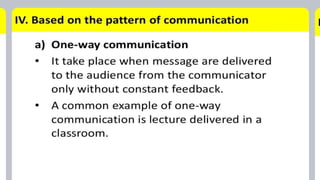
 One way communication
 Two way communication
 One to One Communication
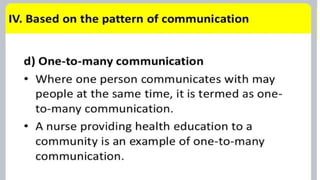
 One to many Communication
 Many to one communication
Managerial communications
• Communication is fundamental to the existence and survival of humans
as well as to an organization. It is a process of creating and sharing
ideas, information, views, facts, feelings from one place, person or
group to another. Communication is the key to the Directing function of
management
• A manager may be highly qualified and skilled but if he does not possess
good communication skills, all his ability becomes irrelevant. A manager
must communicate his directions effectively to the subordinates to get
the work done from them properly.
What is Managerial Communication?
• Managerial Communication is defined as a function that helps the manager to
communicate with their employees and within the organisation.
• It instills a smooth and clarified flow of information amongst employees and managers
working on common goals.
• Facilitating the working of the organisation and smooth working of the employees, firm
communication skills are required. From the superior (boss) to the subordinates and
employees are aware of the relevant & clarified communication for the fluent running of
the organisation.
• It includes ideas, transmission of the command to others, followed by expected actions.
These commands might get hampered by physical or human intermediaries
Objective of Communication in organizations
• To exchange information
• Advice, order, suggestions, education, warning etc.
• To develop a plan
• To implement a plan
• To facilitate policy formulation
• To motivate employees
• Raising morale
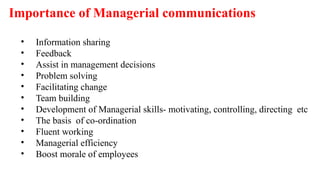
Importance of Managerial communications
• Information sharing
• Feedback
• Assist in management decisions
• Problem solving
• Facilitating change
• Team building
• Development of Managerial skills- motivating, controlling, directing etc
• The basis of co-ordination
• Fluent working
• Managerial efficiency
• Boost morale of employees
Purpose of Communication
• Establish and maintain relationships
• To persuade and change attitudes or behaviors
• Develop an understanding of other people
• Helps for problem solving
• Directing Actions
• Generating and promoting ideas and values
• Inter organizational linking
• Explaining organizational culture, values, objectives , mission, vision etc
• Enhance business goodwill, create customer relationships…
• Smooth functioning of business
• Create effective Team etc
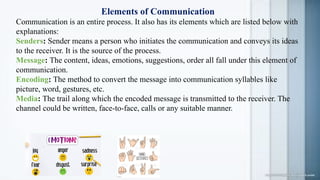
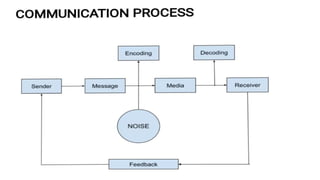
Elements of Communication
Communication is an entire process. It also has its elements which are listed below with
explanations:
Senders: Sender means a person who initiates the communication and conveys its ideas
to the receiver. It is the source of the process.
Message: The content, ideas, emotions, suggestions, order all fall under this element of
communication.
Encoding: The method to convert the message into communication syllables like
picture, word, gestures, etc.
Media: The trail along which the encoded message is transmitted to the receiver. The
channel could be written, face-to-face, calls or any suitable manner.
Decoding: The opposite of the encoding process, the conversion of the
encoded syllables is done by the receiver.
Receiver: The last person in the chain who finally receives the
message from the sender and takes an action as per requirement.
Feedback: It cumulatively involves all the actions of the receiver
indicating that he received and understood the message by senders.
Noise: The obstruction or hindrance in the entire process in the
communication. This hindrance might be caused by the sender,
receiver or the message.
1. Sender:
Sender is the person who initiates, generates and sends the
message. He represents the source of message. The
communication process begins when the sender develops an
idea or message he wants to transmit. He must arrange the
ideas in a manner that can be understood by the receiver. A
lecturer delivering a lecture in the classroom is the sender of
the message or a manager addressing his team in a meeting is
sender of the message.
2. Message:
Message is the idea or information that the sender
wants to convey. He may convey it verbally (by writing or
speaking) or non-verbally (through gestures or body
language). Whatever the form, the message should be
clearly formed so that desired objective is accomplished.
3. Encoding:
Encoding gives meaning to the message or converts ideas into
codes which can be understood by the receiver. Encoding means
translating the message into words (written or spoken),
symbols or gestures. It may be a combination of the three. The
code should be appropriate to the situation, that is, interpreted by
the receiver in the manner intended.
4. Transmission:
Transmission involves selecting the medium or channel
communication. Once decided that the message has to be sent in
writing, the sender may select the electronic channel and the
medium of e-mail or fax. Short messages can be transmitted
through telephone but lengthy messages can be sent through letters
or circulars.
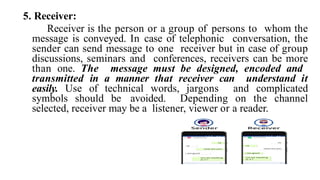
5. Receiver:
Receiver is the person or a group of persons to whom the
message is conveyed. In case of telephonic conversation, the
sender can send message to one receiver but in case of group
discussions, seminars and conferences, receivers can be more
than one. The message must be designed, encoded and
transmitted in a manner that receiver can understand it
easily. Use of technical words, jargons and complicated
symbols should be avoided. Depending on the channel
selected, receiver may be a listener, viewer or a reader.
6. Decoding:
Decoding means giving meaningful interpretation to the message.
On receiving the message, the receiver translates the symbols into
meaningful information to the best of his ability. Communication
is effective if receiver understands the message in the same way
as intended by the sender. The receiver must, therefore, be familiar
with the codes and symbols used by the sender.
7. Noise:
It represents the disturbing factor in the process of
communication. It interferes with effective communication and
reduces clarity of the message. The message may be interpreted
differently than intended by the sender. Conversing near a
machine making sounds, disturbance in telephone line, physical
ailment or mental distress of sender or receiver, psychological
barriers (degree of trust, fear, perception etc.) are the common
forms of noise that obstruct the quality of message transmitted
from sender to the receiver.
8. Feedback:
Feedback is receiver’s response to sender’s message. The
receiver communicates his reaction to the sender through
words, symbols or gestures. It is the reversal of communication
process where receiver becomes the sender and sender becomes
the receiver. Unless the receiver responds to the message,
communication process is incomplete
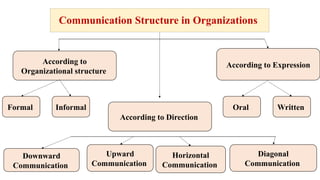
Communication Structure in Organizations
According to
Organizational structure
According to Direction
According to Expression
Formal Informal
Downward
Communication
Upward
Communication
Diagonal
Communication
Oral Written
Horizontal
Communication
Formal communication
• Formal communication typically refers to an official interchange of information.
Regardless of your role within an organization, knowing how to formally
communicate and recognize formal communication can help improve the way you
communicate with colleagues and the company's management
Importance
• It clearly defines and establishes authority
• It improves overall efficiency
• It reduces the likelihood of mistakes and errors
• It can create discipline
• It can improve work coordination
• It tends to be more credible when sending important messages
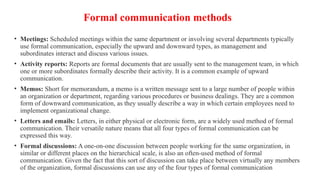
Formal communication methods
• Meetings: Scheduled meetings within the same department or involving several departments typically
use formal communication, especially the upward and downward types, as management and
subordinates interact and discuss various issues.
• Activity reports: Reports are formal documents that are usually sent to the management team, in which
one or more subordinates formally describe their activity. It is a common example of upward
communication.
• Memos: Short for memorandum, a memo is a written message sent to a large number of people within
an organization or department, regarding various procedures or business dealings. They are a common
form of downward communication, as they usually describe a way in which certain employees need to
implement organizational change.
• Letters and emails: Letters, in either physical or electronic form, are a widely used method of formal
communication. Their versatile nature means that all four types of formal communication can be
expressed this way.
• Formal discussions: A one-on-one discussion between people working for the same organization, in
similar or different places on the hierarchical scale, is also an often-used method of formal
communication. Given the fact that this sort of discussion can take place between virtually any members
of the organization, formal discussions can use any of the four types of formal communication
Informal communication
• Informal communication is casual communication between coworkers
in the workplace. It is unofficial in nature and is based in the informal,
social relationships that are formed in a workplace
• Informal communication can be defined as communication between the
individuals or groups which is not officially recognized. Informal
communication is also known as grapevine
Advantages-
• Satisfying the social needs of workers
• Fast and Effective Communication
• Free Environment
• Better Human Relations
• Easy Solution of the Difficult Problems
Disadvantages-
• Unsystematic Communication
• Unreliable information
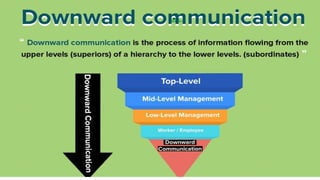
Importance of downward communication
1. To give an idea
2. To encourage
3. Direction
4. To explain about change
5. Assignment of job
6. Control, evaluate
7. Job instruction
Advantages
1. Efficiency
2. Ease of Delegation
3. Organizational discipline
4. Effective Communication of goals
Disadvantages
1. Slow feedback
2. Not motivating
3. Lower morale
4. Interpretative problem
Importance of Upward communication
1. Good relations
2. Idea sharing
3. To explain about change
4. Requesting
5. Feedback
Advantages
1. Good relationship
2. Feedback
3. Motivation, counseling
4. Following responsibilities
Disadvantages
1. Slow feedback
2. Demotivate when lack of proper response
3. Interpretative problem
4. Time consuming
5. Chances of Wilful manipulation of information
• It provides emotional and social assistance to the organisational
members.
• It helps in solving various organisational problems.
• It is time-saving.
• It can also be used for resolving conflicts of a department with other
department or conflicts within a department.
• It facilitates co-operation among team members.
• It is a means of information sharing.
• It facilitates coordination of the task.
Horizontal communication
Diagonal Communication
• Diagonal or crosswise communication is a type of communication that crosses all organizational
units and hierarchical levels. Such communication involves staff members of different departments
interacting with each other, regardless of their reporting relationship. This type of communication
is not affected by any lines of authority.
Oral Communication
• Oral communication implies communication through
mouth. It includes individuals conversing with each other, be
it direct conversation or telephonic conversation. Speeches,
presentations, discussions are all forms of oral
communication.
• staff meetings, business meetings and other face-to-face meetings.
• personal discussions.
• presentations.
• telephone calls.
• informal conversation.
• public presentations such as speeches, lectures and conferences.
• teleconferences or videoconferences.
• interviews.
Written Communication
• Written communication involves any type of interaction that makes
use of the written word
• Emails
• Text messages
• Blog posts
• Business letters
• Reports
• Proposals
• Contracts
• Job descriptions
• Employee manuals
• Memos
• Bulletins
• lnstant messages
• Postcards, Faxes, Advertisements, Brochures, News releases etc..
Barriers in Communication
A communication barrier is anything that prevents us from receiving
and understanding the messages others use to convey their
information, ideas and thoughts. They can interfere with or block the
message you are trying to send
1. Language barriers
2. Cultural barriers
3. Physical barriers
4. Psychological barriers
5. Technological barriers
6. Organizational barriers
7. Semantic barriers
8. Personal barriers
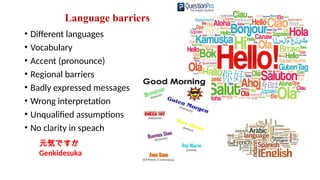
Language barriers
• Different languages
• Vocabulary
• Accent (pronounce)
• Regional barriers
• Badly expressed messages
• Wrong interpretation
• Unqualified assumptions
• No clarity in speach
元気ですか
Genkidesuka
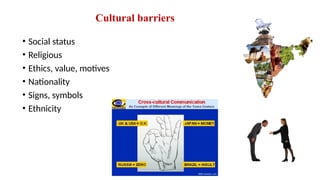
Cultural barriers
• Social status
• Religious
• Ethics, value, motives
• Nationality
• Signs, symbols
• Ethnicity
Physical barriers
• Wrong medium
• Tiredness
• Hearing, sight or speech problems
• Noise, poor environment lighting
• Staff shortage
• Lack of physical equipment
• Faulty organizational structure- Large working area, closed office doors,
Separate area for people of different status
• Improper time, defects in medium, network issues, Mechanical breakdowns
• Information overload
• Premature evaluation
• Lack of attention
• Lack of transmission and poor retention
• Poor retention
• Lack of attention
• Loss by transmission
• Emotions
• Anger, anxiety, status problems
• Differing perception
• False assumption
• Status difference
• Attitudes and opinion
Psychological barriers
• Lack of internet access
• Lack of appropriate hardwares
• Lack of software
• Lack of internet connectivity
• Lack of security
Technological barriers
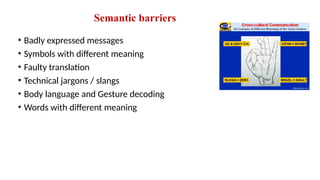
Semantic barriers
• Badly expressed messages
• Symbols with different meaning
• Faulty translation
• Technical jargons / slangs
• Body language and Gesture decoding
• Words with different meaning
Organizational barriers
• Organizational policy
• Rules and regulations
• Complexity in organizations structure
• Status
• Organizational facilities
• Lack of communication policy
• Authoritarian attitudes of management
• Poorly defined authority and responsibility
• Insufficient communication training
Personal barriers
• Lack of confidence of superior towards subordinates
• Lack of listening skills
• Lack of knowledge
• Lack of attention
• Lack of vocabulary
• Be an attentive listener
• Correct, clarity and clear
• Non-verbal communication is the key
• Be relaxed
• Inform
• Show empathy
• Completeness
• Give and Receive Feedback
• Knowledge about subject matter, decoder, environment, human psychology
• Avoid information overload
• Use of simple launguage
• Create environment trust and Confidence
Pre requisite for Effective Communication
Continued….
Continued….
Continued….
Continued….
Continued….
Continued….
Continued….
Continued….
Continued….
Continued….
Continued….
Continued….
Continued….
Continued….
Continued….
Continued….
Continued….
• A communication network refers to how information flows within the
organization. Information within an organization generally flows through a
system, rather than being a free flow. Communication networks are
regular patterns of person-to-person relationships through which
information flows in an organization.
• A communication Network is a collection of methods that users employ to
pass on valuable information. The communication network is the sum of
all the means and methods that an organization employs to communicate
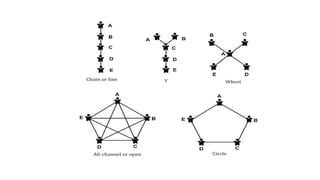
• Vertical Network
• Wheel Network
• Circle/ circuit Network
• Chain Network
• Star/ All channels Network
Communication Network
Vertical Network
• This is a kind of a formal network. So
consequently it is suitable for communications
between different levels of employees. For
example a higher ranking manager and a
lower-ranking official.
• This network thus enables two-way
communication wherein immediate feedback
is a common practice. This is a direct link
between the employees and their subordinates
and thus the chance of miscommunication is
very low.
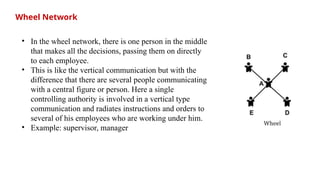
Wheel Network
• In the wheel network, there is one person in the middle
that makes all the decisions, passing them on directly
to each employee.
• This is like the vertical communication but with the
difference that there are several people communicating
with a central figure or person. Here a single
controlling authority is involved in a vertical type
communication and radiates instructions and orders to
several of his employees who are working under him.
• Example: supervisor, manager
Circle Network
In this type of network, two people or nodes will
communicate with each other continuously. One of the
nodes will produce messages and the other a feedback to the
messages. The communication is thus two people
communicating with each other, sending messages and
feedbacks and thus forming a loop or a circuit
For example, a group of managers at a grocery store are
all at the same level. In this network, they will
communicate together and then pass on information to the
assistant managers, then the assistant managers will pass
information on to the cashiers.
Chain Network line network
Superiors ordering the subordinates is the best example of this
type of network. Also, the leader leading the group of people is an
example of Chain Network. The message has to reach from top-
level to bottom level without any alteration of meaning or words.
Care should be taken to avoid the same.
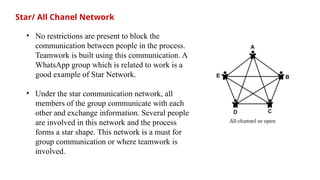
Star/ All Chanel Network
• No restrictions are present to block the
communication between people in the process.
Teamwork is built using this communication. A
WhatsApp group which is related to work is a
good example of Star Network.
• Under the star communication network, all
members of the group communicate with each
other and exchange information. Several people
are involved in this network and the process
forms a star shape. This network is a must for
group communication or where teamwork is
involved.
Managerial communications, Communication.pptx

Managerial communications, Communication.pptx

  • 3.
  • 4.
    ⁂Communication is aLatin originated word, meaning of which is sharing. Communication means sharing or exchanging information, news, ideas, etc. with someone. ⁂ The communication is said to be perfect only when the receiver understand the information send by the sender effectively. Then the receiver interpret the information that is expected by the sender. ⁂ Communication is a systematic and continues process of Telling, Listening and Understanding (TLU)
  • 5.
    • According toMegginson said, “Communication is the process of transmitting meanings, ideas and understanding of a person or a group to another person or group.” • According to Newstrom & Keith Davis said, “Communication is the transfer of information form one person to another. It is a way of reaching others by transmitting ideas, feelings, thoughts, facts and values.” • According to Theo Haiman, “Communication means the process of passing information and understanding from one person to another.”
  • 7.
    Nature of Communication •1. Two-way process • 2. Continuous process • 3. Dynamic process • 4. Pervasive (It takes place at all levels (top, middle, low) in all functional areas (production, finance, personnel, sales) of a business organisation) • 5. Two people • 6. Exchange • 7. Verbal and non-verbal • 8. Mutual understanding • 9. Goal-oriented • 10. Foundation of management • 11. A means, not an end • 12. Human activity • 14. Inter-disciplinary
  • 8.
    Types of Communication Basedon means of delivering the message Based on purpose of communication Based on levels of communication Based on pattern of communication  Verbal communication  Non verbal communication  Formal communication  Informal communication  Intrapersonal communication  Interpersonal communication  Transpersonal communication  Small group communication  Public Communication  Organizational Communication  One way communication  Two way communication  One to One Communication  One to many Communication  Many to one communication
  • 37.
    Managerial communications • Communicationis fundamental to the existence and survival of humans as well as to an organization. It is a process of creating and sharing ideas, information, views, facts, feelings from one place, person or group to another. Communication is the key to the Directing function of management • A manager may be highly qualified and skilled but if he does not possess good communication skills, all his ability becomes irrelevant. A manager must communicate his directions effectively to the subordinates to get the work done from them properly.
  • 38.
    What is ManagerialCommunication? • Managerial Communication is defined as a function that helps the manager to communicate with their employees and within the organisation. • It instills a smooth and clarified flow of information amongst employees and managers working on common goals. • Facilitating the working of the organisation and smooth working of the employees, firm communication skills are required. From the superior (boss) to the subordinates and employees are aware of the relevant & clarified communication for the fluent running of the organisation. • It includes ideas, transmission of the command to others, followed by expected actions. These commands might get hampered by physical or human intermediaries
  • 39.
    Objective of Communicationin organizations • To exchange information • Advice, order, suggestions, education, warning etc. • To develop a plan • To implement a plan • To facilitate policy formulation • To motivate employees • Raising morale
  • 40.
    Importance of Managerialcommunications • Information sharing • Feedback • Assist in management decisions • Problem solving • Facilitating change • Team building • Development of Managerial skills- motivating, controlling, directing etc • The basis of co-ordination • Fluent working • Managerial efficiency • Boost morale of employees
  • 41.
    Purpose of Communication •Establish and maintain relationships • To persuade and change attitudes or behaviors • Develop an understanding of other people • Helps for problem solving • Directing Actions • Generating and promoting ideas and values • Inter organizational linking • Explaining organizational culture, values, objectives , mission, vision etc • Enhance business goodwill, create customer relationships… • Smooth functioning of business • Create effective Team etc
  • 42.
    Elements of Communication Communicationis an entire process. It also has its elements which are listed below with explanations: Senders: Sender means a person who initiates the communication and conveys its ideas to the receiver. It is the source of the process. Message: The content, ideas, emotions, suggestions, order all fall under this element of communication. Encoding: The method to convert the message into communication syllables like picture, word, gestures, etc. Media: The trail along which the encoded message is transmitted to the receiver. The channel could be written, face-to-face, calls or any suitable manner.
  • 43.
    Decoding: The oppositeof the encoding process, the conversion of the encoded syllables is done by the receiver. Receiver: The last person in the chain who finally receives the message from the sender and takes an action as per requirement. Feedback: It cumulatively involves all the actions of the receiver indicating that he received and understood the message by senders. Noise: The obstruction or hindrance in the entire process in the communication. This hindrance might be caused by the sender, receiver or the message.
  • 46.
    1. Sender: Sender isthe person who initiates, generates and sends the message. He represents the source of message. The communication process begins when the sender develops an idea or message he wants to transmit. He must arrange the ideas in a manner that can be understood by the receiver. A lecturer delivering a lecture in the classroom is the sender of the message or a manager addressing his team in a meeting is sender of the message.
  • 47.
    2. Message: Message isthe idea or information that the sender wants to convey. He may convey it verbally (by writing or speaking) or non-verbally (through gestures or body language). Whatever the form, the message should be clearly formed so that desired objective is accomplished.
  • 48.
    3. Encoding: Encoding givesmeaning to the message or converts ideas into codes which can be understood by the receiver. Encoding means translating the message into words (written or spoken), symbols or gestures. It may be a combination of the three. The code should be appropriate to the situation, that is, interpreted by the receiver in the manner intended.
  • 49.
    4. Transmission: Transmission involvesselecting the medium or channel communication. Once decided that the message has to be sent in writing, the sender may select the electronic channel and the medium of e-mail or fax. Short messages can be transmitted through telephone but lengthy messages can be sent through letters or circulars.
  • 50.
    5. Receiver: Receiver isthe person or a group of persons to whom the message is conveyed. In case of telephonic conversation, the sender can send message to one receiver but in case of group discussions, seminars and conferences, receivers can be more than one. The message must be designed, encoded and transmitted in a manner that receiver can understand it easily. Use of technical words, jargons and complicated symbols should be avoided. Depending on the channel selected, receiver may be a listener, viewer or a reader.
  • 51.
    6. Decoding: Decoding meansgiving meaningful interpretation to the message. On receiving the message, the receiver translates the symbols into meaningful information to the best of his ability. Communication is effective if receiver understands the message in the same way as intended by the sender. The receiver must, therefore, be familiar with the codes and symbols used by the sender.
  • 52.
    7. Noise: It representsthe disturbing factor in the process of communication. It interferes with effective communication and reduces clarity of the message. The message may be interpreted differently than intended by the sender. Conversing near a machine making sounds, disturbance in telephone line, physical ailment or mental distress of sender or receiver, psychological barriers (degree of trust, fear, perception etc.) are the common forms of noise that obstruct the quality of message transmitted from sender to the receiver.
  • 53.
    8. Feedback: Feedback isreceiver’s response to sender’s message. The receiver communicates his reaction to the sender through words, symbols or gestures. It is the reversal of communication process where receiver becomes the sender and sender becomes the receiver. Unless the receiver responds to the message, communication process is incomplete
  • 54.
    Communication Structure inOrganizations According to Organizational structure According to Direction According to Expression Formal Informal Downward Communication Upward Communication Diagonal Communication Oral Written Horizontal Communication
  • 55.
    Formal communication • Formalcommunication typically refers to an official interchange of information. Regardless of your role within an organization, knowing how to formally communicate and recognize formal communication can help improve the way you communicate with colleagues and the company's management Importance • It clearly defines and establishes authority • It improves overall efficiency • It reduces the likelihood of mistakes and errors • It can create discipline • It can improve work coordination • It tends to be more credible when sending important messages
  • 56.
    Formal communication methods •Meetings: Scheduled meetings within the same department or involving several departments typically use formal communication, especially the upward and downward types, as management and subordinates interact and discuss various issues. • Activity reports: Reports are formal documents that are usually sent to the management team, in which one or more subordinates formally describe their activity. It is a common example of upward communication. • Memos: Short for memorandum, a memo is a written message sent to a large number of people within an organization or department, regarding various procedures or business dealings. They are a common form of downward communication, as they usually describe a way in which certain employees need to implement organizational change. • Letters and emails: Letters, in either physical or electronic form, are a widely used method of formal communication. Their versatile nature means that all four types of formal communication can be expressed this way. • Formal discussions: A one-on-one discussion between people working for the same organization, in similar or different places on the hierarchical scale, is also an often-used method of formal communication. Given the fact that this sort of discussion can take place between virtually any members of the organization, formal discussions can use any of the four types of formal communication
  • 57.
    Informal communication • Informalcommunication is casual communication between coworkers in the workplace. It is unofficial in nature and is based in the informal, social relationships that are formed in a workplace • Informal communication can be defined as communication between the individuals or groups which is not officially recognized. Informal communication is also known as grapevine Advantages- • Satisfying the social needs of workers • Fast and Effective Communication • Free Environment • Better Human Relations • Easy Solution of the Difficult Problems Disadvantages- • Unsystematic Communication • Unreliable information
  • 60.
    Importance of downwardcommunication 1. To give an idea 2. To encourage 3. Direction 4. To explain about change 5. Assignment of job 6. Control, evaluate 7. Job instruction Advantages 1. Efficiency 2. Ease of Delegation 3. Organizational discipline 4. Effective Communication of goals Disadvantages 1. Slow feedback 2. Not motivating 3. Lower morale 4. Interpretative problem
  • 62.
    Importance of Upwardcommunication 1. Good relations 2. Idea sharing 3. To explain about change 4. Requesting 5. Feedback Advantages 1. Good relationship 2. Feedback 3. Motivation, counseling 4. Following responsibilities Disadvantages 1. Slow feedback 2. Demotivate when lack of proper response 3. Interpretative problem 4. Time consuming 5. Chances of Wilful manipulation of information
  • 64.
    • It providesemotional and social assistance to the organisational members. • It helps in solving various organisational problems. • It is time-saving. • It can also be used for resolving conflicts of a department with other department or conflicts within a department. • It facilitates co-operation among team members. • It is a means of information sharing. • It facilitates coordination of the task. Horizontal communication
  • 65.
    Diagonal Communication • Diagonalor crosswise communication is a type of communication that crosses all organizational units and hierarchical levels. Such communication involves staff members of different departments interacting with each other, regardless of their reporting relationship. This type of communication is not affected by any lines of authority.
  • 66.
    Oral Communication • Oralcommunication implies communication through mouth. It includes individuals conversing with each other, be it direct conversation or telephonic conversation. Speeches, presentations, discussions are all forms of oral communication. • staff meetings, business meetings and other face-to-face meetings. • personal discussions. • presentations. • telephone calls. • informal conversation. • public presentations such as speeches, lectures and conferences. • teleconferences or videoconferences. • interviews.
  • 67.
    Written Communication • Writtencommunication involves any type of interaction that makes use of the written word • Emails • Text messages • Blog posts • Business letters • Reports • Proposals • Contracts • Job descriptions • Employee manuals • Memos • Bulletins • lnstant messages • Postcards, Faxes, Advertisements, Brochures, News releases etc..
  • 68.
    Barriers in Communication Acommunication barrier is anything that prevents us from receiving and understanding the messages others use to convey their information, ideas and thoughts. They can interfere with or block the message you are trying to send 1. Language barriers 2. Cultural barriers 3. Physical barriers 4. Psychological barriers 5. Technological barriers 6. Organizational barriers 7. Semantic barriers 8. Personal barriers
  • 69.
    Language barriers • Differentlanguages • Vocabulary • Accent (pronounce) • Regional barriers • Badly expressed messages • Wrong interpretation • Unqualified assumptions • No clarity in speach 元気ですか Genkidesuka
  • 70.
    Cultural barriers • Socialstatus • Religious • Ethics, value, motives • Nationality • Signs, symbols • Ethnicity
  • 71.
    Physical barriers • Wrongmedium • Tiredness • Hearing, sight or speech problems • Noise, poor environment lighting • Staff shortage • Lack of physical equipment • Faulty organizational structure- Large working area, closed office doors, Separate area for people of different status • Improper time, defects in medium, network issues, Mechanical breakdowns • Information overload
  • 72.
    • Premature evaluation •Lack of attention • Lack of transmission and poor retention • Poor retention • Lack of attention • Loss by transmission • Emotions • Anger, anxiety, status problems • Differing perception • False assumption • Status difference • Attitudes and opinion Psychological barriers
  • 73.
    • Lack ofinternet access • Lack of appropriate hardwares • Lack of software • Lack of internet connectivity • Lack of security Technological barriers
  • 74.
    Semantic barriers • Badlyexpressed messages • Symbols with different meaning • Faulty translation • Technical jargons / slangs • Body language and Gesture decoding • Words with different meaning
  • 78.
    Organizational barriers • Organizationalpolicy • Rules and regulations • Complexity in organizations structure • Status • Organizational facilities • Lack of communication policy • Authoritarian attitudes of management • Poorly defined authority and responsibility • Insufficient communication training
  • 79.
    Personal barriers • Lackof confidence of superior towards subordinates • Lack of listening skills • Lack of knowledge • Lack of attention • Lack of vocabulary
  • 80.
    • Be anattentive listener • Correct, clarity and clear • Non-verbal communication is the key • Be relaxed • Inform • Show empathy • Completeness • Give and Receive Feedback • Knowledge about subject matter, decoder, environment, human psychology • Avoid information overload • Use of simple launguage • Create environment trust and Confidence Pre requisite for Effective Communication
  • 81.
  • 82.
  • 83.
  • 84.
  • 85.
  • 86.
  • 87.
  • 88.
  • 89.
  • 90.
  • 91.
  • 92.
  • 93.
  • 94.
  • 95.
  • 96.
  • 97.
  • 98.
    • A communicationnetwork refers to how information flows within the organization. Information within an organization generally flows through a system, rather than being a free flow. Communication networks are regular patterns of person-to-person relationships through which information flows in an organization. • A communication Network is a collection of methods that users employ to pass on valuable information. The communication network is the sum of all the means and methods that an organization employs to communicate • Vertical Network • Wheel Network • Circle/ circuit Network • Chain Network • Star/ All channels Network Communication Network
  • 99.
    Vertical Network • Thisis a kind of a formal network. So consequently it is suitable for communications between different levels of employees. For example a higher ranking manager and a lower-ranking official. • This network thus enables two-way communication wherein immediate feedback is a common practice. This is a direct link between the employees and their subordinates and thus the chance of miscommunication is very low.
  • 100.
    Wheel Network • Inthe wheel network, there is one person in the middle that makes all the decisions, passing them on directly to each employee. • This is like the vertical communication but with the difference that there are several people communicating with a central figure or person. Here a single controlling authority is involved in a vertical type communication and radiates instructions and orders to several of his employees who are working under him. • Example: supervisor, manager
  • 101.
    Circle Network In thistype of network, two people or nodes will communicate with each other continuously. One of the nodes will produce messages and the other a feedback to the messages. The communication is thus two people communicating with each other, sending messages and feedbacks and thus forming a loop or a circuit For example, a group of managers at a grocery store are all at the same level. In this network, they will communicate together and then pass on information to the assistant managers, then the assistant managers will pass information on to the cashiers.
  • 102.
    Chain Network linenetwork Superiors ordering the subordinates is the best example of this type of network. Also, the leader leading the group of people is an example of Chain Network. The message has to reach from top- level to bottom level without any alteration of meaning or words. Care should be taken to avoid the same.
  • 103.
    Star/ All ChanelNetwork • No restrictions are present to block the communication between people in the process. Teamwork is built using this communication. A WhatsApp group which is related to work is a good example of Star Network. • Under the star communication network, all members of the group communicate with each other and exchange information. Several people are involved in this network and the process forms a star shape. This network is a must for group communication or where teamwork is involved.