
Visual Communication
Methods of Communication
By definition, visual communication is the
practice of graphically representing information
to efficiently, effectively create meaning. There
are many types of content in the realm of visual
communication, with examples including info
graphics, interactive content, motion graphics,
and more.
• The possibilities are endless. But no matter
the medium, all incorporate at least some of
the following elements: interactivity,
iconography, illustration, supporting text,
graphs, data visualization, and animation.
• Which type of visual communication is right
for your company or campaign depends on
the goal(s) you’d like to achieve. It also
depends on your target audience. Ask your
creative content partner for
recommendations.
• Facial expressions and gestures, printed
pictures, posters, slides, film stripes,
photographs etc. fall under visual
communication. Mime is an old art in which
ideas and emotions are expressed through
facial expressions and gestures. Sign boards
posted at public places like cinema, schools,
and hospitals are effective means of visual
communication.
• Visual communication can be more
effective it other media are used along with.
Audio - Visual Communication
Methods of Communication
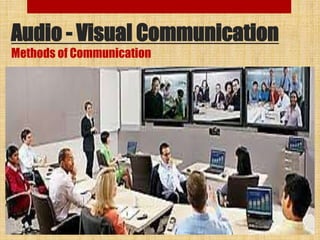
Audio-visual communication is passing
information as in the form of sound and
visual component. Films, Television
programs, video chat etc. are some example
for audio visual communication. This type of
communication can provide more
communication accuracy between the
individuals whom make the communication
• Audio-visual communication that makes use
of telecasts, short films on the cinema screen
and video tapes is powerful medium of
communication. It is a combination of sight
and sound.
• It is most suitable for mass publicity, mass
propaganda, and mass education. In order to
make an effective use of this technique, films
and slides have to be attractive and
interesting, and narration should be clear,
precise and easily understandable.
• Audio visual communication is a productive
form of communication. Using sound and
lighting equipment improves communication by
heightening the awareness of your audience’s
sight and hearing.
• Audiences who use more of their senses to
engage at events remember those events for a
longer period of time. Their retention of the
event material 3 days after an event is 6 times
greater when the information is presented using
creative AV.
• Not all people are auditory learners who can obtain
information from lectures and speeches. Many people
are visual learners who respond better to still or moving
images. It is the combination of sight and sound that
promotes and reinforces this retention, and enables an
audience to better connect to the brand or message. AV
makes it easier for your audience to psychologically
access and remember information once they have left
the event.
Today, there is no doubt that audiovisual productions
play an important role in shaping human life.
Statistics demonstrate that television is, for a large
percentage of the world's population, currently the
only means of accessing culture and information.
Media conglomerates, Economic globalization and
the increasing possibilities of information and
communication technologies have given audiovisual
products global target, while turning audiences all
over the world into potential communicators, without
borders of any sort.
Visual & audio communication

Visual & audio communication

  • 1.
  • 2.
    By definition, visualcommunication is the practice of graphically representing information to efficiently, effectively create meaning. There are many types of content in the realm of visual communication, with examples including info graphics, interactive content, motion graphics, and more.
  • 5.
    • The possibilitiesare endless. But no matter the medium, all incorporate at least some of the following elements: interactivity, iconography, illustration, supporting text, graphs, data visualization, and animation. • Which type of visual communication is right for your company or campaign depends on the goal(s) you’d like to achieve. It also depends on your target audience. Ask your creative content partner for recommendations.
  • 6.
    • Facial expressionsand gestures, printed pictures, posters, slides, film stripes, photographs etc. fall under visual communication. Mime is an old art in which ideas and emotions are expressed through facial expressions and gestures. Sign boards posted at public places like cinema, schools, and hospitals are effective means of visual communication. • Visual communication can be more effective it other media are used along with.
  • 8.
    Audio - VisualCommunication Methods of Communication
  • 9.
    Audio-visual communication ispassing information as in the form of sound and visual component. Films, Television programs, video chat etc. are some example for audio visual communication. This type of communication can provide more communication accuracy between the individuals whom make the communication
  • 11.
    • Audio-visual communicationthat makes use of telecasts, short films on the cinema screen and video tapes is powerful medium of communication. It is a combination of sight and sound. • It is most suitable for mass publicity, mass propaganda, and mass education. In order to make an effective use of this technique, films and slides have to be attractive and interesting, and narration should be clear, precise and easily understandable.
  • 12.
    • Audio visualcommunication is a productive form of communication. Using sound and lighting equipment improves communication by heightening the awareness of your audience’s sight and hearing. • Audiences who use more of their senses to engage at events remember those events for a longer period of time. Their retention of the event material 3 days after an event is 6 times greater when the information is presented using creative AV.
  • 13.
    • Not allpeople are auditory learners who can obtain information from lectures and speeches. Many people are visual learners who respond better to still or moving images. It is the combination of sight and sound that promotes and reinforces this retention, and enables an audience to better connect to the brand or message. AV makes it easier for your audience to psychologically access and remember information once they have left the event.
  • 14.
    Today, there isno doubt that audiovisual productions play an important role in shaping human life. Statistics demonstrate that television is, for a large percentage of the world's population, currently the only means of accessing culture and information. Media conglomerates, Economic globalization and the increasing possibilities of information and communication technologies have given audiovisual products global target, while turning audiences all over the world into potential communicators, without borders of any sort.