D F M E A  World Class Results
What Is ‘World Class?’ According To Most Marketplace Studies, “Best In Class” Quality Includes: A Very Small Number Of Customer-Perceived Defects During Early Ownership The Definition Of “Defect” Continues To Intensify No Severe Defects That Affect Safety During Normal Service Life 75 to 90% Of All Defects Are Design Based Manufacturing Defects Tend To Be More Severe
Common Practices: Not World Class Defect Elimination Is Largely Based On Defect Detection End Of Line Inspection & Post Launch Correction Expensive & Difficult To Control The Law Of Defects: If A Non-Conforming Item Is Found, Two Things Are Certain: It Isn’t The First Non-Conforming Part Produced Quarantine Efforts Will Be Less Than 100% Effective Some Defective Parts Will Reach End Customers
FMEA & World Class Results FMEA Is  A FORMAL PROCESS That: Identifies WHAT Can Go Wrong Quantitatively Prioritizes Potential Problems Improves Designs & Manufacturing Processes  FMEA Does Not Eliminate Risk—It Helps Manage Risk Detection Of Non-Conformance Is Ineffective Excellence Depends On Defect Prevention DFMEA Is Really About Cost Reduction Drives VERIFICATION Activities In Quality Systems—But It’s  Not Just About Quality …
Verification A Methodology That Seeks To Provide Reasonable Evidence That A Product Design Meets Market Requirements Not Absolute Proof—Reasonable Evidence The Goal Is To Demonstrate That Products Are  Fit For Use —Not Mere Compliance With Specifications Or Standards Customers Ultimately Don’t Care About Standards Or Specifications
World Class Verification Verification Is Based On A Logical Foundation Create A Concept, Detail The Design, & Prove That The Final Design Is Fit For Use World Class Verification Relies More On Prevention Than Detection Of Errors Analysis Rather Than Testing World Class Verification Also Controls Disbursement Of Engineering Expense In Development Projects…
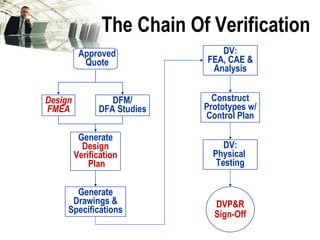
The Chain Of Verification Design FMEA DFM/ DFA Studies Generate Design Verification Plan Generate Drawings & Specifications DV: FEA, CAE & Analysis Construct Prototypes w/ Control Plan DV: Physical  Testing DVP&R Sign-Off Approved Quote
DFMEA DFMEA Is The Critical Tool For Improving Verification DFMEA Should Be Deductive Rather Than Inductive DFMEA Techniques Should Integrate Robustness Considerations DFMEA Should Be Based On A Repeatable & Reproducible  Process …
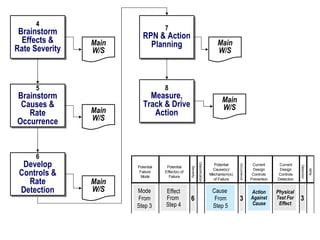
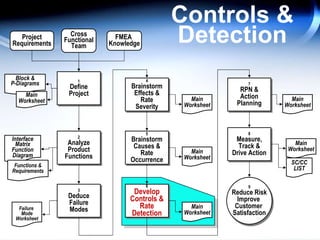
DFMEA  Process 1 Define Project 2 Analyze Product Functions 3 Deduce Failure Modes 4 Brainstorm Effects & Rate Severity 5 Brainstorm Causes & Rate Occurrence 6 Develop Controls & Rate Detection 7 RPN & Action Planning 8 Measure, Track & Drive Action Project Requirements Cross Functional Team FMEA  Knowledge 9 Reduce Risk Improve  Customer  Satisfaction Boundary & Function Diagrams Failure  Mode Worksheet Main Worksheet Main Worksheet Main Worksheet Main Worksheet Main Worksheet SC/CC LIST Block & P-Diagrams, Interface Matrix Main Worksheet Specification Worksheet
Example Analysis Now, using a simple mechanical pencil, we will show you the deductive process for DFMEA for the pencil assembly This analysis will be conducted at a system level for the assembly  as a whole   It’s also possible—using the same techniques—to analyze the design at the component or individual part level…
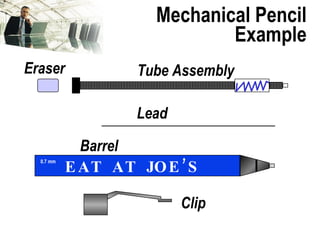
Mechanical Pencil Example 0.7 mm Eraser Lead Clip Tube Assembly Barrel EAT AT JOE’S
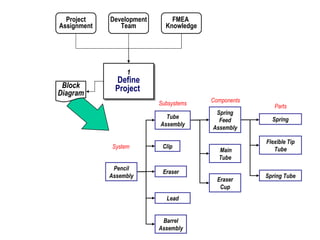
Step 1 Construct A Block Diagram A Block Diagram Is A Pictorial Representation Of The Design Concept Under Consideration You might think of the block diagram as a visual version of an exploded bill of materials…
1 Define Project   Project Assignment Development Team FMEA  Knowledge Block Diagram Pencil Assembly Barrel Assembly Lead Tube Assembly Eraser Clip Main Tube Eraser Cup Spring Feed Assembly Spring Tube Spring Flexible Tip Tube System Subsystems Components Parts
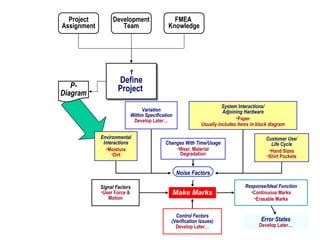
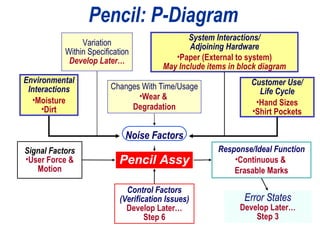
Step 2 Construct A “P” (Parameter) Diagram A P diagram shows how the product should work—the ideal function A P diagram also shows critical noise factors for DFMEA Adjoining Hardware (Often Seen In Block Diagrams) Environmental Challenges Critical User Factors
1 Define Project   Project Assignment Development Team FMEA  Knowledge P- Diagram Noise Factors Variation Within Specification Develop Later… Environmental Interactions Moisture Dirt Changes With Time/Usage Wear, Material Degradation System Interactions/ Adjoining Hardware Paper Usually includes items in block diagram Customer Use/ Life Cycle Hand Sizes Shirt Pockets Signal Factors User Force & Motion Response/Ideal Function Continuous Marks Erasable Marks Make Marks Control Factors (Verification Issues) Develop Later… Error States Develop Later…
Pencil: P-Diagram Response/Ideal Function Continuous &  Erasable Marks Noise Factors Variation Within Specification Develop Later… Environmental Interactions Moisture Dirt Changes With Time/Usage Wear &  Degradation System Interactions/ Adjoining Hardware Paper (External to system) May Include items in block diagram Customer Use/ Life Cycle Hand Sizes Shirt Pockets Signal Factors User Force & Motion Pencil Assy Control Factors (Verification Issues) Develop Later… Step 6 Error States Develop Later… Step 3
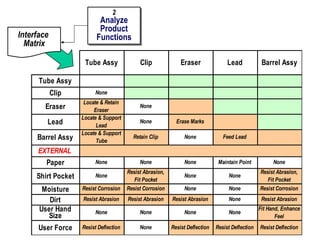
2 Analyze Product Functions Interface  Matrix
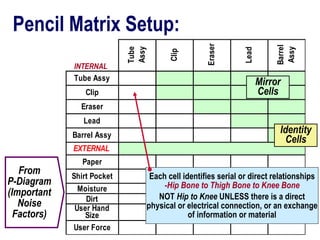
Pencil Matrix Setup: Identity Cells Mirror Cells INTERNAL From P-Diagram (Important Noise Factors) Each cell identifies serial or direct relationships -Hip Bone to Thigh Bone to Knee Bone NOT  Hip to Knee  UNLESS there is a direct physical or electrical connection, or an exchange of information or material
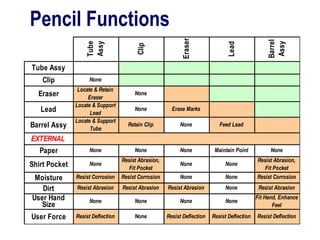
Pencil Functions
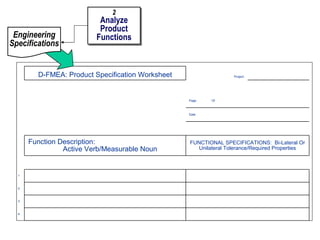
          4     3     2     1 FUNCTIONAL SPECIFICATIONS:  Bi-Lateral Or Unilateral Tolerance/Required Properties Function Description:  Active Verb/Measurable Noun   Date   Page  Of    Project: D-FMEA: Product Specification Worksheet 2 Analyze Product Functions Engineering Specifications
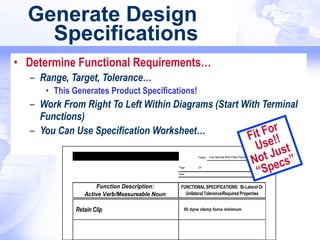
Determine Functional Requirements… Range, Target, Tolerance… This Generates Product Specifications! Work From Right To Left Within Diagrams (Start With Terminal Functions) You Can Use Specification Worksheet… Generate Design Specifications Fit For  Use!! Not Just  “Specs”
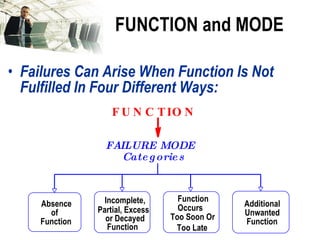
FUNCTION and MODE Failures Can Arise When Function Is Not Fulfilled In Four Different Ways: FUNCTION FAILURE MODE  Categories Absence  of  Function Incomplete,  Partial, Excess or Decayed  Function Function  Occurs  Too Soon Or  Too Late Additional  Unwanted  Function
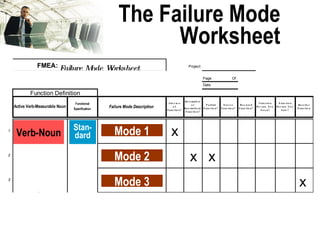
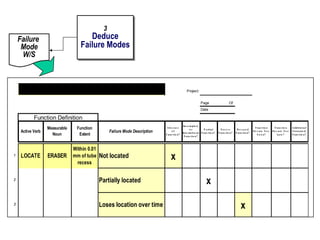
The Failure Mode Worksheet Verb-Noun Stan- dard Mode 1 Mode 2 Mode 3 x x x x
3 Deduce Failure Modes Failure  Mode W/S
Mode From Step 3 Effect From  Step 4 6 Cause  From Step 5 3 3 Action Against Cause Physical Test For Effect 7 RPN & Action Planning Main W/S 4 Brainstorm Effects & Rate Severity Main W/S 5 Brainstorm Causes & Rate Occurrence Main W/S 6 Develop Controls & Rate Detection Main W/S 8 Measure, Track & Drive Action Main W/S
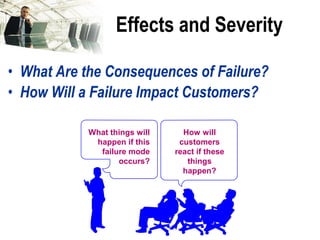
Effects and Severity What Are the Consequences of Failure? How Will a Failure Impact Customers? What things will happen if this failure mode occurs? How will customers react if these things happen?
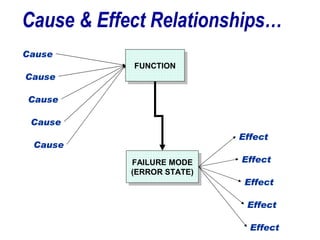
Cause & Effect Relationships… FUNCTION FAILURE MODE (ERROR STATE) Cause Cause Cause Cause Cause Effect Effect Effect Effect Effect
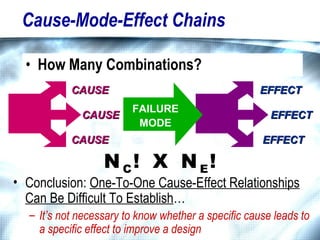
Cause-Mode-Effect Chains How Many Combinations? N   C   !  X  N   E   ! Conclusion:  One-To-One Cause-Effect Relationships Can Be Difficult To Establish … It’s not necessary to know whether a specific cause leads to a specific effect to improve a design EFFECT EFFECT EFFECT CAUSE CAUSE CAUSE FAILURE MODE
Best Practices Work Column By Column, NOT Row By Row For Each Mode, Brainstorm Reasonable Effects Select The Most Severe Effect Enter That Effect On the Worksheet Then Move To The Next Mode  You May Enter More Effects But This Will Have Little Practical Impact On DFMEA Results! After Listing  ALL Effects , Then Rate The Severity Of The Effects Better, Faster, Easier
Brainstorm EFFECTS For Each MODE When Multiple Effects Occur, Enter [At Least] The “Worst Case” Effect Brainstorm All Effects Before Rating Severity
Cause & Occurrence What Events Are Responsible for a Failure Mode Occurring? How Likely Is This Set of Events?
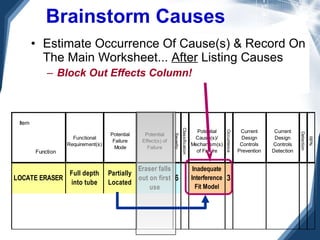
Best Practices Work Column By Column Brainstorm Reasonable Causes For Each Mode, Working Mode-By-Mode Hide  The Effect & Severity Columns When Considering Causes You Are NOT Brainstorming Causes Of Effects—You ARE Brainstorming Causes Of Function Disruption Select The Most Likely Cause Enter That Cause On the Worksheet—Enter More Causes If The Likelihood Is Similar Then Move To The Next Mode After Listing ALL Causes,  Then  Rate Occurrence
Brainstorm Causes Estimate Occurrence Of Cause(s) & Record On The Main Worksheet...  After  Listing Causes Block Out Effects Column!
Controls & Detection 1 Define Project 2 Analyze Product Functions 3 Deduce Failure Modes 4 Brainstorm Effects & Rate Severity 5 Brainstorm Causes & Rate Occurrence 6 Develop Controls & Rate Detection 7 RPN & Action Planning 8 Measure, Track & Drive Action Project Requirements Cross Functional Team FMEA  Knowledge 9 Reduce Risk Improve  Customer  Satisfaction Interface Matrix Function Diagram Failure  Mode Worksheet Main Worksheet Main Worksheet Main Worksheet Main Worksheet Main Worksheet SC/CC LIST Block & P-Diagrams Main Worksheet Functions & Requirements
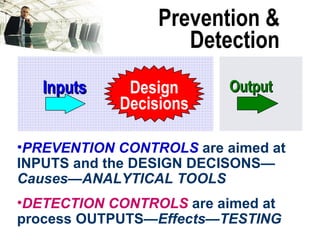
Prevention & Detection PREVENTION CONTROLS  are aimed at INPUTS and the DESIGN DECISONS— Causes—ANALYTICAL TOOLS DETECTION CONTROLS  are aimed at process OUTPUTS— Effects—TESTING Inputs Design Decisions Output
Prevention Controls Prevention Controls Are Critical For Competitive Product Development Best Practice: Complete All Control Work Prior To Construction Of Prototypes & Physical Testing Physical Testing Has Limited Value Low Statistical Significance Doesn’t Always Represent Real-World Usage Cannot Evaluate Limit-Of-Tolerance Conditions Especially For Material Properties Failure Of Physical Testing Is Very Expensive Most Recalled Vehicles Had Successful Test Histories
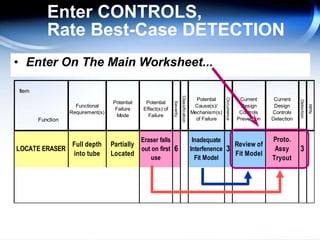
Enter CONTROLS,  Rate Best-Case DETECTION Enter On The Main Worksheet...
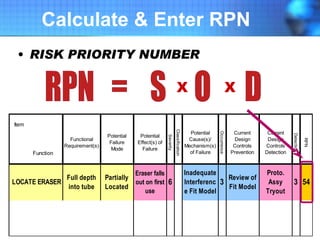
Calculate & Enter RPN RISK PRIORITY NUMBER X X
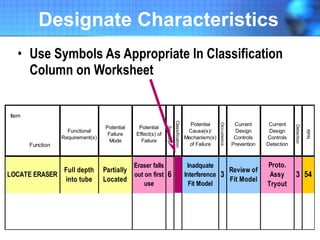
Designate Characteristics Use Symbols As Appropriate In Classification Column on Worksheet
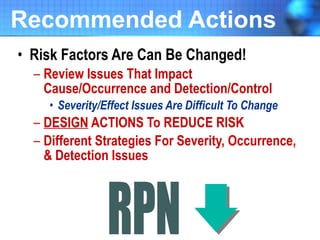
Recommended Actions Risk Factors Are Can Be Changed! Review Issues That Impact Cause/Occurrence and Detection/Control Severity/Effect Issues Are Difficult To Change DESIGN  ACTIONS To REDUCE RISK Different Strategies For Severity, Occurrence, & Detection Issues
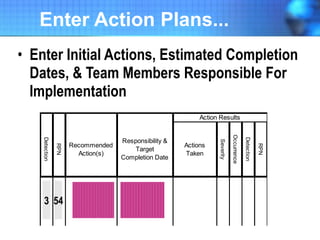
Enter Action Plans... Enter Initial Actions, Estimated Completion Dates, & Team Members Responsible For Implementation 3 54
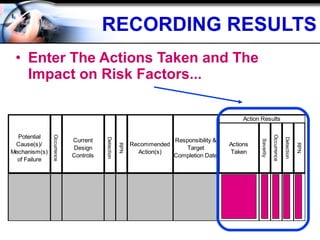
RECORDING RESULTS Enter The Actions Taken and The Impact on Risk Factors...

Best Damn D-FMEA Method!

  • 1.
    D F ME A World Class Results
  • 2.
    What Is ‘WorldClass?’ According To Most Marketplace Studies, “Best In Class” Quality Includes: A Very Small Number Of Customer-Perceived Defects During Early Ownership The Definition Of “Defect” Continues To Intensify No Severe Defects That Affect Safety During Normal Service Life 75 to 90% Of All Defects Are Design Based Manufacturing Defects Tend To Be More Severe
  • 3.
    Common Practices: NotWorld Class Defect Elimination Is Largely Based On Defect Detection End Of Line Inspection & Post Launch Correction Expensive & Difficult To Control The Law Of Defects: If A Non-Conforming Item Is Found, Two Things Are Certain: It Isn’t The First Non-Conforming Part Produced Quarantine Efforts Will Be Less Than 100% Effective Some Defective Parts Will Reach End Customers
  • 4.
    FMEA & WorldClass Results FMEA Is A FORMAL PROCESS That: Identifies WHAT Can Go Wrong Quantitatively Prioritizes Potential Problems Improves Designs & Manufacturing Processes FMEA Does Not Eliminate Risk—It Helps Manage Risk Detection Of Non-Conformance Is Ineffective Excellence Depends On Defect Prevention DFMEA Is Really About Cost Reduction Drives VERIFICATION Activities In Quality Systems—But It’s Not Just About Quality …
  • 5.
    Verification A MethodologyThat Seeks To Provide Reasonable Evidence That A Product Design Meets Market Requirements Not Absolute Proof—Reasonable Evidence The Goal Is To Demonstrate That Products Are Fit For Use —Not Mere Compliance With Specifications Or Standards Customers Ultimately Don’t Care About Standards Or Specifications
  • 6.
    World Class VerificationVerification Is Based On A Logical Foundation Create A Concept, Detail The Design, & Prove That The Final Design Is Fit For Use World Class Verification Relies More On Prevention Than Detection Of Errors Analysis Rather Than Testing World Class Verification Also Controls Disbursement Of Engineering Expense In Development Projects…
  • 7.
    The Chain OfVerification Design FMEA DFM/ DFA Studies Generate Design Verification Plan Generate Drawings & Specifications DV: FEA, CAE & Analysis Construct Prototypes w/ Control Plan DV: Physical Testing DVP&R Sign-Off Approved Quote
  • 8.
    DFMEA DFMEA IsThe Critical Tool For Improving Verification DFMEA Should Be Deductive Rather Than Inductive DFMEA Techniques Should Integrate Robustness Considerations DFMEA Should Be Based On A Repeatable & Reproducible Process …
  • 9.
    DFMEA Process1 Define Project 2 Analyze Product Functions 3 Deduce Failure Modes 4 Brainstorm Effects & Rate Severity 5 Brainstorm Causes & Rate Occurrence 6 Develop Controls & Rate Detection 7 RPN & Action Planning 8 Measure, Track & Drive Action Project Requirements Cross Functional Team FMEA Knowledge 9 Reduce Risk Improve Customer Satisfaction Boundary & Function Diagrams Failure Mode Worksheet Main Worksheet Main Worksheet Main Worksheet Main Worksheet Main Worksheet SC/CC LIST Block & P-Diagrams, Interface Matrix Main Worksheet Specification Worksheet
  • 10.
    Example Analysis Now,using a simple mechanical pencil, we will show you the deductive process for DFMEA for the pencil assembly This analysis will be conducted at a system level for the assembly as a whole It’s also possible—using the same techniques—to analyze the design at the component or individual part level…
  • 11.
    Mechanical Pencil Example0.7 mm Eraser Lead Clip Tube Assembly Barrel EAT AT JOE’S
  • 12.
    Step 1 ConstructA Block Diagram A Block Diagram Is A Pictorial Representation Of The Design Concept Under Consideration You might think of the block diagram as a visual version of an exploded bill of materials…
  • 13.
    1 Define Project Project Assignment Development Team FMEA Knowledge Block Diagram Pencil Assembly Barrel Assembly Lead Tube Assembly Eraser Clip Main Tube Eraser Cup Spring Feed Assembly Spring Tube Spring Flexible Tip Tube System Subsystems Components Parts
  • 14.
    Step 2 ConstructA “P” (Parameter) Diagram A P diagram shows how the product should work—the ideal function A P diagram also shows critical noise factors for DFMEA Adjoining Hardware (Often Seen In Block Diagrams) Environmental Challenges Critical User Factors
  • 15.
    1 Define Project Project Assignment Development Team FMEA Knowledge P- Diagram Noise Factors Variation Within Specification Develop Later… Environmental Interactions Moisture Dirt Changes With Time/Usage Wear, Material Degradation System Interactions/ Adjoining Hardware Paper Usually includes items in block diagram Customer Use/ Life Cycle Hand Sizes Shirt Pockets Signal Factors User Force & Motion Response/Ideal Function Continuous Marks Erasable Marks Make Marks Control Factors (Verification Issues) Develop Later… Error States Develop Later…
  • 16.
    Pencil: P-Diagram Response/IdealFunction Continuous & Erasable Marks Noise Factors Variation Within Specification Develop Later… Environmental Interactions Moisture Dirt Changes With Time/Usage Wear & Degradation System Interactions/ Adjoining Hardware Paper (External to system) May Include items in block diagram Customer Use/ Life Cycle Hand Sizes Shirt Pockets Signal Factors User Force & Motion Pencil Assy Control Factors (Verification Issues) Develop Later… Step 6 Error States Develop Later… Step 3
  • 17.
    2 Analyze ProductFunctions Interface Matrix
  • 18.
    Pencil Matrix Setup:Identity Cells Mirror Cells INTERNAL From P-Diagram (Important Noise Factors) Each cell identifies serial or direct relationships -Hip Bone to Thigh Bone to Knee Bone NOT Hip to Knee UNLESS there is a direct physical or electrical connection, or an exchange of information or material
  • 19.
  • 20.
             4     3     2     1 FUNCTIONAL SPECIFICATIONS: Bi-Lateral Or Unilateral Tolerance/Required Properties Function Description: Active Verb/Measurable Noun   Date   Page Of   Project: D-FMEA: Product Specification Worksheet 2 Analyze Product Functions Engineering Specifications
  • 21.
    Determine Functional Requirements…Range, Target, Tolerance… This Generates Product Specifications! Work From Right To Left Within Diagrams (Start With Terminal Functions) You Can Use Specification Worksheet… Generate Design Specifications Fit For Use!! Not Just “Specs”
  • 22.
    FUNCTION and MODEFailures Can Arise When Function Is Not Fulfilled In Four Different Ways: FUNCTION FAILURE MODE Categories Absence of Function Incomplete, Partial, Excess or Decayed Function Function Occurs Too Soon Or Too Late Additional Unwanted Function
  • 23.
    The Failure ModeWorksheet Verb-Noun Stan- dard Mode 1 Mode 2 Mode 3 x x x x
  • 24.
    3 Deduce FailureModes Failure Mode W/S
  • 25.
    Mode From Step3 Effect From Step 4 6 Cause From Step 5 3 3 Action Against Cause Physical Test For Effect 7 RPN & Action Planning Main W/S 4 Brainstorm Effects & Rate Severity Main W/S 5 Brainstorm Causes & Rate Occurrence Main W/S 6 Develop Controls & Rate Detection Main W/S 8 Measure, Track & Drive Action Main W/S
  • 26.
    Effects and SeverityWhat Are the Consequences of Failure? How Will a Failure Impact Customers? What things will happen if this failure mode occurs? How will customers react if these things happen?
  • 27.
    Cause & EffectRelationships… FUNCTION FAILURE MODE (ERROR STATE) Cause Cause Cause Cause Cause Effect Effect Effect Effect Effect
  • 28.
    Cause-Mode-Effect Chains HowMany Combinations? N C ! X N E ! Conclusion: One-To-One Cause-Effect Relationships Can Be Difficult To Establish … It’s not necessary to know whether a specific cause leads to a specific effect to improve a design EFFECT EFFECT EFFECT CAUSE CAUSE CAUSE FAILURE MODE
  • 29.
    Best Practices WorkColumn By Column, NOT Row By Row For Each Mode, Brainstorm Reasonable Effects Select The Most Severe Effect Enter That Effect On the Worksheet Then Move To The Next Mode You May Enter More Effects But This Will Have Little Practical Impact On DFMEA Results! After Listing ALL Effects , Then Rate The Severity Of The Effects Better, Faster, Easier
  • 30.
    Brainstorm EFFECTS ForEach MODE When Multiple Effects Occur, Enter [At Least] The “Worst Case” Effect Brainstorm All Effects Before Rating Severity
  • 31.
    Cause & OccurrenceWhat Events Are Responsible for a Failure Mode Occurring? How Likely Is This Set of Events?
  • 32.
    Best Practices WorkColumn By Column Brainstorm Reasonable Causes For Each Mode, Working Mode-By-Mode Hide The Effect & Severity Columns When Considering Causes You Are NOT Brainstorming Causes Of Effects—You ARE Brainstorming Causes Of Function Disruption Select The Most Likely Cause Enter That Cause On the Worksheet—Enter More Causes If The Likelihood Is Similar Then Move To The Next Mode After Listing ALL Causes, Then Rate Occurrence
  • 33.
    Brainstorm Causes EstimateOccurrence Of Cause(s) & Record On The Main Worksheet... After Listing Causes Block Out Effects Column!
  • 34.
    Controls & Detection1 Define Project 2 Analyze Product Functions 3 Deduce Failure Modes 4 Brainstorm Effects & Rate Severity 5 Brainstorm Causes & Rate Occurrence 6 Develop Controls & Rate Detection 7 RPN & Action Planning 8 Measure, Track & Drive Action Project Requirements Cross Functional Team FMEA Knowledge 9 Reduce Risk Improve Customer Satisfaction Interface Matrix Function Diagram Failure Mode Worksheet Main Worksheet Main Worksheet Main Worksheet Main Worksheet Main Worksheet SC/CC LIST Block & P-Diagrams Main Worksheet Functions & Requirements
  • 35.
    Prevention & DetectionPREVENTION CONTROLS are aimed at INPUTS and the DESIGN DECISONS— Causes—ANALYTICAL TOOLS DETECTION CONTROLS are aimed at process OUTPUTS— Effects—TESTING Inputs Design Decisions Output
  • 36.
    Prevention Controls PreventionControls Are Critical For Competitive Product Development Best Practice: Complete All Control Work Prior To Construction Of Prototypes & Physical Testing Physical Testing Has Limited Value Low Statistical Significance Doesn’t Always Represent Real-World Usage Cannot Evaluate Limit-Of-Tolerance Conditions Especially For Material Properties Failure Of Physical Testing Is Very Expensive Most Recalled Vehicles Had Successful Test Histories
  • 37.
    Enter CONTROLS, Rate Best-Case DETECTION Enter On The Main Worksheet...
  • 38.
    Calculate & EnterRPN RISK PRIORITY NUMBER X X
  • 39.
    Designate Characteristics UseSymbols As Appropriate In Classification Column on Worksheet
  • 40.
    Recommended Actions RiskFactors Are Can Be Changed! Review Issues That Impact Cause/Occurrence and Detection/Control Severity/Effect Issues Are Difficult To Change DESIGN ACTIONS To REDUCE RISK Different Strategies For Severity, Occurrence, & Detection Issues
  • 41.
    Enter Action Plans...Enter Initial Actions, Estimated Completion Dates, & Team Members Responsible For Implementation 3 54
  • 42.
    RECORDING RESULTS EnterThe Actions Taken and The Impact on Risk Factors...