Process Failure Modes and Effects Analysis
(P-FMEA)
Conducting of P-FMEA
Author: Jozefina Petrasova
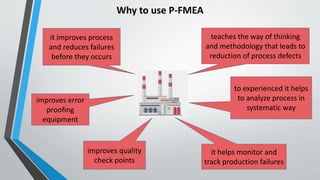
Why to use P-FMEA
it improves process
and reduces failures
before they occurs
it helps monitor and
track production failures
improves error
proofing
equipment
improves quality
check points
teaches the way of thinking
and methodology that leads to
reduction of process defects
to experienced it helps
to analyze process in
systematic way
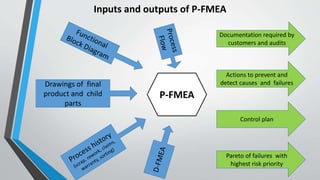
Inputs and outputs of P-FMEA
P-FMEA
Drawings of final
product and child
parts
Documentation required by
customers and audits
Actions to prevent and
detect causes and failures
Control plan
Pareto of failures with
highest risk priority
This presentation shows in few simple steps how to
conduct P-FMEA.
 Solar power system is used as an example system
 secondary solar concentrator is the evaluated subsystem
 Solar concentrator is a part that focuses the incoming light on silicon chip
Solar system
line layout
with
confirmed
process flow
for analyzed
product
Assumptions
 hidden factors are not taken into consideration
 all incoming parts are according to drawing. Only process functional dimensions not
included in incoming inspection plan are considered for P-FMEA
 design failures are covered as part of the D-FMEA
 firm guidelines or norm for limit RPN and rating is specified
 inputs for performing of P-FMEA are available
Create structure.
P-FMEA Analysis - Step 1
List all process steps used for
production of product.
As process step is considered
every action that has a
function (transport of material)
and can create a failure
recognizable by customer.
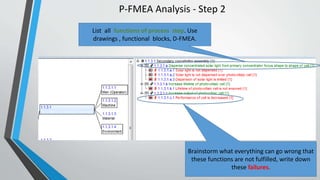
List all functions of process step. Use
drawings , functional blocks, D-FMEA.
P-FMEA Analysis - Step 2
Brainstorm what everything can go wrong that
these functions are not fulfilled, write down
these failures.
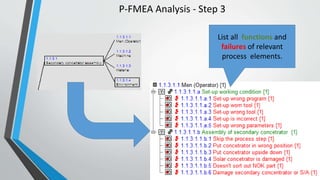
List all functions and
failures of relevant
process elements.
P-FMEA Analysis - Step 3
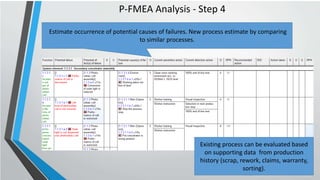
Estimate occurrence of potential causes of failures. New process estimate by comparing
to similar processes.
P-FMEA Analysis - Step 4
Existing process can be evaluated based
on supporting data from production
history (scrap, rework, claims, warranty,
sorting).
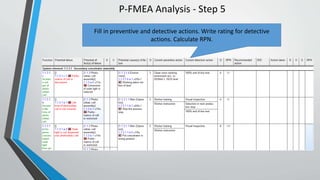
Fill in preventive and detective actions. Write rating for detective
actions. Calculate RPN.
P-FMEA Analysis - Step 5
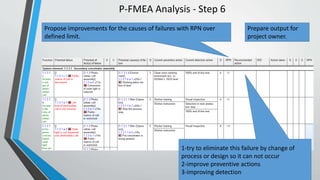
1-try to eliminate this failure by change of
process or design so it can not occur
2-improve preventive actions
3-improving detection
P-FMEA Analysis - Step 6
Propose improvements for the causes of failures with RPN over
defined limit.
Prepare output for
project owner.
Thank you for your attention
Jozefina Petrasova, jozefina.petrasova@gmail.com

PFMEA

  • 1.
    Process Failure Modesand Effects Analysis (P-FMEA) Conducting of P-FMEA Author: Jozefina Petrasova
  • 2.
    Why to useP-FMEA it improves process and reduces failures before they occurs it helps monitor and track production failures improves error proofing equipment improves quality check points teaches the way of thinking and methodology that leads to reduction of process defects to experienced it helps to analyze process in systematic way
  • 3.
    Inputs and outputsof P-FMEA P-FMEA Drawings of final product and child parts Documentation required by customers and audits Actions to prevent and detect causes and failures Control plan Pareto of failures with highest risk priority
  • 4.
    This presentation showsin few simple steps how to conduct P-FMEA.  Solar power system is used as an example system  secondary solar concentrator is the evaluated subsystem  Solar concentrator is a part that focuses the incoming light on silicon chip Solar system line layout with confirmed process flow for analyzed product
  • 5.
    Assumptions  hidden factorsare not taken into consideration  all incoming parts are according to drawing. Only process functional dimensions not included in incoming inspection plan are considered for P-FMEA  design failures are covered as part of the D-FMEA  firm guidelines or norm for limit RPN and rating is specified  inputs for performing of P-FMEA are available
  • 6.
    Create structure. P-FMEA Analysis- Step 1 List all process steps used for production of product. As process step is considered every action that has a function (transport of material) and can create a failure recognizable by customer.
  • 7.
    List all functionsof process step. Use drawings , functional blocks, D-FMEA. P-FMEA Analysis - Step 2 Brainstorm what everything can go wrong that these functions are not fulfilled, write down these failures.
  • 8.
    List all functionsand failures of relevant process elements. P-FMEA Analysis - Step 3
  • 9.
    Estimate occurrence ofpotential causes of failures. New process estimate by comparing to similar processes. P-FMEA Analysis - Step 4 Existing process can be evaluated based on supporting data from production history (scrap, rework, claims, warranty, sorting).
  • 10.
    Fill in preventiveand detective actions. Write rating for detective actions. Calculate RPN. P-FMEA Analysis - Step 5
  • 11.
    1-try to eliminatethis failure by change of process or design so it can not occur 2-improve preventive actions 3-improving detection P-FMEA Analysis - Step 6 Propose improvements for the causes of failures with RPN over defined limit. Prepare output for project owner.
  • 12.
    Thank you foryour attention Jozefina Petrasova, jozefina.petrasova@gmail.com