Process Engineering
Contents

  3.0   Introduction
  3.1   Experience-Based Planning
  3.2   Decision Tables and Decision Trees
  3.3   Process-Capability Analysis
  3.4   Basic Machining Calculations
  3.5   Process Optimization
  3.6   Conclusion


                             i-Design Lab.
3.0 Introduction
3.1   Experience-Based Planning
3.2   Decision Tables and Decision Trees
3.3   Process-Capability Analysis
3.4   Basic Machining Calculations
3.5   Process Optimization
3.6   Conclusion


                           i-Design Lab.
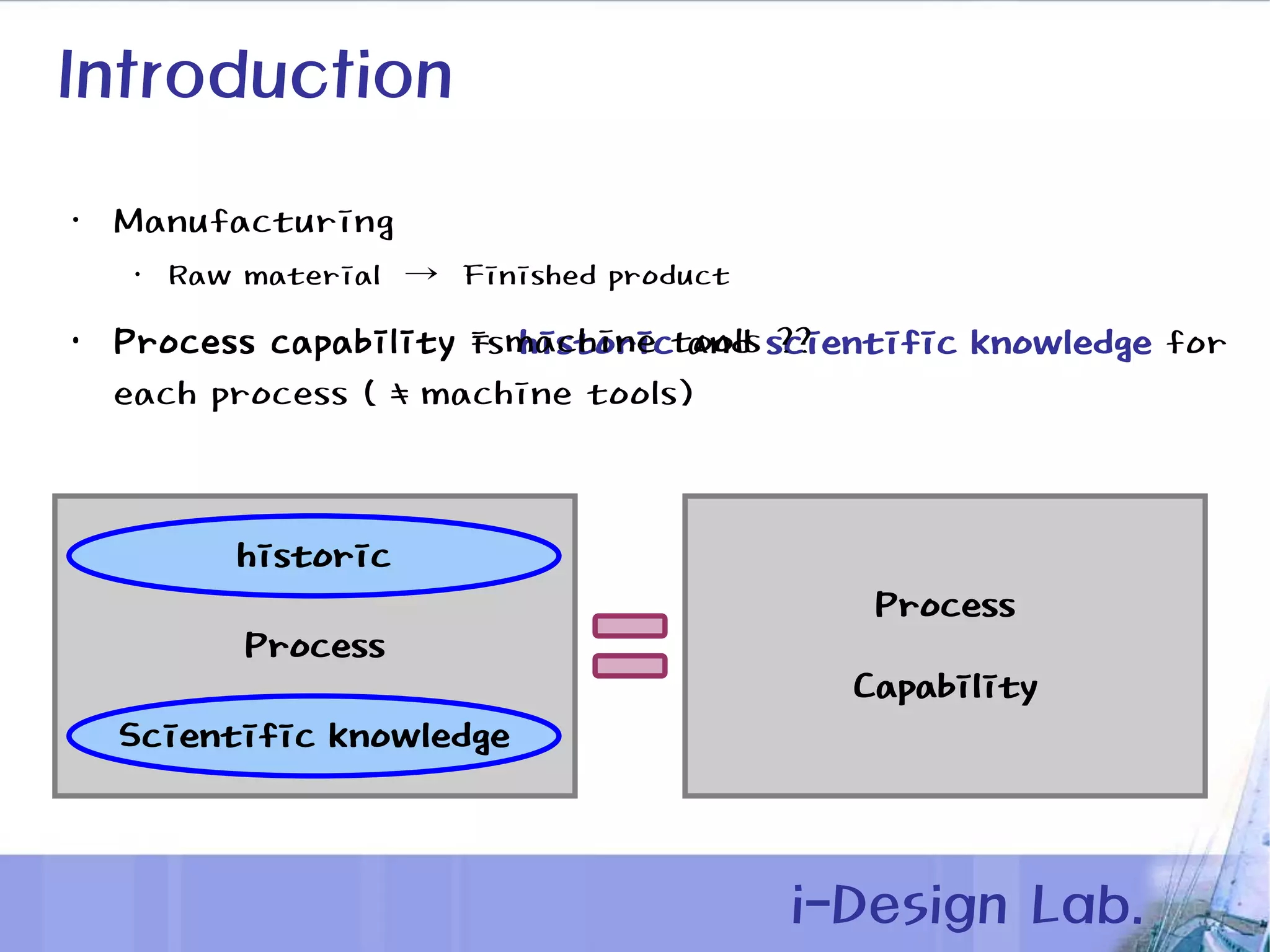
Introduction
• Manufacturing
   • Raw material → Finished product
• Process capability ismachine tools scientific knowledge for
                     = historic and ??
  each process (≠machine tools)


        historic
                                          Process
         Process
                                         Capability
  Scientific knowledge


                                       i-Design Lab.
Process Capability
• Three levels of Process Capability


       Universal               Shop                Machine
         -level                -level               -level


• Important parameters
   •   The shapes and sizes
   •   The dimensions and geometric tolerances
   •   The material removal rate
   •   The relative cost
   •   Other cutting characteristics/constraints

                                            i-Design Lab.
3.0 Introduction
3.1 Experience-Based Planning
3.2   Decision Tables and Decision Trees
3.3   Process-Capability Analysis
3.4   Basic Machining Calculations
3.5   Process Optimization
3.6   Conclusion


                           i-Design Lab.
Experience-Based Planning

"The accumulation of experience is knowledge "

• Problem of Experience-Based
   • requires a significant period of time to accumulate
   • represents only approximate, not exact knowledge
   • is not directly applicable to new processes or new systems


• Machinist Handbooks
   • has long been a standard manufacturing practice


                                            i-Design Lab.
3.0 Introduction
3.1 Experience-Based Planning
3.2 Decision Tables and Decision Trees
3.3   Process-Capability Analysis
3.4   Basic Machining Calculations
3.5   Process Optimization
3.6   Conclusion


                             i-Design Lab.
Decision Tables and Decision Trees
 •   Describing the actions associated with conditions
 •   Help systematize decision making
 •   Translate each other
 •   Difference
     • Ease and elegance of presentation and programming when a
       computer is used               Condition


Action
      Stub                        Entries


                                            i-Design Lab.
Decision Table


                 i-Design Lab.
Decision Table
• When constructing, consider factors
   • Completeness, Accuracy, Redundancy
   • Consistency, Loops, Size
• Merge


                                Merge


                                          i-Design Lab.
Decision Table
• Table splitting and parsing


                                i-Design Lab.
Decision Tree
• Single root, Node, Branch
• Branch – ‘IF’, branches in series – ‘AND’
               Node


                    Branch
     Root


                                      i-Design Lab.
3.0 Introduction
3.1 Experience-Based Planning
3.2 Decision Tables and Decision Trees
3.3 Process-Capability Analysis
3.4 Basic Machining Calculations
3.5 Process Optimization
3.6 Conclusion


                         i-Design Lab.
Information Required to Make the Decision

                           Shape

                      Size Limitation
Capability
                         Tolerance

                      Surface Finish


                       Cutting Force
Limitation
                     Power Consumption


                               i-Design Lab.
Process Boundaries
• One way to represent process capability
• Limiting size, tolerances, surface finish
• System-dependant


                                      i-Design Lab.
3.0   Introduction
3.1   Experience-Based Planning
3.2   Decision Tables and Decision Trees
3.3   Process-Capability Analysis
3.4 Basic Machining Calculations
3.5 Process Optimization
3.6 Conclusion


                           i-Design Lab.
Feed and Feed Rate
• Feed
   • The relative lateral movement between the tool and the workpiece
     during a machining operation (= thickness of the chip)
   • Feed in turning and drilling
       • The advancement of the cutter per revolution of the workpiece
         (turning) or tool (drilling)
       • Unit - ipr (inch per revolution)
   • Feed in milling
       • The advancement of the cutter per cutter-tooth revolution
       • Unit - inch per revolution per tooth


• Feed rate - ipm (inch per minute)
   • Equation (3. 17)


                                              i-Design Lab.
Machining
• Cutting Speed
   • The maximum linear speed between the tool and the workpiece
   • Equation (3. 18)
• Depth of cut
   • Width of the chip
   • Equation (3. 19)
• Metal-Removal Rate
   • How fast material is removed from a workpiece
   • Equation (3. 20) ~ (3. 28)
                                    Short processing time
   MRR is Large (        )
                                    Short the life of cutter

                                          i-Design Lab.
Machining Time
• Total amount of time

• Parameter
   • The length of the workpiece
   • Overtravel of the tool for clearance
   • The number of passes required to clear the volume


• Equation (3. 29) ~ (3. 31)


                                           i-Design Lab.
Tool Life
• Erosion (Wear)
   • Crater wear
      • High Temperature
   • Flank wear
      • Friction


• Breakage (Catastrophic Failure)

• F. W. Taylor
   • Tool-life Equation
   • Relation of Tool life and Cutting speed


                                               i-Design Lab.
Machining Force and Power Requirements

• Important considerations in selecting process parameters
  (feed, speed, and depth of cut)

• Not limiting values

• Machining force
   • Equation (3. 35) ~ (3. 37)


• Cutting power
   • Equation (3. 38) ~ (3. 39)


                                    i-Design Lab.
Process Parameters
• Feed, Speed, Depth of cut

• Process selection becomes an iterative procedure
   • Process Selection
   • Machining parameters are adjusted to accommodate the system
     constraints
      • Parameters affects the time and cost


                                               i-Design Lab.
3.0   Introduction
3.1   Experience-Based Planning
3.2   Decision Tables and Decision Trees
3.3   Process-Capability Analysis
3.4   Basic Machining Calculations
3.5 Process Optimization
3.6 Conclusion


                           i-Design Lab.
Process Optimization

                                 Short processing time
  MRR is Large (   )
                                 Short the life of cutter


• Tool has been worn → Replace

• Trade-off between increased machining rate and machine
  idle time


                                      i-Design Lab.
Single-Pass Model
• Assume that only one pass to produce the required
  geometry
• The depth of cut is fixed
• Constraint
   •   Spindle-speed constraint
   •   Feed constraint
   •   Cutting-force constraint
   •   Power constraint
   •   Surface-finish constraint
• Equation (3. 40) ~ (3. 47)


                                    i-Design Lab.
Multipass Model
•   Assumption of single-pass model is relaxed
•   Can be reconstructed into a single-pass model
•   The depth of cut is a control variable
•   Constraint
    •   Spindle-speed constraint
    •   Feed constraint
    •   Cutting-force constraint
    •   Power constraint
    •   Surface-finish constraint
    •   Depth-of-cut constraint
• Equation (3. 63) ~ (3. 67)
• No general solution method


                                       i-Design Lab.
3.0   Introduction
3.1   Experience-Based Planning
3.2   Decision Tables and Decision Trees
3.3   Process-Capability Analysis
3.4   Basic Machining Calculations
3.5   Process Optimization
3.6 Conclusion


                           i-Design Lab.
Conclusion
• Information of process-planning system
   • Design knowledge – Chapter#2
   • Process knowledge – This Chapter (Chapter#3)


• Process planning
   • Procedure that matches the knowledge of the processes with the
     requirements of the design


• Process Capability
• Decision logic


                                          i-Design Lab.

Process engineering

  • 1.
  • 2.
    Contents 3.0 Introduction 3.1 Experience-Based Planning 3.2 Decision Tables and Decision Trees 3.3 Process-Capability Analysis 3.4 Basic Machining Calculations 3.5 Process Optimization 3.6 Conclusion i-Design Lab.
  • 3.
    3.0 Introduction 3.1 Experience-Based Planning 3.2 Decision Tables and Decision Trees 3.3 Process-Capability Analysis 3.4 Basic Machining Calculations 3.5 Process Optimization 3.6 Conclusion i-Design Lab.
  • 4.
    Introduction • Manufacturing • Raw material → Finished product • Process capability ismachine tools scientific knowledge for = historic and ?? each process (≠machine tools) historic Process Process Capability Scientific knowledge i-Design Lab.
  • 5.
    Process Capability • Threelevels of Process Capability Universal Shop Machine -level -level -level • Important parameters • The shapes and sizes • The dimensions and geometric tolerances • The material removal rate • The relative cost • Other cutting characteristics/constraints i-Design Lab.
  • 6.
    3.0 Introduction 3.1 Experience-BasedPlanning 3.2 Decision Tables and Decision Trees 3.3 Process-Capability Analysis 3.4 Basic Machining Calculations 3.5 Process Optimization 3.6 Conclusion i-Design Lab.
  • 7.
    Experience-Based Planning "The accumulationof experience is knowledge " • Problem of Experience-Based • requires a significant period of time to accumulate • represents only approximate, not exact knowledge • is not directly applicable to new processes or new systems • Machinist Handbooks • has long been a standard manufacturing practice i-Design Lab.
  • 8.
    3.0 Introduction 3.1 Experience-BasedPlanning 3.2 Decision Tables and Decision Trees 3.3 Process-Capability Analysis 3.4 Basic Machining Calculations 3.5 Process Optimization 3.6 Conclusion i-Design Lab.
  • 9.
    Decision Tables andDecision Trees • Describing the actions associated with conditions • Help systematize decision making • Translate each other • Difference • Ease and elegance of presentation and programming when a computer is used Condition Action Stub Entries i-Design Lab.
  • 10.
    Decision Table i-Design Lab.
  • 11.
    Decision Table • Whenconstructing, consider factors • Completeness, Accuracy, Redundancy • Consistency, Loops, Size • Merge Merge i-Design Lab.
  • 12.
    Decision Table • Tablesplitting and parsing i-Design Lab.
  • 13.
    Decision Tree • Singleroot, Node, Branch • Branch – ‘IF’, branches in series – ‘AND’ Node Branch Root i-Design Lab.
  • 14.
    3.0 Introduction 3.1 Experience-BasedPlanning 3.2 Decision Tables and Decision Trees 3.3 Process-Capability Analysis 3.4 Basic Machining Calculations 3.5 Process Optimization 3.6 Conclusion i-Design Lab.
  • 15.
    Information Required toMake the Decision Shape Size Limitation Capability Tolerance Surface Finish Cutting Force Limitation Power Consumption i-Design Lab.
  • 16.
    Process Boundaries • Oneway to represent process capability • Limiting size, tolerances, surface finish • System-dependant i-Design Lab.
  • 17.
    3.0 Introduction 3.1 Experience-Based Planning 3.2 Decision Tables and Decision Trees 3.3 Process-Capability Analysis 3.4 Basic Machining Calculations 3.5 Process Optimization 3.6 Conclusion i-Design Lab.
  • 18.
    Feed and FeedRate • Feed • The relative lateral movement between the tool and the workpiece during a machining operation (= thickness of the chip) • Feed in turning and drilling • The advancement of the cutter per revolution of the workpiece (turning) or tool (drilling) • Unit - ipr (inch per revolution) • Feed in milling • The advancement of the cutter per cutter-tooth revolution • Unit - inch per revolution per tooth • Feed rate - ipm (inch per minute) • Equation (3. 17) i-Design Lab.
  • 19.
    Machining • Cutting Speed • The maximum linear speed between the tool and the workpiece • Equation (3. 18) • Depth of cut • Width of the chip • Equation (3. 19) • Metal-Removal Rate • How fast material is removed from a workpiece • Equation (3. 20) ~ (3. 28) Short processing time MRR is Large ( ) Short the life of cutter i-Design Lab.
  • 20.
    Machining Time • Totalamount of time • Parameter • The length of the workpiece • Overtravel of the tool for clearance • The number of passes required to clear the volume • Equation (3. 29) ~ (3. 31) i-Design Lab.
  • 21.
    Tool Life • Erosion(Wear) • Crater wear • High Temperature • Flank wear • Friction • Breakage (Catastrophic Failure) • F. W. Taylor • Tool-life Equation • Relation of Tool life and Cutting speed i-Design Lab.
  • 22.
    Machining Force andPower Requirements • Important considerations in selecting process parameters (feed, speed, and depth of cut) • Not limiting values • Machining force • Equation (3. 35) ~ (3. 37) • Cutting power • Equation (3. 38) ~ (3. 39) i-Design Lab.
  • 23.
    Process Parameters • Feed,Speed, Depth of cut • Process selection becomes an iterative procedure • Process Selection • Machining parameters are adjusted to accommodate the system constraints • Parameters affects the time and cost i-Design Lab.
  • 24.
    3.0 Introduction 3.1 Experience-Based Planning 3.2 Decision Tables and Decision Trees 3.3 Process-Capability Analysis 3.4 Basic Machining Calculations 3.5 Process Optimization 3.6 Conclusion i-Design Lab.
  • 25.
    Process Optimization Short processing time MRR is Large ( ) Short the life of cutter • Tool has been worn → Replace • Trade-off between increased machining rate and machine idle time i-Design Lab.
  • 26.
    Single-Pass Model • Assumethat only one pass to produce the required geometry • The depth of cut is fixed • Constraint • Spindle-speed constraint • Feed constraint • Cutting-force constraint • Power constraint • Surface-finish constraint • Equation (3. 40) ~ (3. 47) i-Design Lab.
  • 27.
    Multipass Model • Assumption of single-pass model is relaxed • Can be reconstructed into a single-pass model • The depth of cut is a control variable • Constraint • Spindle-speed constraint • Feed constraint • Cutting-force constraint • Power constraint • Surface-finish constraint • Depth-of-cut constraint • Equation (3. 63) ~ (3. 67) • No general solution method i-Design Lab.
  • 28.
    3.0 Introduction 3.1 Experience-Based Planning 3.2 Decision Tables and Decision Trees 3.3 Process-Capability Analysis 3.4 Basic Machining Calculations 3.5 Process Optimization 3.6 Conclusion i-Design Lab.
  • 29.
    Conclusion • Information ofprocess-planning system • Design knowledge – Chapter#2 • Process knowledge – This Chapter (Chapter#3) • Process planning • Procedure that matches the knowledge of the processes with the requirements of the design • Process Capability • Decision logic i-Design Lab.