Department of Mechanical Engineering
JSS Academy of Technical Education, Bangalore-560060
Design for Manufacture
(Course Code:18ME731)
TEXT BOOKS
• Design for Manufacture by Harry Peck, Pitman publishing, 1983
• Engineering Design: A Material & Processing Approach by Dieter, G.E, McGraw Hill Co. 2000
• Handbook of Product Design for Manufacture: A practical guide to low cost production by Bralla,
James G, McGraw Hill Co. , 1986
• Factors to be considered while designing parts with focus on manufacturability.
• Through understanding of GD & T techniques in manufacture.
• Design considerations for designing components produced using various
machining operations.
• Design rules and recommendations for processes like casting, welding, forgings
powder metallurgy and injection moulding.
Learning objectives
Design for Manufacture
CHAPTER 1: Introduction to DFM
Introduction: Definition, Need for DFM, DFM approach for cost
reduction, general design guide lines of DFM, advantages and
disadvantages, application of DFM in industries, Design for Quality
Manufacturability, DFQM approach, designing for economical
production. Design for Excellence (DFX).
Module 1
Introduction
Design for Manufacturability (Design for Manufacture or DFM)
1. DFM includes any step, method, or system, provides a product design that
eases the task of manufacturing and lowers manufacturing cost.
2. Knowledge-based technique, invokes a series of guidelines, principles,
recommendations, or rules of thumb for designing a product.
3. Primary objective is to improve manufacturability.
Definition
Introduction
Optimization of a part, product, or component’s design, to create it cheaper and
more easily (Manufacturability).
Definition
Major DFM objectives
• Estimate the mfg. costs
• Reduce the cost of components
• Reduce the costs of assembly
• Reduce the costs of supporting production
• Impact of DFM decisions on other factors
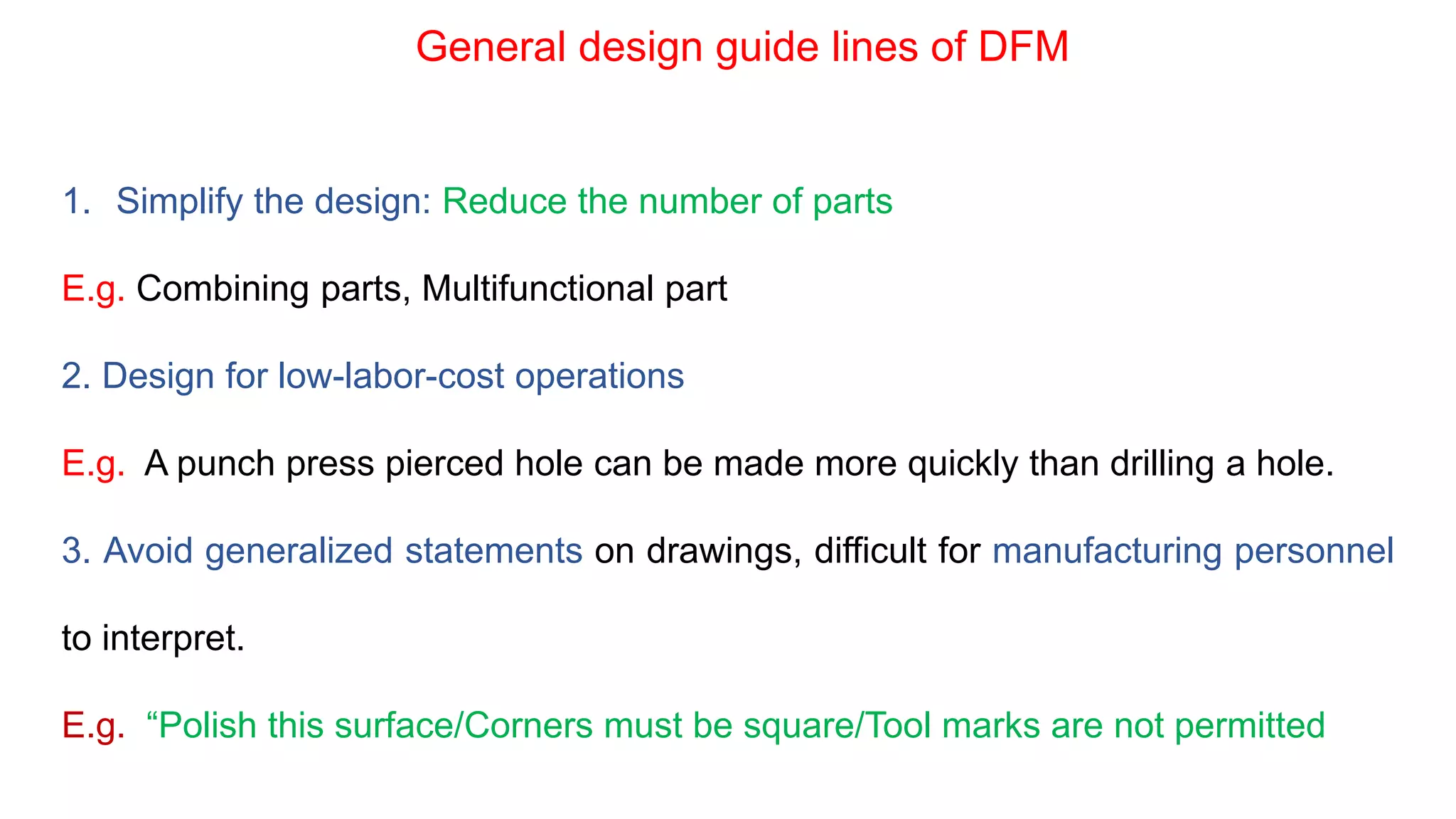
General design guide lines of DFM
1. Simplify the design: Reduce the number of parts
E.g. Combining parts, Multifunctional part
2. Design for low-labor-cost operations
E.g. A punch press pierced hole can be made more quickly than drilling a hole.
3. Avoid generalized statements on drawings, difficult for manufacturing personnel
to interpret.
E.g. “Polish this surface/Corners must be square/Tool marks are not permitted
General design guide lines of DFM
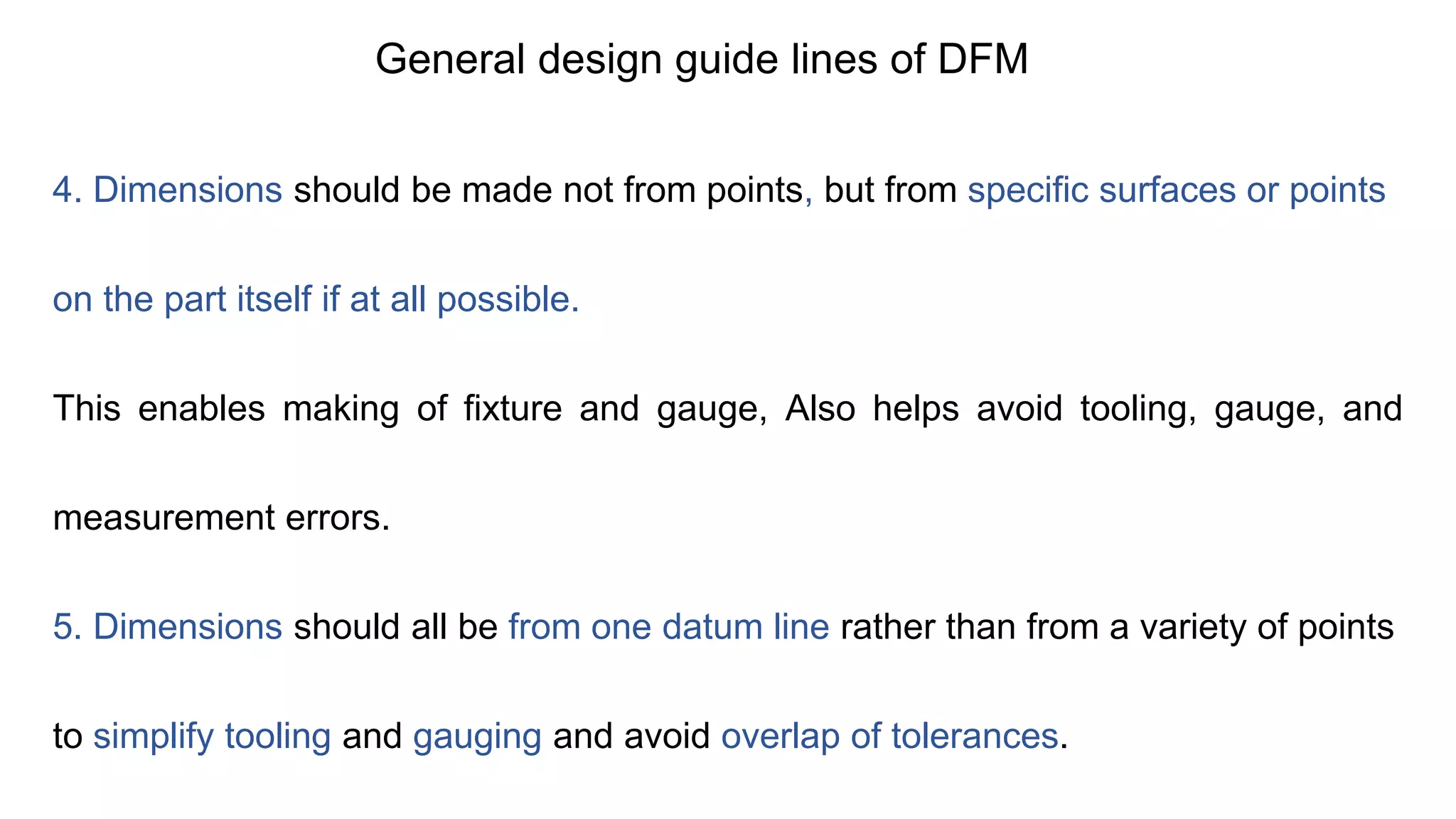
4. Dimensions should be made not from points, but from specific surfaces or points
on the part itself if at all possible.
This enables making of fixture and gauge, Also helps avoid tooling, gauge, and
measurement errors.
5. Dimensions should all be from one datum line rather than from a variety of points
to simplify tooling and gauging and avoid overlap of tolerances.
General design guide lines of DFM
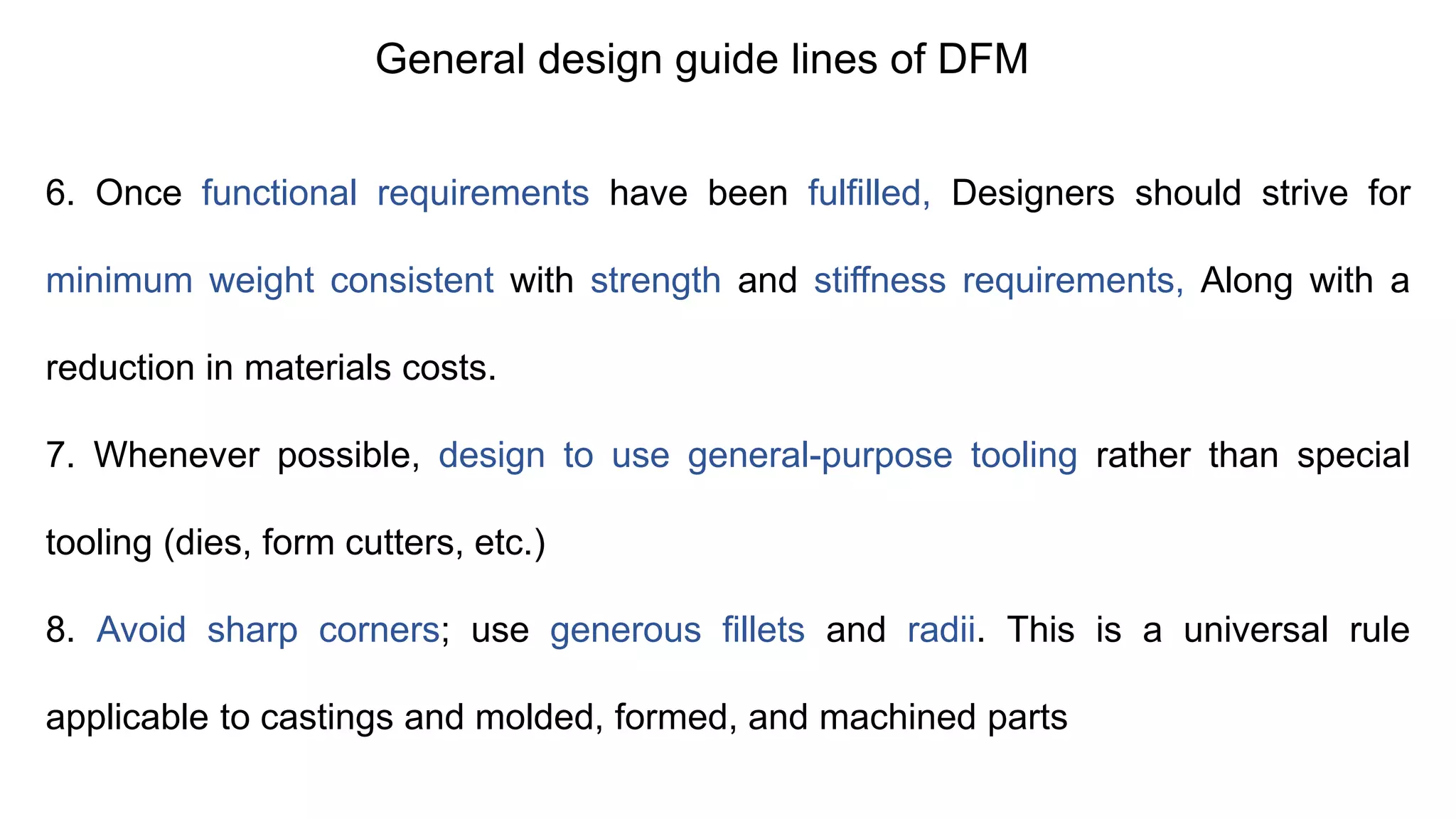
6. Once functional requirements have been fulfilled, Designers should strive for
minimum weight consistent with strength and stiffness requirements, Along with a
reduction in materials costs.
7. Whenever possible, design to use general-purpose tooling rather than special
tooling (dies, form cutters, etc.)
8. Avoid sharp corners; use generous fillets and radii. This is a universal rule
applicable to castings and molded, formed, and machined parts
General design guide lines of DFM
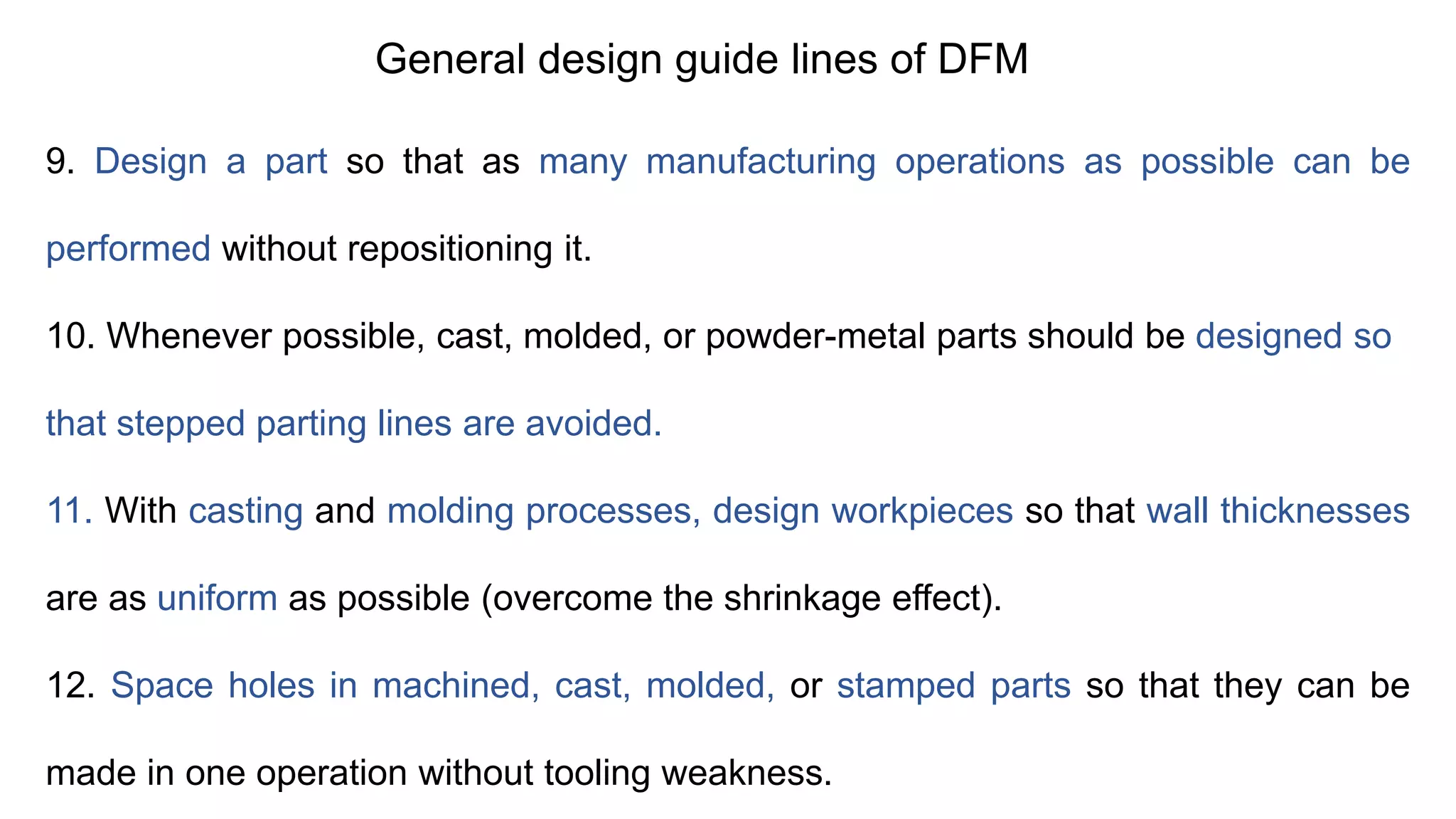
9. Design a part so that as many manufacturing operations as possible can be
performed without repositioning it.
10. Whenever possible, cast, molded, or powder-metal parts should be designed so
that stepped parting lines are avoided.
11. With casting and molding processes, design workpieces so that wall thicknesses
are as uniform as possible (overcome the shrinkage effect).
12. Space holes in machined, cast, molded, or stamped parts so that they can be
made in one operation without tooling weakness.
Advantages/Benefits
• Products made with DFM will have a lower production cost
• Quicker time-to-market
• Shortening of the product development process
• Production will be up to speed sooner
• Parts may be combined to reduce assembly steps and quantity of parts
• Catches and removes mistakes or faults
• Higher quality of a product, as design can be refined and enhanced at every stage
• As construction activities can be removed from a site and placed elsewhere, DFM
can create a safer working environment
Need for DFM/ Achieving Lowest cost
• It has been commonly reported that a high portion of a product’s lifecycle
cost” is “locked in“ at the design stage.
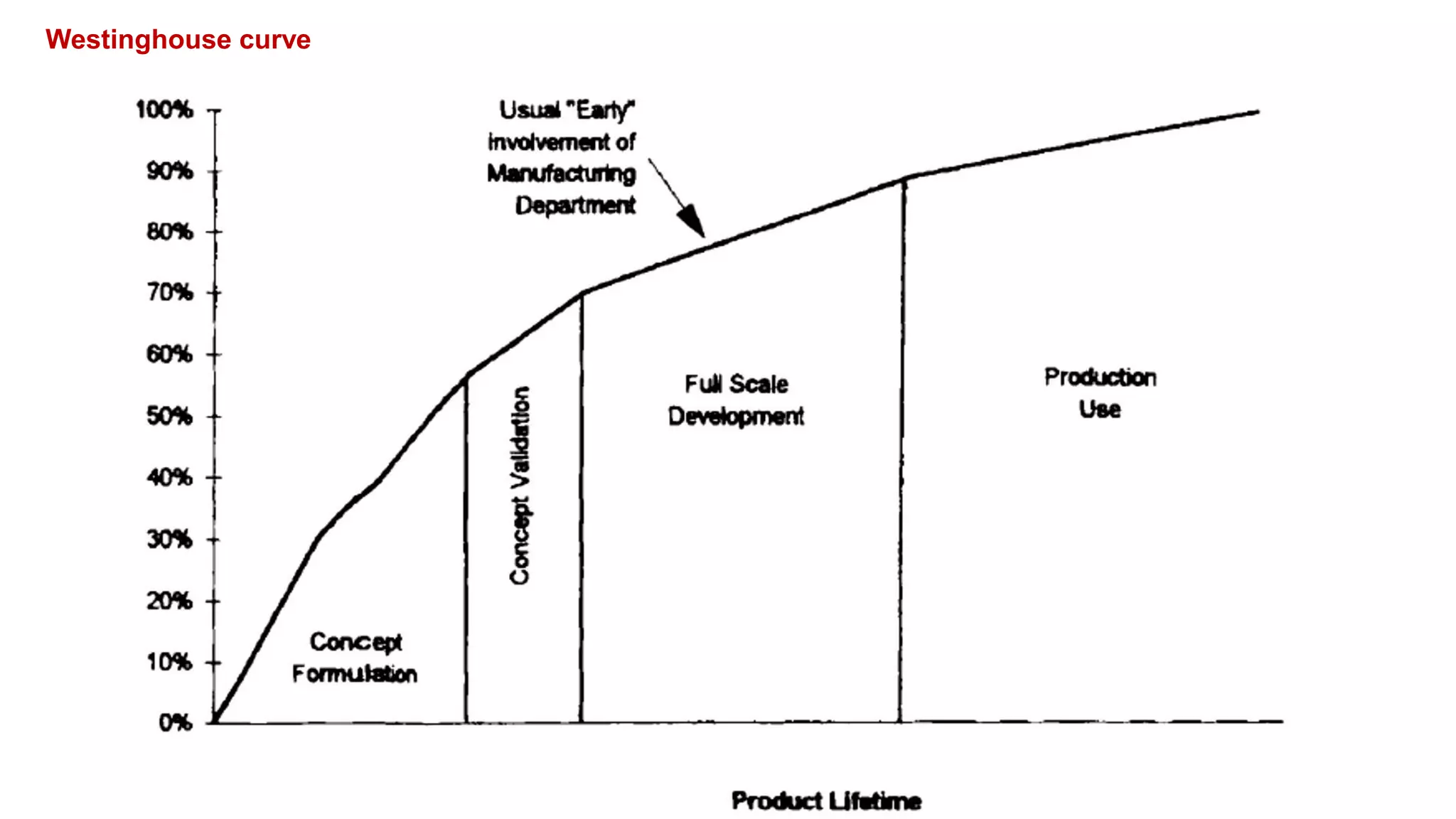
• The ‘Westinghouse Curve’ illustrates this principle.
• Over half of the cost is fixed as soon as the product concept is formulated.
• 75 percent of its cost is determined when the concept is validated.
• Over 80 percent is fixed when full-scale product development is completed.
• He states that 70% percent of the product cost is determined in the design
phase.
Westinghouse curve
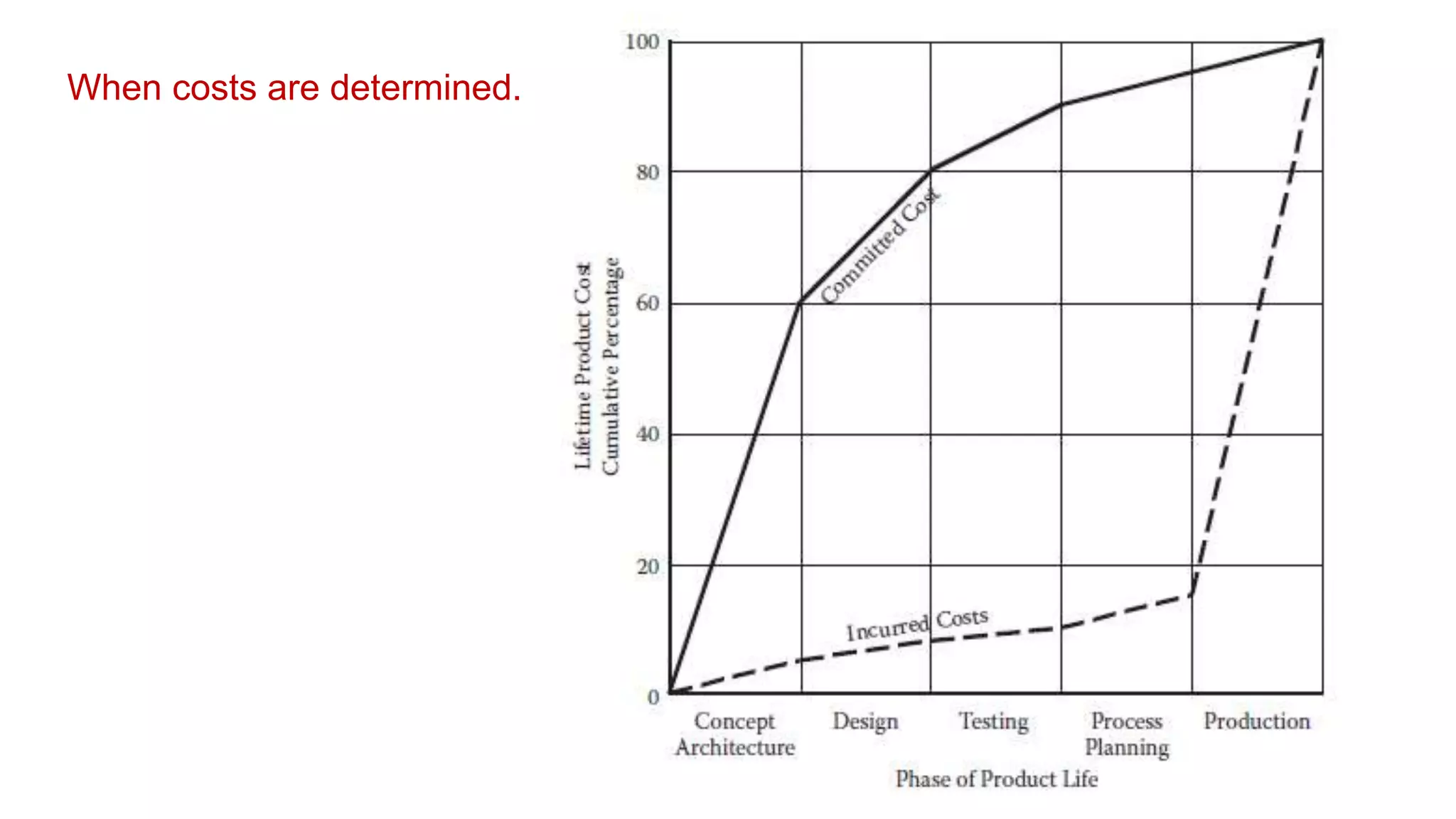
When costs are determined.
Westinghouse curve
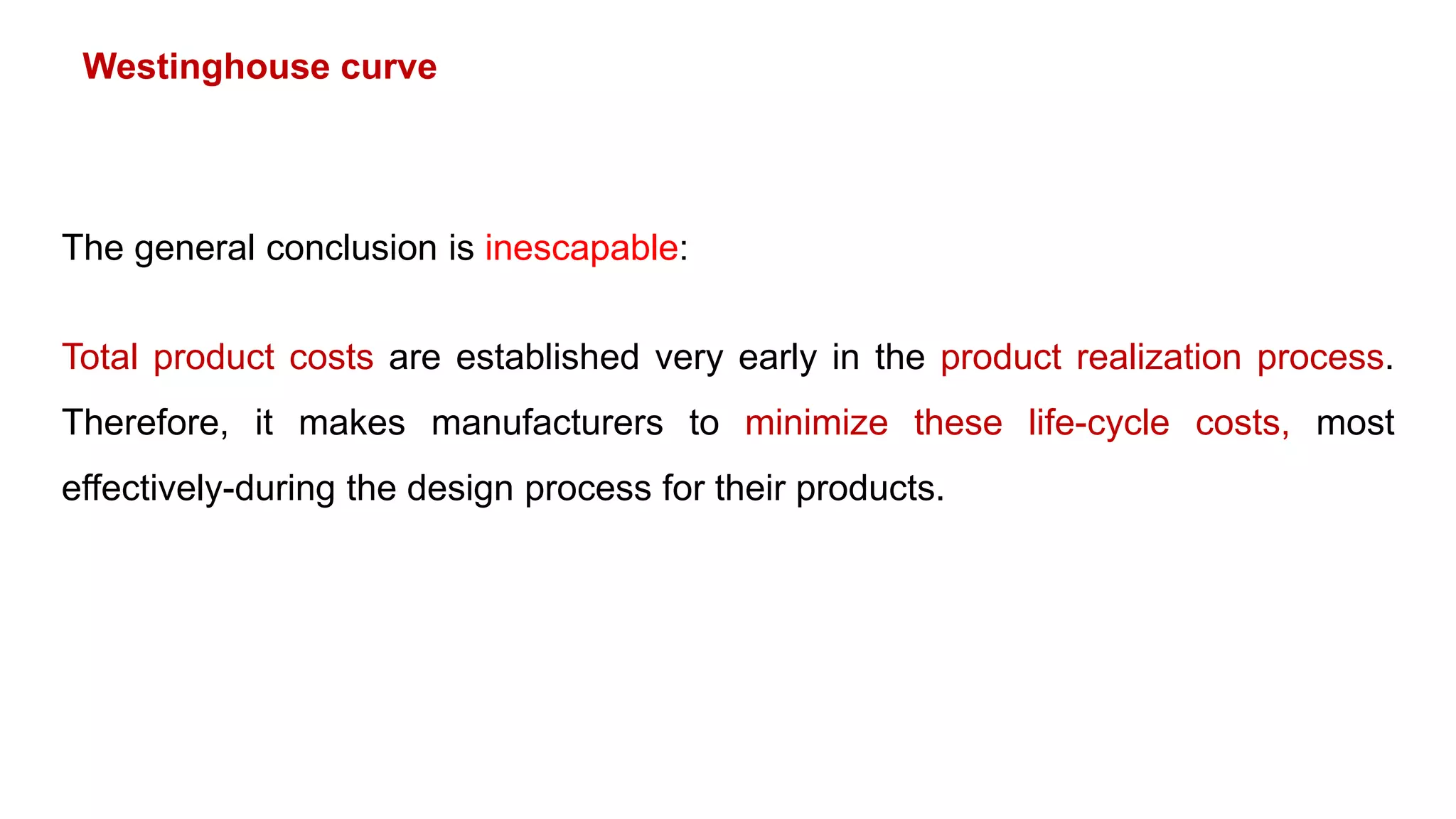
The general conclusion is inescapable:
Total product costs are established very early in the product realization process.
Therefore, it makes manufacturers to minimize these life-cycle costs, most
effectively-during the design process for their products.
Achieving Lowest cost
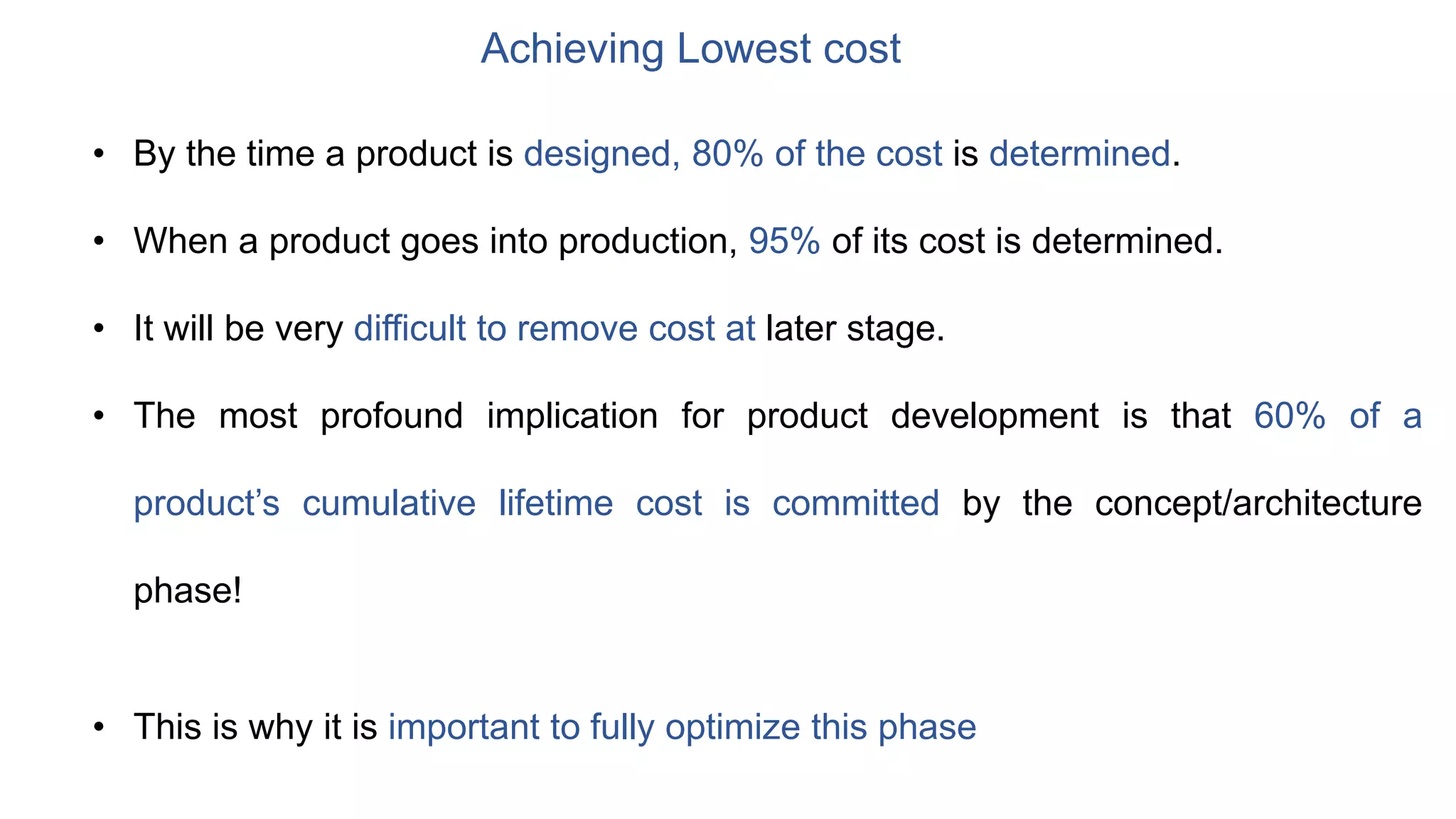
• By the time a product is designed, 80% of the cost is determined.
• When a product goes into production, 95% of its cost is determined.
• It will be very difficult to remove cost at later stage.
• The most profound implication for product development is that 60% of a
product’s cumulative lifetime cost is committed by the concept/architecture
phase!
• This is why it is important to fully optimize this phase
DFM / DFX Approaches
• Controlled Experiment Methods
• The Taguchi Method of Robust Design
• Product Costs
Means of improving product designs and manufacturing operations.
DFM / DFX Approaches
Controlled Experiment Methods
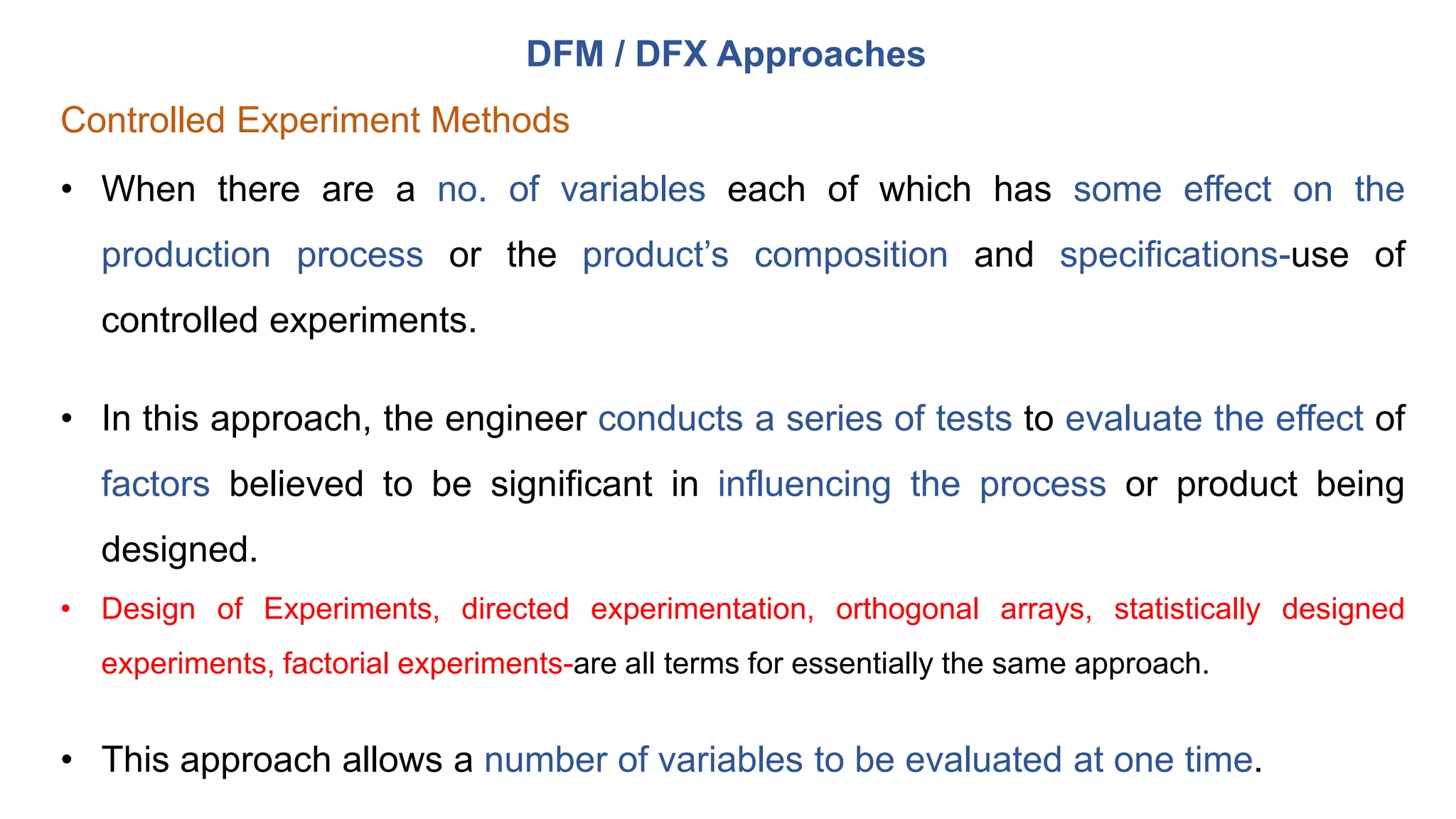
• When there are a no. of variables each of which has some effect on the
production process or the product’s composition and specifications-use of
controlled experiments.
• In this approach, the engineer conducts a series of tests to evaluate the effect of
factors believed to be significant in influencing the process or product being
designed.
• Design of Experiments, directed experimentation, orthogonal arrays, statistically designed
experiments, factorial experiments-are all terms for essentially the same approach.
• This approach allows a number of variables to be evaluated at one time.
DFM / DFX Approaches
Controlled Experiment Methods
• Traditionally, when engineers wanted to optimize some process or design
variable, they have conducted experiments in which all other variables are held
constant while various levels of the variable being tested are evaluated.
• With the Taguchi and other controlled experiment methods, many process
variables can be tested simultaneously.
• By mathematical analysis, the engineer determines which set of variable is
optimum.
• The number of test runs needed for full optimization is thus greatly reduced.
DFM / DFX Approaches
Controlled Experiment Methods
• DFM utilizes existing knowledge from manufacturing engineers and other
production people with years of shop floor experience who have learned which
factors in a product design help and which factors hurt shopfloor productivity.
DFM / DFX Approaches
The Taguchi Method of Robust Design
• Taguchi’s methods are a variety of controlled experiments.
• Purpose of providing a product or process which is more “robust” or less
susceptible to variations in material, manufacturing processes, and operating
conditions.
• This methods are best suited for initial studies of processes and product
designs that have considerable room for improvement.
DFM / DFX Approaches
Product Cost
• Taguchi, another significant contribution to the state of the art of manufacturing
and design
• His concepts of product quality include life-cycle product costs.
• His concept of life-cycle costs is consistent with present thinking about the
nature and control of manufacturing costs.
Definitions of Related Approaches
The following terms are either part of DFM/DFX, related to it, or provide alternative
means of improving product designs and manufacturing operations.
• Design for assembly (DFA) refers to product design aimed specifically at
simplifying a product and its overall assembly.
• Design for manufacturability and assembly (DFMA) : Manufacturability
• Manufacturability
• Producibility
• Design to cost: Design efforts to reduce operating costs including maintenance
as well as the acquisition cost of a product.
Definitions of Related Approaches
• Concurrent engineering / Simultaneous engineering / Concurrent design:
The approach that brings together in a team both the design and manufacturing
engineers (often along with product managers, quality controllers, production
people, service, safety, accounting and other personnel) throughout the design
sequence.
• Life-cycle costs: Costs involved, not only in the manufacture and distribution,
but also those incurred in its ownership, operation and disposal.
Definitions of Related Approaches
• Benchmarking is “a continuous, systematic process for evaluating the products,
services and work processes of organizations that are recognized as
representing best practices for the purpose of organizational improvement.
• Statistical process control (SPC): form of quality control which uses statistical
methods to help control dimensions and other characteristics of manufactured
products.
Definitions of Related Approaches
• Quality function deployment (QFD) is a systematic approach for improving
product quality by concentrating on what the customer wants and will continue to
buy in the product.
• Synchronized manufacturing
• Continuous improvement
• Total quality management
• Failure mode and effects analysis (FMEA)
• Group technology
Design for Excellence - DFX
The Attributes of a Good Design
What does a customer expect when he purchases a product?
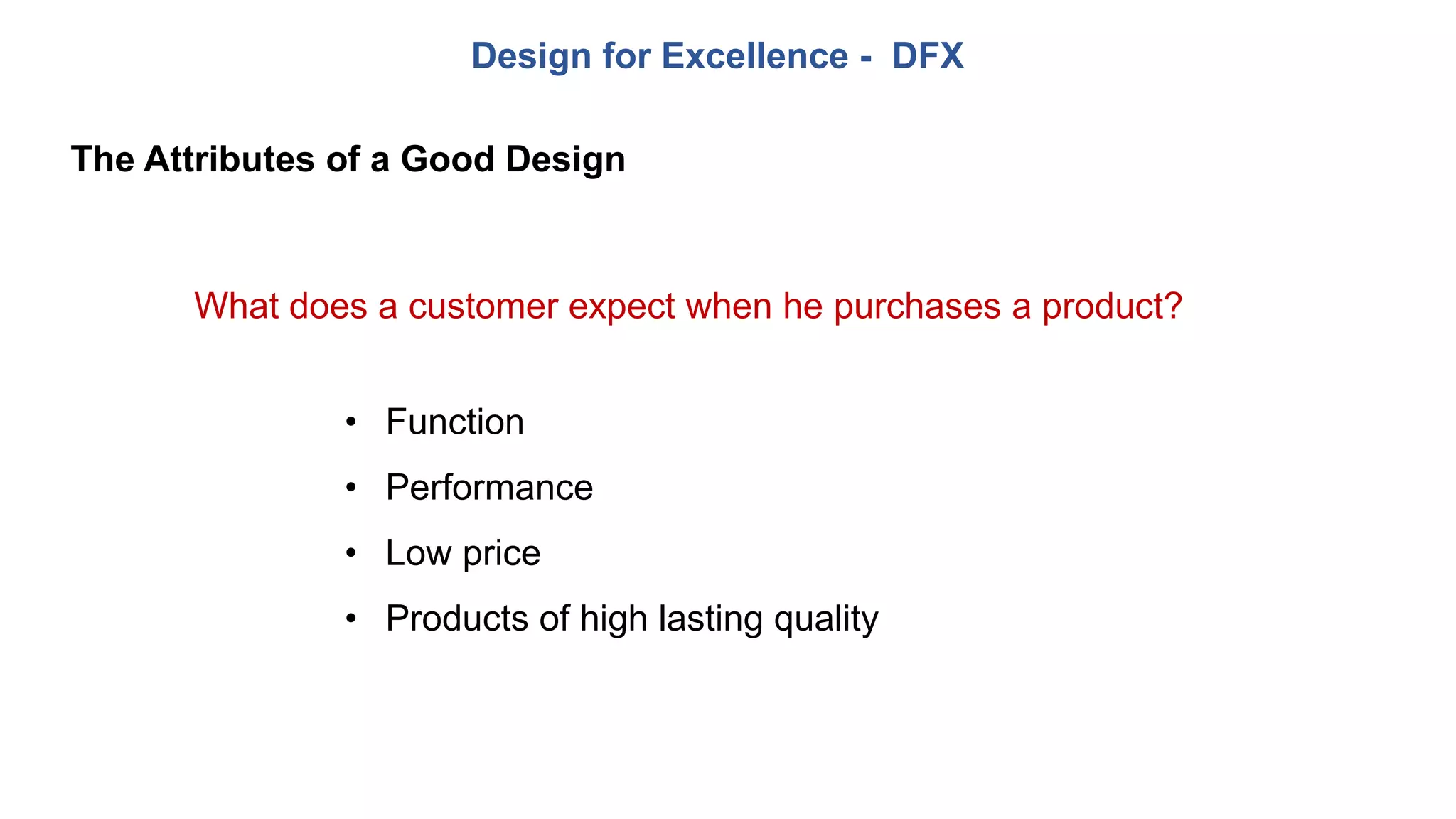
Design for Excellence - DFX
The Attributes of a Good Design
What does a customer expect when he purchases a product?
• Function
• Performance
• Low price
• Products of high lasting quality
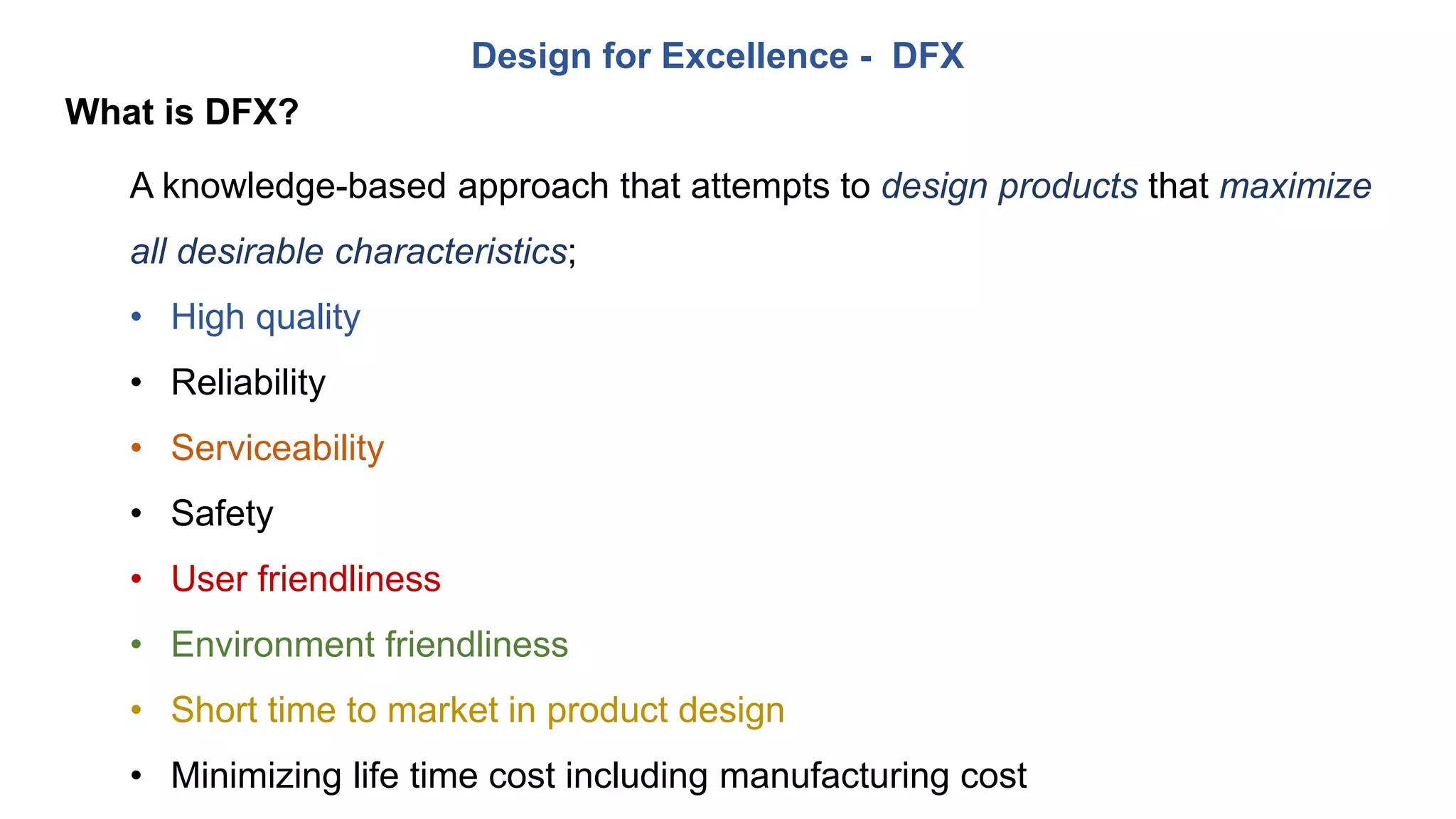
Design for Excellence - DFX
What is DFX?
A knowledge-based approach that attempts to design products that maximize
all desirable characteristics;
• High quality
• Reliability
• Serviceability
• Safety
• User friendliness
• Environment friendliness
• Short time to market in product design
• Minimizing life time cost including manufacturing cost
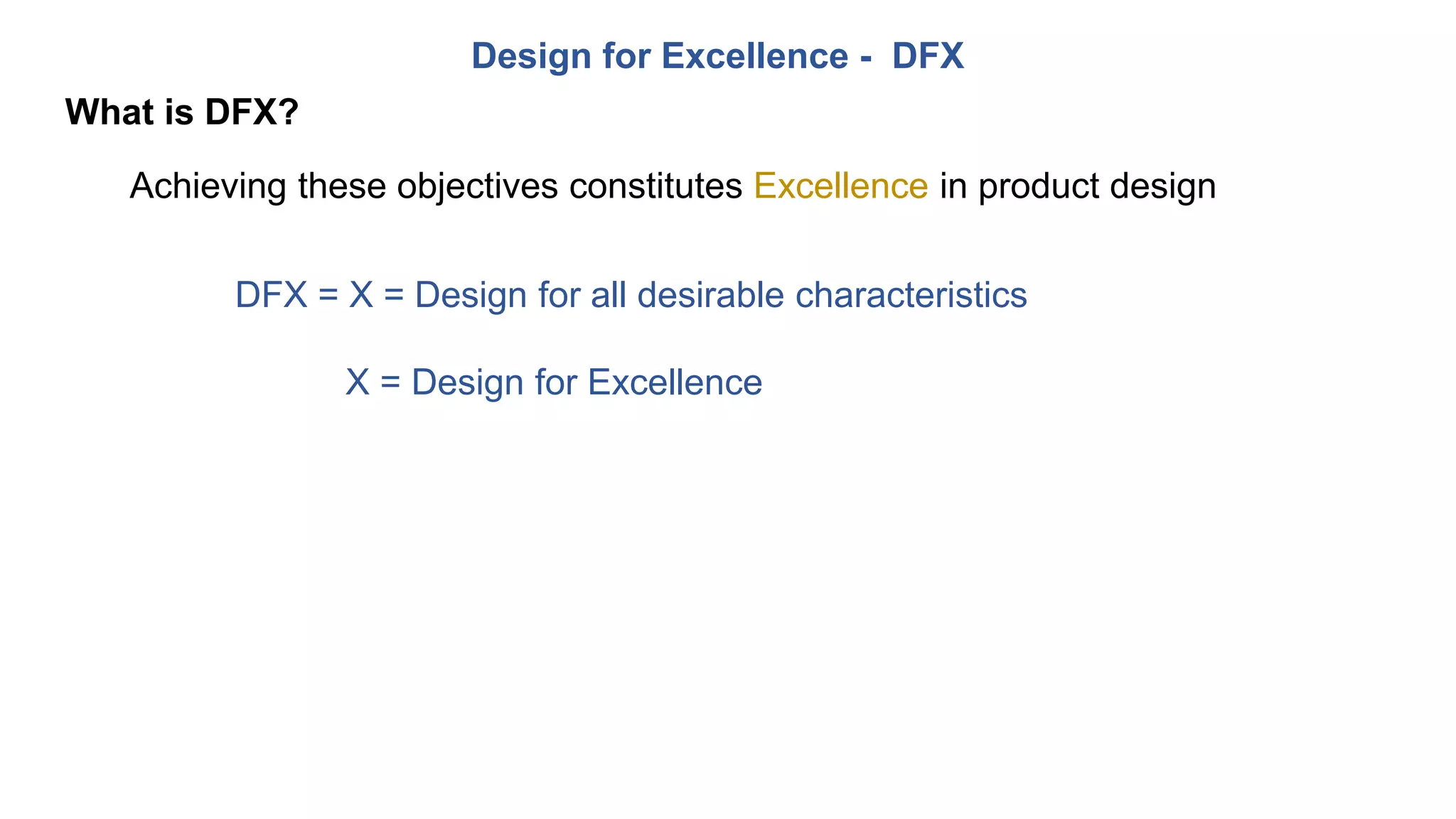
Design for Excellence - DFX
What is DFX?
Achieving these objectives constitutes Excellence in product design
DFX = X = Design for all desirable characteristics
X = Design for Excellence
Designing for Low cost
Various approaches exist to determine the goals for costs and the pricing of
products.
Design for Cost Approaches
1. Cost-Based Pricing
2. Price-Based Costing (Target Costing)
Designing for Low cost
Design for Cost Approaches
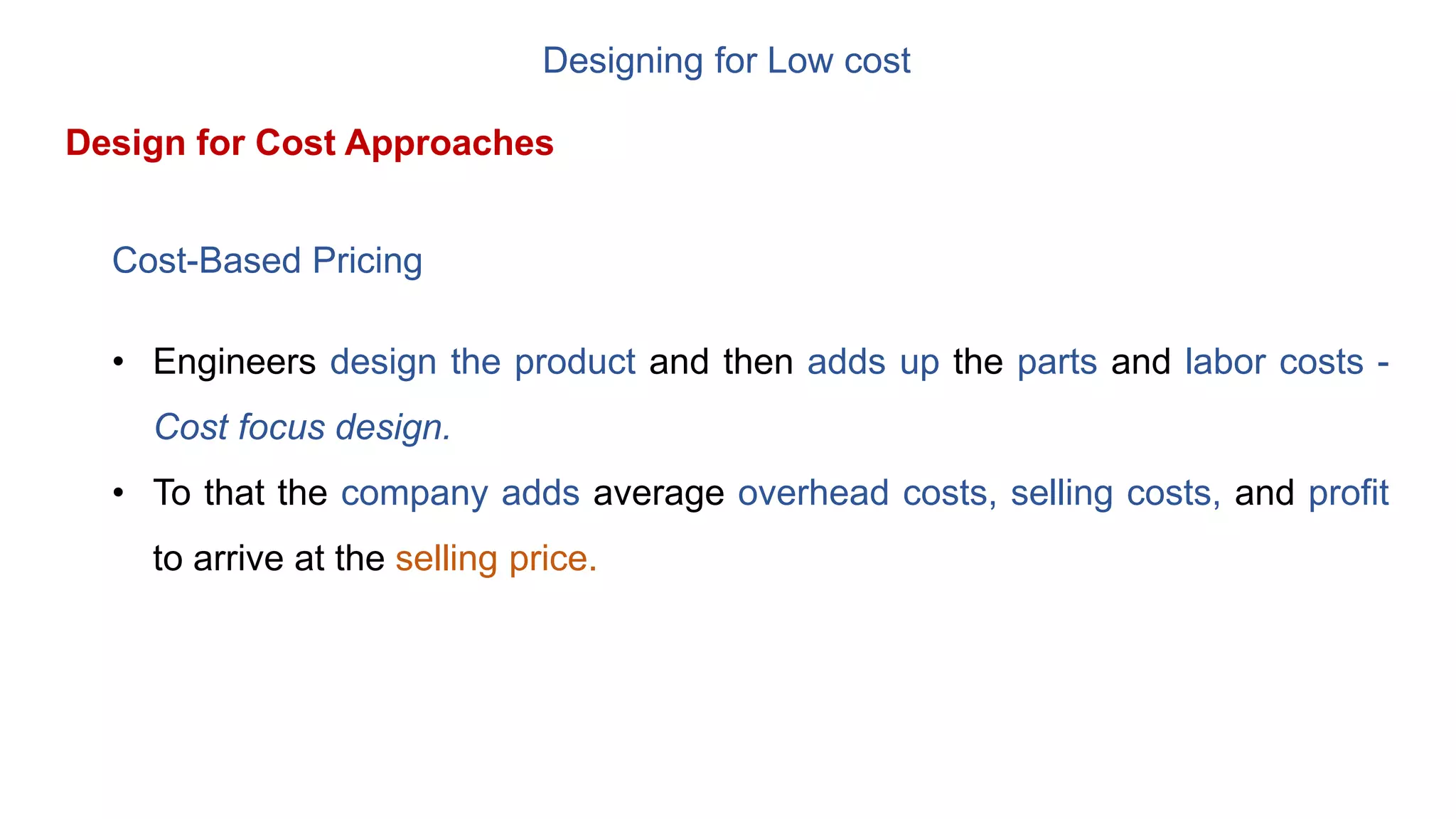
Cost-Based Pricing
• Engineers design the product and then adds up the parts and labor costs -
Cost focus design.
• To that the company adds average overhead costs, selling costs, and profit
to arrive at the selling price.
Designing for Low cost
Design for Cost Approaches
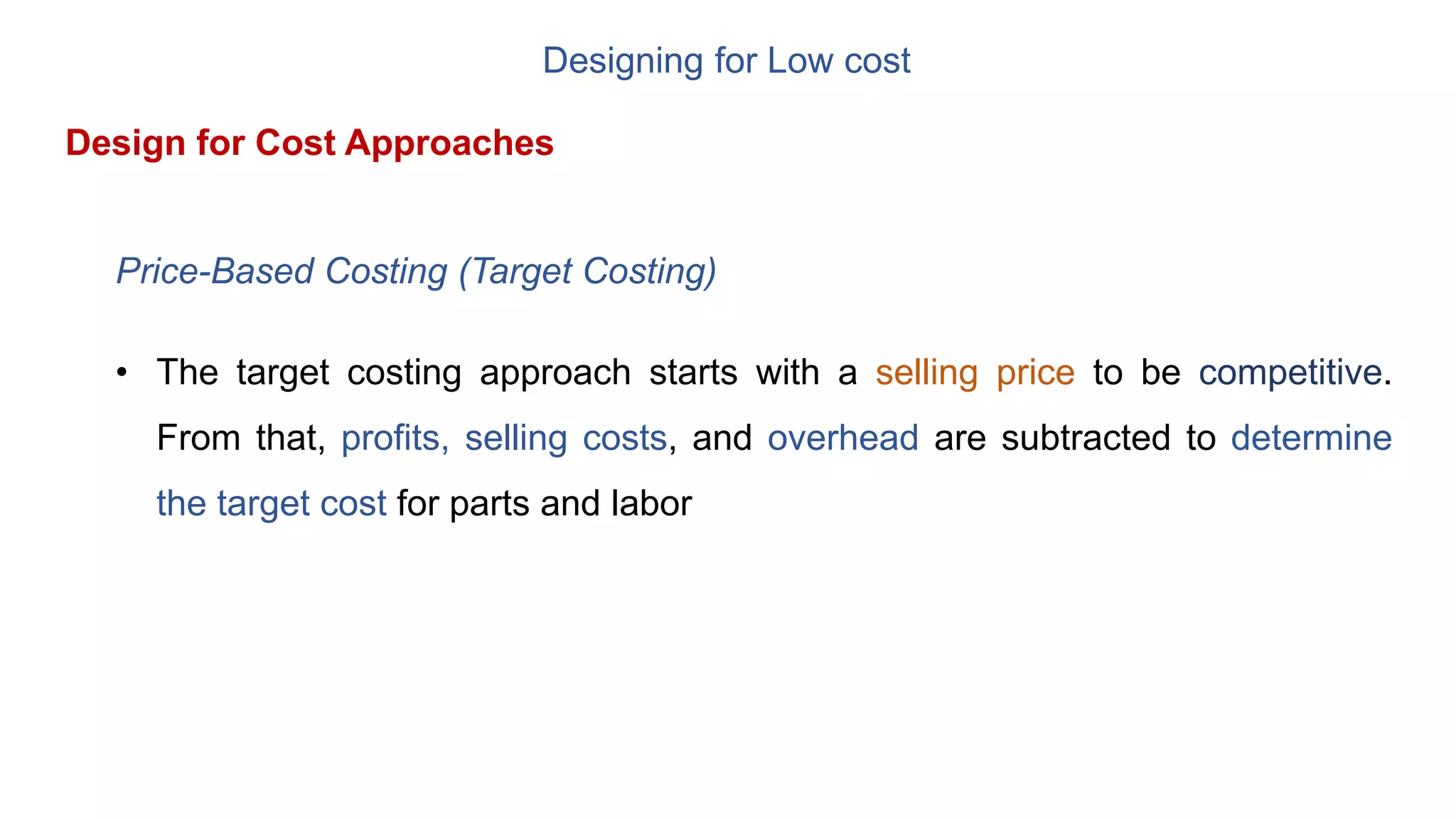
Price-Based Costing (Target Costing)
• The target costing approach starts with a selling price to be competitive.
From that, profits, selling costs, and overhead are subtracted to determine
the target cost for parts and labor
Design Very Low Cost Products
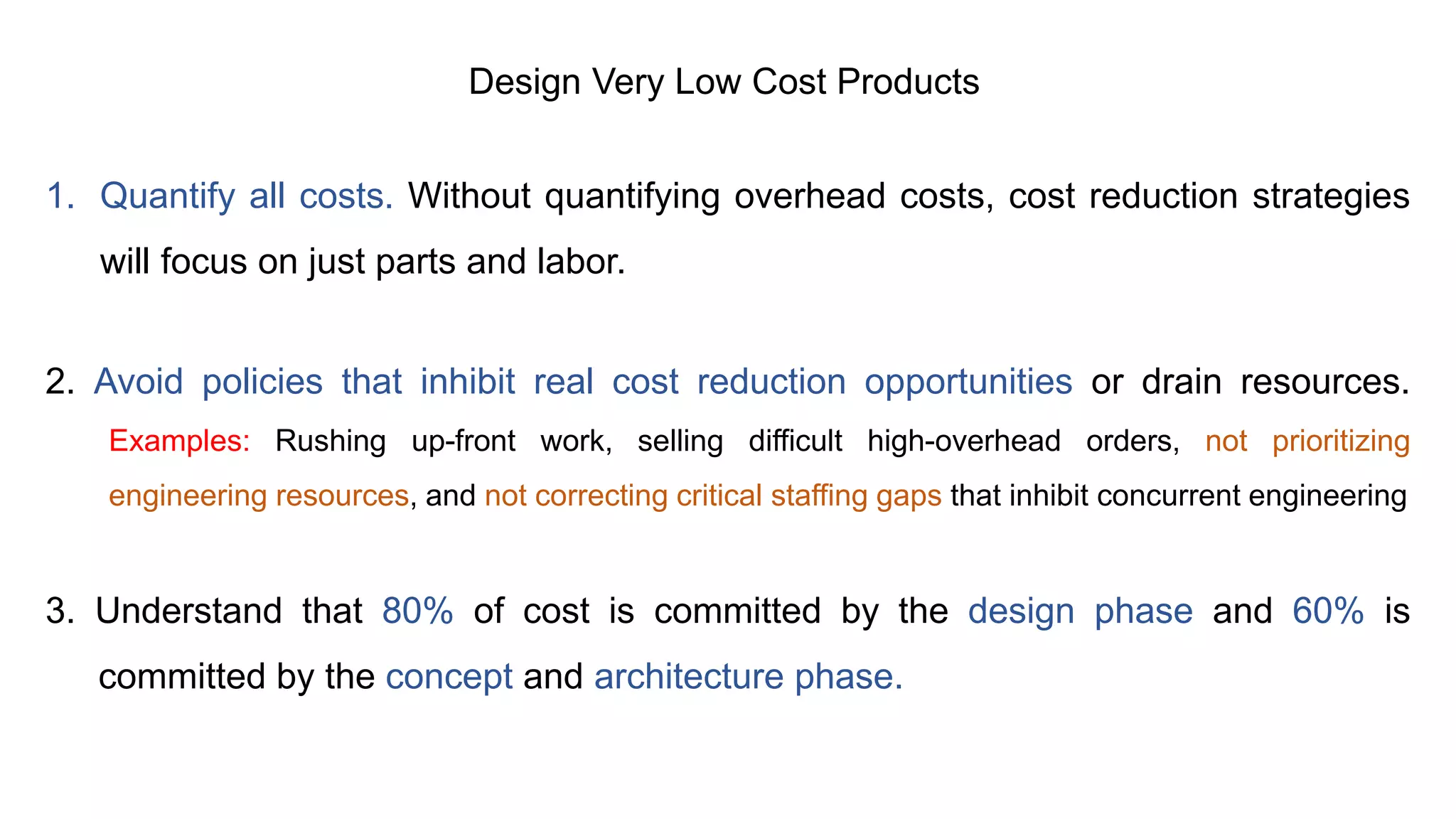
1. Quantify all costs. Without quantifying overhead costs, cost reduction strategies
will focus on just parts and labor.
2. Avoid policies that inhibit real cost reduction opportunities or drain resources.
Examples: Rushing up-front work, selling difficult high-overhead orders, not prioritizing
engineering resources, and not correcting critical staffing gaps that inhibit concurrent engineering
3. Understand that 80% of cost is committed by the design phase and 60% is
committed by the concept and architecture phase.
Design Very Low Cost Products
4. Don’t just look at lists of parts, because
(1) Leads to miss opportunities at the architecture level (60% of the cost)
(2) Substituting cheaper parts requires new product development resources and
introduces many new variables that will lower quality, raise other costs, and delay
product development itself.
5. Investigate what worked well and what caused extra expenditures on related
programs—the “lessons learned”
Design Very Low Cost Products
6. Identify and prioritize cost challenges and cost reduction opportunities.
7. Implement concurrent engineering in which complete multifunctional teams do all
of the above.
8. Thoroughly search for standard off-the-shelf parts, before arbitrary decisions
preclude their use.
Design Very Low Cost Products
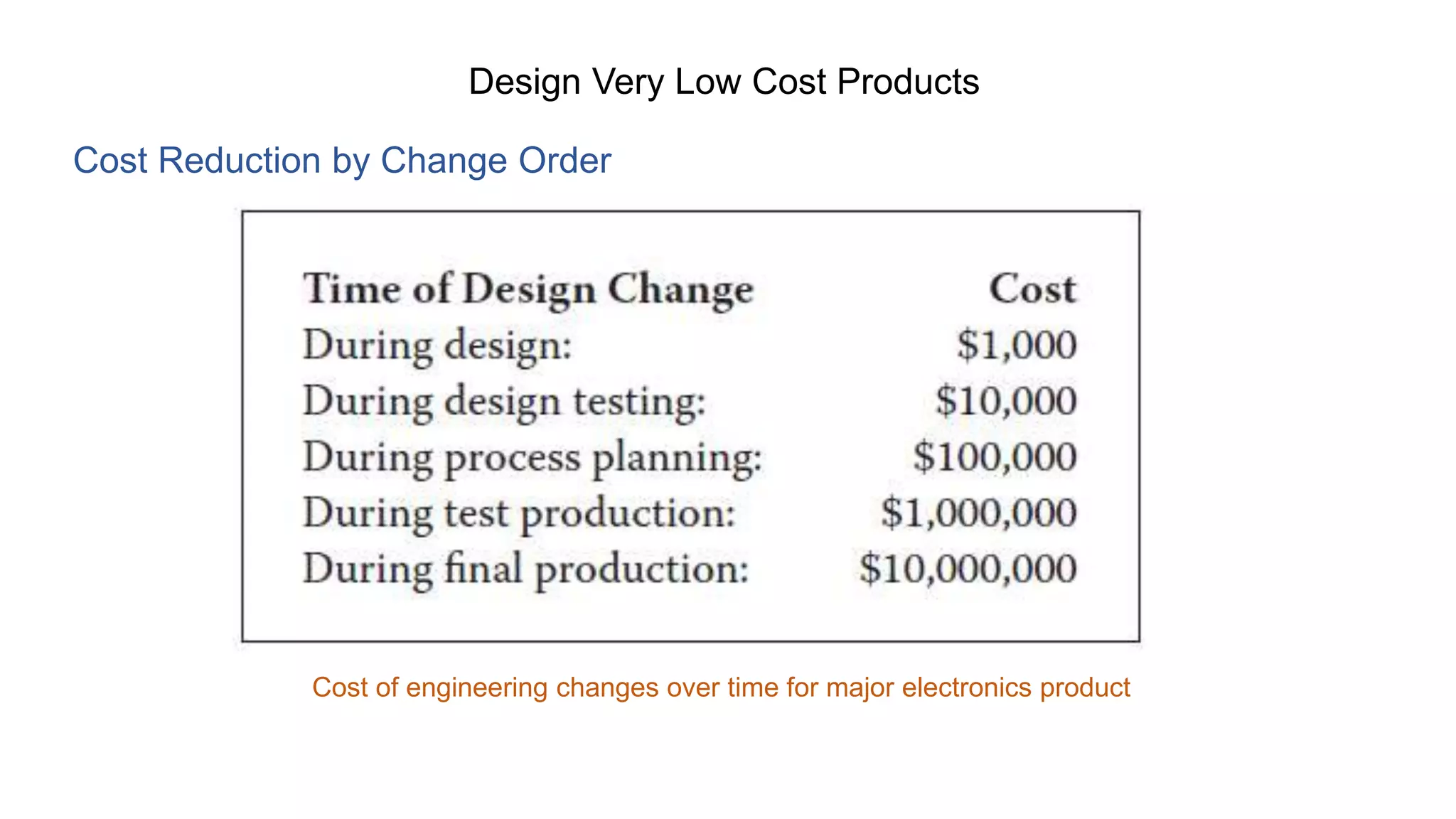
Cost Reduction by Change Order
Cost of engineering changes over time for major electronics product
End

M1: Introduction to Design for Manufacture

  • 1.
    Department of MechanicalEngineering JSS Academy of Technical Education, Bangalore-560060 Design for Manufacture (Course Code:18ME731)
  • 2.
    TEXT BOOKS • Designfor Manufacture by Harry Peck, Pitman publishing, 1983 • Engineering Design: A Material & Processing Approach by Dieter, G.E, McGraw Hill Co. 2000 • Handbook of Product Design for Manufacture: A practical guide to low cost production by Bralla, James G, McGraw Hill Co. , 1986
  • 3.
    • Factors tobe considered while designing parts with focus on manufacturability. • Through understanding of GD & T techniques in manufacture. • Design considerations for designing components produced using various machining operations. • Design rules and recommendations for processes like casting, welding, forgings powder metallurgy and injection moulding. Learning objectives
  • 4.
    Design for Manufacture CHAPTER1: Introduction to DFM
  • 5.
    Introduction: Definition, Needfor DFM, DFM approach for cost reduction, general design guide lines of DFM, advantages and disadvantages, application of DFM in industries, Design for Quality Manufacturability, DFQM approach, designing for economical production. Design for Excellence (DFX). Module 1
  • 6.
    Introduction Design for Manufacturability(Design for Manufacture or DFM) 1. DFM includes any step, method, or system, provides a product design that eases the task of manufacturing and lowers manufacturing cost. 2. Knowledge-based technique, invokes a series of guidelines, principles, recommendations, or rules of thumb for designing a product. 3. Primary objective is to improve manufacturability. Definition
  • 7.
    Introduction Optimization of apart, product, or component’s design, to create it cheaper and more easily (Manufacturability). Definition
  • 8.
    Major DFM objectives •Estimate the mfg. costs • Reduce the cost of components • Reduce the costs of assembly • Reduce the costs of supporting production • Impact of DFM decisions on other factors
  • 9.
    General design guidelines of DFM 1. Simplify the design: Reduce the number of parts E.g. Combining parts, Multifunctional part 2. Design for low-labor-cost operations E.g. A punch press pierced hole can be made more quickly than drilling a hole. 3. Avoid generalized statements on drawings, difficult for manufacturing personnel to interpret. E.g. “Polish this surface/Corners must be square/Tool marks are not permitted
  • 10.
    General design guidelines of DFM 4. Dimensions should be made not from points, but from specific surfaces or points on the part itself if at all possible. This enables making of fixture and gauge, Also helps avoid tooling, gauge, and measurement errors. 5. Dimensions should all be from one datum line rather than from a variety of points to simplify tooling and gauging and avoid overlap of tolerances.
  • 11.
    General design guidelines of DFM 6. Once functional requirements have been fulfilled, Designers should strive for minimum weight consistent with strength and stiffness requirements, Along with a reduction in materials costs. 7. Whenever possible, design to use general-purpose tooling rather than special tooling (dies, form cutters, etc.) 8. Avoid sharp corners; use generous fillets and radii. This is a universal rule applicable to castings and molded, formed, and machined parts
  • 12.
    General design guidelines of DFM 9. Design a part so that as many manufacturing operations as possible can be performed without repositioning it. 10. Whenever possible, cast, molded, or powder-metal parts should be designed so that stepped parting lines are avoided. 11. With casting and molding processes, design workpieces so that wall thicknesses are as uniform as possible (overcome the shrinkage effect). 12. Space holes in machined, cast, molded, or stamped parts so that they can be made in one operation without tooling weakness.
  • 13.
    Advantages/Benefits • Products madewith DFM will have a lower production cost • Quicker time-to-market • Shortening of the product development process • Production will be up to speed sooner • Parts may be combined to reduce assembly steps and quantity of parts • Catches and removes mistakes or faults • Higher quality of a product, as design can be refined and enhanced at every stage • As construction activities can be removed from a site and placed elsewhere, DFM can create a safer working environment
  • 14.
    Need for DFM/Achieving Lowest cost • It has been commonly reported that a high portion of a product’s lifecycle cost” is “locked in“ at the design stage. • The ‘Westinghouse Curve’ illustrates this principle. • Over half of the cost is fixed as soon as the product concept is formulated. • 75 percent of its cost is determined when the concept is validated. • Over 80 percent is fixed when full-scale product development is completed. • He states that 70% percent of the product cost is determined in the design phase.
  • 15.
  • 16.
    When costs aredetermined.
  • 17.
    Westinghouse curve The generalconclusion is inescapable: Total product costs are established very early in the product realization process. Therefore, it makes manufacturers to minimize these life-cycle costs, most effectively-during the design process for their products.
  • 18.
    Achieving Lowest cost •By the time a product is designed, 80% of the cost is determined. • When a product goes into production, 95% of its cost is determined. • It will be very difficult to remove cost at later stage. • The most profound implication for product development is that 60% of a product’s cumulative lifetime cost is committed by the concept/architecture phase! • This is why it is important to fully optimize this phase
  • 19.
    DFM / DFXApproaches • Controlled Experiment Methods • The Taguchi Method of Robust Design • Product Costs Means of improving product designs and manufacturing operations.
  • 20.
    DFM / DFXApproaches Controlled Experiment Methods • When there are a no. of variables each of which has some effect on the production process or the product’s composition and specifications-use of controlled experiments. • In this approach, the engineer conducts a series of tests to evaluate the effect of factors believed to be significant in influencing the process or product being designed. • Design of Experiments, directed experimentation, orthogonal arrays, statistically designed experiments, factorial experiments-are all terms for essentially the same approach. • This approach allows a number of variables to be evaluated at one time.
  • 21.
    DFM / DFXApproaches Controlled Experiment Methods • Traditionally, when engineers wanted to optimize some process or design variable, they have conducted experiments in which all other variables are held constant while various levels of the variable being tested are evaluated. • With the Taguchi and other controlled experiment methods, many process variables can be tested simultaneously. • By mathematical analysis, the engineer determines which set of variable is optimum. • The number of test runs needed for full optimization is thus greatly reduced.
  • 22.
    DFM / DFXApproaches Controlled Experiment Methods • DFM utilizes existing knowledge from manufacturing engineers and other production people with years of shop floor experience who have learned which factors in a product design help and which factors hurt shopfloor productivity.
  • 23.
    DFM / DFXApproaches The Taguchi Method of Robust Design • Taguchi’s methods are a variety of controlled experiments. • Purpose of providing a product or process which is more “robust” or less susceptible to variations in material, manufacturing processes, and operating conditions. • This methods are best suited for initial studies of processes and product designs that have considerable room for improvement.
  • 24.
    DFM / DFXApproaches Product Cost • Taguchi, another significant contribution to the state of the art of manufacturing and design • His concepts of product quality include life-cycle product costs. • His concept of life-cycle costs is consistent with present thinking about the nature and control of manufacturing costs.
  • 25.
    Definitions of RelatedApproaches The following terms are either part of DFM/DFX, related to it, or provide alternative means of improving product designs and manufacturing operations. • Design for assembly (DFA) refers to product design aimed specifically at simplifying a product and its overall assembly. • Design for manufacturability and assembly (DFMA) : Manufacturability • Manufacturability • Producibility • Design to cost: Design efforts to reduce operating costs including maintenance as well as the acquisition cost of a product.
  • 26.
    Definitions of RelatedApproaches • Concurrent engineering / Simultaneous engineering / Concurrent design: The approach that brings together in a team both the design and manufacturing engineers (often along with product managers, quality controllers, production people, service, safety, accounting and other personnel) throughout the design sequence. • Life-cycle costs: Costs involved, not only in the manufacture and distribution, but also those incurred in its ownership, operation and disposal.
  • 27.
    Definitions of RelatedApproaches • Benchmarking is “a continuous, systematic process for evaluating the products, services and work processes of organizations that are recognized as representing best practices for the purpose of organizational improvement. • Statistical process control (SPC): form of quality control which uses statistical methods to help control dimensions and other characteristics of manufactured products.
  • 28.
    Definitions of RelatedApproaches • Quality function deployment (QFD) is a systematic approach for improving product quality by concentrating on what the customer wants and will continue to buy in the product. • Synchronized manufacturing • Continuous improvement • Total quality management • Failure mode and effects analysis (FMEA) • Group technology
  • 29.
    Design for Excellence- DFX The Attributes of a Good Design What does a customer expect when he purchases a product?
  • 30.
    Design for Excellence- DFX The Attributes of a Good Design What does a customer expect when he purchases a product? • Function • Performance • Low price • Products of high lasting quality
  • 31.
    Design for Excellence- DFX What is DFX? A knowledge-based approach that attempts to design products that maximize all desirable characteristics; • High quality • Reliability • Serviceability • Safety • User friendliness • Environment friendliness • Short time to market in product design • Minimizing life time cost including manufacturing cost
  • 32.
    Design for Excellence- DFX What is DFX? Achieving these objectives constitutes Excellence in product design DFX = X = Design for all desirable characteristics X = Design for Excellence
  • 33.
    Designing for Lowcost Various approaches exist to determine the goals for costs and the pricing of products. Design for Cost Approaches 1. Cost-Based Pricing 2. Price-Based Costing (Target Costing)
  • 34.
    Designing for Lowcost Design for Cost Approaches Cost-Based Pricing • Engineers design the product and then adds up the parts and labor costs - Cost focus design. • To that the company adds average overhead costs, selling costs, and profit to arrive at the selling price.
  • 35.
    Designing for Lowcost Design for Cost Approaches Price-Based Costing (Target Costing) • The target costing approach starts with a selling price to be competitive. From that, profits, selling costs, and overhead are subtracted to determine the target cost for parts and labor
  • 36.
    Design Very LowCost Products 1. Quantify all costs. Without quantifying overhead costs, cost reduction strategies will focus on just parts and labor. 2. Avoid policies that inhibit real cost reduction opportunities or drain resources. Examples: Rushing up-front work, selling difficult high-overhead orders, not prioritizing engineering resources, and not correcting critical staffing gaps that inhibit concurrent engineering 3. Understand that 80% of cost is committed by the design phase and 60% is committed by the concept and architecture phase.
  • 37.
    Design Very LowCost Products 4. Don’t just look at lists of parts, because (1) Leads to miss opportunities at the architecture level (60% of the cost) (2) Substituting cheaper parts requires new product development resources and introduces many new variables that will lower quality, raise other costs, and delay product development itself. 5. Investigate what worked well and what caused extra expenditures on related programs—the “lessons learned”
  • 38.
    Design Very LowCost Products 6. Identify and prioritize cost challenges and cost reduction opportunities. 7. Implement concurrent engineering in which complete multifunctional teams do all of the above. 8. Thoroughly search for standard off-the-shelf parts, before arbitrary decisions preclude their use.
  • 39.
    Design Very LowCost Products Cost Reduction by Change Order Cost of engineering changes over time for major electronics product
  • 40.