International Research Journal of Engineering and Technology (IRJET) e-ISSN: 2395-0056
Volume: 05 Issue: 11 | Nov 2018 www.irjet.net p-ISSN: 2395-0072
© 2018, IRJET | Impact Factor value: 7.211 | ISO 9001:2008 Certified Journal | Page 1788
Role of Artificial Intelligence in Flexible Manufacturing
Process - A Review
Amar Kumar Das1, Manas Ranjan Das2
1Asst. Professor, Department of Mechanical Engineering, GIFT, Bhubaneswar, Odisah, India.
2Asst. Professors, Department of Mechanical Engineering, REC, Bhubaneswar, Odisah, India.
---------------------------------------------------------------------***----------------------------------------------------------------------
Abstract - Despite of evidence that information technology
(IT) has recently become a productive investment for a large
cross-section of firms, a number of questions remain. Some of
these issues can be addressed by extending the basic
production function approach that was applied in earlier
work. Such activities involve part design, process design and
process execution, as IT plays such an important role in
various sectors and industries. Artificial Intelligence (AI) has
the potential to enhance and extend the capabilities of
humans, and help businesses achieve more, faster and more
efficiently. AI in smart machines currently manages the more
traditional repetitive tasks; however, this is advancing very
quickly. The ability of AI to adapt to continuously changing
tasks will move quickly into the mainstream. In the case of
production, we will see sensors spotting defects on the
production line. The data is then fed to the cloud to verify,
which will immediately remove thedefectivepartfromthe line
and order a replacement all while calculating in real-time
just-in-time schedules. Each one of these intelligent insights
will turn information into tangible outcomes. This paper
reports different scope of AI implemented in manufacturing
process.
Keywords: Artificial Intelligence, sensors, flexible
manufacturing, real time.
1. INTRODUCTION
Manufacturing has evolved and become more automated,
computerised and complex. In this paper, the origin, current
status and the future developments in manufacturing are
disused. Smart manufacturing is an emerging form of
production integrating manufacturing assets of today and
tomorrow with sensors, computing platforms,
communication technology, control, simulation, data
intensive modelling and predictive engineering. It utilises
the concepts of cyber-physical systems spearheaded by the
internet of things, cloud computing, service-oriented
computing, artificial intelligence and data science. Once
implemented, these concepts and technologies would make
smart manufacturing the hallmark of the next industrial
revolution. The essence of smart manufacturing is captured
in six pillars, manufacturing technology and processes,
materials, data, predictive engineering, sustainability and
resource sharing and networking.
The concept of flexible production has been applied to the
following three basic manufacturing subsystems: (1)
fabrication, (2) machining, (3) assembly (Kusiak [12]).
Flexible machining systems have received great attention
among practitioners (measured by number of systems
developed) and researchers (measuredbynumberofpapers
published). This might be due to the importance of
machining in manufacturing industries and to progress in
technology of machine tools. Although initially flexible
assembly systems have drawnratherlittleattention,interest
has been increasing rapidly in the last few years. Flexible
fabrication systems haveattractedtheleastinterest, butthey
represent a great potential for applications of flexible
technology. One of the most difficult problems generated by
these three subsystems is the scheduling problem. Readers
interested in FMS planning and scheduling frame.
2. MATHEMATICAL MODELLING
Manufacturing comes in many shapes and sizes. Two major
categories are continuous manufacturing are and discrete
manufacturing. Continuous manufacturing ofthesortfound,
for example, in a chemical factory will not be further
discussed. Of the many subcategories of discrete
manufacturing, only one is used for the purposes of
discussion. The area of choice is the manufacture of
mechanical products, i.e., those products made primarily of
three dimensional rigid parts. A bicycle is a goodexample,as
is an automobile, as is an airplane. So are a refrigeratoranda
washing machine.
Processes such as the discrete manufacture of
electrical/electronic products or the continuous
Manufacture of chemical products cannot be viewed as
application areas for computational Techniques. It simply
means that discrete mechanical manufacturing has been
selected as a rich source of examples, most of which are
within the experience of the intended audience.
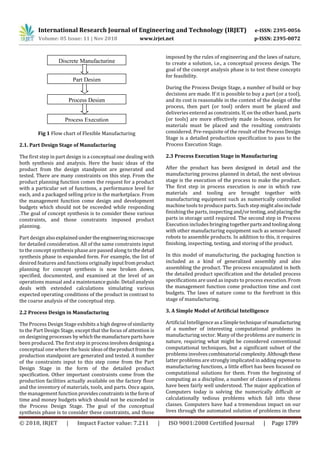
To discuss discrete mechanical manufacturing and
associatedengineeringfunctionsascomputational problems,
a simple (but not overly simplified) model is proposed. This
model consists of three stages of activity including the Part
Design Stage, the Process Design Stage, and the Process
Execution Stage.
International Research Journal of Engineering and Technology (IRJET) e-ISSN: 2395-0056
Volume: 05 Issue: 11 | Nov 2018 www.irjet.net p-ISSN: 2395-0072
© 2018, IRJET | Impact Factor value: 7.211 | ISO 9001:2008 Certified Journal | Page 1789
Fig 1 Flow chart of Flexible Manufacturing
2.1. Part Design Stage of Manufacturing
The first step in part design is a conceptual one dealing with
both synthesis and analysis. Here the basic ideas of the
product from the design standpoint are generated and
tested. There are many constraints on this step. From the
product planning function comes the request for a product
with a particular set of functions, a performance level for
each, and a packaged selling price in the marketplace. From
the management function come design and development
budgets which should not be exceeded while responding
.The goal of concept synthesis is to consider these various
constraints, and those constraints imposed product
planning.
Part design alsoexplainedundertheengineeringmicroscope
for detailed consideration. All of the same constraints input
to the concept synthesis phase are passed along to the detail
synthesis phase in expanded form. For example, the list of
desired features and functions originally inputfromproduct
planning for concept synthesis is now broken down,
specified, documented, and examined at the level of an
operations manual and a maintenance guide. Detail analysis
deals with extended calculations simulating various
expected operating conditions of the product in contrast to
the coarse analysis of the conceptual step.
2.2 Process Design in Manufacturing
The Process Design Stage exhibits a high degreeofsimilarity
to the Part Design Stage, except that the focus of attention is
on designing processes bywhichthemanufacturepartshave
been produced. The first step in processinvolvesdesigninga
conceptual one where the basic ideasoftheproductfrom the
production standpoint are generated and tested. A number
of the constraints input to this step come from the Part
Design Stage in the form of the detailed product
specification. Other important constraints come from the
production facilities actually available on the factory floor
and the inventory of materials, tools, and parts. Once again,
the management function providesconstraintsintheformof
time and money budgets which should not be exceeded in
the Process Design Stage. The goal of the conceptual
synthesis phase is to consider these constraints, and those
imposed by the rules of engineering and the laws of nature,
to create a solution, i.e., a conceptual process design. The
goal of the concept analysis phase is to test these concepts
for feasibility.
During the Process Design Stage, a number of build or buy
decisions are made. If it is possible to buy a part (or a tool),
and its cost is reasonable in the context of the design of the
process, then part (or tool) orders must be placed and
deliveries entered as constraints. If, on the other hand, parts
(or tools) are more effectively made in-house, orders for
materials must be placed and the resulting constraints
considered. Pre-requisite of the result of the Process Design
Stage is a detailed production specification to pass to the
Process Execution Stage.
2.3 Process Execution Stage in Manufacturing
After the product has been designed in detail and the
manufacturing process planned in detail, the next obvious
stage is the execution of the process to make the product.
The first step in process execution is one in which raw
materials and tooling are brought together with
manufacturing equipment such as numerically controlled
machine tools to produce parts. Such step mightalsoinclude
finishing the parts, inspectingand/ortesting,andplacingthe
parts in storage until required. The second step in Process
Execution includes bringing togetherpartsandtoolingalong
with other manufacturing equipment such as sensor-based
robots to assemble products. In addition to this, it requires
finishing, inspecting, testing, and storing of the product.
In this model of manufacturing, the packaging function is
included as a kind of generalized assembly and also
assembling the product. The process encapsulated in both
the detailed product specification and the detailed process
specifications are used as inputs to process execution. From
the management function come production time and cost
budgets. The laws of nature come to the forefront in this
stage of manufacturing.
3. A Simple Model of Artificial Intelligence
Artificial Intelligenceasa Simpletechniqueof manufacturing
of a number of interesting computational problems in
manufacturing sector. Many of the problems are numeric in
nature, requiring what might be considered conventional
computational techniques, but a significant subset of the
problems involves combinatorial complexity.Althoughthese
latter problems are strongly implicated inadding expense to
manufacturing functions, a little effort has been focused on
computational solutions for them. From the beginning of
computing as a discipline, a number of classes of problems
have been fairly well understood. The major application of
Computers today is solving the numerically difficult or
calculationally tedious problems which fall into these
classes. Computers have had a tremendous impact on our
lives through the automated solution of problems in these
Part Design
Process Design
Process Execution
Discrete Manufacturing
International Research Journal of Engineering and Technology (IRJET) e-ISSN: 2395-0056
Volume: 05 Issue: 11 | Nov 2018 www.irjet.net p-ISSN: 2395-0072
© 2018, IRJET | Impact Factor value: 7.211 | ISO 9001:2008 Certified Journal | Page 1790
classes, at least partly because humans are not very efficient
in the face of numerical analysis. Solving equations,
calculating payrolls, and generally keeping track ofnumbers
is the obvious work of the computer, a role from which it
derives its popular name.
In the context of this paper, the problems do not involve
combinatorial complexity in their solution. They may be
numericallydifficultandrequiremathematical creativity and
require programming skills. Second, there is usually a well
known, relatively standard solution process for these
problems. In some cases,the processeswerecommonlyused
by humans before computers and have evolved astheywere
transferred onto the machine. This realization marked the
beginning of Artificial Intelligence (AI) as a branch of
Computer Science. For thepurposesofthisdiscussion,AI can
be thought of as the experimental branch of computer
science which relates a natural phenomenon, human
cognitive ability, with an artificial analogy, computer
programs.
4. CONCLUSION
This paper aims the scope of Artificial Intelligence in
manufacturing process and some substantiationofthebelief
that AI techniques can be useful in manufacturing. As
combinatorial complexity of part design,processdesign,and
process execution continues to increase, AI will become as
indispensable in the factory of the future as conventional
data processing. The data is then fed to the cloud to verify,
which will immediately remove the defective part from the
line and order a replacement all while calculating in real-
time just-in-time schedules. Each one of these intelligent
insights will turn information into tangible outcomes.
REFERENCE
[1] R.M.R. Ellis and O.I. Semenov (eds.), Advances in CAD
/CAM (Proceedings of the 5th International IFIP/IFAC
Conference, Leningrad, 1982), North-Holland(Amsterdam),
1983. (See Section IV. Artificial Intelligence in Design and
Manufacturing.)
[2] J C. Latombe (ed.), Artificial Intelligence and Pattern
Recognition in Computer Aided Design (Proceedings of the
IFIP Working Conference, Grenoble, 1978), North-Holland
(Amsterdam), 1978. (Numerous interesting articles,
especially concerning electronic design.)
[3] H.G. Barrow, "Proving the Correctness of Digital
Hardware Designs," Proceedings of the 3rd National
Conference on Artificial Intelligence (Washington, D.C.),
1983, pp. 17-21.
[4] J.S. Bennett and R.S. Engelmore, "SACON: A Knowledge-
Based Consultant for structural Analysis," Proceedings of the
6th International Joint Conference on Artificial Intelligence
(Tokyo), 1979, pp. 47-49.
[5] J.S. Bennett and C.R. Hollander, "DART: AnExpertSystem
for Computer Fault Diagnosis," Proceedings of the 7th
International Joint Conference on Artificial Intelligence
(Vancouver), 1981, pp. 843-845.
[6] D.C. Brown and B. Chandrasekaran, "An Approach to
Expert Systems for Mechanical Design," ProceedingsTrends
and Applications (Automating Intelligent Behaviour:
Applications and Frontiers)(National Bureau of Standards,
Gaithersburg, MD), 1983, pp. 173-180.