PRESENTED BY: GUIDED BY:
SWATHI M NAMBIAR PROFESSOR KRUPA THULA
M.PHARM SEM-1 ASSISTANT PROFESSOR
ROLL NO:1 M PHARM
PMRA
1
L.J INSTITUTE OF PHARMACY
 INTRODUCTION
 MANUFACTURING DOCUMENTS
 DOCUMENT CONTROL
 MASTER FORMULA RECORDS
 BATCH FORMULA RECORDS
2
3
• Drugs are usually administered into different dosage
forms by converting them into suitable formulations.
• Dosage forms are carriers through which drug molecules
are delivered to the site of action within the body.
• Dosage form=DRUG + EXCIPIENTS
4
DOSAGE
FORMS
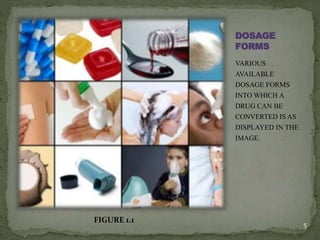
VARIOUS
AVAILABLE
DOSAGE FORMS
INTO WHICH A
DRUG CAN BE
CONVERTED IS AS
DISPLAYED IN THE
IMAGE.
5
FIGURE 1.1
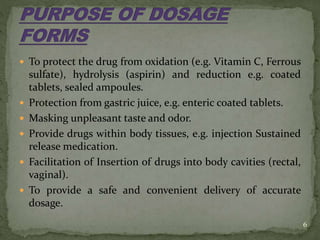
 To protect the drug from oxidation (e.g. Vitamin C, Ferrous
sulfate), hydrolysis (aspirin) and reduction e.g. coated
tablets, sealed ampoules.
 Protection from gastric juice, e.g. enteric coated tablets.
 Masking unpleasant taste and odor.
 Provide drugs within body tissues, e.g. injection Sustained
release medication.
 Facilitation of Insertion of drugs into body cavities (rectal,
vaginal).
 To provide a safe and convenient delivery of accurate
dosage.
6
7
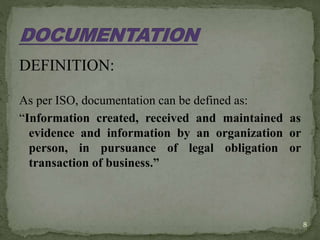
DEFINITION:
As per ISO, documentation can be defined as:
“Information created, received and maintained as
evidence and information by an organization or
person, in pursuance of legal obligation or
transaction of business.”
8
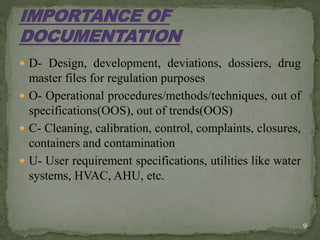
 D- Design, development, deviations, dossiers, drug
master files for regulation purposes
 O- Operational procedures/methods/techniques, out of
specifications(OOS), out of trends(OOS)
 C- Cleaning, calibration, control, complaints, closures,
containers and contamination
 U- User requirement specifications, utilities like water
systems, HVAC, AHU, etc.
9
 M- Man, materials, methods, maintenance,
manufacturing operations and control, monitoring,
master formula, manuals
 E- Engineering control and practices, environmental
control, equipment qualification documents
 N- Non-routine activities, new products and
substances
 T- Technology, transfer, training, testing, trend
analysis, technical dossiers
10
 S- SOP’s, safety practices, sanitation, self inspection,
storage, standardization, standard test procedures, site
master file
11
1) REDUCE COSTS
• Labour expense
• Improve productivity
• Decrease storage costs
• Decrease time and cost with managing compliance
program
12
2) REDUCE CYCLE TIME
 Shorten time to market
 Improve order fulfilment
 Supply chain collaboration
 Support manufacturing
13
3) INCREASE SERVICE LEVELS
 Improve issue resolution methods
 Share knowledge assets
 Strengthen customer relations
 Increases sales proficiency
14
4) Compliance-Regulatory, Corporate Policies, And
Certification Assistance
 ISO Compliance
 FDA Compliance
 OSHA Compliance
 Corrective and Preventive Action (CAPA)
Compliance
 Sarbanes-Oxley (SOX) Compliance
 Disaster Recovery practices
15
5) Mainatainence of management
6) Information about equipment
7) Gives information about product, premises,
personnel,etc
16
 ACCOUNTING- Account receivables/payables
processing
 CUSTOMER SERVICE- Order processing, complete
customer profiling, resolution handling
 ENGINEERING- Change process management
 HUMAN RESOURCES-Sensitive employee
management, hiring processing
 OPERATIONS- Continuous improvement planning
initiatives, project management
17
 QUALITY ASSURANCE- Issue resolution,
documented standard processes, safety compliances
 REGULATORY COMPLIANCE- Complete
document security and audit trial capabilities
 RISK AVERSION-Complete disaster recovery, design
18
19
 Specification and standards
 Raw Material Records
 Labels and printed packaging material records
 Master Formula Records
 Batch Production Records
 Quality Control Records
 Calibration & Validation Records
 Distribution Records
 Batch Packaging Records
20
21
Controlled documents are legible, dated, readily identifiable,
maintained in an orderly manner and retained for a specified
period.
Document control ensures that the documents are able to be
located, reviewed periodically and revised and approved.
22
 The main purpose is to introduce and establish a unified
system of document control.
 It describes the procedures and responsibilities for
creation and modifications of controlled documents.
23
 The major responsibility rests on the QA personnel for
control of the documents.
 Without the approval of the QA personnel no
manufacturing documents can be made legal or controlled.
24
The procedure for control of the documents can be briefed as
follows:
 All documents should be identified by a unique title and
document number.
 Document should be designed, prepared, received, approved,
signed and dated by authorized persons and distributed to
concerned departments.
 Approved documents should not be corrected manually with a
pen / pencil for any reason.
25
26
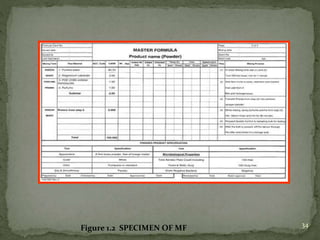
 The Master Formula can be prepared as a set of documents:
one for each segment of the full production process (e.g.
for the production of an intermediate such as a batch of
harvest or for the formulation/filling process from final
bulk), or a single overall document that contains parts
which describe the separate batch products that make up
the full process from the starting materials to the final valid
product.
27
 A document or set of documents specifying the starting
materials with their quantities and the packaging
materials, together with a description of the procedures
and precautions required to produce a specified quantity of
a finished product as well as the processing instructions,
including the in-process controls.
28
 Batch Manufacturing record (BMR).
 Batch Packing record (BPR).
 Intermediate/ Packing Material / Finished product
specification.
 Specimen of Printed packaging material.
 All documents of “ Master Formula Record” should be
stamped as “Master Copy” in Green at the non- text side
(back side).
29
(a) the name of the product together with product reference code
relating to its specifications;
(b) the patent or proprietary name of the product along with the
generic name, a description of the dosage form, strength,
composition of the product and batch size;
(c) a statement of the processing location and the principal
equipment to be used.
(d) name, quantity, and reference number of all the starting
materials to be used. Mention shall be made of any substance that
may .disappear. in the courts of processing.
30
(e) a statement of the expected final yield with the acceptable
limits, and of relevant intermediate yields, where applicable.
(f) The methods, or reference to the methods, to be used for
preparing the critical equipment including cleaning, assembling,
calibrating, sterilizing.
(g) detailed stepwise processing instructions and the time taken
for each step;
(h) the instructions for in-process control with their limits;
31
(i)the requirements for storage conditions of the products,
including the container, labelling and special storage
conditions where applicable;
(j) any special precautions to be observed;
(k) packing details and specimen labels.
32
 The generally recommended MF format is to prepare a
single continuous document that provides step-by-step
production instructions, raw materials, equipment used,
locations of production, dates, operators, etc. for the
product, with blank spaces to record the data and
sign and date all entries, and at least cross-references to all
supporting SOPs and operations.
33
34
Figure 1.2 SPECIMEN OF MF
35
 A batch processing record is built up by filling in all the
blanks on an approved Master Formulae sheets.
 An approved copy of the MF is requested by the
production department for each production run of a batch.
 The Batch Processing Record Document must be verified
by QA or QC as an exact replica of the current MF before
being Released for a batch production run.
 It is ideal to have the batch processing record divided by
day (see format in later section of this guide) so that only
the required blank pages of the batch processing record
are taken into the production area for each day of a
production run.
36
 All documents associated with the manufacture of a batch
of bulk product or finished product. They provide a
history of each batch of product and of all circumstances
pertinent to the quality of the final product.
 Batch formula record should be prepared for each batch of
the product.
37
 Batch formula record shall be essentially based on the
master formula record and shall be compiled, checked,
approved and authorized by competent technical person
responsible for production and quality control. Photo
reproduction, or such other system (e.g. computer
printouts) shall be preferred to avoid transcription errors
provided, however, there are adequate safeguards to
prevent unauthorized re-production.
38
 Name of product
 Batch formula
 Brief manufacturing process
 Batch or code number
 Date of the start and finish of processing and
packaging
 Identity of individual major equipment and lines or
location used
39
 Records of cleaning and sanitation of equipment used for
processing as appropriate
 In-process control and laboratory results, such as pH and
temperature test records
 Packaging line clearance inspection records
 Any sampling performed during various steps of processing
 Any investigation of specific failure or discrepancies
 Results of examinations on packed and labelled products
40
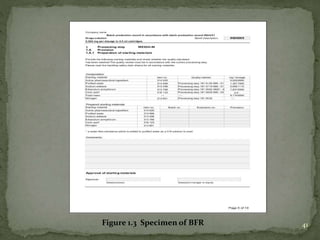
41Figure 1.3 Specimen of BFR
42

Manufacturing documents-GMP

  • 1.
    PRESENTED BY: GUIDEDBY: SWATHI M NAMBIAR PROFESSOR KRUPA THULA M.PHARM SEM-1 ASSISTANT PROFESSOR ROLL NO:1 M PHARM PMRA 1 L.J INSTITUTE OF PHARMACY
  • 2.
     INTRODUCTION  MANUFACTURINGDOCUMENTS  DOCUMENT CONTROL  MASTER FORMULA RECORDS  BATCH FORMULA RECORDS 2
  • 3.
  • 4.
    • Drugs areusually administered into different dosage forms by converting them into suitable formulations. • Dosage forms are carriers through which drug molecules are delivered to the site of action within the body. • Dosage form=DRUG + EXCIPIENTS 4
  • 5.
    DOSAGE FORMS VARIOUS AVAILABLE DOSAGE FORMS INTO WHICHA DRUG CAN BE CONVERTED IS AS DISPLAYED IN THE IMAGE. 5 FIGURE 1.1
  • 6.
     To protectthe drug from oxidation (e.g. Vitamin C, Ferrous sulfate), hydrolysis (aspirin) and reduction e.g. coated tablets, sealed ampoules.  Protection from gastric juice, e.g. enteric coated tablets.  Masking unpleasant taste and odor.  Provide drugs within body tissues, e.g. injection Sustained release medication.  Facilitation of Insertion of drugs into body cavities (rectal, vaginal).  To provide a safe and convenient delivery of accurate dosage. 6
  • 7.
  • 8.
    DEFINITION: As per ISO,documentation can be defined as: “Information created, received and maintained as evidence and information by an organization or person, in pursuance of legal obligation or transaction of business.” 8
  • 9.
     D- Design,development, deviations, dossiers, drug master files for regulation purposes  O- Operational procedures/methods/techniques, out of specifications(OOS), out of trends(OOS)  C- Cleaning, calibration, control, complaints, closures, containers and contamination  U- User requirement specifications, utilities like water systems, HVAC, AHU, etc. 9
  • 10.
     M- Man,materials, methods, maintenance, manufacturing operations and control, monitoring, master formula, manuals  E- Engineering control and practices, environmental control, equipment qualification documents  N- Non-routine activities, new products and substances  T- Technology, transfer, training, testing, trend analysis, technical dossiers 10
  • 11.
     S- SOP’s,safety practices, sanitation, self inspection, storage, standardization, standard test procedures, site master file 11
  • 12.
    1) REDUCE COSTS •Labour expense • Improve productivity • Decrease storage costs • Decrease time and cost with managing compliance program 12
  • 13.
    2) REDUCE CYCLETIME  Shorten time to market  Improve order fulfilment  Supply chain collaboration  Support manufacturing 13
  • 14.
    3) INCREASE SERVICELEVELS  Improve issue resolution methods  Share knowledge assets  Strengthen customer relations  Increases sales proficiency 14
  • 15.
    4) Compliance-Regulatory, CorporatePolicies, And Certification Assistance  ISO Compliance  FDA Compliance  OSHA Compliance  Corrective and Preventive Action (CAPA) Compliance  Sarbanes-Oxley (SOX) Compliance  Disaster Recovery practices 15
  • 16.
    5) Mainatainence ofmanagement 6) Information about equipment 7) Gives information about product, premises, personnel,etc 16
  • 17.
     ACCOUNTING- Accountreceivables/payables processing  CUSTOMER SERVICE- Order processing, complete customer profiling, resolution handling  ENGINEERING- Change process management  HUMAN RESOURCES-Sensitive employee management, hiring processing  OPERATIONS- Continuous improvement planning initiatives, project management 17
  • 18.
     QUALITY ASSURANCE-Issue resolution, documented standard processes, safety compliances  REGULATORY COMPLIANCE- Complete document security and audit trial capabilities  RISK AVERSION-Complete disaster recovery, design 18
  • 19.
  • 20.
     Specification andstandards  Raw Material Records  Labels and printed packaging material records  Master Formula Records  Batch Production Records  Quality Control Records  Calibration & Validation Records  Distribution Records  Batch Packaging Records 20
  • 21.
  • 22.
    Controlled documents arelegible, dated, readily identifiable, maintained in an orderly manner and retained for a specified period. Document control ensures that the documents are able to be located, reviewed periodically and revised and approved. 22
  • 23.
     The mainpurpose is to introduce and establish a unified system of document control.  It describes the procedures and responsibilities for creation and modifications of controlled documents. 23
  • 24.
     The majorresponsibility rests on the QA personnel for control of the documents.  Without the approval of the QA personnel no manufacturing documents can be made legal or controlled. 24
  • 25.
    The procedure forcontrol of the documents can be briefed as follows:  All documents should be identified by a unique title and document number.  Document should be designed, prepared, received, approved, signed and dated by authorized persons and distributed to concerned departments.  Approved documents should not be corrected manually with a pen / pencil for any reason. 25
  • 26.
  • 27.
     The MasterFormula can be prepared as a set of documents: one for each segment of the full production process (e.g. for the production of an intermediate such as a batch of harvest or for the formulation/filling process from final bulk), or a single overall document that contains parts which describe the separate batch products that make up the full process from the starting materials to the final valid product. 27
  • 28.
     A documentor set of documents specifying the starting materials with their quantities and the packaging materials, together with a description of the procedures and precautions required to produce a specified quantity of a finished product as well as the processing instructions, including the in-process controls. 28
  • 29.
     Batch Manufacturingrecord (BMR).  Batch Packing record (BPR).  Intermediate/ Packing Material / Finished product specification.  Specimen of Printed packaging material.  All documents of “ Master Formula Record” should be stamped as “Master Copy” in Green at the non- text side (back side). 29
  • 30.
    (a) the nameof the product together with product reference code relating to its specifications; (b) the patent or proprietary name of the product along with the generic name, a description of the dosage form, strength, composition of the product and batch size; (c) a statement of the processing location and the principal equipment to be used. (d) name, quantity, and reference number of all the starting materials to be used. Mention shall be made of any substance that may .disappear. in the courts of processing. 30
  • 31.
    (e) a statementof the expected final yield with the acceptable limits, and of relevant intermediate yields, where applicable. (f) The methods, or reference to the methods, to be used for preparing the critical equipment including cleaning, assembling, calibrating, sterilizing. (g) detailed stepwise processing instructions and the time taken for each step; (h) the instructions for in-process control with their limits; 31
  • 32.
    (i)the requirements forstorage conditions of the products, including the container, labelling and special storage conditions where applicable; (j) any special precautions to be observed; (k) packing details and specimen labels. 32
  • 33.
     The generallyrecommended MF format is to prepare a single continuous document that provides step-by-step production instructions, raw materials, equipment used, locations of production, dates, operators, etc. for the product, with blank spaces to record the data and sign and date all entries, and at least cross-references to all supporting SOPs and operations. 33
  • 34.
  • 35.
  • 36.
     A batchprocessing record is built up by filling in all the blanks on an approved Master Formulae sheets.  An approved copy of the MF is requested by the production department for each production run of a batch.  The Batch Processing Record Document must be verified by QA or QC as an exact replica of the current MF before being Released for a batch production run.  It is ideal to have the batch processing record divided by day (see format in later section of this guide) so that only the required blank pages of the batch processing record are taken into the production area for each day of a production run. 36
  • 37.
     All documentsassociated with the manufacture of a batch of bulk product or finished product. They provide a history of each batch of product and of all circumstances pertinent to the quality of the final product.  Batch formula record should be prepared for each batch of the product. 37
  • 38.
     Batch formularecord shall be essentially based on the master formula record and shall be compiled, checked, approved and authorized by competent technical person responsible for production and quality control. Photo reproduction, or such other system (e.g. computer printouts) shall be preferred to avoid transcription errors provided, however, there are adequate safeguards to prevent unauthorized re-production. 38
  • 39.
     Name ofproduct  Batch formula  Brief manufacturing process  Batch or code number  Date of the start and finish of processing and packaging  Identity of individual major equipment and lines or location used 39
  • 40.
     Records ofcleaning and sanitation of equipment used for processing as appropriate  In-process control and laboratory results, such as pH and temperature test records  Packaging line clearance inspection records  Any sampling performed during various steps of processing  Any investigation of specific failure or discrepancies  Results of examinations on packed and labelled products 40
  • 41.
  • 42.