SKINPIGMENTATION
PRESENTED BY,
SHARADHA.M
I M PHARM
DEPT.OF PHARMACEUTICS
JSS COLLEGE OF PHARMACY
MYSORE.
Introduction:
• Pigmentation refers to coloring of the skin (some areas
or patches of skin turn darker in colour) due to the
deposition of the pigment melanin, which is produced by
specialized cells called melanocytes.
• Carotenes and melanins play an important role in
imparting colour to the skin .
Color of the Skin:
• Melanin is synthesized in the dendritic
cells(melanocytes) which are present in the basal
epidermal layer.
Melanocyte
Melanosome produced in melanocytes contain
granules of melanin
Melanosome transferred to
Keratinocytes.
• Production of melanin pigment is stimulated by UV
radiation as well as melanocyte stimulating harmone
secreted by anterior pituitary gland.
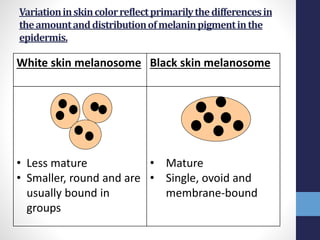
Variationinskincolorreflectprimarilythedifferencesin
theamountanddistributionofmelaninpigmentinthe
epidermis.
White skin melanosome Black skin melanosome
• Less mature
• Smaller, round and are
usually bound in
groups
• Mature
• Single, ovoid and
membrane-bound
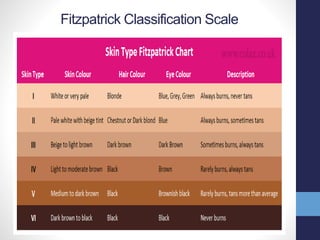
Fitzpatrick Classification Scale
Chemistry of Melanin:
• Two types of melanin are synthesized :
1. Eumelanin : Eumelanin is a dark brown-black insoluble
polymer(derived from the polymerization of tyrosine oxidation
products).
2. Pheomelanin: pheomelanin is a light red-yellow sulphur-
containing soluble polymer .
• Riley surveys the evidence that two types of oxidation are
involved:
1. Oxygen addition to monophenols (cresolase activity)
2. Dehydrogenation of diphenols (catecholase activity)
Sequenceofreactionsinvolvedintheconversion
oftyrosinetomelanin
DISORDERS OF PIGMENTATION
• TYPES:
Freckles
Melasma
Solar lentigines
Post inflammatory hyperpigmentation
Freckles
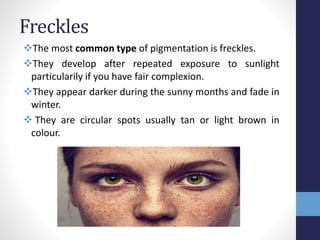
The most common type of pigmentation is freckles.
They develop after repeated exposure to sunlight
particularily if you have fair complexion.
They appear darker during the sunny months and fade in
winter.
 They are circular spots usually tan or light brown in
colour.
MELASMA
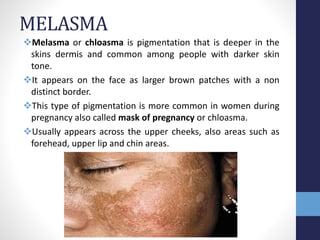
Melasma or chloasma is pigmentation that is deeper in the
skins dermis and common among people with darker skin
tone.
It appears on the face as larger brown patches with a non
distinct border.
This type of pigmentation is more common in women during
pregnancy also called mask of pregnancy or chloasma.
Usually appears across the upper cheeks, also areas such as
forehead, upper lip and chin areas.
Solar lentigines
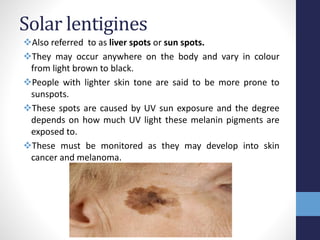
Also referred to as liver spots or sun spots.
They may occur anywhere on the body and vary in colour
from light brown to black.
People with lighter skin tone are said to be more prone to
sunspots.
These spots are caused by UV sun exposure and the degree
depends on how much UV light these melanin pigments are
exposed to.
These must be monitored as they may develop into skin
cancer and melanoma.
Post inflammatory pigmentation
This is a response to injury of the skin and can be the result of
acne,burns, friction.
It is also be due to cosmetic procedures for skin such as
chemical peels, laser treatments or combination therapy.
This type of pigmentation results in tan, brown or black colour
to skin.
TYPES:
Epidermal(surface layer):Tends to be tan,brown or dark brown
in colour and it may take months to years to get rid of it.
Dermis(inner layer skin): tends to be bluish grey in colour and
may be permanent if it is left untreated.
Depigmentation
• Depigmentation is the lightening of the skin, or loss of
pigment.
• Mechanism: The compounds may,
1. Selectively destroy the melanocytes
2. Inhibit the formation of melanosomes and alter their
structure
3. Inhibit the biosynthesis of tyrosinase
4. Inhibit the formation of melanin
5. Interfere with the transfer of melanosomes
6. Have a chemical effect on melanin or enhance the
degradation of melanosomes in kerationocytes.
• Depigmentation can be achieved by using
A. ACTIVE INGREDIENTS:
1. TYROSINASE INHIBITORS
a) Hydroquinone
b) Kojic Acid
c) Azelaic Acid
d) Paper Mulberry Extract
e) Aloesin
f) Arbutin
g) Licorice Extract
h) Ellagic Acid (Copper Chelation)
2. INHIBITORS OF MELANOSOME TRANSFER
a) Niacinamide
b) RWJ-50353
c) Soybean Trypsin Inhibitor
3. SKIN TURNOVER ACCELERATION
a) Alpha Hydroxy Acids
b) Linoleic Acid
4. TRADITIONAL CHINESE MEDICINE
a) Cinnamic Acid
b) Sophorcarpidine
INGREDIENT MECHANISM OF ACTION CONC.
Hydroquinone It is a powerful tyrosinase inhibitor.
HQ inhibits enzymatic oxidation of
tyrosinase substrate (i.e., tyrosine)
and to dihydroxyphenylalanine
(DOPA)
• HQ 2% OTC
• HQ 10%
Prescribed
drugs
• High conc.-
Irritant property
Tretinoin It inhibits the activity of tyrosinase
(Topical retinoid was first used in
combination with HQ to enhance its
penetration)
0.025% to 0.1%
Kojic Acid It acts by chelating copper atoms in
the active site of tyrosinase as well as
suppressing the tautomerization of
dopachrome to 5,6-dihydroxyindole-
2-carboxylic acid
Used alone or it
can be used with
HQ in the
concentration of
2% in AHA gel
base.
Azelaic Acid • The compound bind to amino
and carboxyl groups and
prevent the interaction of
tyrosine in the active site of
tyrosinase and thus function
as a competitive inhibitor.
• It also interfers with DNA
synthesis and mitochondria
activity in hyperactive and
abnormal melanocytes.
• AZA in combination with
tretinoin has better effects
than using AZA alone.
• AZA20% with topical steroids
is more beneficial.
• AZA20% cream with glycolic
acid 15 to 20% is as effective
as HQ 4%.
Flavonoid-like
agents:
• Licorice
Extract
Liquiritin causes
depigmentation by two
mechanism:
1) Melanin dispersibility by
means of the pyran ring
of the color dispersing
flavonoidal nucleus of208
Zhu and Zhangliquiritin,
2) By melanodermic and
epidermal stain removing
property.
• Topical liquiritin cream
applied at 1 g/day for four
weeks is therapeutically
effective in melasma.
• Formulation of a liquiritin
cream containing 20%
liquorice was applied at 1
g/day to patients with
melasma for one to four
months and showed good
efficacy.
• Aloesin It acts by two different mechanisms
of action on tyrosinase activity,
• It inhibits the formation of DOPA
quinone by competitive inhibition
at the DOPA oxidation site.
• Reduction ofcopper ions at the
hydroxylase site, and
consequently tyrosine
hydroxylation by non competitive
inhibition .
Dose dependent
Niacinamide • No effect on tyrosinase activity
• Down regulated the amount of
melanosomes transferred from
melanocytes to surrounding
keratinocytes in a coculture system by
approximately 35–68%.
Daily use of a
niacinamide
moisturizer was
effective in reducing
hyperpigmentation
and in increasing
lightness of basal
skin color compared
with control
moisturizer.
B.ANTI-OXIDANTS
(PRODUCTREDUCTIONANDREACTIVEOXYGENSPECIES):
Compounds with redox properties
Interact with o-quinones
Avoids the oxidative polymerization of melanin intermediates or
with copper at the active site
(Therefore, that melanin cannot be formed by the action of
tyrosinase until all ascorbic acid is oxidized)
DEPIGMENTATION EFFECT
EXAMPLES:
• Ascorbic Acid
• Magnesium-L-Ascorbyl-2-Phosphate (VC-PMG)
• Thioctic Acid (Alpha-Lipoic Acid)
• Alpha-Tocopherol (a-Toc)
FORMULATION:
1. Hydrogen peroxide creams
• They are used for bleaching action.
• Emulsions containing hydrogen peroxide are acidic
• Surfactant used should be an acid stable.
INGREDIENTS %
Stearyl alcohol 6.0
Cetyl alcohol 4.0
Acid stabilized glyceryl monostearate 3.0
Hydrogen Peroxide 15.0
Water To make 100.0
Phosphoric acid (10%)
(to adjust pH 3.5 to 4.0)
q.s.
• Hydrogen peroxide added after the cream is cooled to
45 degree Celsius.
• PH of the cream should be adjusted to 3.5 to 4 using
phosphoric acid sodium phosphate buffer.
• Since the cream does not liberate the hydrogen peroxide
at acidic pH, an activator such as ammonium bicarbonate
is used .
• The activator reacts with phosphoric acid and cause
increase in pH thereby releases hydrogen peroxide.
2. Benzoyl peroxide cream
• It has bleaching effect as well as bactericidal properties
• This cream is used to increase the condition of the skin
and also to treat skin blemishes
• This cream is also used when pustules are present.
INGREDIENTS %
Mineral oil 5.0
Petroleum Jelly 5.0
Polyethylene glycol monostearate 6.0
Benzoyl peroxide 2.5
Potassium hydroxy quinoline sulfate 0.5
Glycerin 3.0
Water To make
100.0
Method of preparation
• Heat oil phase to 75 degree Celsius .
• Heat water also to 75 degree Celsius.
• Add water phase to oil phase with stirring.
• Add mixture of benzoyl peroxide, glycerine, and
potassium hydroxyl quinolone sulfate and mix
well.
3. A sun-screening agent can be added to the formulation
of HQ to prevent its darkening on exposure to sunrays.
SET A % SET B %
Brij 58 2.0 Sodium bisulphite 0.5
Cetyl alcohol 1.5 Hydroquinone 2.0
Stearyl alcohol 2.5 Propylene glycol 4.0
GMS 5.0 Sodium Lauryl
sulfate
2.0
White Petroleum
jelly
3.0 Ascorbic acid 0.2
Mineral Oil 10.0 Water 100.0
Cinnoxate 1.0 Perfume q.s.
• Mix part A and B separately.
• Heat them to 75 degree Celsius.
• Mix A and B and allow to cool down gradually.
• Cream starts thickening at 45 degree Celsius.
• HQ is a white crystalline material with MP 170-171
degree Celsius.
• Solubility in water :HQ =1:14.
• It is freely soluble in alcohol and ether.
• Solution becomes brown on exposure to air
• As it is prone to oxidation certain anti oxidants like
ascorbic acid and sodium meta bisulfite ,sod. Bisulfite are
used.
• Oxidation of HQ is effected the increase in PH of the
product ,heavy metals and oxygen.
• The rate of oxidation increases with increase in pH.
• Preparations should be maintained at a PH Of 3 to 5.5
• Every ingredient of HQ preparation should be tested for
compatibility with HQ .
Test
• Prepare an aqueous solution of same concentration as that of
formulation .
• Subdivide the prepared solution into number of aliquotes
equal to the number of ingredients plus one.
• Add one ingredient to one aliquote one extra aliquote acts as
an control .
• Expose all the aliquots to 60 degree Celsius for 24 hours.
• Compare darkening in each bottle with control.
Manufacture
• Creams containing hydrogen peroxide are generally
manufactured by adding oily phase to aqueous phase
with stirring .
• Cream should be cooled to 45 degree Celsius and then
hydrogen peroxide is added with slow stirring.
• pH should be adjusted to 3.5 to 4 by using phosphoric
acid.
• A high grade stainless steel equipment or glass lined
vessels are preferred .
• Creams containing Hydroquinone should be
manufactured under subdued light.
REGULATORY STATUS OF SKIN BLEACHES IN THE
UNITED STATES:
• Recognizing the drug nature of skin bleaches, the Food and
Drug Administration (FDA) issued a Tentative Final OTC Drug
Monograph, Fed Reg. 47, 39108, on September 3, 1982.
• The proposed monograph identifies only one active
ingredient, hydroquinone at 1.5 to 2%. Even though this
monograph has not been finalized, the use of hydroquinone at
levels outside the 1.5 to 2% range, or the use of other active
ingredients would be considered "non-monograph" and
cannot be marketed at this time in the United States without
an approved New Drug Application (NDA).
• The proposed monograph also allows some combination drug
products, combining hydroquinone with any generally
recognized sunscreen active ingredient.
Indications
• "For the gradual fading or lightening of dark (brownish) (select one
of the following: discolorations, pigment, spots, blotches, or areas)
in the skin such as (select one or more of the following: freckles, age
or liver spots, or pigment in the skin that may occur in pregnancy, or
from the use of oral contraceptives.)"
• If the product is a combination drug with a sunscreen, the following
statement must also appear:
"Contains a sunscreen to help prevent darkening from recurring.“
Warnings
• "Avoid contact with the eyes. Some users of this product may
experience a mild skin irritation. If skin irritation becomes severe,
stop use and consult a doctor. Do not use on children under 12 years
of age unless directed by a doctor."
• If the product is a combination drug containing a sunscreen, the
following statement must also appear.
"This product is not for use in the prevention of sunburn."
Directions
• "Adults: apply a small amount as a thin layer on the affected
area twice daily, or use as directed by a doctor. If no
improvement is seen after 3 months of treatment, use of this
product should be discontinued. Lightening effect of this
product may not be noticeable when used on very dark skin.
Children under 12 years of age: do not use unless directed by
a doctor." In addition, if the product is not a sunscreen
combination, add the following: "Sun exposure should be
limited by using a sunscreen agent, a sun blocking agent, or
protective clothing to cover bleached skin when using and
after using this product in order to prevent darkening from
recurring."
• If the product contains a sunscreen combination, substitute
the following statement for the previous direction:
"Sun exposure should be limited by using a sunscreen agent, a
sun blocking agent, or protective clothing to cover bleached skin
after treatment is completed in order to prevent darkening from
recurring."
THANKYOU!

Skin pigmentation

  • 1.
    SKINPIGMENTATION PRESENTED BY, SHARADHA.M I MPHARM DEPT.OF PHARMACEUTICS JSS COLLEGE OF PHARMACY MYSORE.
  • 2.
    Introduction: • Pigmentation refersto coloring of the skin (some areas or patches of skin turn darker in colour) due to the deposition of the pigment melanin, which is produced by specialized cells called melanocytes. • Carotenes and melanins play an important role in imparting colour to the skin . Color of the Skin: • Melanin is synthesized in the dendritic cells(melanocytes) which are present in the basal epidermal layer.
  • 3.
    Melanocyte Melanosome produced inmelanocytes contain granules of melanin Melanosome transferred to Keratinocytes. • Production of melanin pigment is stimulated by UV radiation as well as melanocyte stimulating harmone secreted by anterior pituitary gland.
  • 4.
    Variationinskincolorreflectprimarilythedifferencesin theamountanddistributionofmelaninpigmentinthe epidermis. White skin melanosomeBlack skin melanosome • Less mature • Smaller, round and are usually bound in groups • Mature • Single, ovoid and membrane-bound
  • 5.
  • 6.
    Chemistry of Melanin: •Two types of melanin are synthesized : 1. Eumelanin : Eumelanin is a dark brown-black insoluble polymer(derived from the polymerization of tyrosine oxidation products). 2. Pheomelanin: pheomelanin is a light red-yellow sulphur- containing soluble polymer . • Riley surveys the evidence that two types of oxidation are involved: 1. Oxygen addition to monophenols (cresolase activity) 2. Dehydrogenation of diphenols (catecholase activity)
  • 7.
  • 8.
    DISORDERS OF PIGMENTATION •TYPES: Freckles Melasma Solar lentigines Post inflammatory hyperpigmentation
  • 9.
    Freckles The most commontype of pigmentation is freckles. They develop after repeated exposure to sunlight particularily if you have fair complexion. They appear darker during the sunny months and fade in winter.  They are circular spots usually tan or light brown in colour.
  • 10.
    MELASMA Melasma or chloasmais pigmentation that is deeper in the skins dermis and common among people with darker skin tone. It appears on the face as larger brown patches with a non distinct border. This type of pigmentation is more common in women during pregnancy also called mask of pregnancy or chloasma. Usually appears across the upper cheeks, also areas such as forehead, upper lip and chin areas.
  • 11.
    Solar lentigines Also referredto as liver spots or sun spots. They may occur anywhere on the body and vary in colour from light brown to black. People with lighter skin tone are said to be more prone to sunspots. These spots are caused by UV sun exposure and the degree depends on how much UV light these melanin pigments are exposed to. These must be monitored as they may develop into skin cancer and melanoma.
  • 12.
    Post inflammatory pigmentation Thisis a response to injury of the skin and can be the result of acne,burns, friction. It is also be due to cosmetic procedures for skin such as chemical peels, laser treatments or combination therapy. This type of pigmentation results in tan, brown or black colour to skin. TYPES: Epidermal(surface layer):Tends to be tan,brown or dark brown in colour and it may take months to years to get rid of it. Dermis(inner layer skin): tends to be bluish grey in colour and may be permanent if it is left untreated.
  • 14.
    Depigmentation • Depigmentation isthe lightening of the skin, or loss of pigment. • Mechanism: The compounds may, 1. Selectively destroy the melanocytes 2. Inhibit the formation of melanosomes and alter their structure 3. Inhibit the biosynthesis of tyrosinase 4. Inhibit the formation of melanin 5. Interfere with the transfer of melanosomes 6. Have a chemical effect on melanin or enhance the degradation of melanosomes in kerationocytes.
  • 15.
    • Depigmentation canbe achieved by using A. ACTIVE INGREDIENTS: 1. TYROSINASE INHIBITORS a) Hydroquinone b) Kojic Acid c) Azelaic Acid d) Paper Mulberry Extract e) Aloesin f) Arbutin g) Licorice Extract h) Ellagic Acid (Copper Chelation)
  • 16.
    2. INHIBITORS OFMELANOSOME TRANSFER a) Niacinamide b) RWJ-50353 c) Soybean Trypsin Inhibitor 3. SKIN TURNOVER ACCELERATION a) Alpha Hydroxy Acids b) Linoleic Acid 4. TRADITIONAL CHINESE MEDICINE a) Cinnamic Acid b) Sophorcarpidine
  • 17.
    INGREDIENT MECHANISM OFACTION CONC. Hydroquinone It is a powerful tyrosinase inhibitor. HQ inhibits enzymatic oxidation of tyrosinase substrate (i.e., tyrosine) and to dihydroxyphenylalanine (DOPA) • HQ 2% OTC • HQ 10% Prescribed drugs • High conc.- Irritant property Tretinoin It inhibits the activity of tyrosinase (Topical retinoid was first used in combination with HQ to enhance its penetration) 0.025% to 0.1% Kojic Acid It acts by chelating copper atoms in the active site of tyrosinase as well as suppressing the tautomerization of dopachrome to 5,6-dihydroxyindole- 2-carboxylic acid Used alone or it can be used with HQ in the concentration of 2% in AHA gel base.
  • 18.
    Azelaic Acid •The compound bind to amino and carboxyl groups and prevent the interaction of tyrosine in the active site of tyrosinase and thus function as a competitive inhibitor. • It also interfers with DNA synthesis and mitochondria activity in hyperactive and abnormal melanocytes. • AZA in combination with tretinoin has better effects than using AZA alone. • AZA20% with topical steroids is more beneficial. • AZA20% cream with glycolic acid 15 to 20% is as effective as HQ 4%. Flavonoid-like agents: • Licorice Extract Liquiritin causes depigmentation by two mechanism: 1) Melanin dispersibility by means of the pyran ring of the color dispersing flavonoidal nucleus of208 Zhu and Zhangliquiritin, 2) By melanodermic and epidermal stain removing property. • Topical liquiritin cream applied at 1 g/day for four weeks is therapeutically effective in melasma. • Formulation of a liquiritin cream containing 20% liquorice was applied at 1 g/day to patients with melasma for one to four months and showed good efficacy.
  • 19.
    • Aloesin Itacts by two different mechanisms of action on tyrosinase activity, • It inhibits the formation of DOPA quinone by competitive inhibition at the DOPA oxidation site. • Reduction ofcopper ions at the hydroxylase site, and consequently tyrosine hydroxylation by non competitive inhibition . Dose dependent Niacinamide • No effect on tyrosinase activity • Down regulated the amount of melanosomes transferred from melanocytes to surrounding keratinocytes in a coculture system by approximately 35–68%. Daily use of a niacinamide moisturizer was effective in reducing hyperpigmentation and in increasing lightness of basal skin color compared with control moisturizer.
  • 20.
    B.ANTI-OXIDANTS (PRODUCTREDUCTIONANDREACTIVEOXYGENSPECIES): Compounds with redoxproperties Interact with o-quinones Avoids the oxidative polymerization of melanin intermediates or with copper at the active site (Therefore, that melanin cannot be formed by the action of tyrosinase until all ascorbic acid is oxidized) DEPIGMENTATION EFFECT
  • 21.
    EXAMPLES: • Ascorbic Acid •Magnesium-L-Ascorbyl-2-Phosphate (VC-PMG) • Thioctic Acid (Alpha-Lipoic Acid) • Alpha-Tocopherol (a-Toc)
  • 22.
    FORMULATION: 1. Hydrogen peroxidecreams • They are used for bleaching action. • Emulsions containing hydrogen peroxide are acidic • Surfactant used should be an acid stable. INGREDIENTS % Stearyl alcohol 6.0 Cetyl alcohol 4.0 Acid stabilized glyceryl monostearate 3.0 Hydrogen Peroxide 15.0 Water To make 100.0 Phosphoric acid (10%) (to adjust pH 3.5 to 4.0) q.s.
  • 23.
    • Hydrogen peroxideadded after the cream is cooled to 45 degree Celsius. • PH of the cream should be adjusted to 3.5 to 4 using phosphoric acid sodium phosphate buffer. • Since the cream does not liberate the hydrogen peroxide at acidic pH, an activator such as ammonium bicarbonate is used . • The activator reacts with phosphoric acid and cause increase in pH thereby releases hydrogen peroxide.
  • 24.
    2. Benzoyl peroxidecream • It has bleaching effect as well as bactericidal properties • This cream is used to increase the condition of the skin and also to treat skin blemishes • This cream is also used when pustules are present. INGREDIENTS % Mineral oil 5.0 Petroleum Jelly 5.0 Polyethylene glycol monostearate 6.0 Benzoyl peroxide 2.5 Potassium hydroxy quinoline sulfate 0.5 Glycerin 3.0 Water To make 100.0
  • 25.
    Method of preparation •Heat oil phase to 75 degree Celsius . • Heat water also to 75 degree Celsius. • Add water phase to oil phase with stirring. • Add mixture of benzoyl peroxide, glycerine, and potassium hydroxyl quinolone sulfate and mix well.
  • 26.
    3. A sun-screeningagent can be added to the formulation of HQ to prevent its darkening on exposure to sunrays. SET A % SET B % Brij 58 2.0 Sodium bisulphite 0.5 Cetyl alcohol 1.5 Hydroquinone 2.0 Stearyl alcohol 2.5 Propylene glycol 4.0 GMS 5.0 Sodium Lauryl sulfate 2.0 White Petroleum jelly 3.0 Ascorbic acid 0.2 Mineral Oil 10.0 Water 100.0 Cinnoxate 1.0 Perfume q.s.
  • 27.
    • Mix partA and B separately. • Heat them to 75 degree Celsius. • Mix A and B and allow to cool down gradually. • Cream starts thickening at 45 degree Celsius.
  • 28.
    • HQ isa white crystalline material with MP 170-171 degree Celsius. • Solubility in water :HQ =1:14. • It is freely soluble in alcohol and ether. • Solution becomes brown on exposure to air • As it is prone to oxidation certain anti oxidants like ascorbic acid and sodium meta bisulfite ,sod. Bisulfite are used. • Oxidation of HQ is effected the increase in PH of the product ,heavy metals and oxygen. • The rate of oxidation increases with increase in pH. • Preparations should be maintained at a PH Of 3 to 5.5
  • 29.
    • Every ingredientof HQ preparation should be tested for compatibility with HQ . Test • Prepare an aqueous solution of same concentration as that of formulation . • Subdivide the prepared solution into number of aliquotes equal to the number of ingredients plus one. • Add one ingredient to one aliquote one extra aliquote acts as an control . • Expose all the aliquots to 60 degree Celsius for 24 hours. • Compare darkening in each bottle with control.
  • 30.
    Manufacture • Creams containinghydrogen peroxide are generally manufactured by adding oily phase to aqueous phase with stirring . • Cream should be cooled to 45 degree Celsius and then hydrogen peroxide is added with slow stirring. • pH should be adjusted to 3.5 to 4 by using phosphoric acid. • A high grade stainless steel equipment or glass lined vessels are preferred . • Creams containing Hydroquinone should be manufactured under subdued light.
  • 31.
    REGULATORY STATUS OFSKIN BLEACHES IN THE UNITED STATES: • Recognizing the drug nature of skin bleaches, the Food and Drug Administration (FDA) issued a Tentative Final OTC Drug Monograph, Fed Reg. 47, 39108, on September 3, 1982. • The proposed monograph identifies only one active ingredient, hydroquinone at 1.5 to 2%. Even though this monograph has not been finalized, the use of hydroquinone at levels outside the 1.5 to 2% range, or the use of other active ingredients would be considered "non-monograph" and cannot be marketed at this time in the United States without an approved New Drug Application (NDA). • The proposed monograph also allows some combination drug products, combining hydroquinone with any generally recognized sunscreen active ingredient.
  • 32.
    Indications • "For thegradual fading or lightening of dark (brownish) (select one of the following: discolorations, pigment, spots, blotches, or areas) in the skin such as (select one or more of the following: freckles, age or liver spots, or pigment in the skin that may occur in pregnancy, or from the use of oral contraceptives.)" • If the product is a combination drug with a sunscreen, the following statement must also appear: "Contains a sunscreen to help prevent darkening from recurring.“ Warnings • "Avoid contact with the eyes. Some users of this product may experience a mild skin irritation. If skin irritation becomes severe, stop use and consult a doctor. Do not use on children under 12 years of age unless directed by a doctor." • If the product is a combination drug containing a sunscreen, the following statement must also appear. "This product is not for use in the prevention of sunburn."
  • 33.
    Directions • "Adults: applya small amount as a thin layer on the affected area twice daily, or use as directed by a doctor. If no improvement is seen after 3 months of treatment, use of this product should be discontinued. Lightening effect of this product may not be noticeable when used on very dark skin. Children under 12 years of age: do not use unless directed by a doctor." In addition, if the product is not a sunscreen combination, add the following: "Sun exposure should be limited by using a sunscreen agent, a sun blocking agent, or protective clothing to cover bleached skin when using and after using this product in order to prevent darkening from recurring." • If the product contains a sunscreen combination, substitute the following statement for the previous direction: "Sun exposure should be limited by using a sunscreen agent, a sun blocking agent, or protective clothing to cover bleached skin after treatment is completed in order to prevent darkening from recurring."
  • 34.