Probability Distribution-
Presented by
Name
Md. Abdullah Al Abid
Md. Mazharul Islam
Md. Nafiur Rahman Tuhin
Md. Saniul Islam
Binomial Distribution:
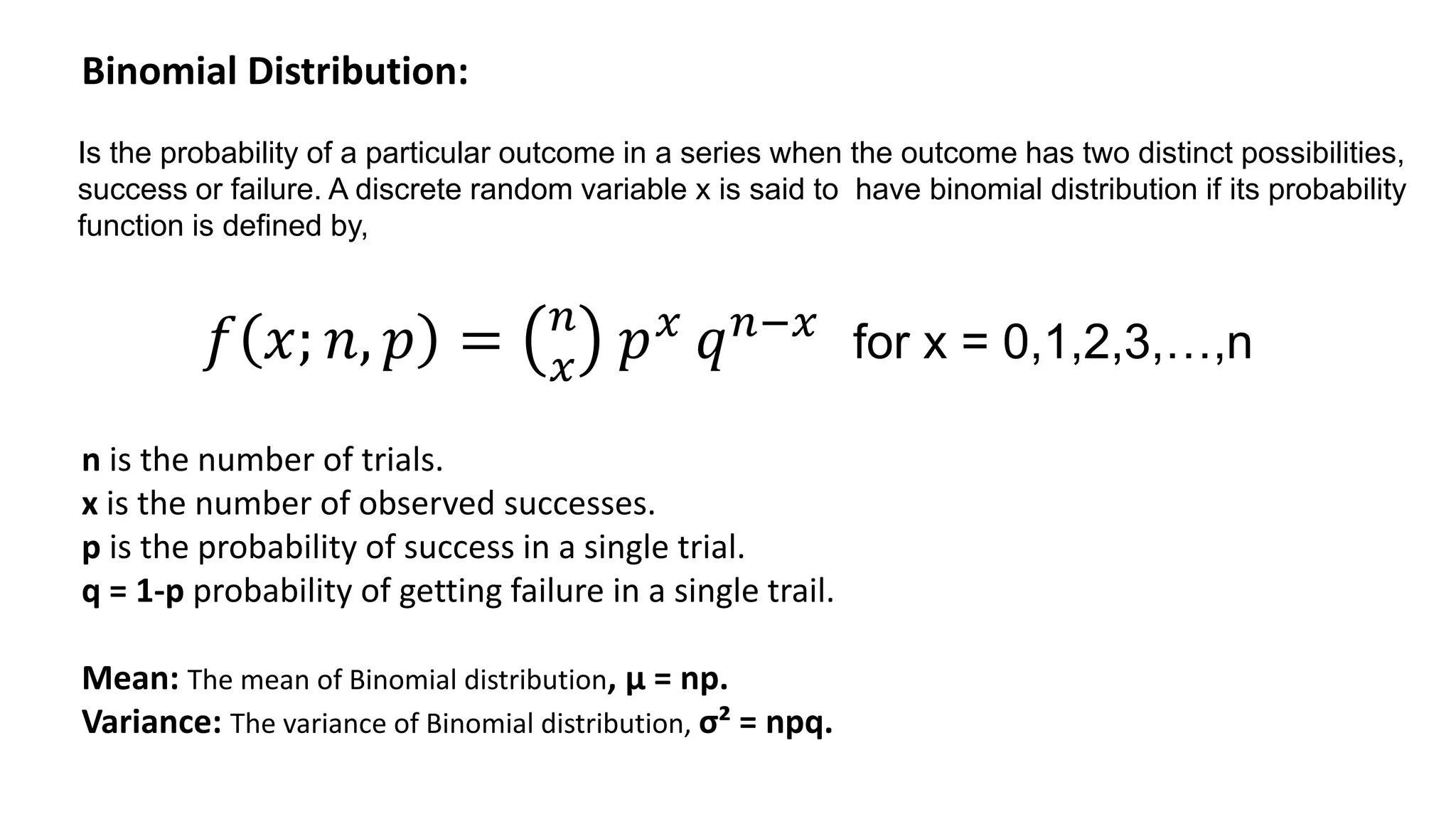
Is the probability of a particular outcome in a series when the outcome has two distinct possibilities,
success or failure. A discrete random variable x is said to have binomial distribution if its probability
function is defined by,
n is the number of trials.
x is the number of observed successes.
p is the probability of success in a single trial.
q = 1-p probability of getting failure in a single trail.
Mean: The mean of Binomial distribution, µ = np.
Variance: The variance of Binomial distribution, σ² = npq.
𝑓 𝑥; 𝑛, 𝑝 = 𝑛
𝑥
𝑝 𝑥
𝑞 𝑛−𝑥
for x = 0,1,2,3,…,n
Problem:
In a large restaurant an average of 3 out of every 5 customer ask for water with their meal.
A random sample of 10 customers is selected.
Find the probability that,
1. Exactly 6 people ask for water with their meal?
2. At least 2 people ask for water with their meal?
Solution-1
Here P = 3/5 = 0.6 and q = 2/5 = 0.4 and x = 6 , n = 10 so using binomial
formula,
P[x = 6] =
𝟏𝟎
𝟔
(𝟎. 𝟔) 𝟔(𝟎. 𝟒) 𝟏𝟎−𝟔
=
𝟏𝟎!
𝟔!𝟒!
∗
𝟕𝟐𝟗
𝟏𝟓𝟔𝟐𝟓
∗
𝟏𝟔
𝟔𝟐𝟓
= 0.2508
Solution-2
Here P = 3/5 = 0.6 and q = 2/5 = 0.4 and x = 2, n = 10 so using binomial formula,
P[x ≥ 2] = p[x = 2] + p[x = 3]
=
𝟏𝟎
𝟐
(𝟎. 𝟔) 𝟐(𝟎. 𝟒) 𝟏𝟎−𝟐 +
𝟏𝟎
𝟑
(𝟎. 𝟔) 𝟑(𝟎. 𝟒) 𝟏𝟎−𝟑
=
𝟏𝟎!
𝟐!𝟖!
∗
𝟗
𝟐𝟓
∗
𝟐𝟓𝟔
𝟑𝟗𝟎𝟔𝟐𝟓
+
𝟏𝟎!
𝟑!𝟕!
∗
𝟐𝟕
𝟏𝟐𝟓
∗
𝟏𝟐𝟖
𝟕𝟖𝟏𝟐𝟓
= 0.0106 + 0.0424
= 0.053
Mean: µ = np = 10*0.6 = 6
Variance: σ² = npq = 10*0.6*0.4 = 2.4
Thank You
What is Bernoulli Distribution?
• A Bernoulli distribution is the probability distribution for a series of
Bernoulli trials where there are only two possible outcomes . In this
case, only two values are possible (n = 0 for failure or n = 1 for
success). That makes the Bernoulli distribution the simplest kind of
probability distribution that exists.
• Consider that only two outcomes: “success” or “failure”
• Let P denote the probability of success
• Let 1 – P be the probability of failure
• Define random variable X:
• x = 1 if success, x = 0 if failure
• Then the Bernoulli probability function is P(1)=P and P(0)=(1-P)
Bernoulli Example
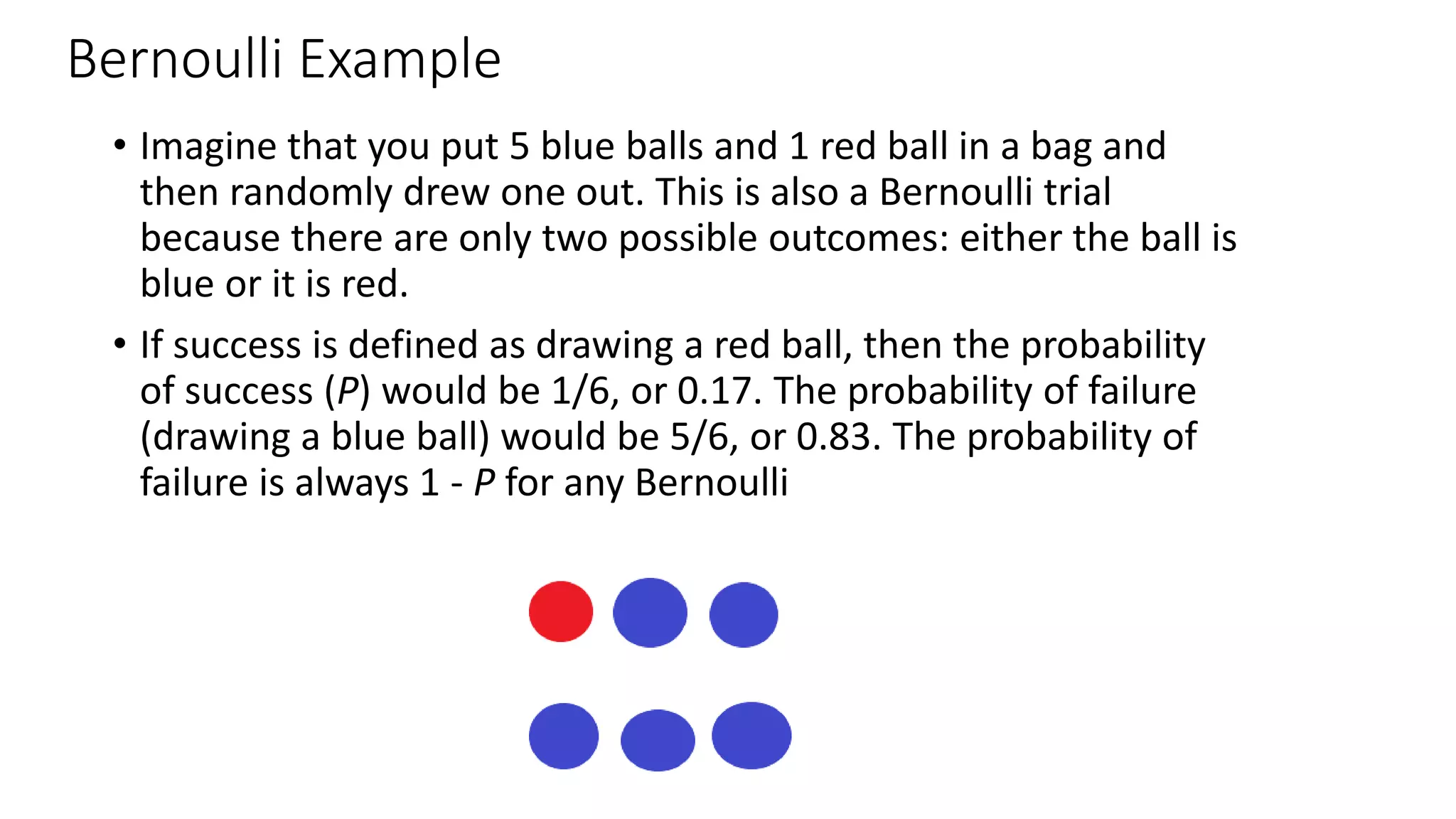
• Imagine that you put 5 blue balls and 1 red ball in a bag and
then randomly drew one out. This is also a Bernoulli trial
because there are only two possible outcomes: either the ball is
blue or it is red.
• If success is defined as drawing a red ball, then the probability
of success (P) would be 1/6, or 0.17. The probability of failure
(drawing a blue ball) would be 5/6, or 0.83. The probability of
failure is always 1 - P for any Bernoulli
Bernoulli Example
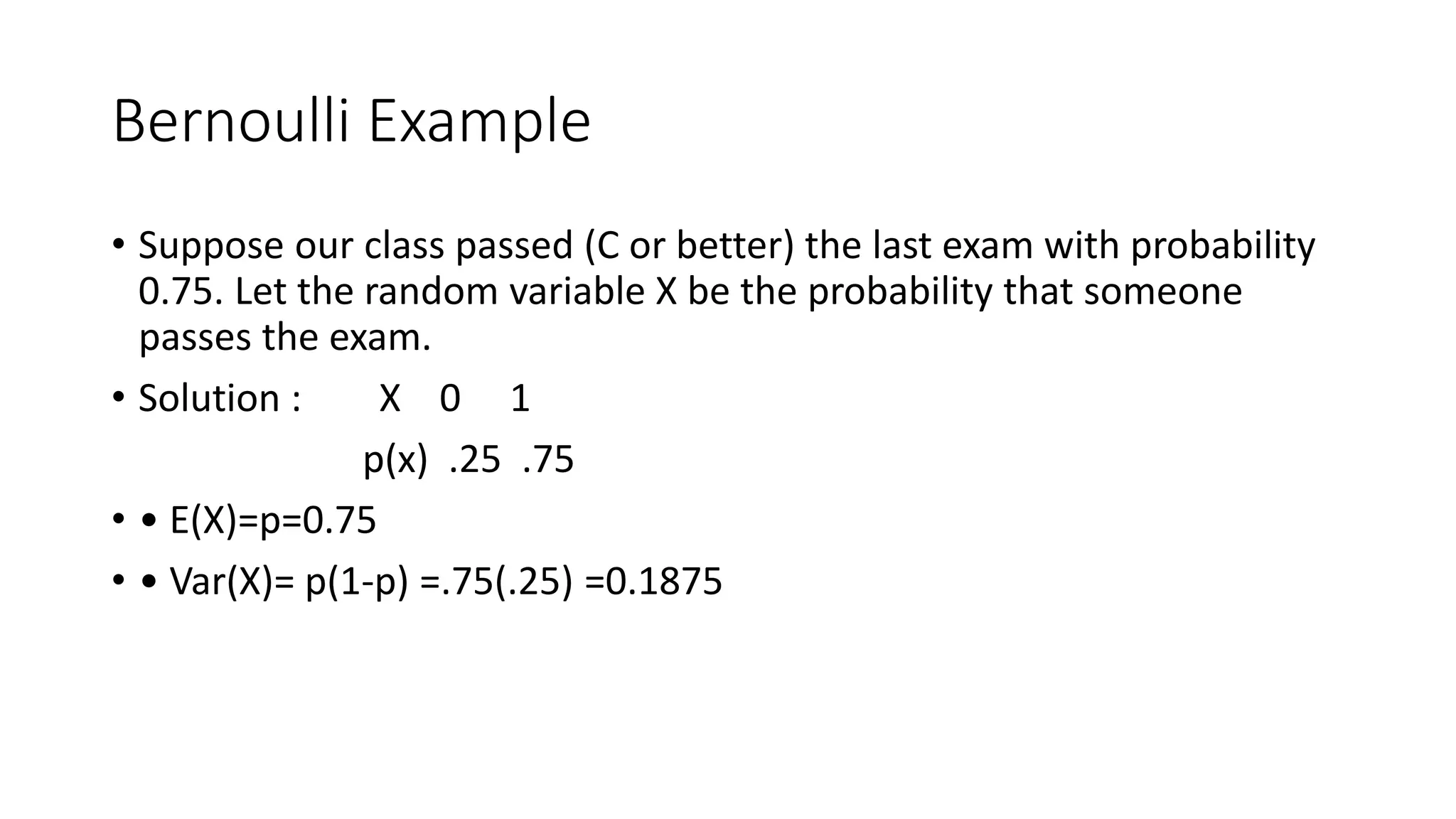
• Suppose our class passed (C or better) the last exam with probability
0.75. Let the random variable X be the probability that someone
passes the exam.
• Solution : X 0 1
p(x) .25 .75
• • E(X)=p=0.75
• • Var(X)= p(1-p) =.75(.25) =0.1875
Thank You
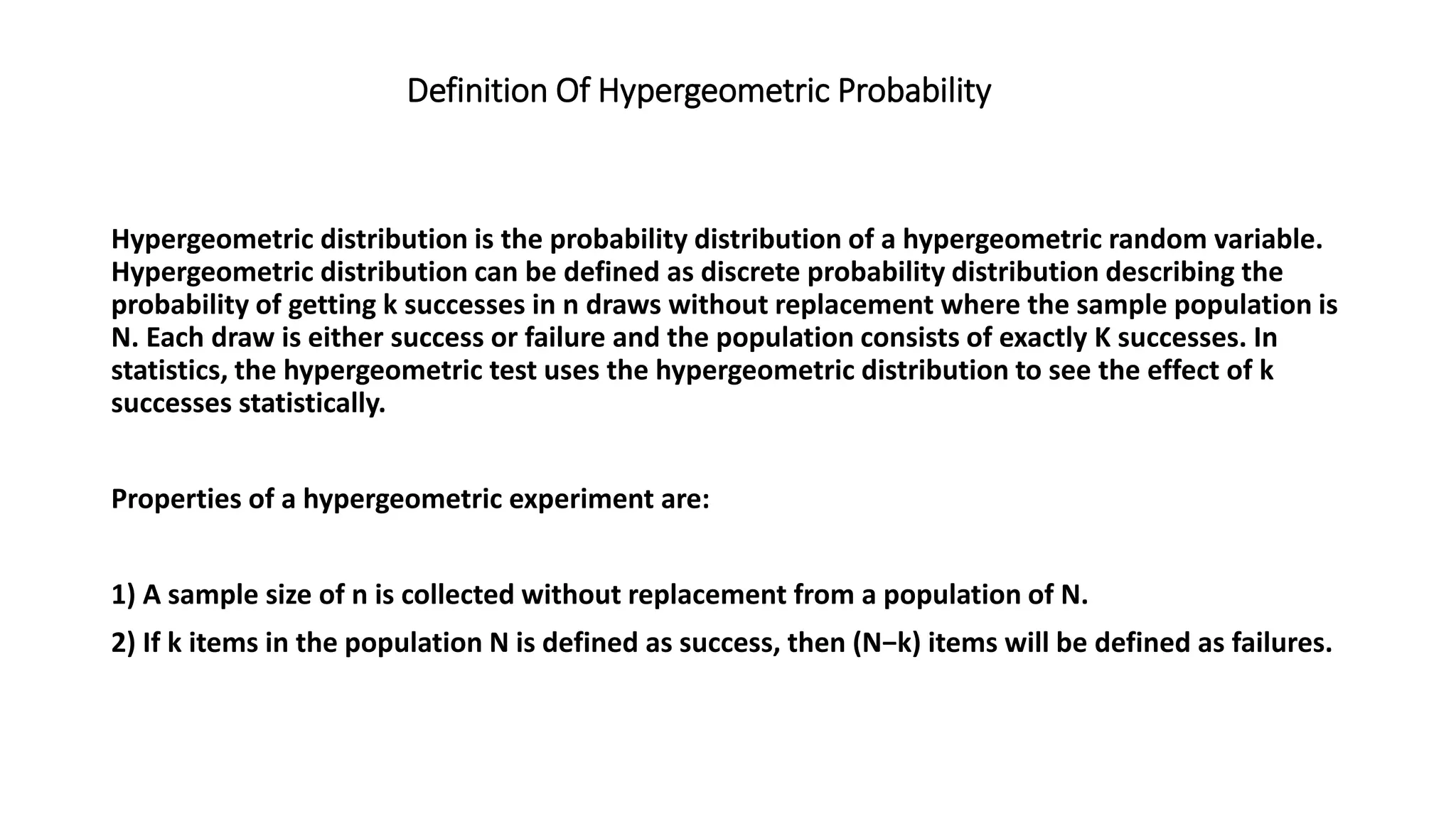
Definition Of Hypergeometric Probability
Hypergeometric distribution is the probability distribution of a hypergeometric random variable.
Hypergeometric distribution can be defined as discrete probability distribution describing the
probability of getting k successes in n draws without replacement where the sample population is
N. Each draw is either success or failure and the population consists of exactly K successes. In
statistics, the hypergeometric test uses the hypergeometric distribution to see the effect of k
successes statistically.
Properties of a hypergeometric experiment are:
1) A sample size of n is collected without replacement from a population of N.
2) If k items in the population N is defined as success, then (N−k) items will be defined as failures.
Hypergeometric Distribution Formula
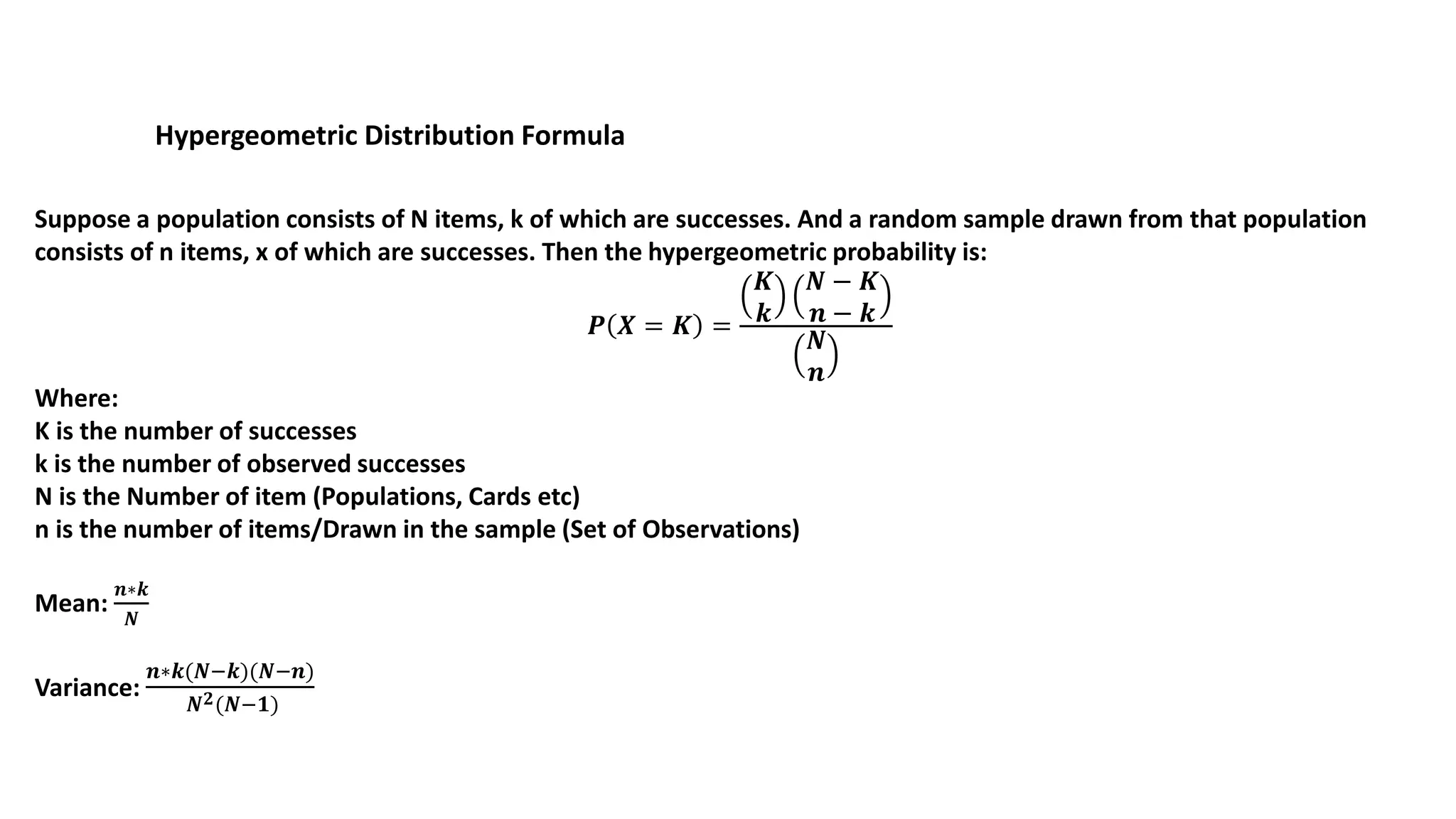
Suppose a population consists of N items, k of which are successes. And a random sample drawn from that population
consists of n items, x of which are successes. Then the hypergeometric probability is:
𝑷 𝑿 = 𝑲 =
𝑲
𝒌
𝑵 − 𝑲
𝒏 − 𝒌
𝑵
𝒏
Where:
K is the number of successes
k is the number of observed successes
N is the Number of item (Populations, Cards etc)
n is the number of items/Drawn in the sample (Set of Observations)
Mean:
𝒏∗𝒌
𝑵
Variance:
𝒏∗𝒌(𝑵−𝒌)(𝑵−𝒏)
𝑵 𝟐(𝑵−𝟏)
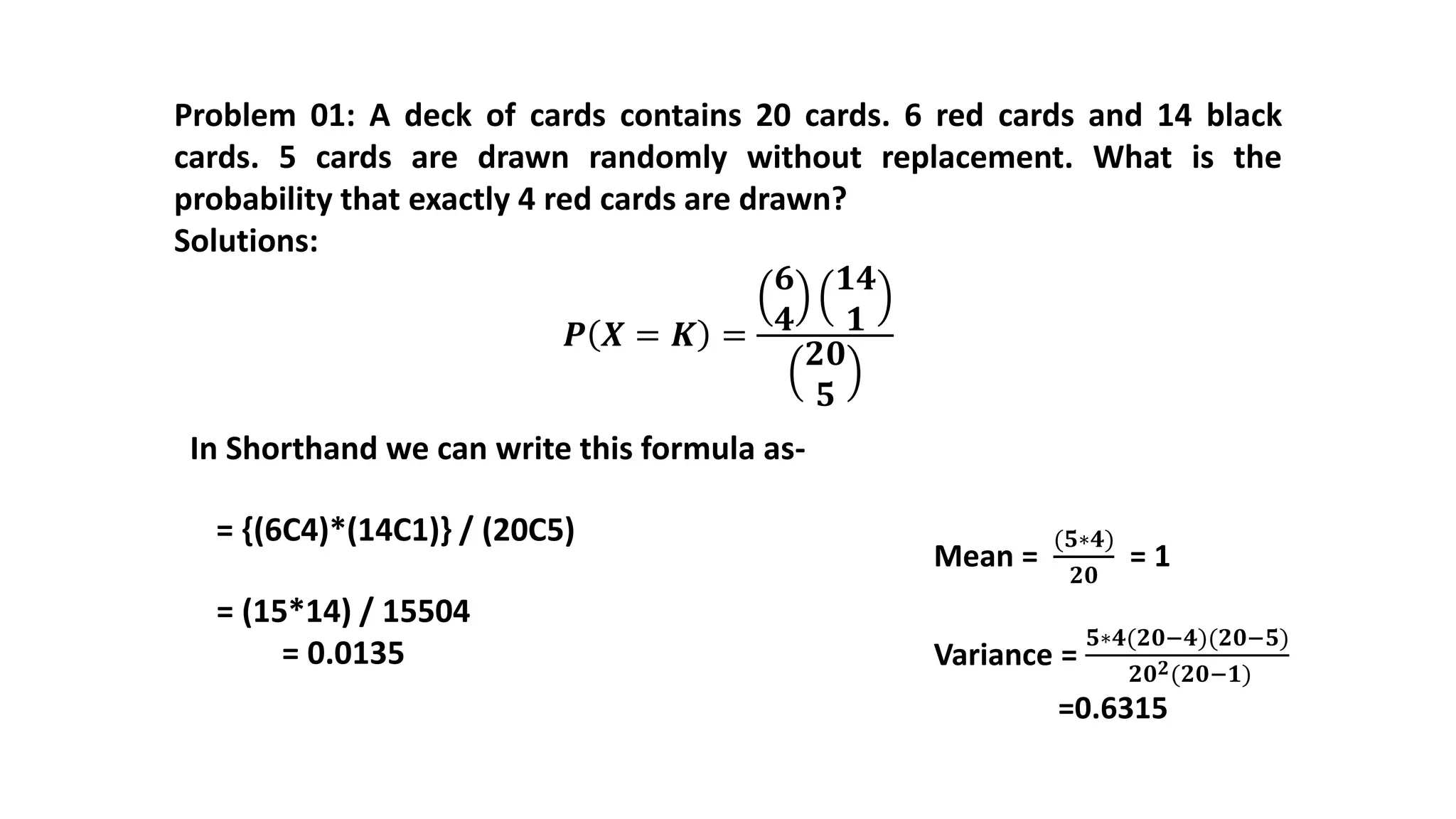
Problem 01: A deck of cards contains 20 cards. 6 red cards and 14 black
cards. 5 cards are drawn randomly without replacement. What is the
probability that exactly 4 red cards are drawn?
Solutions:
𝑷 𝑿 = 𝑲 =
𝟔
𝟒
𝟏𝟒
𝟏
𝟐𝟎
𝟓
= (15*14) / 15504
= 0.0135
= {(6C4)*(14C1)} / (20C5)
In Shorthand we can write this formula as-
Mean =
(𝟓∗𝟒)
𝟐𝟎
= 1
Variance =
𝟓∗𝟒(𝟐𝟎−𝟒)(𝟐𝟎−𝟓)
𝟐𝟎 𝟐(𝟐𝟎−𝟏)
=0.6315
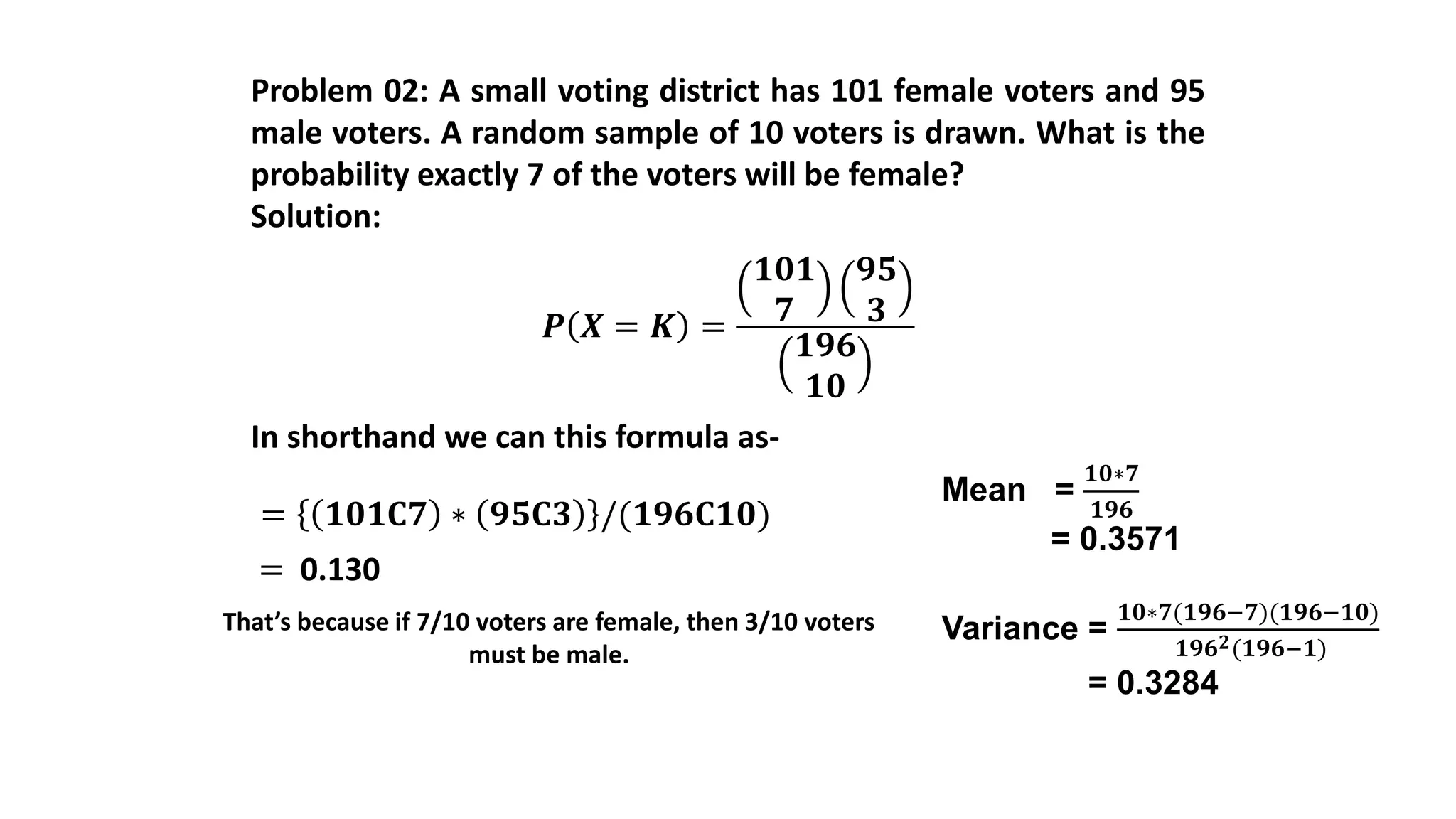
Problem 02: A small voting district has 101 female voters and 95
male voters. A random sample of 10 voters is drawn. What is the
probability exactly 7 of the voters will be female?
Solution:
𝑷 𝑿 = 𝑲 =
𝟏𝟎𝟏
𝟕
𝟗𝟓
𝟑
𝟏𝟗𝟔
𝟏𝟎
In shorthand we can this formula as-
= 𝟏𝟎𝟏𝐂𝟕 ∗ 𝟗𝟓𝐂𝟑 /(𝟏𝟗𝟔𝐂𝟏𝟎)
= 0.130
That’s because if 7/10 voters are female, then 3/10 voters
must be male.
Mean =
𝟏𝟎∗𝟕
𝟏𝟗𝟔
= 0.3571
Variance =
𝟏𝟎∗𝟕(𝟏𝟗𝟔−𝟕)(𝟏𝟗𝟔−𝟏𝟎)
𝟏𝟗𝟔 𝟐(𝟏𝟗𝟔−𝟏)
= 0.3284
Thank You
Hello!
15
The Poisson distribution
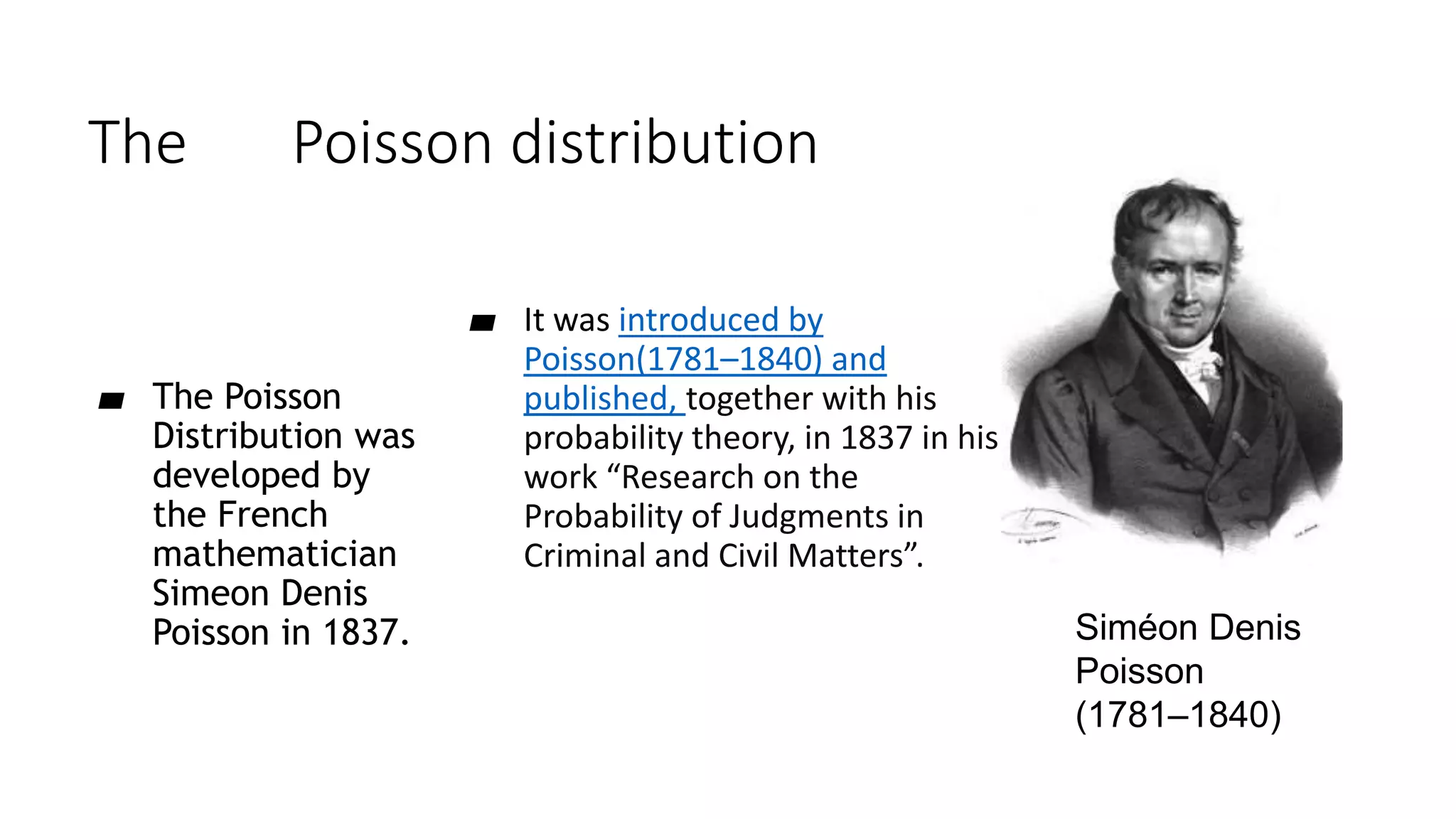
▰ It was introduced by
Poisson(1781–1840) and
published, together with his
probability theory, in 1837 in his
work “Research on the
Probability of Judgments in
Criminal and Civil Matters”.
▰ The Poisson
Distribution was
developed by
the French
mathematician
Simeon Denis
Poisson in 1837. Siméon Denis
Poisson
(1781–1840)
What is Poisson distribution?
▰ • The Poisson distribution is a discrete probability distribution for
the counts of events that occur randomly in a given interval of
time (or space).
▰ Examples:
• The number of causes of a diseases in different towns
• The number of mutations in set sized regions of a
chromosome
Equation
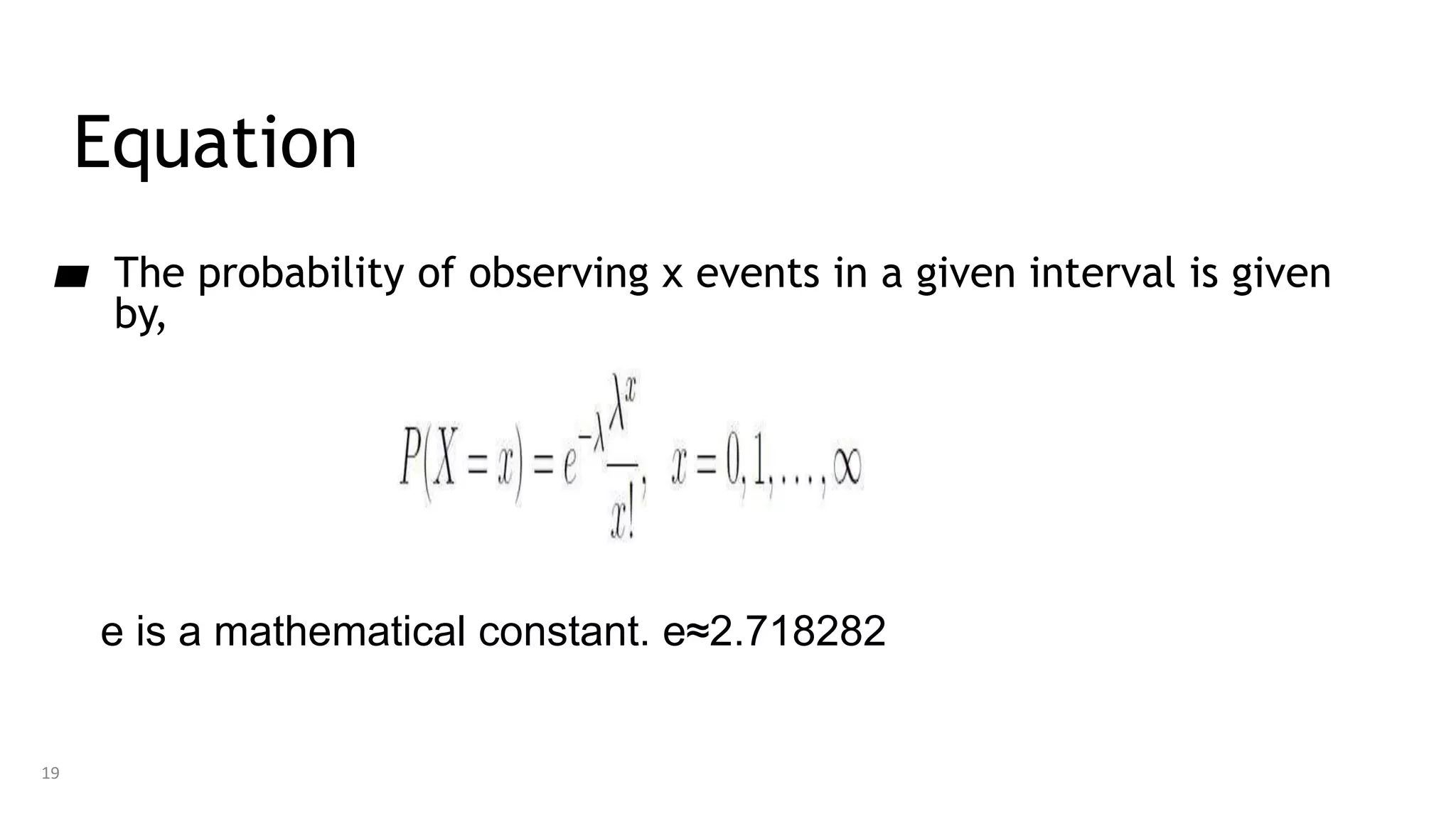
▰ The probability of observing x events in a given interval is given
by,
e is a mathematical constant. e≈2.718282
19
Examples:
▰ 1. Births in a hospital occur randomly at an average rate of 1.8 births per
hour. What is the probability of observing 4 births in a given hour at the
hospital?
▰ 2. If the random variable X follows a Poisson distribution with mean 3.4 find
P(X=6)?
▰ 3. Number of telephone calls in a week.
▰ 4. Number of people arriving at a checkout in a day.
▰ 5. Number of industrial accidents per month in a manufacturing plant.
20
Problem number 1:-
Consider, in an office 2 customers arrived today. Calculate the possibilities
for exactly 3 customers to be arrived on tomorrow.
▰ Solution:-
Find f(x).
P(X=x) = e-λ λ x / x!
P(X=3) = (0.135)(8) / 3! = 0.18.
Hence there are 18% possibilities for 3 customers to be arrived on
tomorrow
21
Problem number 2:-
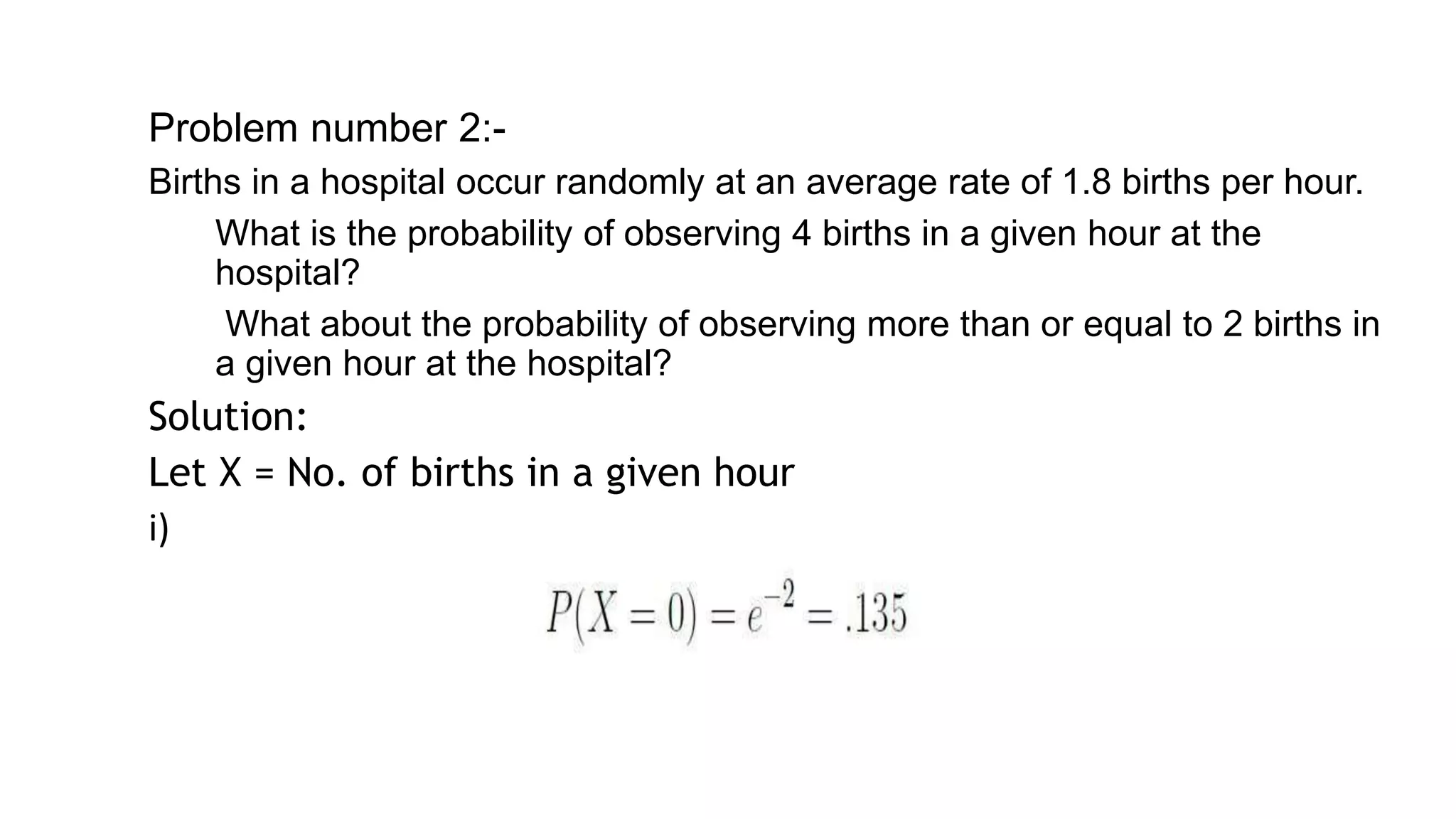
Births in a hospital occur randomly at an average rate of 1.8 births per hour.
▰ What is the probability of observing 4 births in a given hour at the
hospital?
▰ What about the probability of observing more than or equal to 2 births in
a given hour at the hospital?
Solution:
Let X = No. of births in a given hour
i)
22
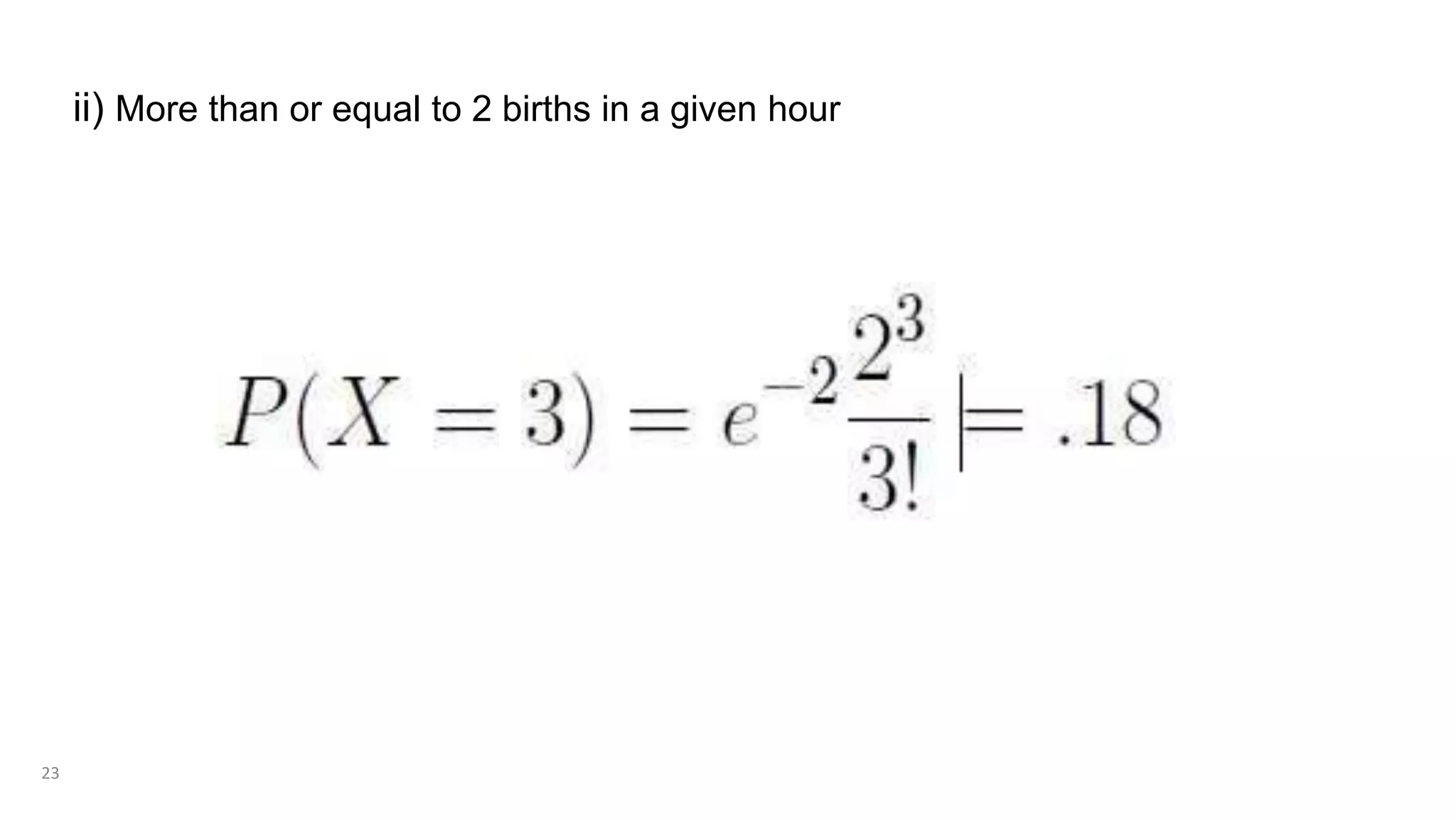
ii) More than or equal to 2 births in a given hour
23
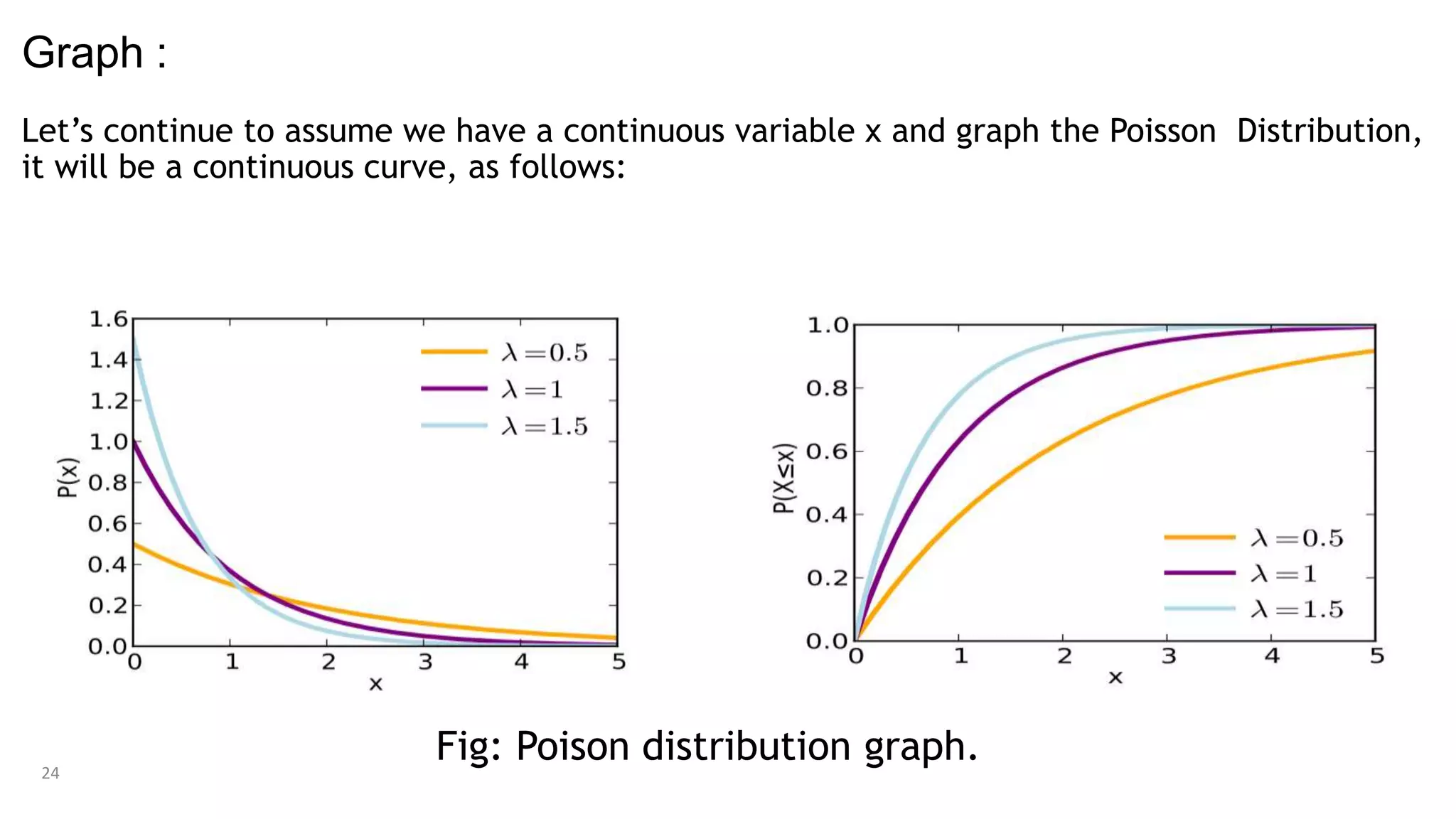
Graph :
Let’s continue to assume we have a continuous variable x and graph the Poisson Distribution,
it will be a continuous curve, as follows:
24
Fig: Poison distribution graph.
Applications of Poisson distribution
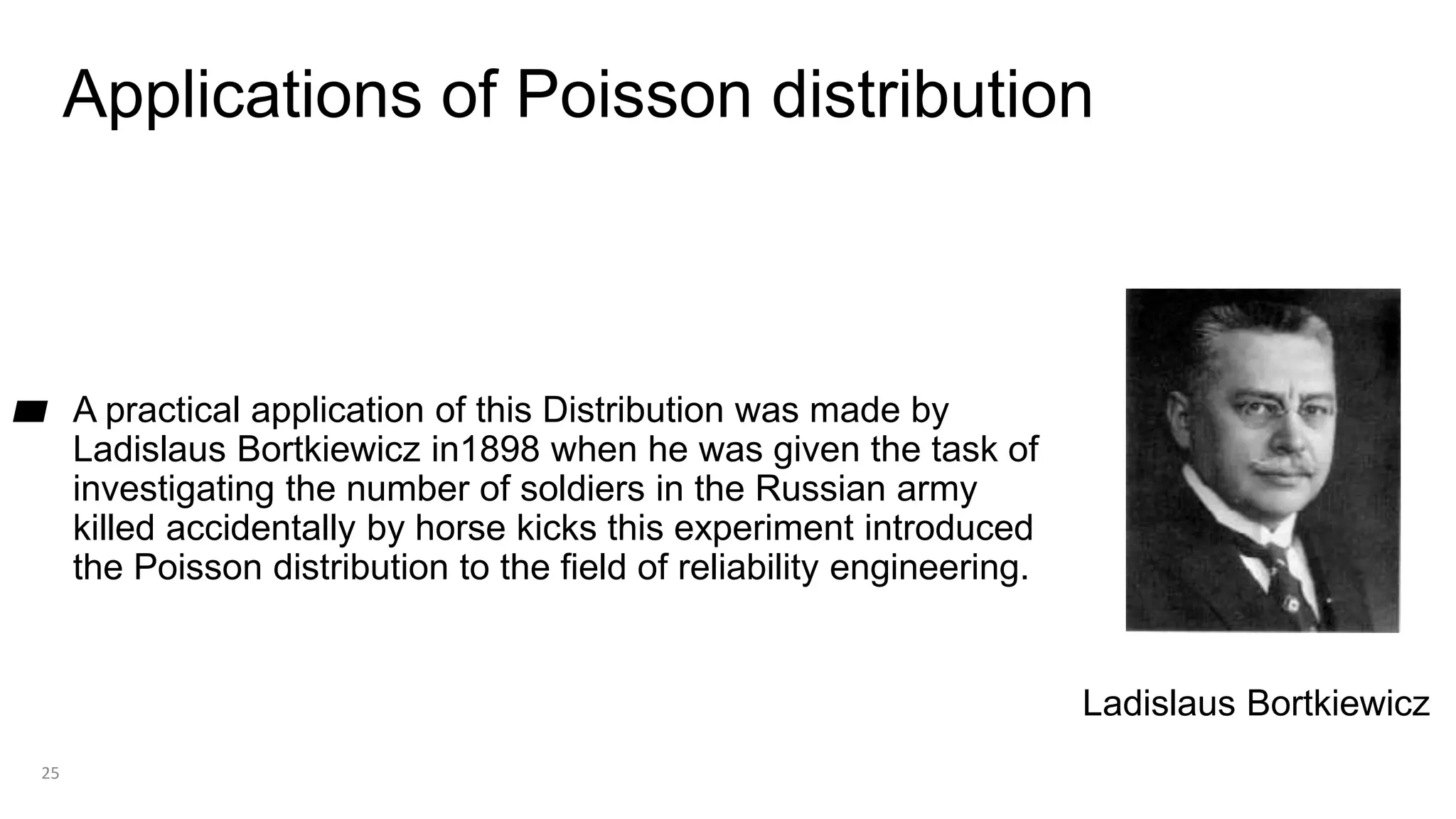
▰ A practical application of this Distribution was made by
Ladislaus Bortkiewicz in1898 when he was given the task of
investigating the number of soldiers in the Russian army
killed accidentally by horse kicks this experiment introduced
the Poisson distribution to the field of reliability engineering.
25
Ladislaus Bortkiewicz
▰ The number of deaths by horse kicking in the Rrussian army
▰ Birth defects and genetic mutations
▰ Rare diseases
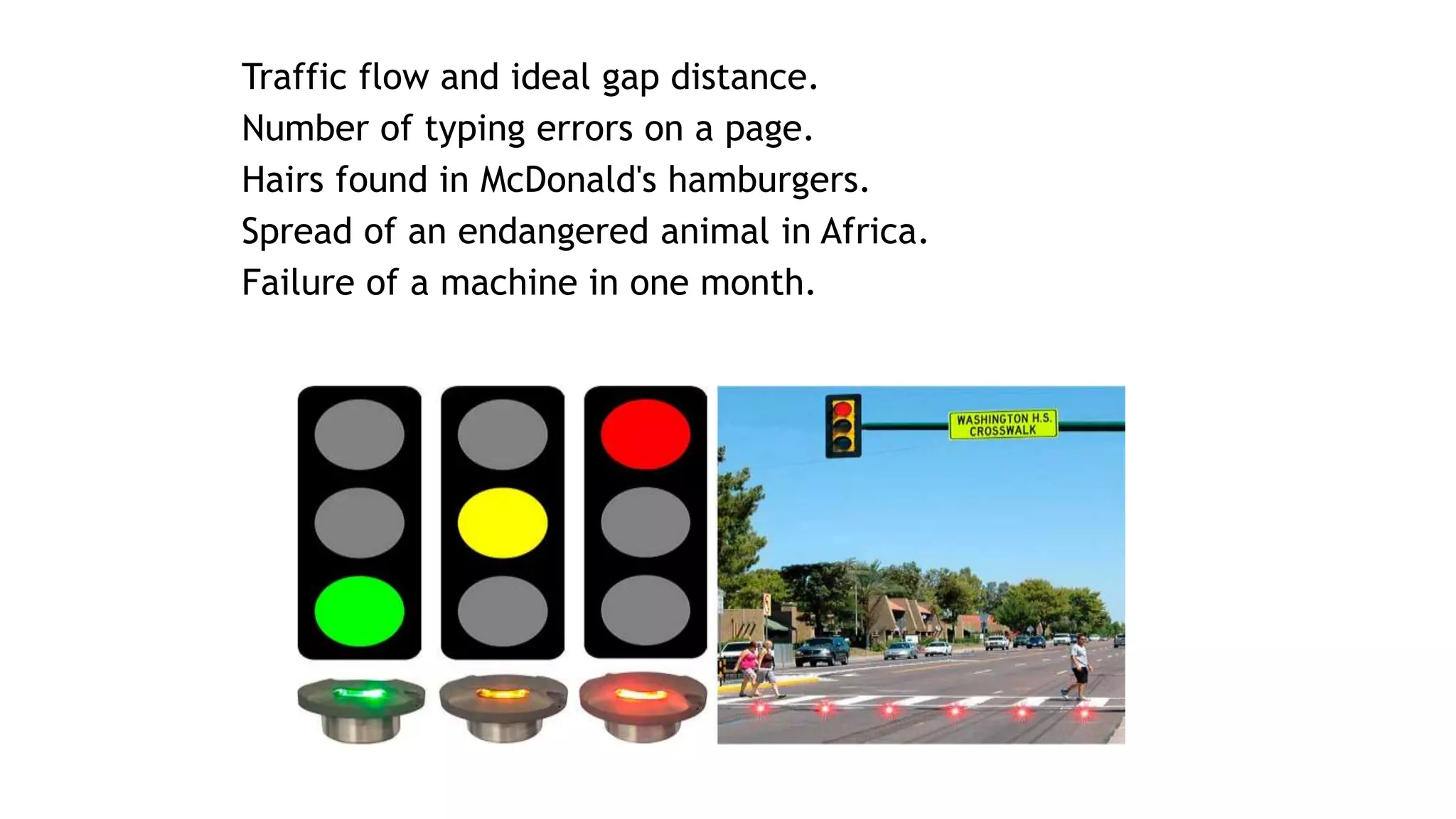
▰ Traffic flow and ideal gap distance.
▰ Number of typing errors on a page.
▰ Hairs found in McDonald's hamburgers.
▰ Spread of an endangered animal in Africa.
▰ Failure of a machine in one month.
27
Thanks!
28
Any
Question..?

Probability distribution

  • 1.
    Probability Distribution- Presented by Name Md.Abdullah Al Abid Md. Mazharul Islam Md. Nafiur Rahman Tuhin Md. Saniul Islam
  • 2.
    Binomial Distribution: Is theprobability of a particular outcome in a series when the outcome has two distinct possibilities, success or failure. A discrete random variable x is said to have binomial distribution if its probability function is defined by, n is the number of trials. x is the number of observed successes. p is the probability of success in a single trial. q = 1-p probability of getting failure in a single trail. Mean: The mean of Binomial distribution, µ = np. Variance: The variance of Binomial distribution, σ² = npq. 𝑓 𝑥; 𝑛, 𝑝 = 𝑛 𝑥 𝑝 𝑥 𝑞 𝑛−𝑥 for x = 0,1,2,3,…,n
  • 3.
    Problem: In a largerestaurant an average of 3 out of every 5 customer ask for water with their meal. A random sample of 10 customers is selected. Find the probability that, 1. Exactly 6 people ask for water with their meal? 2. At least 2 people ask for water with their meal? Solution-1 Here P = 3/5 = 0.6 and q = 2/5 = 0.4 and x = 6 , n = 10 so using binomial formula, P[x = 6] = 𝟏𝟎 𝟔 (𝟎. 𝟔) 𝟔(𝟎. 𝟒) 𝟏𝟎−𝟔 = 𝟏𝟎! 𝟔!𝟒! ∗ 𝟕𝟐𝟗 𝟏𝟓𝟔𝟐𝟓 ∗ 𝟏𝟔 𝟔𝟐𝟓 = 0.2508
  • 4.
    Solution-2 Here P =3/5 = 0.6 and q = 2/5 = 0.4 and x = 2, n = 10 so using binomial formula, P[x ≥ 2] = p[x = 2] + p[x = 3] = 𝟏𝟎 𝟐 (𝟎. 𝟔) 𝟐(𝟎. 𝟒) 𝟏𝟎−𝟐 + 𝟏𝟎 𝟑 (𝟎. 𝟔) 𝟑(𝟎. 𝟒) 𝟏𝟎−𝟑 = 𝟏𝟎! 𝟐!𝟖! ∗ 𝟗 𝟐𝟓 ∗ 𝟐𝟓𝟔 𝟑𝟗𝟎𝟔𝟐𝟓 + 𝟏𝟎! 𝟑!𝟕! ∗ 𝟐𝟕 𝟏𝟐𝟓 ∗ 𝟏𝟐𝟖 𝟕𝟖𝟏𝟐𝟓 = 0.0106 + 0.0424 = 0.053 Mean: µ = np = 10*0.6 = 6 Variance: σ² = npq = 10*0.6*0.4 = 2.4
  • 5.
  • 6.
    What is BernoulliDistribution? • A Bernoulli distribution is the probability distribution for a series of Bernoulli trials where there are only two possible outcomes . In this case, only two values are possible (n = 0 for failure or n = 1 for success). That makes the Bernoulli distribution the simplest kind of probability distribution that exists. • Consider that only two outcomes: “success” or “failure” • Let P denote the probability of success • Let 1 – P be the probability of failure • Define random variable X: • x = 1 if success, x = 0 if failure • Then the Bernoulli probability function is P(1)=P and P(0)=(1-P)
  • 7.
    Bernoulli Example • Imaginethat you put 5 blue balls and 1 red ball in a bag and then randomly drew one out. This is also a Bernoulli trial because there are only two possible outcomes: either the ball is blue or it is red. • If success is defined as drawing a red ball, then the probability of success (P) would be 1/6, or 0.17. The probability of failure (drawing a blue ball) would be 5/6, or 0.83. The probability of failure is always 1 - P for any Bernoulli
  • 8.
    Bernoulli Example • Supposeour class passed (C or better) the last exam with probability 0.75. Let the random variable X be the probability that someone passes the exam. • Solution : X 0 1 p(x) .25 .75 • • E(X)=p=0.75 • • Var(X)= p(1-p) =.75(.25) =0.1875
  • 9.
  • 10.
    Definition Of HypergeometricProbability Hypergeometric distribution is the probability distribution of a hypergeometric random variable. Hypergeometric distribution can be defined as discrete probability distribution describing the probability of getting k successes in n draws without replacement where the sample population is N. Each draw is either success or failure and the population consists of exactly K successes. In statistics, the hypergeometric test uses the hypergeometric distribution to see the effect of k successes statistically. Properties of a hypergeometric experiment are: 1) A sample size of n is collected without replacement from a population of N. 2) If k items in the population N is defined as success, then (N−k) items will be defined as failures.
  • 11.
    Hypergeometric Distribution Formula Supposea population consists of N items, k of which are successes. And a random sample drawn from that population consists of n items, x of which are successes. Then the hypergeometric probability is: 𝑷 𝑿 = 𝑲 = 𝑲 𝒌 𝑵 − 𝑲 𝒏 − 𝒌 𝑵 𝒏 Where: K is the number of successes k is the number of observed successes N is the Number of item (Populations, Cards etc) n is the number of items/Drawn in the sample (Set of Observations) Mean: 𝒏∗𝒌 𝑵 Variance: 𝒏∗𝒌(𝑵−𝒌)(𝑵−𝒏) 𝑵 𝟐(𝑵−𝟏)
  • 12.
    Problem 01: Adeck of cards contains 20 cards. 6 red cards and 14 black cards. 5 cards are drawn randomly without replacement. What is the probability that exactly 4 red cards are drawn? Solutions: 𝑷 𝑿 = 𝑲 = 𝟔 𝟒 𝟏𝟒 𝟏 𝟐𝟎 𝟓 = (15*14) / 15504 = 0.0135 = {(6C4)*(14C1)} / (20C5) In Shorthand we can write this formula as- Mean = (𝟓∗𝟒) 𝟐𝟎 = 1 Variance = 𝟓∗𝟒(𝟐𝟎−𝟒)(𝟐𝟎−𝟓) 𝟐𝟎 𝟐(𝟐𝟎−𝟏) =0.6315
  • 13.
    Problem 02: Asmall voting district has 101 female voters and 95 male voters. A random sample of 10 voters is drawn. What is the probability exactly 7 of the voters will be female? Solution: 𝑷 𝑿 = 𝑲 = 𝟏𝟎𝟏 𝟕 𝟗𝟓 𝟑 𝟏𝟗𝟔 𝟏𝟎 In shorthand we can this formula as- = 𝟏𝟎𝟏𝐂𝟕 ∗ 𝟗𝟓𝐂𝟑 /(𝟏𝟗𝟔𝐂𝟏𝟎) = 0.130 That’s because if 7/10 voters are female, then 3/10 voters must be male. Mean = 𝟏𝟎∗𝟕 𝟏𝟗𝟔 = 0.3571 Variance = 𝟏𝟎∗𝟕(𝟏𝟗𝟔−𝟕)(𝟏𝟗𝟔−𝟏𝟎) 𝟏𝟗𝟔 𝟐(𝟏𝟗𝟔−𝟏) = 0.3284
  • 14.
  • 15.
  • 16.
  • 17.
    The Poisson distribution ▰It was introduced by Poisson(1781–1840) and published, together with his probability theory, in 1837 in his work “Research on the Probability of Judgments in Criminal and Civil Matters”. ▰ The Poisson Distribution was developed by the French mathematician Simeon Denis Poisson in 1837. Siméon Denis Poisson (1781–1840)
  • 18.
    What is Poissondistribution? ▰ • The Poisson distribution is a discrete probability distribution for the counts of events that occur randomly in a given interval of time (or space). ▰ Examples: • The number of causes of a diseases in different towns • The number of mutations in set sized regions of a chromosome
  • 19.
    Equation ▰ The probabilityof observing x events in a given interval is given by, e is a mathematical constant. e≈2.718282 19
  • 20.
    Examples: ▰ 1. Birthsin a hospital occur randomly at an average rate of 1.8 births per hour. What is the probability of observing 4 births in a given hour at the hospital? ▰ 2. If the random variable X follows a Poisson distribution with mean 3.4 find P(X=6)? ▰ 3. Number of telephone calls in a week. ▰ 4. Number of people arriving at a checkout in a day. ▰ 5. Number of industrial accidents per month in a manufacturing plant. 20
  • 21.
    Problem number 1:- Consider,in an office 2 customers arrived today. Calculate the possibilities for exactly 3 customers to be arrived on tomorrow. ▰ Solution:- Find f(x). P(X=x) = e-λ λ x / x! P(X=3) = (0.135)(8) / 3! = 0.18. Hence there are 18% possibilities for 3 customers to be arrived on tomorrow 21
  • 22.
    Problem number 2:- Birthsin a hospital occur randomly at an average rate of 1.8 births per hour. ▰ What is the probability of observing 4 births in a given hour at the hospital? ▰ What about the probability of observing more than or equal to 2 births in a given hour at the hospital? Solution: Let X = No. of births in a given hour i) 22
  • 23.
    ii) More thanor equal to 2 births in a given hour 23
  • 24.
    Graph : Let’s continueto assume we have a continuous variable x and graph the Poisson Distribution, it will be a continuous curve, as follows: 24 Fig: Poison distribution graph.
  • 25.
    Applications of Poissondistribution ▰ A practical application of this Distribution was made by Ladislaus Bortkiewicz in1898 when he was given the task of investigating the number of soldiers in the Russian army killed accidentally by horse kicks this experiment introduced the Poisson distribution to the field of reliability engineering. 25 Ladislaus Bortkiewicz
  • 26.
    ▰ The numberof deaths by horse kicking in the Rrussian army ▰ Birth defects and genetic mutations ▰ Rare diseases
  • 27.
    ▰ Traffic flowand ideal gap distance. ▰ Number of typing errors on a page. ▰ Hairs found in McDonald's hamburgers. ▰ Spread of an endangered animal in Africa. ▰ Failure of a machine in one month. 27
  • 28.