+ 
Conditional Probability, 
and Probability Trees, 
Slides edited by Valerio Di Fonzo for www.globalpolis.org 
Based on the work of Mine Çetinkaya-Rundel of OpenIntro 
The slides may be copied, edited, and/or shared via the CC BY-SA license 
Some images may be included under fair use guidelines (educational purposes)
Relapse 
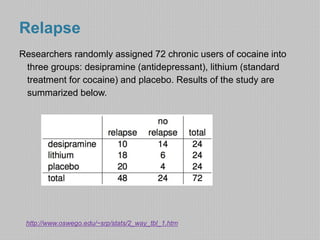
Researchers randomly assigned 72 chronic users of cocaine into 
three groups: desipramine (antidepressant), lithium (standard 
treatment for cocaine) and placebo. Results of the study are 
summarized below. 
http://www.oswego.edu/~srp/stats/2_way_tbl_1.htm
Marginal probability 
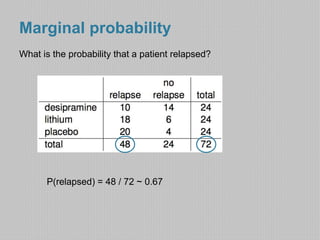
What is the probability that a patient relapsed? 
P(relapsed) = 48 / 72 ~ 0.67
Joint probability 
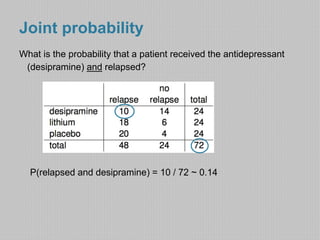
What is the probability that a patient received the antidepressant 
(desipramine) and relapsed? 
P(relapsed and desipramine) = 10 / 72 ~ 0.14
Conditional probability 
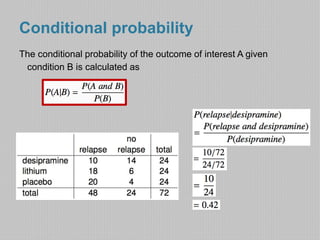
The conditional probability of the outcome of interest A given 
condition B is calculated as
Conditional probability (cont.) 
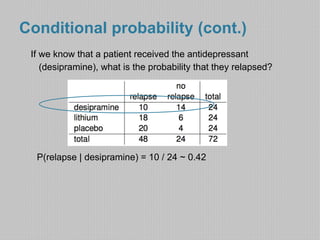
If we know that a patient received the antidepressant 
(desipramine), what is the probability that they relapsed? 
P(relapse | desipramine) = 10 / 24 ~ 0.42
Conditional probability (cont.) 
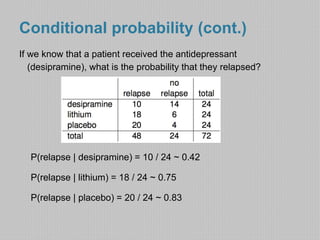
If we know that a patient received the antidepressant 
(desipramine), what is the probability that they relapsed? 
P(relapse | desipramine) = 10 / 24 ~ 0.42 
P(relapse | lithium) = 18 / 24 ~ 0.75 
P(relapse | placebo) = 20 / 24 ~ 0.83
Conditional probability (cont.) 
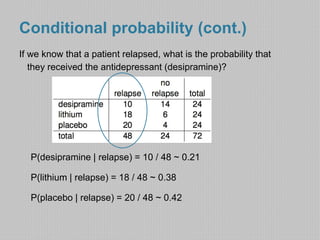
If we know that a patient relapsed, what is the probability that 
they received the antidepressant (desipramine)? 
P(desipramine | relapse) = 10 / 48 ~ 0.21 
P(lithium | relapse) = 18 / 48 ~ 0.38 
P(placebo | relapse) = 20 / 48 ~ 0.42
General multiplication rule 
● Earlier we saw that if two events are independent, their joint 
probability is simply the product of their probabilities. If the 
events are not believed to be independent, the joint 
probability is calculated slightly differently. 
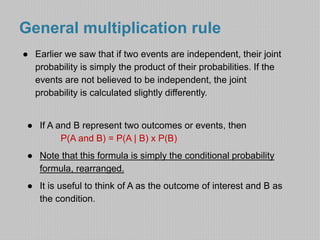
● If A and B represent two outcomes or events, then 
P(A and B) = P(A | B) x P(B) 
● Note that this formula is simply the conditional probability 
formula, rearranged. 
● It is useful to think of A as the outcome of interest and B as 
the condition.
Independence and 
conditional probabilities 
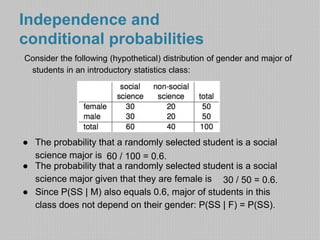
Consider the following (hypothetical) distribution of gender and major of 
students in an introductory statistics class: 
● The probability that a randomly selected student is a social 
science major is 
60 / 100 = 0.6. 
● The probability that a randomly selected student is a social 
science major given that they are female is 
30 / 50 = 0.6. 
● Since P(SS | M) also equals 0.6, major of students in this 
class does not depend on their gender: P(SS | F) = P(SS).
Independence and 
conditional probabilities (cont.) 
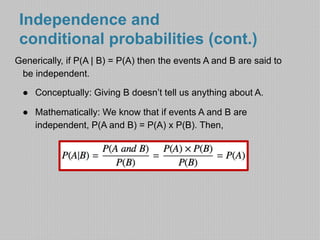
Generically, if P(A | B) = P(A) then the events A and B are said to 
be independent. 
● Conceptually: Giving B doesn’t tell us anything about A. 
● Mathematically: We know that if events A and B are 
independent, P(A and B) = P(A) x P(B). Then,
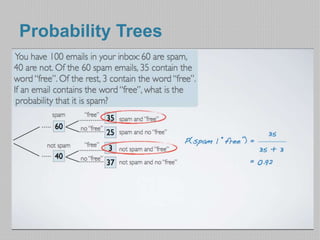
Probability Trees
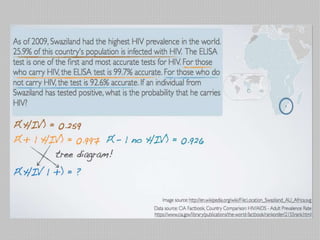
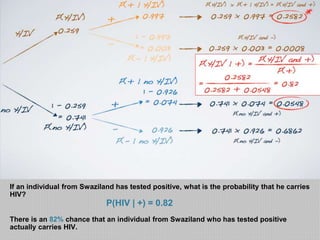
If an individual from Swaziland has tested positive, what is the probability that he carries 
HIV? 
P(HIV | +) = 0.82 
There is an 82% chance that an individual from Swaziland who has tested positive 
actually carries HIV.

Conditional probability, and probability trees

  • 1.
    + Conditional Probability, and Probability Trees, Slides edited by Valerio Di Fonzo for www.globalpolis.org Based on the work of Mine Çetinkaya-Rundel of OpenIntro The slides may be copied, edited, and/or shared via the CC BY-SA license Some images may be included under fair use guidelines (educational purposes)
  • 2.
    Relapse Researchers randomlyassigned 72 chronic users of cocaine into three groups: desipramine (antidepressant), lithium (standard treatment for cocaine) and placebo. Results of the study are summarized below. http://www.oswego.edu/~srp/stats/2_way_tbl_1.htm
  • 3.
    Marginal probability Whatis the probability that a patient relapsed? P(relapsed) = 48 / 72 ~ 0.67
  • 4.
    Joint probability Whatis the probability that a patient received the antidepressant (desipramine) and relapsed? P(relapsed and desipramine) = 10 / 72 ~ 0.14
  • 5.
    Conditional probability Theconditional probability of the outcome of interest A given condition B is calculated as
  • 6.
    Conditional probability (cont.) If we know that a patient received the antidepressant (desipramine), what is the probability that they relapsed? P(relapse | desipramine) = 10 / 24 ~ 0.42
  • 7.
    Conditional probability (cont.) If we know that a patient received the antidepressant (desipramine), what is the probability that they relapsed? P(relapse | desipramine) = 10 / 24 ~ 0.42 P(relapse | lithium) = 18 / 24 ~ 0.75 P(relapse | placebo) = 20 / 24 ~ 0.83
  • 8.
    Conditional probability (cont.) If we know that a patient relapsed, what is the probability that they received the antidepressant (desipramine)? P(desipramine | relapse) = 10 / 48 ~ 0.21 P(lithium | relapse) = 18 / 48 ~ 0.38 P(placebo | relapse) = 20 / 48 ~ 0.42
  • 9.
    General multiplication rule ● Earlier we saw that if two events are independent, their joint probability is simply the product of their probabilities. If the events are not believed to be independent, the joint probability is calculated slightly differently. ● If A and B represent two outcomes or events, then P(A and B) = P(A | B) x P(B) ● Note that this formula is simply the conditional probability formula, rearranged. ● It is useful to think of A as the outcome of interest and B as the condition.
  • 10.
    Independence and conditionalprobabilities Consider the following (hypothetical) distribution of gender and major of students in an introductory statistics class: ● The probability that a randomly selected student is a social science major is 60 / 100 = 0.6. ● The probability that a randomly selected student is a social science major given that they are female is 30 / 50 = 0.6. ● Since P(SS | M) also equals 0.6, major of students in this class does not depend on their gender: P(SS | F) = P(SS).
  • 11.
    Independence and conditionalprobabilities (cont.) Generically, if P(A | B) = P(A) then the events A and B are said to be independent. ● Conceptually: Giving B doesn’t tell us anything about A. ● Mathematically: We know that if events A and B are independent, P(A and B) = P(A) x P(B). Then,
  • 12.
  • 14.
    If an individualfrom Swaziland has tested positive, what is the probability that he carries HIV? P(HIV | +) = 0.82 There is an 82% chance that an individual from Swaziland who has tested positive actually carries HIV.