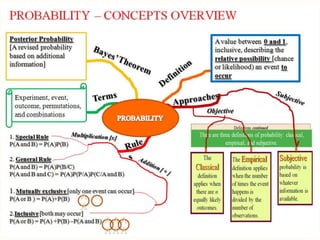
PROBABILITY – CONCEPTS OVERVIEWPosterior Probability[A revised probability based on additional information]A value between 0 and 1, inclusive, describing the relative possibility [chance or likelihood) an event to occurBayes’ TheoremDefinitionTermsApproachesExperiment, event, outcome, permutations, and combinationsSubjectivePROBABILITYObjectiveMultiplication [x]1. Special RuleP(A and B) = P(A)P(B)2. General RuleP(A and B) = P(A)P(B/C)P(A and B and C) = P(A)P(P/A)P(C/A and B)RulesAddition [ + ]1. Mutually exclusive [only one event can occur]P(A or B ) = P(A)+P(B)2.Inclusive [both may occur]P(A or B) = P(A) +P(B) –P(A and B)AAAAAAAA
Chapter FiveA Survey of Probability ConceptsGOALSWhen you have completed this chapter, you will be able to:ONEDefine probability.TWODescribe the classical, empirical, and subjective approaches to probability.THREEUnderstand the terms: experiment, event, outcome, permutations, and combinations.Goals
Chapter Five  continuedA Survey of Probability ConceptsGOALSWhen you have completed this chapter, you will be able to:FOURDefine the terms: conditional probability and joint probability.FIVECalculate probabilities applying the rules of addition and the rules of multiplication.SIXUse a tree diagram to organize and compute probabilities.SEVENCalculate a probability using Bayes’ theorem.Goals
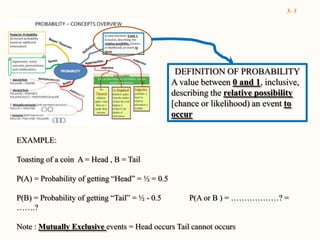
PROBABILITY – CONCEPTS OVERVIEWPosterior Probability[A revised probability based on additional information]A value between 0 and 1, inclusive, describing the relative possibility [chance or likelihood) an event to occurBayes’ TheoremDefinitionTermsApproachesExperiment, event, outcome, permutations, and combinationsSubjectivePROBABILITYObjectiveMultiplication [x]1. Special RuleP(A and B) = P(A)P(B)2. General RuleP(A and B) = P(A)P(B/C)P(A and B and C) = P(A)P(P/A)P(C/A and B)RulesAddition [ + ]1. Mutually exclusive [only one event can occur]P(A or B ) = P(A)+P(B)2.Inclusive [both may occur]P(A or B) = P(A) +P(B) –P(A and B)AAAAAAAA
DEFINITION OF PROBABILITYA value between 0 and 1, inclusive, describing the relative possibility [chance or likelihood) an event to occurEXAMPLE:Toasting of a coin  A = Head , B = TailP(A) = Probability of getting “Head” = ½ = 0.5P(B) = Probability of getting “Tail” = ½ - 0.5              P(A or B ) = ………………? =  …….?Note : Mutually Exclusive events = Head occurs Tail cannot occurs
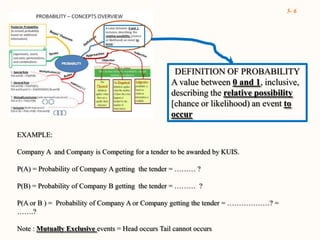
DEFINITION OF PROBABILITYA value between 0 and 1, inclusive, describing the relative possibility [chance or likelihood) an event to occurEXAMPLE:Company A  and Company is Competing for a tender to be awarded by KUIS.P(A) = Probability of Company A getting  the tender = ……… ?P(B) = Probability of Company B getting  the tender = ………  ?         P(A or B ) =  Probability of Company A or Company getting the tender = ………………? =  …….?Note : Mutually Exclusive events = Head occurs Tail cannot occurs
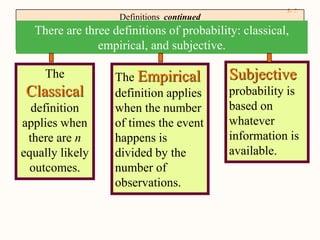
Definitions  continuedThere are three definitions of probability: classical, empirical, and subjective. Subjectiveprobability is based on whatever information is available.The Classical definition applies when there are n equally likely outcomes.The Empirical definition applies when the number of times the event happens is divided by the number of observations.
Movie
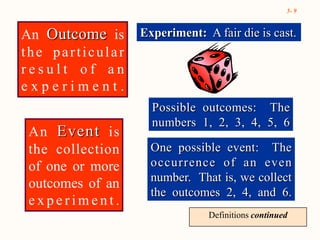
An Outcome is the particular result of an experiment.Experiment:  A fair die is cast.Possible outcomes:  The numbers 1, 2, 3, 4, 5, 6 An Event is the collection of one or more outcomes of an experiment.One possible event:  The occurrence of an even number.  That is, we collect the outcomes 2, 4, and 6.Definitions continued
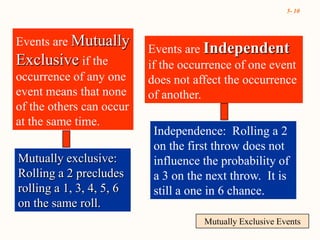
Events are Mutually Exclusive if the  occurrence of any one event means that none of the others can occur at the same time.Events are Independent if the occurrence of one event does not affect the occurrence of another.  Independence:  Rolling a 2 on the first throw does not influence the probability of a 3 on the next throw.  It is still a one in 6 chance.Mutually exclusive: Rolling a 2 precludes rolling a 1, 3, 4, 5, 6 on the same roll.Mutually Exclusive Events
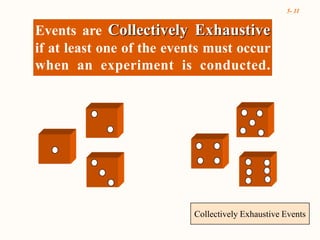
Events are Collectively Exhaustive if at least one of the events must occur when an experiment is conducted.Collectively Exhaustive Events
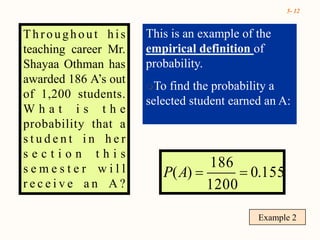
This is an example of the empirical definition of probability.To find the probability a selected student earned an A:	Throughout his teaching career Mr. Shayaa Othman has awarded 186 A’s out of 1,200 students.   What is the probability that a student in her section this semester will receive an A?Example 2
Examples of subjective probability are:estimating the probability the Washington  Redskins will win the Super Bowl this year.estimating the probability mortgage rates for home loans will top 8 percent.Subjective Probability
If two events A and B are mutually exclusive, theSpecial Rule of Addition states that the Probability of A or B occurring equals the sum of their respective probabilities. P(A or B) = P(A) + P(B)Basic Rules of Probability
MALAYSIAN AIRLINE [MAS] recently supplied the following information on their commuter flights from Singapore  to Kuala Lumpur:Example 3
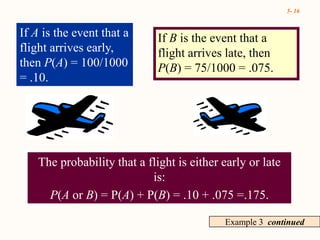
If A is the event that a flight arrives early, then P(A) = 100/1000 = .10.If B is the event that a flight arrives late, then P(B) = 75/1000 = .075.The probability that a flight is either early or late is:P(A or B) = P(A) + P(B) = .10 + .075 =.175.Example 3  continued
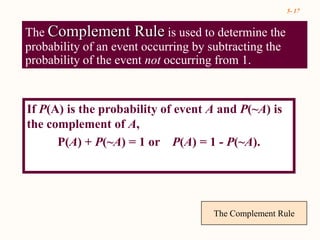
The Complement Rule is used to determine the probability of an event occurring by subtracting the probability of the event not occurring from 1.  If P(A) is the probability of event A and P(~A) is the complement of A,  P(A) + P(~A) = 1 or    P(A) = 1 - P(~A).The Complement Rule
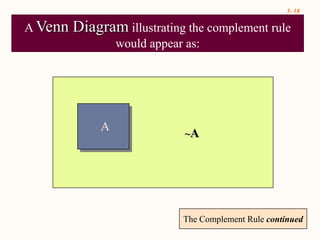
A Venn Diagram illustrating the complement rule would appear as:A~AThe Complement Rule continued
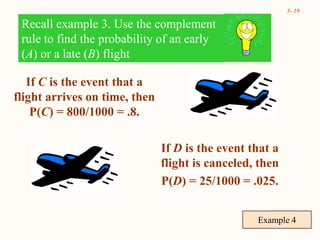
Recall example 3. Use the complement rule to find the probability of an early (A) or a late (B) flightIf C is the event that a flight arrives on time, then P(C) = 800/1000 = .8.If D is the event that a flight is canceled, then P(D) = 25/1000 = .025.Example 4
P(A or B) 	= 1 - P(C or D) 		= 1 - [.8 +.025] 		=.175D.025C.8~(C or D) = (A or B)              .175Example 4  continued
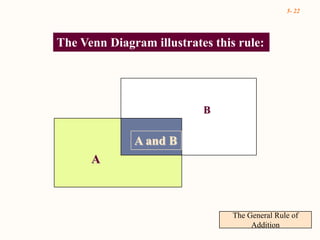
If A and B are two events that are not mutually exclusive, then P(A or B) is given by the following formula:P(A or B) = P(A) + P(B) - P(A and B)The General Rule of Addition
The Venn Diagram illustrates this rule:BA and BAThe General Rule of Addition
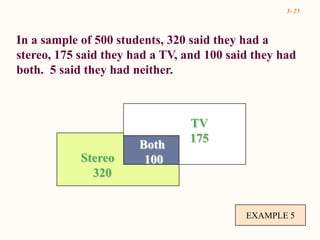
In a sample of 500 students, 320 said they had a stereo, 175 said they had a TV, and 100 said they had both.  5 said they had neither.TV175Both 100Stereo   320EXAMPLE 5
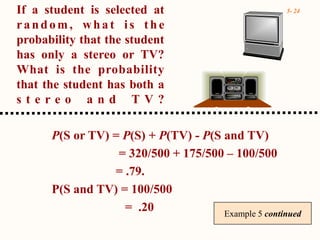
If a student is selected at random, what is the probability that the student has only a stereo or TV? What is the probability that the student has both a stereo and TV?P(S or TV) = P(S) + P(TV) - P(S and TV)		 = 320/500 + 175/500 – 100/500		= .79.P(S and TV) = 100/500		   =  .20			Example 5 continued
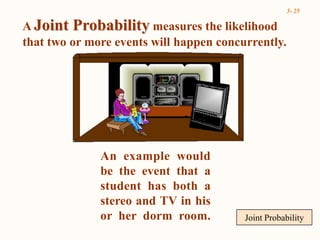
A Joint Probability measures the likelihood that two or more events will happen concurrently.   An example would be the event that a student has both a stereo and TV in his or her dorm room.Joint Probability
The Special Rule of Multiplication requires that two events A and B are independent.Two events A and B are independentif the occurrence of one has no effect on the probability of the occurrence of the other.
This rule is written:    P(A and B) = P(A)P(B)Special Rule of Multiplication
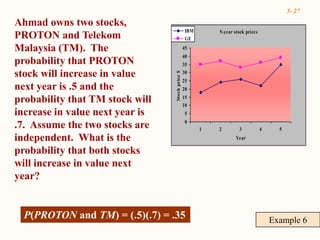
Ahmad owns two stocks, PROTON and Telekom Malaysia (TM).  The probability that PROTON stock will increase in value next year is .5 and the  probability that TM stock will increase in value next year is .7.  Assume the two stocks are independent.  What is the probability that both stocks will increase in value next year?P(PROTON and TM) = (.5)(.7) = .35Example 6
P(at least one) = P(PROTON but not TM) + P(TM but not PROTON) + P(PROTON and TM)   (.5)(1-.7) + (.7)(1-.5) + (.7)(.5) = .85
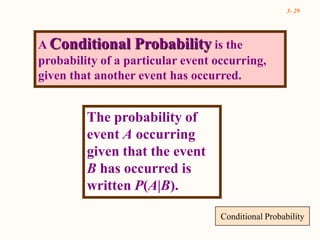
A Conditional Probability is the probability of a particular event occurring, given that another event has occurred.The probability of event A occurring given that the event B has occurred is written P(A|B).Conditional Probability
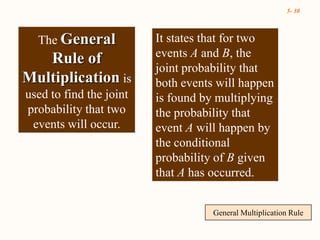
The General Rule of Multiplication is used to find the joint probability that two events will occur.It states that for two events A and B, the joint probability that both events will happen is found by multiplying the probability that event A will happen by the conditional probability of B given that A has occurred.General Multiplication Rule
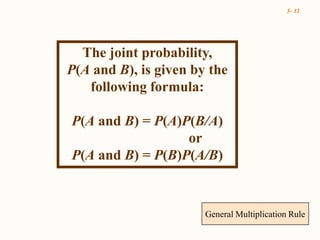
The joint probability, P(A and B), is given by the following formula:  P(A and B) = P(A)P(B/A)                          			or                                                           P(A and B) = P(B)P(A/B)General Multiplication Rule
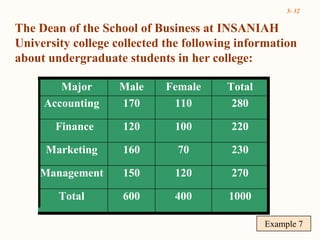
The Dean of the School of Business at INSANIAH University college collected the following information about undergraduate students in her college:Example 7
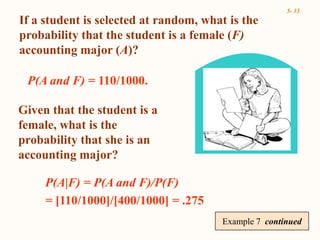
If a student is selected at random, what is the probability that the student is a female (F) accounting major (A)?  P(A and F) = 110/1000.Given that the student is a female, what is the probability that she is an accounting major? 	P(A|F) = P(A and F)/P(F)= [110/1000]/[400/1000] = .275Example 7  continued
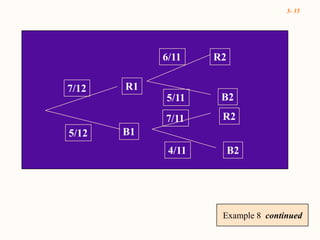
A Tree Diagram is useful for portraying conditional and joint probabilities.  It is particularly useful for analyzing business decisions involving several stages.Example 8: In a bag containing 7 red chips and 5 blue chips you select 2 chips one after the other without replacement.  Construct a tree diagram showing this information. Tree Diagrams
R26/11R17/12B25/11R27/11B15/12B24/11Example 8  continued
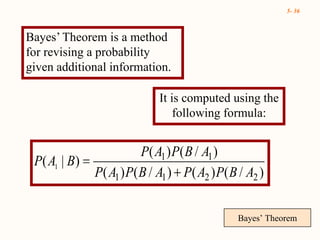
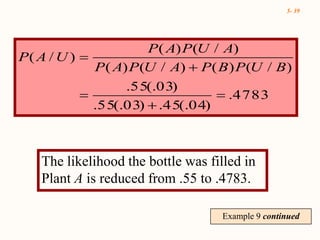
Bayes’ Theorem is a method for revising a probability given additional information.It is computed using the following formula:Bayes’ Theorem
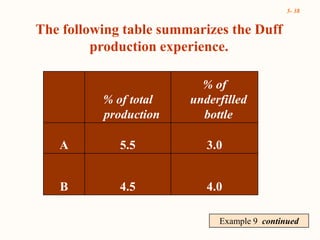
Duff Cola Company recently received several complaints that their bottles are under-filled. A complaint was received today but the production manager is unable to identify which of the two Springfield plants (A or B) filled this bottle.  What is the probability that the under-filled bottle came from plant A?Example 9
The following table summarizes the Duff production experience.  Example 9  continued
The likelihood the bottle was filled in Plant A is reduced from .55 to .4783.  Example 9 continued
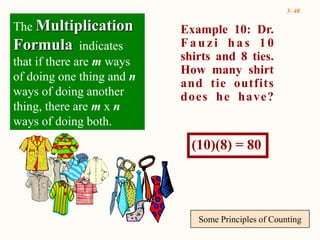
The Multiplication Formula  indicates that if there are m ways of doing one thing and n ways of doing another thing, there are m xn ways of doing both.Example 10: Dr. Fauzi has 10 shirts and 8 ties.  How many shirt and tie outfits does he have? (10)(8) = 80Some Principles of Counting
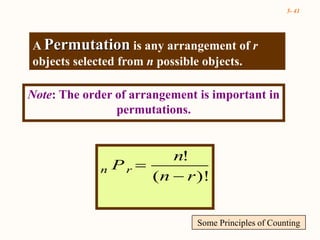
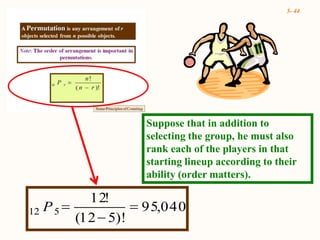
A Permutation is any arrangement of r objects selected from n possible objects.Note: The order of arrangement is important in permutations.Some Principles of Counting
ACombination is the number of ways to choose r objects from a group of n objects without regard to order.Some Principles of Counting
There are 12 players on the Muar High School basketball team.  Coach Ahmad must pick 5 players among the twelve on the team to comprise the starting lineup.  How many different groups are possible?  (Order does not matter.)
Suppose that in addition to selecting the group, he must also rank each of the players in that starting lineup according to their ability (order matters).

Lecture on Statistics 1

  • 1.
    PROBABILITY – CONCEPTSOVERVIEWPosterior Probability[A revised probability based on additional information]A value between 0 and 1, inclusive, describing the relative possibility [chance or likelihood) an event to occurBayes’ TheoremDefinitionTermsApproachesExperiment, event, outcome, permutations, and combinationsSubjectivePROBABILITYObjectiveMultiplication [x]1. Special RuleP(A and B) = P(A)P(B)2. General RuleP(A and B) = P(A)P(B/C)P(A and B and C) = P(A)P(P/A)P(C/A and B)RulesAddition [ + ]1. Mutually exclusive [only one event can occur]P(A or B ) = P(A)+P(B)2.Inclusive [both may occur]P(A or B) = P(A) +P(B) –P(A and B)AAAAAAAA
  • 2.
    Chapter FiveA Surveyof Probability ConceptsGOALSWhen you have completed this chapter, you will be able to:ONEDefine probability.TWODescribe the classical, empirical, and subjective approaches to probability.THREEUnderstand the terms: experiment, event, outcome, permutations, and combinations.Goals
  • 3.
    Chapter Five continuedA Survey of Probability ConceptsGOALSWhen you have completed this chapter, you will be able to:FOURDefine the terms: conditional probability and joint probability.FIVECalculate probabilities applying the rules of addition and the rules of multiplication.SIXUse a tree diagram to organize and compute probabilities.SEVENCalculate a probability using Bayes’ theorem.Goals
  • 4.
    PROBABILITY – CONCEPTSOVERVIEWPosterior Probability[A revised probability based on additional information]A value between 0 and 1, inclusive, describing the relative possibility [chance or likelihood) an event to occurBayes’ TheoremDefinitionTermsApproachesExperiment, event, outcome, permutations, and combinationsSubjectivePROBABILITYObjectiveMultiplication [x]1. Special RuleP(A and B) = P(A)P(B)2. General RuleP(A and B) = P(A)P(B/C)P(A and B and C) = P(A)P(P/A)P(C/A and B)RulesAddition [ + ]1. Mutually exclusive [only one event can occur]P(A or B ) = P(A)+P(B)2.Inclusive [both may occur]P(A or B) = P(A) +P(B) –P(A and B)AAAAAAAA
  • 5.
    DEFINITION OF PROBABILITYAvalue between 0 and 1, inclusive, describing the relative possibility [chance or likelihood) an event to occurEXAMPLE:Toasting of a coin A = Head , B = TailP(A) = Probability of getting “Head” = ½ = 0.5P(B) = Probability of getting “Tail” = ½ - 0.5 P(A or B ) = ………………? = …….?Note : Mutually Exclusive events = Head occurs Tail cannot occurs
  • 6.
    DEFINITION OF PROBABILITYAvalue between 0 and 1, inclusive, describing the relative possibility [chance or likelihood) an event to occurEXAMPLE:Company A and Company is Competing for a tender to be awarded by KUIS.P(A) = Probability of Company A getting the tender = ……… ?P(B) = Probability of Company B getting the tender = ……… ? P(A or B ) = Probability of Company A or Company getting the tender = ………………? = …….?Note : Mutually Exclusive events = Head occurs Tail cannot occurs
  • 7.
    Definitions continuedThereare three definitions of probability: classical, empirical, and subjective. Subjectiveprobability is based on whatever information is available.The Classical definition applies when there are n equally likely outcomes.The Empirical definition applies when the number of times the event happens is divided by the number of observations.
  • 8.
  • 9.
    An Outcome isthe particular result of an experiment.Experiment: A fair die is cast.Possible outcomes: The numbers 1, 2, 3, 4, 5, 6 An Event is the collection of one or more outcomes of an experiment.One possible event: The occurrence of an even number. That is, we collect the outcomes 2, 4, and 6.Definitions continued
  • 10.
    Events are MutuallyExclusive if the occurrence of any one event means that none of the others can occur at the same time.Events are Independent if the occurrence of one event does not affect the occurrence of another. Independence: Rolling a 2 on the first throw does not influence the probability of a 3 on the next throw. It is still a one in 6 chance.Mutually exclusive: Rolling a 2 precludes rolling a 1, 3, 4, 5, 6 on the same roll.Mutually Exclusive Events
  • 11.
    Events are CollectivelyExhaustive if at least one of the events must occur when an experiment is conducted.Collectively Exhaustive Events
  • 12.
    This is anexample of the empirical definition of probability.To find the probability a selected student earned an A: Throughout his teaching career Mr. Shayaa Othman has awarded 186 A’s out of 1,200 students. What is the probability that a student in her section this semester will receive an A?Example 2
  • 13.
    Examples of subjectiveprobability are:estimating the probability the Washington Redskins will win the Super Bowl this year.estimating the probability mortgage rates for home loans will top 8 percent.Subjective Probability
  • 14.
    If two eventsA and B are mutually exclusive, theSpecial Rule of Addition states that the Probability of A or B occurring equals the sum of their respective probabilities. P(A or B) = P(A) + P(B)Basic Rules of Probability
  • 15.
    MALAYSIAN AIRLINE [MAS]recently supplied the following information on their commuter flights from Singapore to Kuala Lumpur:Example 3
  • 16.
    If A isthe event that a flight arrives early, then P(A) = 100/1000 = .10.If B is the event that a flight arrives late, then P(B) = 75/1000 = .075.The probability that a flight is either early or late is:P(A or B) = P(A) + P(B) = .10 + .075 =.175.Example 3 continued
  • 17.
    The Complement Ruleis used to determine the probability of an event occurring by subtracting the probability of the event not occurring from 1. If P(A) is the probability of event A and P(~A) is the complement of A, P(A) + P(~A) = 1 or P(A) = 1 - P(~A).The Complement Rule
  • 18.
    A Venn Diagramillustrating the complement rule would appear as:A~AThe Complement Rule continued
  • 19.
    Recall example 3.Use the complement rule to find the probability of an early (A) or a late (B) flightIf C is the event that a flight arrives on time, then P(C) = 800/1000 = .8.If D is the event that a flight is canceled, then P(D) = 25/1000 = .025.Example 4
  • 20.
    P(A or B) = 1 - P(C or D) = 1 - [.8 +.025] =.175D.025C.8~(C or D) = (A or B) .175Example 4 continued
  • 21.
    If A andB are two events that are not mutually exclusive, then P(A or B) is given by the following formula:P(A or B) = P(A) + P(B) - P(A and B)The General Rule of Addition
  • 22.
    The Venn Diagramillustrates this rule:BA and BAThe General Rule of Addition
  • 23.
    In a sampleof 500 students, 320 said they had a stereo, 175 said they had a TV, and 100 said they had both. 5 said they had neither.TV175Both 100Stereo 320EXAMPLE 5
  • 24.
    If a studentis selected at random, what is the probability that the student has only a stereo or TV? What is the probability that the student has both a stereo and TV?P(S or TV) = P(S) + P(TV) - P(S and TV) = 320/500 + 175/500 – 100/500 = .79.P(S and TV) = 100/500 = .20 Example 5 continued
  • 25.
    A Joint Probabilitymeasures the likelihood that two or more events will happen concurrently. An example would be the event that a student has both a stereo and TV in his or her dorm room.Joint Probability
  • 26.
    The Special Ruleof Multiplication requires that two events A and B are independent.Two events A and B are independentif the occurrence of one has no effect on the probability of the occurrence of the other.
  • 27.
    This rule iswritten: P(A and B) = P(A)P(B)Special Rule of Multiplication
  • 28.
    Ahmad owns twostocks, PROTON and Telekom Malaysia (TM). The probability that PROTON stock will increase in value next year is .5 and the probability that TM stock will increase in value next year is .7. Assume the two stocks are independent. What is the probability that both stocks will increase in value next year?P(PROTON and TM) = (.5)(.7) = .35Example 6
  • 29.
    P(at least one)= P(PROTON but not TM) + P(TM but not PROTON) + P(PROTON and TM) (.5)(1-.7) + (.7)(1-.5) + (.7)(.5) = .85
  • 30.
    A Conditional Probabilityis the probability of a particular event occurring, given that another event has occurred.The probability of event A occurring given that the event B has occurred is written P(A|B).Conditional Probability
  • 31.
    The General Ruleof Multiplication is used to find the joint probability that two events will occur.It states that for two events A and B, the joint probability that both events will happen is found by multiplying the probability that event A will happen by the conditional probability of B given that A has occurred.General Multiplication Rule
  • 32.
    The joint probability,P(A and B), is given by the following formula: P(A and B) = P(A)P(B/A) or P(A and B) = P(B)P(A/B)General Multiplication Rule
  • 33.
    The Dean ofthe School of Business at INSANIAH University college collected the following information about undergraduate students in her college:Example 7
  • 34.
    If a studentis selected at random, what is the probability that the student is a female (F) accounting major (A)? P(A and F) = 110/1000.Given that the student is a female, what is the probability that she is an accounting major? P(A|F) = P(A and F)/P(F)= [110/1000]/[400/1000] = .275Example 7 continued
  • 35.
    A Tree Diagramis useful for portraying conditional and joint probabilities. It is particularly useful for analyzing business decisions involving several stages.Example 8: In a bag containing 7 red chips and 5 blue chips you select 2 chips one after the other without replacement. Construct a tree diagram showing this information. Tree Diagrams
  • 36.
  • 37.
    Bayes’ Theorem isa method for revising a probability given additional information.It is computed using the following formula:Bayes’ Theorem
  • 38.
    Duff Cola Companyrecently received several complaints that their bottles are under-filled. A complaint was received today but the production manager is unable to identify which of the two Springfield plants (A or B) filled this bottle. What is the probability that the under-filled bottle came from plant A?Example 9
  • 39.
    The following tablesummarizes the Duff production experience. Example 9 continued
  • 40.
    The likelihood thebottle was filled in Plant A is reduced from .55 to .4783. Example 9 continued
  • 41.
    The Multiplication Formula indicates that if there are m ways of doing one thing and n ways of doing another thing, there are m xn ways of doing both.Example 10: Dr. Fauzi has 10 shirts and 8 ties. How many shirt and tie outfits does he have? (10)(8) = 80Some Principles of Counting
  • 42.
    A Permutation isany arrangement of r objects selected from n possible objects.Note: The order of arrangement is important in permutations.Some Principles of Counting
  • 43.
    ACombination is thenumber of ways to choose r objects from a group of n objects without regard to order.Some Principles of Counting
  • 44.
    There are 12players on the Muar High School basketball team. Coach Ahmad must pick 5 players among the twelve on the team to comprise the starting lineup. How many different groups are possible? (Order does not matter.)
  • 45.
    Suppose that inaddition to selecting the group, he must also rank each of the players in that starting lineup according to their ability (order matters).