
Educational Motivation
       and the
   Learning Process
        ED 540

    Dr. Asburn Pinnock
What is learning?
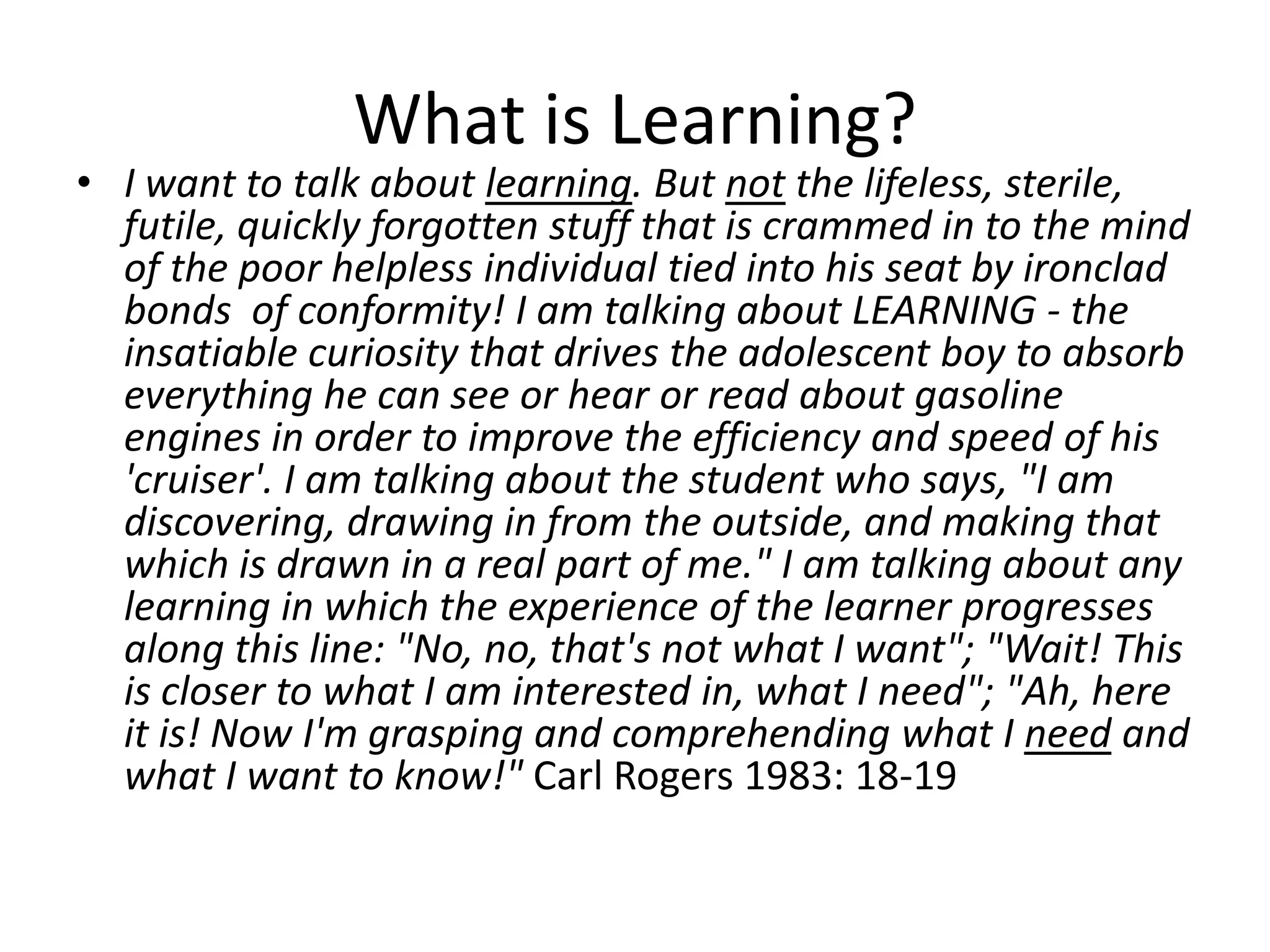
What is Learning?
• I want to talk about learning. But not the lifeless, sterile,
  futile, quickly forgotten stuff that is crammed in to the mind
  of the poor helpless individual tied into his seat by ironclad
  bonds of conformity! I am talking about LEARNING - the
  insatiable curiosity that drives the adolescent boy to absorb
  everything he can see or hear or read about gasoline
  engines in order to improve the efficiency and speed of his
  'cruiser'. I am talking about the student who says, "I am
  discovering, drawing in from the outside, and making that
  which is drawn in a real part of me." I am talking about any
  learning in which the experience of the learner progresses
  along this line: "No, no, that's not what I want"; "Wait! This
  is closer to what I am interested in, what I need"; "Ah, here
  it is! Now I'm grasping and comprehending what I need and
  what I want to know!" Carl Rogers 1983: 18-19
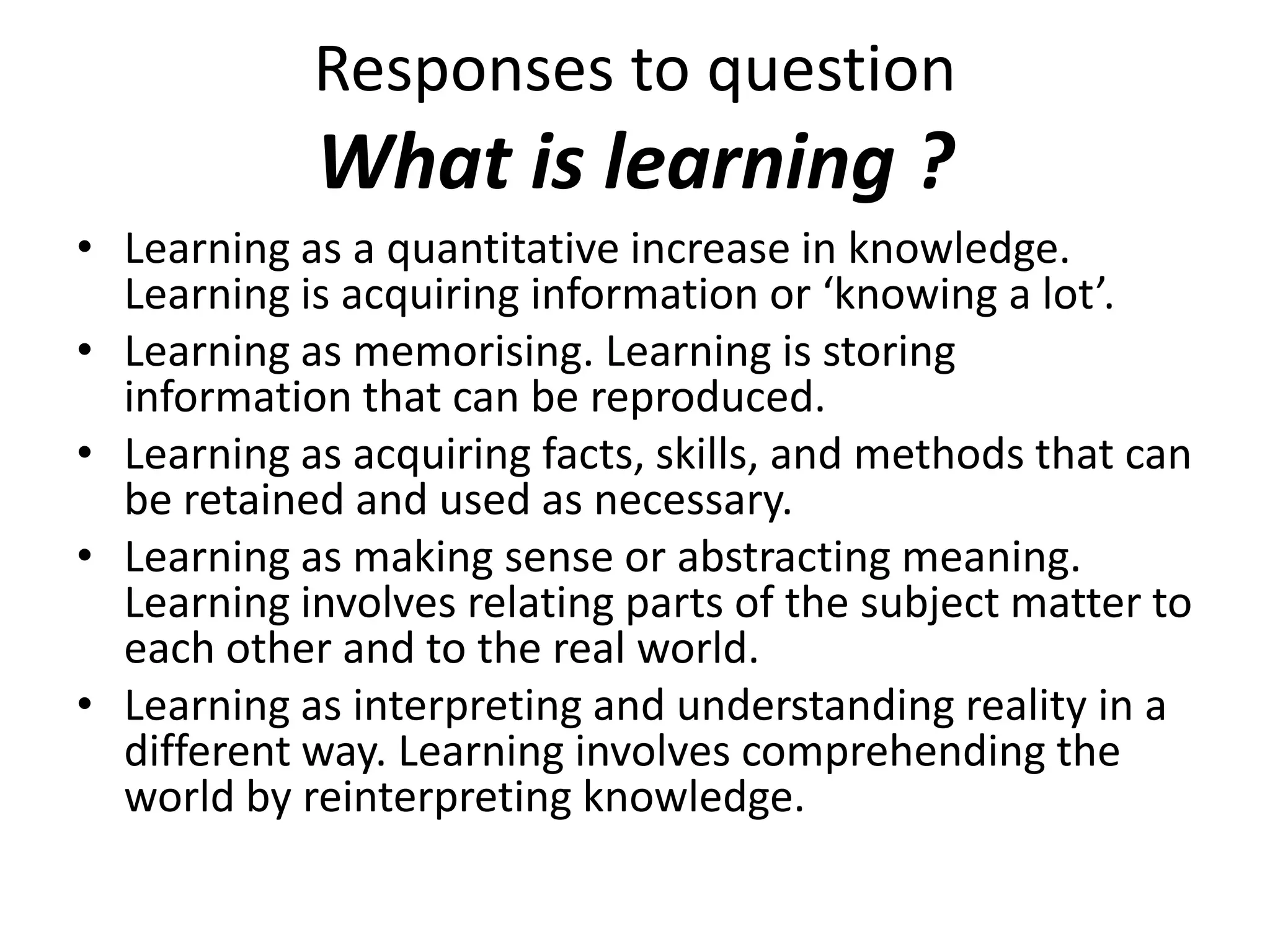
Responses to question
            What is learning ?
• Learning as a quantitative increase in knowledge.
  Learning is acquiring information or ‘knowing a lot’.
• Learning as memorising. Learning is storing
  information that can be reproduced.
• Learning as acquiring facts, skills, and methods that can
  be retained and used as necessary.
• Learning as making sense or abstracting meaning.
  Learning involves relating parts of the subject matter to
  each other and to the real world.
• Learning as interpreting and understanding reality in a
  different way. Learning involves comprehending the
  world by reinterpreting knowledge.
Learning as a Product
• an outcome - the end product of some process.
• It can be recognized or seen.
• This approach has the virtue of highlighting a
  crucial aspect of learning - change.
• Does a person need to perform in order to
  determine whether he/she has learnt
• Are there other factors that could have resulted
  in the changed behaviour
• Is the change long term/ short term?
Is there a difference between

   ‘Knowing that’
        vs
   ‘Knowing how’
A man knowing little or nothing of medical
  science could not be a good surgeon, but
  excellence at surgery is not the same thing as
  knowledge of medical science; nor is it a
  simple product of it. The surgeon must indeed
  have learned from instruction, or by his own
  inductions and observations, a great number
  of truths; but he must also have learned by
  practice a great number of aptitudes.
                                      (Ryle 1949)
• Learning how or improving an ability is not
  like learning that or acquiring information.
  Truths can be imparted, procedures can only
  be inculcated, and while inculcation is a
  gradual process, imparting is relatively
  sudden. It makes sense to ask at what
  moment someone became apprised of a
  truth, but not to ask at what moment
  someone acquired a skill.
                                    (Ryle 1949:
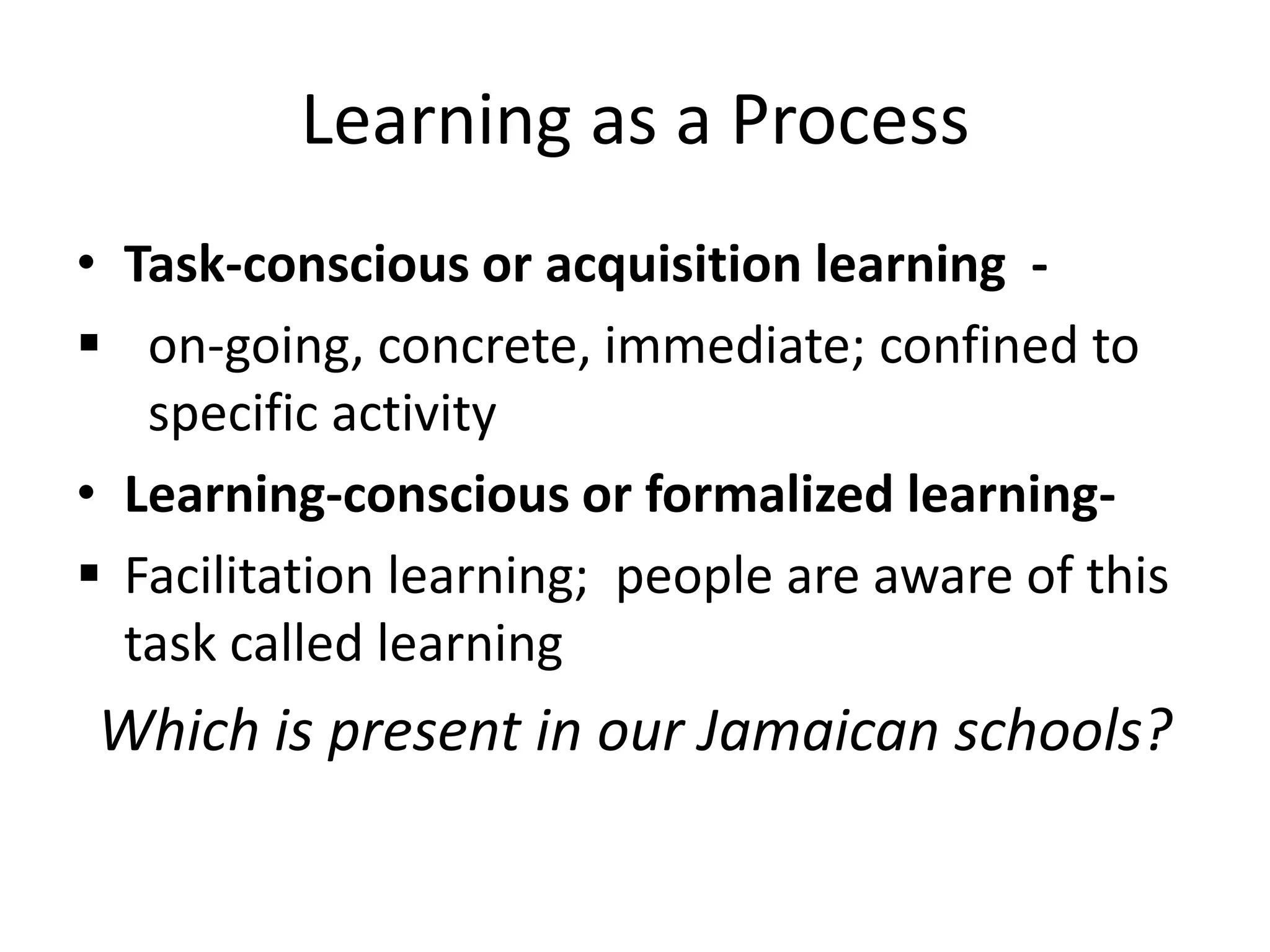
Learning as a Process
• Task-conscious or acquisition learning -
 on-going, concrete, immediate; confined to
   specific activity
• Learning-conscious or formalized learning-
 Facilitation learning; people are aware of this
  task called learning
Which is present in our Jamaican schools?
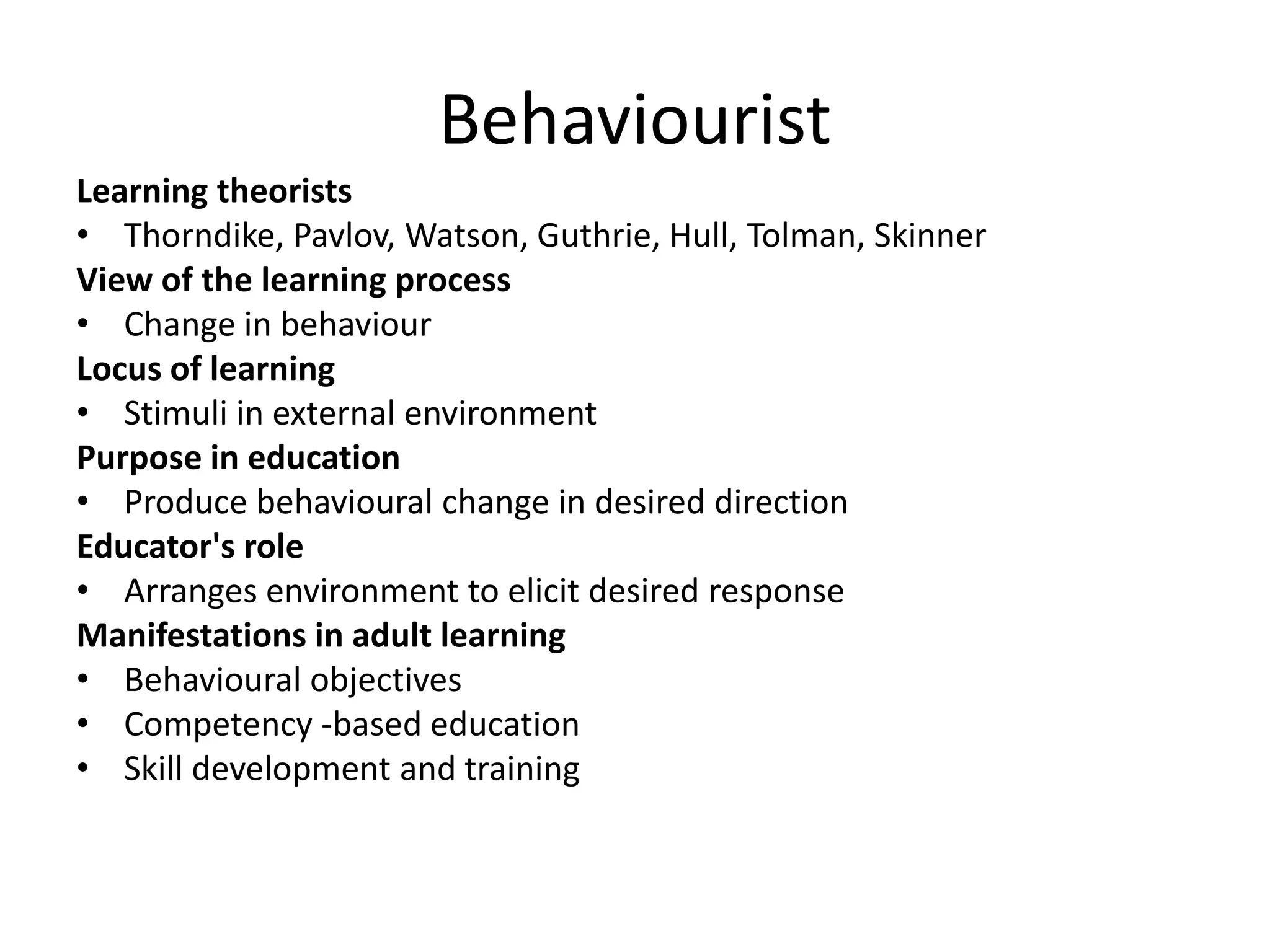
Behaviourist
Learning theorists
• Thorndike, Pavlov, Watson, Guthrie, Hull, Tolman, Skinner
View of the learning process
• Change in behaviour
Locus of learning
• Stimuli in external environment
Purpose in education
• Produce behavioural change in desired direction
Educator's role
• Arranges environment to elicit desired response
Manifestations in adult learning
• Behavioural objectives
• Competency -based education
• Skill development and training
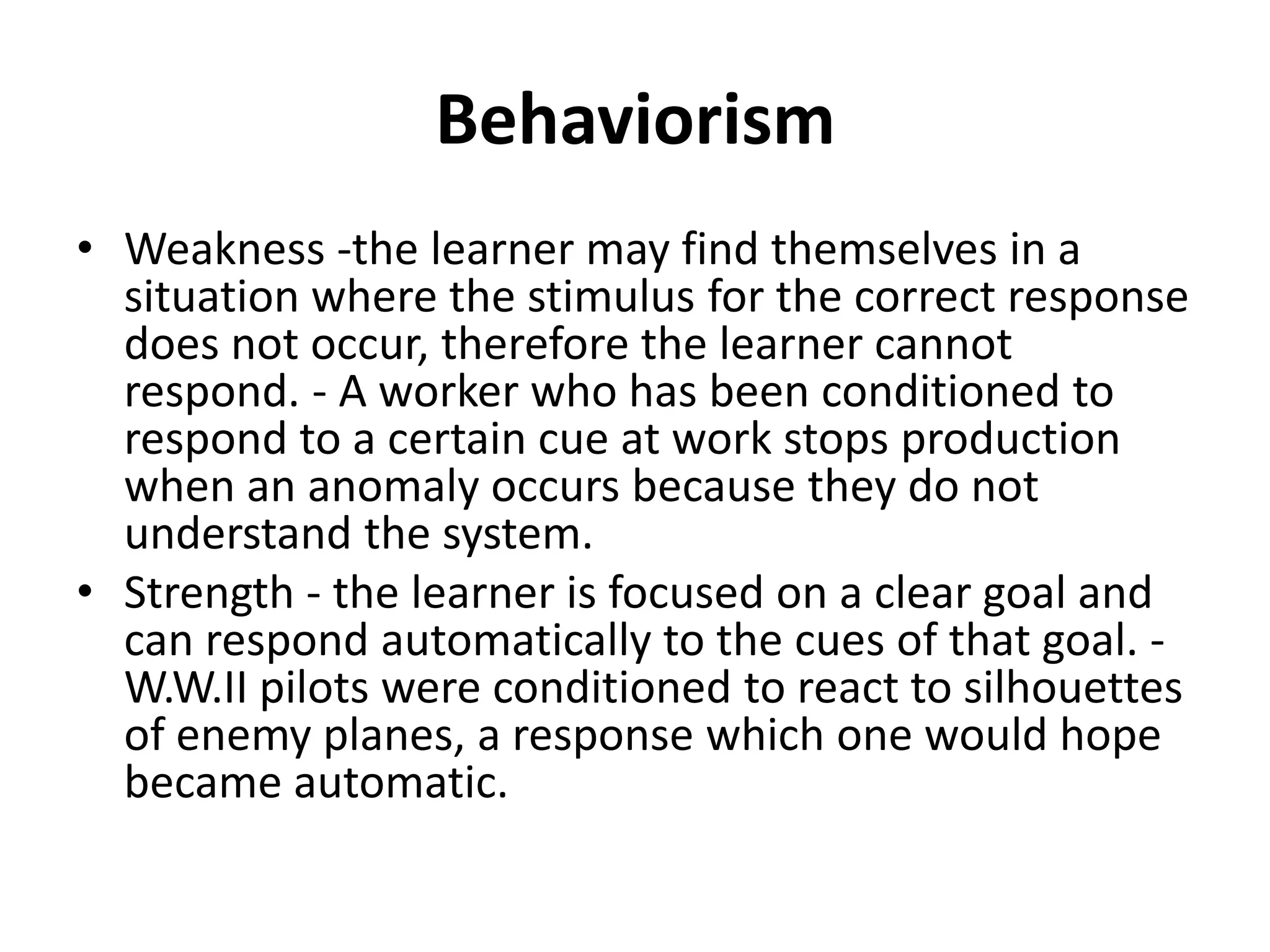
Behaviorism
• Weakness -the learner may find themselves in a
  situation where the stimulus for the correct response
  does not occur, therefore the learner cannot
  respond. - A worker who has been conditioned to
  respond to a certain cue at work stops production
  when an anomaly occurs because they do not
  understand the system.
• Strength - the learner is focused on a clear goal and
  can respond automatically to the cues of that goal. -
  W.W.II pilots were conditioned to react to silhouettes
  of enemy planes, a response which one would hope
  became automatic.
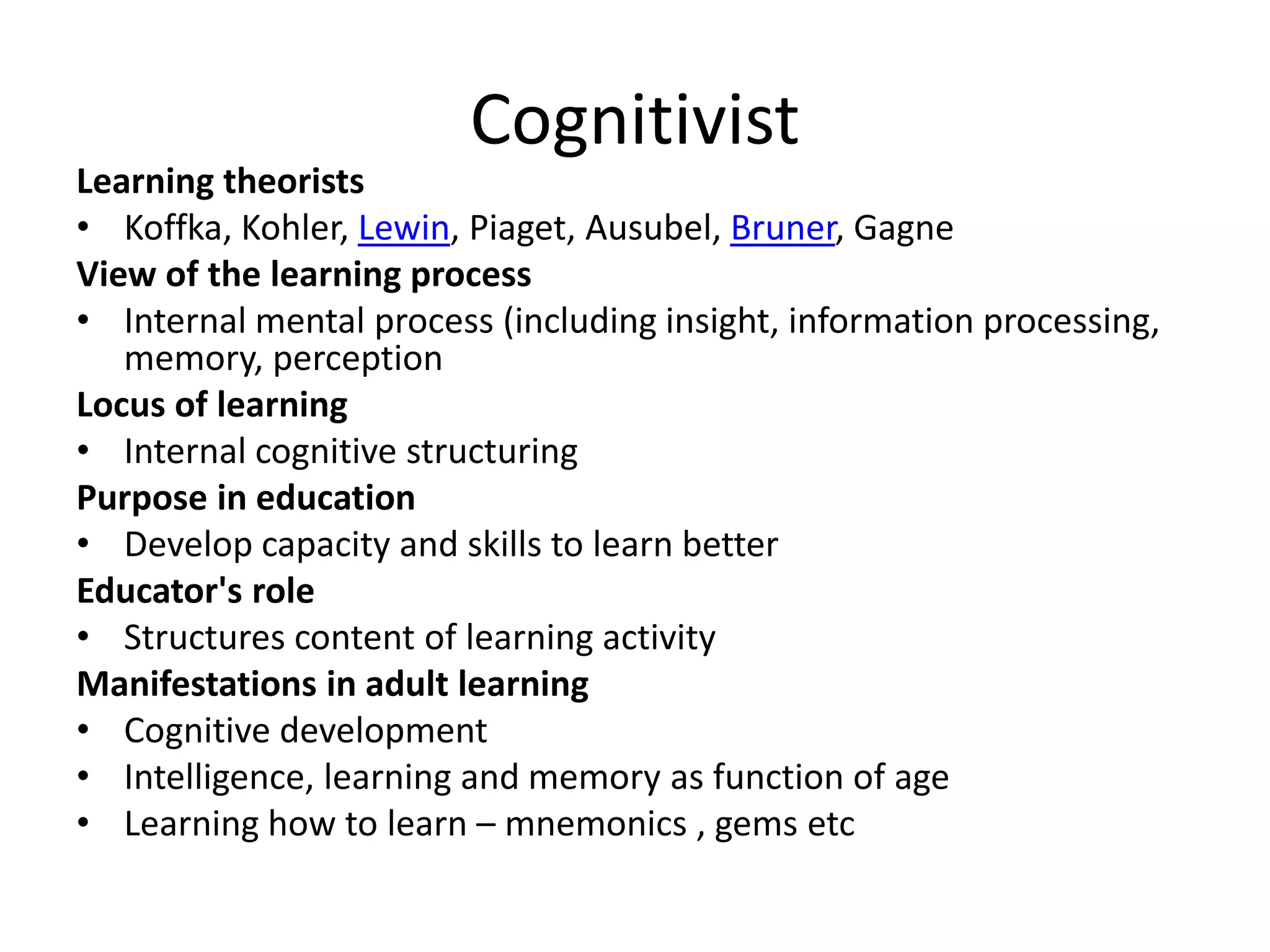
Cognitivist
Learning theorists
• Koffka, Kohler, Lewin, Piaget, Ausubel, Bruner, Gagne
View of the learning process
• Internal mental process (including insight, information processing,
   memory, perception
Locus of learning
• Internal cognitive structuring
Purpose in education
• Develop capacity and skills to learn better
Educator's role
• Structures content of learning activity
Manifestations in adult learning
• Cognitive development
• Intelligence, learning and memory as function of age
• Learning how to learn – mnemonics , gems etc
Cognitivism
• Weakness - the learner learns a way to accomplish a
  task, but it may not be the best way, or suited to the
  learner or the situation. For example, logging onto
  the internet on one computer may not be the same
  as logging in on another computer.
• Strength - the goal is to train learners to do a task the
  same way to enable consistency. - Logging onto and
  off of a workplace computer is the same for all
  employees; it may be important do an exact routine
  to avoid problems.
Humanist
Learning theorists
• Maslow, Rogers
View of the learning process
• A personal act to fulfil potential.
Locus of learning
• Affective and cognitive needs
Purpose in education
• Become self-actualized, autonomous
Educator's role
• Facilitates development of the whole person
Manifestations in adult learning
• Andragogy
• Self-directed learning
Constructivist
Learning theorists
• Bandura, Vygotsky,
View of the learning process
• Interaction /observation in social contexts. Movement from the periphery to the centre of a
    community of practice
Locus of learning
• Group dialogue and collaborative problem solving model and guide
• Learning is in relationship between people and environment
Purpose in education
• Full participation in communities of practice and utilization of resources, practical, authentic
    situations
Educator's role
• Works to establish communities of practice in which conversation and participation can occur.
Manifestations
• Socialization
• Social participation
• Problem solving
MOTIVATION
http://www.anthonyfernando.com/uploads/hoy
  t.html
What is motivation?
• Motivation is the inner power or energy that
  pushes one toward performing a certain action.
  Motivation has much to do with desire and
  ambition, and if they are absent, motivation is
  absent too
• Motivation is a desire to achieve a goal,
  combined with the energy to work towards that
  goal. Students who are motivated have a desire
  to undertake their study and complete the
  requirements of their course.
Are you a motivated student?
• Being a motivated student doesn’t mean you
  are always excited or fully committed to your
  study, but it does mean you will complete the
  tasks set for you even when assignments or
  practicals are difficult, or seem uninteresting.
Can you motivate a person?
• As educators we need to provide the
  environment that will cause persons to be
  motivated.
Basic principles of Motivation that can
        be applied to Learning
• The environment can be used to focus the student's
  attention on what needs to be learned.
• Incentives motivate learning.
• Internal motivation is longer lasting and more self-
  directive than is external motivation, which must be
  repeatedly reinforced by praise or concrete rewards.
• Learning is most effective when an individual is ready to
  learn, that is, when one wants to know something. If a
  student is not ready to learn, he or she may not be reliable
  in following instructions and therefore must be supervised
  and have the instructions repeated again and again.
• Motivation is enhanced by the way in which the
  instructional material is organized.
What is Brain based Learning?
• A comprehensive approach to instruction using current research
  from neuroscience.
• Emphasizes how the brain learns naturally and is based on what we
  currently know about the actual structure and function of the
  human brain at varying developmental stages.
• Using the latest neural research, educational techniques that are
  brain friendly provide a biologically driven framework for creating
  effective instruction.
• This theory also helps explain recurring learning behaviors, and is
  a meta-concept that includes an eclectic mix of techniques.
• Currently, related techniques stress allowing teachers to connect
  learning to students' real lives and emotional experiences, as well
  as their personal histories and experiences.
BBL involves
This form of learning also encompasses such newer
  educational concepts like:
• mastery learning,
• experiential learning,
• learning styles,
• multiple intelligences,
• cooperative learning,
• practical simulations,
• experiential learning,
• problem-based learning,
• movement education.
Core Principles of BBL
• The brain is a parallel processor. It can perform several activities at
  once.
• The brain perceives wholes and parts simultaneously.
• Information is stored in multiple areas of the brain, and can be
  retrieved through multiple memory and neural pathways.
• Learning engages the whole body. All learning is mind-body:
  movement, foods, attention cycles, and chemicals modulate
  learning.
• Humans search for meaning is innate.
• The search for meaning comes through patterning.
• Emotions are critical to patterning, and drive our attention,
  meaning and memory.
                                                       (Caine and Caine)
•   Meaning is more important than just information.
•   Learning involves focused attention and peripheral perception.
•   We have two types of memory: spatial and rote.
•   We understand best when facts are embedded in natural spatial
    memory.
•   The brain is social. It develops better in concert with other brains.
•   Complex learning is enhanced by challenge and inhibited by stress.
•   Every brain in uniquely organized.
•   Learning is developmental.
                                                         (Caine and Caine)
BBL -Implications
• Learning environments are created that immerse students in a
  learning experience.
• Relaxed alertness: An effort is made to eliminate fear while
  maintaining a highly challenging environment.
• All students are accepted with their various learning styles,
  capabilities and disabilities. A relaxed accepting environment
  pervades the room.
• Children are stretched to maximize their potential.
• Active processing where the learner consolidates and internalizes
  information by actively processing it.
• Information is connected to prior learning.
• The stage is set before a unit of study is begun by the teacher
  preparing the students to attach new information to prior
  knowledge so the new information has something to latch onto.
                                                  (Jensen; Caine & Caine)
What does the class look like?
•   Rich, stimulating environments using student created materials and products are
    evident on bulletin boards and display areas.
•   Places for group learning like tables and desks grouped together, to stimulate
    social skills and cooperative work groups. Have comfortable furniture, for casual
    discussion areas. Areas with large pillows who prefer not the work at a desk or
    table.
•   Safe places for students to be where threat is reduced, particularly in large urban
    settings.
•   Variety of places where children prefer to learn
•   Change displays in the classroom regularly to provide a stimulating situations for
    brain development.
•   Have students create stage sets where they can act out scenes from their readings
    or demonstrate a science principle or act out a dialogue between historical figures.
•   Have multiple resources available. Provide educational, physical and a variety of
    setting within the classroom so that learning activities can be integrated easily.
    Learning centers. Multiple functions of learning is our goal.
                                                                         (Darcangelo, 2000)
• Flexibility: This common principle of the past is relevant. The
  teachable moment must be recognized and capitalized upon.
  Dimensions of flexibility are evident in other principles.
• Active and passive places: Students need quiet areas for reflection
  and retreat from others to use intrapersonal intelligences.
• Personal space: Students need a home base, a desk. All this allows
  learners to express their unique identity.
• The community at large as an optimal learning environment:
  Teachers need to find ways to fully use space a primary learning
  setting. Technology, distance learning, community and business
  partnerships, all need to be explored by educational institutions.
• Enrichment: The brain can grow new connections at any age.
  Challenging, complex experiences with appropriate feedback are
  best. Cognitive skills develop better with music and motor skills.
                                                      (Darcangelo, 2000)
References for BBL
• Caine, G., Nummela-Caine, R., & Crowell, S. (1999)
  Mindshifts: A Brain-Based Process for Restructuring
  Schools and Renewing Education, 2nd edition. Tucson,
  AZ: Zephyr Press.

• Caine, G., Nummela-Caine, (1997) Education on the
  edge of possibility. Alexandria, VA: ASCD--Association
  for Supervision and Curriculum Development.

• D'Arcangelo, M. (2000). How does the brain develop? A
  conversation with Steven Peterson. Educational
  Leadership, 58(3), 68-71.

Educational motivation lesson 1

  • 1.
    Educational Motivation and the Learning Process ED 540 Dr. Asburn Pinnock
  • 2.
  • 3.
    What is Learning? •I want to talk about learning. But not the lifeless, sterile, futile, quickly forgotten stuff that is crammed in to the mind of the poor helpless individual tied into his seat by ironclad bonds of conformity! I am talking about LEARNING - the insatiable curiosity that drives the adolescent boy to absorb everything he can see or hear or read about gasoline engines in order to improve the efficiency and speed of his 'cruiser'. I am talking about the student who says, "I am discovering, drawing in from the outside, and making that which is drawn in a real part of me." I am talking about any learning in which the experience of the learner progresses along this line: "No, no, that's not what I want"; "Wait! This is closer to what I am interested in, what I need"; "Ah, here it is! Now I'm grasping and comprehending what I need and what I want to know!" Carl Rogers 1983: 18-19
  • 4.
    Responses to question What is learning ? • Learning as a quantitative increase in knowledge. Learning is acquiring information or ‘knowing a lot’. • Learning as memorising. Learning is storing information that can be reproduced. • Learning as acquiring facts, skills, and methods that can be retained and used as necessary. • Learning as making sense or abstracting meaning. Learning involves relating parts of the subject matter to each other and to the real world. • Learning as interpreting and understanding reality in a different way. Learning involves comprehending the world by reinterpreting knowledge.
  • 5.
    Learning as aProduct • an outcome - the end product of some process. • It can be recognized or seen. • This approach has the virtue of highlighting a crucial aspect of learning - change. • Does a person need to perform in order to determine whether he/she has learnt • Are there other factors that could have resulted in the changed behaviour • Is the change long term/ short term?
  • 6.
    Is there adifference between ‘Knowing that’ vs ‘Knowing how’
  • 7.
    A man knowinglittle or nothing of medical science could not be a good surgeon, but excellence at surgery is not the same thing as knowledge of medical science; nor is it a simple product of it. The surgeon must indeed have learned from instruction, or by his own inductions and observations, a great number of truths; but he must also have learned by practice a great number of aptitudes. (Ryle 1949)
  • 8.
    • Learning howor improving an ability is not like learning that or acquiring information. Truths can be imparted, procedures can only be inculcated, and while inculcation is a gradual process, imparting is relatively sudden. It makes sense to ask at what moment someone became apprised of a truth, but not to ask at what moment someone acquired a skill. (Ryle 1949:
  • 9.
    Learning as aProcess • Task-conscious or acquisition learning -  on-going, concrete, immediate; confined to specific activity • Learning-conscious or formalized learning-  Facilitation learning; people are aware of this task called learning Which is present in our Jamaican schools?
  • 10.
    Behaviourist Learning theorists • Thorndike,Pavlov, Watson, Guthrie, Hull, Tolman, Skinner View of the learning process • Change in behaviour Locus of learning • Stimuli in external environment Purpose in education • Produce behavioural change in desired direction Educator's role • Arranges environment to elicit desired response Manifestations in adult learning • Behavioural objectives • Competency -based education • Skill development and training
  • 11.
    Behaviorism • Weakness -thelearner may find themselves in a situation where the stimulus for the correct response does not occur, therefore the learner cannot respond. - A worker who has been conditioned to respond to a certain cue at work stops production when an anomaly occurs because they do not understand the system. • Strength - the learner is focused on a clear goal and can respond automatically to the cues of that goal. - W.W.II pilots were conditioned to react to silhouettes of enemy planes, a response which one would hope became automatic.
  • 12.
    Cognitivist Learning theorists • Koffka,Kohler, Lewin, Piaget, Ausubel, Bruner, Gagne View of the learning process • Internal mental process (including insight, information processing, memory, perception Locus of learning • Internal cognitive structuring Purpose in education • Develop capacity and skills to learn better Educator's role • Structures content of learning activity Manifestations in adult learning • Cognitive development • Intelligence, learning and memory as function of age • Learning how to learn – mnemonics , gems etc
  • 13.
    Cognitivism • Weakness -the learner learns a way to accomplish a task, but it may not be the best way, or suited to the learner or the situation. For example, logging onto the internet on one computer may not be the same as logging in on another computer. • Strength - the goal is to train learners to do a task the same way to enable consistency. - Logging onto and off of a workplace computer is the same for all employees; it may be important do an exact routine to avoid problems.
  • 14.
    Humanist Learning theorists • Maslow,Rogers View of the learning process • A personal act to fulfil potential. Locus of learning • Affective and cognitive needs Purpose in education • Become self-actualized, autonomous Educator's role • Facilitates development of the whole person Manifestations in adult learning • Andragogy • Self-directed learning
  • 15.
    Constructivist Learning theorists • Bandura,Vygotsky, View of the learning process • Interaction /observation in social contexts. Movement from the periphery to the centre of a community of practice Locus of learning • Group dialogue and collaborative problem solving model and guide • Learning is in relationship between people and environment Purpose in education • Full participation in communities of practice and utilization of resources, practical, authentic situations Educator's role • Works to establish communities of practice in which conversation and participation can occur. Manifestations • Socialization • Social participation • Problem solving
  • 16.
  • 17.
    What is motivation? •Motivation is the inner power or energy that pushes one toward performing a certain action. Motivation has much to do with desire and ambition, and if they are absent, motivation is absent too • Motivation is a desire to achieve a goal, combined with the energy to work towards that goal. Students who are motivated have a desire to undertake their study and complete the requirements of their course.
  • 18.
    Are you amotivated student? • Being a motivated student doesn’t mean you are always excited or fully committed to your study, but it does mean you will complete the tasks set for you even when assignments or practicals are difficult, or seem uninteresting.
  • 19.
    Can you motivatea person? • As educators we need to provide the environment that will cause persons to be motivated.
  • 20.
    Basic principles ofMotivation that can be applied to Learning • The environment can be used to focus the student's attention on what needs to be learned. • Incentives motivate learning. • Internal motivation is longer lasting and more self- directive than is external motivation, which must be repeatedly reinforced by praise or concrete rewards. • Learning is most effective when an individual is ready to learn, that is, when one wants to know something. If a student is not ready to learn, he or she may not be reliable in following instructions and therefore must be supervised and have the instructions repeated again and again. • Motivation is enhanced by the way in which the instructional material is organized.
  • 21.
    What is Brainbased Learning? • A comprehensive approach to instruction using current research from neuroscience. • Emphasizes how the brain learns naturally and is based on what we currently know about the actual structure and function of the human brain at varying developmental stages. • Using the latest neural research, educational techniques that are brain friendly provide a biologically driven framework for creating effective instruction. • This theory also helps explain recurring learning behaviors, and is a meta-concept that includes an eclectic mix of techniques. • Currently, related techniques stress allowing teachers to connect learning to students' real lives and emotional experiences, as well as their personal histories and experiences.
  • 22.
    BBL involves This formof learning also encompasses such newer educational concepts like: • mastery learning, • experiential learning, • learning styles, • multiple intelligences, • cooperative learning, • practical simulations, • experiential learning, • problem-based learning, • movement education.
  • 23.
    Core Principles ofBBL • The brain is a parallel processor. It can perform several activities at once. • The brain perceives wholes and parts simultaneously. • Information is stored in multiple areas of the brain, and can be retrieved through multiple memory and neural pathways. • Learning engages the whole body. All learning is mind-body: movement, foods, attention cycles, and chemicals modulate learning. • Humans search for meaning is innate. • The search for meaning comes through patterning. • Emotions are critical to patterning, and drive our attention, meaning and memory. (Caine and Caine)
  • 24.
    Meaning is more important than just information. • Learning involves focused attention and peripheral perception. • We have two types of memory: spatial and rote. • We understand best when facts are embedded in natural spatial memory. • The brain is social. It develops better in concert with other brains. • Complex learning is enhanced by challenge and inhibited by stress. • Every brain in uniquely organized. • Learning is developmental. (Caine and Caine)
  • 25.
    BBL -Implications • Learningenvironments are created that immerse students in a learning experience. • Relaxed alertness: An effort is made to eliminate fear while maintaining a highly challenging environment. • All students are accepted with their various learning styles, capabilities and disabilities. A relaxed accepting environment pervades the room. • Children are stretched to maximize their potential. • Active processing where the learner consolidates and internalizes information by actively processing it. • Information is connected to prior learning. • The stage is set before a unit of study is begun by the teacher preparing the students to attach new information to prior knowledge so the new information has something to latch onto. (Jensen; Caine & Caine)
  • 26.
    What does theclass look like? • Rich, stimulating environments using student created materials and products are evident on bulletin boards and display areas. • Places for group learning like tables and desks grouped together, to stimulate social skills and cooperative work groups. Have comfortable furniture, for casual discussion areas. Areas with large pillows who prefer not the work at a desk or table. • Safe places for students to be where threat is reduced, particularly in large urban settings. • Variety of places where children prefer to learn • Change displays in the classroom regularly to provide a stimulating situations for brain development. • Have students create stage sets where they can act out scenes from their readings or demonstrate a science principle or act out a dialogue between historical figures. • Have multiple resources available. Provide educational, physical and a variety of setting within the classroom so that learning activities can be integrated easily. Learning centers. Multiple functions of learning is our goal. (Darcangelo, 2000)
  • 27.
    • Flexibility: Thiscommon principle of the past is relevant. The teachable moment must be recognized and capitalized upon. Dimensions of flexibility are evident in other principles. • Active and passive places: Students need quiet areas for reflection and retreat from others to use intrapersonal intelligences. • Personal space: Students need a home base, a desk. All this allows learners to express their unique identity. • The community at large as an optimal learning environment: Teachers need to find ways to fully use space a primary learning setting. Technology, distance learning, community and business partnerships, all need to be explored by educational institutions. • Enrichment: The brain can grow new connections at any age. Challenging, complex experiences with appropriate feedback are best. Cognitive skills develop better with music and motor skills. (Darcangelo, 2000)
  • 28.
    References for BBL •Caine, G., Nummela-Caine, R., & Crowell, S. (1999) Mindshifts: A Brain-Based Process for Restructuring Schools and Renewing Education, 2nd edition. Tucson, AZ: Zephyr Press. • Caine, G., Nummela-Caine, (1997) Education on the edge of possibility. Alexandria, VA: ASCD--Association for Supervision and Curriculum Development. • D'Arcangelo, M. (2000). How does the brain develop? A conversation with Steven Peterson. Educational Leadership, 58(3), 68-71.