
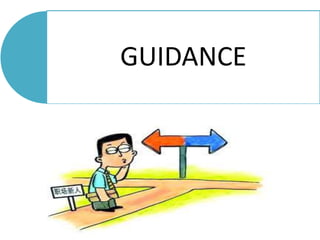





GUIDANCE
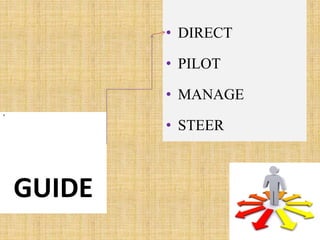
• DIRECT
• PILOT
• MANAGE
• STEER
‘
GUIDE
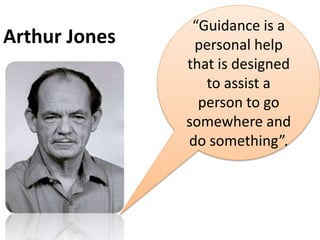
Arthur Jones
“Guidance is a
personal help
that is designed
to assist a
person to go
somewhere and
do something”.
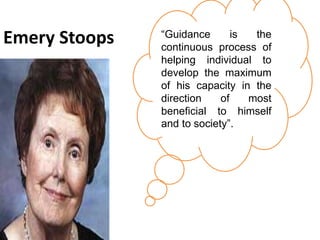
Emery Stoops “Guidance is the
continuous process of
helping individual to
develop the maximum
of his capacity in the
direction of most
beneficial to himself
and to society”.
NEED AND SIGNIFICANCE OF GUIDANCE
I. EDUCATIONAL NEEDS
 Guidance as an Instrument for the Qualitative
Improvement Education
 Expanding Educational Objectives
 Solution of Educational Problems
Solving Discipline Problems
II. VOCATIONAL NEEDS
• Vocationalisation of Education and Guidance
• Guidance as an Instrument of National
Development
• Expanding Complexity of the World of Work
•
Increasing need for Man-power Planning
and Utilization
Occupational Awareness
Changes in the Conditions of Industry and
Labour
III. PERSONAL / PSYCHOLOGICAL NEEDS
 Guidance is the Basic Need of Man
 Educational and Social Aspirations
 Psychological Problems
 Satisfactory Adjustment
 Proper Development of Personality
IV. SOCIAL NEEDS
Complex Nature of Society
Changed Family Contexts
Explosion of Population and Expansion in Human
Resources
Political Change and Extension of Democracy
Change in the Concept of Education
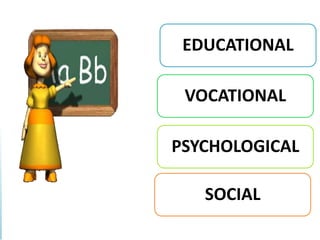
EDUCATIONAL
VOCATIONAL
PSYCHOLOGICAL
SOCIAL
OBJECTIVES OF GUIDANCE
• To help individual to understand and accept the
positive and negative aspects of his personality,
interests, aptitudes, attitudes etc.
• Provide a wide choice and opportunities
• Help make adjustment in the new life situation.
• Help in facing the challenges of life and
manage tensions by realizing and accepting
the facts.
• Help in solving social and personal
problems and be able to adjust with oneself
and the environment.
AIMS OF GUIDANCE
• Exploring Self
• Determining Values
• Setting Goals
• Improving Efficiency
• Building Relationship
• Accepting Responsibility for the Future
PURPOSE OF GUIDANCE
• To enable the individual or person to be matured,
socially responsible, economically self-sufficient and
ultimately to be self-directing citizen, for that
necessary programmes are undertaken for his best
development.
• It enables the individual/person to take right
decision in each and every stage of his life by
overcoming the necessities and incorporating
the necessities.
To achieve of self-sufficiency in each and every
aspects of life, the individual/person is helped to
analyze his self clearly i.e. his strength, limitation,
interests, aptitudes, abilities, potentialities etc.
Guidance is organized with the help of different
services to provide realistic information about
potentialities of the individual and the opening of
the world of work in which he is best fitted for.
NATURE AND CHARACTERISTICS OF
GUIDANCE
It is a Process
It is a Continuous Process
It is apart from Instruction
Guidance is a process of Development rather than
Direction
Guidance fulfills some aims of Education
BASIC ASSUMPTIONS OF GUIDANCE
Race, colour and sex have little as no relation
to aptitude and abilities.
Many crises cannot be successfully met by
student without assistance.
The school is in a strategic position to give the
assistance needed.
• Variations within the individual are
significant.
• Abilities already existing in individual are
not usually specialized
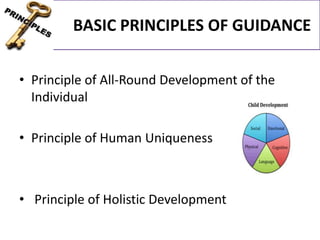
BASIC PRINCIPLES OF GUIDANCE
• Principle of All-Round Development of the
Individual
• Principle of Human Uniqueness
• Principle of Holistic Development
• Principle of Cooperation
• Principle of Continuity
• Principle of Adjustment
• Principle of Individual Needs
• Principle of Expert Opinion
• Principle of Evaluation
• Principle of Responsibility
• Principle of Periodic Appraisal
• The focus of guidance is the individual and not his
problem.
• Guidance is not a direction. At the same time, it is
not thrusting somebody’s views on others.
Guidance is also not taking decisions for others.
Guidance is, in fact, an integrated, organized and
creative process.
• Agarwal,R.(2007). Guidance and Counselling.
Delhi: Shipra Publications.
• Chand,S.(2008). Guidance and Counselling. New
Delhi: Rajendra Ravindra Pvt.Ltd.
• Chandra,S, & Rao,R.(2006). Educational
Psychology Evaluation & Statistics. Meerut: Raj
Printers.
• Kinra, K. (2008). Guidance and Counselling.
Noida: Dorling Kindersley Pvt.Ltd.
Guidance

Guidance

  • 2.
  • 5.
    • DIRECT • PILOT •MANAGE • STEER ‘ GUIDE
  • 7.
    Arthur Jones “Guidance isa personal help that is designed to assist a person to go somewhere and do something”.
  • 8.
    Emery Stoops “Guidanceis the continuous process of helping individual to develop the maximum of his capacity in the direction of most beneficial to himself and to society”.
  • 9.
  • 10.
    I. EDUCATIONAL NEEDS Guidance as an Instrument for the Qualitative Improvement Education  Expanding Educational Objectives  Solution of Educational Problems Solving Discipline Problems
  • 11.
    II. VOCATIONAL NEEDS •Vocationalisation of Education and Guidance • Guidance as an Instrument of National Development • Expanding Complexity of the World of Work •
  • 12.
    Increasing need forMan-power Planning and Utilization Occupational Awareness Changes in the Conditions of Industry and Labour
  • 13.
    III. PERSONAL /PSYCHOLOGICAL NEEDS  Guidance is the Basic Need of Man  Educational and Social Aspirations  Psychological Problems  Satisfactory Adjustment  Proper Development of Personality
  • 14.
    IV. SOCIAL NEEDS ComplexNature of Society Changed Family Contexts Explosion of Population and Expansion in Human Resources Political Change and Extension of Democracy Change in the Concept of Education
  • 15.
  • 16.
    OBJECTIVES OF GUIDANCE •To help individual to understand and accept the positive and negative aspects of his personality, interests, aptitudes, attitudes etc. • Provide a wide choice and opportunities • Help make adjustment in the new life situation.
  • 17.
    • Help infacing the challenges of life and manage tensions by realizing and accepting the facts. • Help in solving social and personal problems and be able to adjust with oneself and the environment.
  • 18.
    AIMS OF GUIDANCE •Exploring Self • Determining Values • Setting Goals • Improving Efficiency • Building Relationship • Accepting Responsibility for the Future
  • 19.
    PURPOSE OF GUIDANCE •To enable the individual or person to be matured, socially responsible, economically self-sufficient and ultimately to be self-directing citizen, for that necessary programmes are undertaken for his best development. • It enables the individual/person to take right decision in each and every stage of his life by overcoming the necessities and incorporating the necessities.
  • 20.
    To achieve ofself-sufficiency in each and every aspects of life, the individual/person is helped to analyze his self clearly i.e. his strength, limitation, interests, aptitudes, abilities, potentialities etc. Guidance is organized with the help of different services to provide realistic information about potentialities of the individual and the opening of the world of work in which he is best fitted for.
  • 21.
    NATURE AND CHARACTERISTICSOF GUIDANCE It is a Process It is a Continuous Process It is apart from Instruction Guidance is a process of Development rather than Direction Guidance fulfills some aims of Education
  • 22.
    BASIC ASSUMPTIONS OFGUIDANCE Race, colour and sex have little as no relation to aptitude and abilities. Many crises cannot be successfully met by student without assistance. The school is in a strategic position to give the assistance needed.
  • 23.
    • Variations withinthe individual are significant. • Abilities already existing in individual are not usually specialized
  • 24.
    BASIC PRINCIPLES OFGUIDANCE • Principle of All-Round Development of the Individual • Principle of Human Uniqueness • Principle of Holistic Development
  • 25.
    • Principle ofCooperation • Principle of Continuity • Principle of Adjustment • Principle of Individual Needs
  • 26.
    • Principle ofExpert Opinion • Principle of Evaluation • Principle of Responsibility • Principle of Periodic Appraisal
  • 27.
    • The focusof guidance is the individual and not his problem. • Guidance is not a direction. At the same time, it is not thrusting somebody’s views on others. Guidance is also not taking decisions for others. Guidance is, in fact, an integrated, organized and creative process.
  • 28.
    • Agarwal,R.(2007). Guidanceand Counselling. Delhi: Shipra Publications. • Chand,S.(2008). Guidance and Counselling. New Delhi: Rajendra Ravindra Pvt.Ltd. • Chandra,S, & Rao,R.(2006). Educational Psychology Evaluation & Statistics. Meerut: Raj Printers. • Kinra, K. (2008). Guidance and Counselling. Noida: Dorling Kindersley Pvt.Ltd.