PRESENTATION on
Basic principles
of learning and
their
implications
-P. SUBASRI,
VOC COLLEGE OF EDUCATION,
THOOTHUKUDI.
Learning
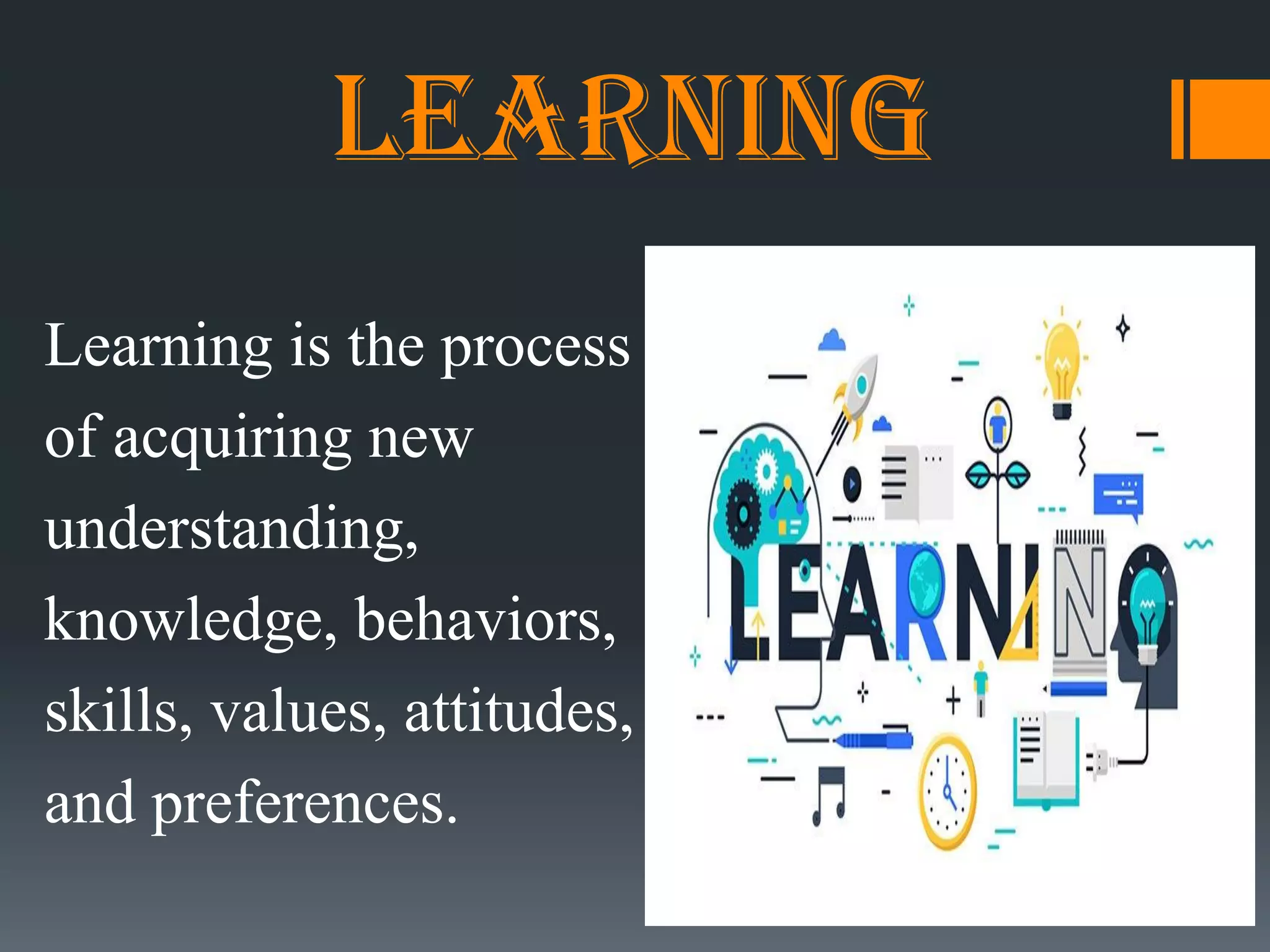
Learning is the process
of acquiring new
understanding,
knowledge, behaviors,
skills, values, attitudes,
and preferences.
Basic principles of
learning
LEARNING IS GROWTH:
Form of growth.
Natural and Inevitable.
Mental and physical growth.
Pestalozzi, Froebel and Marietta John – modern
education.
Learning is growth through experience.
LEARNING IS ADJUSTMENT:
Basic - adjust ourselves to our environment.
Gates and others,
“Learning may be thought of as the
progressive change in behaviour which is
associated on the one hand with successive
presentations of a situation, and, on the
other, with repeated efforts of the
individual to react to it effectively.”
School learning - adjustment toward the goal
of learning.
LEARNING IS ORGANIZING
EXPERIENCE:
Synthesis of the old and the new experiences -
results - new organization of pattern of
experiences.
Organization of experiences involves the
elimination of unnecessary habits.
Arranged and rearranged in proper relation.
Finally appropriate learning takes place.
LEARNING IS PURPOSEFUL:
Goal-directed.
Learner finds that his desires are fulfilled -
learning is effective.
Irrelevant material is more rapidly forgotten
than relevant material.
LEARNING IS INTELLIGENT:
An insight is gained - processes are
understood.
Understand – intelligence gain – learning can
be long lasted.
Meaningless repetition does not produce
permanent learning.
LEARNING IS ACTION:
Learning is the natural outcome to meet one’s
basic and normal needs.
All genuine learning is self – learning.
Individual should be an active participant in
learning process.
The Dalton plan, the Project method, the
Montessori Method, the Kindergarten – Basic
education lay stress on the characteristics of
learning.
LEARNING IS BOTH
INDIVIDUALAND SOCIAL:
Learning is more than an individual activity; it
is a social activity too.
Family, community, gang, religious places,
and other institutions.
Social agencies - tremendous influence on an
individual - affects their behavior pattern.
Either consciously or unconsciously it affect
an individual.
LEARNING IS
UNENFORCEABLE:
Human learning - human action.
It cannot be enforced upon the human beings.
Teacher must wait for the child to be ready for
learning.
Unenforceable - characteristic of learning.
LEARNING IS A PRODUCT OF
THE ENVIRONMENT:
Learning - takes place in relation to the
environment.
Environment - healthy and rich in educative
possibilities - conductive to learning.
TRUE LEARNING AFFECTS THE
CONDUCT OF THE LEARNER:
Changes in the conduct (behavior pattern) of
the leaner.
Every experience produces a change in the
mental structure of the learner.
It affects the conduct of the learner.
Goal of learning.
LEARNING FREQUENTLY
DEPENDS UPON INSIGHT:
Insight - “flash of understanding”.
It occurs when suddenly becomes charged
with meaning, or when the solution to a
problem or the way to a goal.
The ability to gain insight depends upon
interest, previous knowledge and intelligence.
Dull child – the teacher should give special
assistance to the child.
Implications
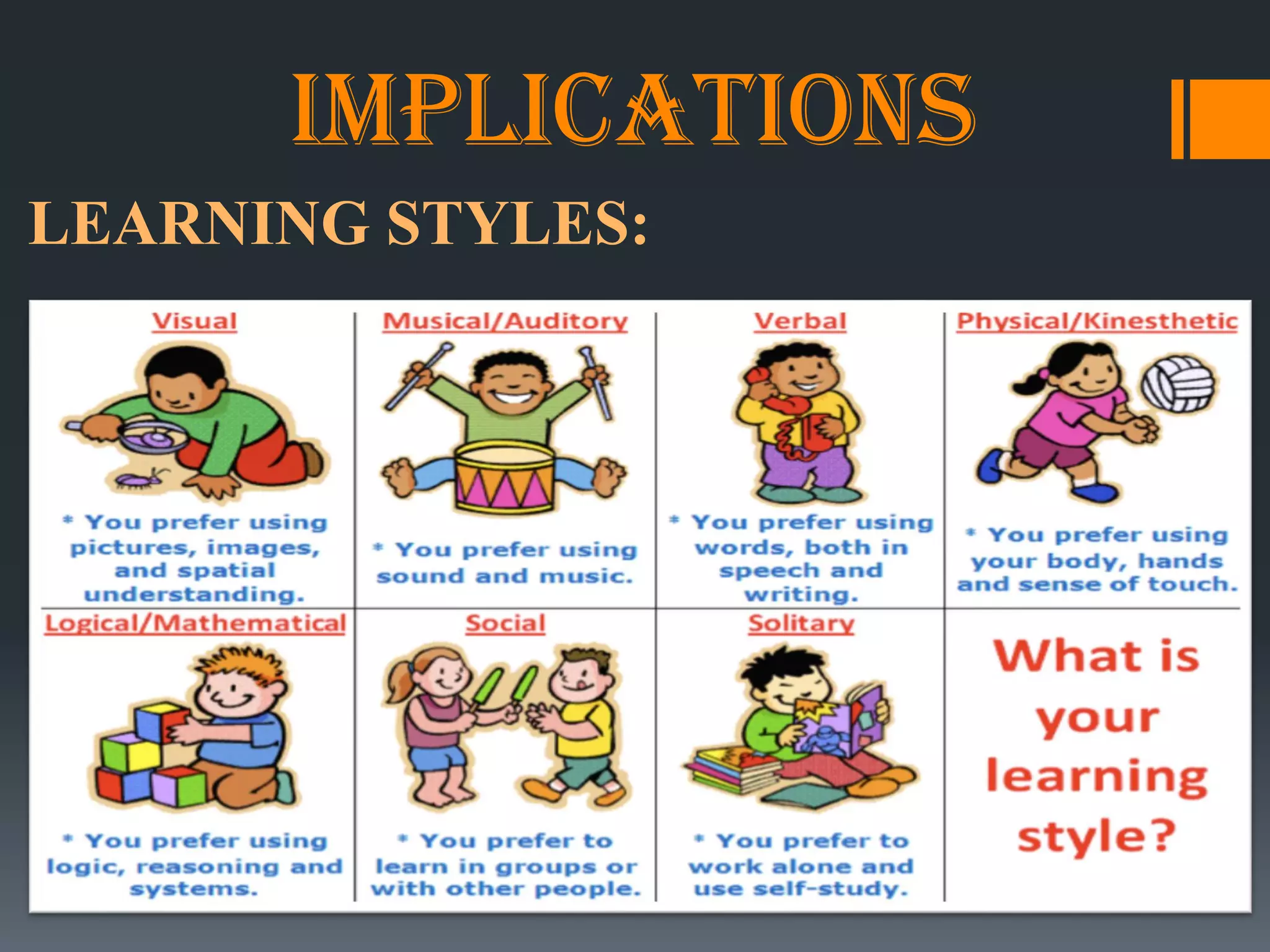
LEARNING STYLES:
Haynes list out some activities for students
with different learning styles,
Visual learners - computer graphic, maps,
graphs, charts, cartoons, posters, diagrams text
with a lot of pictures.
Auditory learners - interviewing, debating,
participating on a panel, giving oral reports
and participating in oral discussions of written
material.
Kinesthetic learners - playing games that
involve the whole body, movement activities,
making models, and setting up experiments.
Thank you

Presentation on Basic principles of learning and their implications

  • 1.
    PRESENTATION on Basic principles oflearning and their implications -P. SUBASRI, VOC COLLEGE OF EDUCATION, THOOTHUKUDI.
  • 2.
    Learning Learning is theprocess of acquiring new understanding, knowledge, behaviors, skills, values, attitudes, and preferences.
  • 3.
    Basic principles of learning LEARNINGIS GROWTH: Form of growth. Natural and Inevitable. Mental and physical growth. Pestalozzi, Froebel and Marietta John – modern education. Learning is growth through experience.
  • 4.
    LEARNING IS ADJUSTMENT: Basic- adjust ourselves to our environment. Gates and others, “Learning may be thought of as the progressive change in behaviour which is associated on the one hand with successive presentations of a situation, and, on the other, with repeated efforts of the individual to react to it effectively.” School learning - adjustment toward the goal of learning.
  • 5.
    LEARNING IS ORGANIZING EXPERIENCE: Synthesisof the old and the new experiences - results - new organization of pattern of experiences. Organization of experiences involves the elimination of unnecessary habits. Arranged and rearranged in proper relation. Finally appropriate learning takes place.
  • 6.
    LEARNING IS PURPOSEFUL: Goal-directed. Learnerfinds that his desires are fulfilled - learning is effective. Irrelevant material is more rapidly forgotten than relevant material. LEARNING IS INTELLIGENT: An insight is gained - processes are understood. Understand – intelligence gain – learning can be long lasted. Meaningless repetition does not produce permanent learning.
  • 7.
    LEARNING IS ACTION: Learningis the natural outcome to meet one’s basic and normal needs. All genuine learning is self – learning. Individual should be an active participant in learning process. The Dalton plan, the Project method, the Montessori Method, the Kindergarten – Basic education lay stress on the characteristics of learning.
  • 9.
    LEARNING IS BOTH INDIVIDUALANDSOCIAL: Learning is more than an individual activity; it is a social activity too. Family, community, gang, religious places, and other institutions. Social agencies - tremendous influence on an individual - affects their behavior pattern. Either consciously or unconsciously it affect an individual.
  • 10.
    LEARNING IS UNENFORCEABLE: Human learning- human action. It cannot be enforced upon the human beings. Teacher must wait for the child to be ready for learning. Unenforceable - characteristic of learning. LEARNING IS A PRODUCT OF THE ENVIRONMENT: Learning - takes place in relation to the environment. Environment - healthy and rich in educative possibilities - conductive to learning.
  • 11.
    TRUE LEARNING AFFECTSTHE CONDUCT OF THE LEARNER: Changes in the conduct (behavior pattern) of the leaner. Every experience produces a change in the mental structure of the learner. It affects the conduct of the learner. Goal of learning.
  • 12.
    LEARNING FREQUENTLY DEPENDS UPONINSIGHT: Insight - “flash of understanding”. It occurs when suddenly becomes charged with meaning, or when the solution to a problem or the way to a goal. The ability to gain insight depends upon interest, previous knowledge and intelligence. Dull child – the teacher should give special assistance to the child.
  • 13.
  • 14.
    Haynes list outsome activities for students with different learning styles, Visual learners - computer graphic, maps, graphs, charts, cartoons, posters, diagrams text with a lot of pictures. Auditory learners - interviewing, debating, participating on a panel, giving oral reports and participating in oral discussions of written material. Kinesthetic learners - playing games that involve the whole body, movement activities, making models, and setting up experiments.
  • 15.