By
Dr. Satish Raj
Assistant Professor
School of Education
Lovely Professional University Jalandhar,
Punjab, India
Email:- satishnurpur@gmail.com
+91 7589110552
INTRODUCTION
• Guidance & counselling are twin concepts & have
emerged as essential elements of every educational
activity.
• Guidance & counselling are not synonymous term.
Counselling is a part of guidance.
• Guidance, in educational context, means to
indicate, point out, show the way, lead out & direct.
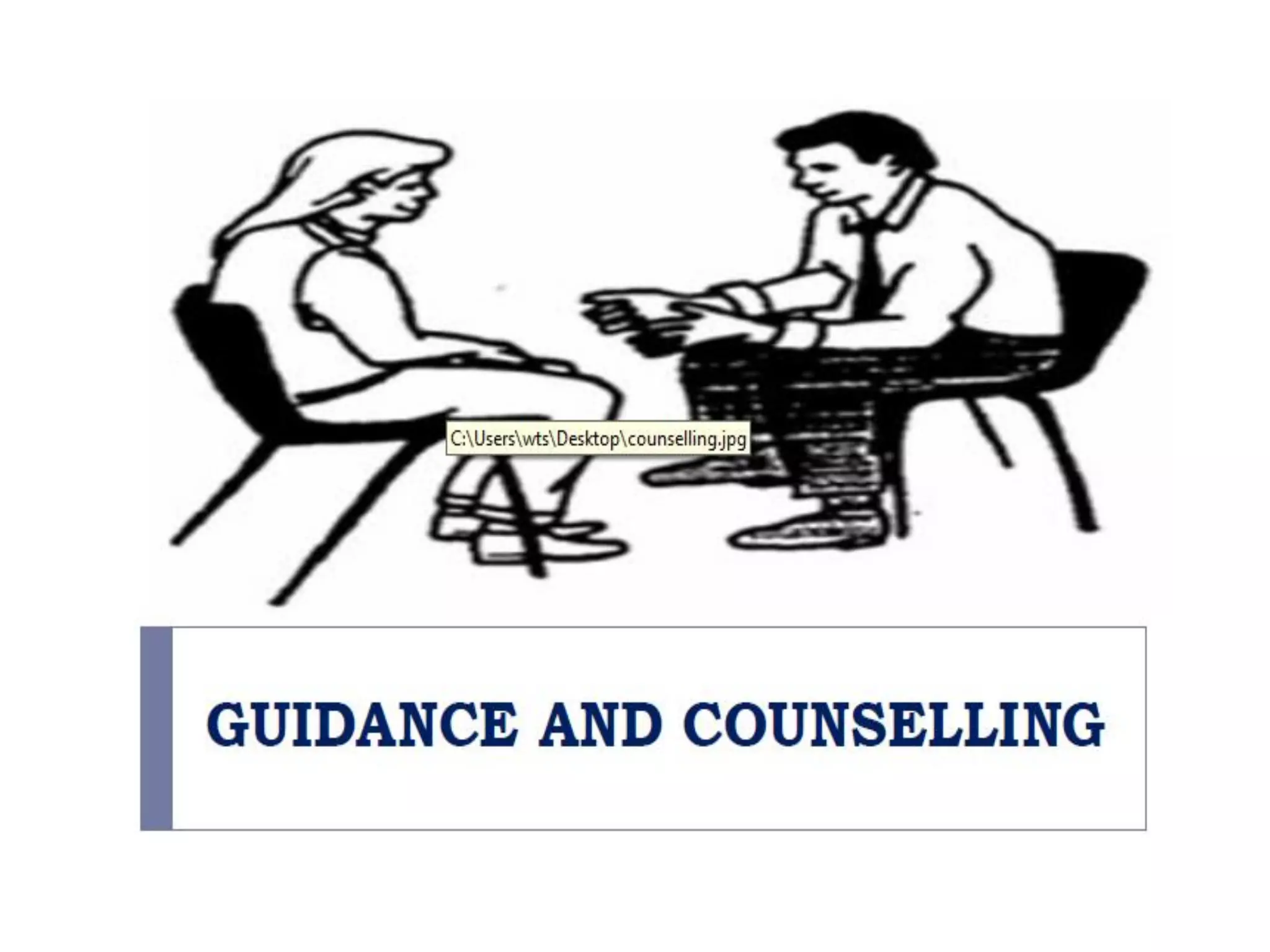
• Counselling is a specialized service of guidance. It
is the process of helping individuals learn more
about themselves & their present & possible future
situations to make a substantial contribution to the
society.
DEFINITION OF COUNSELLING
• Counseling is essentially a process in
which the counselor assists the counselee
to make interpretations of facts relating to
a choice, plan or adjustment which he
needs to make. - Glenn F. Smith
• Counseling is a series of direct contacts
with the individual which aims to offer
him assistance in changing his attitude &
behaviors.- Carl Rogers
DIFFERENCE BETWEEN GUIDANCE
AND COUNSELLING
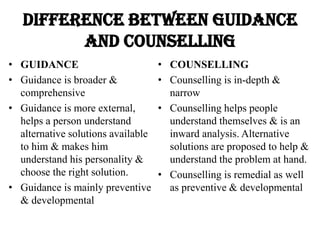
• GUIDANCE
• Guidance is broader &
comprehensive
• Guidance is more external,
helps a person understand
alternative solutions available
to him & makes him
understand his personality &
choose the right solution.
• Guidance is mainly preventive
& developmental
• COUNSELLING
• Counselling is in-depth &
narrow
• Counselling helps people
understand themselves & is an
inward analysis. Alternative
solutions are proposed to help &
understand the problem at hand.
• Counselling is remedial as well
as preventive & developmental
DIFFERENCE BETWEEN GUIDANCE
AND COUNSELLING
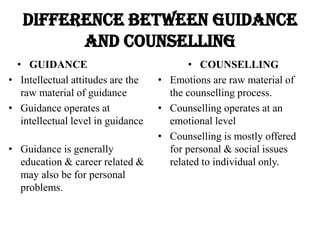
• GUIDANCE
• Intellectual attitudes are the
raw material of guidance
• Guidance operates at
intellectual level in guidance
• Guidance is generally
education & career related &
may also be for personal
problems.
• COUNSELLING
• Emotions are raw material of
the counselling process.
• Counselling operates at an
emotional level
• Counselling is mostly offered
for personal & social issues
related to individual only.
CHARACTERISTS OF COUNSELLING
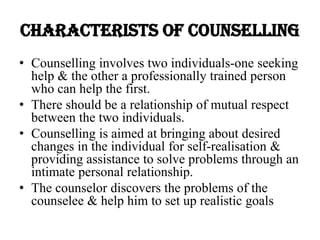
• Counselling involves two individuals-one seeking
help & the other a professionally trained person
who can help the first.
• There should be a relationship of mutual respect
between the two individuals.
• Counselling is aimed at bringing about desired
changes in the individual for self-realisation &
providing assistance to solve problems through an
intimate personal relationship.
• The counselor discovers the problems of the
counselee & help him to set up realistic goals
CHARACTERISTS OF COUNSELLING
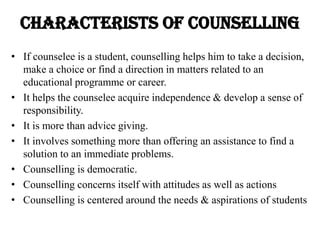
• If counselee is a student, counselling helps him to take a decision,
make a choice or find a direction in matters related to an
educational programme or career.
• It helps the counselee acquire independence & develop a sense of
responsibility.
• It is more than advice giving.
• It involves something more than offering an assistance to find a
solution to an immediate problems.
• Counselling is democratic.
• Counselling concerns itself with attitudes as well as actions
• Counselling is centered around the needs & aspirations of students
Objectives OF COUNSELLING
• To help individuals with development problems.
• To help individuals through a temporary crisis during the different
stages of life.
• To identify signs of disturbed behavior at early stage, so manage
it.
• To refer critical cases to specialists for best possible management.
• To facilitate communication within & between educational
institutions & homes.
• To establish mutual understanding between students and teachers
• To work out the programme for solving the difficulties
• To help the individual to know his interests, abilities attitudes etc.
• To encourage students to develop special abilities and right
attitudes
Principles OF COUNSELLING
• Hann and Maclean described following principles of counseling
• 1. Counselling is strongly dedicated to self-direction and self-
• realisation of the client.
• 2. Counselling is development of insights and understandings of
• the relations of self and environment.
• 3. Counselling is structured learning situation
• 4. Counselling methods vary with the needs of the client
• 5. Counselling is primarily a preventive and remedial process
Scope OF COUNSELLING
• Educational counselling
• Vocational counselling
• Placement counselling
• Health counselling
• Personal counselling
• Motivational counselling
• Developmental counselling
• Marriage counselling
Directive Counselling
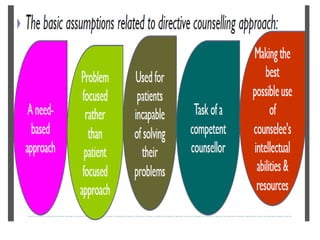
• It is also known as prescriptive counselling or counsellor-centred
approach of counselling.
• This approach of counselling is advocated by E.G. Williamson, a
professor at University of Minnesota.
• In directive counselling, the counsellor plays a leading role & uses
a variety of techniques to suggest appropriate solutions to the
counselee's problem.
• This approach also known as authoritarian or psychoanalytic
approach.
• The counsellor is active & help individuals in making decisions &
finding solution to their problems.
• The client makes the decision but the counsellor does all he can to
get the client make decision keeping with his diagnosis.
• The counsellor tries to direct the client’s thinking by informing,
explaining, interpreting & advising.
Advantages of the directive
counselling approach
• This approach save time.
• It emphasizes the problem & not the
individual. The counsellor can see the client
more objectively than the patient himself.
• It lays more emphasis on the intellectual rather
than the emotional aspects of an individual’s
personality.
• The methods used in directive counselling are
direct, persuasive & explanatory.
Limitations of the directive
counselling approach
• The client does not gain any liability for self
analysis or solve new problems of adjustment by
counselling.
• It makes the counselee over dependent on the
counsellor.
• Problems regarding emotional maladjustment
may be better solved by nondirective counselling.
• Sometimes the counselee lacks information
regarding the counselee, leads wrong counselling.
• It does not guarantee that the counselee will able
to solve the same problem on his own in future.
Nondirective Counselling
• The chief exponent of this counselling approach, Carp R.
• It is also known as the permissive counselling approach
where the counselor's role is passive & the counselee’s
role is active.
• It is a counselee-centredor patient-centred humanistic
approach.
• The counselee makes the final decisions as individuals
are thoughts to have full right to make final decisions for
the self & solve their problems.
• The counsellor has to accept the counselee’s capacity to
make adjustment & adapt.
• The principles of acceptance & tolerance are extremely
important in this approach.
basic assumptions
• Patient is given importance than the counselling
directions & investigations
• Emotional aspects are more significant than
intellectual aspects.
• Creation of an atmosphere where patients can
work out their understanding is more important
than cultivating self-understanding in the
patient.
• Counselling leads to a voluntary choice of goals
& a conscious selection of courses of action.
.
• .
Advantages of nondirective counselling
• It is a slow but sure process to make an
individual capable of making adjustments.
• No tests are used so one avoids all that is
laborious & difficult .
• It removes emotional block & helps an
individual bring repressed thoughts on a
conscious level thereby reducing tension.
Limitations of nondirective counselling
• It is a slow & time-consuming process.
• One cannot rely upon one’s resources, judgment &
wisdom as the patient is immature in making the
decision himself.
• It depends too much on the ability & initiative of the
patient.
• Sometime difficulty to control pace of the interview
discussion.
• This approach is individual centric, it may not possible
for counsellor to attend every patient equally well.
• It require high degree of motivation in the patient.
Eclectic Counselling
• This approach is based on the fact that all
individuals are different from one another.
• The techniques are elective in nature because
they have been derived from all sources of
counselling.
• This approach is based on selecting the best &
leaving out what is least required.
Eclectic Counselling
• In this type of counseling counselor is neither
too active and nor too passive and the same
principle is true to counselee also. The
counselor tries to adopt his methods according
to needs of the counselee and motivates the
counselee to solve his own problems after
careful observation and analysis of personality
and needs of the individual.
basic assumptions
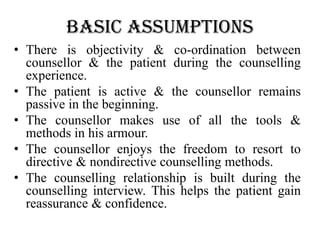
• There is objectivity & co-ordination between
counsellor & the patient during the counselling
experience.
• The patient is active & the counsellor remains
passive in the beginning.
• The counsellor makes use of all the tools &
methods in his armour.
• The counsellor enjoys the freedom to resort to
directive & nondirective counselling methods.
• The counselling relationship is built during the
counselling interview. This helps the patient gain
reassurance & confidence.
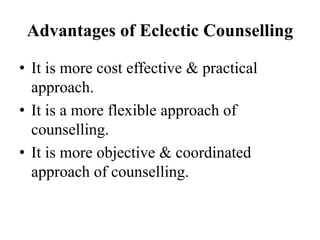
Advantages of Eclectic Counselling
• It is more cost effective & practical
approach.
• It is a more flexible approach of
counselling.
• It is more objective & coordinated
approach of counselling.
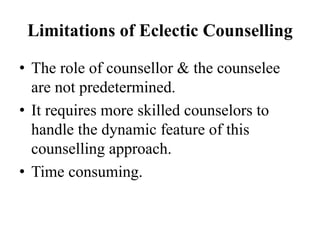
Limitations of Eclectic Counselling
• The role of counsellor & the counselee
are not predetermined.
• It requires more skilled counselors to
handle the dynamic feature of this
counselling approach.
• Time consuming.
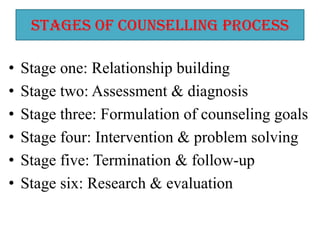
Stages of counselling process
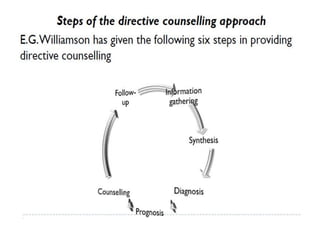
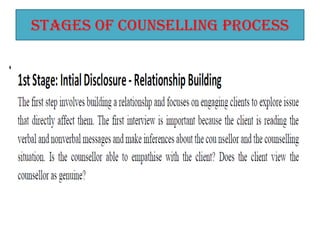
• Stage one: Relationship building
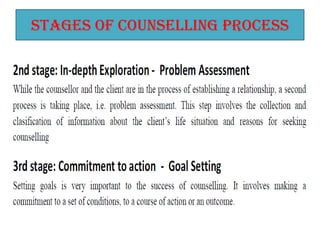
• Stage two: Assessment & diagnosis
• Stage three: Formulation of counseling goals
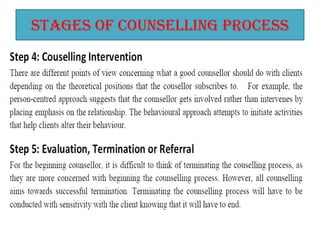
• Stage four: Intervention & problem solving
• Stage five: Termination & follow-up
• Stage six: Research & evaluation
Stages of counselling process
• .
Stages of counselling process
• .
Stages of counselling process
• .
Place of counselling in guidance
programme
• Problem solving approach
• Client is center of consideration
• Individual attention is there
• Unique problems can be sorted out
• Supplement to general guidance programme
• Interventions can be given as remedial
measures
• Deep analysis and exploration can be done

Counseling

  • 2.
    By Dr. Satish Raj AssistantProfessor School of Education Lovely Professional University Jalandhar, Punjab, India Email:- satishnurpur@gmail.com +91 7589110552
  • 3.
    INTRODUCTION • Guidance &counselling are twin concepts & have emerged as essential elements of every educational activity. • Guidance & counselling are not synonymous term. Counselling is a part of guidance. • Guidance, in educational context, means to indicate, point out, show the way, lead out & direct. • Counselling is a specialized service of guidance. It is the process of helping individuals learn more about themselves & their present & possible future situations to make a substantial contribution to the society.
  • 4.
    DEFINITION OF COUNSELLING •Counseling is essentially a process in which the counselor assists the counselee to make interpretations of facts relating to a choice, plan or adjustment which he needs to make. - Glenn F. Smith • Counseling is a series of direct contacts with the individual which aims to offer him assistance in changing his attitude & behaviors.- Carl Rogers
  • 5.
    DIFFERENCE BETWEEN GUIDANCE ANDCOUNSELLING • GUIDANCE • Guidance is broader & comprehensive • Guidance is more external, helps a person understand alternative solutions available to him & makes him understand his personality & choose the right solution. • Guidance is mainly preventive & developmental • COUNSELLING • Counselling is in-depth & narrow • Counselling helps people understand themselves & is an inward analysis. Alternative solutions are proposed to help & understand the problem at hand. • Counselling is remedial as well as preventive & developmental
  • 6.
    DIFFERENCE BETWEEN GUIDANCE ANDCOUNSELLING • GUIDANCE • Intellectual attitudes are the raw material of guidance • Guidance operates at intellectual level in guidance • Guidance is generally education & career related & may also be for personal problems. • COUNSELLING • Emotions are raw material of the counselling process. • Counselling operates at an emotional level • Counselling is mostly offered for personal & social issues related to individual only.
  • 7.
    CHARACTERISTS OF COUNSELLING •Counselling involves two individuals-one seeking help & the other a professionally trained person who can help the first. • There should be a relationship of mutual respect between the two individuals. • Counselling is aimed at bringing about desired changes in the individual for self-realisation & providing assistance to solve problems through an intimate personal relationship. • The counselor discovers the problems of the counselee & help him to set up realistic goals
  • 8.
    CHARACTERISTS OF COUNSELLING •If counselee is a student, counselling helps him to take a decision, make a choice or find a direction in matters related to an educational programme or career. • It helps the counselee acquire independence & develop a sense of responsibility. • It is more than advice giving. • It involves something more than offering an assistance to find a solution to an immediate problems. • Counselling is democratic. • Counselling concerns itself with attitudes as well as actions • Counselling is centered around the needs & aspirations of students
  • 9.
    Objectives OF COUNSELLING •To help individuals with development problems. • To help individuals through a temporary crisis during the different stages of life. • To identify signs of disturbed behavior at early stage, so manage it. • To refer critical cases to specialists for best possible management. • To facilitate communication within & between educational institutions & homes. • To establish mutual understanding between students and teachers • To work out the programme for solving the difficulties • To help the individual to know his interests, abilities attitudes etc. • To encourage students to develop special abilities and right attitudes
  • 10.
    Principles OF COUNSELLING •Hann and Maclean described following principles of counseling • 1. Counselling is strongly dedicated to self-direction and self- • realisation of the client. • 2. Counselling is development of insights and understandings of • the relations of self and environment. • 3. Counselling is structured learning situation • 4. Counselling methods vary with the needs of the client • 5. Counselling is primarily a preventive and remedial process
  • 11.
    Scope OF COUNSELLING •Educational counselling • Vocational counselling • Placement counselling • Health counselling • Personal counselling • Motivational counselling • Developmental counselling • Marriage counselling
  • 13.
    Directive Counselling • Itis also known as prescriptive counselling or counsellor-centred approach of counselling. • This approach of counselling is advocated by E.G. Williamson, a professor at University of Minnesota. • In directive counselling, the counsellor plays a leading role & uses a variety of techniques to suggest appropriate solutions to the counselee's problem. • This approach also known as authoritarian or psychoanalytic approach. • The counsellor is active & help individuals in making decisions & finding solution to their problems. • The client makes the decision but the counsellor does all he can to get the client make decision keeping with his diagnosis. • The counsellor tries to direct the client’s thinking by informing, explaining, interpreting & advising.
  • 16.
    Advantages of thedirective counselling approach • This approach save time. • It emphasizes the problem & not the individual. The counsellor can see the client more objectively than the patient himself. • It lays more emphasis on the intellectual rather than the emotional aspects of an individual’s personality. • The methods used in directive counselling are direct, persuasive & explanatory.
  • 17.
    Limitations of thedirective counselling approach • The client does not gain any liability for self analysis or solve new problems of adjustment by counselling. • It makes the counselee over dependent on the counsellor. • Problems regarding emotional maladjustment may be better solved by nondirective counselling. • Sometimes the counselee lacks information regarding the counselee, leads wrong counselling. • It does not guarantee that the counselee will able to solve the same problem on his own in future.
  • 18.
    Nondirective Counselling • Thechief exponent of this counselling approach, Carp R. • It is also known as the permissive counselling approach where the counselor's role is passive & the counselee’s role is active. • It is a counselee-centredor patient-centred humanistic approach. • The counselee makes the final decisions as individuals are thoughts to have full right to make final decisions for the self & solve their problems. • The counsellor has to accept the counselee’s capacity to make adjustment & adapt. • The principles of acceptance & tolerance are extremely important in this approach.
  • 19.
    basic assumptions • Patientis given importance than the counselling directions & investigations • Emotional aspects are more significant than intellectual aspects. • Creation of an atmosphere where patients can work out their understanding is more important than cultivating self-understanding in the patient. • Counselling leads to a voluntary choice of goals & a conscious selection of courses of action.
  • 20.
  • 21.
    Advantages of nondirectivecounselling • It is a slow but sure process to make an individual capable of making adjustments. • No tests are used so one avoids all that is laborious & difficult . • It removes emotional block & helps an individual bring repressed thoughts on a conscious level thereby reducing tension.
  • 22.
    Limitations of nondirectivecounselling • It is a slow & time-consuming process. • One cannot rely upon one’s resources, judgment & wisdom as the patient is immature in making the decision himself. • It depends too much on the ability & initiative of the patient. • Sometime difficulty to control pace of the interview discussion. • This approach is individual centric, it may not possible for counsellor to attend every patient equally well. • It require high degree of motivation in the patient.
  • 23.
    Eclectic Counselling • Thisapproach is based on the fact that all individuals are different from one another. • The techniques are elective in nature because they have been derived from all sources of counselling. • This approach is based on selecting the best & leaving out what is least required.
  • 24.
    Eclectic Counselling • Inthis type of counseling counselor is neither too active and nor too passive and the same principle is true to counselee also. The counselor tries to adopt his methods according to needs of the counselee and motivates the counselee to solve his own problems after careful observation and analysis of personality and needs of the individual.
  • 25.
    basic assumptions • Thereis objectivity & co-ordination between counsellor & the patient during the counselling experience. • The patient is active & the counsellor remains passive in the beginning. • The counsellor makes use of all the tools & methods in his armour. • The counsellor enjoys the freedom to resort to directive & nondirective counselling methods. • The counselling relationship is built during the counselling interview. This helps the patient gain reassurance & confidence.
  • 27.
    Advantages of EclecticCounselling • It is more cost effective & practical approach. • It is a more flexible approach of counselling. • It is more objective & coordinated approach of counselling.
  • 28.
    Limitations of EclecticCounselling • The role of counsellor & the counselee are not predetermined. • It requires more skilled counselors to handle the dynamic feature of this counselling approach. • Time consuming.
  • 29.
    Stages of counsellingprocess • Stage one: Relationship building • Stage two: Assessment & diagnosis • Stage three: Formulation of counseling goals • Stage four: Intervention & problem solving • Stage five: Termination & follow-up • Stage six: Research & evaluation
  • 30.
    Stages of counsellingprocess • .
  • 31.
    Stages of counsellingprocess • .
  • 32.
    Stages of counsellingprocess • .
  • 33.
    Place of counsellingin guidance programme • Problem solving approach • Client is center of consideration • Individual attention is there • Unique problems can be sorted out • Supplement to general guidance programme • Interventions can be given as remedial measures • Deep analysis and exploration can be done