
According to American Society
of Anesthesiology
((ASA
Patients Classified into
ASA I; ASA II; ASAIII ;ASA IV
& ASA V
20/01/14
ASA I
Healthy, normal patient
Physiologically able to tolerate the stress
Without psychological problems
No treatment modifications are indicated

20/01/14
ASA II
Mild systemic disease
Can perform normal activity without
experiencing distress
Healthy patient with more extreme anxiety
May need modification in treatment

20/01/14
ASA III
Severe systemic disease
Limited activity but not incapacitated
Need stress reduction method during dental
treatment
May need to alter treatment

20/01/14
ASA IV
Has an incapacitating disease that is life
threatening
Patient is in distress at rest
No elective dental therapy
Emergency treatment should be in hospital
setting

20/01/14
ASA V
Moribund patient - not expected to live 24
hours with or without operation

20/01/14
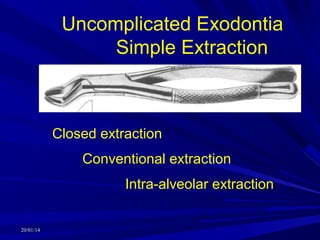
Uncomplicated Exodontia
Simple Extraction

Closed extraction
Conventional extraction
Intra-alveolar extraction
20/01/14
Indications for removal of teeth
• Sever caries
• Pulpal necrosis not amenable to
•
•
•
•
•
•

endodontic treatment
Sever periodontal disease with
excessive bone loss
Orthodontic reasons
Malopposed or malpositioned
teeth
Supernumerary teeth
Cracked teeth
Preprosthetic extractions
20/01/14
Indications for removal of teeth
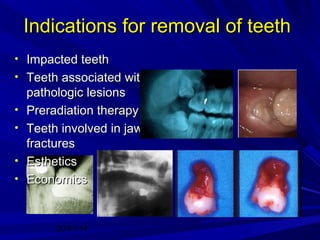
• Impacted teeth
• Teeth associated with
•
•
•
•

pathologic lesions
Preradiation therapy
Teeth involved in jaw
fractures
Esthetics
Economics

20/01/14
20/01/14
Contraindications for the
removal of teeth
• Systemic contraindications
• Local contraindications

20/01/14
Systemic contraindications
• Uncontrolled or poorly controlled medical

conditions: diabetics, Leukemia , cardiac
disease ;end stage renal disease
• Severe bleeding diathesis as hemophilia ,or
platelet disorder
• Pregnancy is a relative contraindication? Safe in
the second trimester
• Patients on special medications: corticosteroids,
immunosuppressive, or chemotherapy
20/01/14
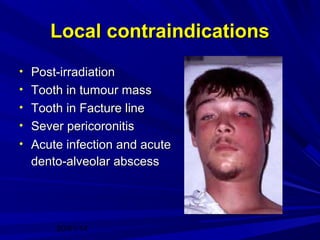
Local contraindications
• Post-irradiation
• Tooth in tumour mass
• Tooth in Facture line
• Sever pericoronitis
• Acute infection and acute

dento-alveolar abscess

20/01/14
Patient assessment
• Level of co-operation
• Medical history
• Choice of anaesthesia

20/01/14
Level of co-operation
• All patient to be consented for dental extraction

and the procedure explained to them
• Most patients are co-operative and can be
treated under LA
• Conscious sedation and GA should be
considered in the following conditions:
• Irreconcilable dental phobia
• Handicapped patients
• Young children below the age of reason
• Long procedure
• Contraindication to LA
20/01/14
Medical history
• Patient medical history has to be

thoroughly evaluated e.g.:

Bleeding problems
Immunocompromised patients
Ischemic heart disease, cardiac infarction
Infective endocarditis
Patients with previous radiotherapy to the
jaws
• Others
•
•
•
•
•

20/01/14
Choice of anaesthesia
Judged by: Medical history and Level
of co-operation
a. Local anaesthesia( LA):
 Simple procedures (30-45min)
 Single operative site
 Accessible areas

b. General anaesthesia (GA):
 Complicated procedures
 Multiple operative sites
 Difficult accessibility
20/01/14
Clinical Examination
.The tooth to be extracted is examined
Teeth misplaced palatally or lingually ,
rotated , inclined or single standing teeth
.in occlusion , are all potentially difficult
Certain teeth have abnormal root formation,
particularly the upper and lower third
.molars . Heavily filled and dead teeth

20/01/14
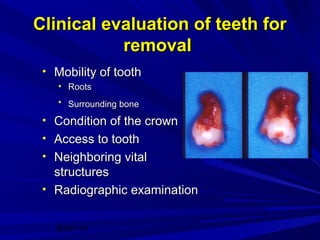
Clinical evaluation of teeth for
removal
• Mobility of tooth
• Roots
• Surrounding bone

• Condition of the crown
• Access to tooth
• Neighboring vital

structures
• Radiographic examination
20/01/14
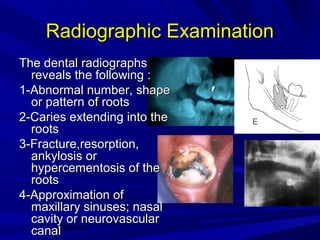
Radiographic Examination
The dental radiographs
reveals the following :
1-Abnormal number, shape
or pattern of roots
2-Caries extending into the
roots
3-Fracture,resorption,
ankylosis or
hypercementosis of the
roots
4-Approximation of
maxillary sinuses; nasal
cavity or neurovascular
20/01/14
canal
Requirements of Pre-extraction
Radiograph
A-It should show the whole root structure
B-It should show the bone investing
C-It should show the relation to any
important anatomical structure
Types of Radiograph :
A-Intra-oral radiograph
B-Extra-oral radiograph
20/01/14
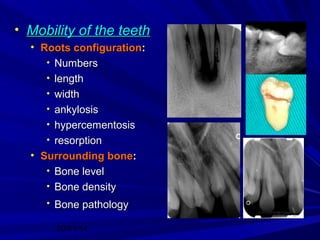
• Mobility of the teeth
• Roots configuration:
• Numbers
• length
• width
• ankylosis
• hypercementosis
• resorption
• Surrounding bone:
• Bone level
• Bone density
• Bone pathology
20/01/14

Principles of Exodontia

  • 1.
    According to AmericanSociety of Anesthesiology ((ASA Patients Classified into ASA I; ASA II; ASAIII ;ASA IV & ASA V 20/01/14
  • 2.
    ASA I Healthy, normalpatient Physiologically able to tolerate the stress Without psychological problems No treatment modifications are indicated 20/01/14
  • 3.
    ASA II Mild systemicdisease Can perform normal activity without experiencing distress Healthy patient with more extreme anxiety May need modification in treatment 20/01/14
  • 4.
    ASA III Severe systemicdisease Limited activity but not incapacitated Need stress reduction method during dental treatment May need to alter treatment 20/01/14
  • 5.
    ASA IV Has anincapacitating disease that is life threatening Patient is in distress at rest No elective dental therapy Emergency treatment should be in hospital setting 20/01/14
  • 6.
    ASA V Moribund patient- not expected to live 24 hours with or without operation 20/01/14
  • 7.
    Uncomplicated Exodontia Simple Extraction Closedextraction Conventional extraction Intra-alveolar extraction 20/01/14
  • 8.
    Indications for removalof teeth • Sever caries • Pulpal necrosis not amenable to • • • • • • endodontic treatment Sever periodontal disease with excessive bone loss Orthodontic reasons Malopposed or malpositioned teeth Supernumerary teeth Cracked teeth Preprosthetic extractions 20/01/14
  • 9.
    Indications for removalof teeth • Impacted teeth • Teeth associated with • • • • pathologic lesions Preradiation therapy Teeth involved in jaw fractures Esthetics Economics 20/01/14
  • 10.
  • 11.
    Contraindications for the removalof teeth • Systemic contraindications • Local contraindications 20/01/14
  • 12.
    Systemic contraindications • Uncontrolledor poorly controlled medical conditions: diabetics, Leukemia , cardiac disease ;end stage renal disease • Severe bleeding diathesis as hemophilia ,or platelet disorder • Pregnancy is a relative contraindication? Safe in the second trimester • Patients on special medications: corticosteroids, immunosuppressive, or chemotherapy 20/01/14
  • 13.
    Local contraindications • Post-irradiation •Tooth in tumour mass • Tooth in Facture line • Sever pericoronitis • Acute infection and acute dento-alveolar abscess 20/01/14
  • 14.
    Patient assessment • Levelof co-operation • Medical history • Choice of anaesthesia 20/01/14
  • 15.
    Level of co-operation •All patient to be consented for dental extraction and the procedure explained to them • Most patients are co-operative and can be treated under LA • Conscious sedation and GA should be considered in the following conditions: • Irreconcilable dental phobia • Handicapped patients • Young children below the age of reason • Long procedure • Contraindication to LA 20/01/14
  • 16.
    Medical history • Patientmedical history has to be thoroughly evaluated e.g.: Bleeding problems Immunocompromised patients Ischemic heart disease, cardiac infarction Infective endocarditis Patients with previous radiotherapy to the jaws • Others • • • • • 20/01/14
  • 17.
    Choice of anaesthesia Judgedby: Medical history and Level of co-operation a. Local anaesthesia( LA):  Simple procedures (30-45min)  Single operative site  Accessible areas b. General anaesthesia (GA):  Complicated procedures  Multiple operative sites  Difficult accessibility 20/01/14
  • 18.
    Clinical Examination .The toothto be extracted is examined Teeth misplaced palatally or lingually , rotated , inclined or single standing teeth .in occlusion , are all potentially difficult Certain teeth have abnormal root formation, particularly the upper and lower third .molars . Heavily filled and dead teeth 20/01/14
  • 19.
    Clinical evaluation ofteeth for removal • Mobility of tooth • Roots • Surrounding bone • Condition of the crown • Access to tooth • Neighboring vital structures • Radiographic examination 20/01/14
  • 20.
    Radiographic Examination The dentalradiographs reveals the following : 1-Abnormal number, shape or pattern of roots 2-Caries extending into the roots 3-Fracture,resorption, ankylosis or hypercementosis of the roots 4-Approximation of maxillary sinuses; nasal cavity or neurovascular 20/01/14 canal
  • 21.
    Requirements of Pre-extraction Radiograph A-Itshould show the whole root structure B-It should show the bone investing C-It should show the relation to any important anatomical structure Types of Radiograph : A-Intra-oral radiograph B-Extra-oral radiograph 20/01/14
  • 22.
    • Mobility ofthe teeth • Roots configuration: • Numbers • length • width • ankylosis • hypercementosis • resorption • Surrounding bone: • Bone level • Bone density • Bone pathology 20/01/14