Traumatic Injuries, Cracked Teeth and
vertical root fractures (VRF)
ABU-HUSSEIN MUHAMAD
Abbreviation guide







FX=fracture
PN=pulp necrosis
B4=before or prior to..
TX=treatment
VPT=vital pulp therapy
VIP=very important
Outline:
I. Crown Fracture
2. Crown-root fractures
3. Vertical/Horizontal Root Fracture
4. Luxation
5. Avulsion
6. Resorption
7. Prevention
Fact



Most dental trauma occurs in 7_10 age range
And most trauma occurs in the anterior region
of the mouth, maxilla>mandible
1. Crown FX without Pulp exposure

NO PROBLEM,
RELAX AND RESTORE
Complicated Crown FX with Pulp
Exposure=VPT

@80% IF
w/in 24hrs

Pulp Cap?

Partial Pulpotomy@95%
Full pulpotomy @75%

OR:
EXTIRPATION if
root is fully formed
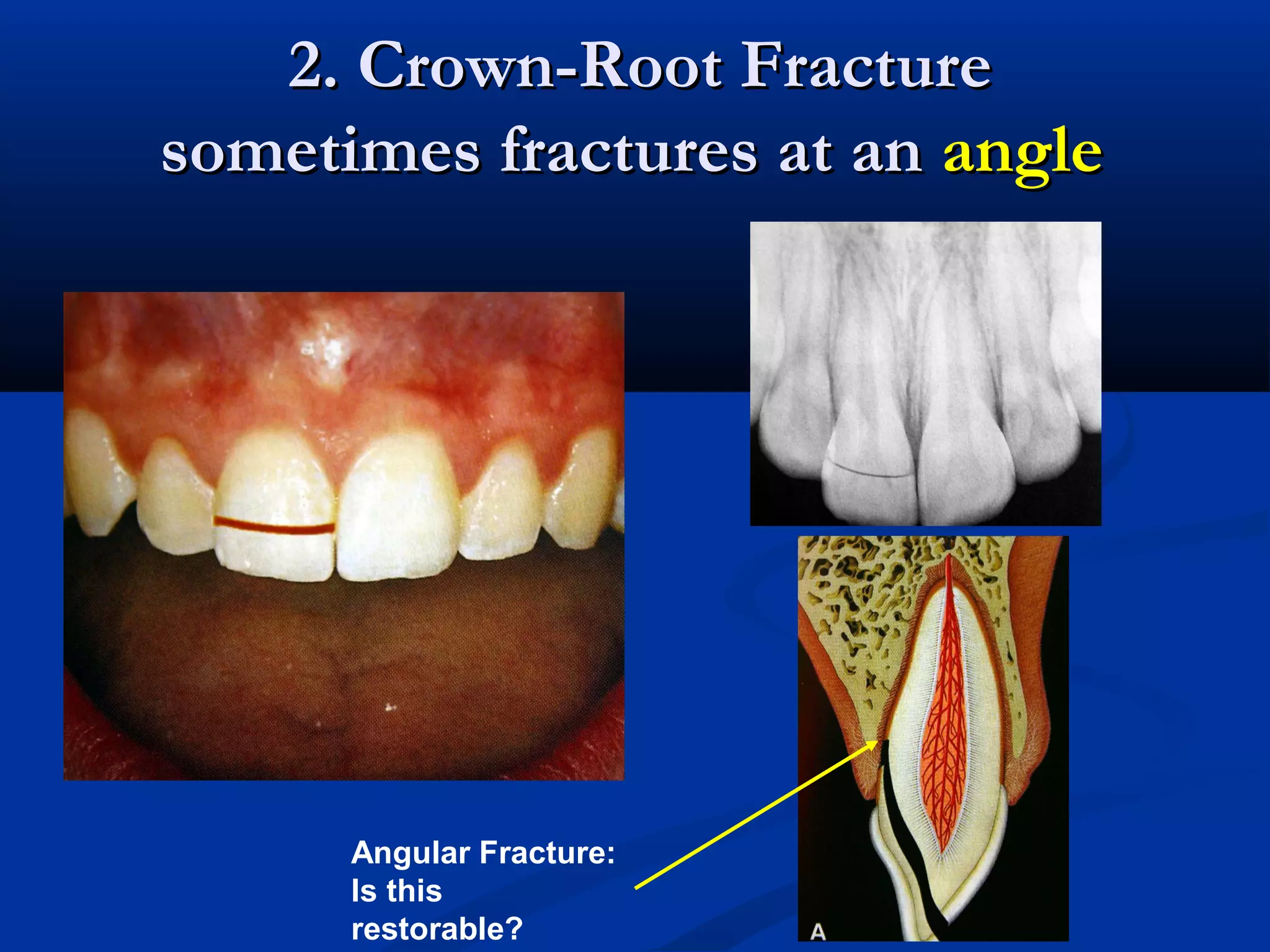
2. Crown-Root Fracture
sometimes fractures at an angle
Angular Fracture:
Is this
restorable?
Remember,


In all trauma, the primary purpose of our
treatment is to keep the pulp vital, if at all
possible, ESPECIALLY if apex is open



WHY?
Pulpotomy – Immature Apex
If Vital = “Apexogenesis”*
Apexogenesis vs Apexification
Dealing with the immature root

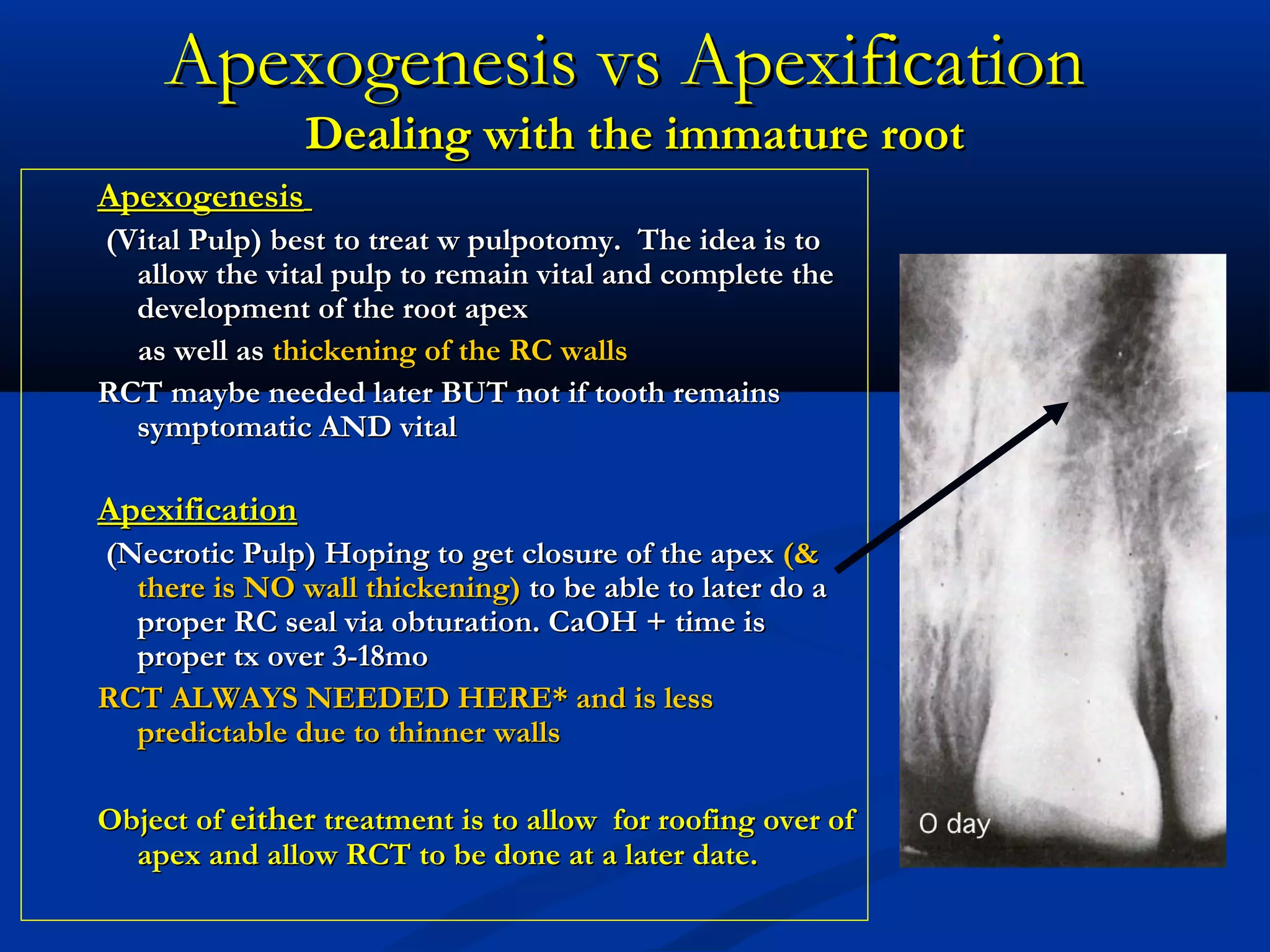
Apexogenesis
(Vital Pulp) best to treat w pulpotomy. The idea is to
allow the vital pulp to remain vital and complete the
development of the root apex
as well as thickening of the RC walls
RCT maybe needed later BUT not if tooth remains
symptomatic AND vital

Apexification
(Necrotic Pulp) Hoping to get closure of the apex (&
there is NO wall thickening) to be able to later do a
proper RC seal via obturation. CaOH + time is
proper tx over 3-18mo
RCT ALWAYS NEEDED HERE* and is less
predictable due to thinner walls
Object of either treatment is to allow for roofing over of
apex and allow RCT to be done at a later date.
And now, Regeneration?


Revascularization of immature permanent teeth
utilizing a mixture of antibiotics, creating a blood
clot w/in the RCS which produces development of
the tooth structure



Banchs F, Trope M
“Revascularization of immature permanent
teeth w PN & apical periodontitis….
JOE, 196; 2004
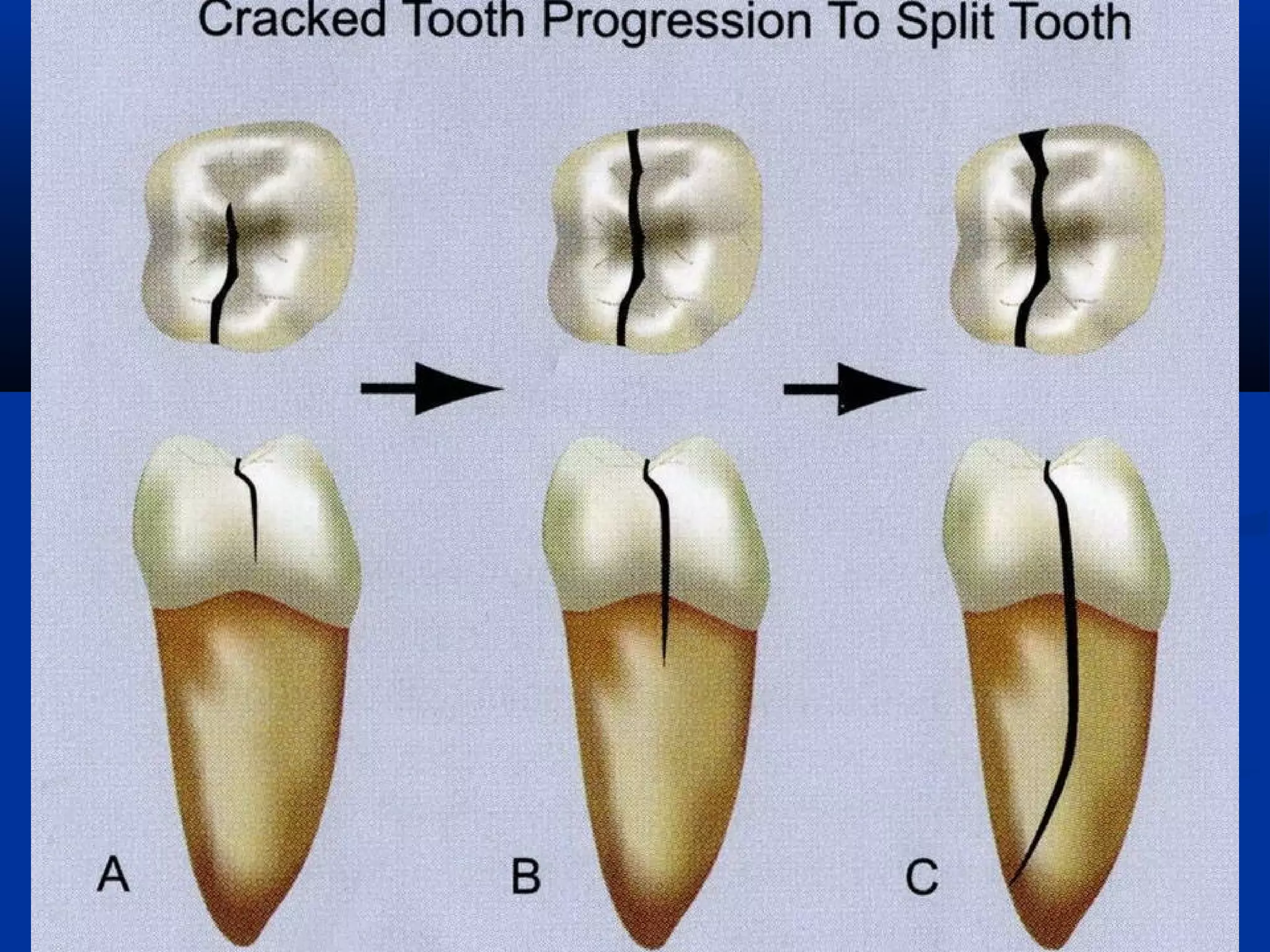
Vertical FX of Crown>Root
@ 3% of all dental injuries
Generally if crack extends to the pulpal floor (molar), the tooth will be
lost
Most commonly cracked tooth – Distal of Mandibular second molar –

– May need to STAIN crown to see crack
WHY?
Look for
“Drop-Off”
Pocket at
base of
Crack site
Insert occlusal view of MMR/DMR
fracture to supplement previous slide


Because, endo/perio lesion can mimic VRF
radiogragraph
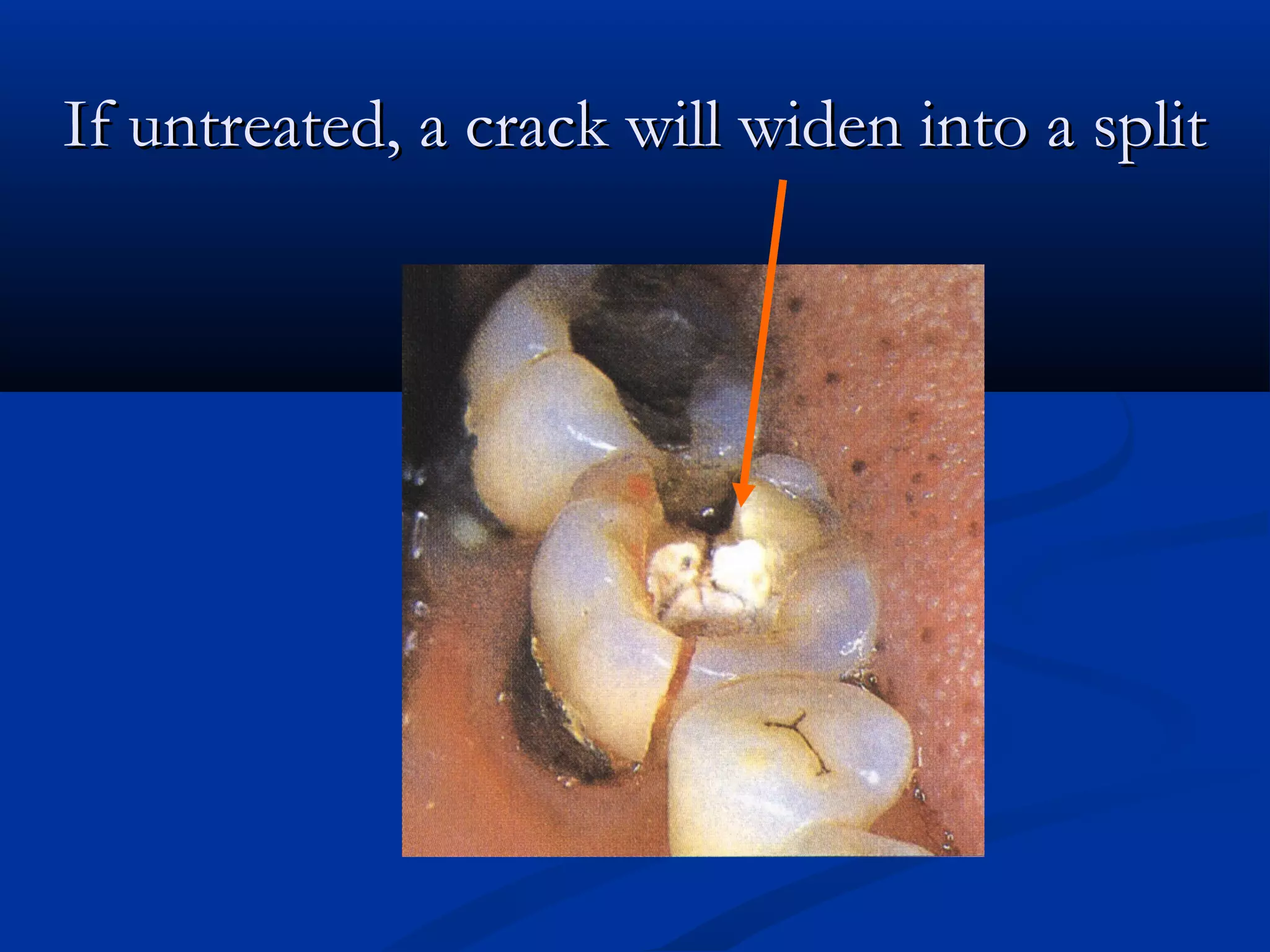
If untreated, a crack will widen into a split
3. Vertical Root Fracture
Look for ‘J’-Shaped apical lesion
Look for Drop-off Pocket if . . . .

VRF difficult to confirm
radiographically –UNLESS
separation of segments occurs
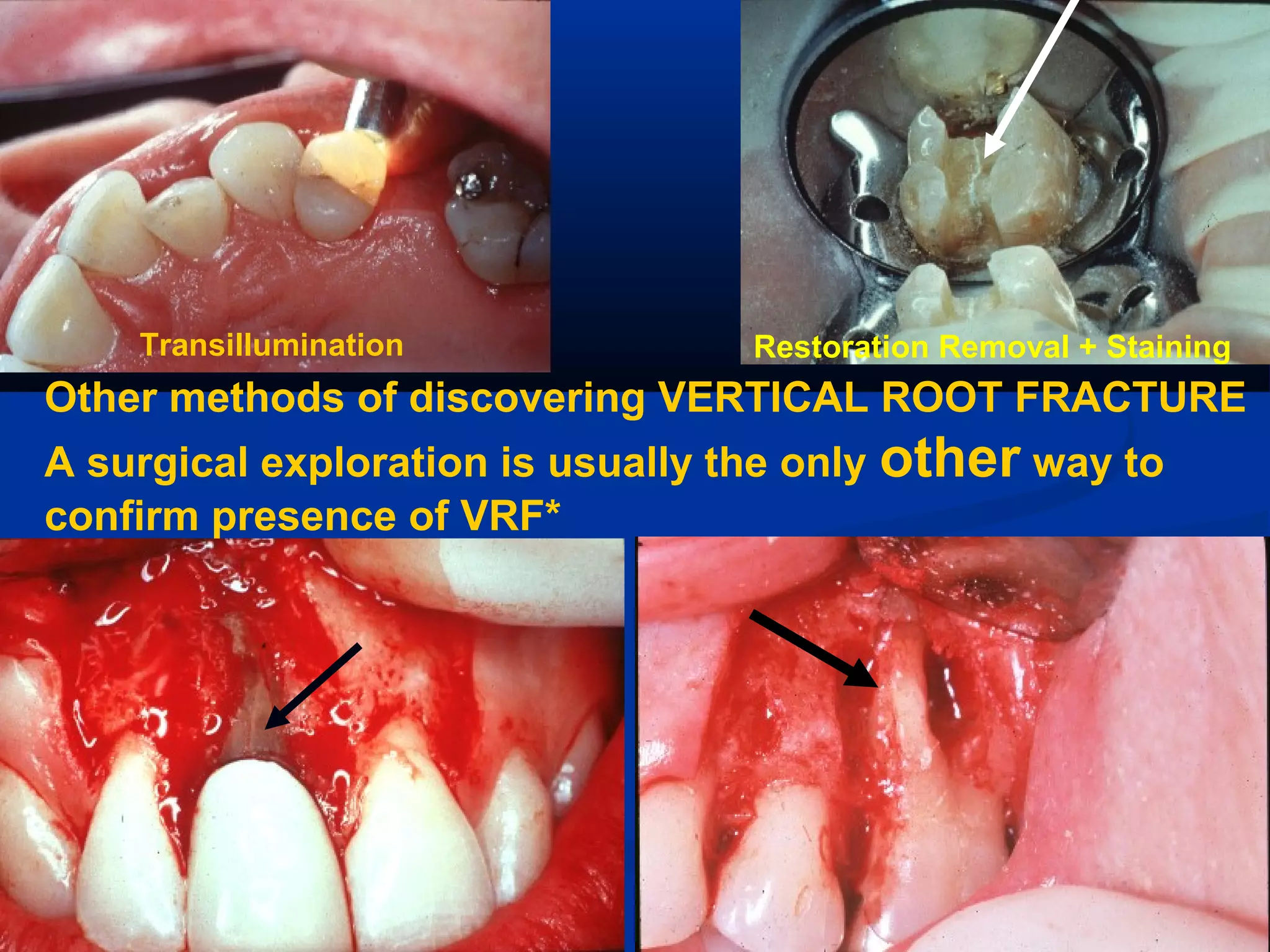
Transillumination

Restoration Removal + Staining

Other methods of discovering VERTICAL ROOT FRACTURE
A surgical exploration is usually the only other way to
confirm presence of VRF*
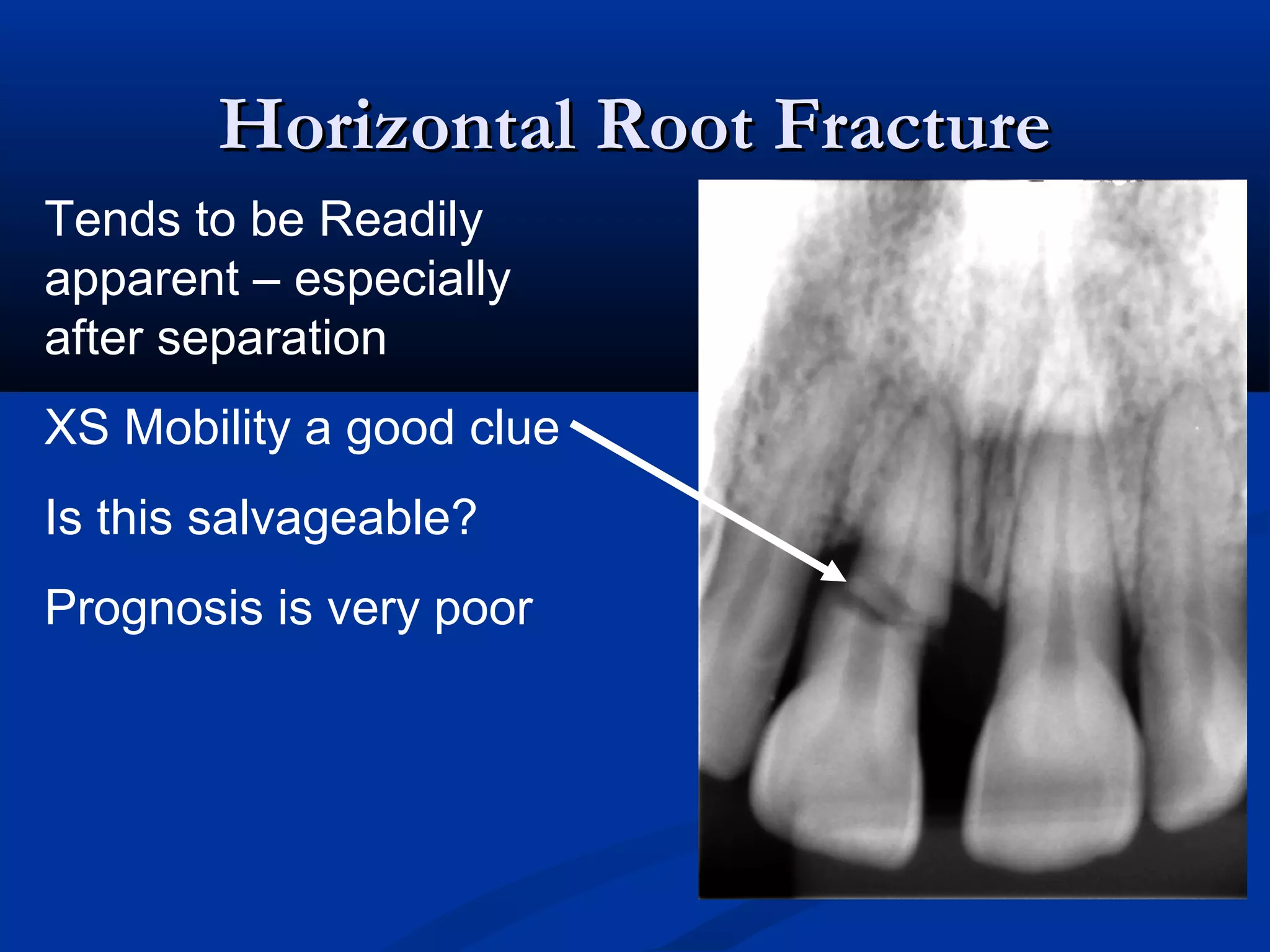
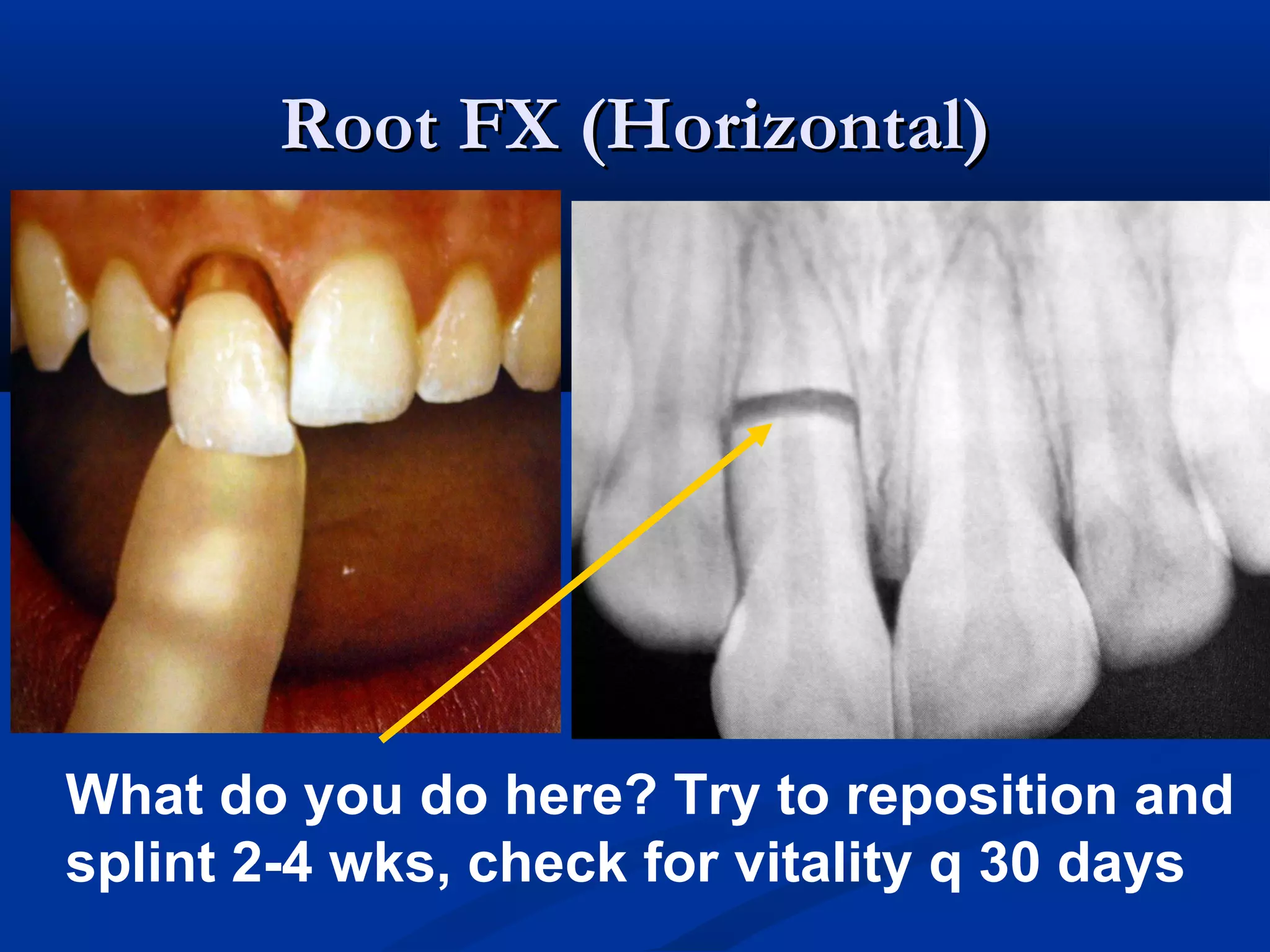
Horizontal Root Fracture
Tends to be Readily
apparent – especially
after separation
XS Mobility a good clue
Is this salvageable?
Prognosis is very poor
Root FX (Horizontal)

What do you do here? Try to reposition and
splint 2-4 wks, check for vitality q 30 days
4. Luxation Injuries
(MOST COMMON OF ALL DENTAL INJURIES)
30-44% text p630







Concussion
Subluxation
Extrusion
Lateral
Intrusive

AVULSION

WORST CASE SEQUELAE?
PULP NECROSIS
EXTERNAL/INTERNAL
ROOT RESORPTION

Possible tooth loss
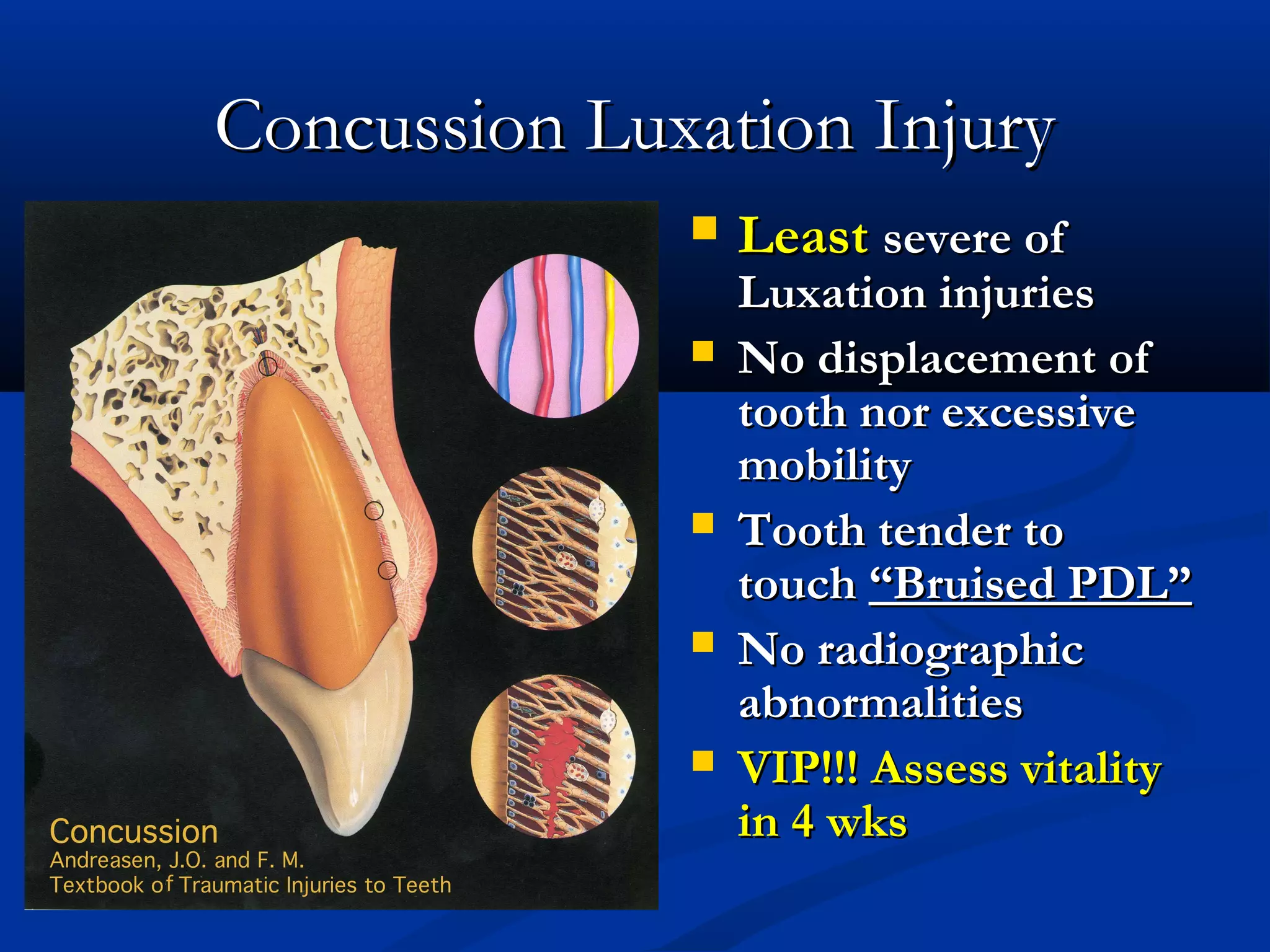
Concussion Luxation Injury







Least severe of

Luxation injuries
No displacement of
tooth nor excessive
mobility
Tooth tender to
touch “Bruised PDL”
No radiographic
abnormalities
VIP!!! Assess vitality
in 4 wks
Subluxation Luxation Injury










Tooth tender to touch &
slightly mobile (1+) but not
displaced
Possible hemorrhage from
gingival crevice
No radiographic
abnormalities
Damage to supporting
structures?
VIP!!! Assess vitality in 4
weeks
Extrusion Luxation Injury


Elongated mobile tooth









Cl. II mobility or greater

Radiographs show
increased apical
periodontal space
Manually reposition
Reposition tooth +
Flexible splint
MANDATORY 7-10 days ?
VIP!!! Assess vitality in 4
weeks
What is a flexible splint?
-Allows physiologic movement of the teeth in
order to minimize ankylosis
-In the past, .028 gauge ortho wire bonded to
tooth for 7-10 days unless alveolar FX had
occurred. Then 4-8 wks
OR: 4-6# fishing line bonded to teeth
-Currently, titanium trauma splint (TTS) is
recommended see p643, text
Semi-rigid or flexible splinting






Experimental studies in non-human primates have
demonstrated that rigid splinting ,especially for
prolonged periods, leads to ankylosis &/or external
resorption.
Maintaining a slight degree of tooth mobility appears to
be beneficial to PDL healing
Von Arx T, etal Splinting of Traumatized teeth
with a new device:TTS; Dent Traumatol
2001;17:180-84
Titanium Trauma Splint
Medaris AG, Basel Switzerland
TTS splint






Insert picture of same
Splinting of traumatized teeth with a new
device:TTS (Titanium Trauma Splint)
Medartis AG, Basel, Switzerland
Von arx T, etal Dent Traumatol, ’01;17:180-84
Lateral Luxation Injury










Displaced laterally & often
locked in bone
Not tender to touch, not
mobile
Alveolus fractured
Percussion test: high metallic
sound (ankylosis)
Increased PDL space best
seen on eccentric or occlusal
radiographs
Anesthetize & reposition
+ Flexible splint
MANDATORY 4-8 weeks
VIP!!! Assess vitality in 4
weeks
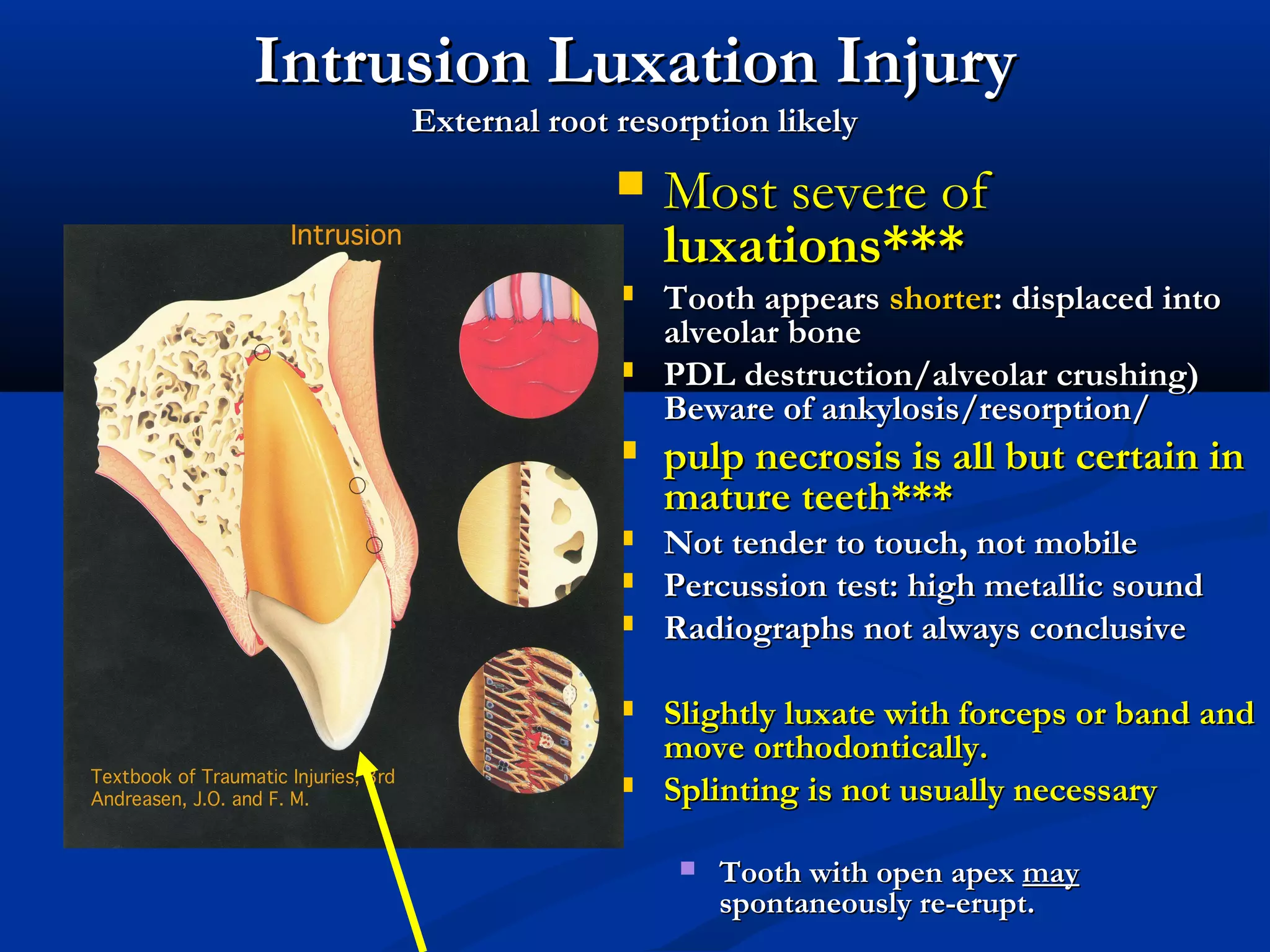
Intrusion Luxation Injury
External root resorption likely





Most severe of
luxations***

Tooth appears shorter: displaced into
alveolar bone
PDL destruction/alveolar crushing)
Beware of ankylosis/resorption/



pulp necrosis is all but certain in
mature teeth***



Not tender to touch, not mobile
Percussion test: high metallic sound
Radiographs not always conclusive






Slightly luxate with forceps or band and
move orthodontically.
Splinting is not usually necessary


Tooth with open apex may
spontaneously re-erupt.
Treatment of intrusion luxation


Closed apex needs ortho. or surgical
repositioning and probable RCT in 1-3 weeks

In all LUXATION and especially INTRUSION injuries,
the apical neurovascular bundle and attachment
apparatus will be affected to some degree>>>loss

of vitality & internal/external resorption
5. Avulsion








Tooth is knocked completely out of
mouth
Viability of the PDL must be
preserved for success
Extra-oral dry time is CRITICAL 3060”***
Must be replaced in socket ASAP
(15-20”) (text p641) in order to..



Prevent ankylosis
Prevent external root resorption

To replant or not? should be “decent tooth”: No point in replanting THIS one
Replant?






TX is aimed at minimizing the inflammation
from the two main consequences of avulsion,
namely; attachment damage and pulpal infection
that inevitably results
The SINGLE most VIP factor in achieving a
favorable outcome is the SPEED at which a
clean tooth is properly replanted
Keeping the attached PDL moist is VIP!!*
Replantation guidelines
HOW FAST IS FAST? 5”, 30” 60”, TAKE YOUR PICK, it depends on whose book you read!







If tooth is out of the mouth less than 15-20”,
replant according to guidelines
If tooth was out and placed in cold milk or other
physiological solution w/in 15-20” & available for
replantation w/in 30”, replant and follow
guidelines
If tooth is out > 60” and not stored, there is usually
one outcome: resorption and probable loss
If the pt is pre adolescent, the tooth may become
infraoccluded (ankylosed) as he/she grows older
To replant or not (cont)






If the root of the avulsed tooth is not completely formed,
the prognosis for survival and revascularization is possible
if not left out>60”
If root is incompletely formed and replantation is rapid,
vitality may be maintained but is not predictable
Kenny DH etal; Medicolegal aspects of replanting
permanent teeth. J Can Dent Assoc 71:245-48, 2005
First Aid Instructions






Handle by crown only
Pick off debris with tweezers
Replant tooth if possible
_________________________________
If not, transport in appropriate medium:
“Save-a-tooth” (Hank’s Balanced Salt solution)
 OR “Via Span” (if available)
 OR milk if above not available


 OR place in vestibule (saliva) & Report to

dental office ASAP
Once in Dental office:


Take films to make sure there is no alveolar FX
& that adjacent teeth are OK
“Save-a-tooth” (Hank’s Balanced Salt solution)
 OR “Via Span”, milk, saline
 Gently clean socket
 Replant and check occlusion
 Splint
 RX antibiotics

Avulsion Injury
What NOT to do!
 Do Not
Handle by root
 Scrub root
 Allow tooth to dry
 Submerge the tooth in water
(tap water is hypotonic>
and will cause cell rupture)


AAE has a Flow Chart Outlining Current Treatment Management Protocols of
both Luxation and Avulsion cases ..www. aae.org.
If over 60” “dry time”







Remove remnants ofPDL by soaking in acid for 1”
Soak in Stannous Fl for 5”
No harm done to go ahead and complete endo ASAP
Splint
Pray
Immature Tooth: Open Apex, revascularization
is possible if out less than 30-60”









Replant as above EXCEPT different
Soak tooth in Doxycycline (1mg/20cc
saline)<replantation for 5” text,p642
Monitor pulp vitality closely (q 30 d or until root
development is confirmed)
Vital Open apex will NOT necessarily require RCT
UNLESS pulp becomes necrotic.
What if it does? Do we do apexogenesis then?
Case History


16 yr., African-American male presents
with avulsed teeth and deep puncture
wound or lip
# 7 and # 8 intact
 30 minutes post assault (60 minutes=critical)






Patient is lucid, responsive, with no
apparent neurological impairment
Medical history non-contributory
Ankylosis


A problem following trauma and
long term rigid splinting



Tooth is solidly fixed and has a high
metallic ring when percussing. Does
not erupt with other teeth



May lead to massive external
resorption & loss of tooth



Internal= appearance of
“aneurysm” w/in canal.
Complications with Replanted
avulsed teeth & Possibly with Rigid
Long-Term Splinting


Ankylosis (Replacement Resorption)
7. Plug for Prevention






Mouth guards***
Many of the injuries we discussed could be
prevented through the aggressive promotion and
use of mouth guards.
Every child should wear one for most active play.
Every adult involved in sports should wear one.

 Become Involved in your

Community! Begin the Service if
not available in your area.

DENTAL TRAUMA

  • 1.
    Traumatic Injuries, CrackedTeeth and vertical root fractures (VRF) ABU-HUSSEIN MUHAMAD
  • 2.
    Abbreviation guide       FX=fracture PN=pulp necrosis B4=beforeor prior to.. TX=treatment VPT=vital pulp therapy VIP=very important
  • 3.
    Outline: I. Crown Fracture 2.Crown-root fractures 3. Vertical/Horizontal Root Fracture 4. Luxation 5. Avulsion 6. Resorption 7. Prevention
  • 4.
    Fact   Most dental traumaoccurs in 7_10 age range And most trauma occurs in the anterior region of the mouth, maxilla>mandible
  • 5.
    1. Crown FXwithout Pulp exposure NO PROBLEM, RELAX AND RESTORE
  • 6.
    Complicated Crown FXwith Pulp Exposure=VPT @80% IF w/in 24hrs Pulp Cap? Partial Pulpotomy@95% Full pulpotomy @75% OR: EXTIRPATION if root is fully formed
  • 7.
    2. Crown-Root Fracture sometimesfractures at an angle Angular Fracture: Is this restorable?
  • 8.
    Remember,  In all trauma,the primary purpose of our treatment is to keep the pulp vital, if at all possible, ESPECIALLY if apex is open  WHY?
  • 9.
    Pulpotomy – ImmatureApex If Vital = “Apexogenesis”*
  • 10.
    Apexogenesis vs Apexification Dealingwith the immature root Apexogenesis (Vital Pulp) best to treat w pulpotomy. The idea is to allow the vital pulp to remain vital and complete the development of the root apex as well as thickening of the RC walls RCT maybe needed later BUT not if tooth remains symptomatic AND vital Apexification (Necrotic Pulp) Hoping to get closure of the apex (& there is NO wall thickening) to be able to later do a proper RC seal via obturation. CaOH + time is proper tx over 3-18mo RCT ALWAYS NEEDED HERE* and is less predictable due to thinner walls Object of either treatment is to allow for roofing over of apex and allow RCT to be done at a later date.
  • 11.
    And now, Regeneration?  Revascularizationof immature permanent teeth utilizing a mixture of antibiotics, creating a blood clot w/in the RCS which produces development of the tooth structure  Banchs F, Trope M “Revascularization of immature permanent teeth w PN & apical periodontitis…. JOE, 196; 2004
  • 12.
    Vertical FX ofCrown>Root @ 3% of all dental injuries Generally if crack extends to the pulpal floor (molar), the tooth will be lost Most commonly cracked tooth – Distal of Mandibular second molar – – May need to STAIN crown to see crack WHY? Look for “Drop-Off” Pocket at base of Crack site
  • 13.
    Insert occlusal viewof MMR/DMR fracture to supplement previous slide  Because, endo/perio lesion can mimic VRF radiogragraph
  • 14.
    If untreated, acrack will widen into a split
  • 15.
    3. Vertical RootFracture Look for ‘J’-Shaped apical lesion Look for Drop-off Pocket if . . . . VRF difficult to confirm radiographically –UNLESS separation of segments occurs
  • 16.
    Transillumination Restoration Removal +Staining Other methods of discovering VERTICAL ROOT FRACTURE A surgical exploration is usually the only other way to confirm presence of VRF*
  • 19.
    Horizontal Root Fracture Tendsto be Readily apparent – especially after separation XS Mobility a good clue Is this salvageable? Prognosis is very poor
  • 20.
    Root FX (Horizontal) Whatdo you do here? Try to reposition and splint 2-4 wks, check for vitality q 30 days
  • 21.
    4. Luxation Injuries (MOSTCOMMON OF ALL DENTAL INJURIES) 30-44% text p630      Concussion Subluxation Extrusion Lateral Intrusive AVULSION WORST CASE SEQUELAE? PULP NECROSIS EXTERNAL/INTERNAL ROOT RESORPTION Possible tooth loss
  • 22.
    Concussion Luxation Injury      Leastsevere of Luxation injuries No displacement of tooth nor excessive mobility Tooth tender to touch “Bruised PDL” No radiographic abnormalities VIP!!! Assess vitality in 4 wks
  • 23.
    Subluxation Luxation Injury      Toothtender to touch & slightly mobile (1+) but not displaced Possible hemorrhage from gingival crevice No radiographic abnormalities Damage to supporting structures? VIP!!! Assess vitality in 4 weeks
  • 24.
    Extrusion Luxation Injury  Elongatedmobile tooth      Cl. II mobility or greater Radiographs show increased apical periodontal space Manually reposition Reposition tooth + Flexible splint MANDATORY 7-10 days ? VIP!!! Assess vitality in 4 weeks
  • 25.
    What is aflexible splint? -Allows physiologic movement of the teeth in order to minimize ankylosis -In the past, .028 gauge ortho wire bonded to tooth for 7-10 days unless alveolar FX had occurred. Then 4-8 wks OR: 4-6# fishing line bonded to teeth -Currently, titanium trauma splint (TTS) is recommended see p643, text
  • 26.
    Semi-rigid or flexiblesplinting    Experimental studies in non-human primates have demonstrated that rigid splinting ,especially for prolonged periods, leads to ankylosis &/or external resorption. Maintaining a slight degree of tooth mobility appears to be beneficial to PDL healing Von Arx T, etal Splinting of Traumatized teeth with a new device:TTS; Dent Traumatol 2001;17:180-84
  • 27.
    Titanium Trauma Splint MedarisAG, Basel Switzerland
  • 29.
    TTS splint     Insert pictureof same Splinting of traumatized teeth with a new device:TTS (Titanium Trauma Splint) Medartis AG, Basel, Switzerland Von arx T, etal Dent Traumatol, ’01;17:180-84
  • 30.
    Lateral Luxation Injury        Displacedlaterally & often locked in bone Not tender to touch, not mobile Alveolus fractured Percussion test: high metallic sound (ankylosis) Increased PDL space best seen on eccentric or occlusal radiographs Anesthetize & reposition + Flexible splint MANDATORY 4-8 weeks VIP!!! Assess vitality in 4 weeks
  • 31.
    Intrusion Luxation Injury Externalroot resorption likely    Most severe of luxations*** Tooth appears shorter: displaced into alveolar bone PDL destruction/alveolar crushing) Beware of ankylosis/resorption/  pulp necrosis is all but certain in mature teeth***  Not tender to touch, not mobile Percussion test: high metallic sound Radiographs not always conclusive     Slightly luxate with forceps or band and move orthodontically. Splinting is not usually necessary  Tooth with open apex may spontaneously re-erupt.
  • 32.
    Treatment of intrusionluxation  Closed apex needs ortho. or surgical repositioning and probable RCT in 1-3 weeks In all LUXATION and especially INTRUSION injuries, the apical neurovascular bundle and attachment apparatus will be affected to some degree>>>loss of vitality & internal/external resorption
  • 33.
    5. Avulsion     Tooth isknocked completely out of mouth Viability of the PDL must be preserved for success Extra-oral dry time is CRITICAL 3060”*** Must be replaced in socket ASAP (15-20”) (text p641) in order to..   Prevent ankylosis Prevent external root resorption To replant or not? should be “decent tooth”: No point in replanting THIS one
  • 34.
    Replant?    TX is aimedat minimizing the inflammation from the two main consequences of avulsion, namely; attachment damage and pulpal infection that inevitably results The SINGLE most VIP factor in achieving a favorable outcome is the SPEED at which a clean tooth is properly replanted Keeping the attached PDL moist is VIP!!*
  • 35.
    Replantation guidelines HOW FASTIS FAST? 5”, 30” 60”, TAKE YOUR PICK, it depends on whose book you read!     If tooth is out of the mouth less than 15-20”, replant according to guidelines If tooth was out and placed in cold milk or other physiological solution w/in 15-20” & available for replantation w/in 30”, replant and follow guidelines If tooth is out > 60” and not stored, there is usually one outcome: resorption and probable loss If the pt is pre adolescent, the tooth may become infraoccluded (ankylosed) as he/she grows older
  • 36.
    To replant ornot (cont)    If the root of the avulsed tooth is not completely formed, the prognosis for survival and revascularization is possible if not left out>60” If root is incompletely formed and replantation is rapid, vitality may be maintained but is not predictable Kenny DH etal; Medicolegal aspects of replanting permanent teeth. J Can Dent Assoc 71:245-48, 2005
  • 37.
    First Aid Instructions      Handleby crown only Pick off debris with tweezers Replant tooth if possible _________________________________ If not, transport in appropriate medium: “Save-a-tooth” (Hank’s Balanced Salt solution)  OR “Via Span” (if available)  OR milk if above not available   OR place in vestibule (saliva) & Report to dental office ASAP
  • 38.
    Once in Dentaloffice:  Take films to make sure there is no alveolar FX & that adjacent teeth are OK “Save-a-tooth” (Hank’s Balanced Salt solution)  OR “Via Span”, milk, saline  Gently clean socket  Replant and check occlusion  Splint  RX antibiotics 
  • 39.
    Avulsion Injury What NOTto do!  Do Not Handle by root  Scrub root  Allow tooth to dry  Submerge the tooth in water (tap water is hypotonic> and will cause cell rupture)  AAE has a Flow Chart Outlining Current Treatment Management Protocols of both Luxation and Avulsion cases ..www. aae.org.
  • 40.
    If over 60”“dry time”      Remove remnants ofPDL by soaking in acid for 1” Soak in Stannous Fl for 5” No harm done to go ahead and complete endo ASAP Splint Pray
  • 41.
    Immature Tooth: OpenApex, revascularization is possible if out less than 30-60”      Replant as above EXCEPT different Soak tooth in Doxycycline (1mg/20cc saline)<replantation for 5” text,p642 Monitor pulp vitality closely (q 30 d or until root development is confirmed) Vital Open apex will NOT necessarily require RCT UNLESS pulp becomes necrotic. What if it does? Do we do apexogenesis then?
  • 42.
    Case History  16 yr.,African-American male presents with avulsed teeth and deep puncture wound or lip # 7 and # 8 intact  30 minutes post assault (60 minutes=critical)    Patient is lucid, responsive, with no apparent neurological impairment Medical history non-contributory
  • 43.
    Ankylosis  A problem followingtrauma and long term rigid splinting  Tooth is solidly fixed and has a high metallic ring when percussing. Does not erupt with other teeth  May lead to massive external resorption & loss of tooth  Internal= appearance of “aneurysm” w/in canal.
  • 44.
    Complications with Replanted avulsedteeth & Possibly with Rigid Long-Term Splinting  Ankylosis (Replacement Resorption)
  • 45.
    7. Plug forPrevention     Mouth guards*** Many of the injuries we discussed could be prevented through the aggressive promotion and use of mouth guards. Every child should wear one for most active play. Every adult involved in sports should wear one.  Become Involved in your Community! Begin the Service if not available in your area.