Forceps & elevators
Prepared by : Mohammed Nameer
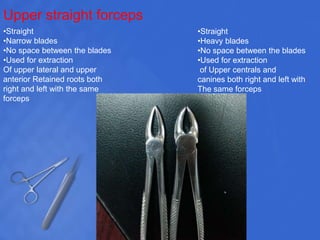
Upper straight forceps
•Straight
•Heavy blades
•No space between the blades
•Used for extraction
of Upper centrals and
canines both right and left with
The same forceps
•Straight
•Narrow blades
•No space between the blades
•Used for extraction
Of upper lateral and upper
anterior Retained roots both
right and left with the same
forceps
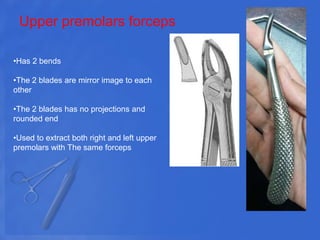
Upper premolars forceps
•Has 2 bends
•The 2 blades are mirror image to each
other
•The 2 blades has no projections and
rounded end
•Used to extract both right and left upper
premolars with The same forceps
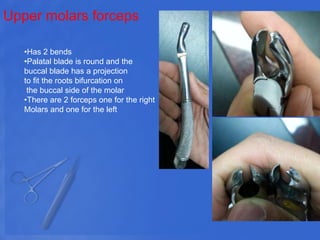
Upper molars forceps
•Has 2 bends
•Palatal blade is round and the
buccal blade has a projection
to fit the roots bifurcation on
the buccal side of the molar
•There are 2 forceps one for the right
Molars and one for the left
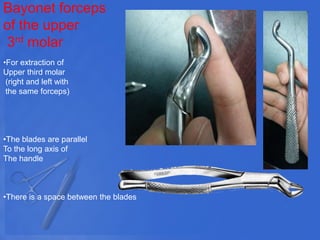
Bayonet forceps
of the upper
3rd molar
•For extraction of
Upper third molar
(right and left with
the same forceps)
•The blades are parallel
To the long axis of
The handle
•There is a space between the blades
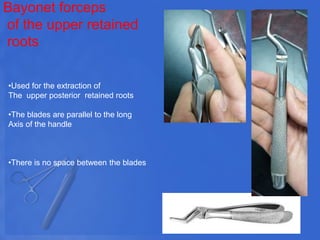
Bayonet forceps
of the upper retained
roots
•Used for the extraction of
The upper posterior retained roots
•The blades are parallel to the long
Axis of the handle
•There is no space between the blades
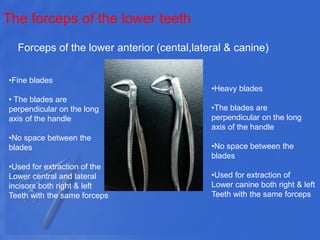
The forceps of the lower teeth
Forceps of the lower anterior (cental,lateral & canine)
•Fine blades
• The blades are
perpendicular on the long
axis of the handle
•No space between the
blades
•Used for extraction of the
Lower central and lateral
incisors both right & left
Teeth with the same forceps
•Heavy blades
•The blades are
perpendicular on the long
axis of the handle
•No space between the
blades
•Used for extraction of
Lower canine both right & left
Teeth with the same forceps
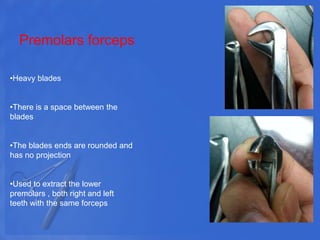
Premolars forceps
•Heavy blades
•There is a space between the
blades
•The blades ends are rounded and
has no projection
•Used to extract the lower
premolars , both right and left
teeth with the same forceps
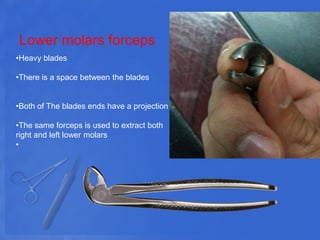
Lower molars forceps
•Heavy blades
•There is a space between the blades
•Both of The blades ends have a projection
•The same forceps is used to extract both
right and left lower molars
•
Elevators
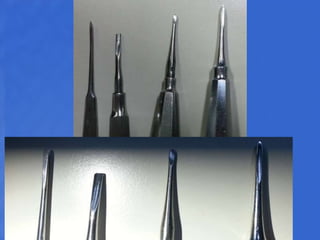
Straight elevator
•Handle , shank and blade are straight
•The working end is blind and round
•There are sizes
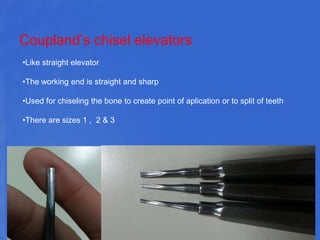
Coupland’s chisel elevators
•Like straight elevator
•The working end is straight and sharp
•Used for chiseling the bone to create point of aplication or to split of teeth
•There are sizes 1 , 2 & 3
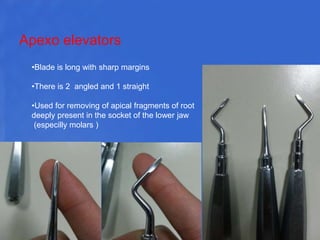
Apexo elevators
•Blade is long with sharp margins
•There is 2 angled and 1 straight
•Used for removing of apical fragments of root
deeply present in the socket of the lower jaw
(especilly molars )
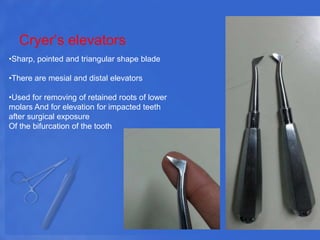
Cryer’s elevators
•Sharp, pointed and triangular shape blade
•There are mesial and distal elevators
•Used for removing of retained roots of lower
molars And for elevation for impacted teeth
after surgical exposure
Of the bifurcation of the tooth
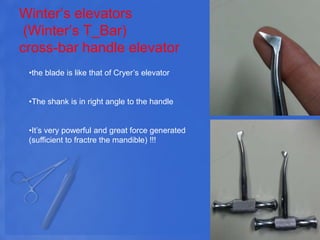
Winter’s elevators
(Winter’s T_Bar)
cross-bar handle elevator
•the blade is like that of Cryer’s elevator
•The shank is in right angle to the handle
•It’s very powerful and great force generated
(sufficient to fractre the mandible) !!!
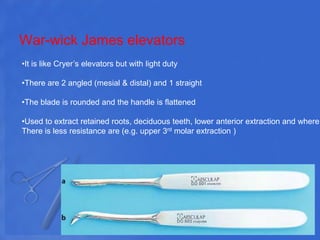
War-wick James elevators
•It is like Cryer’s elevators but with light duty
•There are 2 angled (mesial & distal) and 1 straight
•The blade is rounded and the handle is flattened
•Used to extract retained roots, deciduous teeth, lower anterior extraction and where
There is less resistance are (e.g. upper 3rd molar extraction )
Extraction instruments | Dental surgery | by Dr.mohammad nameer

Extraction instruments | Dental surgery | by Dr.mohammad nameer

  • 1.
    Forceps & elevators Preparedby : Mohammed Nameer
  • 2.
    Upper straight forceps •Straight •Heavyblades •No space between the blades •Used for extraction of Upper centrals and canines both right and left with The same forceps •Straight •Narrow blades •No space between the blades •Used for extraction Of upper lateral and upper anterior Retained roots both right and left with the same forceps
  • 3.
    Upper premolars forceps •Has2 bends •The 2 blades are mirror image to each other •The 2 blades has no projections and rounded end •Used to extract both right and left upper premolars with The same forceps
  • 4.
    Upper molars forceps •Has2 bends •Palatal blade is round and the buccal blade has a projection to fit the roots bifurcation on the buccal side of the molar •There are 2 forceps one for the right Molars and one for the left
  • 5.
    Bayonet forceps of theupper 3rd molar •For extraction of Upper third molar (right and left with the same forceps) •The blades are parallel To the long axis of The handle •There is a space between the blades
  • 6.
    Bayonet forceps of theupper retained roots •Used for the extraction of The upper posterior retained roots •The blades are parallel to the long Axis of the handle •There is no space between the blades
  • 7.
    The forceps ofthe lower teeth Forceps of the lower anterior (cental,lateral & canine) •Fine blades • The blades are perpendicular on the long axis of the handle •No space between the blades •Used for extraction of the Lower central and lateral incisors both right & left Teeth with the same forceps •Heavy blades •The blades are perpendicular on the long axis of the handle •No space between the blades •Used for extraction of Lower canine both right & left Teeth with the same forceps
  • 8.
    Premolars forceps •Heavy blades •Thereis a space between the blades •The blades ends are rounded and has no projection •Used to extract the lower premolars , both right and left teeth with the same forceps
  • 9.
    Lower molars forceps •Heavyblades •There is a space between the blades •Both of The blades ends have a projection •The same forceps is used to extract both right and left lower molars •
  • 10.
  • 11.
    Straight elevator •Handle ,shank and blade are straight •The working end is blind and round •There are sizes
  • 12.
    Coupland’s chisel elevators •Likestraight elevator •The working end is straight and sharp •Used for chiseling the bone to create point of aplication or to split of teeth •There are sizes 1 , 2 & 3
  • 13.
    Apexo elevators •Blade islong with sharp margins •There is 2 angled and 1 straight •Used for removing of apical fragments of root deeply present in the socket of the lower jaw (especilly molars )
  • 15.
    Cryer’s elevators •Sharp, pointedand triangular shape blade •There are mesial and distal elevators •Used for removing of retained roots of lower molars And for elevation for impacted teeth after surgical exposure Of the bifurcation of the tooth
  • 16.
    Winter’s elevators (Winter’s T_Bar) cross-barhandle elevator •the blade is like that of Cryer’s elevator •The shank is in right angle to the handle •It’s very powerful and great force generated (sufficient to fractre the mandible) !!!
  • 17.
    War-wick James elevators •Itis like Cryer’s elevators but with light duty •There are 2 angled (mesial & distal) and 1 straight •The blade is rounded and the handle is flattened •Used to extract retained roots, deciduous teeth, lower anterior extraction and where There is less resistance are (e.g. upper 3rd molar extraction )