Presented by- Krishna Naikwade
• To induce desirable working area in the oral cavity there
should be proper moisture control, visibility and good
accessibility .
• If an instrument is swallowed or aspirated during
endodontic treatment without a rubber dam, one is likely
to confronted with a law suit
• Grossman has stated that ``in the eyes of court, when an
endodontic instrument escapes from dentist’s fingers and
is ingested or aspirated, expert opinion is unnecessary to
justify claims of negligence``
• Dry clean operating field
• Access with visibility
• Moisture control
• Retraction of soft tissue
• Aseptic environment
• Prevents tissue damages
• Minimization of mouth breathing
• Patient acceptance
• Poorly retentive
• Trauma to tissues
• Frame can cause pressure mark habbits
• Latex allergy
• Build up saliva
• Partially erupted tooth cant receive retainer
• Psychological intolerance
• Allergy to latex
• Patient with respiratory problems
• Patient at risk with transient bacteremia
• Severe gingival disease
• Rubber dam material
• Rubber dam clamp
• Rubber dam punch
• Rubber dam clamp carrying forceps
• Rubber dam frame rubber dam template
• Wedgets cord dental silk floss
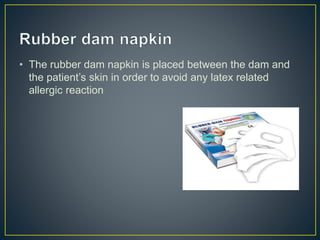
• Rubber dam napkin
• This is available as heavy , medium ,light and in different
colors and standard sizes.
• Readymade sheets are available in 5×5’’ and 6×6’’ and rolls
according to need which may be conveniently cut into
necessary size .
• It is usually made up of latex material.
• For patient with latex allergy, non latex rubber dam material
is used in clinics.
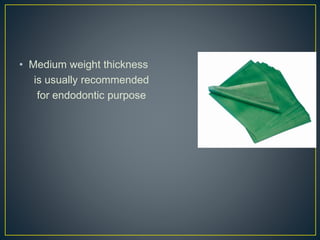
• Medium weight thickness
is usually recommended
for endodontic purpose
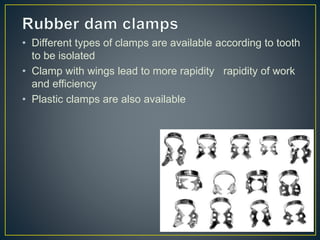
• Different types of clamps are available according to tooth
to be isolated
• Clamp with wings lead to more rapidity rapidity of work
and efficiency
• Plastic clamps are also available
• In summary only five clamps are needed for applying
rubber dam to most teeth
• For anterior teeth-HF 9S
• For premolars-HF 1 and HF 2
• For molars – HF 7 and HF 14A
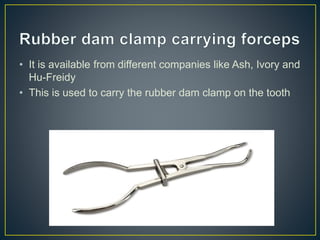
• It is available from different companies like Ash, Ivory and
Hu-Freidy
• This is used to carry the rubber dam clamp on the tooth
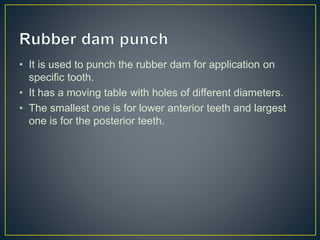
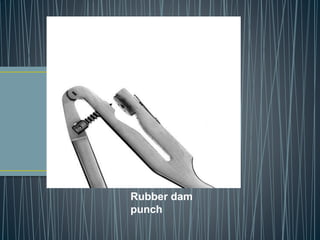
• It is used to punch the rubber dam for application on
specific tooth.
• It has a moving table with holes of different diameters.
• The smallest one is for lower anterior teeth and largest
one is for the posterior teeth.
Rubber dam
punch
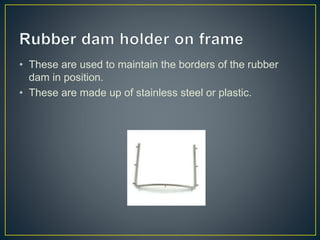
• These are used to maintain the borders of the rubber
dam in position.
• These are made up of stainless steel or plastic.
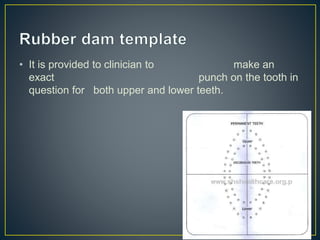
• It is provided to clinician to make an
exact punch on the tooth in
question for both upper and lower teeth.
• It is used to stabilize the interproximal area of the rubber
dam.
• It is flexible elastic material that can be passed over dam
interproximally below the contact area.
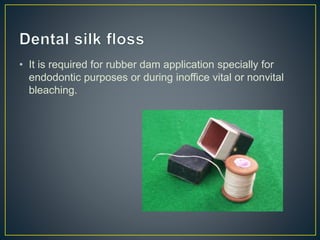
• It is required for rubber dam application specially for
endodontic purposes or during inoffice vital or nonvital
bleaching.
• The rubber dam napkin is placed between the dam and
the patient’s skin in order to avoid any latex related
allergic reaction
• Cleaning of teeth
• Selection of clamp
• Punching of the hole in rubber dam
• Flossing the clamp
• Application of rubber dam
• Application of lubricant & flossing through contact with
lubricant
• Application of napkin and holder
Rubber dam

Rubber dam

  • 1.
  • 2.
    • To inducedesirable working area in the oral cavity there should be proper moisture control, visibility and good accessibility . • If an instrument is swallowed or aspirated during endodontic treatment without a rubber dam, one is likely to confronted with a law suit • Grossman has stated that ``in the eyes of court, when an endodontic instrument escapes from dentist’s fingers and is ingested or aspirated, expert opinion is unnecessary to justify claims of negligence``
  • 3.
    • Dry cleanoperating field • Access with visibility • Moisture control • Retraction of soft tissue • Aseptic environment • Prevents tissue damages • Minimization of mouth breathing
  • 4.
    • Patient acceptance •Poorly retentive • Trauma to tissues • Frame can cause pressure mark habbits • Latex allergy • Build up saliva • Partially erupted tooth cant receive retainer • Psychological intolerance
  • 5.
    • Allergy tolatex • Patient with respiratory problems • Patient at risk with transient bacteremia • Severe gingival disease
  • 6.
    • Rubber dammaterial • Rubber dam clamp • Rubber dam punch • Rubber dam clamp carrying forceps • Rubber dam frame rubber dam template • Wedgets cord dental silk floss • Rubber dam napkin
  • 7.
    • This isavailable as heavy , medium ,light and in different colors and standard sizes. • Readymade sheets are available in 5×5’’ and 6×6’’ and rolls according to need which may be conveniently cut into necessary size . • It is usually made up of latex material. • For patient with latex allergy, non latex rubber dam material is used in clinics.
  • 8.
    • Medium weightthickness is usually recommended for endodontic purpose
  • 9.
    • Different typesof clamps are available according to tooth to be isolated • Clamp with wings lead to more rapidity rapidity of work and efficiency • Plastic clamps are also available
  • 10.
    • In summaryonly five clamps are needed for applying rubber dam to most teeth • For anterior teeth-HF 9S • For premolars-HF 1 and HF 2 • For molars – HF 7 and HF 14A
  • 11.
    • It isavailable from different companies like Ash, Ivory and Hu-Freidy • This is used to carry the rubber dam clamp on the tooth
  • 12.
    • It isused to punch the rubber dam for application on specific tooth. • It has a moving table with holes of different diameters. • The smallest one is for lower anterior teeth and largest one is for the posterior teeth.
  • 13.
  • 14.
    • These areused to maintain the borders of the rubber dam in position. • These are made up of stainless steel or plastic.
  • 15.
    • It isprovided to clinician to make an exact punch on the tooth in question for both upper and lower teeth.
  • 16.
    • It isused to stabilize the interproximal area of the rubber dam. • It is flexible elastic material that can be passed over dam interproximally below the contact area.
  • 17.
    • It isrequired for rubber dam application specially for endodontic purposes or during inoffice vital or nonvital bleaching.
  • 18.
    • The rubberdam napkin is placed between the dam and the patient’s skin in order to avoid any latex related allergic reaction
  • 19.
    • Cleaning ofteeth • Selection of clamp • Punching of the hole in rubber dam • Flossing the clamp • Application of rubber dam • Application of lubricant & flossing through contact with lubricant • Application of napkin and holder