DEFINITION
INDICATION
CONTRAINDICATION
PRINCIPLES
By- Dr. Prathamesh Fulsundar
EXODONTIA CAN BE DEFINED AS THE
PAINLESS REMOVAL OF THE WHOLE
TOOTH OR A TOOTH ROOT WITHOUT
TRAUMA TO THE INVESTING TISSUES, SO
THAT THE WOUND HEALS UNEVENTFULLY
AND NO POST OPERATIVE PROSTHETIC
PROBLEM IS CREATED.
1. PERIODONTAL DISTURBANCES
 Most common cause of extraction in India.
 If loss of periodontal support is more than
40%, it warrants an extraction.
2. DENTAL CARIES
 When the tooth is extensively damaged by
dental caries, even if the patient and doctor
desire to save the tooth , it is indicated for
extraction if all conservative procedures fail.
 Multiple carious teeth may lead to deteriorating
oral hygiene.
 In such cases, removal of teeth will improve the
oral hygiene.
3. PULP PATHOLOGY
 If endodontic therapy is not possible or if the
tooth is having pulpal pathology such as pulp
necrosis or irreversible pulpitis, extraction is
indicated.
4. APICAL PATHOLOGY
 If the teeth fail to respond to all conservative
measures to resolve apical pathology, either
because of technical reasons or systemic
factors, such teeth are indicated for extraction.
5. ORTHODONTIC REASONS
 During orthodontic treatment, few teeth may
require extraction either due to therapeutic
reasons or because of malposition.
 Serial extraction: During mixed dentition
period, the dental surgeon may have to
extract a few decidious teeth in a
chronological order to prevent malocclusion
as the child grows.
6. PROSTHETIC CONSIDERATIONS
 Extraction of teeth is indicated for providing
efficient dental prosthesis.
7. IMPACTIONS
 Retention of unerupted teeth beyond the
chronological eruption may sometimes be
responsible for facial pain, periodontal
disturbances of adjoining teeth, TMJ
problems, bony pathology like cysts and
pathological fractures of the jaws.
8. SUPERNUMERARY TEETH
 Unless retention of supernumerary teeth are
advantageous to the patients, they are
indicated for extraction.
9. TEETH PRIOR TO IRRADIATION
 Irradiation is one of the modalities of treating
oral carcinomas .
 All patients before irradiation must be
carefully examined so that a decision is taken
regarding the extraction of teeth.
 Only teeth which which cannot be maintained
in a sound oral condition require removal.
10. ECONOMIC CONSIDERATIONS
 Sometimes the dental surgeon and patient
are faced with economic constraints even
though technically conservation of teeth may
be feasible.
11. FOCAL SEPSIS
 Sometimes teeth may appear apparently sound. But
radiologic evaluation is a guiding factor to decide
whether any teeth are to be considered as foci of
infection.
 In such circumstances, weightage is in favor of the
underlying systemic disorders like dermatological
lesions, facial pain, uncontrollable opthalmic
problems etc.
 In such conditions, doubtful teeth are extracted
instead of resorting to any conservative methods of
management.
12. ASSOCIATED PATHOLOGY
 They are involved in cyst formation, neoplasm or
osteomyelitis, extraction is indicated.
 However, carefully evaluation is required before
extracting teeth involved in cyst formations.
13. ESTHETICS
 Due to certain compelling reasons like
marriage and job opportunities, some teeth
may require attention for esthetic
considerations.
 But due to time factor, it may not be possible
to improve esthetics by any conservative
orthodontic or surgical means.
 If so, such teeth are indicated for extraction,
provided it is followed by immediate
prosthetic restoration in a shorter duration.
14. TOOTH IN LINE OF FRACTURE
 This has been controversial over the course
of years.
 The present concept is to extract the tooth in
the line of fracture if (a) it is a source of
infection at the site fracture (b) the tooth
itself is fractured ©the retention may
interfere with fracture reduction or with
healing of the fracture.
 Formerly, all the teeth in the line of fracture
were routinely removed.
 But now, a conservative approach is
advocated and hence extraction of such teeth
requires guarded approach.
RELATIVE
If the contraindication is
provided with
additional care one can
overcome the
complication.
In other words, given the
situation, the patient is
made fit to undergo
extraction once the
underlying condition is
treated.
ABSOLUTE
There are few conditions
which are absolute
contraindications.
These factors will be
impediment for
extraction even if care
is taken.
If extraction is carried
out in presence of such
absolute contra
indications, the
outcome may be fatal.
1. LOCAL
 IRRADIATED TISSUE
• Extractions performed in an area of
radiation may result osteoradionecrosis.
 ADJACENT NEOPLASM
• Teeth that are located within an area of
tumor, especially a malignant tumor, should
not be extracted.
• The surgical procedure of extraction could
disseminate malignant cells and thereby
seed metastasis.
 PERICORONITIS
• Patients who have severe pericoronitis around
an impacted mandibular third molar should
not have the tooth extracted until the
pericoronitis has been treated.
• Non surgical treatment should include
irrigations, antibiotics and removal of
maxillary third molar.
2. SYSTEMIC
 DIABETES AND HYPERTENSION
• One should investigate the state of these
disorders in every patient and extraction
should be carried out only after confirming
that they are under control.
 2. PATIENTS ON STEROID THERAPY
• If patient gives history of cortisone therapy,
the, dental surgeon has to take certain
precautions.
• A physician’s opinion must be taken.
 3. PREGNANCY
• The clinician should bear in mind the
existence of the possibility of obstetric
complications during the first and last
trimester.
• Hence if possible, extraction can be carried
out after obtaining the obstetrician’s expert
opinion.
 4. BLEEDING DISORDERS
• The patients who give a definite history of
bleeding episodes need careful evaluation
• Patients with anticoagulant therapy can
undergo extraction after obtaining prior
advice from the patient’s
physician/cardiologist.
 5. ACTIVE INFECTIONS
• These are relative contra indications.
• For example: Extraction in the presence of
active and uncontrolled infection will lead to
the regional or systemic spread.
• Hence, it is preferable to control the infection
and extraction can be safely carried out under
the umbrella of antibiotic therapy.
 6. EXTRACTION OF TEETH IN RECENTLY
IRRADIATED PATIENTS
• These cases deserve special mention.
• Irradiation of jaws reduces blood supply due
to fibrosis.
 CLINICAL EVALUATION
 RADIOGRAPHIC EVALUATION
 PATIENT AND SURGEON PREPARATION
 PATIENT POSITION
 OPERATOR POSITION
 PRINCIPLES OF EXTRACTION
 PRINCIPLES OF ELEVATORS
 POST OPERATIVE INSTRUCTIONS
 Access: The first factor to see is the adequacy
of mouth opening. The cause of limited
mouth opening must be ruled out.
 Status of supporting structures: The status of
surrounding structure should be evaluated.
Presence of any infection periodontal
problems should be ruled out.
 Status of tooth and crown: The presence of
large carious lesion, root canal filled tooth
and large restoration should be checked. One
must check for presence of mobility of teeth.
 As bone density increases, the amount of
socket expansion obtained during forceps
extraction becomes less and tooth removal
thus requires more force.
 Bone density can be interpreted
radiographically by relative amount of
trabeculation.
 This possible by standardising radiographic
procedure in the office.
 The concept of universal principles states that all
patients must be viewed as having blood borne
diseases that can be transmitted to the surgical
team.
 Before extraction the patient must vigorously
rinse their mouths with an antiseptic mouth rinse
such as chlorhexidine.
 To prevent teeth or fragments of teeth from
falling into the mouth and potentially being
swallowed or aspirated into the lungs, it is
preferable to place a 4*4 inch gauze loosely into
the back of the mouth. However it should make
the patient gag.
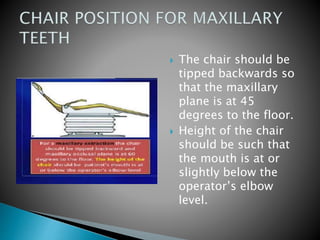
 The chair should be
tipped backwards so
that the maxillary
plane is at 45
degrees to the floor.
 Height of the chair
should be such that
the mouth is at or
slightly below the
operator’s elbow
level.
 For the left and anterior teeth, the left and
index finger of the surgeon should reflect the
lip and cheek tissue, the thumb should rest
on palate.
 For right, the index finger is on the palate
and thumb on the buccal aspect.
 Patient should be
positioned in a more
upright position so that
the occlusal plane is
parallel to the floor when
the mouth is opened.
 The chair should be
lower than for extraction
of maxillary teeth, and
the surgeon’s arm is
inclined downward
approximately a 120
degree angle at the
elbow.
 For the left posterior and anterior teeth, the
index finger of the hand reflects the cheek
and lips as it is placed in the buccal vestibule.
 The middle finger reflects th tongue as it is
placed in the lingual vestibule.
 The thumb is placed below the chin so that
the jaw is held between the fingers and
thumb.
1. Reflecting soft tissues to provide adequate
visualization of the area of surgery.
2. Protection of other teeth from the forceps.
3. Stabilization of the patient’s head during
extraction.
4. Most importantly it supports the alveolar
process and provides tactile information to
the operator concerning the expansion of
the alveolar process during luxation.
5. Compress the socket after removal of the
tooth.
WHEEL AND AXLE
PRINCIPLE:
 It is a modified form
of a lever.
 The effort is applied
to the circumference
of the wheel which
turns the axle so as
to raise a weight.
 It can be used a sole
work principle in
removing teeth.
 Expansion of bony socket i.e. the forcep creates
micro fracture in the alveolar process by use of
wedge shaped beaks and movement of the tooth
itself with the forceps.
 Lever principle – this works same as that for
elevator
 Wedge principle – the tip of the forceps beak is
narrower anteriorly and broaden posteriorly.
When the tip is forced between the
mucoperiosteum and tooth it causes expansion
of the bony socket so that the tooth displaced
out of socket.
DOS
 Bite firmly on the
gauze for atleast 20
minutes .
 Take soft, cold food.
 Take the painkiller
prescribed by your
dentist.
 Maintain oral
hygiene.
DONTS
 Constantly
spitting/rinsing out
saliva.
 Taking hot
food/drinks.
 Use straw to drink.
 Smoking/drinking
alcohol.
 Meddling extraction
site.
 Exert yourself.
REFERENCES:
1.Oral and maxillofacial surgery, Edward Ellis, James Hupp,
Myron Tucker
2.Exodontia practice, Abhay Datarkar

Exodontia

  • 1.
  • 2.
    EXODONTIA CAN BEDEFINED AS THE PAINLESS REMOVAL OF THE WHOLE TOOTH OR A TOOTH ROOT WITHOUT TRAUMA TO THE INVESTING TISSUES, SO THAT THE WOUND HEALS UNEVENTFULLY AND NO POST OPERATIVE PROSTHETIC PROBLEM IS CREATED.
  • 4.
    1. PERIODONTAL DISTURBANCES Most common cause of extraction in India.  If loss of periodontal support is more than 40%, it warrants an extraction. 2. DENTAL CARIES  When the tooth is extensively damaged by dental caries, even if the patient and doctor desire to save the tooth , it is indicated for extraction if all conservative procedures fail.
  • 5.
     Multiple cariousteeth may lead to deteriorating oral hygiene.  In such cases, removal of teeth will improve the oral hygiene. 3. PULP PATHOLOGY  If endodontic therapy is not possible or if the tooth is having pulpal pathology such as pulp necrosis or irreversible pulpitis, extraction is indicated. 4. APICAL PATHOLOGY  If the teeth fail to respond to all conservative measures to resolve apical pathology, either because of technical reasons or systemic factors, such teeth are indicated for extraction.
  • 6.
    5. ORTHODONTIC REASONS During orthodontic treatment, few teeth may require extraction either due to therapeutic reasons or because of malposition.  Serial extraction: During mixed dentition period, the dental surgeon may have to extract a few decidious teeth in a chronological order to prevent malocclusion as the child grows. 6. PROSTHETIC CONSIDERATIONS  Extraction of teeth is indicated for providing efficient dental prosthesis.
  • 7.
    7. IMPACTIONS  Retentionof unerupted teeth beyond the chronological eruption may sometimes be responsible for facial pain, periodontal disturbances of adjoining teeth, TMJ problems, bony pathology like cysts and pathological fractures of the jaws. 8. SUPERNUMERARY TEETH  Unless retention of supernumerary teeth are advantageous to the patients, they are indicated for extraction.
  • 8.
    9. TEETH PRIORTO IRRADIATION  Irradiation is one of the modalities of treating oral carcinomas .  All patients before irradiation must be carefully examined so that a decision is taken regarding the extraction of teeth.  Only teeth which which cannot be maintained in a sound oral condition require removal. 10. ECONOMIC CONSIDERATIONS  Sometimes the dental surgeon and patient are faced with economic constraints even though technically conservation of teeth may be feasible.
  • 9.
    11. FOCAL SEPSIS Sometimes teeth may appear apparently sound. But radiologic evaluation is a guiding factor to decide whether any teeth are to be considered as foci of infection.  In such circumstances, weightage is in favor of the underlying systemic disorders like dermatological lesions, facial pain, uncontrollable opthalmic problems etc.  In such conditions, doubtful teeth are extracted instead of resorting to any conservative methods of management. 12. ASSOCIATED PATHOLOGY  They are involved in cyst formation, neoplasm or osteomyelitis, extraction is indicated.  However, carefully evaluation is required before extracting teeth involved in cyst formations.
  • 10.
    13. ESTHETICS  Dueto certain compelling reasons like marriage and job opportunities, some teeth may require attention for esthetic considerations.  But due to time factor, it may not be possible to improve esthetics by any conservative orthodontic or surgical means.  If so, such teeth are indicated for extraction, provided it is followed by immediate prosthetic restoration in a shorter duration.
  • 11.
    14. TOOTH INLINE OF FRACTURE  This has been controversial over the course of years.  The present concept is to extract the tooth in the line of fracture if (a) it is a source of infection at the site fracture (b) the tooth itself is fractured ©the retention may interfere with fracture reduction or with healing of the fracture.  Formerly, all the teeth in the line of fracture were routinely removed.  But now, a conservative approach is advocated and hence extraction of such teeth requires guarded approach.
  • 12.
    RELATIVE If the contraindicationis provided with additional care one can overcome the complication. In other words, given the situation, the patient is made fit to undergo extraction once the underlying condition is treated. ABSOLUTE There are few conditions which are absolute contraindications. These factors will be impediment for extraction even if care is taken. If extraction is carried out in presence of such absolute contra indications, the outcome may be fatal.
  • 13.
    1. LOCAL  IRRADIATEDTISSUE • Extractions performed in an area of radiation may result osteoradionecrosis.  ADJACENT NEOPLASM • Teeth that are located within an area of tumor, especially a malignant tumor, should not be extracted. • The surgical procedure of extraction could disseminate malignant cells and thereby seed metastasis.
  • 14.
     PERICORONITIS • Patientswho have severe pericoronitis around an impacted mandibular third molar should not have the tooth extracted until the pericoronitis has been treated. • Non surgical treatment should include irrigations, antibiotics and removal of maxillary third molar.
  • 15.
    2. SYSTEMIC  DIABETESAND HYPERTENSION • One should investigate the state of these disorders in every patient and extraction should be carried out only after confirming that they are under control.  2. PATIENTS ON STEROID THERAPY • If patient gives history of cortisone therapy, the, dental surgeon has to take certain precautions. • A physician’s opinion must be taken.
  • 16.
     3. PREGNANCY •The clinician should bear in mind the existence of the possibility of obstetric complications during the first and last trimester. • Hence if possible, extraction can be carried out after obtaining the obstetrician’s expert opinion.  4. BLEEDING DISORDERS • The patients who give a definite history of bleeding episodes need careful evaluation • Patients with anticoagulant therapy can undergo extraction after obtaining prior advice from the patient’s physician/cardiologist.
  • 17.
     5. ACTIVEINFECTIONS • These are relative contra indications. • For example: Extraction in the presence of active and uncontrolled infection will lead to the regional or systemic spread. • Hence, it is preferable to control the infection and extraction can be safely carried out under the umbrella of antibiotic therapy.  6. EXTRACTION OF TEETH IN RECENTLY IRRADIATED PATIENTS • These cases deserve special mention. • Irradiation of jaws reduces blood supply due to fibrosis.
  • 18.
     CLINICAL EVALUATION RADIOGRAPHIC EVALUATION  PATIENT AND SURGEON PREPARATION  PATIENT POSITION  OPERATOR POSITION  PRINCIPLES OF EXTRACTION  PRINCIPLES OF ELEVATORS  POST OPERATIVE INSTRUCTIONS
  • 19.
     Access: Thefirst factor to see is the adequacy of mouth opening. The cause of limited mouth opening must be ruled out.  Status of supporting structures: The status of surrounding structure should be evaluated. Presence of any infection periodontal problems should be ruled out.  Status of tooth and crown: The presence of large carious lesion, root canal filled tooth and large restoration should be checked. One must check for presence of mobility of teeth.
  • 20.
     As bonedensity increases, the amount of socket expansion obtained during forceps extraction becomes less and tooth removal thus requires more force.  Bone density can be interpreted radiographically by relative amount of trabeculation.  This possible by standardising radiographic procedure in the office.
  • 21.
     The conceptof universal principles states that all patients must be viewed as having blood borne diseases that can be transmitted to the surgical team.  Before extraction the patient must vigorously rinse their mouths with an antiseptic mouth rinse such as chlorhexidine.  To prevent teeth or fragments of teeth from falling into the mouth and potentially being swallowed or aspirated into the lungs, it is preferable to place a 4*4 inch gauze loosely into the back of the mouth. However it should make the patient gag.
  • 22.
     The chairshould be tipped backwards so that the maxillary plane is at 45 degrees to the floor.  Height of the chair should be such that the mouth is at or slightly below the operator’s elbow level.
  • 23.
     For theleft and anterior teeth, the left and index finger of the surgeon should reflect the lip and cheek tissue, the thumb should rest on palate.  For right, the index finger is on the palate and thumb on the buccal aspect.
  • 24.
     Patient shouldbe positioned in a more upright position so that the occlusal plane is parallel to the floor when the mouth is opened.  The chair should be lower than for extraction of maxillary teeth, and the surgeon’s arm is inclined downward approximately a 120 degree angle at the elbow.
  • 25.
     For theleft posterior and anterior teeth, the index finger of the hand reflects the cheek and lips as it is placed in the buccal vestibule.  The middle finger reflects th tongue as it is placed in the lingual vestibule.  The thumb is placed below the chin so that the jaw is held between the fingers and thumb.
  • 26.
    1. Reflecting softtissues to provide adequate visualization of the area of surgery. 2. Protection of other teeth from the forceps. 3. Stabilization of the patient’s head during extraction. 4. Most importantly it supports the alveolar process and provides tactile information to the operator concerning the expansion of the alveolar process during luxation. 5. Compress the socket after removal of the tooth.
  • 27.
    WHEEL AND AXLE PRINCIPLE: It is a modified form of a lever.  The effort is applied to the circumference of the wheel which turns the axle so as to raise a weight.  It can be used a sole work principle in removing teeth.
  • 28.
     Expansion ofbony socket i.e. the forcep creates micro fracture in the alveolar process by use of wedge shaped beaks and movement of the tooth itself with the forceps.  Lever principle – this works same as that for elevator  Wedge principle – the tip of the forceps beak is narrower anteriorly and broaden posteriorly. When the tip is forced between the mucoperiosteum and tooth it causes expansion of the bony socket so that the tooth displaced out of socket.
  • 29.
    DOS  Bite firmlyon the gauze for atleast 20 minutes .  Take soft, cold food.  Take the painkiller prescribed by your dentist.  Maintain oral hygiene. DONTS  Constantly spitting/rinsing out saliva.  Taking hot food/drinks.  Use straw to drink.  Smoking/drinking alcohol.  Meddling extraction site.  Exert yourself.
  • 30.
    REFERENCES: 1.Oral and maxillofacialsurgery, Edward Ellis, James Hupp, Myron Tucker 2.Exodontia practice, Abhay Datarkar