ENDODONTIC EMERGENCIES
1
PRESENTED BY-
Dr. Arpit Viradiya
GUIDED BY-
DR SANDEEP METGUD
DEFINITION :-
EMERGENCY according to Dorland’s Medical dictionary is
defined as a sudden, urgent, usually unforeseen occurrence
requiring immediate action. Life threatening emergencies
can and do occur in the practice of dentistry.
Endodontic emergencies are circumstances associated
primarily with Pain and/or Swelling that require immediate
diagnosis and treatment.
2
Most of the emergencies are unscheduled.
The reason for endodontic emergency treatment is
pain and swelling from pulpo periapical pathosis.
Although, all forms of medical emergencies may develop in
dental practice, some are seen with greater frequency. These
are situations produced entirely by stress or those that are
acutely aggravated when the patient is under stress.
3
Most dental emergencies are unscheduled intrusions into
the routine of daily practice. Nevertheless, the dentist must
provide speedy and effective relief because such care is an
essential part of daily practice.
The reason for endodontic emergency treatment is PAIN
and at times SWELLING ensuing from pulpoperiapical
pathosis. Because dental pain has many causes, the adept
clinician must diagnose the origin of pain as quickly as
possible to render rapid and effective relief.
4
DIAGNOSIS
In an ACUTE pain emergency, the PHYSICAL as well
as the EMOTIONAL state of the patient should be
considered. The doctor’s reactions to the patient is
important for both pain and patient management. The
patient’s needs, their fears about the immediate problem and
their defenses for coping with the situation must be
understood.
The chief tool in establishing a correct diagnosis
remains in careful history taking, followed by a thorough
but quick clinical examination.
5
According to Grossman – The diagnostic methods available to
clinicians are:
SUBJECTIVE SYMPTOMS : Which is the chief complaint of
patient eliciting either:
1) Pain
2) Swelling
3) Lack of function
4) Esthetics
DENTAL HISTORY
MEDICAL HISTORY
6
OBJECTIVE SYMPTOMS
Which are determined by tests and observations
performed by clinicians.
The tests are as follows:
•Visual and Tactile Inspection.
•Percussion.
•Palpation.
•Mobility and Depressibility.
•Radiographs.
•Electric pulp test
•Thermal tests
- Hot
- Cold
•Anesthetic test
•Test cavity
7
CLASSIFICATION OF ENDODONTIC
EMERGENCIES
1. According to GROSSMAN
a)Acute Conditions
•Reversible pulpitis
•Irreversible pulpitis.
•Alveolar abscess.
•Periodontal abscess
b)Emergencies During Treatment
c)Fractures
Crown
Root
d)Avulsed tooth
e)Referred pain
8
2. According to GUTTMAN
I] TREATMENT OF VITAL PULP
Acute reversible pulpitis
Hypersensitive dentin.
Recurrent decay.
Recent restoration.
Cracked tooth syndrome.
II] TREATMENT OF NON-VITAL PULP
Acute apical periodontitis.
Necrotic pulp.
Acute alveolar abscess.
Phoenix abscess.
Acute irreversible pulpitis
- Localized.
- Non-localized
9
III] ESTHETIC EMERGENCY
•Fracture of crown.
•Fracture of root.
•Avulsed tooth.
3. According to WALTON
(A)Pretreatment emergencies.
(B)Interappointment emergencies.
(C)Post-obturation emergencies
10
Pre - endo emergencies are:-
Acute reversible pulpitis
Acute irreversible pulpitis
Acute apical periodontitis
Acute alveolar abscess
Acute periodontal abscess
Cracked tooth syndrome
Crown fracture
Root fracture
Tooth Avulsion
Referred pain
11
Interappointment Emergencies
Mid treatment flare-ups
Exposure of pulp
Fracture of tooth
Recently placed restoration
Periodontal treatment
12
Post - endo emergencies:
Vertical Fracture
Over obturation
Under obturation
13
HOT TOOTH
Hot tooth refers to a painful tooth and initial therapy for it
refers to what needs to be done to give relief from pain at
first appointment.
Before treatment is given, diagnosis is made, that whether
the pain is of odontogenic or non odotogenic origin
Sometimes living nerve tissue is present
inside the hot tooth, but the extent of inflammation prevents
the tooth from recovery. Sometimes hot tooth will no longer
be vital, such teeth are termed necrotic.
Pretreatment Emergencies
14
Prior to making final diagnosis, three clinical determinations
are required prior to the initiation of endodontic therapy:
Presence or absence of pulp vitality.
Presence or absence of pain on percussion.
Radiographic evaluation.
If bacteria gain access to root canal of necrotic teeth they can
create a significant colony before the body’s immune system
knows about their presence. Large bacterial colonies are
capable of producing a significant amount of tissue destroying
enzymes and acids and when the immune system begins to
fight the infection the bone and soft tissues around the tooth
become tender on percussion and become hot to touch.
15
The pain management is the most critical factor which affects
the prognosis of the treatment.
To obtain an adequate anaesthesia of inflamed tissues is the
challenge.
Maxillary anaesthesia is easier to obtain by giving infiltration
or block injections in the buccal or palatal region.
For adequate pulpal anaesthesia in the mandible, inferior
alveolar, lingual and long buccal injections are preferred.
16
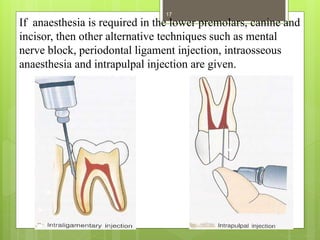
If anaesthesia is required in the lower premolars, canine and
incisor, then other alternative techniques such as mental
nerve block, periodontal ligament injection, intraosseous
anaesthesia and intrapulpal injection are given.
17
DENTIN HYPERSENSITIVITY
It is defined as sharp, short
pain arising from exposed
dentin in response to stimuli
typically thermal, chemical,
tactile or osmotic
and which can’t be ascribed
to any other form of dental
defect or pathology.
18
Treatment
Two main treatment options are plug the dentinal tubules
preventing the fluid flow and desensitize the nerve.
Etiology
The primary underlying cause for dentin hypersensitivity
is exposed dentinal tubules which can occur by two
processes-
by loss of enamel or by loss of covering periodontal
structures.
19
ACUTE REVERSIBLE PULPITIS:-[Hyperemia]
DEFINITION:
It is a mild to moderate
inflammatory condition of the
pulp caused by noxious
stimuli in which the pulp is
capable of returning to the uninflamed state
following removal of the stimulus
20
It is characterized by sharp pain lasting for a moment,
more often brought on by cold than hot food or
beverages.
The patient can identify the tooth.
Momentary pain that subsides on removal of stimulus.
21
Symptoms:
A.R.P. is characterized by:
•Sharp pain lasting for a moment.
•Shooting pain lasting for short-duration.
•Pain brought on by cold beverages and sweets.
•Clinically – the patient can identify the tooth by pointing to it.
22
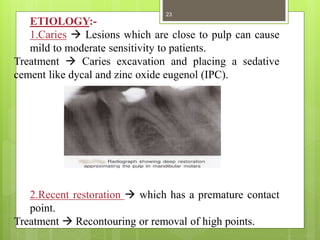
ETIOLOGY:-
1.Caries  Lesions which are close to pulp can cause
mild to moderate sensitivity to patients.
Treatment  Caries excavation and placing a sedative
cement like dycal and zinc oxide eugenol (IPC).
2.Recent restoration  which has a premature contact
point.
Treatment  Recontouring or removal of high points.
23
4.Recurrent caries -> under an old restorations.
Treatment  Remove all caries and replace with a sedative
cement.
5.Thermal shock from preparing a cavity with a dull
bur or keeping the bur in contact with the tooth for a
long time can cause acute reversible pulpitis which
exaggerates on placing a metallic restoration over the
tooth.
3.Persistent pain and severe sensitivity after cavity
preparation  Suggesting chemical leakage.
Treatment  Removal of restoration and placing sedative
cement like ZOE.
24
TREATMENT:-
The best Rx is prevention.
 In a recently restored tooth, occlusion is adjusted.
 In cases of marginal leakage or secondary caries ,the old
restorations are removed and replaced with sedative
cement.
 Pain usually disappears with in several days ,if it persists
then pulp has to be extirpated
25
Prognosis: The prognosis is favourable if early
removal of irritant is achieved ,otherwise the condition
may develop into irreversible pulpitis.
26
.
ACUTE IRREVERSIBLE PULPITIS
DEFINITION:
It is a persistent inflammatory condition of the pulp,
symptomatic or asymptomatic, caused by a noxious
stimulus. Acute Irreversible Pulpitis exhibits pain usually
caused by hot or cold stimulus
27
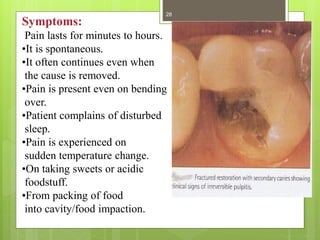
Symptoms:
Pain lasts for minutes to hours.
•It is spontaneous.
•It often continues even when
the cause is removed.
•Pain is present even on bending
over.
•Patient complains of disturbed
sleep.
•Pain is experienced on
sudden temperature change.
•On taking sweets or acidic
foodstuff.
•From packing of food
into cavity/food impaction.
28
Causes:
•The most common cause of irreversible pulpitis is bacterial
involvement of pulp through caries.
•Reversible pulpitis may also deteriorate into irreversible pulpitis.
In irreversible pulpitis the pulp may be Vital
Non-vital
29
1.Vital pulp
According to Grossman, the preferable emergency treatment
is ‘PULPECTOMY’ - complete removal of the pulp and
placement of an intracanal medicament to act as a disinfectant or
obtundent.
According to many authors like Weine, Walton and
Grossman, in posterior teeth, where time is a factor,
PULPOTOMY or removal of coronal pulp and placement of
formocresol or similar dressing on the radicular pulp should be
performed as an emergency treatment whereas in single rooted
teeth, pulpectomy can be performed directly.
30
Procedure:
• Administration of local anaesthesia.
• Access cavity is prepared.
• With a spoon excavator and round bur the coronal pulp is
removed.
• A cotton pellet moistened with formocresol is placed in the
cavity and it is sealed with ZnOE cement.
After removal of the tissue, the site of inflammation
precipitating a painful response is gone.
The formocresol fixes the non-inflammed tissues in the canal
until the subsequent treatment of endodontics is followed.
The tooth involved is then relieved out of occlusion.
31
2. Non-Vital Pulp
Necrotic pulp rarely causes an emergency procedure.
Most of the time these teeth do not respond to stimuli such as hot,
cold or electric stimulation, they may still contain vital inflamed
tissue in the apical portion of root canal and also inflamed
periapical tissue which causes pain.
32
ACUTE APICAL PERIODONTITIS:-
DEFINITION:-
It is a painful inflammation of periodontium as a result of
trauma, irritation or infection through root canal whether the
pulp is vital or non vital.
CAUSES:-
Occlusal trauma
Wedging of foreign objects
Blow to tooth
Over instrumentation or over filling
Symptoms: Pain & tenderness of the tooth,sometimes the
tooth may be extruded.
TREATMENT:-
Vital tooth--------symptomatic Rx
33
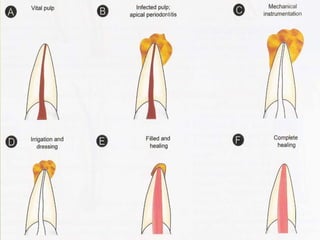
Management of Non vital tooth
Profound anaesthesia of the involved tooth
Preparation of the access cavity
Total extirpation of pulp in pulp chamber
Determination of working length
Total extirpation of the pulp
Bio-mechanical preparation
Thorough irrigation
Placement of sedative dressing folllowed by closed
dressing
Relieve occlusion if indicated
Prescribe analgesics to reduce pain.
34
35
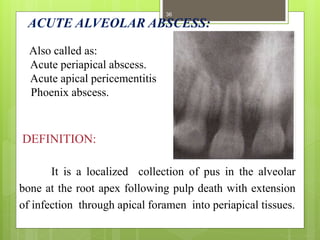
ACUTE ALVEOLAR ABSCESS:
Also called as:
Acute periapical abscess.
Acute apical pericementitis
Phoenix abscess.
DEFINITION:
It is a localized collection of pus in the alveolar
bone at the root apex following pulp death with extension
of infection through apical foramen into periapical tissues.
36
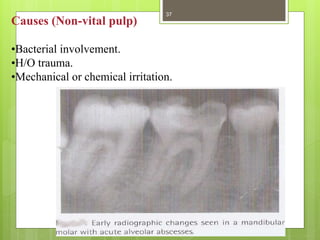
Causes (Non-vital pulp)
•Bacterial involvement.
•H/O trauma.
•Mechanical or chemical irritation.
37
The acute episode may result from:
a)PULPITIS that progressively developed
into pulp necrosis affecting the periapical
tissues.
b)ACUTE EXACERBATION of a chronic
periapical lesion
c)ENDO-PERIO lesion when the periodontal
abscess secondarily affects the pulp through
the lateral canals or deep infrabony pockets.
38
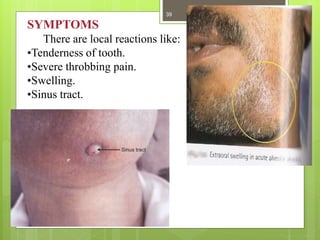
SYMPTOMS
There are local reactions like:
•Tenderness of tooth.
•Severe throbbing pain.
•Swelling.
•Sinus tract.
39
Systemic reactions are:
•Elevated temperature.
•Gastro-intestinal
disturbances.
•Malaise.
•Nausea.
•Dizziness.
•Lack of sleep.
40
TREATMENT
The main treatment is biphasic in nature i.e.
I – Debridement of canals.
II – Drainage of abscess.
The emergency treatment of acute alveolar abscess
differs from acute irreversible pulpitis, as the pulp is
necrotic, local anaesthesia is not required and
frequently contraindicated.
Forcing anaesthetic solution into an acutely infected
and swollen area may increase pain and may spread
infection.
41
“BLOCK MAY BE USED IN SUCH CASES”
Most of the pain that occurs during access cavity
preparation is caused by tooth movement resulting from
vibration of the bur, therefore, one should stabilize tooth
with finger pressure so that the pain is reduced.
Treatment procedure follows as:
•Access cavity preparation.
•Profuse irrigation avoiding forcing of any solution or debris
into the periapical tissue.
•In most cases PURULENT EXUDATE escapes into the
chamber and indicates that root canal is patent and draining.
•If drainage does not occur, the apical constriction is
purposefully violated and enlarged to a minimum of 20/25 no.
instrument to allow for exudate to drain because in most cases
the apical constriction may prevent the drainage.
42
According to GROSSMAN & COHEN leaving the
tooth OPEN for drainage reduces the possibility of
continued pain and swelling. Open root canals permit
drainage and frequently eliminate the need for surgical
incision as well as routine administration of oral
antibiotics and analgesics.
According to WALTON, after copious irrigation,
the canals are dried with paper points and a
medicated temporary cotton pellet is kept – in other
words – open dressing is given.
Some clinicians suggested acutely abscessed teeth to be
sealed with an intracanal medicament after the initial
emergency treatment is done. According to them, this stops
the infiltration of new microorganisms.
43
As opposed to them, AUGUST found that only 3%
out of 311 abscessed teeth which had been left open
reacted adversely.
Therefore, the decision to keep the canal patent or
closed must be made depending on the amount of
drainage and size of swelling.
SWELLINGS ASSOCIATED
•If it is slight and localized it will disappear 24 to 48 hours
after drainage.
•If it is extensive, soft and fluctuant, an incision through soft
tissue is a must.
•If swelling is hard – it can be converted to soft fluctuant
state by rinsing with hot saline solution 3-5 minutes at a time
repeated every hour.
44
Acute Alveolar Abscess
Patient may present with no swelling,
with intra oral sinus OR
with swelling [facial asymmetry ]
45
WITH SWELLING:-
3 ways to resolve it:
1. Establish drainage through root canal
2. Establish drainage by incising a fluctuant swelling [if the
swelling is hard ,rinse it 3-5 mins with hot saline]
3. Antibiotics
use of antibiotics is regarded as an aid to drainage .
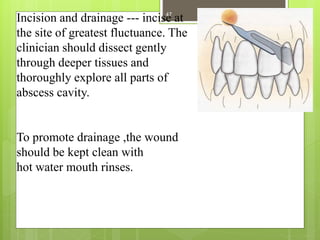
46
Incision and drainage --- incise at
the site of greatest fluctuance. The
clinician should dissect gently
through deeper tissues and
thoroughly explore all parts of
abscess cavity.
To promote drainage ,the wound
should be kept clean with
hot water mouth rinses.
47
In cases where periapical drainage cannot be
established, Surgical Trephination is done.
Definition:
Trephination is the surgical perforation of alveolar
cortical plate [over the root end] to release the
accumulated tissue exudate that is causing pain.
[A small vertical incision is made adjacent to the tooth,
the mucosa is retracted and No.6 round bur is used to
penetrate cortical plate. This provides a drainage.]
Recent technique involves use of engine driven perforator
to enter the medullary bone with out the need of incision.
48
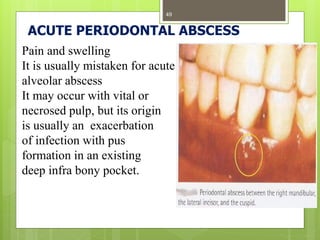
ACUTE PERIODONTAL ABSCESS
Pain and swelling
It is usually mistaken for acute
alveolar abscess
It may occur with vital or
necrosed pulp, but its origin
is usually an exacerbation
of infection with pus
formation in an existing
deep infra bony pocket.
49
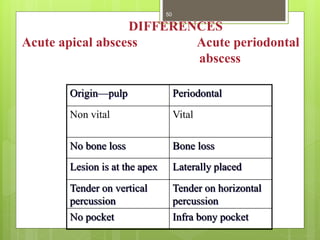
DIFFERENCES
Acute apical abscess Acute periodontal
abscess
Origin—pulp Periodontal
Non vital Vital
No bone loss Bone loss
Lesion is at the apex Laterally placed
Tender on vertical
percussion
Tender on horizontal
percussion
No pocket Infra bony pocket
50
• Its origin is usually an ACUTE EXACERBATION of
infection with pus formation in an existing deep infrabony
pocket.
 If the pulp is VITAL
Treatment  Consists of curettage, debridement and
establishment of drainage of the infrabony pocket through
sulcus.
 If the pulp is NECROTIC
Treatment – extirpation and pulpectomy, similar to acute
alveolar abscess.
In any case, emergency periodontal treatment must be done
simultaneously, otherwise the patient will not be relieved of
pain and swelling.
51
EMERGENCIES DURING TREATMENT
Endodontic emergencies can occur during the course of
treatment.
Most emergencies are reactive phenomenon to pressure and
chemical mediators created as a result of inflammatory
response in periradicular tissues.
According to Grossman
The emergencies can be due to:
•Instrumentation beyond the root apex causing trauma to
periradicular tissue.
•When debris and microorganisms are pushed beyond the
apical foramen which can cause an infectious reaction.
•Chemical irritants like - Irrigating solution.
- Intracanal medicament
52
•Incomplete debridement of all root canals.
•Lost or depressed access cavity seals leading to
recontamination.
•Overfilled root canals with subsequent periapical
inflammation.
The inflammation in the peri-radicular tissue is induced as
a result of release of substances such as vasoactive amines,
kinins and arachadonic acid metabolites. This
interappointment emergency as classified by WALTON is
referred to as “FLARE-UP”.
53
WALTON has suggested the possible factors related as
discussed before as:
• Irritants within the pulp system.
• Operator controlled or iatrogenic factors.
• Host factors.
• General systemic factors which are related to Flare-up.
Patients can accept that pain may continue to a lesser
extent when they come to the dental office for emergency
treatment. What is difficult for patients to comprehend is
when they enter the office having little or no pain before
therapy but then encounter an explosive flare-up after the
treatment is done.
54
Therefore PREVENTION OF FLARE-UPS can be
done by:
• The most important preventive measure is preparing the
patient to accept some discomfort which should subside in
a day or two i.e. psychological preparation of patients.
• Using long acting anaesthetic solution.
• Complete cleaning and shaping of root canals.
• Administration of appropriate analgesics, prophylactic
analgesics before next appointment reduces the incidence
of discomfort and flare-ups.
55
HYPOCHLORITE ACCIDENT
Another very important but rare emergency is due to
expelling of an irrigant such as NaOCl beyond the apex.
This happens only by locking the needle of the irrigating
syringe in the canal and forcefully injecting the irrigant.
• Within minutes the patient feels SUDDEN EXTREME
PAIN.
• SWELLING within minutes.
• Profuse, prolonged BLEEDING through the root canal.
This bleeding is the body’s reaction to the irrigant.
Remove the toxic fluid with high volume evacuation to
encourage further drainage from periradicular tissue.
56
Treatment:
•Allow the bleeding to continue. If the body rids itself of
toxic fluid healing may be faster.
•If the treated tooth is pulpless consider prescribing an
antibiotic and an analgesic for 5 and 3 days respectively.
•Since this may be hypersensitive reaction consider
prescribing an antihistaminic.
57
POSTOBTURATION EMERGENCIES:
Various factors resulting in postobturation pain can be:
Overinstrumentation
It is directly proportional to post operative pain.
Carelessness while recording working length, can result in
overobturation or overfilling.
Overextended obturation
It leads to pain. Periapical inflammation results in firing of
proprioceptive nerve fibres in the PDL. They are short lived
and don’t require any treatment.
58
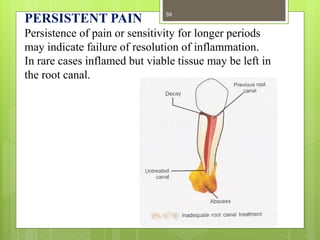
PERSISTENT PAIN
Persistence of pain or sensitivity for longer periods
may indicate failure of resolution of inflammation.
In rare cases inflamed but viable tissue may be left in
the root canal.
59
TRAUMATIC & ESTHETIC EMERGENCY
It can be broadly classified as:
• Crown fracture.
• Root fracture.
• Tooth avulsion.
A traumatic injury to a tooth can cause a: - Cracked crown
- Fractured crown.
- Fractured root
And all this results in pain.
60
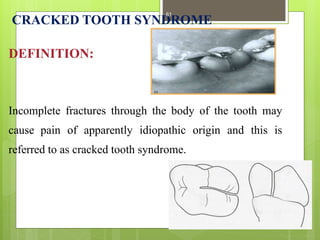
CRACKED TOOTH SYNDROME
DEFINITION:
Incomplete fractures through the body of the tooth may
cause pain of apparently idiopathic origin and this is
referred to as cracked tooth syndrome.
61
Causes:
•Intact tooth that has an opposing plunger cusp occluding
centrically against a marginal ridge.
•Biting unexpectedly on a hard object like stone.
•Trauma / blow.
Symptoms:
1)Sharp, piercing pain during mastication.
2)Fleeting pain on thermal changes.
3)Hypersensitivity.
The patient usually complains of pain ranging from mild to
excruciating at the initiation or release of biting pressure
62
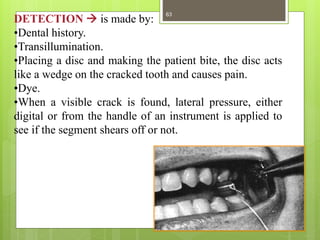
DETECTION  is made by:
•Dental history.
•Transillumination.
•Placing a disc and making the patient bite, the disc acts
like a wedge on the cracked tooth and causes pain.
•Dye.
•When a visible crack is found, lateral pressure, either
digital or from the handle of an instrument is applied to
see if the segment shears off or not.
63
TREATMENT
•Immediate treatment is covering the exposed dentin with a
sedative cement like ZnOE and cementing a stainless steel
band.
•If a green stick fracture of the crown is present and the
crown segment does not shear off under pressure, one should
cement stainless steel band.
•If the pulp is exposed, a band should be placed and cemented
and a pulpectomy should be performed.
•This should be immediately followed by relieving of
occlusion by grinding the cusps of the tooth.
64
Because any traumatic accident can temporarily affect the
usual responses to the electric pulp test, cold test and test
cavity, negative test responses for pulp vitality are non
diagnostic and should not be the basis for selecting endo
emergency treatment. It is wiser to assume that pulp is vital
as vital pulp in the root canal of fractured tooth can enhance
the prognosis of healing.
65
CROWN FRACTURES
Crown fractures can be divided into 4 major groups:
• Only enamel.
• Enamel and dentine without pulp exposure.
• Enamel and dentin with pulp exposure.
• Untreatable.
66
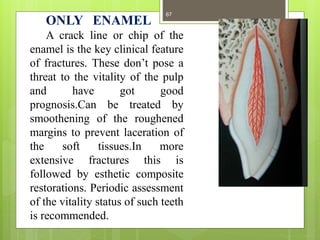
ONLY ENAMEL
A crack line or chip of the
enamel is the key clinical feature
of fractures. These don’t pose a
threat to the vitality of the pulp
and have got good
prognosis.Can be treated by
smoothening of the roughened
margins to prevent laceration of
the soft tissues.In more
extensive fractures this is
followed by esthetic composite
restorations. Periodic assessment
of the vitality status of such teeth
is recommended.
67
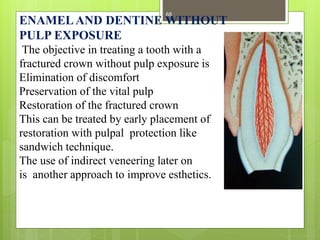
ENAMELAND DENTINE WITHOUT
PULP EXPOSURE
The objective in treating a tooth with a
fractured crown without pulp exposure is
Elimination of discomfort
Preservation of the vital pulp
Restoration of the fractured crown
This can be treated by early placement of
restoration with pulpal protection like
sandwich technique.
The use of indirect veneering later on
is another approach to improve esthetics.
68
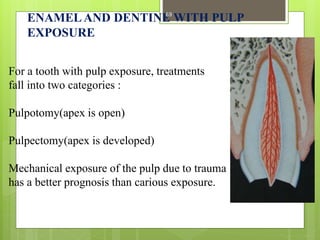
ENAMELAND DENTINE WITH PULP
EXPOSURE
For a tooth with pulp exposure, treatments
fall into two categories :
Pulpotomy(apex is open)
Pulpectomy(apex is developed)
Mechanical exposure of the pulp due to trauma
has a better prognosis than carious exposure.
69
UNTREATABLE
These imply to crown fracture in which an aesthetic
and periodontally healthy condition is impossible.
70
ROOT FRACTURE
Can be divided as : - Vertical
- Horizontal
Coronal third.
Middle third
Apical third
71
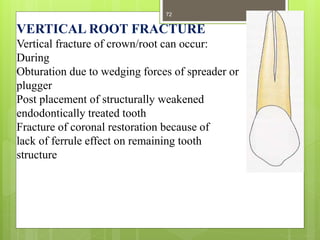
VERTICAL ROOT FRACTURE
Vertical fracture of crown/root can occur:
During
Obturation due to wedging forces of spreader or
plugger
Post placement of structurally weakened
endodontically treated tooth
Fracture of coronal restoration because of
lack of ferrule effect on remaining tooth
structure
72
Vertical fractures have hopeless prognosis
because it is not possible to either
stabilize the fragments or remove
one part surgically and leave the other in situ.
Periodontal probing may reveal single isolated narrow
pocket adjacent to fracture site.
Management
Diagnosis
73
HORIZONTAL FRACTURES
 Above alveolar crest  excellent prognosis.
The closer the root fractures to the apex the more
favourable the prognosis as sufficient root length is seen if
fractured fragment is to be removed.
Treatment  stabilize by ligation to adjacent teeth.
 Check pulp vitality after 6 weeks as the pulp will be in
a “stunned” state.
If the fracture is at mid root or below the alveolar crest 
poor prognosis.
If remaining root portion is left post and core can be
given.
74
Prognosis depends on location and direction of fracture
A horizontal fracture above the alveolar crest has
excellent prognosis since the tooth can be restored .
Apical root fracture has favourable prognosis
75
Rx for horizontal fracture - Stabilization by ligation of tooth with
adjacent teeth if mobility is present
Pulp is in a state of shock so vitality tests are to be repeated after
6wks
Cervical 1/3 fracture – Re attachment of the segment if displaced
Stabilization by splinting
If the segment is lost, post and core is done
Prognosis is favourable
76
Middle 1/3 fracture
Is treated by stabilization and orthodontic
extrusion of fractured segment
Prognosis is poor
Apical 1/3 fracture
Apical 1/3 fracture is left untreated
Prognosis is very good
In multirooted teeth, hemisection is done.
77
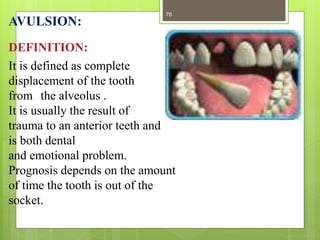
AVULSION:
DEFINITION:
It is defined as complete
displacement of the tooth
from the alveolus .
It is usually the result of
trauma to an anterior teeth and
is both dental
and emotional problem.
Prognosis depends on the amount
of time the tooth is out of the
socket.
78
Management:
Outside the dental office.
Success depends on the speed with which the tooth is
replaced.
Extra oral time:
Should not exceed 30 minutes ,should be
placed within 15-20 mins. Care should be
taken not to damage the attachment apparatus.
79
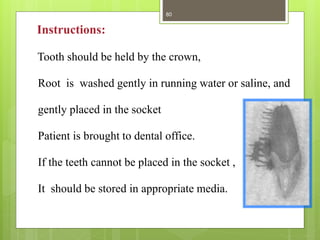
Instructions:
Tooth should be held by the crown,
Root is washed gently in running water or saline, and
gently placed in the socket
Patient is brought to dental office.
If the teeth cannot be placed in the socket ,
It should be stored in appropriate media.
80
Suggested Media:
Vestibule of mouth, Physiologic saline, Milk
Cell culture media, Hank's Balanced Salt Solution
[HBSS]
Milk
is considered the best medium because it has pH
& osmolality compatible to vital cells and
relatively free of bacteria and is readily available.
It maintains vitality of periodontal tissues for 3 hours.
Water
tooth should not be kept in water since it is a
hypotonic environment and leads to rapid cell lysis.
81
Management at the office
If the tooth was replanted, positioning in the socket is
assessed and Rg is taken for confirmation
If unacceptable, tooth is removed gently and
replanted. Splinting and soft tissue management is
done.
82
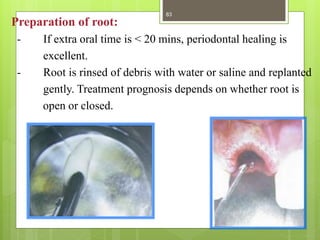
Preparation of root:
- If extra oral time is < 20 mins, periodontal healing is
excellent.
- Root is rinsed of debris with water or saline and replanted
gently. Treatment prognosis depends on whether root is
open or closed.
83
If extra oral time is > 60 mins. periodontal cells have died,
then the tooth is soaked in citric acid for 5 mins, in 2% SnF
for 5mins to remove remaining periodontal cells and
replanted.
If tooth is dry for more than 60mins ,endodontic Rx is
performed extra orally. The socket is lightly aspirated if blood
clot is present.
84
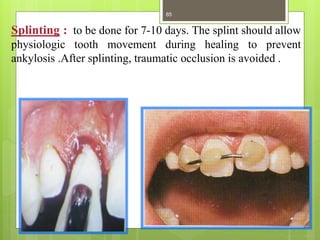
Splinting : to be done for 7-10 days. The splint should allow
physiologic tooth movement during healing to prevent
ankylosis .After splinting, traumatic occlusion is avoided .
85
REVIEW :
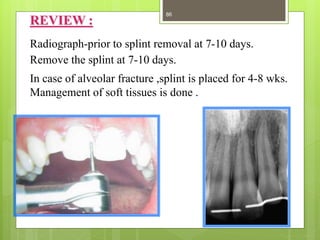
Radiograph-prior to splint removal at 7-10 days.
Remove the splint at 7-10 days.
In case of alveolar fracture ,splint is placed for 4-8 wks.
Management of soft tissues is done .
86
Adjunctive therapy:
analgesics and antibiotics to prevent infection
chlorhexidine rinse
Endodontic Rx is initiated if the tooth is nonvital
In cases of open apex, apexification is done
Follow up care to be done every 6mths for 5 years.
87
Prognosis:
The failure of replantations is related to resorption
The extra oral time is very crucial and affects the treatment
results
When teeth were replanted within 30mins only 10%
showed resorption where as 95% resorbed when replanted
more than 2hrs post trauma
88
REFERRED PAIN:-
Cause: Pulpo periapical pathosis
Dental pain can have its origin in trigeminal neuralgia,
atypical facial neuralgia ,migraine,cardiac pain,TM
arthrosis
Sinusitis –may cause pain in upper molars
Periodontal pain is mistaken as periapical
Pain from lower posterior teeth can be referred to ear
or back of head
Rx depends on diagnosis
89
Pain arising from periodontal problems:
• Periodontal abscess.
• Occlusal trauma.
• Muscle spasm.
• Bruxism and clenching.
• Pericoronitis may be confused as pulpoperiapical pain.
Spicer reported pain referred to a lower molar from a basilar
artery aneurysm that produces pressure in the trigeminal nerve.
Verbin and colleagues described odontalgia in a
maxillary lateral incisor due to herpes zoster of trigeminal
nerve.
90
Sanubai and Richardson described vascular neck pain
referred to mandibular posterior teeth.
Otitis Media may refer to mandibular molars.
Myocardial infarction or angina pectoris may cause tooth
ache on left side especially if it occurs while patient is
exercising.
Other causes of referred or unusual pain are:
• Intensive radiation.
• Malaria, typhoid, influenza.
• Menstrual pain.
• Some malignant diseases and tumors.
Thus, the role of diagnosing a true endo emergency cannot
be over emphasized.
91
ANALGESICS AND ANTIBIOTICS
The use of analgesics and antibiotics is important in endodontic
emergency treatment. Every clinician should be familiar with
their:
•Mode of action.
•Dosage.
•Indications.
•Interactions with other drugs.
•Route of administration.
•Toxicity
•Contraindications.
92
ANALGESICS
Analgesics are pain relievers.
NARCOTIC analgesics are used to relieve acute, severe pain.
NON-NARCOTIC or mild analgesics are used to relieve
slight to moderate pain.
The most frequently used non-narcotic analgesics are:
•Aspirin.
•Acetaminophen.
•Naproxen.
•Ibuprofen.
93
ASPIRIN alone or in compound is used most often in the
dosage of 600mg. Aspirin should be taken with caution as it can
cause an anaphylactic reaction in an allergic person or an
adverse reaction in persons with gastric ulcers.
Aspirin is contra-indicated in patients receiving
anticoagulant therapy, diabetes and arthritis.
ACETAMINOPHEN is the second most commonly used
analgesics and is effective for mild-to-moderate pain. It has
lower incidence of side effects than aspirin. It lacks anti-
inflammatory effect of aspirin. It is recommended for children
and is available in liquid form.
94
IBUPROFEN, a proprionic acid derivative prescribed
in doses of 300-400mg,4 times daily, is more effective in
severe pain relief than aspirin. But it should not be used
in patients with h/o peptic ulcer or aspirin intolerance.
NARCOTIC ANALGESICS like morphine, codine
30mg, neperidine, hydrocone 5mg with acetaminophen
500mg etc are generally not used or are used with
caution as they may depress the C.N.S. They interact
adversely sometimes, fatally with alcohol, local
anaesthetic, antihistaminics etc.
95
ANTIBIOTICS
Antibiotics are life saving therapeutic agents which are used
for prophylactic coverage of medically compromised patients
and as an adjunctive treatment for acute periapical and
periodontal infections.
Ideally, the selection of antibiotics should be based on the
susceptibility tests that indicate effectiveness against the
infecting microorganisms. Therefore, the more lethal the
antibiotic, the less likely resistant the microorganisms will
develop to it.
The most effective antibiotics for use in endodontic
emergencies is PENICILLIN.
Penicillin acts by inhibiting the cell wall synthesis during
multiplication of microorganisms and are effective against
gm+ve cocci, viridans strains, many anaerobes which are
involved in endodontic infections.
96
The standard regime for dental procedures is penicillin V, 2.0gm
1 hr before treatment and 1.0gm 6 hourly later.
This is quite feasible according to the European standards owing
to their larger physique and body wt and higher BMR, but
according to Indian Standards, this regime works out to be on a
larger scale owing to its less body wt. Therefore, the dosage reduces
in accordance to the body wt, which is 250mg to 500mg tid.
In cases of PENICILLIN ALLERGY, ERYTHROMYCIN may be
prescribed which acts by inhibiting proteins synthesis. The dosage
is 250mg-500mg 6 hourly.
Other antibiotics useful for treating endo-emergencies are:
Cephalexin – 250-500mg 6 hourly.
Clindamycin phosphate – 150-300mg 6 hourly.
Tetracycline HCl – 250-300mg 6 hourly.
Tetracycline is the least effective of all antibiotics for endo
emergencies.
97
CONCLUSION
A satisfying and rewarding experience is to successfully
manage a distraught patient who initially presented with
severe pain for an emergency appointment.
Proper operators attitude, patient control, accurate
diagnosis, and profound anaesthesia as well as prompt and
effective treatment are all integral components of management
of endo-emergencies.
98
REFERENCES
Pathways of pulp - 10th edition Cohen’s
Textbook of Endodontics - Nisha Garg
Ingle’s Endodontics - 6th edition
Advanced Endodontics by Nageshwar Rao
Grossman’s Endodontic Practice - Twelfth edition
Oral and Maxillofacial Pathology – Neville
Endodontic Therapy – Weine
World Wide Net
99
THANK YOU
100

Endodontic emergencies

  • 1.
    ENDODONTIC EMERGENCIES 1 PRESENTED BY- Dr.Arpit Viradiya GUIDED BY- DR SANDEEP METGUD
  • 2.
    DEFINITION :- EMERGENCY accordingto Dorland’s Medical dictionary is defined as a sudden, urgent, usually unforeseen occurrence requiring immediate action. Life threatening emergencies can and do occur in the practice of dentistry. Endodontic emergencies are circumstances associated primarily with Pain and/or Swelling that require immediate diagnosis and treatment. 2
  • 3.
    Most of theemergencies are unscheduled. The reason for endodontic emergency treatment is pain and swelling from pulpo periapical pathosis. Although, all forms of medical emergencies may develop in dental practice, some are seen with greater frequency. These are situations produced entirely by stress or those that are acutely aggravated when the patient is under stress. 3
  • 4.
    Most dental emergenciesare unscheduled intrusions into the routine of daily practice. Nevertheless, the dentist must provide speedy and effective relief because such care is an essential part of daily practice. The reason for endodontic emergency treatment is PAIN and at times SWELLING ensuing from pulpoperiapical pathosis. Because dental pain has many causes, the adept clinician must diagnose the origin of pain as quickly as possible to render rapid and effective relief. 4
  • 5.
    DIAGNOSIS In an ACUTEpain emergency, the PHYSICAL as well as the EMOTIONAL state of the patient should be considered. The doctor’s reactions to the patient is important for both pain and patient management. The patient’s needs, their fears about the immediate problem and their defenses for coping with the situation must be understood. The chief tool in establishing a correct diagnosis remains in careful history taking, followed by a thorough but quick clinical examination. 5
  • 6.
    According to Grossman– The diagnostic methods available to clinicians are: SUBJECTIVE SYMPTOMS : Which is the chief complaint of patient eliciting either: 1) Pain 2) Swelling 3) Lack of function 4) Esthetics DENTAL HISTORY MEDICAL HISTORY 6
  • 7.
    OBJECTIVE SYMPTOMS Which aredetermined by tests and observations performed by clinicians. The tests are as follows: •Visual and Tactile Inspection. •Percussion. •Palpation. •Mobility and Depressibility. •Radiographs. •Electric pulp test •Thermal tests - Hot - Cold •Anesthetic test •Test cavity 7
  • 8.
    CLASSIFICATION OF ENDODONTIC EMERGENCIES 1.According to GROSSMAN a)Acute Conditions •Reversible pulpitis •Irreversible pulpitis. •Alveolar abscess. •Periodontal abscess b)Emergencies During Treatment c)Fractures Crown Root d)Avulsed tooth e)Referred pain 8
  • 9.
    2. According toGUTTMAN I] TREATMENT OF VITAL PULP Acute reversible pulpitis Hypersensitive dentin. Recurrent decay. Recent restoration. Cracked tooth syndrome. II] TREATMENT OF NON-VITAL PULP Acute apical periodontitis. Necrotic pulp. Acute alveolar abscess. Phoenix abscess. Acute irreversible pulpitis - Localized. - Non-localized 9
  • 10.
    III] ESTHETIC EMERGENCY •Fractureof crown. •Fracture of root. •Avulsed tooth. 3. According to WALTON (A)Pretreatment emergencies. (B)Interappointment emergencies. (C)Post-obturation emergencies 10
  • 11.
    Pre - endoemergencies are:- Acute reversible pulpitis Acute irreversible pulpitis Acute apical periodontitis Acute alveolar abscess Acute periodontal abscess Cracked tooth syndrome Crown fracture Root fracture Tooth Avulsion Referred pain 11
  • 12.
    Interappointment Emergencies Mid treatmentflare-ups Exposure of pulp Fracture of tooth Recently placed restoration Periodontal treatment 12
  • 13.
    Post - endoemergencies: Vertical Fracture Over obturation Under obturation 13
  • 14.
    HOT TOOTH Hot toothrefers to a painful tooth and initial therapy for it refers to what needs to be done to give relief from pain at first appointment. Before treatment is given, diagnosis is made, that whether the pain is of odontogenic or non odotogenic origin Sometimes living nerve tissue is present inside the hot tooth, but the extent of inflammation prevents the tooth from recovery. Sometimes hot tooth will no longer be vital, such teeth are termed necrotic. Pretreatment Emergencies 14
  • 15.
    Prior to makingfinal diagnosis, three clinical determinations are required prior to the initiation of endodontic therapy: Presence or absence of pulp vitality. Presence or absence of pain on percussion. Radiographic evaluation. If bacteria gain access to root canal of necrotic teeth they can create a significant colony before the body’s immune system knows about their presence. Large bacterial colonies are capable of producing a significant amount of tissue destroying enzymes and acids and when the immune system begins to fight the infection the bone and soft tissues around the tooth become tender on percussion and become hot to touch. 15
  • 16.
    The pain managementis the most critical factor which affects the prognosis of the treatment. To obtain an adequate anaesthesia of inflamed tissues is the challenge. Maxillary anaesthesia is easier to obtain by giving infiltration or block injections in the buccal or palatal region. For adequate pulpal anaesthesia in the mandible, inferior alveolar, lingual and long buccal injections are preferred. 16
  • 17.
    If anaesthesia isrequired in the lower premolars, canine and incisor, then other alternative techniques such as mental nerve block, periodontal ligament injection, intraosseous anaesthesia and intrapulpal injection are given. 17
  • 18.
    DENTIN HYPERSENSITIVITY It isdefined as sharp, short pain arising from exposed dentin in response to stimuli typically thermal, chemical, tactile or osmotic and which can’t be ascribed to any other form of dental defect or pathology. 18
  • 19.
    Treatment Two main treatmentoptions are plug the dentinal tubules preventing the fluid flow and desensitize the nerve. Etiology The primary underlying cause for dentin hypersensitivity is exposed dentinal tubules which can occur by two processes- by loss of enamel or by loss of covering periodontal structures. 19
  • 20.
    ACUTE REVERSIBLE PULPITIS:-[Hyperemia] DEFINITION: Itis a mild to moderate inflammatory condition of the pulp caused by noxious stimuli in which the pulp is capable of returning to the uninflamed state following removal of the stimulus 20
  • 21.
    It is characterizedby sharp pain lasting for a moment, more often brought on by cold than hot food or beverages. The patient can identify the tooth. Momentary pain that subsides on removal of stimulus. 21
  • 22.
    Symptoms: A.R.P. is characterizedby: •Sharp pain lasting for a moment. •Shooting pain lasting for short-duration. •Pain brought on by cold beverages and sweets. •Clinically – the patient can identify the tooth by pointing to it. 22
  • 23.
    ETIOLOGY:- 1.Caries  Lesionswhich are close to pulp can cause mild to moderate sensitivity to patients. Treatment  Caries excavation and placing a sedative cement like dycal and zinc oxide eugenol (IPC). 2.Recent restoration  which has a premature contact point. Treatment  Recontouring or removal of high points. 23
  • 24.
    4.Recurrent caries ->under an old restorations. Treatment  Remove all caries and replace with a sedative cement. 5.Thermal shock from preparing a cavity with a dull bur or keeping the bur in contact with the tooth for a long time can cause acute reversible pulpitis which exaggerates on placing a metallic restoration over the tooth. 3.Persistent pain and severe sensitivity after cavity preparation  Suggesting chemical leakage. Treatment  Removal of restoration and placing sedative cement like ZOE. 24
  • 25.
    TREATMENT:- The best Rxis prevention.  In a recently restored tooth, occlusion is adjusted.  In cases of marginal leakage or secondary caries ,the old restorations are removed and replaced with sedative cement.  Pain usually disappears with in several days ,if it persists then pulp has to be extirpated 25
  • 26.
    Prognosis: The prognosisis favourable if early removal of irritant is achieved ,otherwise the condition may develop into irreversible pulpitis. 26
  • 27.
    . ACUTE IRREVERSIBLE PULPITIS DEFINITION: Itis a persistent inflammatory condition of the pulp, symptomatic or asymptomatic, caused by a noxious stimulus. Acute Irreversible Pulpitis exhibits pain usually caused by hot or cold stimulus 27
  • 28.
    Symptoms: Pain lasts forminutes to hours. •It is spontaneous. •It often continues even when the cause is removed. •Pain is present even on bending over. •Patient complains of disturbed sleep. •Pain is experienced on sudden temperature change. •On taking sweets or acidic foodstuff. •From packing of food into cavity/food impaction. 28
  • 29.
    Causes: •The most commoncause of irreversible pulpitis is bacterial involvement of pulp through caries. •Reversible pulpitis may also deteriorate into irreversible pulpitis. In irreversible pulpitis the pulp may be Vital Non-vital 29
  • 30.
    1.Vital pulp According toGrossman, the preferable emergency treatment is ‘PULPECTOMY’ - complete removal of the pulp and placement of an intracanal medicament to act as a disinfectant or obtundent. According to many authors like Weine, Walton and Grossman, in posterior teeth, where time is a factor, PULPOTOMY or removal of coronal pulp and placement of formocresol or similar dressing on the radicular pulp should be performed as an emergency treatment whereas in single rooted teeth, pulpectomy can be performed directly. 30
  • 31.
    Procedure: • Administration oflocal anaesthesia. • Access cavity is prepared. • With a spoon excavator and round bur the coronal pulp is removed. • A cotton pellet moistened with formocresol is placed in the cavity and it is sealed with ZnOE cement. After removal of the tissue, the site of inflammation precipitating a painful response is gone. The formocresol fixes the non-inflammed tissues in the canal until the subsequent treatment of endodontics is followed. The tooth involved is then relieved out of occlusion. 31
  • 32.
    2. Non-Vital Pulp Necroticpulp rarely causes an emergency procedure. Most of the time these teeth do not respond to stimuli such as hot, cold or electric stimulation, they may still contain vital inflamed tissue in the apical portion of root canal and also inflamed periapical tissue which causes pain. 32
  • 33.
    ACUTE APICAL PERIODONTITIS:- DEFINITION:- Itis a painful inflammation of periodontium as a result of trauma, irritation or infection through root canal whether the pulp is vital or non vital. CAUSES:- Occlusal trauma Wedging of foreign objects Blow to tooth Over instrumentation or over filling Symptoms: Pain & tenderness of the tooth,sometimes the tooth may be extruded. TREATMENT:- Vital tooth--------symptomatic Rx 33
  • 34.
    Management of Nonvital tooth Profound anaesthesia of the involved tooth Preparation of the access cavity Total extirpation of pulp in pulp chamber Determination of working length Total extirpation of the pulp Bio-mechanical preparation Thorough irrigation Placement of sedative dressing folllowed by closed dressing Relieve occlusion if indicated Prescribe analgesics to reduce pain. 34
  • 35.
  • 36.
    ACUTE ALVEOLAR ABSCESS: Alsocalled as: Acute periapical abscess. Acute apical pericementitis Phoenix abscess. DEFINITION: It is a localized collection of pus in the alveolar bone at the root apex following pulp death with extension of infection through apical foramen into periapical tissues. 36
  • 37.
    Causes (Non-vital pulp) •Bacterialinvolvement. •H/O trauma. •Mechanical or chemical irritation. 37
  • 38.
    The acute episodemay result from: a)PULPITIS that progressively developed into pulp necrosis affecting the periapical tissues. b)ACUTE EXACERBATION of a chronic periapical lesion c)ENDO-PERIO lesion when the periodontal abscess secondarily affects the pulp through the lateral canals or deep infrabony pockets. 38
  • 39.
    SYMPTOMS There are localreactions like: •Tenderness of tooth. •Severe throbbing pain. •Swelling. •Sinus tract. 39
  • 40.
    Systemic reactions are: •Elevatedtemperature. •Gastro-intestinal disturbances. •Malaise. •Nausea. •Dizziness. •Lack of sleep. 40
  • 41.
    TREATMENT The main treatmentis biphasic in nature i.e. I – Debridement of canals. II – Drainage of abscess. The emergency treatment of acute alveolar abscess differs from acute irreversible pulpitis, as the pulp is necrotic, local anaesthesia is not required and frequently contraindicated. Forcing anaesthetic solution into an acutely infected and swollen area may increase pain and may spread infection. 41
  • 42.
    “BLOCK MAY BEUSED IN SUCH CASES” Most of the pain that occurs during access cavity preparation is caused by tooth movement resulting from vibration of the bur, therefore, one should stabilize tooth with finger pressure so that the pain is reduced. Treatment procedure follows as: •Access cavity preparation. •Profuse irrigation avoiding forcing of any solution or debris into the periapical tissue. •In most cases PURULENT EXUDATE escapes into the chamber and indicates that root canal is patent and draining. •If drainage does not occur, the apical constriction is purposefully violated and enlarged to a minimum of 20/25 no. instrument to allow for exudate to drain because in most cases the apical constriction may prevent the drainage. 42
  • 43.
    According to GROSSMAN& COHEN leaving the tooth OPEN for drainage reduces the possibility of continued pain and swelling. Open root canals permit drainage and frequently eliminate the need for surgical incision as well as routine administration of oral antibiotics and analgesics. According to WALTON, after copious irrigation, the canals are dried with paper points and a medicated temporary cotton pellet is kept – in other words – open dressing is given. Some clinicians suggested acutely abscessed teeth to be sealed with an intracanal medicament after the initial emergency treatment is done. According to them, this stops the infiltration of new microorganisms. 43
  • 44.
    As opposed tothem, AUGUST found that only 3% out of 311 abscessed teeth which had been left open reacted adversely. Therefore, the decision to keep the canal patent or closed must be made depending on the amount of drainage and size of swelling. SWELLINGS ASSOCIATED •If it is slight and localized it will disappear 24 to 48 hours after drainage. •If it is extensive, soft and fluctuant, an incision through soft tissue is a must. •If swelling is hard – it can be converted to soft fluctuant state by rinsing with hot saline solution 3-5 minutes at a time repeated every hour. 44
  • 45.
    Acute Alveolar Abscess Patientmay present with no swelling, with intra oral sinus OR with swelling [facial asymmetry ] 45
  • 46.
    WITH SWELLING:- 3 waysto resolve it: 1. Establish drainage through root canal 2. Establish drainage by incising a fluctuant swelling [if the swelling is hard ,rinse it 3-5 mins with hot saline] 3. Antibiotics use of antibiotics is regarded as an aid to drainage . 46
  • 47.
    Incision and drainage--- incise at the site of greatest fluctuance. The clinician should dissect gently through deeper tissues and thoroughly explore all parts of abscess cavity. To promote drainage ,the wound should be kept clean with hot water mouth rinses. 47
  • 48.
    In cases whereperiapical drainage cannot be established, Surgical Trephination is done. Definition: Trephination is the surgical perforation of alveolar cortical plate [over the root end] to release the accumulated tissue exudate that is causing pain. [A small vertical incision is made adjacent to the tooth, the mucosa is retracted and No.6 round bur is used to penetrate cortical plate. This provides a drainage.] Recent technique involves use of engine driven perforator to enter the medullary bone with out the need of incision. 48
  • 49.
    ACUTE PERIODONTAL ABSCESS Painand swelling It is usually mistaken for acute alveolar abscess It may occur with vital or necrosed pulp, but its origin is usually an exacerbation of infection with pus formation in an existing deep infra bony pocket. 49
  • 50.
    DIFFERENCES Acute apical abscessAcute periodontal abscess Origin—pulp Periodontal Non vital Vital No bone loss Bone loss Lesion is at the apex Laterally placed Tender on vertical percussion Tender on horizontal percussion No pocket Infra bony pocket 50
  • 51.
    • Its originis usually an ACUTE EXACERBATION of infection with pus formation in an existing deep infrabony pocket.  If the pulp is VITAL Treatment  Consists of curettage, debridement and establishment of drainage of the infrabony pocket through sulcus.  If the pulp is NECROTIC Treatment – extirpation and pulpectomy, similar to acute alveolar abscess. In any case, emergency periodontal treatment must be done simultaneously, otherwise the patient will not be relieved of pain and swelling. 51
  • 52.
    EMERGENCIES DURING TREATMENT Endodonticemergencies can occur during the course of treatment. Most emergencies are reactive phenomenon to pressure and chemical mediators created as a result of inflammatory response in periradicular tissues. According to Grossman The emergencies can be due to: •Instrumentation beyond the root apex causing trauma to periradicular tissue. •When debris and microorganisms are pushed beyond the apical foramen which can cause an infectious reaction. •Chemical irritants like - Irrigating solution. - Intracanal medicament 52
  • 53.
    •Incomplete debridement ofall root canals. •Lost or depressed access cavity seals leading to recontamination. •Overfilled root canals with subsequent periapical inflammation. The inflammation in the peri-radicular tissue is induced as a result of release of substances such as vasoactive amines, kinins and arachadonic acid metabolites. This interappointment emergency as classified by WALTON is referred to as “FLARE-UP”. 53
  • 54.
    WALTON has suggestedthe possible factors related as discussed before as: • Irritants within the pulp system. • Operator controlled or iatrogenic factors. • Host factors. • General systemic factors which are related to Flare-up. Patients can accept that pain may continue to a lesser extent when they come to the dental office for emergency treatment. What is difficult for patients to comprehend is when they enter the office having little or no pain before therapy but then encounter an explosive flare-up after the treatment is done. 54
  • 55.
    Therefore PREVENTION OFFLARE-UPS can be done by: • The most important preventive measure is preparing the patient to accept some discomfort which should subside in a day or two i.e. psychological preparation of patients. • Using long acting anaesthetic solution. • Complete cleaning and shaping of root canals. • Administration of appropriate analgesics, prophylactic analgesics before next appointment reduces the incidence of discomfort and flare-ups. 55
  • 56.
    HYPOCHLORITE ACCIDENT Another veryimportant but rare emergency is due to expelling of an irrigant such as NaOCl beyond the apex. This happens only by locking the needle of the irrigating syringe in the canal and forcefully injecting the irrigant. • Within minutes the patient feels SUDDEN EXTREME PAIN. • SWELLING within minutes. • Profuse, prolonged BLEEDING through the root canal. This bleeding is the body’s reaction to the irrigant. Remove the toxic fluid with high volume evacuation to encourage further drainage from periradicular tissue. 56
  • 57.
    Treatment: •Allow the bleedingto continue. If the body rids itself of toxic fluid healing may be faster. •If the treated tooth is pulpless consider prescribing an antibiotic and an analgesic for 5 and 3 days respectively. •Since this may be hypersensitive reaction consider prescribing an antihistaminic. 57
  • 58.
    POSTOBTURATION EMERGENCIES: Various factorsresulting in postobturation pain can be: Overinstrumentation It is directly proportional to post operative pain. Carelessness while recording working length, can result in overobturation or overfilling. Overextended obturation It leads to pain. Periapical inflammation results in firing of proprioceptive nerve fibres in the PDL. They are short lived and don’t require any treatment. 58
  • 59.
    PERSISTENT PAIN Persistence ofpain or sensitivity for longer periods may indicate failure of resolution of inflammation. In rare cases inflamed but viable tissue may be left in the root canal. 59
  • 60.
    TRAUMATIC & ESTHETICEMERGENCY It can be broadly classified as: • Crown fracture. • Root fracture. • Tooth avulsion. A traumatic injury to a tooth can cause a: - Cracked crown - Fractured crown. - Fractured root And all this results in pain. 60
  • 61.
    CRACKED TOOTH SYNDROME DEFINITION: Incompletefractures through the body of the tooth may cause pain of apparently idiopathic origin and this is referred to as cracked tooth syndrome. 61
  • 62.
    Causes: •Intact tooth thathas an opposing plunger cusp occluding centrically against a marginal ridge. •Biting unexpectedly on a hard object like stone. •Trauma / blow. Symptoms: 1)Sharp, piercing pain during mastication. 2)Fleeting pain on thermal changes. 3)Hypersensitivity. The patient usually complains of pain ranging from mild to excruciating at the initiation or release of biting pressure 62
  • 63.
    DETECTION  ismade by: •Dental history. •Transillumination. •Placing a disc and making the patient bite, the disc acts like a wedge on the cracked tooth and causes pain. •Dye. •When a visible crack is found, lateral pressure, either digital or from the handle of an instrument is applied to see if the segment shears off or not. 63
  • 64.
    TREATMENT •Immediate treatment iscovering the exposed dentin with a sedative cement like ZnOE and cementing a stainless steel band. •If a green stick fracture of the crown is present and the crown segment does not shear off under pressure, one should cement stainless steel band. •If the pulp is exposed, a band should be placed and cemented and a pulpectomy should be performed. •This should be immediately followed by relieving of occlusion by grinding the cusps of the tooth. 64
  • 65.
    Because any traumaticaccident can temporarily affect the usual responses to the electric pulp test, cold test and test cavity, negative test responses for pulp vitality are non diagnostic and should not be the basis for selecting endo emergency treatment. It is wiser to assume that pulp is vital as vital pulp in the root canal of fractured tooth can enhance the prognosis of healing. 65
  • 66.
    CROWN FRACTURES Crown fracturescan be divided into 4 major groups: • Only enamel. • Enamel and dentine without pulp exposure. • Enamel and dentin with pulp exposure. • Untreatable. 66
  • 67.
    ONLY ENAMEL A crackline or chip of the enamel is the key clinical feature of fractures. These don’t pose a threat to the vitality of the pulp and have got good prognosis.Can be treated by smoothening of the roughened margins to prevent laceration of the soft tissues.In more extensive fractures this is followed by esthetic composite restorations. Periodic assessment of the vitality status of such teeth is recommended. 67
  • 68.
    ENAMELAND DENTINE WITHOUT PULPEXPOSURE The objective in treating a tooth with a fractured crown without pulp exposure is Elimination of discomfort Preservation of the vital pulp Restoration of the fractured crown This can be treated by early placement of restoration with pulpal protection like sandwich technique. The use of indirect veneering later on is another approach to improve esthetics. 68
  • 69.
    ENAMELAND DENTINE WITHPULP EXPOSURE For a tooth with pulp exposure, treatments fall into two categories : Pulpotomy(apex is open) Pulpectomy(apex is developed) Mechanical exposure of the pulp due to trauma has a better prognosis than carious exposure. 69
  • 70.
    UNTREATABLE These imply tocrown fracture in which an aesthetic and periodontally healthy condition is impossible. 70
  • 71.
    ROOT FRACTURE Can bedivided as : - Vertical - Horizontal Coronal third. Middle third Apical third 71
  • 72.
    VERTICAL ROOT FRACTURE Verticalfracture of crown/root can occur: During Obturation due to wedging forces of spreader or plugger Post placement of structurally weakened endodontically treated tooth Fracture of coronal restoration because of lack of ferrule effect on remaining tooth structure 72
  • 73.
    Vertical fractures havehopeless prognosis because it is not possible to either stabilize the fragments or remove one part surgically and leave the other in situ. Periodontal probing may reveal single isolated narrow pocket adjacent to fracture site. Management Diagnosis 73
  • 74.
    HORIZONTAL FRACTURES  Abovealveolar crest  excellent prognosis. The closer the root fractures to the apex the more favourable the prognosis as sufficient root length is seen if fractured fragment is to be removed. Treatment  stabilize by ligation to adjacent teeth.  Check pulp vitality after 6 weeks as the pulp will be in a “stunned” state. If the fracture is at mid root or below the alveolar crest  poor prognosis. If remaining root portion is left post and core can be given. 74
  • 75.
    Prognosis depends onlocation and direction of fracture A horizontal fracture above the alveolar crest has excellent prognosis since the tooth can be restored . Apical root fracture has favourable prognosis 75
  • 76.
    Rx for horizontalfracture - Stabilization by ligation of tooth with adjacent teeth if mobility is present Pulp is in a state of shock so vitality tests are to be repeated after 6wks Cervical 1/3 fracture – Re attachment of the segment if displaced Stabilization by splinting If the segment is lost, post and core is done Prognosis is favourable 76
  • 77.
    Middle 1/3 fracture Istreated by stabilization and orthodontic extrusion of fractured segment Prognosis is poor Apical 1/3 fracture Apical 1/3 fracture is left untreated Prognosis is very good In multirooted teeth, hemisection is done. 77
  • 78.
    AVULSION: DEFINITION: It is definedas complete displacement of the tooth from the alveolus . It is usually the result of trauma to an anterior teeth and is both dental and emotional problem. Prognosis depends on the amount of time the tooth is out of the socket. 78
  • 79.
    Management: Outside the dentaloffice. Success depends on the speed with which the tooth is replaced. Extra oral time: Should not exceed 30 minutes ,should be placed within 15-20 mins. Care should be taken not to damage the attachment apparatus. 79
  • 80.
    Instructions: Tooth should beheld by the crown, Root is washed gently in running water or saline, and gently placed in the socket Patient is brought to dental office. If the teeth cannot be placed in the socket , It should be stored in appropriate media. 80
  • 81.
    Suggested Media: Vestibule ofmouth, Physiologic saline, Milk Cell culture media, Hank's Balanced Salt Solution [HBSS] Milk is considered the best medium because it has pH & osmolality compatible to vital cells and relatively free of bacteria and is readily available. It maintains vitality of periodontal tissues for 3 hours. Water tooth should not be kept in water since it is a hypotonic environment and leads to rapid cell lysis. 81
  • 82.
    Management at theoffice If the tooth was replanted, positioning in the socket is assessed and Rg is taken for confirmation If unacceptable, tooth is removed gently and replanted. Splinting and soft tissue management is done. 82
  • 83.
    Preparation of root: -If extra oral time is < 20 mins, periodontal healing is excellent. - Root is rinsed of debris with water or saline and replanted gently. Treatment prognosis depends on whether root is open or closed. 83
  • 84.
    If extra oraltime is > 60 mins. periodontal cells have died, then the tooth is soaked in citric acid for 5 mins, in 2% SnF for 5mins to remove remaining periodontal cells and replanted. If tooth is dry for more than 60mins ,endodontic Rx is performed extra orally. The socket is lightly aspirated if blood clot is present. 84
  • 85.
    Splinting : tobe done for 7-10 days. The splint should allow physiologic tooth movement during healing to prevent ankylosis .After splinting, traumatic occlusion is avoided . 85
  • 86.
    REVIEW : Radiograph-prior tosplint removal at 7-10 days. Remove the splint at 7-10 days. In case of alveolar fracture ,splint is placed for 4-8 wks. Management of soft tissues is done . 86
  • 87.
    Adjunctive therapy: analgesics andantibiotics to prevent infection chlorhexidine rinse Endodontic Rx is initiated if the tooth is nonvital In cases of open apex, apexification is done Follow up care to be done every 6mths for 5 years. 87
  • 88.
    Prognosis: The failure ofreplantations is related to resorption The extra oral time is very crucial and affects the treatment results When teeth were replanted within 30mins only 10% showed resorption where as 95% resorbed when replanted more than 2hrs post trauma 88
  • 89.
    REFERRED PAIN:- Cause: Pulpoperiapical pathosis Dental pain can have its origin in trigeminal neuralgia, atypical facial neuralgia ,migraine,cardiac pain,TM arthrosis Sinusitis –may cause pain in upper molars Periodontal pain is mistaken as periapical Pain from lower posterior teeth can be referred to ear or back of head Rx depends on diagnosis 89
  • 90.
    Pain arising fromperiodontal problems: • Periodontal abscess. • Occlusal trauma. • Muscle spasm. • Bruxism and clenching. • Pericoronitis may be confused as pulpoperiapical pain. Spicer reported pain referred to a lower molar from a basilar artery aneurysm that produces pressure in the trigeminal nerve. Verbin and colleagues described odontalgia in a maxillary lateral incisor due to herpes zoster of trigeminal nerve. 90
  • 91.
    Sanubai and Richardsondescribed vascular neck pain referred to mandibular posterior teeth. Otitis Media may refer to mandibular molars. Myocardial infarction or angina pectoris may cause tooth ache on left side especially if it occurs while patient is exercising. Other causes of referred or unusual pain are: • Intensive radiation. • Malaria, typhoid, influenza. • Menstrual pain. • Some malignant diseases and tumors. Thus, the role of diagnosing a true endo emergency cannot be over emphasized. 91
  • 92.
    ANALGESICS AND ANTIBIOTICS Theuse of analgesics and antibiotics is important in endodontic emergency treatment. Every clinician should be familiar with their: •Mode of action. •Dosage. •Indications. •Interactions with other drugs. •Route of administration. •Toxicity •Contraindications. 92
  • 93.
    ANALGESICS Analgesics are painrelievers. NARCOTIC analgesics are used to relieve acute, severe pain. NON-NARCOTIC or mild analgesics are used to relieve slight to moderate pain. The most frequently used non-narcotic analgesics are: •Aspirin. •Acetaminophen. •Naproxen. •Ibuprofen. 93
  • 94.
    ASPIRIN alone orin compound is used most often in the dosage of 600mg. Aspirin should be taken with caution as it can cause an anaphylactic reaction in an allergic person or an adverse reaction in persons with gastric ulcers. Aspirin is contra-indicated in patients receiving anticoagulant therapy, diabetes and arthritis. ACETAMINOPHEN is the second most commonly used analgesics and is effective for mild-to-moderate pain. It has lower incidence of side effects than aspirin. It lacks anti- inflammatory effect of aspirin. It is recommended for children and is available in liquid form. 94
  • 95.
    IBUPROFEN, a proprionicacid derivative prescribed in doses of 300-400mg,4 times daily, is more effective in severe pain relief than aspirin. But it should not be used in patients with h/o peptic ulcer or aspirin intolerance. NARCOTIC ANALGESICS like morphine, codine 30mg, neperidine, hydrocone 5mg with acetaminophen 500mg etc are generally not used or are used with caution as they may depress the C.N.S. They interact adversely sometimes, fatally with alcohol, local anaesthetic, antihistaminics etc. 95
  • 96.
    ANTIBIOTICS Antibiotics are lifesaving therapeutic agents which are used for prophylactic coverage of medically compromised patients and as an adjunctive treatment for acute periapical and periodontal infections. Ideally, the selection of antibiotics should be based on the susceptibility tests that indicate effectiveness against the infecting microorganisms. Therefore, the more lethal the antibiotic, the less likely resistant the microorganisms will develop to it. The most effective antibiotics for use in endodontic emergencies is PENICILLIN. Penicillin acts by inhibiting the cell wall synthesis during multiplication of microorganisms and are effective against gm+ve cocci, viridans strains, many anaerobes which are involved in endodontic infections. 96
  • 97.
    The standard regimefor dental procedures is penicillin V, 2.0gm 1 hr before treatment and 1.0gm 6 hourly later. This is quite feasible according to the European standards owing to their larger physique and body wt and higher BMR, but according to Indian Standards, this regime works out to be on a larger scale owing to its less body wt. Therefore, the dosage reduces in accordance to the body wt, which is 250mg to 500mg tid. In cases of PENICILLIN ALLERGY, ERYTHROMYCIN may be prescribed which acts by inhibiting proteins synthesis. The dosage is 250mg-500mg 6 hourly. Other antibiotics useful for treating endo-emergencies are: Cephalexin – 250-500mg 6 hourly. Clindamycin phosphate – 150-300mg 6 hourly. Tetracycline HCl – 250-300mg 6 hourly. Tetracycline is the least effective of all antibiotics for endo emergencies. 97
  • 98.
    CONCLUSION A satisfying andrewarding experience is to successfully manage a distraught patient who initially presented with severe pain for an emergency appointment. Proper operators attitude, patient control, accurate diagnosis, and profound anaesthesia as well as prompt and effective treatment are all integral components of management of endo-emergencies. 98
  • 99.
    REFERENCES Pathways of pulp- 10th edition Cohen’s Textbook of Endodontics - Nisha Garg Ingle’s Endodontics - 6th edition Advanced Endodontics by Nageshwar Rao Grossman’s Endodontic Practice - Twelfth edition Oral and Maxillofacial Pathology – Neville Endodontic Therapy – Weine World Wide Net 99
  • 100.