Definition
is a painless removal of teeth from their bony alveolar socket.
Methods
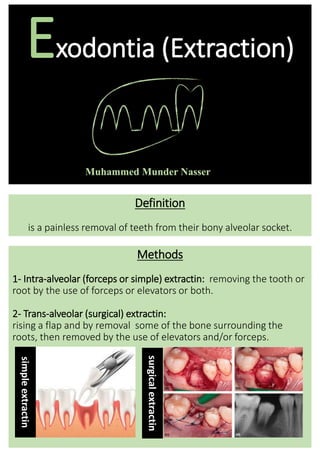
1- Intra-alveolar (forceps or simple) extractin: removing the tooth or
root by the use of forceps or elevators or both.
2- Trans-alveolar (surgical) extractin:
rising a flap and by removal some of the bone surrounding the
roots, then removed by the use of elevators and/or forceps.
Exodontia (Extraction)
simple
extractin
surgical
extractin
Indications
1- Sever caries (Badly carious teeth).
2- Sever periodontal disease.
3- Pulp pathology: If endodontic therapy wasn't possible.
4- Apical pathology (P.A. abscess, granuloma and cyst…): If the teeth
failed to respond to all conservative treatment.
5- Orthodontic reason
a) Therapeutic extraction: provide space for teeth alignment.
b) Malposed teeth : teeth which erupted out of arch line.
c) Preventive exaction: extract few deciduous teeth to prevent future
malocclusion.
6- Prosthetic considerations
a) To provide better design and success of partial denture.
b) To enable the patient to have complete denture.
7- Impacted teeth:
are indicated for extraction when they responsible for:
a) Vagus facial pain.
b) Periodontal problems of the adjoining teeth.
c) TMJ problems
d) Bony pathology eg cyst & tumor.
e) May predispose, to anterior teeth crowding.
f) Significant infection (pericoronitis) e.g. partially erupted third
molar.
8- Supernumerary tooth (Extra tooth).
9- Tooth in the line of fracture of the jaws
a) It is a source of infection at the site of the fracture
b) The tooth itself is fractured.
c) Interfere with fracture reduction.
d) Interfere with healing of fracture
10- Teeth in relation to bony pathology: Cyst formation, Neoplasm
(tumor) and Osteomyelitis( infection of bone)
11- Root fragments (Retained root)
12- Teeth prior to irradiation (before radiotherapy )
13- Aesthetic considerations: due to severe staining (tetracydine,
flourosis) or hypoplasia of enamel or dentine and they cannot be
restored.
Contraindications
Local
Contraindications
• 1- Acute and uncontrolled infections.
• 2- Previous radiotherapy
• 3- Teeth located within area of tumor
Systemic
Contraindications
• 1-Sever uncontrolled metabolic disease, eg,
uncontrolled diabetes, end stage renal disease.
• 2- Uncontrolled leukemias and lymphomas.
• 3- Sever uncontrolled cardiac disease. eg,
myocardial infarction, unstable angina pectoris,
dysrhythmias.
• 4- Sever uncontrolled hypertension.
• 5-Pregnancy (some cases).
• 6- Uncontrolled bleeding disorder eg;
hemophilia, platelet disorder, patient on
anticoagulants.
• 7- Patients who take a variety of medications
eg: patient on steroid and immunosuppressive
drugs, cancer and chemotherapy.
• 8- Uncontrolled epilepsy.

Exodontia (Extraction)

  • 1.
    Definition is a painlessremoval of teeth from their bony alveolar socket. Methods 1- Intra-alveolar (forceps or simple) extractin: removing the tooth or root by the use of forceps or elevators or both. 2- Trans-alveolar (surgical) extractin: rising a flap and by removal some of the bone surrounding the roots, then removed by the use of elevators and/or forceps. Exodontia (Extraction) simple extractin surgical extractin
  • 2.
    Indications 1- Sever caries(Badly carious teeth). 2- Sever periodontal disease. 3- Pulp pathology: If endodontic therapy wasn't possible. 4- Apical pathology (P.A. abscess, granuloma and cyst…): If the teeth failed to respond to all conservative treatment. 5- Orthodontic reason a) Therapeutic extraction: provide space for teeth alignment. b) Malposed teeth : teeth which erupted out of arch line. c) Preventive exaction: extract few deciduous teeth to prevent future malocclusion. 6- Prosthetic considerations a) To provide better design and success of partial denture. b) To enable the patient to have complete denture. 7- Impacted teeth: are indicated for extraction when they responsible for: a) Vagus facial pain. b) Periodontal problems of the adjoining teeth. c) TMJ problems d) Bony pathology eg cyst & tumor. e) May predispose, to anterior teeth crowding. f) Significant infection (pericoronitis) e.g. partially erupted third molar. 8- Supernumerary tooth (Extra tooth). 9- Tooth in the line of fracture of the jaws a) It is a source of infection at the site of the fracture b) The tooth itself is fractured. c) Interfere with fracture reduction. d) Interfere with healing of fracture 10- Teeth in relation to bony pathology: Cyst formation, Neoplasm (tumor) and Osteomyelitis( infection of bone) 11- Root fragments (Retained root) 12- Teeth prior to irradiation (before radiotherapy ) 13- Aesthetic considerations: due to severe staining (tetracydine, flourosis) or hypoplasia of enamel or dentine and they cannot be restored.
  • 3.
    Contraindications Local Contraindications • 1- Acuteand uncontrolled infections. • 2- Previous radiotherapy • 3- Teeth located within area of tumor Systemic Contraindications • 1-Sever uncontrolled metabolic disease, eg, uncontrolled diabetes, end stage renal disease. • 2- Uncontrolled leukemias and lymphomas. • 3- Sever uncontrolled cardiac disease. eg, myocardial infarction, unstable angina pectoris, dysrhythmias. • 4- Sever uncontrolled hypertension. • 5-Pregnancy (some cases). • 6- Uncontrolled bleeding disorder eg; hemophilia, platelet disorder, patient on anticoagulants. • 7- Patients who take a variety of medications eg: patient on steroid and immunosuppressive drugs, cancer and chemotherapy. • 8- Uncontrolled epilepsy.