ELT: 529
PRINCIPLES AND METHODS OF TEACHING
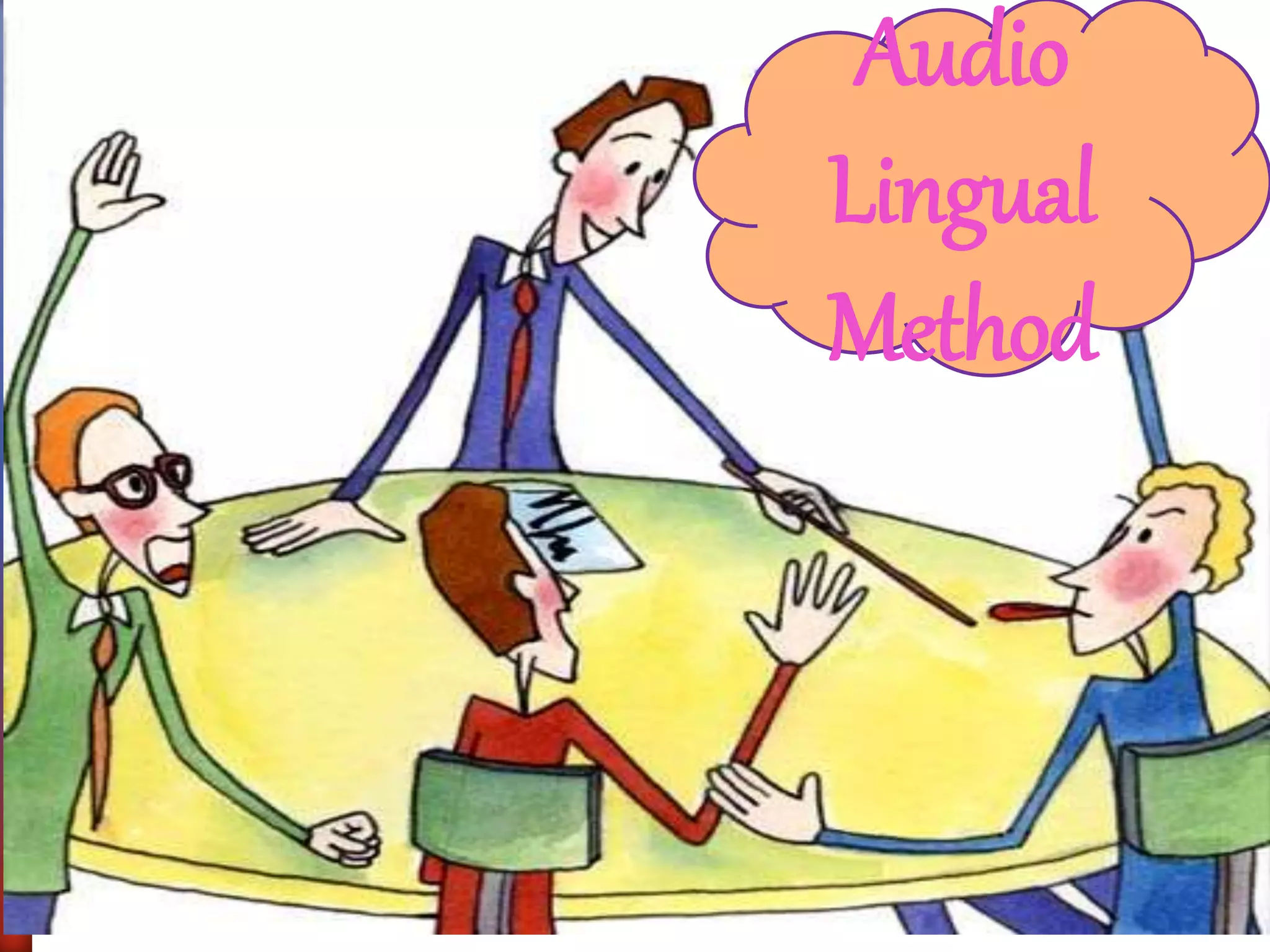
Audio
Lingual
Method
» The Audio-lingual Method is a
method of foreign language
teaching which emphasizes the
teaching of listening and speaking
before reading and writing. It uses
dialogues as the main form of
language presentation and drills as
the main training techniques.
Mother tongue is discouraged in
the classroom.
The emergency of the Audiolingual
Method resulted from the increased
attention given to foreign language
teaching in the United States toward the
end of the 1950s. The need for a radical
change and rethinking of foreign
language teaching methodology (most of
which was still linked to the Reading
Method) was prompted by the launching
of the first Russian satellite in 1957.
Theory of Language: Structuralism
» Structural linguistics
influenced
Audiolingualism.
» Elements in a language
are linearly produced in a
rule-governed way.
» Linguistic levels are
pyramidally structured.
Phonology
Morphology
Phrases
Sentences
Approach
Theory of Learning: Behaviourism
 Behavioural psychology influenced Audiolingualism. Behaviourists
believe that humans are organisms capable of learning many
behaviours. It depends on three elements:
1. Stimulus: Bring out behaviour.
2. Response: Triggered by stimulus.
3. Reinforcement: Marks the response as being appropriate or not
and encourages repetition which is vital in the learning process.
 Organism
 Behaviour
 Stimulus
 Response
 Reinforcement
 Learner.
 Language behaviour.
 Content.
 Learner’s response.
 Reaction
intrinsic/extrinsic
approval.
Behaviourism Learning Behaviour
Approach
Approach
Language Theory
Speaking is the primary
requirement
Writing is secondary needs
Learning
Approach
behavioral habits
Short-term Objectives Long-term Objectives
» Listening
comprehension.
» Accurate pronunciation.
» Recognition of speech
symbols as graphic signs.
» The ability to reproduce
these symbols in writing.
» Language as the native
speaker uses it.
The Syllabus
• Based on a linguistic or structure-based approach to
language teaching. Built on:
1. Step by step linguistic syllabus, which contains:
• Phonology.
• Morphology.
• Syntax.
2. Lexical syllabus of basic vocabulary.
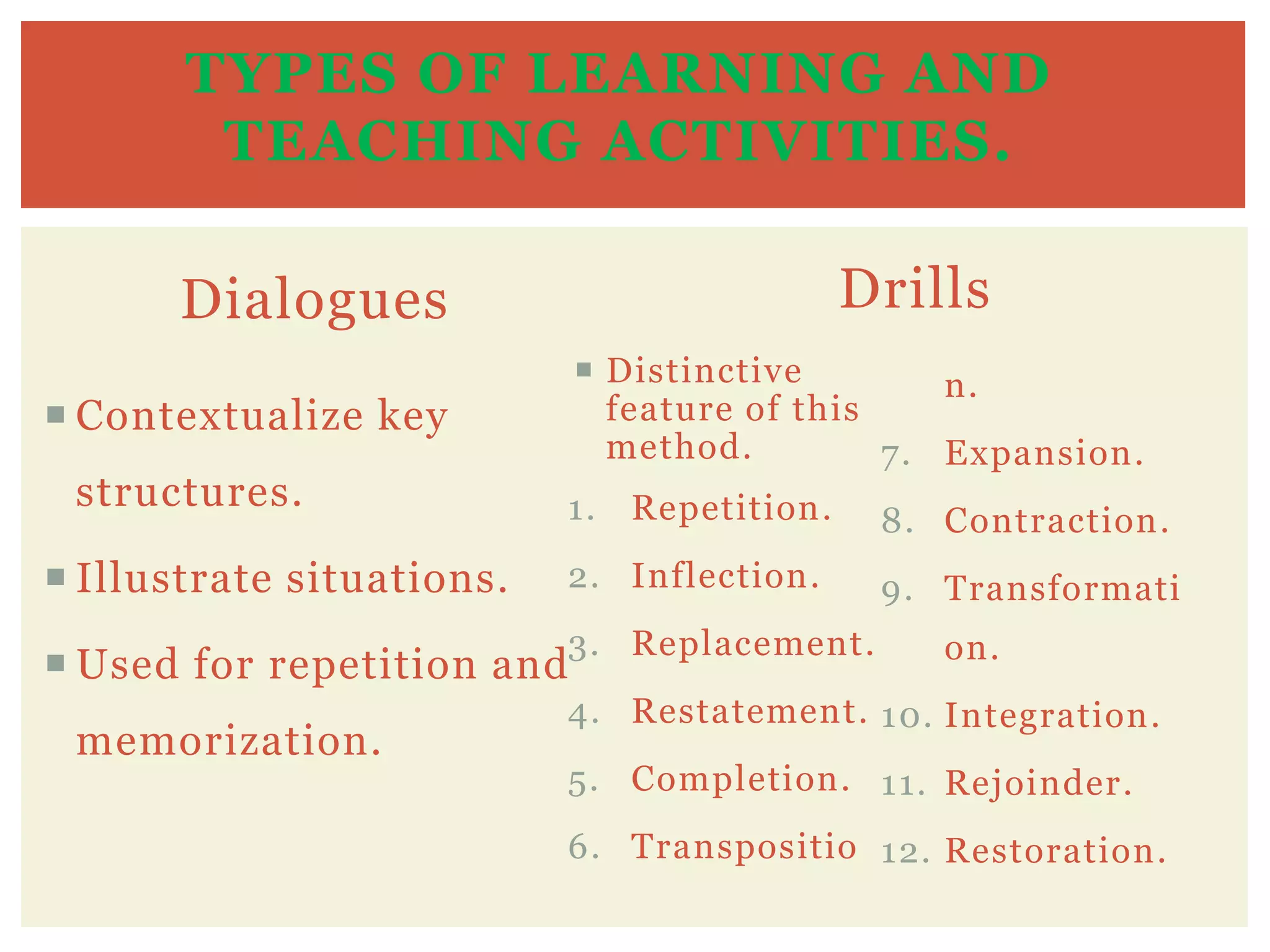
Dialogues
 Contextualize key
structures.
 Illustrate situations.
 Used for repetition and
memorization.
Drills
 Distinctive
feature of this
method.
1. Repetition.
2. Inflection.
3. Replacement.
4. Restatement.
5. Completion.
6. Transpositio
n.
7. Expansion.
8. Contraction.
9. Transformati
on.
10. Integration.
11. Rejoinder.
12. Restoration.
TYPES OF LEARNING AND
TEACHING ACTIVITIES.
1. Learner roles:
» They can be
directed by
skilled training
techniques.
» External
displays.
» Reactive role.
» They do not
initiate
interaction.
2. Teacher roles:
» Central and
active.
» Model of the
target language.
» Controls the
process of
learning.
» Monitors and
controls the
learner’s
performance.
3. The role of
instructional
materials:
» Teacher-
oriented.
» Tape recorders, a
language
laboratory and
audiovisual
equipment are
important.
Procedure
The use of drills and patterns practice are the
distinctive features of the Audio-Lingual
method. These are some kind of drills often
used:
1.Repetition:
The studentts repeats an utterance aloud as soon
as they have heard it . they do this without
looking at a printed text. The utterance must
be brief enough to retained by the ear.
Sound is as important as form and order.
EXAMPLE
This is the seventh month. -This is the seventh
month. After a student has repeated an
utterance, he may repeat it again and add a
few words, then repeat that whole utterance
and add more words.
• EXAMPLES
T : I used to know him.
S : I used to know him.
T : I used to know him years ago
S : I used to know him years ago
when we were in school.
2. Inflection: One word in no
utterance appears in another form when
repeated.
EXAMPLES:
0 I bought the ticket. - I bought the
tickets.
0 He bought the candy -She bought the
candy.
0 I called the young man. -I called the
young men
3. Replacement: One word in an
utterance is replaced by another ,
EXAMPLES.
0 He bought this house cheap. -He
bought it cheap
0 Helen left early -She left early.
0 They gave their boss a watch. -They
gave him a watch
4. Restatement:
The student rephrases an
utterance and addresses
that to someone else,
according to instructions.
EXAMPLES:
T: Tell him to wait for you.
S: Wait for me.
T : Ask her how old she is
S : How old are you?
T : Ask Jecky when he
began
S : Jecky, when did you
begin?
5. Completion:
The ststudent hears an utterance
that is complete except for one
word, then repeats the utterance in
completed form.
EXAMPLES :
T : I'll go my way and you go......
S : I’ll go my way and you go yours.
T : We all have . . . own troubles.
S : We al1 have our own troubles
6. Expansion:
When a word is added it takes a
certain place in the sequence.
EXAMPLES :
• 1 know him. (hardly). -I hardly know
him.
• 1 know him. (well). -1 know him well
7. Transposition:
A change in word order is
necessary when a word is added.
EXAMPLES :
• I'm hungry. (so). -So am I
• I'll never do it again. ( neither ). -
Neither will I
8. Contraction:
A single word stands for a phrase
or clause.
EXAMPLES :
• Put your hand on the table.
- Put your hand there
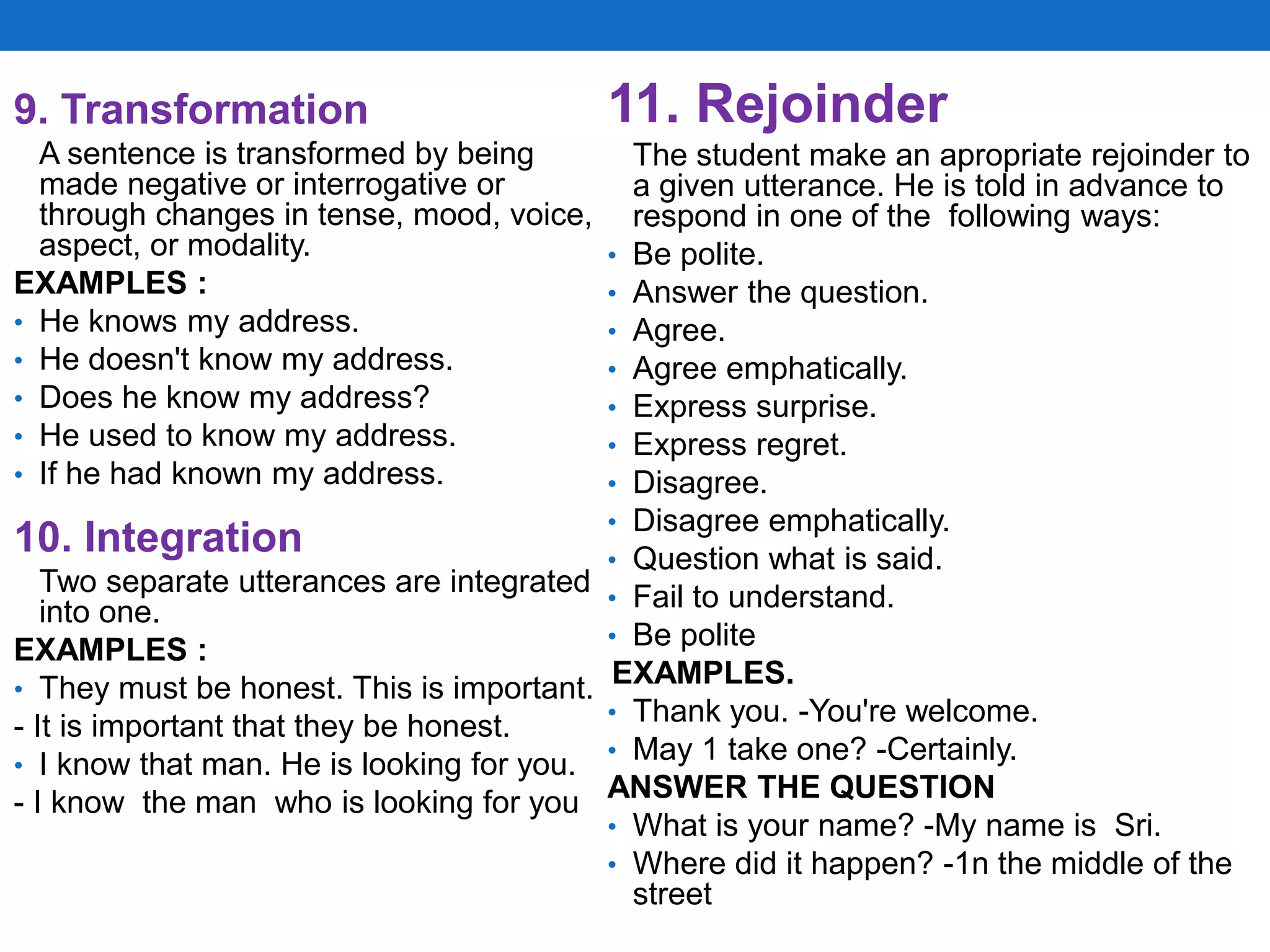
9. Transformation
A sentence is transformed by being
made negative or interrogative or
through changes in tense, mood, voice,
aspect, or modality.
EXAMPLES :
• He knows my address.
• He doesn't know my address.
• Does he know my address?
• He used to know my address.
• If he had known my address.
10. Integration
Two separate utterances are integrated
into one.
EXAMPLES :
• They must be honest. This is important.
- It is important that they be honest.
• I know that man. He is looking for you.
- I know the man who is looking for you
11. Rejoinder
The student make an apropriate rejoinder to
a given utterance. He is told in advance to
respond in one of the following ways:
• Be polite.
• Answer the question.
• Agree.
• Agree emphatically.
• Express surprise.
• Express regret.
• Disagree.
• Disagree emphatically.
• Question what is said.
• Fail to understand.
• Be polite
EXAMPLES.
• Thank you. -You're welcome.
• May 1 take one? -Certainly.
ANSWER THE QUESTION
• What is your name? -My name is Sri.
• Where did it happen? -1n the middle of the
street
What is advantages and disadvantages of Audio
lingual ?
Advantages : the strength is in the accuracy.
Disadvantages : the weakness is in the fluency
Principles and methods of teaching

Principles and methods of teaching

  • 1.
    ELT: 529 PRINCIPLES ANDMETHODS OF TEACHING
  • 2.
  • 3.
    » The Audio-lingualMethod is a method of foreign language teaching which emphasizes the teaching of listening and speaking before reading and writing. It uses dialogues as the main form of language presentation and drills as the main training techniques. Mother tongue is discouraged in the classroom.
  • 4.
    The emergency ofthe Audiolingual Method resulted from the increased attention given to foreign language teaching in the United States toward the end of the 1950s. The need for a radical change and rethinking of foreign language teaching methodology (most of which was still linked to the Reading Method) was prompted by the launching of the first Russian satellite in 1957.
  • 5.
    Theory of Language:Structuralism » Structural linguistics influenced Audiolingualism. » Elements in a language are linearly produced in a rule-governed way. » Linguistic levels are pyramidally structured. Phonology Morphology Phrases Sentences
  • 6.
    Approach Theory of Learning:Behaviourism  Behavioural psychology influenced Audiolingualism. Behaviourists believe that humans are organisms capable of learning many behaviours. It depends on three elements: 1. Stimulus: Bring out behaviour. 2. Response: Triggered by stimulus. 3. Reinforcement: Marks the response as being appropriate or not and encourages repetition which is vital in the learning process.
  • 7.
     Organism  Behaviour Stimulus  Response  Reinforcement  Learner.  Language behaviour.  Content.  Learner’s response.  Reaction intrinsic/extrinsic approval. Behaviourism Learning Behaviour
  • 8.
    Approach Approach Language Theory Speaking isthe primary requirement Writing is secondary needs Learning Approach behavioral habits
  • 9.
    Short-term Objectives Long-termObjectives » Listening comprehension. » Accurate pronunciation. » Recognition of speech symbols as graphic signs. » The ability to reproduce these symbols in writing. » Language as the native speaker uses it.
  • 10.
    The Syllabus • Basedon a linguistic or structure-based approach to language teaching. Built on: 1. Step by step linguistic syllabus, which contains: • Phonology. • Morphology. • Syntax. 2. Lexical syllabus of basic vocabulary.
  • 11.
    Dialogues  Contextualize key structures. Illustrate situations.  Used for repetition and memorization. Drills  Distinctive feature of this method. 1. Repetition. 2. Inflection. 3. Replacement. 4. Restatement. 5. Completion. 6. Transpositio n. 7. Expansion. 8. Contraction. 9. Transformati on. 10. Integration. 11. Rejoinder. 12. Restoration. TYPES OF LEARNING AND TEACHING ACTIVITIES.
  • 13.
    1. Learner roles: »They can be directed by skilled training techniques. » External displays. » Reactive role. » They do not initiate interaction. 2. Teacher roles: » Central and active. » Model of the target language. » Controls the process of learning. » Monitors and controls the learner’s performance. 3. The role of instructional materials: » Teacher- oriented. » Tape recorders, a language laboratory and audiovisual equipment are important.
  • 14.
    Procedure The use ofdrills and patterns practice are the distinctive features of the Audio-Lingual method. These are some kind of drills often used: 1.Repetition: The studentts repeats an utterance aloud as soon as they have heard it . they do this without looking at a printed text. The utterance must be brief enough to retained by the ear. Sound is as important as form and order. EXAMPLE This is the seventh month. -This is the seventh month. After a student has repeated an utterance, he may repeat it again and add a few words, then repeat that whole utterance and add more words. • EXAMPLES T : I used to know him. S : I used to know him. T : I used to know him years ago S : I used to know him years ago when we were in school.
  • 15.
    2. Inflection: Oneword in no utterance appears in another form when repeated. EXAMPLES: 0 I bought the ticket. - I bought the tickets. 0 He bought the candy -She bought the candy. 0 I called the young man. -I called the young men 3. Replacement: One word in an utterance is replaced by another , EXAMPLES. 0 He bought this house cheap. -He bought it cheap 0 Helen left early -She left early. 0 They gave their boss a watch. -They gave him a watch 4. Restatement: The student rephrases an utterance and addresses that to someone else, according to instructions. EXAMPLES: T: Tell him to wait for you. S: Wait for me. T : Ask her how old she is S : How old are you? T : Ask Jecky when he began S : Jecky, when did you begin?
  • 16.
    5. Completion: The ststudenthears an utterance that is complete except for one word, then repeats the utterance in completed form. EXAMPLES : T : I'll go my way and you go...... S : I’ll go my way and you go yours. T : We all have . . . own troubles. S : We al1 have our own troubles 6. Expansion: When a word is added it takes a certain place in the sequence. EXAMPLES : • 1 know him. (hardly). -I hardly know him. • 1 know him. (well). -1 know him well 7. Transposition: A change in word order is necessary when a word is added. EXAMPLES : • I'm hungry. (so). -So am I • I'll never do it again. ( neither ). - Neither will I 8. Contraction: A single word stands for a phrase or clause. EXAMPLES : • Put your hand on the table. - Put your hand there
  • 17.
    9. Transformation A sentenceis transformed by being made negative or interrogative or through changes in tense, mood, voice, aspect, or modality. EXAMPLES : • He knows my address. • He doesn't know my address. • Does he know my address? • He used to know my address. • If he had known my address. 10. Integration Two separate utterances are integrated into one. EXAMPLES : • They must be honest. This is important. - It is important that they be honest. • I know that man. He is looking for you. - I know the man who is looking for you 11. Rejoinder The student make an apropriate rejoinder to a given utterance. He is told in advance to respond in one of the following ways: • Be polite. • Answer the question. • Agree. • Agree emphatically. • Express surprise. • Express regret. • Disagree. • Disagree emphatically. • Question what is said. • Fail to understand. • Be polite EXAMPLES. • Thank you. -You're welcome. • May 1 take one? -Certainly. ANSWER THE QUESTION • What is your name? -My name is Sri. • Where did it happen? -1n the middle of the street
  • 19.
    What is advantagesand disadvantages of Audio lingual ? Advantages : the strength is in the accuracy. Disadvantages : the weakness is in the fluency