AUDIO-LINGUAL
      METHOD

IKFI MAWARIDA AH      113411003
MARIA ULFAH           113411005
NUR FAIDATUN NAIMAH   113411033
THE HISTORY OF AUDIO-LINGUAL METHOD


The emergency of the Audiolingual
Method resulted from the increased
attention given to foreign language
teaching in the United States toward the
end of the 1950s. The need for a radical
change and rethinking of foreign
language teaching methodology (most of
which was still linked to the Reading
Method) was prompted by the launching
of the first Russian satellite in 1957.
The U.S. government acknowledged the need for a more intensive effort to teach
H   foreign languages in order to prevent Americans from becoming isolated from
    scientific advances made in other countries. The National Defense Act (1958),
I   among other measures, provided funds for the study and analysis of modern
    languages, for the development of teaching materials, and for the training of
    teachers.
S   Teachers were encouraged to attend summer institutes to improve their
    knowledge of foreign languages and to learn the principles of linguistics and the
T   new linguistically based teaching methods. Language teaching specialists set
    about developing a method that was applicable to condition in U.S. colleges and
    university classrooms. They drew on the earlier experience of the army programs
O   and the Aural-Oral or Structural Approach developed by Fries and his colleges,
    adding insights taken from behaviorist psychology. This combination of
R   structural linguistic theory, contrastive analysis, aural-oral procedures, and
    behaviorist psychology led to the Audiolingual Method.

Y
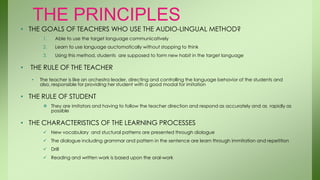
THE PRINCIPLES
• THE GOALS OF TEACHERS WHO USE THE AUDIO-LINGUAL METHOD?
         1.   Able to use the target language communicatively
         2.   Learn to use language auctomatically without stopping to think
         3.   Using this method, students are supposed to form new habit in the target language

•   THE RULE OF THE TEACHER
    •   The teacher is like an orchestra leader, directing and controlling the language behavior of the students and
        also, responsible for providing her student with a good modal for imitation

• THE RULE OF STUDENT
          They are imitators and having to follow the teacher direction and respond as accurately and as rapidly as
           possible

• THE CHARACTERISTICS OF THE LEARNING PROCESSES
          New vocabulary and stuctural patterns are presented through diologue
          The dialogue including grammar and pattern in the sentence are learn through immitation and repetition
          Drill
          Reading and written work is based upon the oral-work
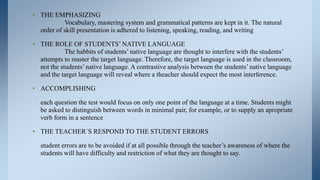
• THE EMPHASIZING
           Vocabulary, mastering system and grammatical patterns are kept in it. The natural
  order of skill presentation is adhered to listening, speaking, reading, and writing

• THE ROLE OF STUDENTS’ NATIVE LANGUAGE
            The habbits of students’ native language are thought to interfere with the students’
  attempts to master the target language. Therefore, the target language is used in the classroom,
  not the students’ native language. A contrastive analysis between the students’ native language
  and the target language will reveal where a theacher should expect the most interference.

• ACCOMPLISHING

   each question the test would focus on only one point of the language at a time. Students might
   be asked to distinguish between words in minimal pair, for example, or to supply an apropriate
   verb form in a sentence

• THE TEACHER`S RESPOND TO THE STUDENT ERRORS

   student errors are to be avoided if at all possible through the teacher’s awareness of where the
   students will have difficulty and restriction of what they are thought to say.
THE PRINCIPLES
• THE NATURE OF STUDENT-TEACHER AND STUDENT-STUDENT INTERACTION
        There is student – to – student interaction in chain drills or when
         students take different roles in dialogue, but this interaction is teacher-
         directed. Most of the interaction is between teacher and students as is
         initiated by the teacher.

• THE LANGUAGE AND THE CULTURE VIEWED
       o The view of language has been influenced by descriptive linguists
       o The view of culture in this method is how the culture consist of the
         everday behavior and lifestyle of the target language speaker

• Solving a math problem, such as estimating the number of beans in a jar.

• Writing an encouraging letter to their child.

• Going on a classroom scavenger hunt for their child's work, the books their
  child likes best, and messages from their child.
Types of learning and teaching
activities

Dialogues and drills form the basis of Audiolingual classroom practices.
  Dialogues are used for repetition
and rnemorization. Correct pronunciation, stress, rhythm, and intonation
are emphasized.. After a dialogue has been presented and memorized,
specific grammatical patterns in the dialogue are selected and become
the focus of various kind of drill and pattern-practice exercises
Approach and method in learning
The use of drills and patterns practice are the
  distinctive features of the Audio-Lingual
  method. These are some kind of drills often
  used:                                           • EXAMPLES
1. Repetition.
                                                  T : I used to know him.
The students repeats an utterance aloud as
   soon as they have heard it. they do this       S : I used to know him.
   without looking at a printed text. The
   utterance must be brief enough to              T : I used to know him years ago
   retained by the ear. Sound is as important
   as form and order.                             S : I used to know him years ago when
                                                      we were in school.
EXAMPLE

This is the seventh month. -This is the seventh
   month. After a student has repeared an
   utterance, he may repeat it again andadd
   a few words, then repeat that whole
   utterance and add more words.
2.     Inflection. One word in nn utterance appears   4. Restatement
      in another torm when repeated. EXAMPLES:
                                                       The student rephrases an
    I bought the ticket. - I bought the tickets.
                                                        utterance and addresses it to
    He bought the candy -She bought the candy.
                                                        someone else, according to
    I called the young man. -I called the young
                                                        instructions.
     men
                                                      EXAMPLES:
3. Replacement. One word in an utterance is           T: Tell him to wait for you.
   replaced by another , EXAMPLES.                    S: Wait for me.
 He bought this house cheap. -He bought it
  clieap
                                                      T : Ask her how old she is
 Helen left early -She left early.                   S : How old are you?
 They gave their boss a watch. -They gave            T : Ask Jecky when he began
  him a watch                                         S : Jecky, when did you begin?
5. Completion                                   7. Transposition.
    The student hears an utterance that is         A change in word order is necessary
   complete except for one word, then repeats      when a word is added.
   the utterance in completed form.
                                                EXAMPLES :
EXAMPLES :
                                                 i'm hungry. (so). -So am I
T : I'll go my way and you go......
                                                 i'll never do it again. ( neither ). -
S : I’ll go my way and you go yours.               Neither will I
T : We all have . . . own troubles.             8. Contraction
S : We al1 have our own troubles                   A single word stands for a phrase or
6. Expansion                                       clause.
    When a word is added it takes a certain     EXAMPLES :
   place in the sequence.                        Put your hand on the table.
EXAMPLES :                                      - Put your hand there
 1 know him. (hardly). -I hardly know him.      They believe that the earth is flat
 1 know him. (well). -1 know him well          - They believe it
9.Transformation                                             11. Rejoinder
   A sentence is transformed by being made negative or          The student make an apropriate rejoinder to a
   interrogative or through changes in tense, mood, voice,      given utterance. He is told in advance to respond
   aspect, or modality.                                         in one of the following ways:
EXAMPLES :                                                    Be polite.
 He knows my address.                                        Answer the question.
 He doesn't know my address.                                 Agree.
 Does he know my address?                                    Agree emphatically.
 He used to know my address.                                 Express surprise.
 If he had known my address.                                 Express regret.
                                                              Disagree.
10. Integration                                               Disagree emphatically.
    Two separate utterances are integrnted into one.          Question what is said.
EXAMPLES :                                                    Fail to understand.
 They must be honest. This is irnportant.                    Be polite
- It is important that they be honest.                        EXAMPLES.
 I know that man. He is looking for you.                     Thank you. -You're welcome.
- I know the man who is looking for you                       May 1 take one? -Certainly.
                                                             ANSWER THE QUESTION
                                                              What is your name? -My name is Sri.
                                                              Where did it happen? -1n the middle of the street
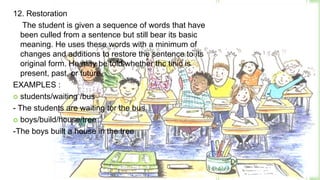
12. Restoration
    The student is given a sequence of words that have
   been culled from a sentence but still bear its basic
   meaning. He uses these words with a minimum of
   changes and additions to restore the sentence to its
   original form. He may be told whether thc tinic is
   present, past, or future.
EXAMPLES :
 students/waiting /bus

- The students are waiting tor the bus.
 boys/build/house/tree

-The boys built a house in the tree
Audio lingual method

Audio lingual method

  • 1.
    AUDIO-LINGUAL METHOD IKFI MAWARIDA AH 113411003 MARIA ULFAH 113411005 NUR FAIDATUN NAIMAH 113411033
  • 2.
    THE HISTORY OFAUDIO-LINGUAL METHOD The emergency of the Audiolingual Method resulted from the increased attention given to foreign language teaching in the United States toward the end of the 1950s. The need for a radical change and rethinking of foreign language teaching methodology (most of which was still linked to the Reading Method) was prompted by the launching of the first Russian satellite in 1957.
  • 3.
    The U.S. governmentacknowledged the need for a more intensive effort to teach H foreign languages in order to prevent Americans from becoming isolated from scientific advances made in other countries. The National Defense Act (1958), I among other measures, provided funds for the study and analysis of modern languages, for the development of teaching materials, and for the training of teachers. S Teachers were encouraged to attend summer institutes to improve their knowledge of foreign languages and to learn the principles of linguistics and the T new linguistically based teaching methods. Language teaching specialists set about developing a method that was applicable to condition in U.S. colleges and university classrooms. They drew on the earlier experience of the army programs O and the Aural-Oral or Structural Approach developed by Fries and his colleges, adding insights taken from behaviorist psychology. This combination of R structural linguistic theory, contrastive analysis, aural-oral procedures, and behaviorist psychology led to the Audiolingual Method. Y
  • 4.
    THE PRINCIPLES • THEGOALS OF TEACHERS WHO USE THE AUDIO-LINGUAL METHOD? 1. Able to use the target language communicatively 2. Learn to use language auctomatically without stopping to think 3. Using this method, students are supposed to form new habit in the target language • THE RULE OF THE TEACHER • The teacher is like an orchestra leader, directing and controlling the language behavior of the students and also, responsible for providing her student with a good modal for imitation • THE RULE OF STUDENT  They are imitators and having to follow the teacher direction and respond as accurately and as rapidly as possible • THE CHARACTERISTICS OF THE LEARNING PROCESSES  New vocabulary and stuctural patterns are presented through diologue  The dialogue including grammar and pattern in the sentence are learn through immitation and repetition  Drill  Reading and written work is based upon the oral-work
  • 5.
    • THE EMPHASIZING Vocabulary, mastering system and grammatical patterns are kept in it. The natural order of skill presentation is adhered to listening, speaking, reading, and writing • THE ROLE OF STUDENTS’ NATIVE LANGUAGE The habbits of students’ native language are thought to interfere with the students’ attempts to master the target language. Therefore, the target language is used in the classroom, not the students’ native language. A contrastive analysis between the students’ native language and the target language will reveal where a theacher should expect the most interference. • ACCOMPLISHING each question the test would focus on only one point of the language at a time. Students might be asked to distinguish between words in minimal pair, for example, or to supply an apropriate verb form in a sentence • THE TEACHER`S RESPOND TO THE STUDENT ERRORS student errors are to be avoided if at all possible through the teacher’s awareness of where the students will have difficulty and restriction of what they are thought to say.
  • 6.
    THE PRINCIPLES • THENATURE OF STUDENT-TEACHER AND STUDENT-STUDENT INTERACTION  There is student – to – student interaction in chain drills or when students take different roles in dialogue, but this interaction is teacher- directed. Most of the interaction is between teacher and students as is initiated by the teacher. • THE LANGUAGE AND THE CULTURE VIEWED o The view of language has been influenced by descriptive linguists o The view of culture in this method is how the culture consist of the everday behavior and lifestyle of the target language speaker • Solving a math problem, such as estimating the number of beans in a jar. • Writing an encouraging letter to their child. • Going on a classroom scavenger hunt for their child's work, the books their child likes best, and messages from their child.
  • 7.
    Types of learningand teaching activities Dialogues and drills form the basis of Audiolingual classroom practices. Dialogues are used for repetition and rnemorization. Correct pronunciation, stress, rhythm, and intonation are emphasized.. After a dialogue has been presented and memorized, specific grammatical patterns in the dialogue are selected and become the focus of various kind of drill and pattern-practice exercises
  • 8.
    Approach and methodin learning The use of drills and patterns practice are the distinctive features of the Audio-Lingual method. These are some kind of drills often used: • EXAMPLES 1. Repetition. T : I used to know him. The students repeats an utterance aloud as soon as they have heard it. they do this S : I used to know him. without looking at a printed text. The utterance must be brief enough to T : I used to know him years ago retained by the ear. Sound is as important as form and order. S : I used to know him years ago when we were in school. EXAMPLE This is the seventh month. -This is the seventh month. After a student has repeared an utterance, he may repeat it again andadd a few words, then repeat that whole utterance and add more words.
  • 9.
    2. Inflection. One word in nn utterance appears 4. Restatement in another torm when repeated. EXAMPLES: The student rephrases an  I bought the ticket. - I bought the tickets. utterance and addresses it to  He bought the candy -She bought the candy. someone else, according to  I called the young man. -I called the young instructions. men EXAMPLES: 3. Replacement. One word in an utterance is T: Tell him to wait for you. replaced by another , EXAMPLES. S: Wait for me.  He bought this house cheap. -He bought it clieap T : Ask her how old she is  Helen left early -She left early. S : How old are you?  They gave their boss a watch. -They gave T : Ask Jecky when he began him a watch S : Jecky, when did you begin?
  • 10.
    5. Completion 7. Transposition. The student hears an utterance that is A change in word order is necessary complete except for one word, then repeats when a word is added. the utterance in completed form. EXAMPLES : EXAMPLES :  i'm hungry. (so). -So am I T : I'll go my way and you go......  i'll never do it again. ( neither ). - S : I’ll go my way and you go yours. Neither will I T : We all have . . . own troubles. 8. Contraction S : We al1 have our own troubles A single word stands for a phrase or 6. Expansion clause. When a word is added it takes a certain EXAMPLES : place in the sequence.  Put your hand on the table. EXAMPLES : - Put your hand there  1 know him. (hardly). -I hardly know him.  They believe that the earth is flat  1 know him. (well). -1 know him well - They believe it
  • 11.
    9.Transformation 11. Rejoinder A sentence is transformed by being made negative or The student make an apropriate rejoinder to a interrogative or through changes in tense, mood, voice, given utterance. He is told in advance to respond aspect, or modality. in one of the following ways: EXAMPLES :  Be polite.  He knows my address.  Answer the question.  He doesn't know my address.  Agree.  Does he know my address?  Agree emphatically.  He used to know my address.  Express surprise.  If he had known my address.  Express regret.  Disagree. 10. Integration  Disagree emphatically. Two separate utterances are integrnted into one.  Question what is said. EXAMPLES :  Fail to understand.  They must be honest. This is irnportant.  Be polite - It is important that they be honest. EXAMPLES.  I know that man. He is looking for you.  Thank you. -You're welcome. - I know the man who is looking for you  May 1 take one? -Certainly. ANSWER THE QUESTION  What is your name? -My name is Sri.  Where did it happen? -1n the middle of the street
  • 12.
    12. Restoration The student is given a sequence of words that have been culled from a sentence but still bear its basic meaning. He uses these words with a minimum of changes and additions to restore the sentence to its original form. He may be told whether thc tinic is present, past, or future. EXAMPLES :  students/waiting /bus - The students are waiting tor the bus.  boys/build/house/tree -The boys built a house in the tree