SYLLABUS
• Audiolingualism is a linguistic, or structure-
based, approach to language teaching. The
starting point is a linguistic syllabus, which
contains the key items of phonology,
morphology, and syntax of the language
arranged according to their order of
presentation.
• The language skills are taught in the
order of listening, speaking, reading, and
writing. Listening is viewed largely as
training in aural discrimination of basic
sound patterns. The language may be
presented entirely orally at first; written
representations are usually withheld
from learners in early stages.
Types of learning and teaching
activities
• Dialogues and drills form the basis of
audiolingual classroom practices. Dialogues
provide the means of contextualizing key
structures and illustrate situations which
structures might be used as well as some
cultural aspects of the target language.
• Repetition. The students repeats an
utterance aloud as soon as he has
heard it. He does this without
looking at a printed text. The
utterance must be brief enough to
be retained by the ear. Sound is as
important as form and order.
Example:
• I used to know him. –I used to know him.
• I used to know him years ago. -1 used to know
him years ago when we were in school.. . .
• Inflection. One word in an utterance appears
in another term when repeated.
Examples
• I bought the ticket. –I bought the tickets.
• He bought the candy -She bought the candy.
• I called the young man. – I called the young
men
• Replacement. One word in an utterance is
replaced by another.
Examples
• He bought this house cheap. -He bought it
cheap
• Helen left early -She left early.
• They gave their boss a watch. -They gave him
a watch
• Restatement. The student rephrases an
utterance and addresses it to someone else,
according to instructions.
Examples
• Tell him to wait for you. -Wait for me.
• Ask her how old she is -How old are you?
• Ask John when he began -John, when did you
begin? . .
• Completion. The student hears an utterance
that is complete except for one word, then
repeats the utterance in completed form.
• I'll go my way and you go.. . . –I’ll go my way
and you go yours.
• We all have . . . own troubles. -We all have our
own troubles. . . .
• Transposition. A change in word order is
necessary when a word is added.
• I'm hungry. (so). -So am l.
• I'll never do it again. (neither)-Neither will I . . .
• Expansion. When a word is added it takes a
certain place in the sequence.
• I know him. (hardly). – I hardly know him.
• I know him. (well). –I know him well.. . .
• Contraction. A single word stands for a phrase
or clnuse.
• Put your hand on the table. -Put your hand
there.
• They believe that the earth is flat -They
believe it
• Trnnsformation. A sentence is transformed by
being made negative or interrogative or
through changes in tense, mood, voice,
aspect, or modality.
• He knows my address.
• He doesn't know my address.
• Does he know my address?
• He used to know my address.
• If he had known my address.
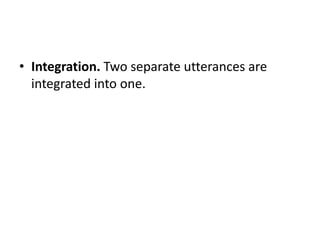
• Integration. Two separate utterances are
integrated into one.
• They must be honest. This is important. -It is
important that they be honest.
• I know that man. He is looking for you. –I
know, the man who is looking for you.. . .
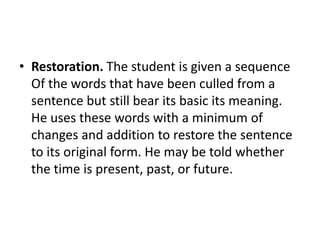
• Restoration. The student is given a sequence
Of the words that have been culled from a
sentence but still bear its basic its meaning.
He uses these words with a minimum of
changes and addition to restore the sentence
to its original form. He may be told whether
the time is present, past, or future.
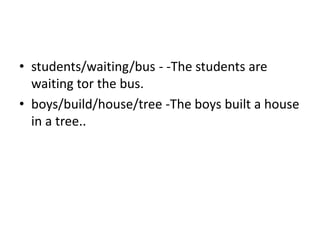
• students/waiting/bus - -The students are
waiting tor the bus.
• boys/build/house/tree -The boys built a house
in a tree..
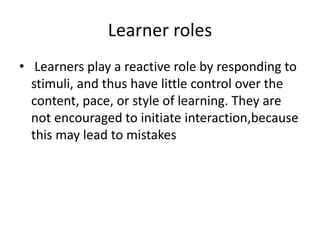
Learner roles
• Learners play a reactive role by responding to
stimuli, and thus have little control over the
content, pace, or style of learning. They are
not encouraged to initiate interaction,because
this may lead to mistakes
Teacher roles
• The teacher models the target language,
controls the direction and pace of learning
and monitors and corrects the learners’
performance. The teacher must keep the
learners attentive by varying drills and tasks
and choosing relevant situations to practice
structures.

Syllabus

  • 1.
    SYLLABUS • Audiolingualism isa linguistic, or structure- based, approach to language teaching. The starting point is a linguistic syllabus, which contains the key items of phonology, morphology, and syntax of the language arranged according to their order of presentation.
  • 2.
    • The languageskills are taught in the order of listening, speaking, reading, and writing. Listening is viewed largely as training in aural discrimination of basic sound patterns. The language may be presented entirely orally at first; written representations are usually withheld from learners in early stages.
  • 3.
    Types of learningand teaching activities • Dialogues and drills form the basis of audiolingual classroom practices. Dialogues provide the means of contextualizing key structures and illustrate situations which structures might be used as well as some cultural aspects of the target language.
  • 4.
    • Repetition. Thestudents repeats an utterance aloud as soon as he has heard it. He does this without looking at a printed text. The utterance must be brief enough to be retained by the ear. Sound is as important as form and order.
  • 5.
    Example: • I usedto know him. –I used to know him. • I used to know him years ago. -1 used to know him years ago when we were in school.. . .
  • 6.
    • Inflection. Oneword in an utterance appears in another term when repeated.
  • 7.
    Examples • I boughtthe ticket. –I bought the tickets. • He bought the candy -She bought the candy. • I called the young man. – I called the young men
  • 8.
    • Replacement. Oneword in an utterance is replaced by another.
  • 9.
    Examples • He boughtthis house cheap. -He bought it cheap • Helen left early -She left early. • They gave their boss a watch. -They gave him a watch
  • 10.
    • Restatement. Thestudent rephrases an utterance and addresses it to someone else, according to instructions.
  • 11.
    Examples • Tell himto wait for you. -Wait for me. • Ask her how old she is -How old are you? • Ask John when he began -John, when did you begin? . .
  • 12.
    • Completion. Thestudent hears an utterance that is complete except for one word, then repeats the utterance in completed form.
  • 13.
    • I'll gomy way and you go.. . . –I’ll go my way and you go yours. • We all have . . . own troubles. -We all have our own troubles. . . .
  • 14.
    • Transposition. Achange in word order is necessary when a word is added.
  • 15.
    • I'm hungry.(so). -So am l. • I'll never do it again. (neither)-Neither will I . . .
  • 16.
    • Expansion. Whena word is added it takes a certain place in the sequence.
  • 17.
    • I knowhim. (hardly). – I hardly know him. • I know him. (well). –I know him well.. . .
  • 18.
    • Contraction. Asingle word stands for a phrase or clnuse.
  • 19.
    • Put yourhand on the table. -Put your hand there. • They believe that the earth is flat -They believe it
  • 20.
    • Trnnsformation. Asentence is transformed by being made negative or interrogative or through changes in tense, mood, voice, aspect, or modality.
  • 21.
    • He knowsmy address. • He doesn't know my address. • Does he know my address? • He used to know my address. • If he had known my address.
  • 22.
    • Integration. Twoseparate utterances are integrated into one.
  • 23.
    • They mustbe honest. This is important. -It is important that they be honest. • I know that man. He is looking for you. –I know, the man who is looking for you.. . .
  • 24.
    • Restoration. Thestudent is given a sequence Of the words that have been culled from a sentence but still bear its basic its meaning. He uses these words with a minimum of changes and addition to restore the sentence to its original form. He may be told whether the time is present, past, or future.
  • 25.
    • students/waiting/bus --The students are waiting tor the bus. • boys/build/house/tree -The boys built a house in a tree..
  • 26.
    Learner roles • Learnersplay a reactive role by responding to stimuli, and thus have little control over the content, pace, or style of learning. They are not encouraged to initiate interaction,because this may lead to mistakes
  • 27.
    Teacher roles • Theteacher models the target language, controls the direction and pace of learning and monitors and corrects the learners’ performance. The teacher must keep the learners attentive by varying drills and tasks and choosing relevant situations to practice structures.