The Audio-Lingual Method
Sakar Hussein Ali
M.A Student in ELT
University of Sulemani
School of Basic Education
Department of English
May 4th , 2021
 Outline :
 Overview
 History
 Characteristics
 Teacher and students’ role
 Advantages
 Criticisms
 Techniques and activities
 Conclusion
 References
4/5/2021
Sakar Hussein > M.A > ELT
2
The Audio-lingual Method
 It is an oral based approach but it has a strong theoretical
base in linguistics and psychology.
 drills students in the use of grammatical sentence patterns.
 It was thought that the way to acquire the sentence patterns
of the target language was through conditioning.
 want their students to be able to use the target language
communicatively through forming new habits in the target
language and overcoming the old habits of their native
language.
4/5/2021
Sakar Hussein > M.A > ELT
3
4/5/2021
Sakar Hussein > M.A > ELT
4
History:
 It came to birth in America during world war II, in 1950s.
 Charles Fries (1945) of the University of Michigan led the
way in applying principles from structural linguistics in
developing the method, and for this reason, it has
sometimes been referred to as the ‘Michigan Method.’
 Later in its development, principles from behavioral
psychology (Skinner 1957) were incorporated.
 Known by different names: Aural-oral, Army, the Michigan
and the Informant method .
4/5/2021
Sakar Hussein > M.A > ELT
5
Characteristics :
 New vocabulary and structural patterns are presented
through dialogues.
 The dialogues are learned through imitation and repetition.
 Drills (such as repetition , backward build-up, substitution and
question-and-answer) are conducted based upon the
patterns present in the dialogue.
 Students’ successful responses are positively reinforced.
 Grammar is induced from the examples given; explicit
grammar rules are not provided.
4/5/2021
Sakar Hussein > M.A > ELT
6
Characteristics :
4/5/2021
Sakar Hussein > M.A > ELT
7
 Cultural information is contextualized in the
dialogues or presented by the teacher.
 Students’ reading and written work is based upon
the oral work they did earlier.
 Input is highly controlled.
 Errors are avoided at all costs.
Role of teacher and students
4/5/2021
Sakar Hussein > M.A > ELT
8
 The teacher is like an orchestra leader, directing and
controlling the language behavior of her students.
 She is also responsible for providing her students
with a good model for imitation.
 Students are imitators of the teacher’s model or the
tapes she supplies of model speakers.
 They follow the teacher’s directions and respond as
accurately and as rapidly as possible.
Instructional materials
4/5/2021
Sakar Hussein > M.A > ELT
9
 They are primarily teacher oriented.
 A student textbook is often not used in the
elementary phases
 When textbooks and printed materials are introduced
to the student, they provide the texts of dialogues
and cues needed for drills and exercises.
 Tape recorders and audiovisual equipment often
have central roles in an audio-lingual course.
 A language laboratory may also be considered
essential
Advantages :
4/5/2021
Sakar Hussein > M.A > ELT
10
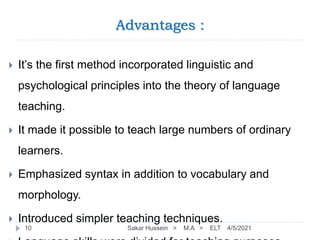
 It’s the first method incorporated linguistic and
psychological principles into the theory of language
teaching.
 It made it possible to teach large numbers of ordinary
learners.
 Emphasized syntax in addition to vocabulary and
morphology.
 Introduced simpler teaching techniques.
Criticisms :
4/5/2021
Sakar Hussein > M.A > ELT
11
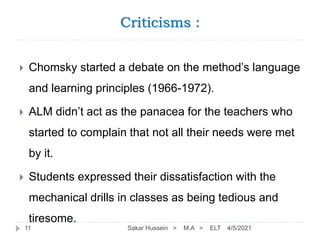
 Chomsky started a debate on the method’s language
and learning principles (1966-1972).
 ALM didn’t act as the panacea for the teachers who
started to complain that not all their needs were met
by it.
 Students expressed their dissatisfaction with the
mechanical drills in classes as being tedious and
tiresome.
The Techniques of Audio Lingual Method
4/5/2021
Sakar Hussein > M.A > ELT
12
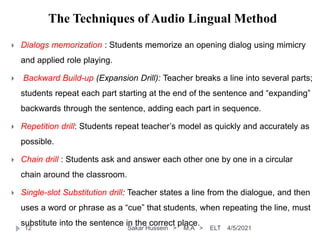
 Dialogs memorization : Students memorize an opening dialog using mimicry
and applied role playing.
 Backward Build-up (Expansion Drill): Teacher breaks a line into several parts;
students repeat each part starting at the end of the sentence and “expanding”
backwards through the sentence, adding each part in sequence.
 Repetition drill: Students repeat teacher’s model as quickly and accurately as
possible.
 Chain drill : Students ask and answer each other one by one in a circular
chain around the classroom.
 Single-slot Substitution drill: Teacher states a line from the dialogue, and then
uses a word or phrase as a “cue” that students, when repeating the line, must
substitute into the sentence in the correct place.
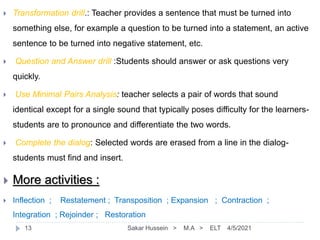
 Transformation drill.: Teacher provides a sentence that must be turned into
something else, for example a question to be turned into a statement, an active
sentence to be turned into negative statement, etc.
 Question and Answer drill :Students should answer or ask questions very
quickly.
 Use Minimal Pairs Analysis: teacher selects a pair of words that sound
identical except for a single sound that typically poses difficulty for the learners-
students are to pronounce and differentiate the two words.
 Complete the dialog: Selected words are erased from a line in the dialog-
students must find and insert.
 More activities :
 Inflection ; Restatement ; Transposition ; Expansion ; Contraction ;
Integration ; Rejoinder ; Restoration
4/5/2021
Sakar Hussein > M.A > ELT
13
EXAMPLES.
4/5/2021
Sakar Hussein > M.A > ELT
14
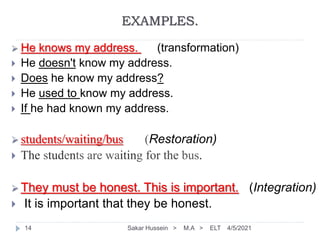
 He knows my address. (transformation)
 He doesn't know my address.
 Does he know my address?
 He used to know my address.
 If he had known my address.
 students/waiting/bus (Restoration)
 The students are waiting for the bus.
 They must be honest. This is important. (Integration)
 It is important that they be honest.
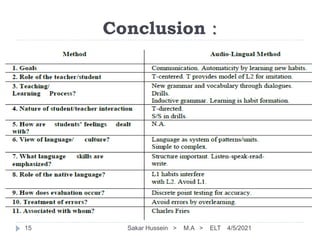
Conclusion :
4/5/2021
Sakar Hussein > M.A > ELT
15
References
4/5/2021
Sakar Hussein > M.A > ELT
16
 Hassaskhah, J., & Vahabi, M. (2014). English Language
Teaching Methodology. Jungle.
 Richards, J. C., & Rodgers, T. S. (2001). Approaches
and methods in language teaching (2nd ). Cambridge
University Press.
 Larsen-Freeman, D., & Anderson, M. (2011). Techniques
& principles in language teaching (3rd). Oxford University
Press.

The audio lingual method . sakar

  • 1.
    The Audio-Lingual Method SakarHussein Ali M.A Student in ELT University of Sulemani School of Basic Education Department of English May 4th , 2021
  • 2.
     Outline : Overview  History  Characteristics  Teacher and students’ role  Advantages  Criticisms  Techniques and activities  Conclusion  References 4/5/2021 Sakar Hussein > M.A > ELT 2
  • 3.
    The Audio-lingual Method It is an oral based approach but it has a strong theoretical base in linguistics and psychology.  drills students in the use of grammatical sentence patterns.  It was thought that the way to acquire the sentence patterns of the target language was through conditioning.  want their students to be able to use the target language communicatively through forming new habits in the target language and overcoming the old habits of their native language. 4/5/2021 Sakar Hussein > M.A > ELT 3
  • 4.
  • 5.
    History:  It cameto birth in America during world war II, in 1950s.  Charles Fries (1945) of the University of Michigan led the way in applying principles from structural linguistics in developing the method, and for this reason, it has sometimes been referred to as the ‘Michigan Method.’  Later in its development, principles from behavioral psychology (Skinner 1957) were incorporated.  Known by different names: Aural-oral, Army, the Michigan and the Informant method . 4/5/2021 Sakar Hussein > M.A > ELT 5
  • 6.
    Characteristics :  Newvocabulary and structural patterns are presented through dialogues.  The dialogues are learned through imitation and repetition.  Drills (such as repetition , backward build-up, substitution and question-and-answer) are conducted based upon the patterns present in the dialogue.  Students’ successful responses are positively reinforced.  Grammar is induced from the examples given; explicit grammar rules are not provided. 4/5/2021 Sakar Hussein > M.A > ELT 6
  • 7.
    Characteristics : 4/5/2021 Sakar Hussein> M.A > ELT 7  Cultural information is contextualized in the dialogues or presented by the teacher.  Students’ reading and written work is based upon the oral work they did earlier.  Input is highly controlled.  Errors are avoided at all costs.
  • 8.
    Role of teacherand students 4/5/2021 Sakar Hussein > M.A > ELT 8  The teacher is like an orchestra leader, directing and controlling the language behavior of her students.  She is also responsible for providing her students with a good model for imitation.  Students are imitators of the teacher’s model or the tapes she supplies of model speakers.  They follow the teacher’s directions and respond as accurately and as rapidly as possible.
  • 9.
    Instructional materials 4/5/2021 Sakar Hussein> M.A > ELT 9  They are primarily teacher oriented.  A student textbook is often not used in the elementary phases  When textbooks and printed materials are introduced to the student, they provide the texts of dialogues and cues needed for drills and exercises.  Tape recorders and audiovisual equipment often have central roles in an audio-lingual course.  A language laboratory may also be considered essential
  • 10.
    Advantages : 4/5/2021 Sakar Hussein> M.A > ELT 10  It’s the first method incorporated linguistic and psychological principles into the theory of language teaching.  It made it possible to teach large numbers of ordinary learners.  Emphasized syntax in addition to vocabulary and morphology.  Introduced simpler teaching techniques.
  • 11.
    Criticisms : 4/5/2021 Sakar Hussein> M.A > ELT 11  Chomsky started a debate on the method’s language and learning principles (1966-1972).  ALM didn’t act as the panacea for the teachers who started to complain that not all their needs were met by it.  Students expressed their dissatisfaction with the mechanical drills in classes as being tedious and tiresome.
  • 12.
    The Techniques ofAudio Lingual Method 4/5/2021 Sakar Hussein > M.A > ELT 12  Dialogs memorization : Students memorize an opening dialog using mimicry and applied role playing.  Backward Build-up (Expansion Drill): Teacher breaks a line into several parts; students repeat each part starting at the end of the sentence and “expanding” backwards through the sentence, adding each part in sequence.  Repetition drill: Students repeat teacher’s model as quickly and accurately as possible.  Chain drill : Students ask and answer each other one by one in a circular chain around the classroom.  Single-slot Substitution drill: Teacher states a line from the dialogue, and then uses a word or phrase as a “cue” that students, when repeating the line, must substitute into the sentence in the correct place.
  • 13.
     Transformation drill.:Teacher provides a sentence that must be turned into something else, for example a question to be turned into a statement, an active sentence to be turned into negative statement, etc.  Question and Answer drill :Students should answer or ask questions very quickly.  Use Minimal Pairs Analysis: teacher selects a pair of words that sound identical except for a single sound that typically poses difficulty for the learners- students are to pronounce and differentiate the two words.  Complete the dialog: Selected words are erased from a line in the dialog- students must find and insert.  More activities :  Inflection ; Restatement ; Transposition ; Expansion ; Contraction ; Integration ; Rejoinder ; Restoration 4/5/2021 Sakar Hussein > M.A > ELT 13
  • 14.
    EXAMPLES. 4/5/2021 Sakar Hussein >M.A > ELT 14  He knows my address. (transformation)  He doesn't know my address.  Does he know my address?  He used to know my address.  If he had known my address.  students/waiting/bus (Restoration)  The students are waiting for the bus.  They must be honest. This is important. (Integration)  It is important that they be honest.
  • 15.
  • 16.
    References 4/5/2021 Sakar Hussein >M.A > ELT 16  Hassaskhah, J., & Vahabi, M. (2014). English Language Teaching Methodology. Jungle.  Richards, J. C., & Rodgers, T. S. (2001). Approaches and methods in language teaching (2nd ). Cambridge University Press.  Larsen-Freeman, D., & Anderson, M. (2011). Techniques & principles in language teaching (3rd). Oxford University Press.