1.Background
2.Approach
WHAT IS AUDIOLINGUAL METHOD?
 Audiolingual method is a style of
teaching used in teaching foreign
languages.
 It is based on behaviorist theory,
which professes that certain traits of
living things, and in this case
humans, could be trained through a
system of reinforcement—correct use
of a trait would receive positive
feedback while incorrect use of that
BACKGROUND
 The United States involvement in
World War II
brought a significant change in the
teaching of languages in U.S.
Schools.
o U.S. Government asked the
universities to develop foreign
language program.Thus the Army
Specialized Training Program was
 The Army Specialized Training
Program was a military training
program instituted by the United
States Army during World War II at a
number of American universities to
meet wartime demands for junior
officers and soldiers with technical
skills.
 Army method had a significant
impact on linguistics and the way
foreign languages were taught. It was
based on Leonard Bloomfield’s
technique (informant method) of
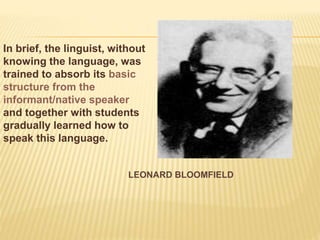
LEONARD BLOOMFIELD
In brief, the linguist, without
knowing the language, was
trained to absorb its basic
structure from the
informant/native speaker
and together with students
gradually learned how to
speak this language.
 The methodology of the Army Method
,like the Direct method, derived from the
intensity of contact with the target
language rather than from any well
developed methodological basis.
 Linguists and applied linguists during this
period were becoming increasingly
involved in the teaching of English as a
foreign language.
 There was a growing demand for foreign
expertise in the teaching of English.
 Many students entered the United States
to study in universities. And these factors
led to emergence of the American
approach to ESL which by the (mid 1950s)
had become Audiolingualism.
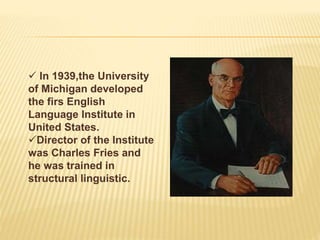
 In 1939,the University
of Michigan developed
the firs English
Language Institute in
United States.
Director of the Institute
was Charles Fries and
he was trained in
structural linguistic.
 Fries and his colleagues rejected
approaches such as those of Direct
Method, in which learners are
exposed to the language, use it
,and gradually absorb its
grammatical patterns.
 For Fries, grammar ,or “structure
“was the starting point.
 According to Fries, the structure of
the language was identified with is
basic sentence patterns and
grammatical structures.
Audio-lingual approach suggests that
students be taught phonology,
morphology, and syntax of the
language; all these patterns can be
learned through contrastive analysis of
the differences between the native
tongue and the target language, which
helps students to acquire new language
easier.
Audiolingual Method is based on
Speaking
Reading
Listening writing
 Fries published “his principles in
Teaching and Learning English as a
Foreign Language (1945), in which the
problems of learning a foreign language
were attributed to the conflict of different
structural systems.
 The idea of contrastive analysis of two
languages was presented in this work. It
was essential in order to prevent potential
problems in second language acquisition
and it became the basis for a major
branch of applied linguistics called
systematic comparisons. This
development of systematic comparison
provided a new perspective towards
Foreign Language Teaching.
THE AURAL ORAL STRUCTURAL METHOD
 The Aural-Oral Structural Approach was
invented by Charles Fries.
According to Fries, language should be
taught
by using “intensive oral drilling of its
basic patterns”. This method
emphasizes proper pronunciation and
intonation.
APPROACH
 Theory of language
The theory of language underlying
Audiolingualism was derived from a view
proposed by American linguists in the
1950s_ a view that came to be known as
structural linguistics.
Structural linguistics had developed
in part as a reaction to traditional
grammar.
Many nineteenth century language
scholars had viewed modern European
languages as corruption of classical
grammar
 The reaction against traditional
grammar was prompted by the
movement toward positivism and
empiricism.
 A more practical interest in language
study emerged.
 A new interest in phonetics ,
phonology , morphology , and syntax
developed.
 Language was viewed as a system of
structurally related elements for the
encoding meaning , the elements
being phonemes ,morphemes ,words

, structures and sentence types.
THEORY OF LEARNING
 It is closely tied to Behaviorism,thus made
drilling,repetition,and habit formation central
elements of instruction.
 Proponents of ALM felt that this emphasis on
repetition necessitated a corollary emphasis
on accuracy.
 Language learning:process of mechanical habit
form.
 Language mastery:acquiring a set of appropriate
language stimulus-response chain.
Behaviorism of Language Leaning:
 -Classical /Operant
 Conditioning:helping learners to respond correctly
to stimuli through shaping/reinforcement.
 Behaviorism,including:
 Mistakes are bad and should be avoided,as
they make bad habits.
 Positive reinforcement helps students to
develop correct habits.
 Behaviorist psychology claimed that it
knows the “secrets of all human learning
including languages” (Richards & Rodgers,
1987).
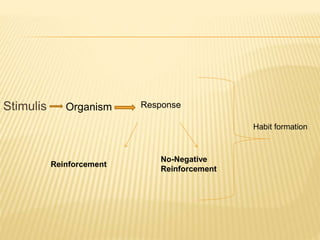
Stimulis Organism Response
Reinforcement
No-Negative
Reinforcement
Habit formation
 The descriptive practices of structural linguists:
 Language beginning with the phonological level
and finishing with the sentence level-assumed-
appropriate
 Speech was held to be primary and writing
secondary.
 Structure is what is important and unique about a
language-early practice-mastery of phonological
structures rather than vocabulary.
PSYCHOLOGY FOUNDATIONS OF ALM
1)First language learning is a process of
mechanical habit formation.
2)Language skills are learned more effectively
in spoken form before written form.
3)Analogy provides a better foundation for
language learning than analysis.
4)The meaning that the words of a language
have for the native speaker only in a
linguistic and cultural context and not
isolation.
 DESIGN
Like the 19th cent.,they
advocated a return to speech-
based instruction with the
primary objective of oral
proficiency.
OBJECTIVES
-accurate pronunciation and grammar.
-ability to respond quickly and accurately in
speech situation.
-knowledge of sufficient vocabulary to use with
grammar patterns.
BROOKS
1)Short range
2)Long range-as the
native uses
THE SYLLABUS
ALM-a linguistic or structure based
approach to language teaching.
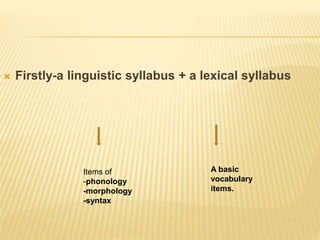
 Firstly-a linguistic syllabus + a lexical syllabus
Items of
-phonology
-morphology
-syntax
A basic
vocabulary
items.
Audio lingual method relies on structured
dialogues and repetitive drills to reinforced
targed language forms.
Dialogues and drill form are the basis of
audolingual classroom practices.
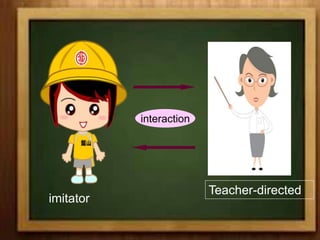
interaction
imitator
Teacher-directed
There are various kinds of
drills .
 Repetition :students
attempt to repeat exactly
what the teacher says.
Exp:This is the seventh
month.-This is the seventh month.
 Inflection:one word in an utterance appears in
another form when repeated.
Exp: I bought the ticket.
I bought the tickets.
 Replacement: one word in an utterance is
replaced by
another.
Exp: He bought this house cheap.
he bought it cheap.
 Restatement : The student rephrases an utterance
and addresses it to someone else ,according to
instructions.
Exp: Tell him to wait for you .
-wait for me.
29
 Completion: The student hears an utterance that is
complete except for one word ,then repeats the
utterance in completed form.
Exp:we all have …own troubles.
we all have our own troubles.
 Transposition :A chance in word order is necessary
when a word is added.
Exp: I am hungry.( so) – so am ı
 Expansion : When a word is added it takes a certain
place
İn the sequence.
Exp: I know him (well) –ı know him well.
30
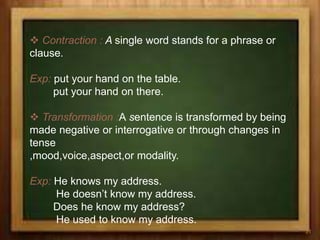
 Contraction : A single word stands for a phrase or
clause.
Exp: put your hand on the table.
put your hand on there.
 Transformation :A sentence is transformed by being
made negative or interrogative or through changes in
tense
,mood,voice,aspect,or modality.
Exp: He knows my address.
He doesn’t know my address.
Does he know my address?
He used to know my address.
31
Integration :Two separate utterance are integrated into
one.
Exp: They must be honest .this is important.
ıt is important that they be honest.
Rejoinder: the student makes an appropriate rejoider to
a given utterance.
Be polite
Answer the question
Agree
Agree emphatically
Express surprise
32
Restoration: The student is given
a sequence of words that have
been culled from a sentence but
still bear its basic meaning.
Exp:student/wait/bus
The students are waiting for the
bus .
33
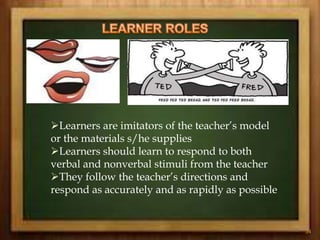
Learners are imitators of the teacher’s model
or the materials s/he supplies
Learners should learn to respond to both
verbal and nonverbal stimuli from the teacher
They follow the teacher’s directions and
respond as accurately and as rapidly as possible
34
 The teacher is a model of the target
language – the teacher and the materials s/he
brings are the only resources of the target language
 The teacher should be like an
orchestra leader – conducting, controlling the
students’ behaviour in the target language
 The teacher is responsible for
helping students to overcome the habits
of their native language – through
comparing the students’ native language and the
target language
 The teacher is also responsible to
present information about the culture of
the target language
THE ROLE OF INSTRUCTION MATERIALS
 Materials are under the control of teacher
 Tape recorders
 Audiovisual equipments
 Language laboratories
PROCEDURE
Little provision for grammar and talking
about the language
Target language as the center of
instructions
Discouragement of translation and the use
of native language
BROOKS’ PROCEDURE LIST:
 The modelling of all learnings by the teacher
 The early and continued training of the ear
and tongue
 The learniing of structure through the practice
of patterns of sound, order and form rather
than by explanation
 Summarizing of the main points of structure
 Shortening of the time spent
 Minimizing of vocabulary until structures
have been learned
 The study of vocabulary only in context
 Practice in translation only as a literary
exercise at an advanced level
IN A TYPICAL AUDIOLINGUAL LESSON:
 Hearing the dialogues including basic
structures
 Changed certain key words by students
 The selection of certain key structures from
the dialogue and practice in chorus, or
individually
 Imitative writing
 More dialogue and drill work
THE DECLINE OF AUDIOLINGUALISM
 unable to transfer skills to real
communication outside the classroom
 boring and unsatisfying
 attacked as being invalid in terms of both
language theory and learning theory
-Noam Chomsky (cognitive code learning)
‘Language is not a habit structure’.
CONCLUSION
 Mechanistic aspects of language learning
and language use
Similarity between Situational Language
Teaching And Audiolingulism:
 Focusing on the basic structures of the target
language
DIFFERENCE BETWEEN SITUATIONAL LANGUAGE
TEACHING AND AUDIOLINGUALISM:
-SITUATIONAL LANGUAGE TEACHING DOES NOT HAVE
THE STRONG LINKS TO LINGUISTICS AND
BEHAVIORAL PSYCHOLOGY THAT CHARACTERIZE
AUDIOLINGULISM
REFERENCES
 Chomsky, S. 1966. Linguistic theory.
Reprinted in J. P. B. Allen and P. Van
 Buren (eds.), Chomsky: Selected
Readings, pp. 152-9. London: Oxford
 University Press.
 Fries, C. C, 2nd A. C. Fries. 1961
Foundations for English Teaching Tokyo:
47
THANK YOU 

Audiolingual method 2 b

  • 2.
  • 3.
    WHAT IS AUDIOLINGUALMETHOD?  Audiolingual method is a style of teaching used in teaching foreign languages.  It is based on behaviorist theory, which professes that certain traits of living things, and in this case humans, could be trained through a system of reinforcement—correct use of a trait would receive positive feedback while incorrect use of that
  • 4.
    BACKGROUND  The UnitedStates involvement in World War II brought a significant change in the teaching of languages in U.S. Schools. o U.S. Government asked the universities to develop foreign language program.Thus the Army Specialized Training Program was
  • 5.
     The ArmySpecialized Training Program was a military training program instituted by the United States Army during World War II at a number of American universities to meet wartime demands for junior officers and soldiers with technical skills.  Army method had a significant impact on linguistics and the way foreign languages were taught. It was based on Leonard Bloomfield’s technique (informant method) of
  • 6.
    LEONARD BLOOMFIELD In brief,the linguist, without knowing the language, was trained to absorb its basic structure from the informant/native speaker and together with students gradually learned how to speak this language.
  • 7.
     The methodologyof the Army Method ,like the Direct method, derived from the intensity of contact with the target language rather than from any well developed methodological basis.  Linguists and applied linguists during this period were becoming increasingly involved in the teaching of English as a foreign language.  There was a growing demand for foreign expertise in the teaching of English.  Many students entered the United States to study in universities. And these factors led to emergence of the American approach to ESL which by the (mid 1950s) had become Audiolingualism.
  • 8.
     In 1939,theUniversity of Michigan developed the firs English Language Institute in United States. Director of the Institute was Charles Fries and he was trained in structural linguistic.
  • 9.
     Fries andhis colleagues rejected approaches such as those of Direct Method, in which learners are exposed to the language, use it ,and gradually absorb its grammatical patterns.  For Fries, grammar ,or “structure “was the starting point.  According to Fries, the structure of the language was identified with is basic sentence patterns and grammatical structures.
  • 10.
    Audio-lingual approach suggeststhat students be taught phonology, morphology, and syntax of the language; all these patterns can be learned through contrastive analysis of the differences between the native tongue and the target language, which helps students to acquire new language easier. Audiolingual Method is based on Speaking Reading Listening writing
  • 11.
     Fries published“his principles in Teaching and Learning English as a Foreign Language (1945), in which the problems of learning a foreign language were attributed to the conflict of different structural systems.  The idea of contrastive analysis of two languages was presented in this work. It was essential in order to prevent potential problems in second language acquisition and it became the basis for a major branch of applied linguistics called systematic comparisons. This development of systematic comparison provided a new perspective towards Foreign Language Teaching.
  • 12.
    THE AURAL ORALSTRUCTURAL METHOD  The Aural-Oral Structural Approach was invented by Charles Fries. According to Fries, language should be taught by using “intensive oral drilling of its basic patterns”. This method emphasizes proper pronunciation and intonation.
  • 13.
    APPROACH  Theory oflanguage The theory of language underlying Audiolingualism was derived from a view proposed by American linguists in the 1950s_ a view that came to be known as structural linguistics. Structural linguistics had developed in part as a reaction to traditional grammar. Many nineteenth century language scholars had viewed modern European languages as corruption of classical grammar
  • 14.
     The reactionagainst traditional grammar was prompted by the movement toward positivism and empiricism.  A more practical interest in language study emerged.  A new interest in phonetics , phonology , morphology , and syntax developed.  Language was viewed as a system of structurally related elements for the encoding meaning , the elements being phonemes ,morphemes ,words , structures and sentence types.
  • 15.
    THEORY OF LEARNING It is closely tied to Behaviorism,thus made drilling,repetition,and habit formation central elements of instruction.  Proponents of ALM felt that this emphasis on repetition necessitated a corollary emphasis on accuracy.
  • 16.
     Language learning:processof mechanical habit form.  Language mastery:acquiring a set of appropriate language stimulus-response chain. Behaviorism of Language Leaning:  -Classical /Operant  Conditioning:helping learners to respond correctly to stimuli through shaping/reinforcement.
  • 17.
     Behaviorism,including:  Mistakesare bad and should be avoided,as they make bad habits.  Positive reinforcement helps students to develop correct habits.  Behaviorist psychology claimed that it knows the “secrets of all human learning including languages” (Richards & Rodgers, 1987).
  • 18.
  • 19.
     The descriptivepractices of structural linguists:  Language beginning with the phonological level and finishing with the sentence level-assumed- appropriate  Speech was held to be primary and writing secondary.  Structure is what is important and unique about a language-early practice-mastery of phonological structures rather than vocabulary.
  • 20.
    PSYCHOLOGY FOUNDATIONS OFALM 1)First language learning is a process of mechanical habit formation. 2)Language skills are learned more effectively in spoken form before written form. 3)Analogy provides a better foundation for language learning than analysis. 4)The meaning that the words of a language have for the native speaker only in a linguistic and cultural context and not isolation.
  • 21.
     DESIGN Like the19th cent.,they advocated a return to speech- based instruction with the primary objective of oral proficiency.
  • 22.
    OBJECTIVES -accurate pronunciation andgrammar. -ability to respond quickly and accurately in speech situation. -knowledge of sufficient vocabulary to use with grammar patterns.
  • 23.
  • 24.
    THE SYLLABUS ALM-a linguisticor structure based approach to language teaching.
  • 25.
     Firstly-a linguisticsyllabus + a lexical syllabus Items of -phonology -morphology -syntax A basic vocabulary items.
  • 26.
    Audio lingual methodrelies on structured dialogues and repetitive drills to reinforced targed language forms. Dialogues and drill form are the basis of audolingual classroom practices.
  • 27.
  • 28.
    There are variouskinds of drills .  Repetition :students attempt to repeat exactly what the teacher says. Exp:This is the seventh month.-This is the seventh month.  Inflection:one word in an utterance appears in another form when repeated. Exp: I bought the ticket. I bought the tickets.
  • 29.
     Replacement: oneword in an utterance is replaced by another. Exp: He bought this house cheap. he bought it cheap.  Restatement : The student rephrases an utterance and addresses it to someone else ,according to instructions. Exp: Tell him to wait for you . -wait for me. 29
  • 30.
     Completion: Thestudent hears an utterance that is complete except for one word ,then repeats the utterance in completed form. Exp:we all have …own troubles. we all have our own troubles.  Transposition :A chance in word order is necessary when a word is added. Exp: I am hungry.( so) – so am ı  Expansion : When a word is added it takes a certain place İn the sequence. Exp: I know him (well) –ı know him well. 30
  • 31.
     Contraction :A single word stands for a phrase or clause. Exp: put your hand on the table. put your hand on there.  Transformation :A sentence is transformed by being made negative or interrogative or through changes in tense ,mood,voice,aspect,or modality. Exp: He knows my address. He doesn’t know my address. Does he know my address? He used to know my address. 31
  • 32.
    Integration :Two separateutterance are integrated into one. Exp: They must be honest .this is important. ıt is important that they be honest. Rejoinder: the student makes an appropriate rejoider to a given utterance. Be polite Answer the question Agree Agree emphatically Express surprise 32
  • 33.
    Restoration: The studentis given a sequence of words that have been culled from a sentence but still bear its basic meaning. Exp:student/wait/bus The students are waiting for the bus . 33
  • 34.
    Learners are imitatorsof the teacher’s model or the materials s/he supplies Learners should learn to respond to both verbal and nonverbal stimuli from the teacher They follow the teacher’s directions and respond as accurately and as rapidly as possible 34
  • 35.
     The teacheris a model of the target language – the teacher and the materials s/he brings are the only resources of the target language  The teacher should be like an orchestra leader – conducting, controlling the students’ behaviour in the target language  The teacher is responsible for helping students to overcome the habits of their native language – through comparing the students’ native language and the target language  The teacher is also responsible to present information about the culture of the target language
  • 36.
    THE ROLE OFINSTRUCTION MATERIALS  Materials are under the control of teacher  Tape recorders  Audiovisual equipments  Language laboratories
  • 37.
    PROCEDURE Little provision forgrammar and talking about the language Target language as the center of instructions Discouragement of translation and the use of native language
  • 39.
    BROOKS’ PROCEDURE LIST: The modelling of all learnings by the teacher  The early and continued training of the ear and tongue  The learniing of structure through the practice of patterns of sound, order and form rather than by explanation  Summarizing of the main points of structure  Shortening of the time spent
  • 40.
     Minimizing ofvocabulary until structures have been learned  The study of vocabulary only in context  Practice in translation only as a literary exercise at an advanced level
  • 41.
    IN A TYPICALAUDIOLINGUAL LESSON:  Hearing the dialogues including basic structures  Changed certain key words by students  The selection of certain key structures from the dialogue and practice in chorus, or individually  Imitative writing  More dialogue and drill work
  • 43.
    THE DECLINE OFAUDIOLINGUALISM  unable to transfer skills to real communication outside the classroom  boring and unsatisfying  attacked as being invalid in terms of both language theory and learning theory -Noam Chomsky (cognitive code learning) ‘Language is not a habit structure’.
  • 44.
    CONCLUSION  Mechanistic aspectsof language learning and language use Similarity between Situational Language Teaching And Audiolingulism:  Focusing on the basic structures of the target language
  • 45.
    DIFFERENCE BETWEEN SITUATIONALLANGUAGE TEACHING AND AUDIOLINGUALISM: -SITUATIONAL LANGUAGE TEACHING DOES NOT HAVE THE STRONG LINKS TO LINGUISTICS AND BEHAVIORAL PSYCHOLOGY THAT CHARACTERIZE AUDIOLINGULISM
  • 46.
    REFERENCES  Chomsky, S.1966. Linguistic theory. Reprinted in J. P. B. Allen and P. Van  Buren (eds.), Chomsky: Selected Readings, pp. 152-9. London: Oxford  University Press.  Fries, C. C, 2nd A. C. Fries. 1961 Foundations for English Teaching Tokyo:
  • 47.