INTERCULTURAL COMMUNICATION
Relationships between
Communication and Culture
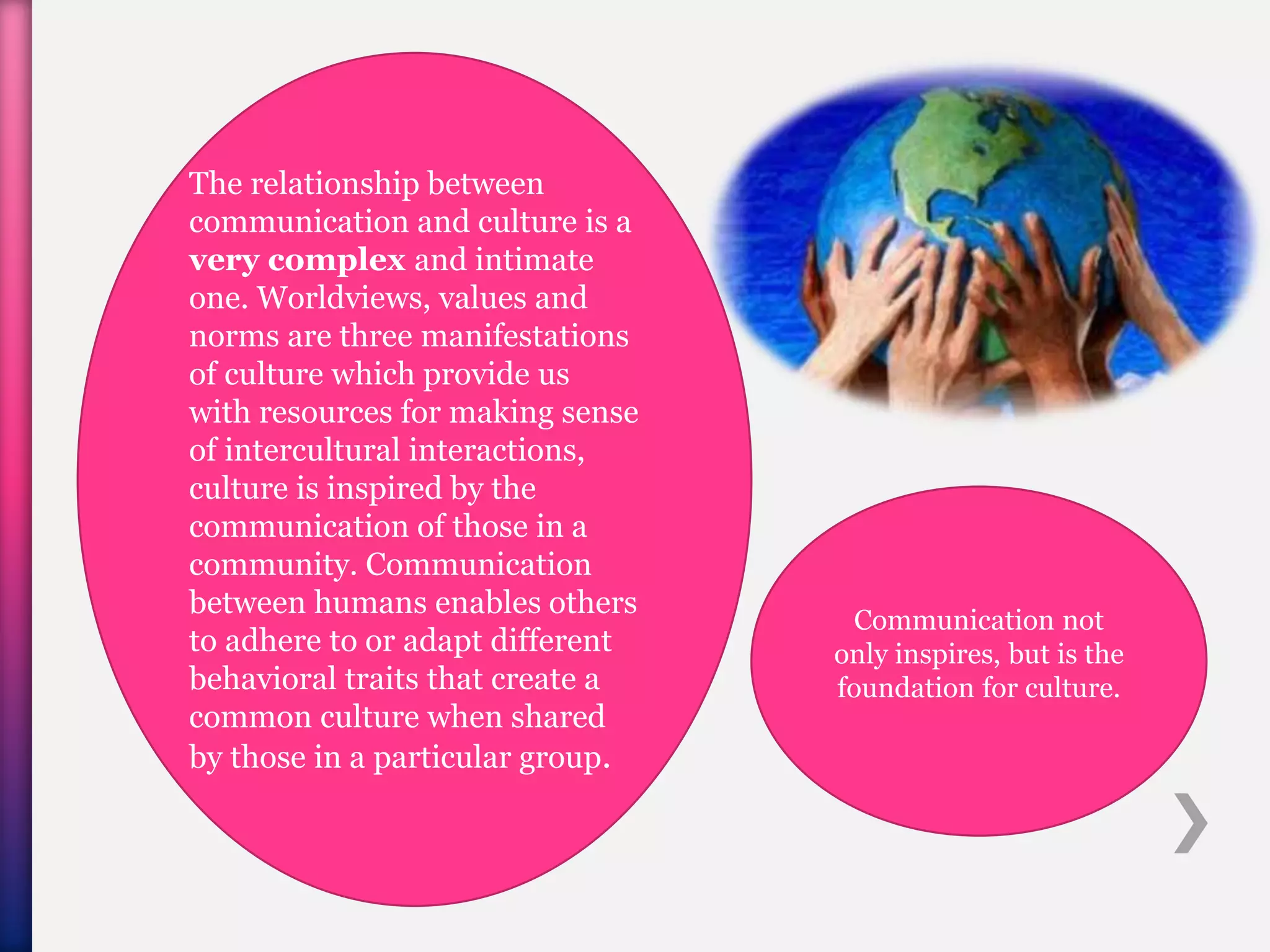
The relationship between
communication and culture is a
very complex and intimate
one. Worldviews, values and
norms are three manifestations
of culture which provide us
with resources for making sense
of intercultural interactions,
culture is inspired by the
communication of those in a
community. Communication
between humans enables others
to adhere to or adapt different
behavioral traits that create a
common culture when shared
by those in a particular group.
Communication not
only inspires, but is the
foundation for culture.
CULTURE COMMUNICATION
˃ Is a learned set of
shared
interpretations
˃ Is about beliefs,
values, and norms
˃ Affects the behavior
of a relatively large
group of people
˃ Is the vehicle by which
culture is expressed
˃ Is directly effected by
communication
patterns
Worldviews are abstract notions about the way the world is,
they are usually the premises upon which challenges and
debates are conducted. Worldviews operate at an unconscious
level so that we are not aware that other ways of seeing the
world are either possible or legitimate, worldviews are a vital
part of who we are but not a part we usually think much about.
How culture influence communication
The work of Kluckhohn and Strodbeck is important to our
understanding of how cultures develop their value systems.
Kluckhohn and Strodbeck studied the cultural values of
European Americans, Hispanics and native American .they
posited the fact that all cultures must answer the following
questions about the world around them:
These questions are universal for all human beings ,
although different cultures address them differently. The
way a culture answers these questions is part of its deep
structure;
Kluckhohn and Strodbeck
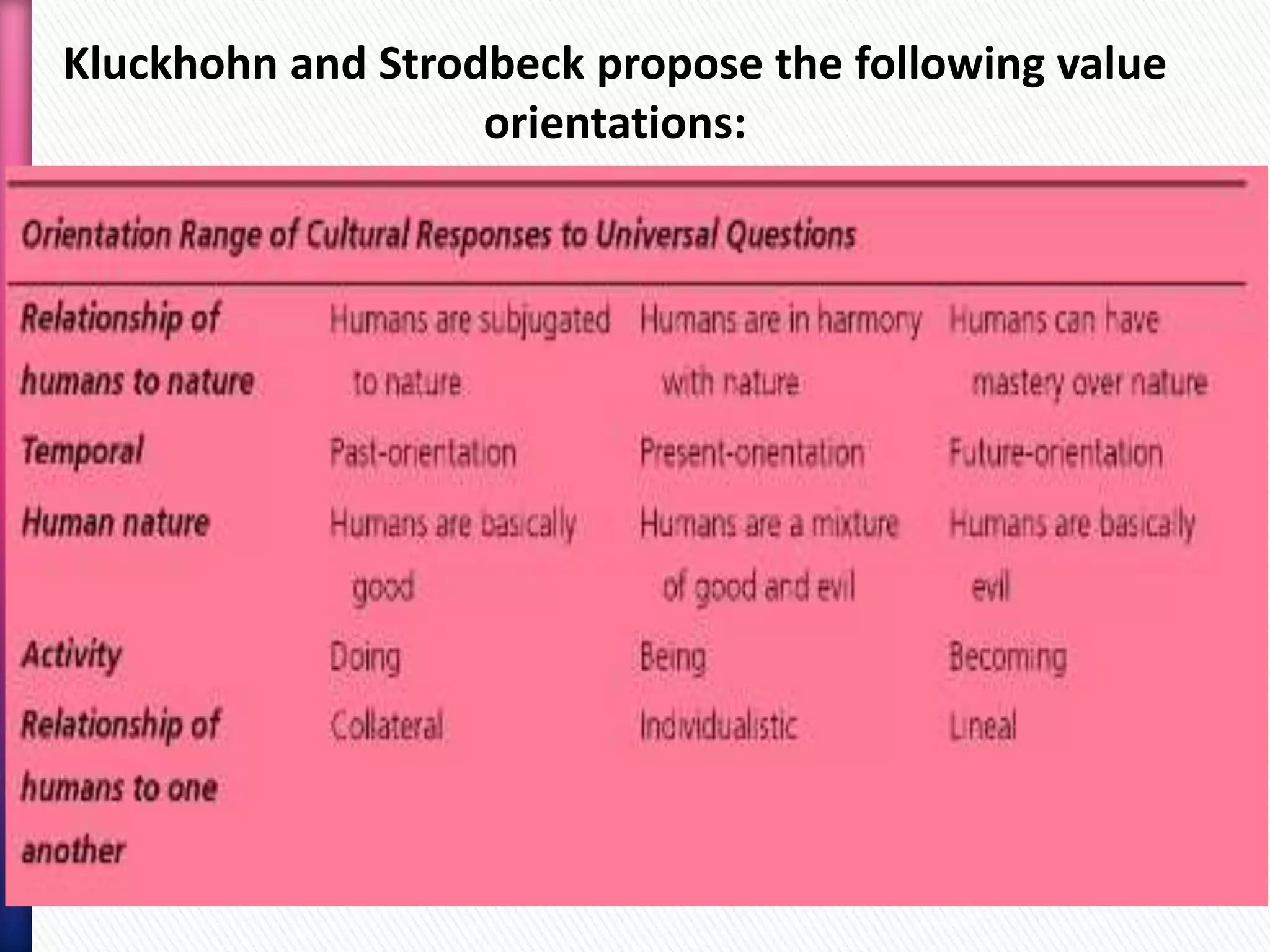
 What is the human nature?
 What is the relationship of humans to nature ?
 What is the orientation to time?
 What is the preferable form of human activity?
 What is the social relationship of humans with one
another?
Kluckhohn and Strodbeck propose the following value
orientations:
Geert Hofstede studied work-related values. His extensive
original data1967-1973) comes from 40 countries and
involved 116,000 people working at IBM. Based on these,
and later data, Hofstede has developed theory of cultural
variation which features four dimensions along which
cultures differ. These dimensions are;
 individualism/collectivism
 power distance
 uncertainty avoidance
 masculinity/femininity
Hofstede
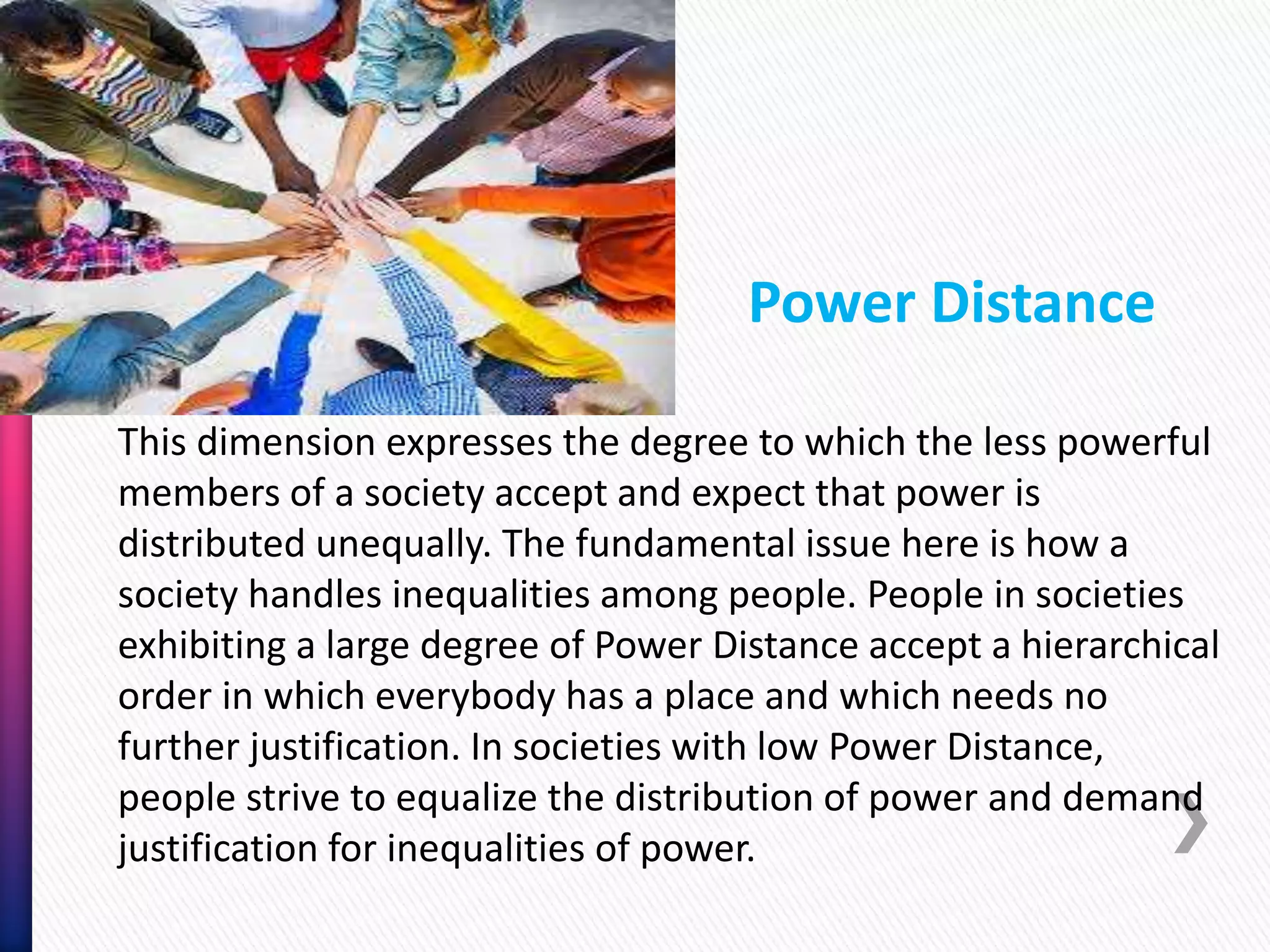
This dimension expresses the degree to which the less powerful
members of a society accept and expect that power is
distributed unequally. The fundamental issue here is how a
society handles inequalities among people. People in societies
exhibiting a large degree of Power Distance accept a hierarchical
order in which everybody has a place and which needs no
further justification. In societies with low Power Distance,
people strive to equalize the distribution of power and demand
justification for inequalities of power.
Power Distance
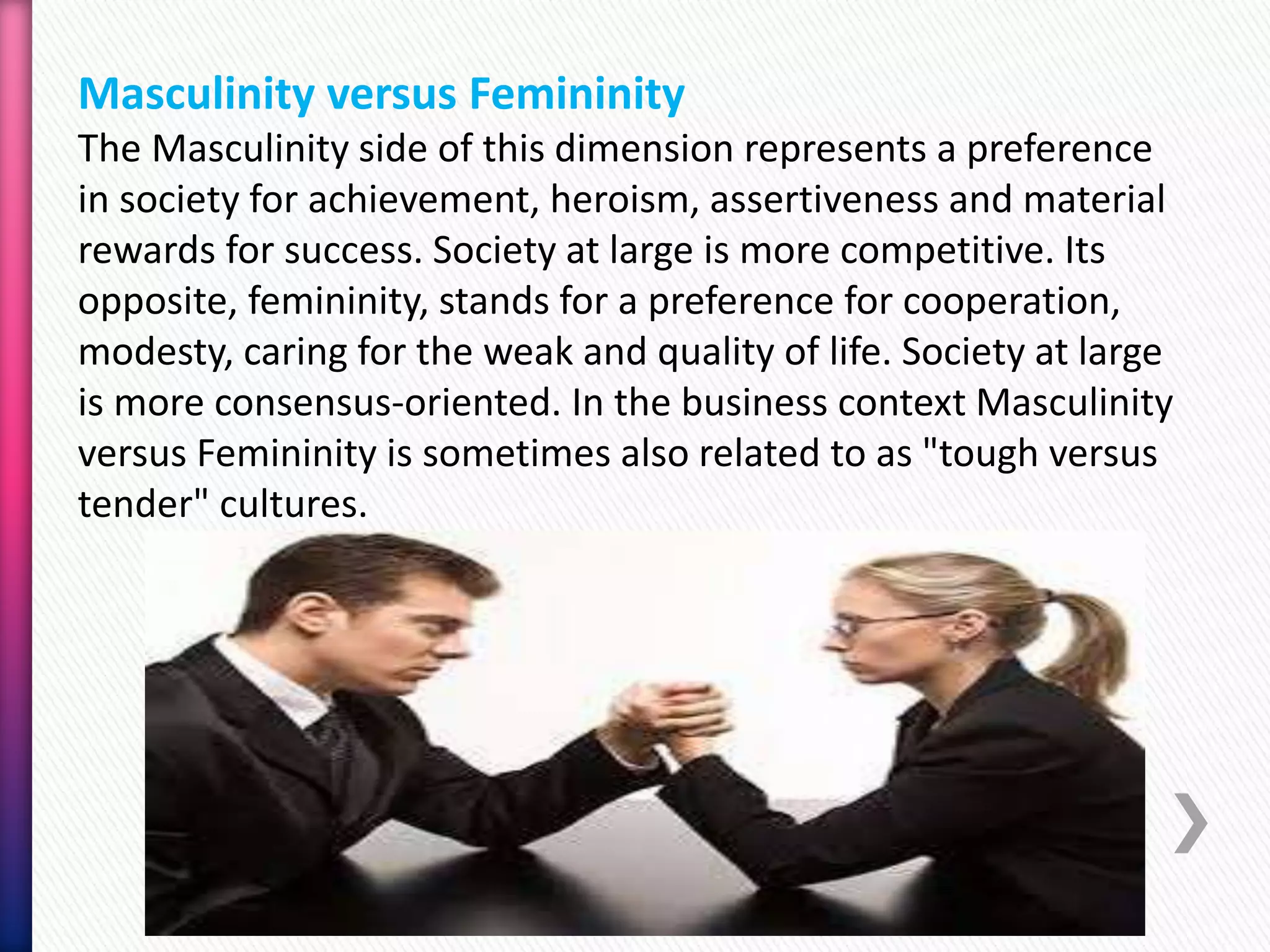
Masculinity versus Femininity
The Masculinity side of this dimension represents a preference
in society for achievement, heroism, assertiveness and material
rewards for success. Society at large is more competitive. Its
opposite, femininity, stands for a preference for cooperation,
modesty, caring for the weak and quality of life. Society at large
is more consensus-oriented. In the business context Masculinity
versus Femininity is sometimes also related to as "tough versus
tender" cultures.
Uncertainty Avoidance
The Uncertainty Avoidance dimension expresses the
degree to which the members of a society feel
uncomfortable with uncertainty and ambiguity. The
fundamental issue here is how a society deals with the fact
that the future can never be known: should we try to
control the future or just let it happen? Countries
exhibiting strong UA maintain rigid codes of belief and
behavior and are intolerant of unorthodox behavior and
ideas. Weak UA societies maintain a more relaxed attitude
in which practice counts more than principles.
Long Term Orientation versus Short Term Normative
Orientation
Every society has to maintain some links with its own past while
dealing with the challenges of the present and the future. Societies
prioritize these two existential goals differently.
Societies who score low on this dimension, for example, prefer to
maintain time-honored traditions and norms while viewing societal
change with suspicion. Those with a culture which scores high, on
the other hand, take a more pragmatic approach: they encourage
thrift and efforts in modern education as a way to prepare for the
future.
Individualism versus Collectivism
The high side of this dimension, called individualism, can be
defined as a preference for a loosely-knit social framework in
which individuals are expected to take care of only themselves
and their immediate families. Its opposite, collectivism,
represents a preference for a tightly-knit framework in society
in which individuals can expect their relatives or members of a
particular in-group to look after them in exchange for
unquestioning loyalty. A society's position on this dimension is
reflected in whether people’s self-image is defined in terms of
“I” or “we.”
Intercultural communication

Intercultural communication

  • 1.
  • 2.
  • 3.
    The relationship between communicationand culture is a very complex and intimate one. Worldviews, values and norms are three manifestations of culture which provide us with resources for making sense of intercultural interactions, culture is inspired by the communication of those in a community. Communication between humans enables others to adhere to or adapt different behavioral traits that create a common culture when shared by those in a particular group. Communication not only inspires, but is the foundation for culture.
  • 4.
    CULTURE COMMUNICATION ˃ Isa learned set of shared interpretations ˃ Is about beliefs, values, and norms ˃ Affects the behavior of a relatively large group of people ˃ Is the vehicle by which culture is expressed ˃ Is directly effected by communication patterns
  • 5.
    Worldviews are abstractnotions about the way the world is, they are usually the premises upon which challenges and debates are conducted. Worldviews operate at an unconscious level so that we are not aware that other ways of seeing the world are either possible or legitimate, worldviews are a vital part of who we are but not a part we usually think much about.
  • 6.
    How culture influencecommunication The work of Kluckhohn and Strodbeck is important to our understanding of how cultures develop their value systems. Kluckhohn and Strodbeck studied the cultural values of European Americans, Hispanics and native American .they posited the fact that all cultures must answer the following questions about the world around them: These questions are universal for all human beings , although different cultures address them differently. The way a culture answers these questions is part of its deep structure; Kluckhohn and Strodbeck
  • 7.
     What isthe human nature?  What is the relationship of humans to nature ?  What is the orientation to time?  What is the preferable form of human activity?  What is the social relationship of humans with one another?
  • 8.
    Kluckhohn and Strodbeckpropose the following value orientations:
  • 9.
    Geert Hofstede studiedwork-related values. His extensive original data1967-1973) comes from 40 countries and involved 116,000 people working at IBM. Based on these, and later data, Hofstede has developed theory of cultural variation which features four dimensions along which cultures differ. These dimensions are;  individualism/collectivism  power distance  uncertainty avoidance  masculinity/femininity Hofstede
  • 11.
    This dimension expressesthe degree to which the less powerful members of a society accept and expect that power is distributed unequally. The fundamental issue here is how a society handles inequalities among people. People in societies exhibiting a large degree of Power Distance accept a hierarchical order in which everybody has a place and which needs no further justification. In societies with low Power Distance, people strive to equalize the distribution of power and demand justification for inequalities of power. Power Distance
  • 12.
    Masculinity versus Femininity TheMasculinity side of this dimension represents a preference in society for achievement, heroism, assertiveness and material rewards for success. Society at large is more competitive. Its opposite, femininity, stands for a preference for cooperation, modesty, caring for the weak and quality of life. Society at large is more consensus-oriented. In the business context Masculinity versus Femininity is sometimes also related to as "tough versus tender" cultures.
  • 13.
    Uncertainty Avoidance The UncertaintyAvoidance dimension expresses the degree to which the members of a society feel uncomfortable with uncertainty and ambiguity. The fundamental issue here is how a society deals with the fact that the future can never be known: should we try to control the future or just let it happen? Countries exhibiting strong UA maintain rigid codes of belief and behavior and are intolerant of unorthodox behavior and ideas. Weak UA societies maintain a more relaxed attitude in which practice counts more than principles.
  • 14.
    Long Term Orientationversus Short Term Normative Orientation Every society has to maintain some links with its own past while dealing with the challenges of the present and the future. Societies prioritize these two existential goals differently. Societies who score low on this dimension, for example, prefer to maintain time-honored traditions and norms while viewing societal change with suspicion. Those with a culture which scores high, on the other hand, take a more pragmatic approach: they encourage thrift and efforts in modern education as a way to prepare for the future.
  • 15.
    Individualism versus Collectivism Thehigh side of this dimension, called individualism, can be defined as a preference for a loosely-knit social framework in which individuals are expected to take care of only themselves and their immediate families. Its opposite, collectivism, represents a preference for a tightly-knit framework in society in which individuals can expect their relatives or members of a particular in-group to look after them in exchange for unquestioning loyalty. A society's position on this dimension is reflected in whether people’s self-image is defined in terms of “I” or “we.”