PRIMITIVE AND TONIC
REFLEX
These reflex are normaly
present during infancy and
become integrated by the CNS
at an early stage.
These reflex are not generally
present in adults .
Patients who exhibit these reflexes
typically present with extensive
brain damage and either UMN sign.
Reflexes important to examine in
the patients suspected of abnormal
reflex activity include flexor
withdrawal
A reflex scouring key from is:• 0+ve
absent.
• 1+ve
tone
change, slight,
transient with no movement of
the extremities.
• 2+ve
visible movements of
extremities.
• 3+ve
exaggerated, full
movement of extremities.
• 4+ve
obligatory and sustained
movement raising for more than 30
sec.
Primitive/spinal reflexes
•
•
•
•

Name- Flexor withdrawal
Onset-2-3wks gestation
Integrated- 1-2months
Stimulus- noxious stimulus(pin prick) to sole
of foot.
• Response-Toes extended, foot DF, entire lower
extremity flexes.
Name- cross extension
Onset-28 wks gestation
Integrated- 1-2months
Stimulus- noxious
stimulus to ball of foot of
lower extremity fixed in
extension.
Response- opposite lower
extremity flexes then
adduction and extends.
Name- Traction
Onset-28wks of
gestation
Integrated- 2-5 months
Stimulus- Grasp
forearm and pull up
from supine into sitting
position.
Response-grasps and
total flexion of upper
extremity.
Name- Moro
Onset- 28 wks of gestation
Integrated- 5-6 months
Stimulus- head drag method
used. Baby held in supine
with supported behind the
chest and head then head is
allowed to drop 10degree
Response- elbow extended
shoulder abducted , upper
limb- hand opening and
crying followed by flexion
, adduction of arms across
chest.
Name- Startle
Onset- birth
Integrated- persist
Stimulus- sudden loud or
harsh noise.
Response- sudden
extension or abduction of
upper extremity , crying.
NameGrasp(planter/palmer)
Onset- palmer birth
Integrated- palmer 4-6
months
planter 9 months
Stimulus- Maintain pressure
to palm of hand(palmer
grasp) or to ball of foot under
toes (planter grasp).
Response- Maintain flexion of
fingers of hands or toes.
Name- STNR
OnsetIntegrated- 4-6 month
Stimulus- Flexion or extension
of head.
Response - With head flex
, flexion of upper extremity
, extension of lower extremity
- with head
extension , extension of upper
extremity and flexion of lower
extremity
Name- symetrical tonic baby
ri TLR or STLR
Onset- birth
Integrated- 6 month
Stimulus- Prone or supine
position
Response- With prone it
increases flexor
tone/Flexion of all limbs with
supine and increase extensor
tone / extension of all limbs
Name- Positive supporting
Onset- birth
Integrated- 6 month
Stimulus- contact to the ball of the feet
in upright standing position.
Response- Rigid extension , coactions
of the lower extremity.
Name - Associated reactions
Onset - birth/ 3months
Integrated - 8-9 yrs
Stimulus - Resisted voluntary
movement in any part of body.
Response - Involuntary movements in a
resting extremity.
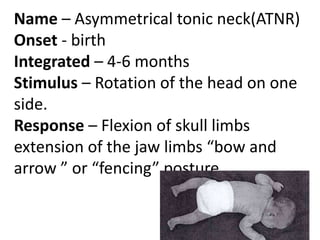
Name – Asymmetrical tonic neck(ATNR)
Onset - birth
Integrated – 4-6 months
Stimulus – Rotation of the head on one
side.
Response – Flexion of skull limbs
extension of the jaw limbs “bow and
arrow ” or “fencing” posture.
Name – Neck righting action of the
body(NOB)
Onset – 4-6 months
Integrated – 5 years
Stimulus – Passively turn head to one
side, tested in supine
Response – Body rotates as a whole to
align the body with the head.
Name – Body righting acting on
head(BOH)
Onset – birth-2 months
Integrated – 5 years
Stimulus – Place in prone or supine
position.
Response – Head orients to vertical
position with mouth horizontal.
Name – Protective extension(PE)
Onset – arms, 4-6 months; legs , 6-9
months.
Integrated – persists
Stimulus – Displace center of gravity
outside the base of support
Response – Arms or legs extend and
abduct to support and to protect the
body against falling
THANK Uuuuu………

Primitive and tonic reflex

  • 1.
  • 2.
    These reflex arenormaly present during infancy and become integrated by the CNS at an early stage. These reflex are not generally present in adults .
  • 3.
    Patients who exhibitthese reflexes typically present with extensive brain damage and either UMN sign. Reflexes important to examine in the patients suspected of abnormal reflex activity include flexor withdrawal
  • 4.
    A reflex scouringkey from is:• 0+ve absent. • 1+ve tone change, slight, transient with no movement of the extremities. • 2+ve visible movements of extremities.
  • 5.
    • 3+ve exaggerated, full movementof extremities. • 4+ve obligatory and sustained movement raising for more than 30 sec.
  • 6.
    Primitive/spinal reflexes • • • • Name- Flexorwithdrawal Onset-2-3wks gestation Integrated- 1-2months Stimulus- noxious stimulus(pin prick) to sole of foot. • Response-Toes extended, foot DF, entire lower extremity flexes.
  • 7.
    Name- cross extension Onset-28wks gestation Integrated- 1-2months Stimulus- noxious stimulus to ball of foot of lower extremity fixed in extension. Response- opposite lower extremity flexes then adduction and extends.
  • 8.
    Name- Traction Onset-28wks of gestation Integrated-2-5 months Stimulus- Grasp forearm and pull up from supine into sitting position. Response-grasps and total flexion of upper extremity.
  • 9.
    Name- Moro Onset- 28wks of gestation Integrated- 5-6 months Stimulus- head drag method used. Baby held in supine with supported behind the chest and head then head is allowed to drop 10degree Response- elbow extended shoulder abducted , upper limb- hand opening and crying followed by flexion , adduction of arms across chest.
  • 10.
    Name- Startle Onset- birth Integrated-persist Stimulus- sudden loud or harsh noise. Response- sudden extension or abduction of upper extremity , crying.
  • 11.
    NameGrasp(planter/palmer) Onset- palmer birth Integrated-palmer 4-6 months planter 9 months Stimulus- Maintain pressure to palm of hand(palmer grasp) or to ball of foot under toes (planter grasp). Response- Maintain flexion of fingers of hands or toes.
  • 12.
    Name- STNR OnsetIntegrated- 4-6month Stimulus- Flexion or extension of head. Response - With head flex , flexion of upper extremity , extension of lower extremity - with head extension , extension of upper extremity and flexion of lower extremity
  • 13.
    Name- symetrical tonicbaby ri TLR or STLR Onset- birth Integrated- 6 month Stimulus- Prone or supine position Response- With prone it increases flexor tone/Flexion of all limbs with supine and increase extensor tone / extension of all limbs
  • 14.
    Name- Positive supporting Onset-birth Integrated- 6 month Stimulus- contact to the ball of the feet in upright standing position. Response- Rigid extension , coactions of the lower extremity.
  • 15.
    Name - Associatedreactions Onset - birth/ 3months Integrated - 8-9 yrs Stimulus - Resisted voluntary movement in any part of body. Response - Involuntary movements in a resting extremity.
  • 16.
    Name – Asymmetricaltonic neck(ATNR) Onset - birth Integrated – 4-6 months Stimulus – Rotation of the head on one side. Response – Flexion of skull limbs extension of the jaw limbs “bow and arrow ” or “fencing” posture.
  • 17.
    Name – Neckrighting action of the body(NOB) Onset – 4-6 months Integrated – 5 years Stimulus – Passively turn head to one side, tested in supine Response – Body rotates as a whole to align the body with the head.
  • 18.
    Name – Bodyrighting acting on head(BOH) Onset – birth-2 months Integrated – 5 years Stimulus – Place in prone or supine position. Response – Head orients to vertical position with mouth horizontal.
  • 19.
    Name – Protectiveextension(PE) Onset – arms, 4-6 months; legs , 6-9 months. Integrated – persists Stimulus – Displace center of gravity outside the base of support Response – Arms or legs extend and abduct to support and to protect the body against falling
  • 20.