NORMAL DEVELOPMENTAL MILESTONES
DR. MOMINA AKRAM
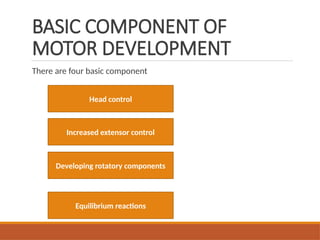
BASIC COMPONENT OF
MOTOR DEVELOPMENT
There are four basic component
Head control
Increased extensor control
Developing rotatory components
Equilibrium reactions
HIGHER LEVEL MOVEMENTS
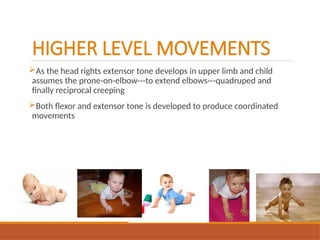
As the head rights extensor tone develops in upper limb and child
assumes the prone-on-elbow---to extend elbows---quadruped and
finally reciprocal creeping
Both flexor and extensor tone is developed to produce coordinated
movements
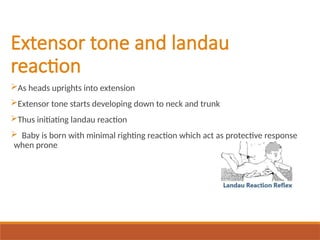
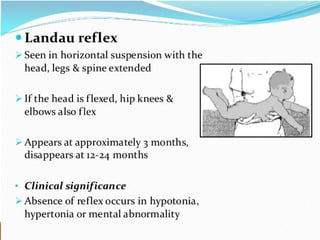
Extensor tone and landau
reaction
As heads uprights into extension
Extensor tone starts developing down to neck and trunk
Thus initiating landau reaction
 Baby is born with minimal righting reaction which act as protective response
when prone
ATNR & SIDELYING
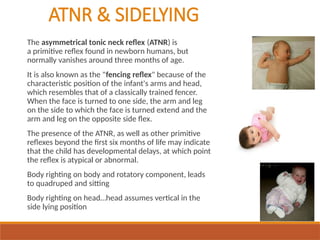
The asymmetrical tonic neck reflex (ATNR) is
a primitive reflex found in newborn humans, but
normally vanishes around three months of age.
It is also known as the "fencing reflex" because of the
characteristic position of the infant's arms and head,
which resembles that of a classically trained fencer.
When the face is turned to one side, the arm and leg
on the side to which the face is turned extend and the
arm and leg on the opposite side flex.
The presence of the ATNR, as well as other primitive
reflexes beyond the first six months of life may indicate
that the child has developmental delays, at which point
the reflex is atypical or abnormal.
Body righting on body and rotatory component, leads
to quadruped and sitting
Body righting on head…head assumes vertical in the
side lying position
STNR
Symmetrical tonic neck reflex (STNR) is a bridging or transitional
brainstem reflex that is not a primitive reflex but is an important
developmental stage and is necessary for a baby for transition from
lying on the floor quadruped crawling or creeping.
Onset of STNR occurs between 4–6 months and its integration occurs by
8–12 months.
It allows babies to make the transition from laying down to getting up
on their hands and knees.
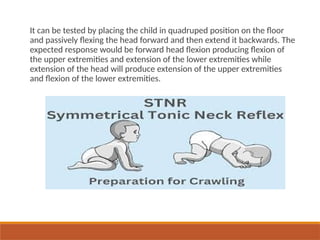
It can be tested by placing the child in quadruped position on the floor
and passively flexing the head forward and then extend it backwards. The
expected response would be forward head flexion producing flexion of
the upper extremities and extension of the lower extremities while
extension of the head will produce extension of the upper extremities
and flexion of the lower extremities.
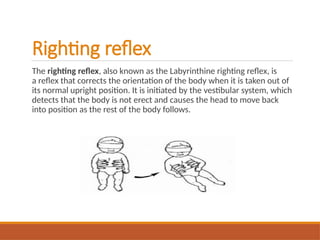
Righting reflex
The righting reflex, also known as the Labyrinthine righting reflex, is
a reflex that corrects the orientation of the body when it is taken out of
its normal upright position. It is initiated by the vestibular system, which
detects that the body is not erect and causes the head to move back
into position as the rest of the body follows.
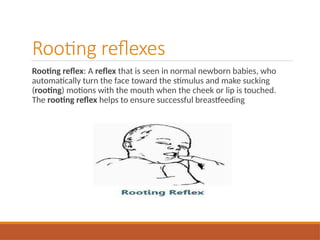
Rooting reflexes
Rooting reflex: A reflex that is seen in normal newborn babies, who
automatically turn the face toward the stimulus and make sucking
(rooting) motions with the mouth when the cheek or lip is touched.
The rooting reflex helps to ensure successful breastfeeding
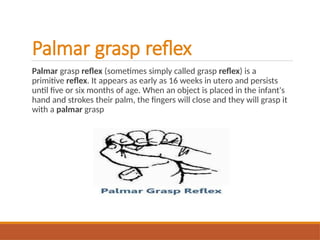
Palmar grasp reflex
Palmar grasp reflex (sometimes simply called grasp reflex) is a
primitive reflex. It appears as early as 16 weeks in utero and persists
until five or six months of age. When an object is placed in the infant's
hand and strokes their palm, the fingers will close and they will grasp it
with a palmar grasp
NORMAL DEVELOPMENT
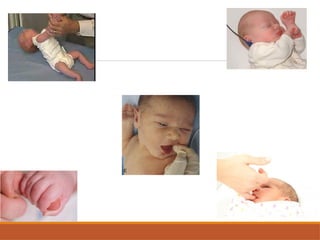
NEONATE-ONE MONTH
Momentary neck extension
Reflexive flexion posture
No functional muscle has developed
Hip are flexed with weight bearing on head and upper limb
Symmetrical in supine
Limbs retracted assuming position of abduction and flexion
Pronounced head lag, rounding of back, no extensor tone
No rotation except for neck righting, rooting reflex stimulates rotations
Hands fisted mostly, grasp reflex
Eye able to focus with in a limit range
TWO MONTH
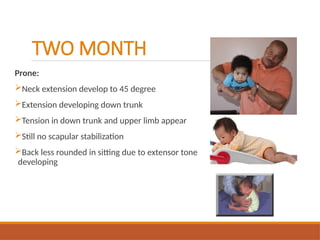
Prone:
Neck extension develop to 45 degree
Extension developing down trunk
Tension in down trunk and upper limb appear
Still no scapular stabilization
Back less rounded in sitting due to extensor tone
developing
TWO MONTH
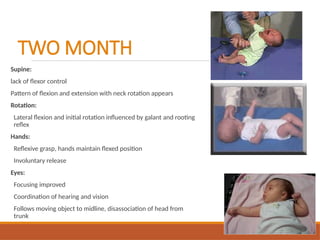
Supine:
lack of flexor control
Pattern of flexion and extension with neck rotation appears
Rotation:
Lateral flexion and initial rotation influenced by galant and rooting
reflex
Hands:
Reflexive grasp, hands maintain flexed position
Involuntary release
Eyes:
Focusing improved
Coordination of hearing and vision
Follows moving object to midline, disassociation of head from
trunk
THREE MONTH
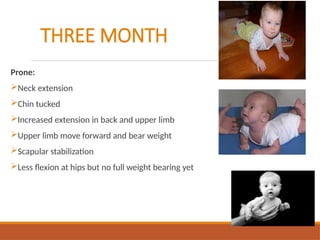
Prone:
Neck extension
Chin tucked
Increased extension in back and upper limb
Upper limb move forward and bear weight
Scapular stabilization
Less flexion at hips but no full weight bearing yet
THREE MONTH
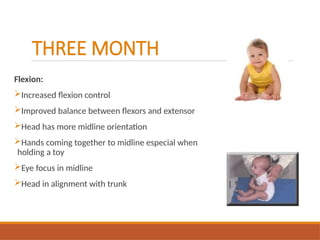
Flexion:
Increased flexion control
Improved balance between flexors and extensor
Head has more midline orientation
Hands coming together to midline especial when
holding a toy
Eye focus in midline
Head in alignment with trunk
THREE MONTH
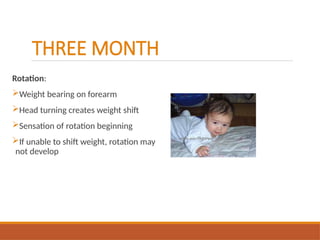
Rotation:
Weight bearing on forearm
Head turning creates weight shift
Sensation of rotation beginning
If unable to shift weight, rotation may
not develop
THREE MONTH
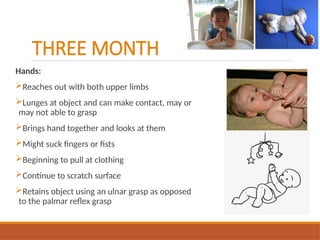
Hands:
Reaches out with both upper limbs
Lunges at object and can make contact, may or
may not able to grasp
Brings hand together and looks at them
Might suck fingers or fists
Beginning to pull at clothing
Continue to scratch surface
Retains object using an ulnar grasp as opposed
to the palmar reflex grasp
THREE MONTH
Eye:
Follow slow moving object through 180
degree
May see head rotating with eyes
Reaches with eyes when held in sitting
position
FOUR MONTH
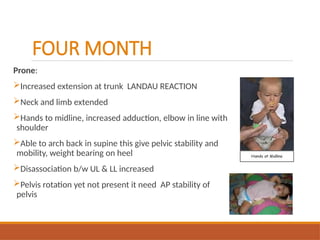
Prone:
Increased extension at trunk LANDAU REACTION
Neck and limb extended
Hands to midline, increased adduction, elbow in line with
shoulder
Able to arch back in supine this give pelvic stability and
mobility, weight bearing on heel
Disassociation b/w UL & LL increased
Pelvis rotation yet not present it need AP stability of
pelvis
FOUR MONTH
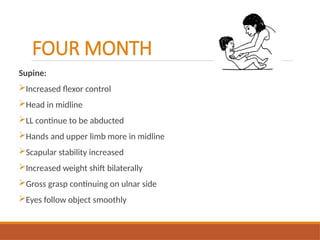
Supine:
Increased flexor control
Head in midline
LL continue to be abducted
Hands and upper limb more in midline
Scapular stability increased
Increased weight shift bilaterally
Gross grasp continuing on ulnar side
Eyes follow object smoothly
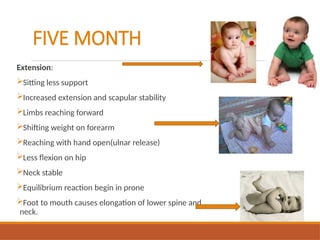
FIVE MONTH
Extension:
Sitting less support
Increased extension and scapular stability
Limbs reaching forward
Shifting weight on forearm
Reaching with hand open(ulnar release)
Less flexion on hip
Neck stable
Equilibrium reaction begin in prone
Foot to mouth causes elongation of lower spine and
neck.
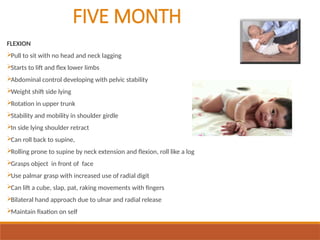
FIVE MONTH
FLEXION
Pull to sit with no head and neck lagging
Starts to lift and flex lower limbs
Abdominal control developing with pelvic stability
Weight shift side lying
Rotation in upper trunk
Stability and mobility in shoulder girdle
In side lying shoulder retract
Can roll back to supine,
Rolling prone to supine by neck extension and flexion, roll like a log
Grasps object in front of face
Use palmar grasp with increased use of radial digit
Can lift a cube, slap, pat, raking movements with fingers
Bilateral hand approach due to ulnar and radial release
Maintain fixation on self
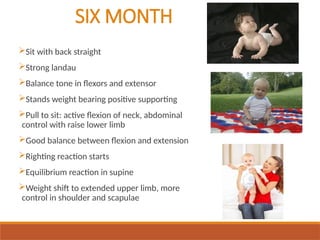
SIX MONTH
Sit with back straight
Strong landau
Balance tone in flexors and extensor
Stands weight bearing positive supporting
Pull to sit: active flexion of neck, abdominal
control with raise lower limb
Good balance between flexion and extension
Righting reaction starts
Equilibrium reaction in supine
Weight shift to extended upper limb, more
control in shoulder and scapulae
SIX MONTH- ROLLING
Roll from supine to prone:
Body righting on body
Need increased neck flexion
Upper limb reaches out and cross midline of
body
If initiate roll with lower limb needs increased
flexion to past the mid line, asymmetrical
movement of lower limb crossed extension
SIX MONTH-HANDS
Radial palmar grasp
If drops object may rescue it
Transfer objects from hand to other
Reaches out with one hand while holding object other
Pats image in mirror
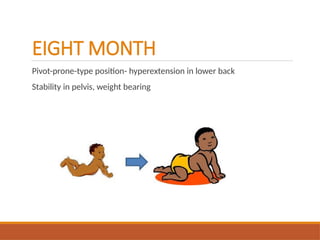
EIGHT MONTH
Pivot-prone-type position- hyperextension in lower back
Stability in pelvis, weight bearing
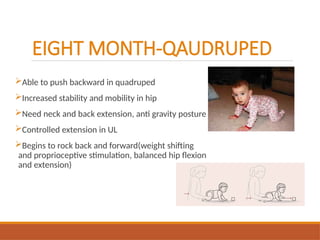
EIGHT MONTH-QAUDRUPED
Able to push backward in quadruped
Increased stability and mobility in hip
Need neck and back extension, anti gravity posture
Controlled extension in UL
Begins to rock back and forward(weight shifting
and proprioceptive stimulation, balanced hip flexion
and extension)
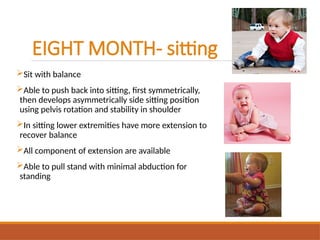
EIGHT MONTH- sitting
Sit with balance
Able to push back into sitting, first symmetrically,
then develops asymmetrically side sitting position
using pelvis rotation and stability in shoulder
In sitting lower extremities have more extension to
recover balance
All component of extension are available
Able to pull stand with minimal abduction for
standing
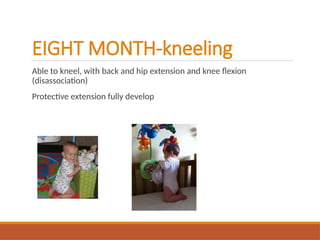
EIGHT MONTH-kneeling
Able to kneel, with back and hip extension and knee flexion
(disassociation)
Protective extension fully develop
EIGHT MONTH-rotation
Pushes back into quadruped position, rotates pelvis into side sitting
Begins lower extremities out in front for long sit position
Righting reaction, equilibrium reaction and disassociation of body parts
are in voluntary control
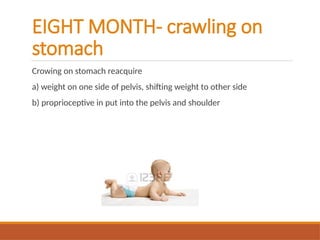
EIGHT MONTH- crawling on
stomach
Crowing on stomach reacquire
a) weight on one side of pelvis, shifting weight to other side
b) proprioceptive in put into the pelvis and shoulder
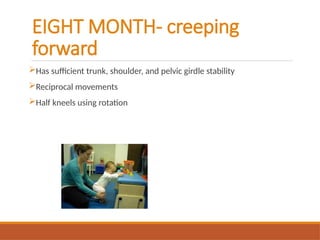
EIGHT MONTH- creeping
forward
Has sufficient trunk, shoulder, and pelvic girdle stability
Reciprocal movements
Half kneels using rotation
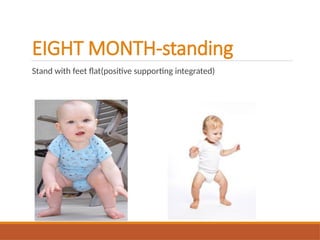
EIGHT MONTH-standing
Stand with feet flat(positive supporting integrated)
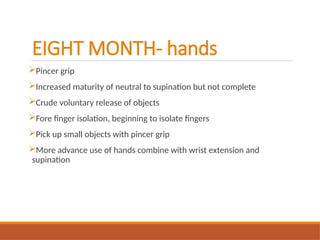
EIGHT MONTH- hands
Pincer grip
Increased maturity of neutral to supination but not complete
Crude voluntary release of objects
Fore finger isolation, beginning to isolate fingers
Pick up small objects with pincer grip
More advance use of hands combine with wrist extension and
supination
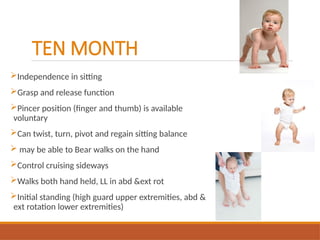
TEN MONTH
Independence in sitting
Grasp and release function
Pincer position (finger and thumb) is available
voluntary
Can twist, turn, pivot and regain sitting balance
 may be able to Bear walks on the hand
Control cruising sideways
Walks both hand held, LL in abd &ext rot
Initial standing (high guard upper extremities, abd &
ext rotation lower extremities)
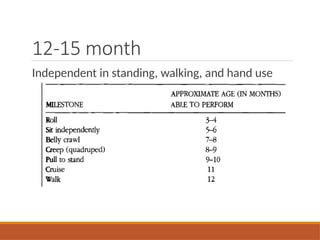
12-15 month
Independent in standing, walking, and hand use
NORMAL DEVELOPMENT.pptx by the book having complete understanding

NORMAL DEVELOPMENT.pptx by the book having complete understanding

  • 1.
  • 2.
    BASIC COMPONENT OF MOTORDEVELOPMENT There are four basic component Head control Increased extensor control Developing rotatory components Equilibrium reactions
  • 3.
    HIGHER LEVEL MOVEMENTS Asthe head rights extensor tone develops in upper limb and child assumes the prone-on-elbow---to extend elbows---quadruped and finally reciprocal creeping Both flexor and extensor tone is developed to produce coordinated movements
  • 4.
    Extensor tone andlandau reaction As heads uprights into extension Extensor tone starts developing down to neck and trunk Thus initiating landau reaction  Baby is born with minimal righting reaction which act as protective response when prone
  • 6.
    ATNR & SIDELYING Theasymmetrical tonic neck reflex (ATNR) is a primitive reflex found in newborn humans, but normally vanishes around three months of age. It is also known as the "fencing reflex" because of the characteristic position of the infant's arms and head, which resembles that of a classically trained fencer. When the face is turned to one side, the arm and leg on the side to which the face is turned extend and the arm and leg on the opposite side flex. The presence of the ATNR, as well as other primitive reflexes beyond the first six months of life may indicate that the child has developmental delays, at which point the reflex is atypical or abnormal. Body righting on body and rotatory component, leads to quadruped and sitting Body righting on head…head assumes vertical in the side lying position
  • 7.
    STNR Symmetrical tonic neckreflex (STNR) is a bridging or transitional brainstem reflex that is not a primitive reflex but is an important developmental stage and is necessary for a baby for transition from lying on the floor quadruped crawling or creeping. Onset of STNR occurs between 4–6 months and its integration occurs by 8–12 months. It allows babies to make the transition from laying down to getting up on their hands and knees.
  • 8.
    It can betested by placing the child in quadruped position on the floor and passively flexing the head forward and then extend it backwards. The expected response would be forward head flexion producing flexion of the upper extremities and extension of the lower extremities while extension of the head will produce extension of the upper extremities and flexion of the lower extremities.
  • 9.
    Righting reflex The rightingreflex, also known as the Labyrinthine righting reflex, is a reflex that corrects the orientation of the body when it is taken out of its normal upright position. It is initiated by the vestibular system, which detects that the body is not erect and causes the head to move back into position as the rest of the body follows.
  • 10.
    Rooting reflexes Rooting reflex:A reflex that is seen in normal newborn babies, who automatically turn the face toward the stimulus and make sucking (rooting) motions with the mouth when the cheek or lip is touched. The rooting reflex helps to ensure successful breastfeeding
  • 11.
    Palmar grasp reflex Palmargrasp reflex (sometimes simply called grasp reflex) is a primitive reflex. It appears as early as 16 weeks in utero and persists until five or six months of age. When an object is placed in the infant's hand and strokes their palm, the fingers will close and they will grasp it with a palmar grasp
  • 12.
  • 13.
    NEONATE-ONE MONTH Momentary neckextension Reflexive flexion posture No functional muscle has developed Hip are flexed with weight bearing on head and upper limb Symmetrical in supine Limbs retracted assuming position of abduction and flexion Pronounced head lag, rounding of back, no extensor tone No rotation except for neck righting, rooting reflex stimulates rotations Hands fisted mostly, grasp reflex Eye able to focus with in a limit range
  • 15.
    TWO MONTH Prone: Neck extensiondevelop to 45 degree Extension developing down trunk Tension in down trunk and upper limb appear Still no scapular stabilization Back less rounded in sitting due to extensor tone developing
  • 16.
    TWO MONTH Supine: lack offlexor control Pattern of flexion and extension with neck rotation appears Rotation: Lateral flexion and initial rotation influenced by galant and rooting reflex Hands: Reflexive grasp, hands maintain flexed position Involuntary release Eyes: Focusing improved Coordination of hearing and vision Follows moving object to midline, disassociation of head from trunk
  • 17.
    THREE MONTH Prone: Neck extension Chintucked Increased extension in back and upper limb Upper limb move forward and bear weight Scapular stabilization Less flexion at hips but no full weight bearing yet
  • 18.
    THREE MONTH Flexion: Increased flexioncontrol Improved balance between flexors and extensor Head has more midline orientation Hands coming together to midline especial when holding a toy Eye focus in midline Head in alignment with trunk
  • 19.
    THREE MONTH Rotation: Weight bearingon forearm Head turning creates weight shift Sensation of rotation beginning If unable to shift weight, rotation may not develop
  • 20.
    THREE MONTH Hands: Reaches outwith both upper limbs Lunges at object and can make contact, may or may not able to grasp Brings hand together and looks at them Might suck fingers or fists Beginning to pull at clothing Continue to scratch surface Retains object using an ulnar grasp as opposed to the palmar reflex grasp
  • 21.
    THREE MONTH Eye: Follow slowmoving object through 180 degree May see head rotating with eyes Reaches with eyes when held in sitting position
  • 22.
    FOUR MONTH Prone: Increased extensionat trunk LANDAU REACTION Neck and limb extended Hands to midline, increased adduction, elbow in line with shoulder Able to arch back in supine this give pelvic stability and mobility, weight bearing on heel Disassociation b/w UL & LL increased Pelvis rotation yet not present it need AP stability of pelvis
  • 23.
    FOUR MONTH Supine: Increased flexorcontrol Head in midline LL continue to be abducted Hands and upper limb more in midline Scapular stability increased Increased weight shift bilaterally Gross grasp continuing on ulnar side Eyes follow object smoothly
  • 24.
    FIVE MONTH Extension: Sitting lesssupport Increased extension and scapular stability Limbs reaching forward Shifting weight on forearm Reaching with hand open(ulnar release) Less flexion on hip Neck stable Equilibrium reaction begin in prone Foot to mouth causes elongation of lower spine and neck.
  • 25.
    FIVE MONTH FLEXION Pull tosit with no head and neck lagging Starts to lift and flex lower limbs Abdominal control developing with pelvic stability Weight shift side lying Rotation in upper trunk Stability and mobility in shoulder girdle In side lying shoulder retract Can roll back to supine, Rolling prone to supine by neck extension and flexion, roll like a log Grasps object in front of face Use palmar grasp with increased use of radial digit Can lift a cube, slap, pat, raking movements with fingers Bilateral hand approach due to ulnar and radial release Maintain fixation on self
  • 26.
    SIX MONTH Sit withback straight Strong landau Balance tone in flexors and extensor Stands weight bearing positive supporting Pull to sit: active flexion of neck, abdominal control with raise lower limb Good balance between flexion and extension Righting reaction starts Equilibrium reaction in supine Weight shift to extended upper limb, more control in shoulder and scapulae
  • 27.
    SIX MONTH- ROLLING Rollfrom supine to prone: Body righting on body Need increased neck flexion Upper limb reaches out and cross midline of body If initiate roll with lower limb needs increased flexion to past the mid line, asymmetrical movement of lower limb crossed extension
  • 28.
    SIX MONTH-HANDS Radial palmargrasp If drops object may rescue it Transfer objects from hand to other Reaches out with one hand while holding object other Pats image in mirror
  • 29.
    EIGHT MONTH Pivot-prone-type position-hyperextension in lower back Stability in pelvis, weight bearing
  • 30.
    EIGHT MONTH-QAUDRUPED Able topush backward in quadruped Increased stability and mobility in hip Need neck and back extension, anti gravity posture Controlled extension in UL Begins to rock back and forward(weight shifting and proprioceptive stimulation, balanced hip flexion and extension)
  • 31.
    EIGHT MONTH- sitting Sitwith balance Able to push back into sitting, first symmetrically, then develops asymmetrically side sitting position using pelvis rotation and stability in shoulder In sitting lower extremities have more extension to recover balance All component of extension are available Able to pull stand with minimal abduction for standing
  • 32.
    EIGHT MONTH-kneeling Able tokneel, with back and hip extension and knee flexion (disassociation) Protective extension fully develop
  • 33.
    EIGHT MONTH-rotation Pushes backinto quadruped position, rotates pelvis into side sitting Begins lower extremities out in front for long sit position Righting reaction, equilibrium reaction and disassociation of body parts are in voluntary control
  • 34.
    EIGHT MONTH- crawlingon stomach Crowing on stomach reacquire a) weight on one side of pelvis, shifting weight to other side b) proprioceptive in put into the pelvis and shoulder
  • 35.
    EIGHT MONTH- creeping forward Hassufficient trunk, shoulder, and pelvic girdle stability Reciprocal movements Half kneels using rotation
  • 36.
    EIGHT MONTH-standing Stand withfeet flat(positive supporting integrated)
  • 37.
    EIGHT MONTH- hands Pincergrip Increased maturity of neutral to supination but not complete Crude voluntary release of objects Fore finger isolation, beginning to isolate fingers Pick up small objects with pincer grip More advance use of hands combine with wrist extension and supination
  • 38.
    TEN MONTH Independence insitting Grasp and release function Pincer position (finger and thumb) is available voluntary Can twist, turn, pivot and regain sitting balance  may be able to Bear walks on the hand Control cruising sideways Walks both hand held, LL in abd &ext rot Initial standing (high guard upper extremities, abd & ext rotation lower extremities)
  • 39.
    12-15 month Independent instanding, walking, and hand use