Radhika Chintamani
Contents
 Definition
 History
 Introduction
 Mechanism
 Rationale
 Effects of PRT
 Tender points: definition, jump sign, trigger points, rules to
treat TrPs, General principles, comfort zone
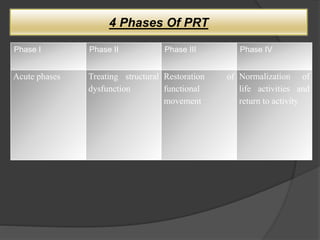
 4 phases of PRT
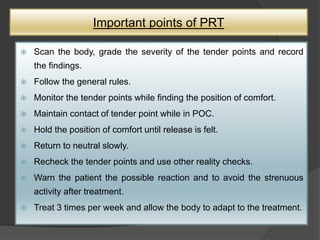
 Important points of PRT
DEFINITION
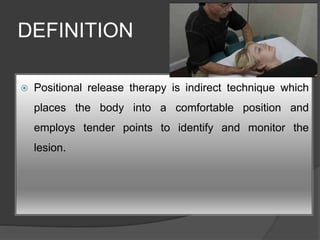
 Positional release therapy is indirect technique which
places the body into a comfortable position and
employs tender points to identify and monitor the
lesion.
HISTORY
 PRT was first developed in 1950 by Dr. Lawrence Jones, an osteopathic
physician. He first termed it positional release technique then later coined it
as Strain Counter Strain (SCS).
 In 1969 Harold V. Hoover used the term “Dynamic Neutral”.
 Further , Charles Bowels (1969) discussed Dynamic Neutral and stated that -
“Dynamic Neutral is a state in which tissues find themselves when the
motion of structure they serve is free, unrestricted and within the range of
normal physiological limits.”
 Later Jones, developed strain counter strain in more depth during
1981; in which;
Jones tried finding a comfortable position for the patient in which pain
was either zero or was very minimal
Patient was in the same position for a short time
On recovering back to the normal position subject found relief which was
lasting
 Thus; he stated the term counterstrain with its meaning. He gave the
aims of the technique as: “To relieve musculoskeletal pain and
somatic dysfunction through indirect manual manipulation.”
INTRODUCTION
 PRT is a passive technique used to treat musculoskeletal pain and
neurological imbalance due to hypertonic, contracted dysfunctional
condition would not enforce lengthening or stretching, but would
attempt to (depending on which PRT variation was selected) change
the tissue according to ARTT criteria.
 This technique is used in all three planes of motion. It positions the
body to enhance tissue function and release tension by inducing a little
discomfort allowing spontaneous resolution of tense and dysfunctional
state of tissues.
 It is a form of manual medicine that resolves pain and
dysfunction through positioning a part of body or tissue
in a comfortable zone such that restriction during
movement caused either by muscular changes or bony
lever are placed in such a way that the position induces
release of strain on muscle so that the vicious pain cycle
is reduced.
 The technique facilitates tissue regeneration, growth,
and repair so that body learns to self correct.
MECHANISM
 Indirect and passive method
 Severe tender points are located
 They are palpated as to guide position of comfort
 POC produces optimum relaxation of the involved tissues, allows
optimal relaxation and reduce inappropriate proprioceptive activities
 Decrease in muscle tension, fascial tension and joint hypermobility.
 Improvement in functional range of motion and decrease in pain.
RATIONALE FOR PRT
 Somatic dysfunction: this is impaired or altered function of
related components of the somatic system. Diagnostic test
for somatic dysfunction includes:
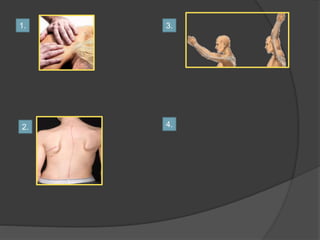
1. T: Tissue texture change.
(feel)
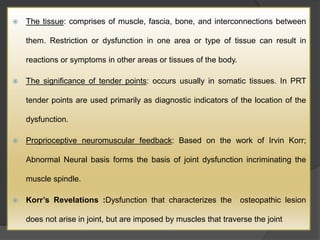
2. A: Asymmetry or positional
change (look)
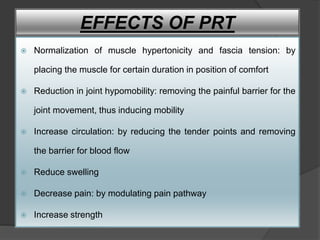
3. R: restriction of motion
(movement)
4. T: Tenderness
1.
4.2.
3.
 The tissue: comprises of muscle, fascia, bone, and interconnections between
them. Restriction or dysfunction in one area or type of tissue can result in
reactions or symptoms in other areas or tissues of the body.
 The significance of tender points: occurs usually in somatic tissues. In PRT
tender points are used primarily as diagnostic indicators of the location of the
dysfunction.
 Proprioceptive neuromuscular feedback: Based on the work of Irvin Korr;
Abnormal Neural basis forms the basis of joint dysfunction incriminating the
muscle spindle.
 Korr’s Revelations :Dysfunction that characterizes the osteopathic lesion
does not arise in joint, but are imposed by muscles that traverse the joint
EFFECTS OF PRT
 Normalization of muscle hypertonicity and fascia tension: by
placing the muscle for certain duration in position of comfort
 Reduction in joint hypomobility: removing the painful barrier for the
joint movement, thus inducing mobility
 Increase circulation: by reducing the tender points and removing
the barrier for blood flow
 Reduce swelling
 Decrease pain: by modulating pain pathway
 Increase strength
Tender points Trigger points
 Tender points are the areas
which are painful on
superficial or deep
palpation
 Usually occurring in
muscle, at muscle-tendon
junction, bursa or fat-pad.
 Trigger points are the areas
which are painful on
superficial or deep
palpation occurs along with
a local muscle twitch on
palpation
 Usually occurring in muscle
and at muscle-tendon
junction.
Assessment of tender
points
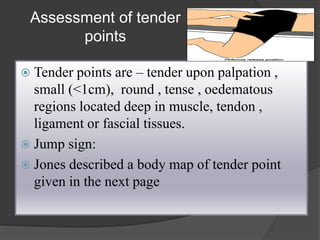
 Tender points are – tender upon palpation ,
small (<1cm), round , tense , oedematous
regions located deep in muscle, tendon ,
ligament or fascial tissues.
 Jump sign:
 Jones described a body map of tender point
given in the next page
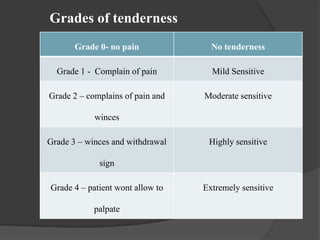
Grade 0- no pain No tenderness
Grade 1 - Complain of pain Mild Sensitive
Grade 2 – complains of pain and
winces
Moderate sensitive
Grade 3 – winces and withdrawal
sign
Highly sensitive
Grade 4 – patient wont allow to
palpate
Extremely sensitive
Grades of tenderness
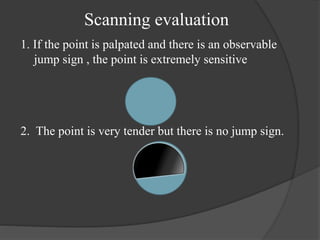
1. If the point is palpated and there is an observable
jump sign , the point is extremely sensitive
2. The point is very tender but there is no jump sign.
Scanning evaluation
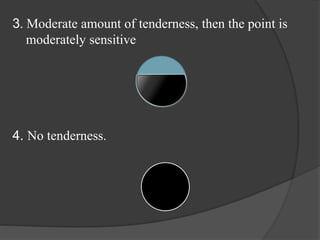
3. Moderate amount of tenderness, then the point is
moderately sensitive
4. No tenderness.
Trigger points as described by Travell and
Simon
 A focus of hyperirritability in a tissue that, when compressed, is
locally tender and, if sufficiently hypersensitive, gives rise to
referred pain and tenderness and, sometimes, to referred
autonomic phenomena and distortion of proprioception.
 Types include:
i. Myofascial
ii. Cutaneous
iii. Fascial
iv. Ligamentous
v. Periosteal trigger points.
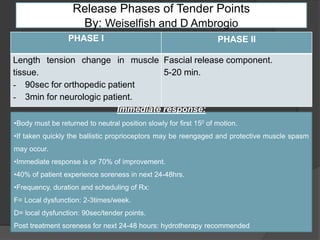
Release Phases of Tender Points
By: Weiselfish and D Ambrogio
PHASE I PHASE II
Length tension change in muscle
tissue.
- 90sec for orthopedic patient
- 3min for neurologic patient.
Fascial release component.
5-20 min.
Immediate response:
•Body must be returned to neutral position slowly for first 150 of motion.
•If taken quickly the ballistic proprioceptors may be reengaged and protective muscle spasm
may occur.
•Immediate response is or 70% of improvement.
•40% of patient experience soreness in next 24-48hrs.
•Frequency, duration and scheduling of Rx:
F= Local dysfunction: 2-3times/week.
D= local dysfunction: 90sec/tender points.
Post treatment soreness for next 24-48 hours: hydrotherapy recommended
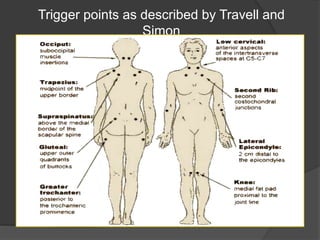
Trigger points as described by Travell and
Simon
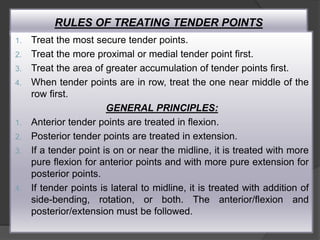
RULES OF TREATING TENDER POINTS
1. Treat the most secure tender points.
2. Treat the more proximal or medial tender point first.
3. Treat the area of greater accumulation of tender points first.
4. When tender points are in row, treat the one near middle of the
row first.
GENERAL PRINCIPLES:
1. Anterior tender points are treated in flexion.
2. Posterior tender points are treated in extension.
3. If a tender point is on or near the midline, it is treated with more
pure flexion for anterior points and with more pure extension for
posterior points.
4. If tender points is lateral to midline, it is treated with addition of
side-bending, rotation, or both. The anterior/flexion and
posterior/extension must be followed.
4 Phases Of PRT
Phase I Phase II Phase III Phase IV
Acute phases Treating structural
dysfunction
Restoration of
functional
movement
Normalization of
life activities and
return to activity
Important points of PRT
 Scan the body, grade the severity of the tender points and record
the findings.
 Follow the general rules.
 Monitor the tender points while finding the position of comfort.
 Maintain contact of tender point while in POC.
 Hold the position of comfort until release is felt.
 Return to neutral slowly.
 Recheck the tender points and use other reality checks.
 Warn the patient the possible reaction and to avoid the strenuous
activity after treatment.
 Treat 3 times per week and allow the body to adapt to the treatment.
Thank You

Positional release technique

  • 1.
  • 2.
    Contents  Definition  History Introduction  Mechanism  Rationale  Effects of PRT  Tender points: definition, jump sign, trigger points, rules to treat TrPs, General principles, comfort zone  4 phases of PRT  Important points of PRT
  • 3.
    DEFINITION  Positional releasetherapy is indirect technique which places the body into a comfortable position and employs tender points to identify and monitor the lesion.
  • 4.
    HISTORY  PRT wasfirst developed in 1950 by Dr. Lawrence Jones, an osteopathic physician. He first termed it positional release technique then later coined it as Strain Counter Strain (SCS).  In 1969 Harold V. Hoover used the term “Dynamic Neutral”.  Further , Charles Bowels (1969) discussed Dynamic Neutral and stated that - “Dynamic Neutral is a state in which tissues find themselves when the motion of structure they serve is free, unrestricted and within the range of normal physiological limits.”
  • 5.
     Later Jones,developed strain counter strain in more depth during 1981; in which; Jones tried finding a comfortable position for the patient in which pain was either zero or was very minimal Patient was in the same position for a short time On recovering back to the normal position subject found relief which was lasting  Thus; he stated the term counterstrain with its meaning. He gave the aims of the technique as: “To relieve musculoskeletal pain and somatic dysfunction through indirect manual manipulation.”
  • 6.
    INTRODUCTION  PRT isa passive technique used to treat musculoskeletal pain and neurological imbalance due to hypertonic, contracted dysfunctional condition would not enforce lengthening or stretching, but would attempt to (depending on which PRT variation was selected) change the tissue according to ARTT criteria.  This technique is used in all three planes of motion. It positions the body to enhance tissue function and release tension by inducing a little discomfort allowing spontaneous resolution of tense and dysfunctional state of tissues.
  • 7.
     It isa form of manual medicine that resolves pain and dysfunction through positioning a part of body or tissue in a comfortable zone such that restriction during movement caused either by muscular changes or bony lever are placed in such a way that the position induces release of strain on muscle so that the vicious pain cycle is reduced.  The technique facilitates tissue regeneration, growth, and repair so that body learns to self correct.
  • 8.
    MECHANISM  Indirect andpassive method  Severe tender points are located  They are palpated as to guide position of comfort  POC produces optimum relaxation of the involved tissues, allows optimal relaxation and reduce inappropriate proprioceptive activities  Decrease in muscle tension, fascial tension and joint hypermobility.  Improvement in functional range of motion and decrease in pain.
  • 9.
    RATIONALE FOR PRT Somatic dysfunction: this is impaired or altered function of related components of the somatic system. Diagnostic test for somatic dysfunction includes: 1. T: Tissue texture change. (feel) 2. A: Asymmetry or positional change (look) 3. R: restriction of motion (movement) 4. T: Tenderness
  • 10.
  • 11.
     The tissue:comprises of muscle, fascia, bone, and interconnections between them. Restriction or dysfunction in one area or type of tissue can result in reactions or symptoms in other areas or tissues of the body.  The significance of tender points: occurs usually in somatic tissues. In PRT tender points are used primarily as diagnostic indicators of the location of the dysfunction.  Proprioceptive neuromuscular feedback: Based on the work of Irvin Korr; Abnormal Neural basis forms the basis of joint dysfunction incriminating the muscle spindle.  Korr’s Revelations :Dysfunction that characterizes the osteopathic lesion does not arise in joint, but are imposed by muscles that traverse the joint
  • 12.
    EFFECTS OF PRT Normalization of muscle hypertonicity and fascia tension: by placing the muscle for certain duration in position of comfort  Reduction in joint hypomobility: removing the painful barrier for the joint movement, thus inducing mobility  Increase circulation: by reducing the tender points and removing the barrier for blood flow  Reduce swelling  Decrease pain: by modulating pain pathway  Increase strength
  • 13.
    Tender points Triggerpoints  Tender points are the areas which are painful on superficial or deep palpation  Usually occurring in muscle, at muscle-tendon junction, bursa or fat-pad.  Trigger points are the areas which are painful on superficial or deep palpation occurs along with a local muscle twitch on palpation  Usually occurring in muscle and at muscle-tendon junction.
  • 14.
    Assessment of tender points Tender points are – tender upon palpation , small (<1cm), round , tense , oedematous regions located deep in muscle, tendon , ligament or fascial tissues.  Jump sign:  Jones described a body map of tender point given in the next page
  • 15.
    Grade 0- nopain No tenderness Grade 1 - Complain of pain Mild Sensitive Grade 2 – complains of pain and winces Moderate sensitive Grade 3 – winces and withdrawal sign Highly sensitive Grade 4 – patient wont allow to palpate Extremely sensitive Grades of tenderness
  • 16.
    1. If thepoint is palpated and there is an observable jump sign , the point is extremely sensitive 2. The point is very tender but there is no jump sign. Scanning evaluation
  • 17.
    3. Moderate amountof tenderness, then the point is moderately sensitive 4. No tenderness.
  • 18.
    Trigger points asdescribed by Travell and Simon  A focus of hyperirritability in a tissue that, when compressed, is locally tender and, if sufficiently hypersensitive, gives rise to referred pain and tenderness and, sometimes, to referred autonomic phenomena and distortion of proprioception.  Types include: i. Myofascial ii. Cutaneous iii. Fascial iv. Ligamentous v. Periosteal trigger points.
  • 19.
    Release Phases ofTender Points By: Weiselfish and D Ambrogio PHASE I PHASE II Length tension change in muscle tissue. - 90sec for orthopedic patient - 3min for neurologic patient. Fascial release component. 5-20 min. Immediate response: •Body must be returned to neutral position slowly for first 150 of motion. •If taken quickly the ballistic proprioceptors may be reengaged and protective muscle spasm may occur. •Immediate response is or 70% of improvement. •40% of patient experience soreness in next 24-48hrs. •Frequency, duration and scheduling of Rx: F= Local dysfunction: 2-3times/week. D= local dysfunction: 90sec/tender points. Post treatment soreness for next 24-48 hours: hydrotherapy recommended
  • 20.
    Trigger points asdescribed by Travell and Simon
  • 21.
    RULES OF TREATINGTENDER POINTS 1. Treat the most secure tender points. 2. Treat the more proximal or medial tender point first. 3. Treat the area of greater accumulation of tender points first. 4. When tender points are in row, treat the one near middle of the row first. GENERAL PRINCIPLES: 1. Anterior tender points are treated in flexion. 2. Posterior tender points are treated in extension. 3. If a tender point is on or near the midline, it is treated with more pure flexion for anterior points and with more pure extension for posterior points. 4. If tender points is lateral to midline, it is treated with addition of side-bending, rotation, or both. The anterior/flexion and posterior/extension must be followed.
  • 22.
    4 Phases OfPRT Phase I Phase II Phase III Phase IV Acute phases Treating structural dysfunction Restoration of functional movement Normalization of life activities and return to activity
  • 23.
    Important points ofPRT  Scan the body, grade the severity of the tender points and record the findings.  Follow the general rules.  Monitor the tender points while finding the position of comfort.  Maintain contact of tender point while in POC.  Hold the position of comfort until release is felt.  Return to neutral slowly.  Recheck the tender points and use other reality checks.  Warn the patient the possible reaction and to avoid the strenuous activity after treatment.  Treat 3 times per week and allow the body to adapt to the treatment.
  • 24.