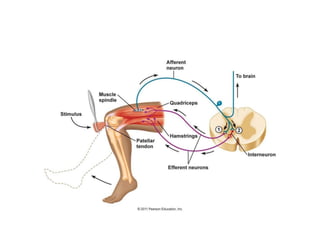
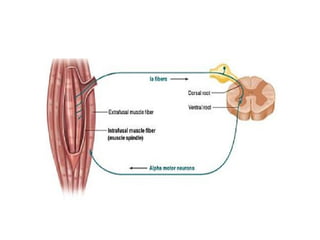
PRIMITIVE REFLEXES
DEVELOPMENTAL REFLEXES
Primitive reflexes are important for
– Protection
– Nutrition
• Sucking reflex
• Rooting reflex
– Survival
• Labyrinthine reflex
WHY THERAPIST NEED TO TEST……
• Therapist should be aware of and test for when presented
with an infant or child with possible developmental delay
or tonal problems.
• Reflex testing can assist the therapist in determining the
cause of the delay such as CNS impairment, peripheral
nerve injury, and muscle weakness.
• Reflex review will also assist in developing an individual
treatment intervention designed to help the child integrate
reflexes that appear to be delayed or missing
SPINAL LEVEL
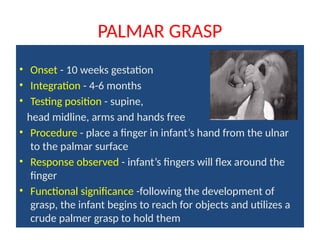
PALMAR GRASP
• Onset - 10 weeks gestation
• Integration - 4-6 months
• Testing position - supine,
head midline, arms and hands free
• Procedure - place a finger in infant’s hand from the ulnar
to the palmar surface
• Response observed - infant’s fingers will flex around the
finger
• Functional significance -following the development of
grasp, the infant begins to reach for objects and utilizes a
crude palmer grasp to hold them
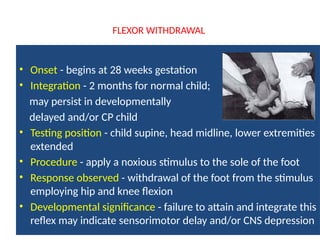
FLEXOR WITHDRAWAL
• Onset - begins at 28 weeks gestation
• Integration - 2 months for normal child;
may persist in developmentally
delayed and/or CP child
• Testing position - child supine, head midline, lower extremities
extended
• Procedure - apply a noxious stimulus to the sole of the foot
• Response observed - withdrawal of the foot from the stimulus
employing hip and knee flexion
• Developmental significance - failure to attain and integrate this
reflex may indicate sensorimotor delay and/or CNS depression
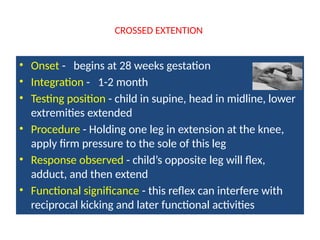
CROSSED EXTENTION
• Onset - begins at 28 weeks gestation
• Integration - 1-2 month
• Testing position - child in supine, head in midline, lower
extremities extended
• Procedure - Holding one leg in extension at the knee,
apply firm pressure to the sole of this leg
• Response observed - child’s opposite leg will flex,
adduct, and then extend
• Functional significance - this reflex can interfere with
reciprocal kicking and later functional activities
THE TRACTION RESPONSE
Onset - begins at 28 weeks gestation
Integration - 2-5 months
• Testing position - child in supine with the arms and head in midline
• Procedure - grasp the child’s wrists and pull up to sitting placing a
stretch on the shoulder adductors and arm flexors
• Response observed - the child will flex and elevate shoulders, arms
and wrists
• Functional significance- traction is a primitive reflex which enables
the child to hold onto the mother when being pulled. Traction helps
stabilize the head before the child has voluntary head control
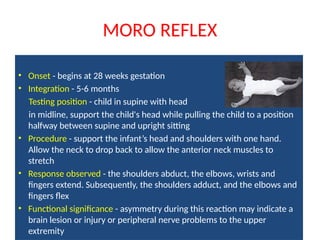
MORO REFLEX
• Onset - begins at 28 weeks gestation
• Integration - 5-6 months
Testing position - child in supine with head
in midline, support the child's head while pulling the child to a position
halfway between supine and upright sitting
• Procedure - support the infant’s head and shoulders with one hand.
Allow the neck to drop back to allow the anterior neck muscles to
stretch
• Response observed - the shoulders abduct, the elbows, wrists and
fingers extend. Subsequently, the shoulders adduct, and the elbows and
fingers flex
• Functional significance - asymmetry during this reaction may indicate a
brain lesion or injury or peripheral nerve problems to the upper
extremity
BRAIN STEM LEVEL
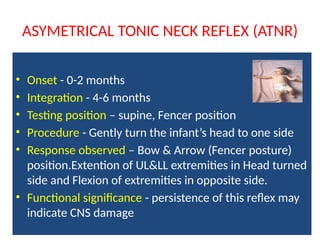
ASYMETRICAL TONIC NECK REFLEX (ATNR)
• Onset - 0-2 months
• Integration - 4-6 months
• Testing position – supine, Fencer position
• Procedure - Gently turn the infant’s head to one side
• Response observed – Bow & Arrow (Fencer posture)
position.Extention of UL&LL extremities in Head turned
side and Flexion of extremities in opposite side.
• Functional significance - persistence of this reflex may
indicate CNS damage
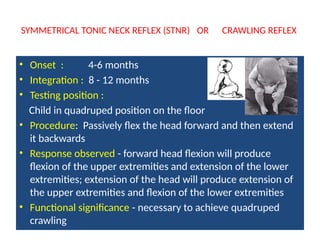
SYMMETRICAL TONIC NECK REFLEX (STNR) OR CRAWLING REFLEX
• Onset : 4-6 months
• Integration : 8 - 12 months
• Testing position :
Child in quadruped position on the floor
• Procedure: Passively flex the head forward and then extend
it backwards
• Response observed - forward head flexion will produce
flexion of the upper extremities and extension of the lower
extremities; extension of the head will produce extension of
the upper extremities and flexion of the lower extremities
• Functional significance - necessary to achieve quadruped
crawling
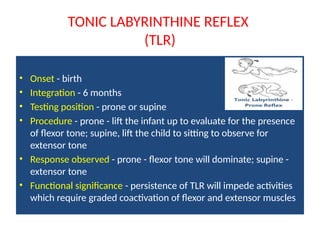
TONIC LABYRINTHINE REFLEX
(TLR)
• Onset - birth
• Integration - 6 months
• Testing position - prone or supine
• Procedure - prone - lift the infant up to evaluate for the presence
of flexor tone; supine, lift the child to sitting to observe for
extensor tone
• Response observed - prone - flexor tone will dominate; supine -
extensor tone
• Functional significance - persistence of TLR will impede activities
which require graded coactivation of flexor and extensor muscles
ASSOCIATED REACTIONS
• Onset - birth to 3 months
• Integration - never, less common after 8-9 years
• Testing position - sitting
• Procedure - hand grasp in younger children, rapid
arm movements in older children
• Response observed - overflow of movement to the
contralateral side should decrease with age
• Functional significance - excessive build-up of
movement, or tonal increases in the opposite
extremity indicate brain damage
CORTICAL LEVEL
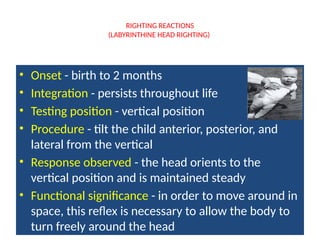
RIGHTING REACTIONS
(LABYRINTHINE HEAD RIGHTING)
• Onset - birth to 2 months
• Integration - persists throughout life
• Testing position - vertical position
• Procedure - tilt the child anterior, posterior, and
lateral from the vertical
• Response observed - the head orients to the
vertical position and is maintained steady
• Functional significance - in order to move around in
space, this reflex is necessary to allow the body to
turn freely around the head
EQUILIBRIUM REACTIONS
• Onset: 8 months
• Integrated: Persists throughout the life
• Testing position: standing
• Procedure: Alter the body centre of mass
(COM) and / or base of support (BOS)
• Keep COM with in BOS
• Response: Observe the automatic postural
adjusment that serve to maintain balance
• PROTECTIVE REACTIONS: Outside the BOS
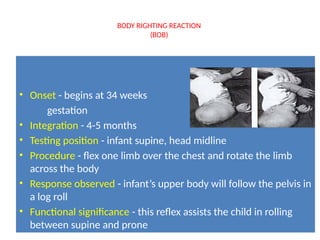
BODY RIGHTING REACTION
(BOB)
• Onset - begins at 34 weeks
gestation
• Integration - 4-5 months
• Testing position - infant supine, head midline
• Procedure - flex one limb over the chest and rotate the limb
across the body
• Response observed - infant’s upper body will follow the pelvis in
a log roll
• Functional significance - this reflex assists the child in rolling
between supine and prone
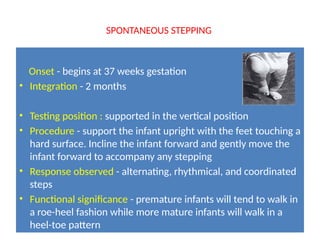
SPONTANEOUS STEPPING
Onset - begins at 37 weeks gestation
• Integration - 2 months
• Testing position : supported in the vertical position
• Procedure - support the infant upright with the feet touching a
hard surface. Incline the infant forward and gently move the
infant forward to accompany any stepping
• Response observed - alternating, rhythmical, and coordinated
steps
• Functional significance - premature infants will tend to walk in
a roe-heel fashion while more mature infants will walk in a
heel-toe pattern
POSTURAL FIXATION IN STANDING
• Onset - 12 - 21 months
• Integration - persists through life
• Testing position - standing and one-legged standing
• Procedure - exert minimal force to the pelvis in all four
directions
• Response observed - observe for force fields of the
lower extremities to prevent falling or tipping
• Functional significance - allows for the preservation of
the center of gravity and balance in standing and
walking
THANKS
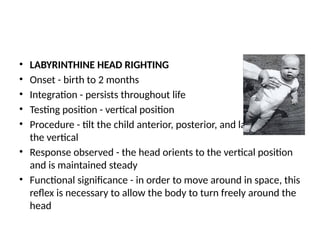
• LABYRINTHINE HEAD RIGHTING
• Onset - birth to 2 months
• Integration - persists throughout life
• Testing position - vertical position
• Procedure - tilt the child anterior, posterior, and lateral from
the vertical
• Response observed - the head orients to the vertical position
and is maintained steady
• Functional significance - in order to move around in space, this
reflex is necessary to allow the body to turn freely around the
head
• THE ROOTING REACTION
• Onset - 28 weeks gestation
• Integration - 3 months
• Testing position - with the infant supine, the head in midline
and hands on chest
• Procedure - gently stroke the infant from the lips to the cheek
• Normal response - the infant should turn his head toward the
stimulated side with the mouth opening and a trial of sucking
the finger. May not be present if the infant is not hungry.
• Functional significance - persistence can interfere with sucking.
Absence of this is seen in neurologically impaired infants
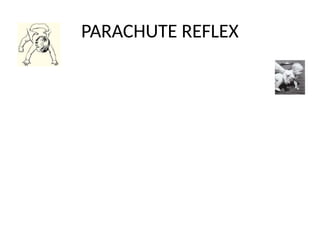
PARACHUTE REFLEX
• NECK RIGHTING ON THE BODY (NOB)
• Onset - begins at 34 weeks gestation
• Integration - 4-6 months
• Testing position - infant in supine, head midline
• Procedure - turn the infant’s head to one side
• Response observed - infant’s entire body will turn in the
direction of the head
• Functional significance - early in development the infant
uses NOB in order to transition between supine,
sidelying, and eventually prone
CORTEX LEVEL
• NECK RIGHTING ON THE BODY (NOB)
• Onset - begins at 34 weeks gestation
• Integration - 4-6 months
• Testing position - infant in supine, head midline
• Procedure - turn the infant’s head to one side
• Response observed - infant’s entire body will turn in the
direction of the head
• Functional significance - early in development the infant
uses NOB in order to transition between supine,
sidelying, and eventually prone
6. Developmental Reflexes ppt personal.pptx

6. Developmental Reflexes ppt personal.pptx

  • 1.
  • 2.
    DEVELOPMENTAL REFLEXES Primitive reflexesare important for – Protection – Nutrition • Sucking reflex • Rooting reflex – Survival • Labyrinthine reflex
  • 3.
    WHY THERAPIST NEEDTO TEST…… • Therapist should be aware of and test for when presented with an infant or child with possible developmental delay or tonal problems. • Reflex testing can assist the therapist in determining the cause of the delay such as CNS impairment, peripheral nerve injury, and muscle weakness. • Reflex review will also assist in developing an individual treatment intervention designed to help the child integrate reflexes that appear to be delayed or missing
  • 4.
  • 5.
    PALMAR GRASP • Onset- 10 weeks gestation • Integration - 4-6 months • Testing position - supine, head midline, arms and hands free • Procedure - place a finger in infant’s hand from the ulnar to the palmar surface • Response observed - infant’s fingers will flex around the finger • Functional significance -following the development of grasp, the infant begins to reach for objects and utilizes a crude palmer grasp to hold them
  • 6.
    FLEXOR WITHDRAWAL • Onset- begins at 28 weeks gestation • Integration - 2 months for normal child; may persist in developmentally delayed and/or CP child • Testing position - child supine, head midline, lower extremities extended • Procedure - apply a noxious stimulus to the sole of the foot • Response observed - withdrawal of the foot from the stimulus employing hip and knee flexion • Developmental significance - failure to attain and integrate this reflex may indicate sensorimotor delay and/or CNS depression
  • 7.
    CROSSED EXTENTION • Onset- begins at 28 weeks gestation • Integration - 1-2 month • Testing position - child in supine, head in midline, lower extremities extended • Procedure - Holding one leg in extension at the knee, apply firm pressure to the sole of this leg • Response observed - child’s opposite leg will flex, adduct, and then extend • Functional significance - this reflex can interfere with reciprocal kicking and later functional activities
  • 8.
    THE TRACTION RESPONSE Onset- begins at 28 weeks gestation Integration - 2-5 months • Testing position - child in supine with the arms and head in midline • Procedure - grasp the child’s wrists and pull up to sitting placing a stretch on the shoulder adductors and arm flexors • Response observed - the child will flex and elevate shoulders, arms and wrists • Functional significance- traction is a primitive reflex which enables the child to hold onto the mother when being pulled. Traction helps stabilize the head before the child has voluntary head control
  • 9.
    MORO REFLEX • Onset- begins at 28 weeks gestation • Integration - 5-6 months Testing position - child in supine with head in midline, support the child's head while pulling the child to a position halfway between supine and upright sitting • Procedure - support the infant’s head and shoulders with one hand. Allow the neck to drop back to allow the anterior neck muscles to stretch • Response observed - the shoulders abduct, the elbows, wrists and fingers extend. Subsequently, the shoulders adduct, and the elbows and fingers flex • Functional significance - asymmetry during this reaction may indicate a brain lesion or injury or peripheral nerve problems to the upper extremity
  • 10.
  • 11.
    ASYMETRICAL TONIC NECKREFLEX (ATNR) • Onset - 0-2 months • Integration - 4-6 months • Testing position – supine, Fencer position • Procedure - Gently turn the infant’s head to one side • Response observed – Bow & Arrow (Fencer posture) position.Extention of UL&LL extremities in Head turned side and Flexion of extremities in opposite side. • Functional significance - persistence of this reflex may indicate CNS damage
  • 12.
    SYMMETRICAL TONIC NECKREFLEX (STNR) OR CRAWLING REFLEX • Onset : 4-6 months • Integration : 8 - 12 months • Testing position : Child in quadruped position on the floor • Procedure: Passively flex the head forward and then extend it backwards • Response observed - forward head flexion will produce flexion of the upper extremities and extension of the lower extremities; extension of the head will produce extension of the upper extremities and flexion of the lower extremities • Functional significance - necessary to achieve quadruped crawling
  • 13.
    TONIC LABYRINTHINE REFLEX (TLR) •Onset - birth • Integration - 6 months • Testing position - prone or supine • Procedure - prone - lift the infant up to evaluate for the presence of flexor tone; supine, lift the child to sitting to observe for extensor tone • Response observed - prone - flexor tone will dominate; supine - extensor tone • Functional significance - persistence of TLR will impede activities which require graded coactivation of flexor and extensor muscles
  • 14.
    ASSOCIATED REACTIONS • Onset- birth to 3 months • Integration - never, less common after 8-9 years • Testing position - sitting • Procedure - hand grasp in younger children, rapid arm movements in older children • Response observed - overflow of movement to the contralateral side should decrease with age • Functional significance - excessive build-up of movement, or tonal increases in the opposite extremity indicate brain damage
  • 15.
  • 16.
    RIGHTING REACTIONS (LABYRINTHINE HEADRIGHTING) • Onset - birth to 2 months • Integration - persists throughout life • Testing position - vertical position • Procedure - tilt the child anterior, posterior, and lateral from the vertical • Response observed - the head orients to the vertical position and is maintained steady • Functional significance - in order to move around in space, this reflex is necessary to allow the body to turn freely around the head
  • 17.
    EQUILIBRIUM REACTIONS • Onset:8 months • Integrated: Persists throughout the life • Testing position: standing • Procedure: Alter the body centre of mass (COM) and / or base of support (BOS) • Keep COM with in BOS • Response: Observe the automatic postural adjusment that serve to maintain balance • PROTECTIVE REACTIONS: Outside the BOS
  • 18.
    BODY RIGHTING REACTION (BOB) •Onset - begins at 34 weeks gestation • Integration - 4-5 months • Testing position - infant supine, head midline • Procedure - flex one limb over the chest and rotate the limb across the body • Response observed - infant’s upper body will follow the pelvis in a log roll • Functional significance - this reflex assists the child in rolling between supine and prone
  • 19.
    SPONTANEOUS STEPPING Onset -begins at 37 weeks gestation • Integration - 2 months • Testing position : supported in the vertical position • Procedure - support the infant upright with the feet touching a hard surface. Incline the infant forward and gently move the infant forward to accompany any stepping • Response observed - alternating, rhythmical, and coordinated steps • Functional significance - premature infants will tend to walk in a roe-heel fashion while more mature infants will walk in a heel-toe pattern
  • 20.
    POSTURAL FIXATION INSTANDING • Onset - 12 - 21 months • Integration - persists through life • Testing position - standing and one-legged standing • Procedure - exert minimal force to the pelvis in all four directions • Response observed - observe for force fields of the lower extremities to prevent falling or tipping • Functional significance - allows for the preservation of the center of gravity and balance in standing and walking
  • 21.
  • 22.
    • LABYRINTHINE HEADRIGHTING • Onset - birth to 2 months • Integration - persists throughout life • Testing position - vertical position • Procedure - tilt the child anterior, posterior, and lateral from the vertical • Response observed - the head orients to the vertical position and is maintained steady • Functional significance - in order to move around in space, this reflex is necessary to allow the body to turn freely around the head
  • 23.
    • THE ROOTINGREACTION • Onset - 28 weeks gestation • Integration - 3 months • Testing position - with the infant supine, the head in midline and hands on chest • Procedure - gently stroke the infant from the lips to the cheek • Normal response - the infant should turn his head toward the stimulated side with the mouth opening and a trial of sucking the finger. May not be present if the infant is not hungry. • Functional significance - persistence can interfere with sucking. Absence of this is seen in neurologically impaired infants
  • 24.
  • 25.
    • NECK RIGHTINGON THE BODY (NOB) • Onset - begins at 34 weeks gestation • Integration - 4-6 months • Testing position - infant in supine, head midline • Procedure - turn the infant’s head to one side • Response observed - infant’s entire body will turn in the direction of the head • Functional significance - early in development the infant uses NOB in order to transition between supine, sidelying, and eventually prone
  • 26.
  • 27.
    • NECK RIGHTINGON THE BODY (NOB) • Onset - begins at 34 weeks gestation • Integration - 4-6 months • Testing position - infant in supine, head midline • Procedure - turn the infant’s head to one side • Response observed - infant’s entire body will turn in the direction of the head • Functional significance - early in development the infant uses NOB in order to transition between supine, sidelying, and eventually prone