Downloaded 13 times




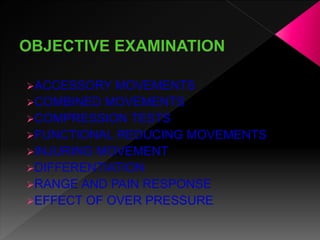
![TO know the origin of patient symptoms from joint surface
abnormality compression performed in following circumstances
when usual test movements do not show patient symptoms
,compression applied through range assessing the smoothness and
matching pain response
If pain response much greater than when surfaces compressed,the
indication is that the disorder associated wih [joint surface
abnormality]
NOTE Common joints require examination by compression are
Tarsometatarsal joint of big toe
Patellofemral jint
Carpometacarpal joint of the thumb
The hip and
The glenohumeral joint](https://image.slidesharecdn.com/maitlandmobiisation-180330122007/85/Maitland-mobiisation-10-320.jpg)
![To note whether it is [through range pain or end
range pain ]
Does the behavior of the pain with the movement
match the behavior of the resistance with that same
movement within its available range?
NEVER THINK OF RANGE WITHOUT
THINKING OF PAIN
NEVER THINK OF PAIN WITHOUT
THINKING OF RANGE](https://image.slidesharecdn.com/maitlandmobiisation-180330122007/85/Maitland-mobiisation-13-320.jpg)


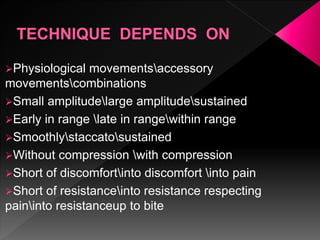
![The basic treatment techniques must include every
movement of which the joint is capable[Both
Physiological movements and accessory movements
] and possible combination of them.
The techniques are never ending and NEVER
should have ending.
The clinicians mind must always be open ; the
teacher must never be dogmatic.](https://image.slidesharecdn.com/maitlandmobiisation-180330122007/85/Maitland-mobiisation-18-320.jpg)
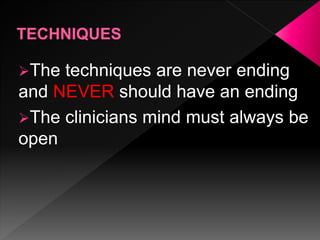
![Pain [at rest or with movement ]
Stiffness [due to contracted structure or adhesion
Muscle spasm
the above may occur in combinations
Eg painless spasm painful and stiff joint](https://image.slidesharecdn.com/maitlandmobiisation-180330122007/85/Maitland-mobiisation-21-320.jpg)
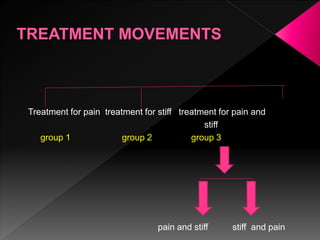
![Patient opinion of effect of treatment [a
comparison statement]
Execute treatment plans by planning and reasoning
process which has to be recorded.
The treatment and effect record next .it involves
treatment technique ,its grade ,its rhythm and its
symptomatic response.
Commit thoughts about how the treatment
techniques need to be modified next .](https://image.slidesharecdn.com/maitlandmobiisation-180330122007/85/Maitland-mobiisation-25-320.jpg)



This document discusses principles and techniques for manual therapy examinations and treatments. It describes the central themes of listening to the patient, understanding verbal and non-verbal communication, and building trust. It emphasizes keeping theoretical knowledge separate from clinical evidence when examining patients. Examination techniques discussed include range of motion tests, accessory movements, and compression tests to identify pain sources. Treatment techniques focus on physiological and accessory movements at varying amplitudes, ranges, and force levels to address pain, stiffness, and spasms. The importance of ongoing assessment and modifying techniques based on a patient's response is stressed.


