Primer Designing
Krishnendu Sinha
Assistant Professor in Zoology
Jhargram Raj College
PCR
Primers
Polymerase chain reaction (PCR) is a method, invented in 1983 by the American biochemist Kary Mullis, used widely
in molecular biology to make millions to billions of copies of a specific DNA sample rapidly, allowing scientists to take
a very small sample of DNA and amplify it to a large enough amount to study in detail (Wikipedia).
A primer is a short single-stranded nucleic acid utilized by all living organisms in the initiation of DNA synthesis as
the enzymes responsible for DNA replication, DNA polymerases, are only capable of adding nucleotides to the 3’-
end of an existing nucleic acid, requiring a primer be bound to the template before DNA polymerase can begin a
complementary strand. Taq polymerase use in PCR also have similar requirement. For effective amplification, a pair
of forward and reverse primer is required in PCR. Good primer design is one of the most important parameters in
PCR.
PCR
Primers
Polymerase chain reaction (PCR) is a method, invented in 1983 by the American biochemist Kary Mullis, used widely
in molecular biology to make millions to billions of copies of a specific DNA sample rapidly, allowing scientists to take
a very small sample of DNA and amplify it to a large enough amount to study in detail (Wikipedia).
A primer is a short single-stranded nucleic acid utilized by all living organisms in the initiation of DNA synthesis as
the enzymes responsible for DNA replication, DNA polymerases, are only capable of adding nucleotides to the 3’-
end of an existing nucleic acid, requiring a primer be bound to the template before DNA polymerase can begin a
complementary strand. Taq polymerase use in PCR also have similar requirement. For effective amplification, a pair
of forward and reverse primer is required in PCR. Good primer design is one of the most important parameters in
PCR.
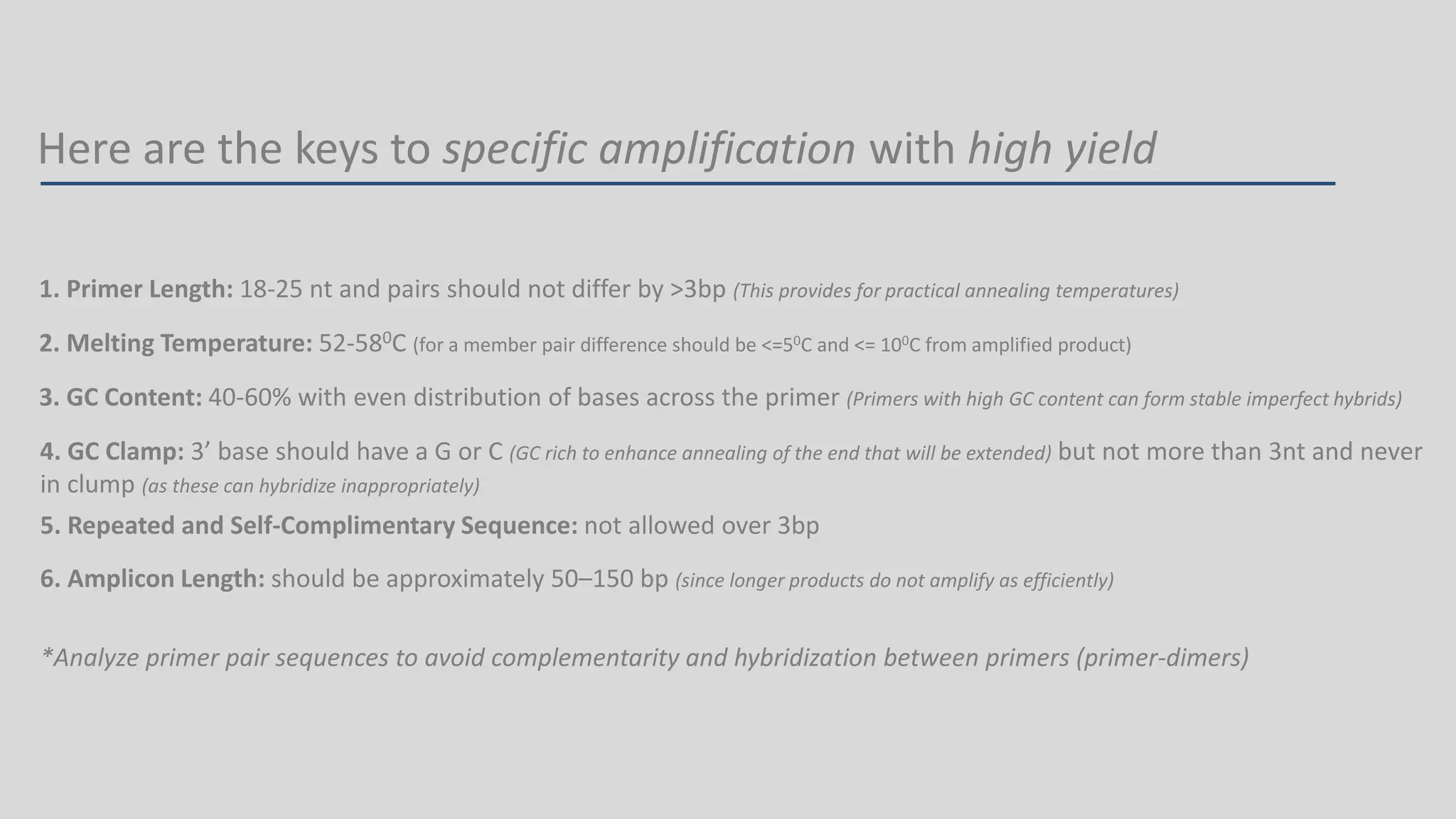
Here are the keys to specific amplification with high yield
1. Primer Length: 18-25 nt and pairs should not differ by >3bp (This provides for practical annealing temperatures)
2. Melting Temperature: 52-580C (for a member pair difference should be <=50C and <= 100C from amplified product)
3. GC Content: 40-60% with even distribution of bases across the primer (Primers with high GC content can form stable imperfect hybrids)
4. GC Clamp: 3’ base should have a G or C (GC rich to enhance annealing of the end that will be extended) but not more than 3nt and never
in clump (as these can hybridize inappropriately)
5. Repeated and Self-Complimentary Sequence: not allowed over 3bp
6. Amplicon Length: should be approximately 50–150 bp (since longer products do not amplify as efficiently)
*Analyze primer pair sequences to avoid complementarity and hybridization between primers (primer-dimers)
Method
1. Finding cDNA sequence:
a) Go to NCBI website by clicking https://www.ncbi.nlm.nih.gov/
Method
1. Finding cDNA sequence:
a) Go to NCBI website by clicking https://www.ncbi.nlm.nih.gov/
Method
1. Finding cDNA sequence:
a) Go to NCBI website by clicking https://www.ncbi.nlm.nih.gov/
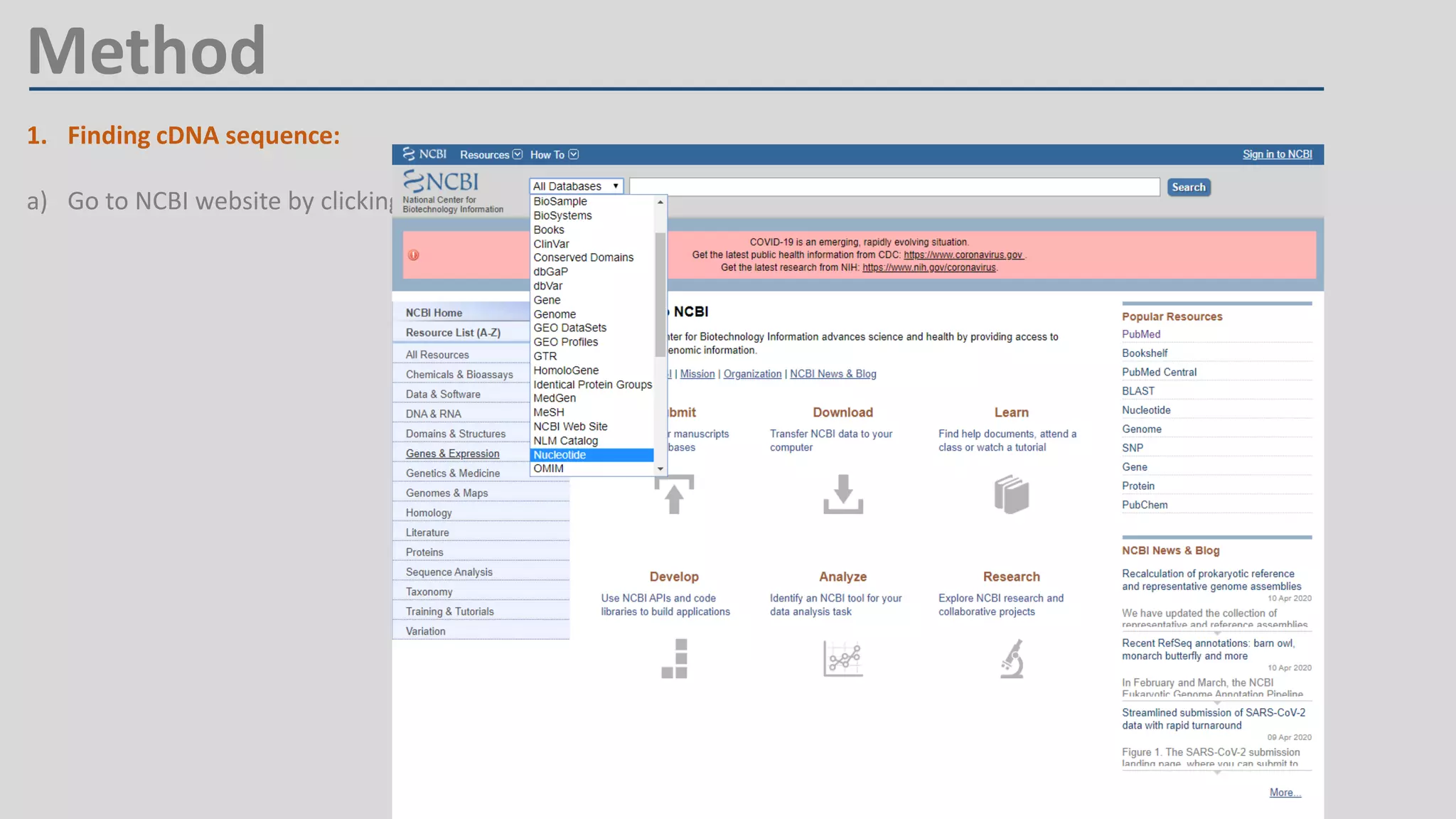
From dropdown menu
select Nucleotide instead
of all database
Method
1. Finding cDNA sequence:
a) Go to NCBI website by clicking https://www.ncbi.nlm.nih.gov/
Method
1. Finding cDNA sequence:
a) Go to NCBI website by clicking https://www.ncbi.nlm.nih.gov/
In the search box type the
name of the gene and its
species you want to copy by
PCR (e.g. FSH gene of mu i.e.
scientific species name of
mice)…
Method
1. Finding cDNA sequence:
a) Go to NCBI website by clicking https://www.ncbi.nlm.nih.gov/
…and type complete
CDS (i.e. complete
coding sequence of the
gene which is actually a
cDNA sequence of the
gene with start and
stop codon)…press
search
Method
1. Finding cDNA sequence:
a) Go to NCBI website by clicking https://www.ncbi.nlm.nih.gov/
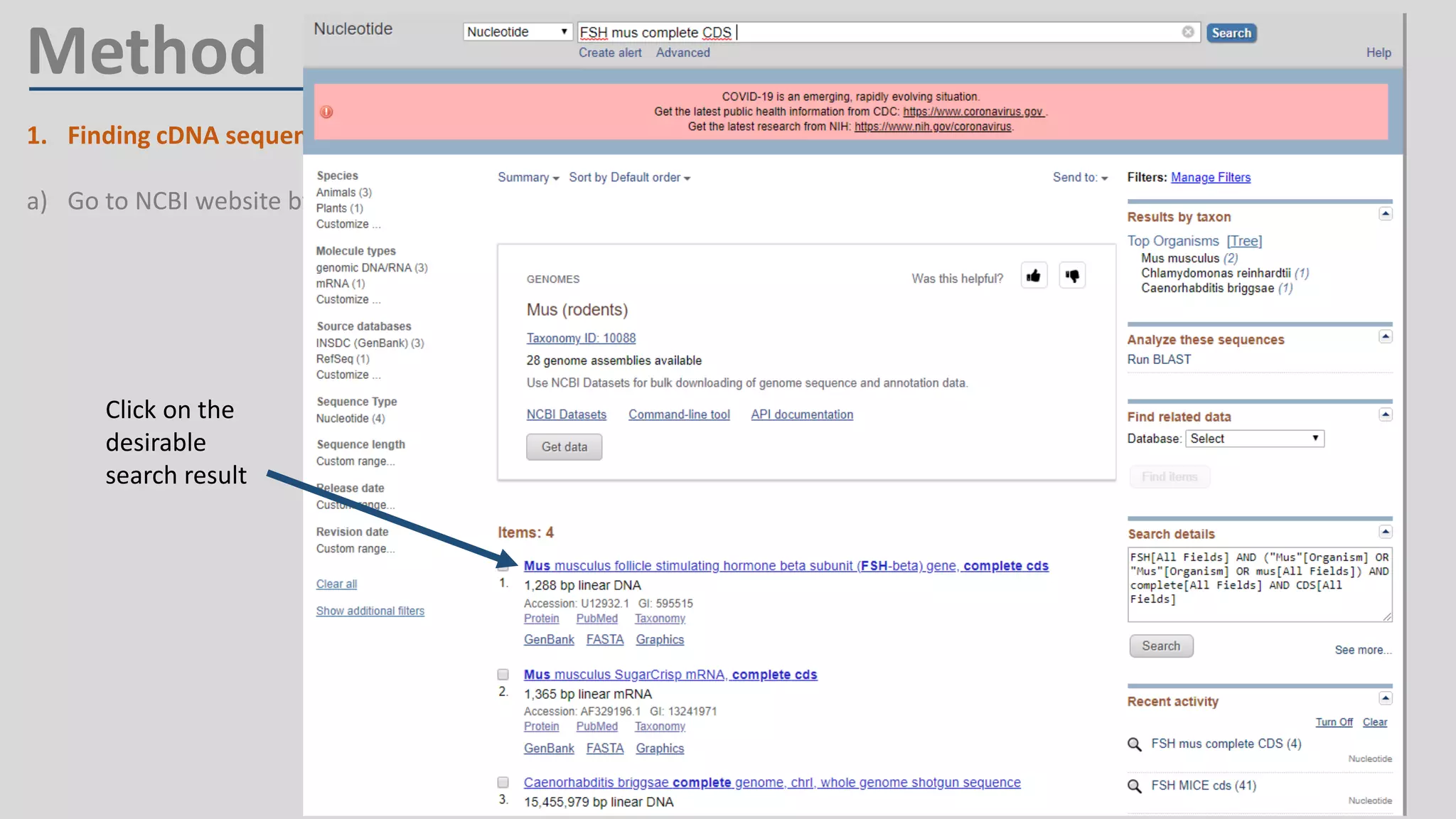
Click on the
desirable
search result
Method
1. Finding cDNA sequence:
a) Go to NCBI website by clicking https://www.ncbi.nlm.nih.gov/
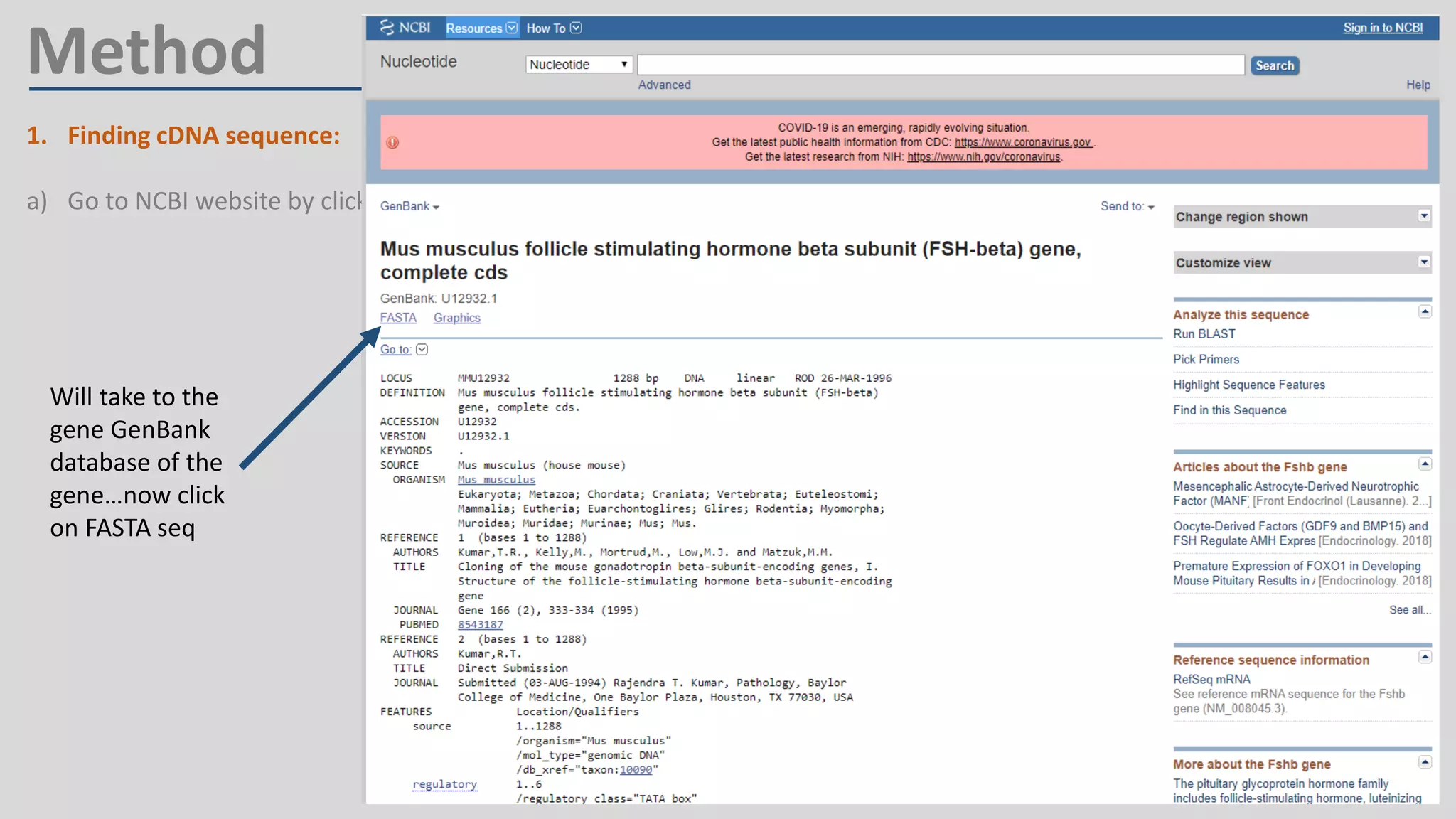
Will take to the
gene GenBank
database of the
gene…now click
on FASTA seq
Method
1. Finding cDNA sequence:
a) Go to NCBI website by clicking https://www.ncbi.nlm.nih.gov/
This is the FASTA
seq of the cDNA
Method
1. Finding cDNA sequence:
a) Go to NCBI website by clicking https://www.ncbi.nlm.nih.gov/
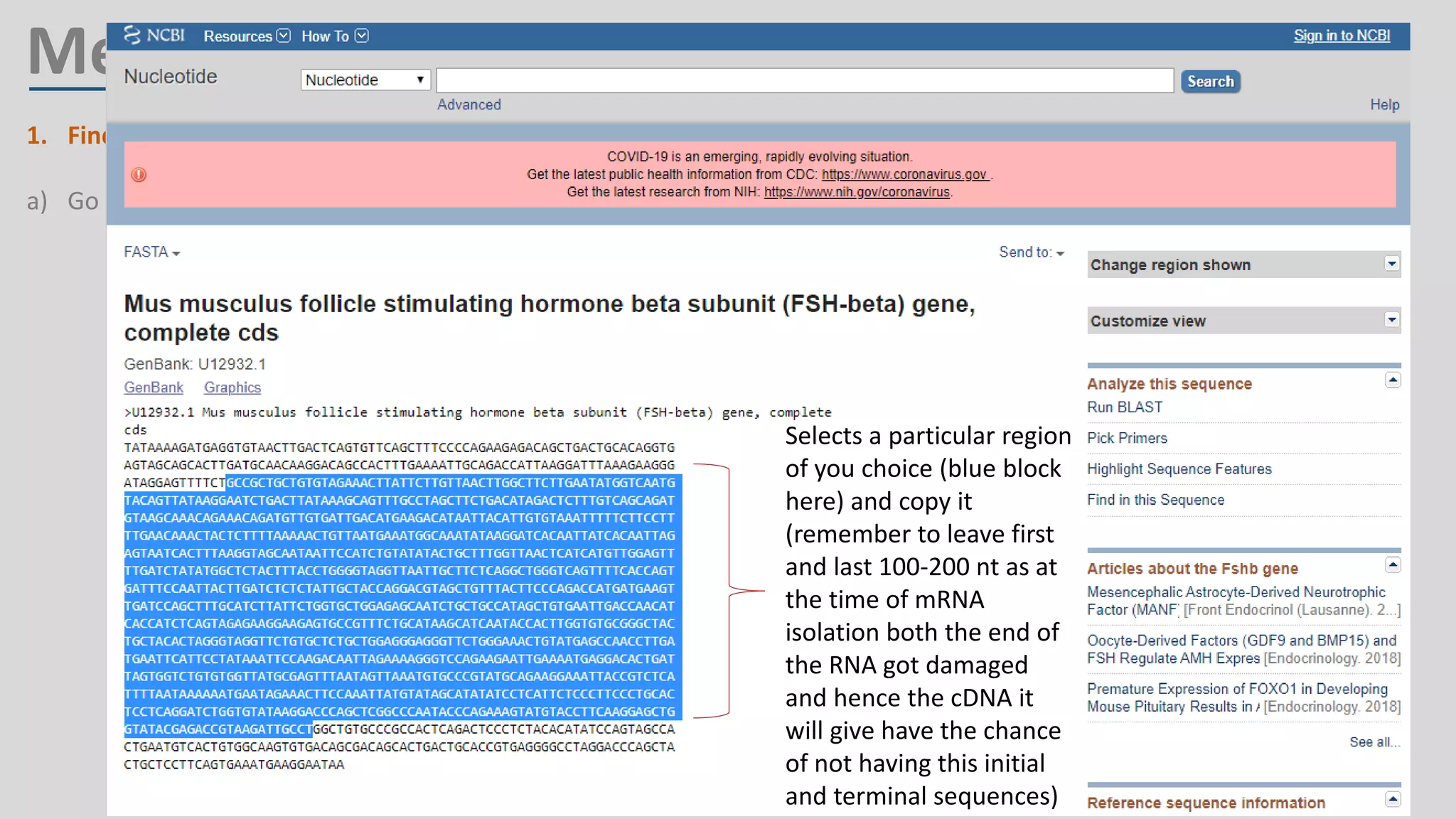
Selects a particular region
of you choice (blue block
here) and copy it
(remember to leave first
and last 100-200 nt as at
the time of mRNA
isolation both the end of
the RNA got damaged
and hence the cDNA it
will give have the chance
of not having this initial
and terminal sequences)
Method
2. Designing the Primer:
a) Go to NCBI website by clicking https://www.ncbi.nlm.nih.gov/
Now click on https://www.idtdna.com/site/account/login?returnurl=%2FPrimerquest%2FHome%2FIndex and
login with the user name and password provided in the comment
2. Designing the Primer:
a) Go to NCBI website by clicking https://www.ncbi.nlm.nih.gov/
Now click on https://www.idtdna.com/site/account/login?returnurl=%2FPrimerquest%2FHome%2FIndex and
login with the user name and password provided in the comment
Method
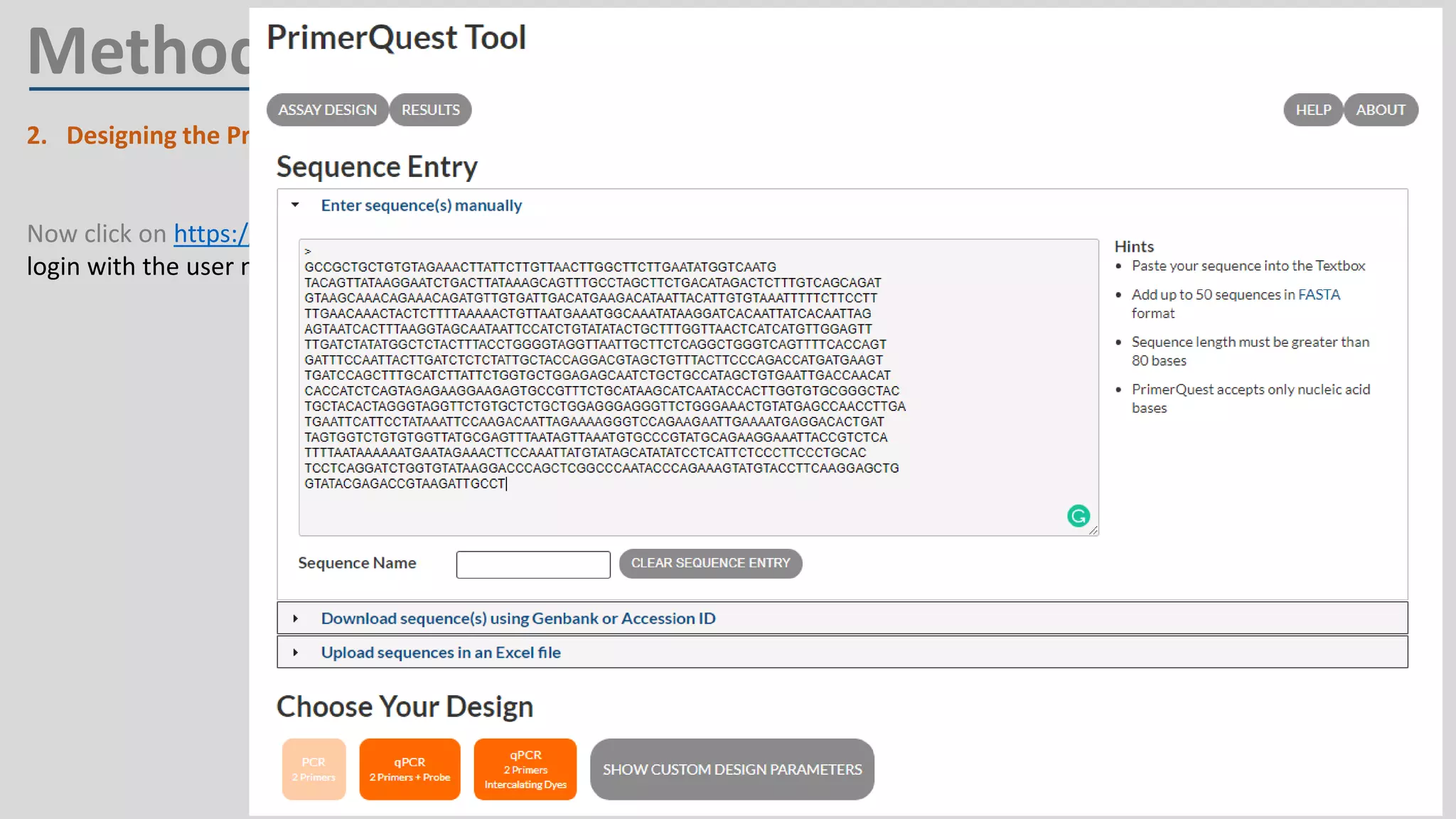
Here paste the copied FASTA seq as shown here
2. Designing the Primer:
a) Go to NCBI website by clicking https://www.ncbi.nlm.nih.gov/
Now click on https://www.idtdna.com/site/account/login?returnurl=%2FPrimerquest%2FHome%2FIndex and
login with the user name and password provided in the comment
Method
2. Designing the Primer:
a) Go to NCBI website by clicking https://www.ncbi.nlm.nih.gov/
Now click on https://www.idtdna.com/site/account/login?returnurl=%2FPrimerquest%2FHome%2FIndex and
login with the user name and password provided in the comment
Method
>
Is the FASTA format and you have to put it
2. Designing the Primer:
a) Go to NCBI website by clicking https://www.ncbi.nlm.nih.gov/
Now click on https://www.idtdna.com/site/account/login?returnurl=%2FPrimerquest%2FHome%2FIndex and
login with the user name and password provided in the comment
Method
2. Designing the Primer:
a) Go to NCBI website by clicking https://www.ncbi.nlm.nih.gov/
Now click on https://www.idtdna.com/site/account/login?returnurl=%2FPrimerquest%2FHome%2FIndex and
login with the user name and password provided in the comment
Method
Click here to get primer
pair on predefined
parameters
Or get primer pair on
you customized
parameters
2. Designing the Primer:
a) Go to NCBI website by clicking https://www.ncbi.nlm.nih.gov/
Now click on https://www.idtdna.com/site/account/login?returnurl=%2FPrimerquest%2FHome%2FIndex and
login with the user name and password provided in the comment
Method
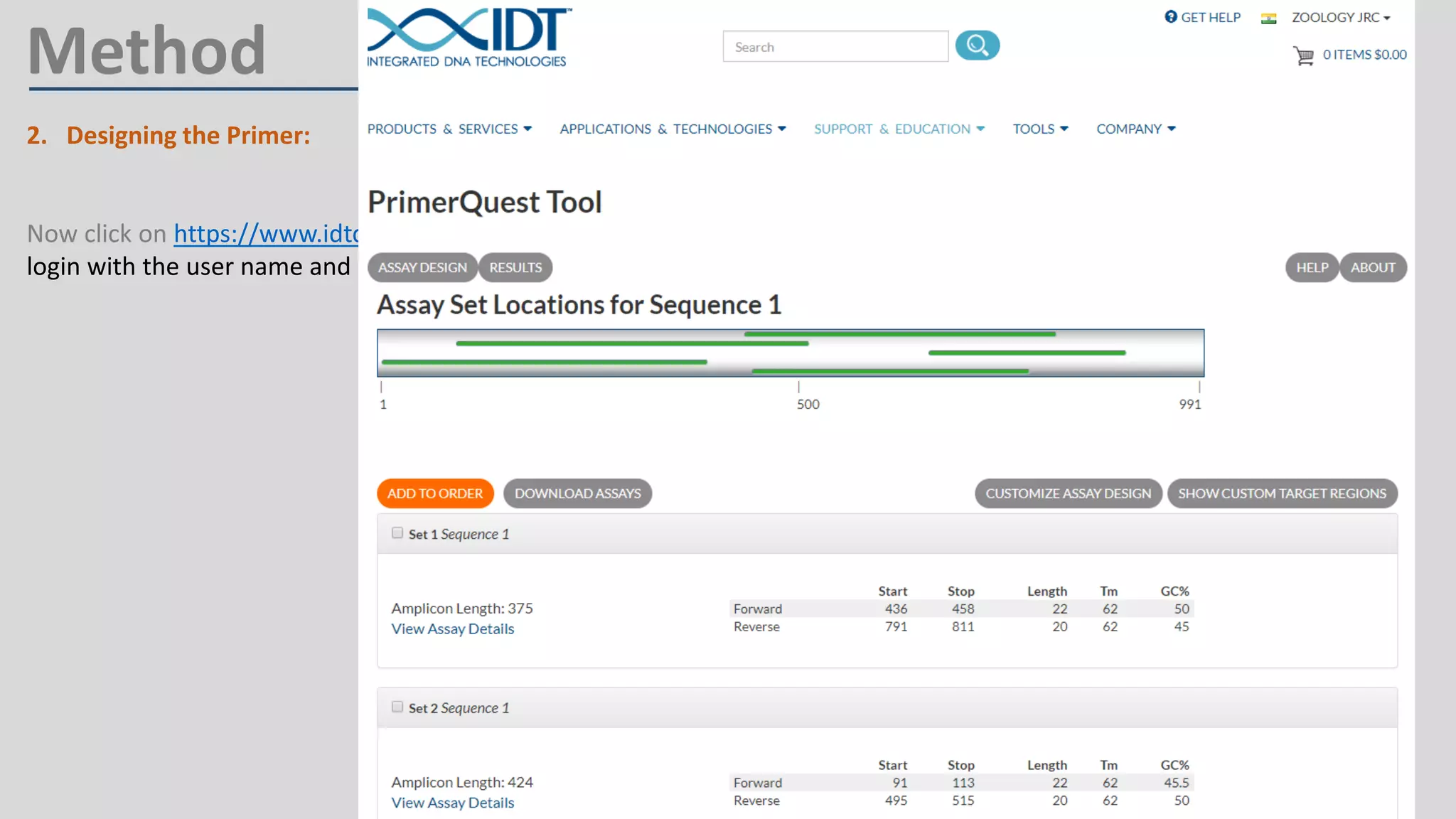
By default this
programme
will give five
primer set
(green lines
showing the
length of the
replicon
based on the
primer pair)
2. Designing the Primer:
a) Go to NCBI website by clicking https://www.ncbi.nlm.nih.gov/
Now click on https://www.idtdna.com/site/account/login?returnurl=%2FPrimerquest%2FHome%2FIndex and
login with the user name and password provided in the comment
Method
2. Designing the Primer:
a) Go to NCBI website by clicking https://www.ncbi.nlm.nih.gov/
Now click on https://www.idtdna.com/site/account/login?returnurl=%2FPrimerquest%2FHome%2FIndex and
login with the user name and password provided in the comment
Method
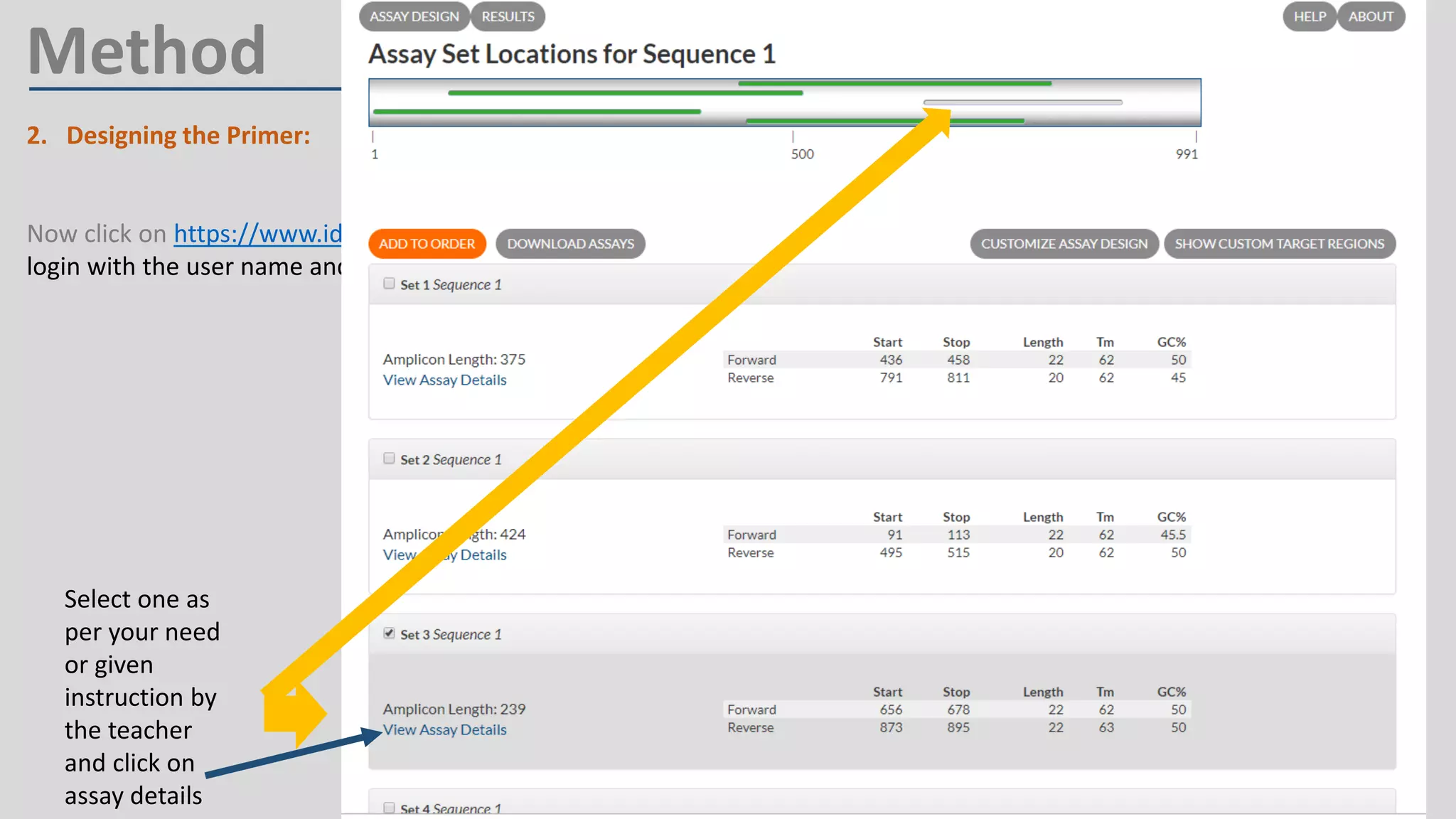
Select one as
per your need
or given
instruction by
the teacher
and click on
assay details
2. Designing the Primer:
a) Go to NCBI website by clicking https://www.ncbi.nlm.nih.gov/
Now click on https://www.idtdna.com/site/account/login?returnurl=%2FPrimerquest%2FHome%2FIndex and
login with the user name and password provided in the comment
Method
Select one as
per your need
or given
instruction by
the teacher
and click on
assay details
2. Designing the Primer:
a) Go to NCBI website by clicking https://www.ncbi.nlm.nih.gov/
Now click on https://www.idtdna.com/site/account/login?returnurl=%2FPrimerquest%2FHome%2FIndex and
login with the user name and password provided in the comment
Method
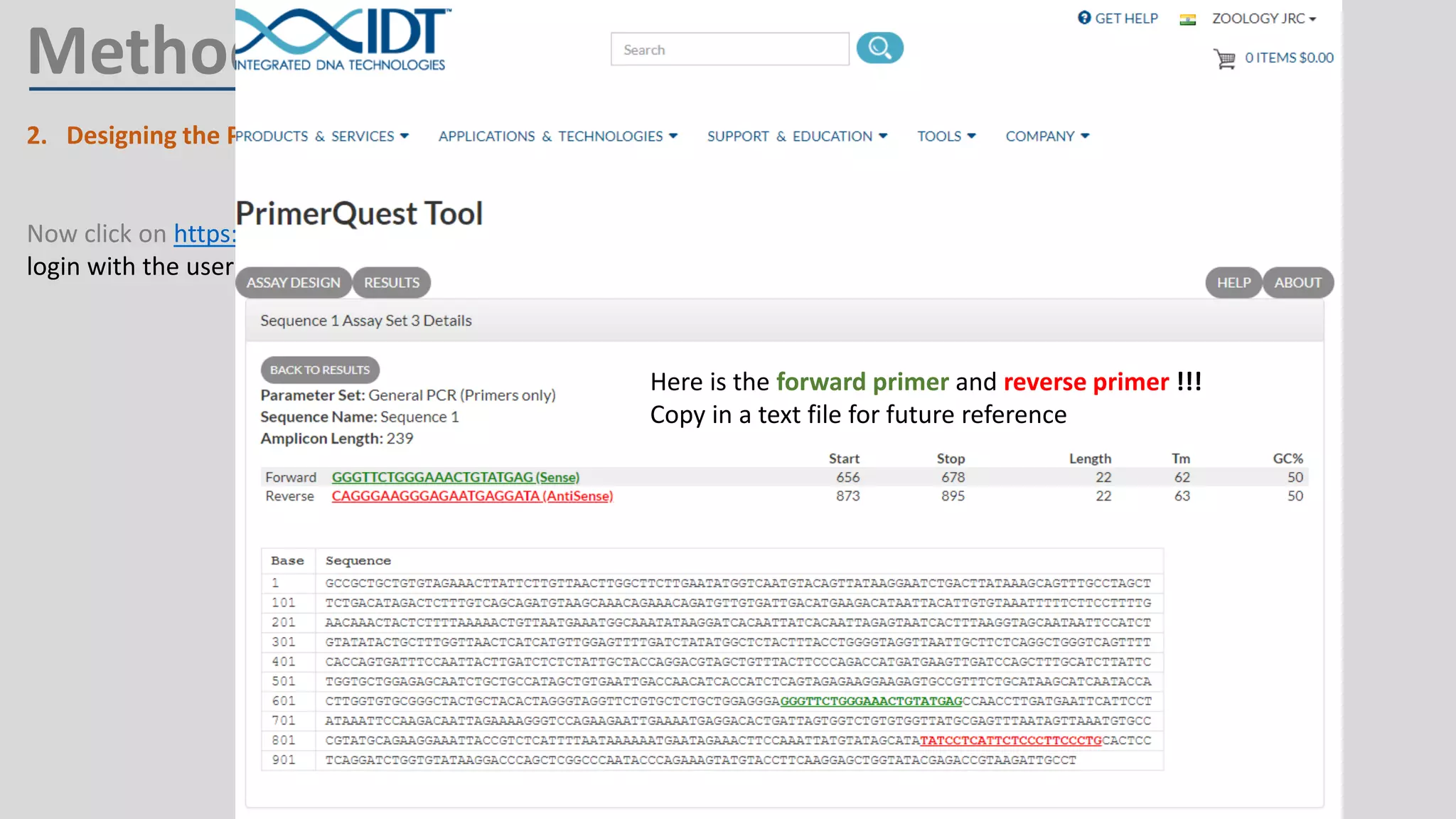
Here is the forward primer and reverse primer !!!
Copy in a text file for future reference
References
1. https://fire.biol.wwu.edu/cmoyer/zztemp_fire/biol324_W08/PCR_lect/GoodPCRdesign.pdf
2. Wikipedia
3. https://www.ncbi.nlm.nih.gov/
4. https://www.idtdna.com/pages
5. PrimerQuest Tool (IDT)
Primer desining

Primer desining

  • 1.
    Primer Designing Krishnendu Sinha AssistantProfessor in Zoology Jhargram Raj College
  • 2.
    PCR Primers Polymerase chain reaction(PCR) is a method, invented in 1983 by the American biochemist Kary Mullis, used widely in molecular biology to make millions to billions of copies of a specific DNA sample rapidly, allowing scientists to take a very small sample of DNA and amplify it to a large enough amount to study in detail (Wikipedia). A primer is a short single-stranded nucleic acid utilized by all living organisms in the initiation of DNA synthesis as the enzymes responsible for DNA replication, DNA polymerases, are only capable of adding nucleotides to the 3’- end of an existing nucleic acid, requiring a primer be bound to the template before DNA polymerase can begin a complementary strand. Taq polymerase use in PCR also have similar requirement. For effective amplification, a pair of forward and reverse primer is required in PCR. Good primer design is one of the most important parameters in PCR.
  • 3.
    PCR Primers Polymerase chain reaction(PCR) is a method, invented in 1983 by the American biochemist Kary Mullis, used widely in molecular biology to make millions to billions of copies of a specific DNA sample rapidly, allowing scientists to take a very small sample of DNA and amplify it to a large enough amount to study in detail (Wikipedia). A primer is a short single-stranded nucleic acid utilized by all living organisms in the initiation of DNA synthesis as the enzymes responsible for DNA replication, DNA polymerases, are only capable of adding nucleotides to the 3’- end of an existing nucleic acid, requiring a primer be bound to the template before DNA polymerase can begin a complementary strand. Taq polymerase use in PCR also have similar requirement. For effective amplification, a pair of forward and reverse primer is required in PCR. Good primer design is one of the most important parameters in PCR.
  • 4.
    Here are thekeys to specific amplification with high yield 1. Primer Length: 18-25 nt and pairs should not differ by >3bp (This provides for practical annealing temperatures) 2. Melting Temperature: 52-580C (for a member pair difference should be <=50C and <= 100C from amplified product) 3. GC Content: 40-60% with even distribution of bases across the primer (Primers with high GC content can form stable imperfect hybrids) 4. GC Clamp: 3’ base should have a G or C (GC rich to enhance annealing of the end that will be extended) but not more than 3nt and never in clump (as these can hybridize inappropriately) 5. Repeated and Self-Complimentary Sequence: not allowed over 3bp 6. Amplicon Length: should be approximately 50–150 bp (since longer products do not amplify as efficiently) *Analyze primer pair sequences to avoid complementarity and hybridization between primers (primer-dimers)
  • 5.
    Method 1. Finding cDNAsequence: a) Go to NCBI website by clicking https://www.ncbi.nlm.nih.gov/
  • 6.
    Method 1. Finding cDNAsequence: a) Go to NCBI website by clicking https://www.ncbi.nlm.nih.gov/
  • 7.
    Method 1. Finding cDNAsequence: a) Go to NCBI website by clicking https://www.ncbi.nlm.nih.gov/ From dropdown menu select Nucleotide instead of all database
  • 8.
    Method 1. Finding cDNAsequence: a) Go to NCBI website by clicking https://www.ncbi.nlm.nih.gov/
  • 9.
    Method 1. Finding cDNAsequence: a) Go to NCBI website by clicking https://www.ncbi.nlm.nih.gov/ In the search box type the name of the gene and its species you want to copy by PCR (e.g. FSH gene of mu i.e. scientific species name of mice)…
  • 10.
    Method 1. Finding cDNAsequence: a) Go to NCBI website by clicking https://www.ncbi.nlm.nih.gov/ …and type complete CDS (i.e. complete coding sequence of the gene which is actually a cDNA sequence of the gene with start and stop codon)…press search
  • 11.
    Method 1. Finding cDNAsequence: a) Go to NCBI website by clicking https://www.ncbi.nlm.nih.gov/ Click on the desirable search result
  • 12.
    Method 1. Finding cDNAsequence: a) Go to NCBI website by clicking https://www.ncbi.nlm.nih.gov/ Will take to the gene GenBank database of the gene…now click on FASTA seq
  • 13.
    Method 1. Finding cDNAsequence: a) Go to NCBI website by clicking https://www.ncbi.nlm.nih.gov/ This is the FASTA seq of the cDNA
  • 14.
    Method 1. Finding cDNAsequence: a) Go to NCBI website by clicking https://www.ncbi.nlm.nih.gov/ Selects a particular region of you choice (blue block here) and copy it (remember to leave first and last 100-200 nt as at the time of mRNA isolation both the end of the RNA got damaged and hence the cDNA it will give have the chance of not having this initial and terminal sequences)
  • 15.
    Method 2. Designing thePrimer: a) Go to NCBI website by clicking https://www.ncbi.nlm.nih.gov/ Now click on https://www.idtdna.com/site/account/login?returnurl=%2FPrimerquest%2FHome%2FIndex and login with the user name and password provided in the comment
  • 16.
    2. Designing thePrimer: a) Go to NCBI website by clicking https://www.ncbi.nlm.nih.gov/ Now click on https://www.idtdna.com/site/account/login?returnurl=%2FPrimerquest%2FHome%2FIndex and login with the user name and password provided in the comment Method Here paste the copied FASTA seq as shown here
  • 17.
    2. Designing thePrimer: a) Go to NCBI website by clicking https://www.ncbi.nlm.nih.gov/ Now click on https://www.idtdna.com/site/account/login?returnurl=%2FPrimerquest%2FHome%2FIndex and login with the user name and password provided in the comment Method
  • 18.
    2. Designing thePrimer: a) Go to NCBI website by clicking https://www.ncbi.nlm.nih.gov/ Now click on https://www.idtdna.com/site/account/login?returnurl=%2FPrimerquest%2FHome%2FIndex and login with the user name and password provided in the comment Method > Is the FASTA format and you have to put it
  • 19.
    2. Designing thePrimer: a) Go to NCBI website by clicking https://www.ncbi.nlm.nih.gov/ Now click on https://www.idtdna.com/site/account/login?returnurl=%2FPrimerquest%2FHome%2FIndex and login with the user name and password provided in the comment Method
  • 20.
    2. Designing thePrimer: a) Go to NCBI website by clicking https://www.ncbi.nlm.nih.gov/ Now click on https://www.idtdna.com/site/account/login?returnurl=%2FPrimerquest%2FHome%2FIndex and login with the user name and password provided in the comment Method Click here to get primer pair on predefined parameters Or get primer pair on you customized parameters
  • 21.
    2. Designing thePrimer: a) Go to NCBI website by clicking https://www.ncbi.nlm.nih.gov/ Now click on https://www.idtdna.com/site/account/login?returnurl=%2FPrimerquest%2FHome%2FIndex and login with the user name and password provided in the comment Method By default this programme will give five primer set (green lines showing the length of the replicon based on the primer pair)
  • 22.
    2. Designing thePrimer: a) Go to NCBI website by clicking https://www.ncbi.nlm.nih.gov/ Now click on https://www.idtdna.com/site/account/login?returnurl=%2FPrimerquest%2FHome%2FIndex and login with the user name and password provided in the comment Method
  • 23.
    2. Designing thePrimer: a) Go to NCBI website by clicking https://www.ncbi.nlm.nih.gov/ Now click on https://www.idtdna.com/site/account/login?returnurl=%2FPrimerquest%2FHome%2FIndex and login with the user name and password provided in the comment Method Select one as per your need or given instruction by the teacher and click on assay details
  • 24.
    2. Designing thePrimer: a) Go to NCBI website by clicking https://www.ncbi.nlm.nih.gov/ Now click on https://www.idtdna.com/site/account/login?returnurl=%2FPrimerquest%2FHome%2FIndex and login with the user name and password provided in the comment Method Select one as per your need or given instruction by the teacher and click on assay details
  • 25.
    2. Designing thePrimer: a) Go to NCBI website by clicking https://www.ncbi.nlm.nih.gov/ Now click on https://www.idtdna.com/site/account/login?returnurl=%2FPrimerquest%2FHome%2FIndex and login with the user name and password provided in the comment Method Here is the forward primer and reverse primer !!! Copy in a text file for future reference
  • 26.
    References 1. https://fire.biol.wwu.edu/cmoyer/zztemp_fire/biol324_W08/PCR_lect/GoodPCRdesign.pdf 2. Wikipedia 3.https://www.ncbi.nlm.nih.gov/ 4. https://www.idtdna.com/pages 5. PrimerQuest Tool (IDT)