Respiratory System & Gas Bladder
Krishnendu Sinha
Assistant Professor
Department of Zoology
Jhargram Raj College
KS_JRC_Resp&GB
KS_JRC_Resp&GB
Ventilation of Internal Gills: Agnathous
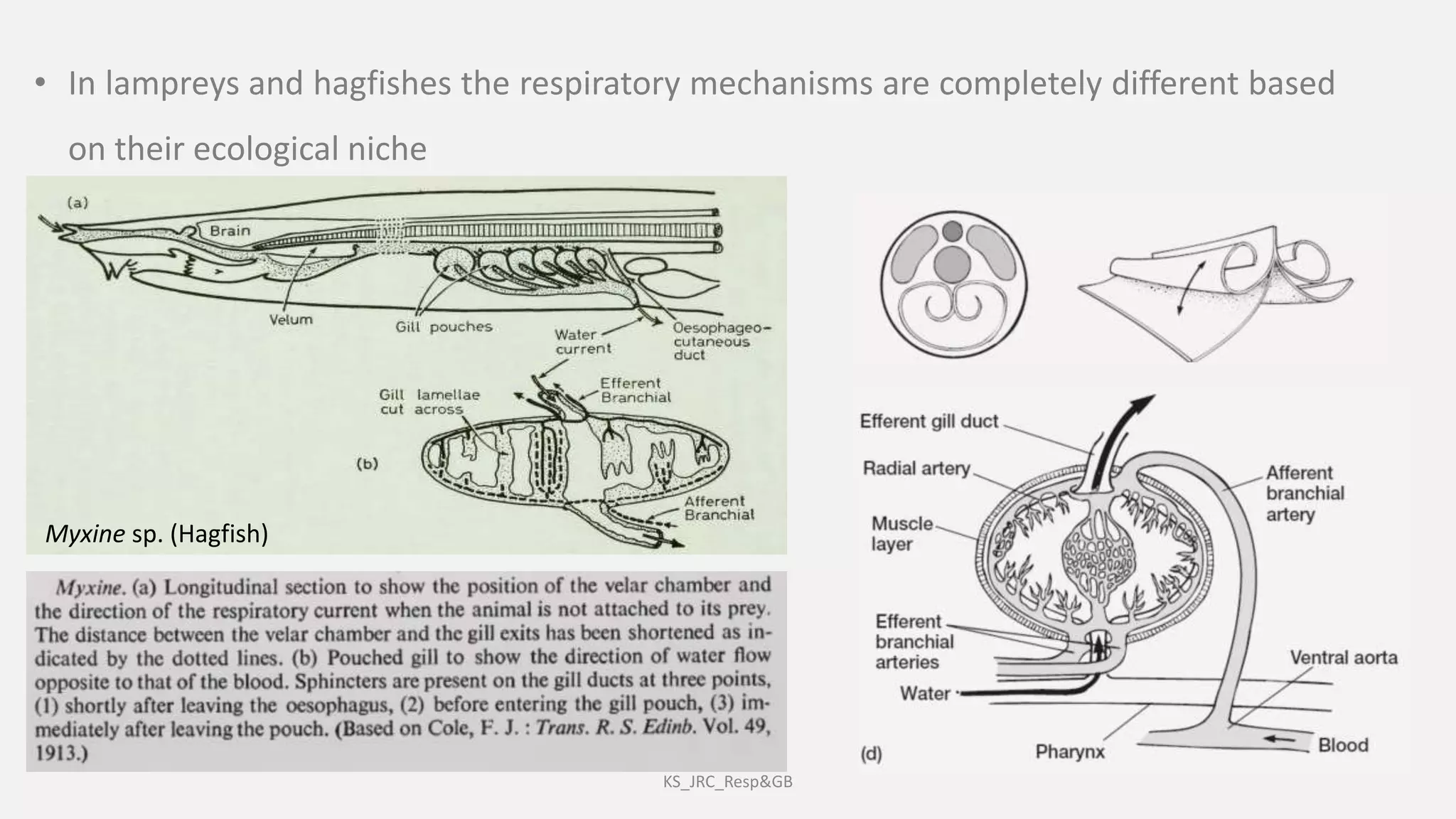
Myxine sp. (Hagfish)
• In lampreys and hagfishes the respiratory mechanisms are completely different based
on their ecological niche
KS_JRC_Resp&GB
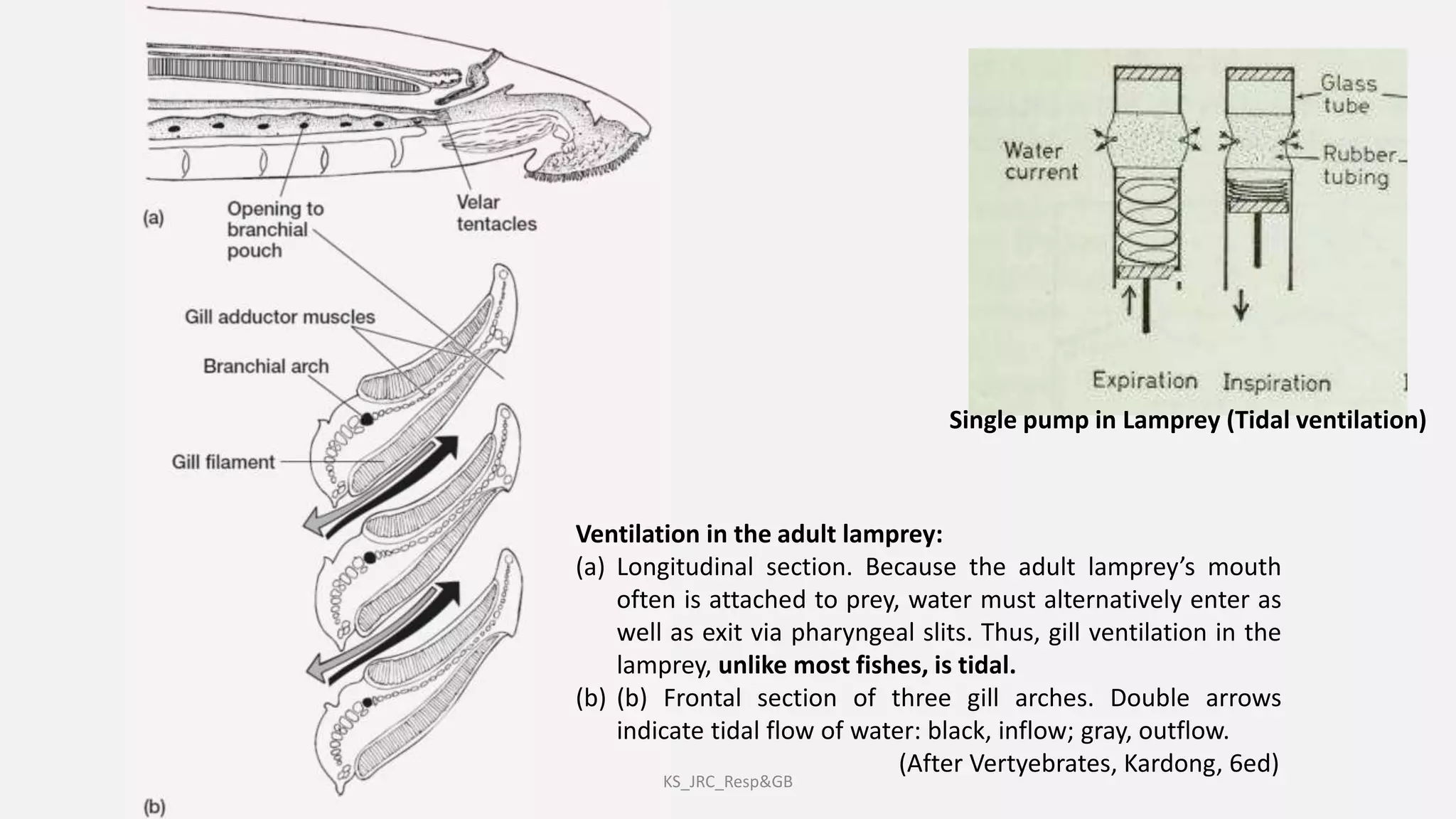
Single pump in Lamprey (Tidal ventilation)
Ventilation in the adult lamprey:
(a) Longitudinal section. Because the adult lamprey’s mouth
often is attached to prey, water must alternatively enter as
well as exit via pharyngeal slits. Thus, gill ventilation in the
lamprey, unlike most fishes, is tidal.
(b) (b) Frontal section of three gill arches. Double arrows
indicate tidal flow of water: black, inflow; gray, outflow.
(After Vertyebrates, Kardong, 6ed)
KS_JRC_Resp&GB
KS_JRC_Resp&GB
Ventilation of Internal Gills: Bony Fishes
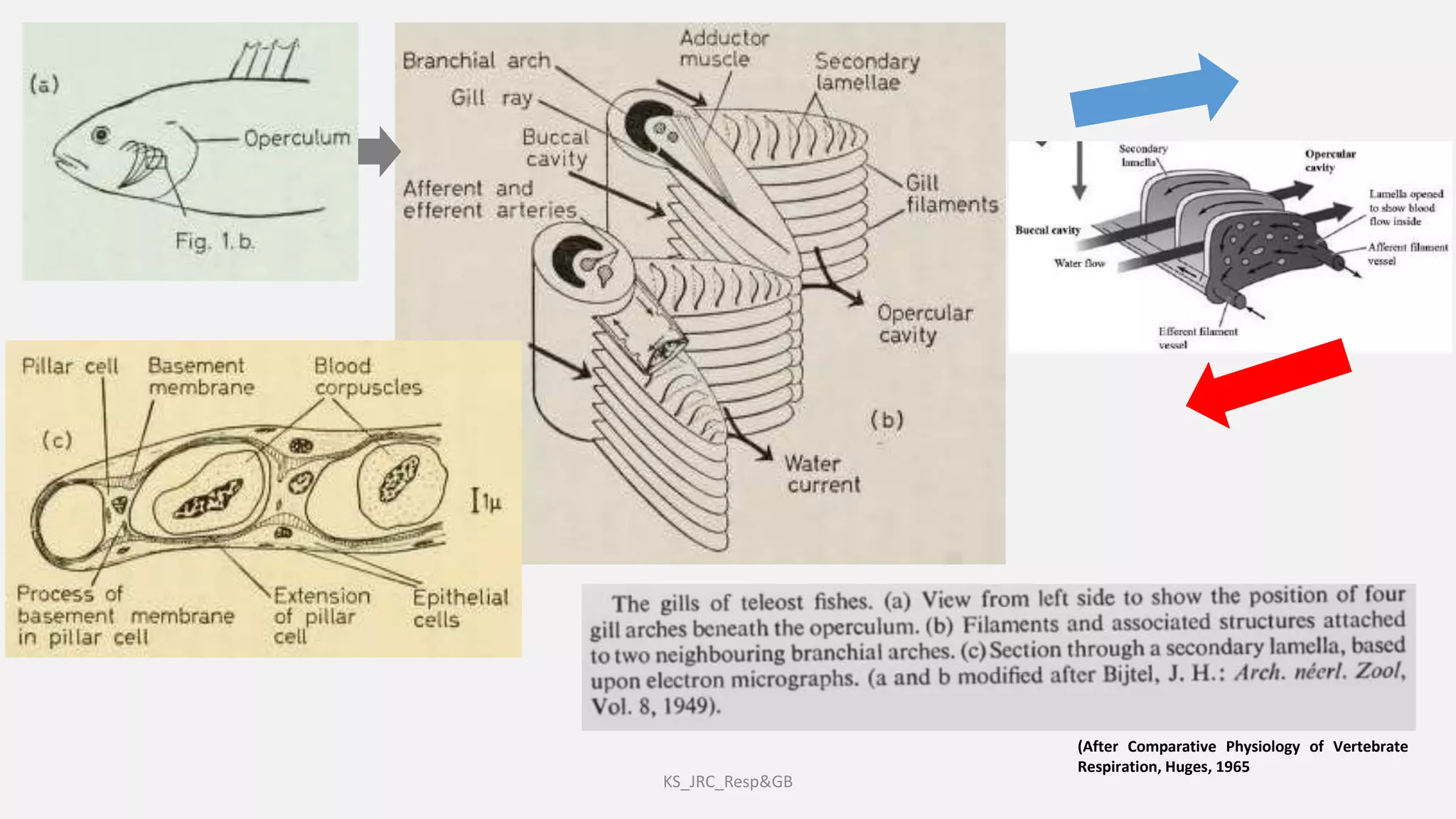
(After Comparative Physiology of Vertebrate
Respiration, Huges, 1965
KS_JRC_Resp&GB
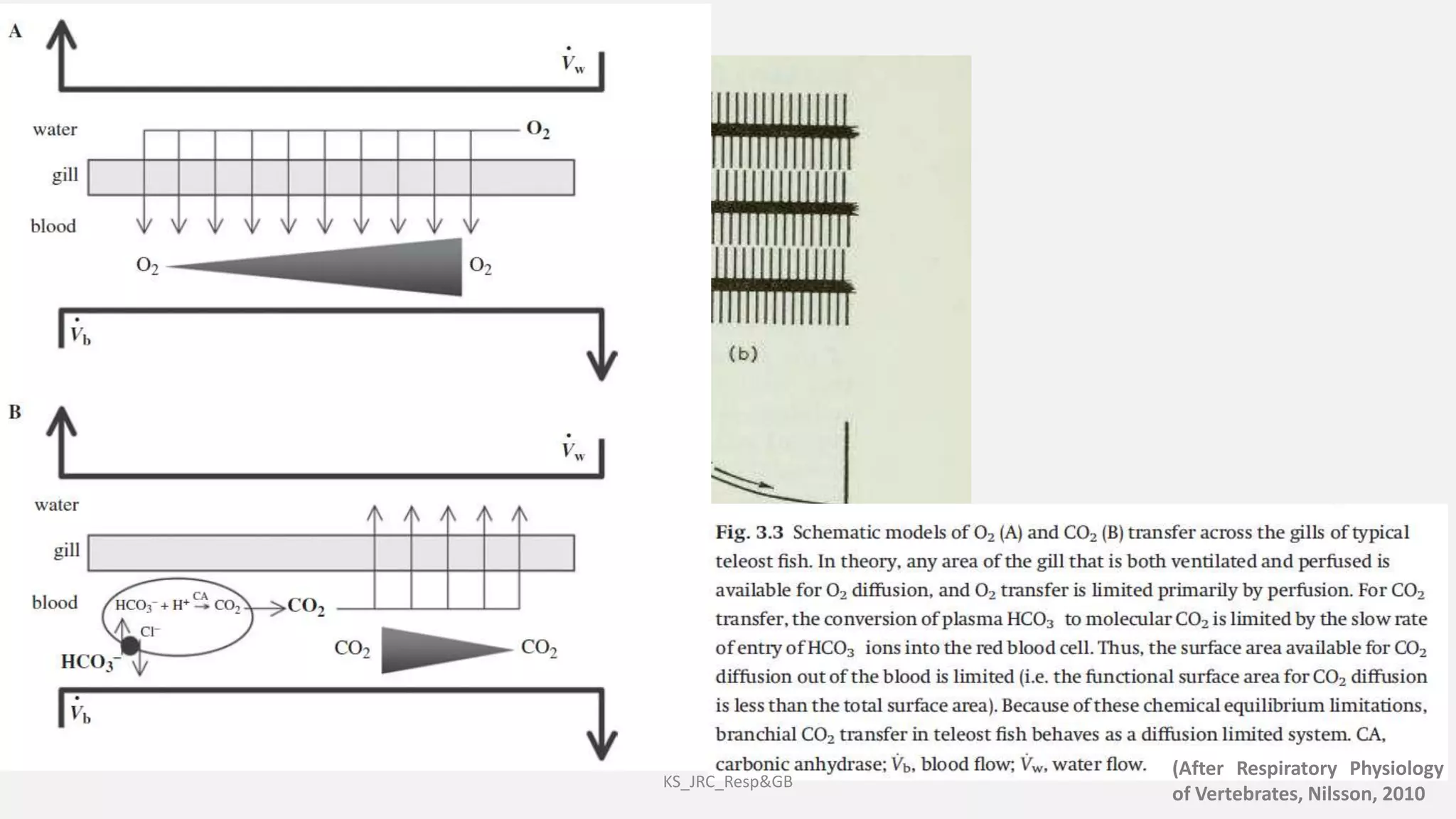
(c) Counter-current; (d) concurrent
KS_JRC_Resp&GB
(c) Counter-current; (d) concurrent
(After Respiratory Physiology
of Vertebrates, Nilsson, 2010
KS_JRC_Resp&GB
KS_JRC_Resp&GB
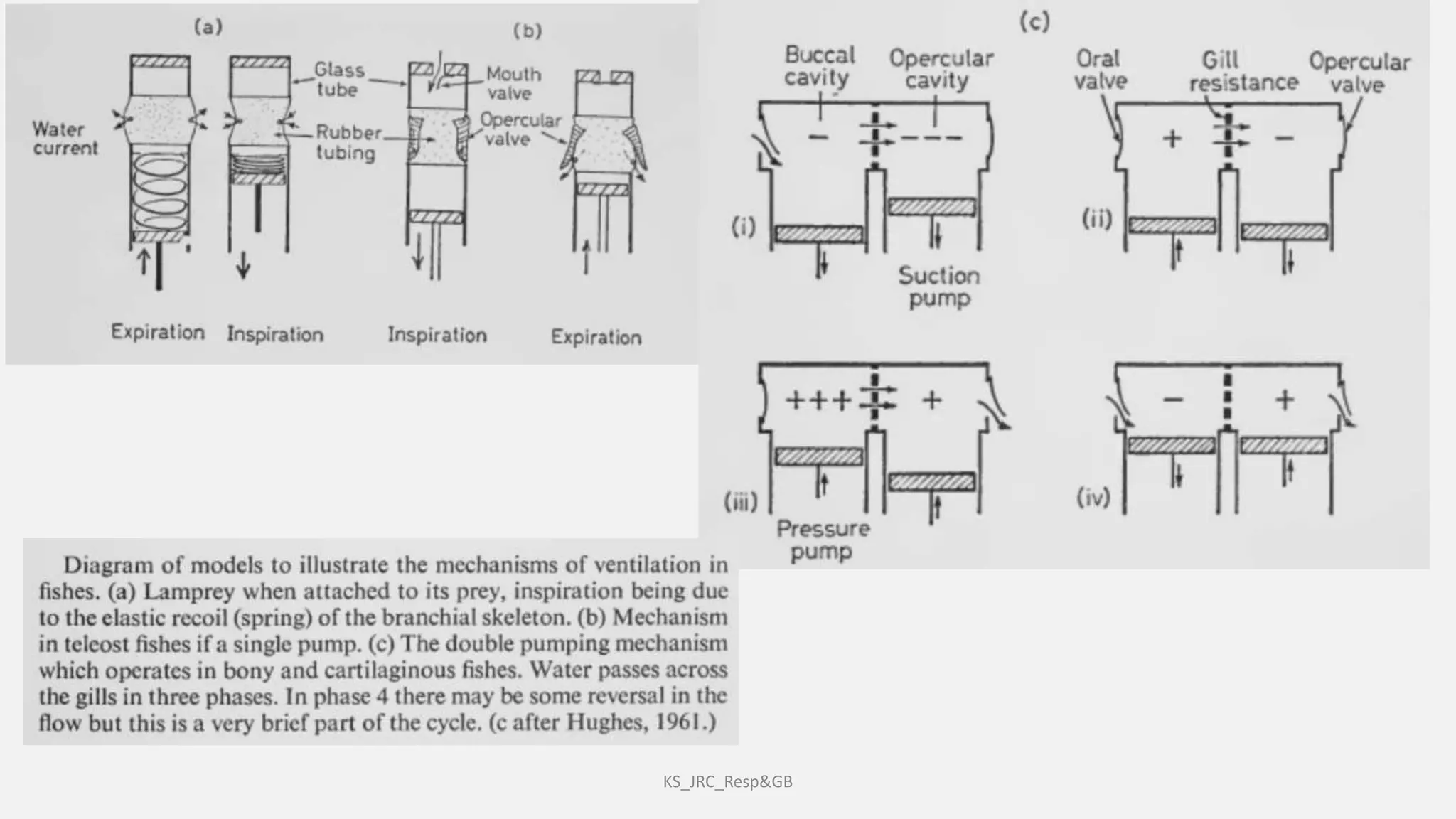
The operation of a double-pumping mechanism and the consequent
continuous flow across the gills make the terms inspiration and expiration
not entirely suitable.
These are applicable to tidal ventilation but for fish a subdivision of each
respiratory cycle into four parts is preferable
KS_JRC_Resp&GB
KS_JRC_Resp&GB
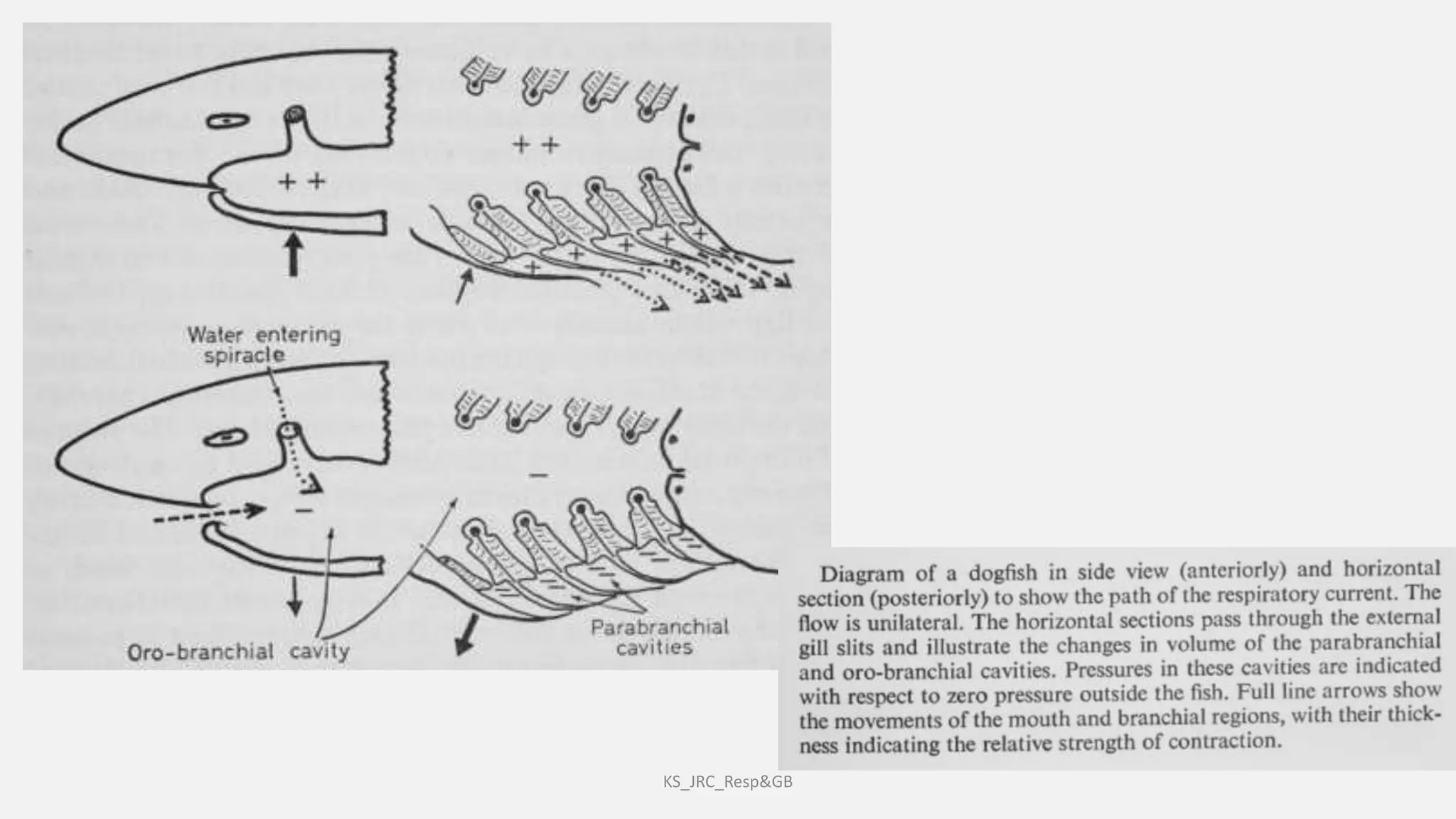
Ventilation of Internal Gills: Cartilaginous fishes
Shark gill
(a) The interbranchial septum has banks
of lamellae supported by gill rays and a
medial branchial arch
(b) Structural units include a hemibranch
and a holobranch as well as a functional
respiratory unit
(After Vertyebrates, Kardong, 6ed)KS_JRC_Resp&GB
KS_JRC_Resp&GB
KS_JRC_Resp&GB
Arial Respiration in Lung Fishes
 Lungfishes arose in the Devonian period
 They are closely related to the group of fishes (Crossopterygii) which gave rise to the first land vertebrates
 In common with crossopterygian fishes they possess internal nostrils which can be seen in the three living genera of
lungfishes
 These are found in the three southern continents and are Neoceratodus (Australia), Protopterus (Africa), and
Lepidosiren (South America)
KS_JRC_Resp&GB
 Lungfishes arose in the Devonian period
 They are closely related to the group of fishes (Crossopterygii) which gave rise to the first land vertebrates
 In common with crossopterygian fishes they possess internal nostrils which can be seen in the three living genera of
lungfishes
 These are found in the three southern continents and are Neoceratodus (Australia), Protopterus (Africa), and
Lepidosiren (South America)
KS_JRC_Resp&GB
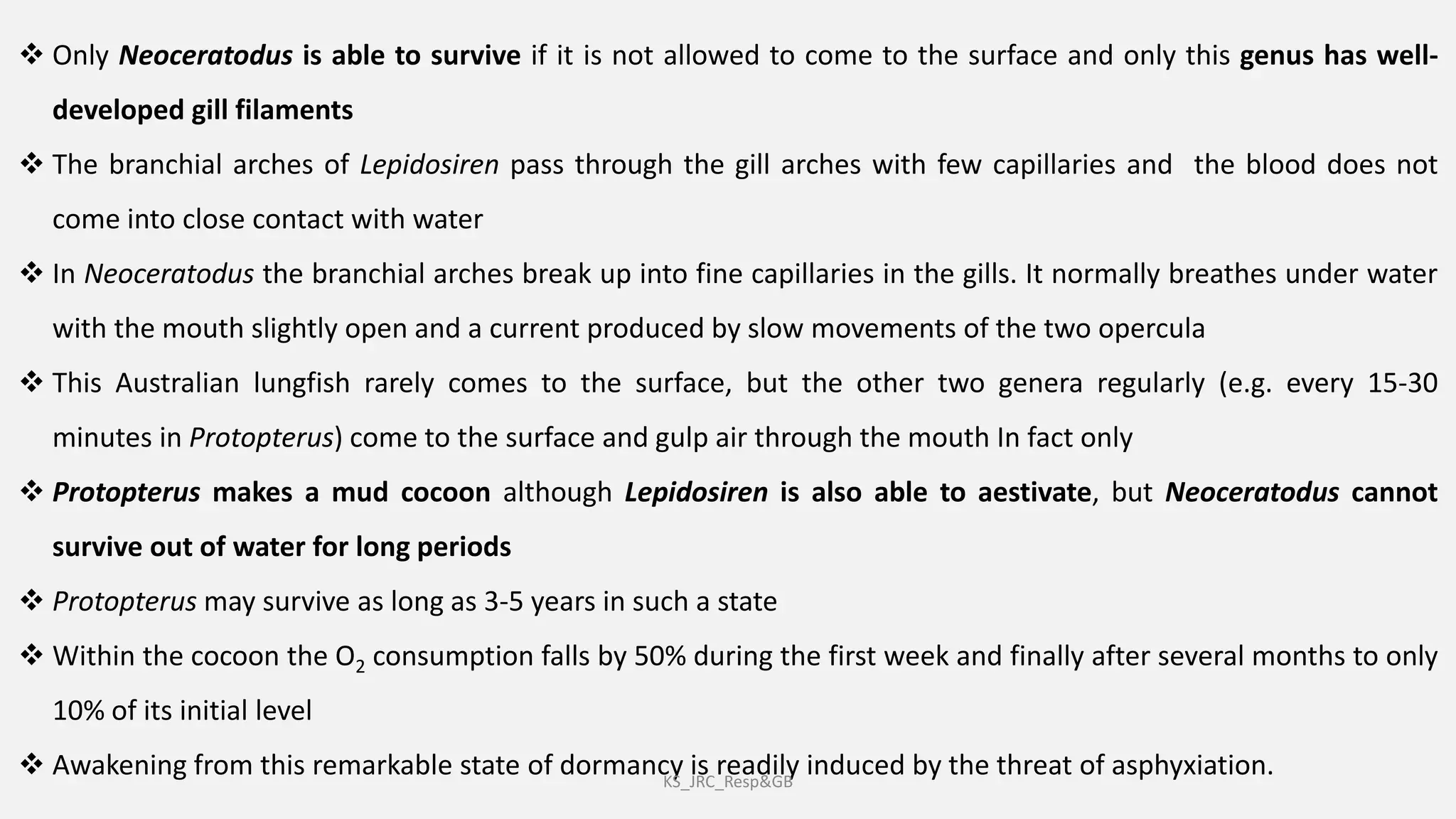
 Only Neoceratodus is able to survive if it is not allowed to come to the surface and only this genus has well-
developed gill filaments
 The branchial arches of Lepidosiren pass through the gill arches with few capillaries and the blood does not
come into close contact with water
 In Neoceratodus the branchial arches break up into fine capillaries in the gills. It normally breathes under water
with the mouth slightly open and a current produced by slow movements of the two opercula
 This Australian lungfish rarely comes to the surface, but the other two genera regularly (e.g. every 15-30
minutes in Protopterus) come to the surface and gulp air through the mouth In fact only
 Protopterus makes a mud cocoon although Lepidosiren is also able to aestivate, but Neoceratodus cannot
survive out of water for long periods
 Protopterus may survive as long as 3-5 years in such a state
 Within the cocoon the O2 consumption falls by 50% during the first week and finally after several months to only
10% of its initial level
 Awakening from this remarkable state of dormancy is readily induced by the threat of asphyxiation.KS_JRC_Resp&GB
KS_JRC_Resp&GB
Swim Bladder and the Origin of Lungs
Swim Bladder
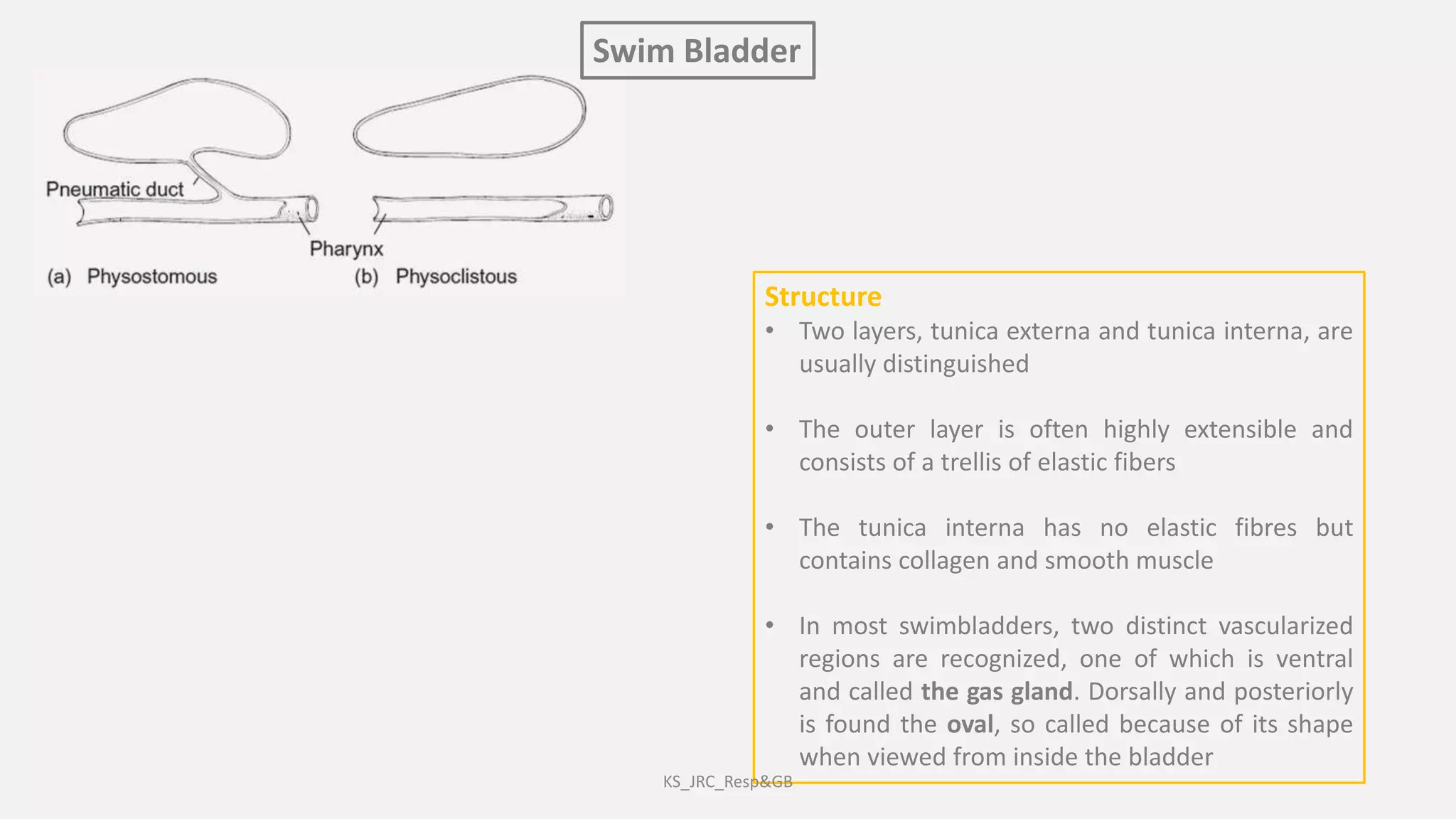
Structure
• Two layers, tunica externa and tunica interna, are
usually distinguished
• The outer layer is often highly extensible and
consists of a trellis of elastic fibers
• The tunica interna has no elastic fibres but
contains collagen and smooth muscle
• In most swimbladders, two distinct vascularized
regions are recognized, one of which is ventral
and called the gas gland. Dorsally and posteriorly
is found the oval, so called because of its shape
when viewed from inside the bladder
KS_JRC_Resp&GB
Structure
• Two layers, tunica externa and tunica interna, are
usually distinguished
• The outer layer is often highly extensible and
consists of a trellis of elastic fibers
• The tunica interna has no elastic fibres but
contains collagen and smooth muscle
• In most swimbladders, two distinct vascularized
regions are recognized, one of which is ventral
and called the gas gland. Dorsally and posteriorly
is found the oval, so called because of its shape
when viewed from inside the bladder
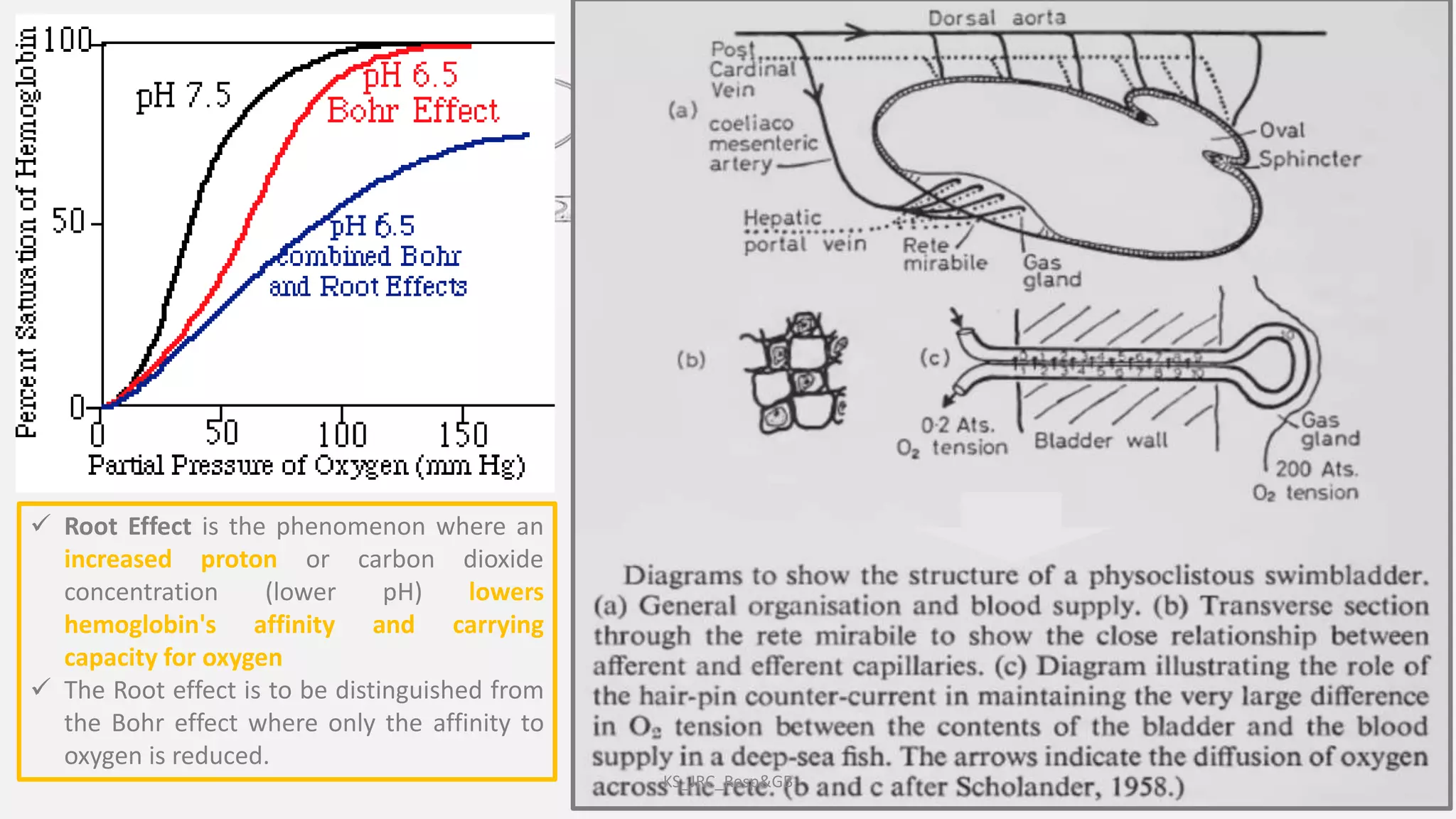
Swim Bladder
 Root Effect is the phenomenon where an
increased proton or carbon dioxide
concentration (lower pH) lowers
hemoglobin's affinity and carrying
capacity for oxygen
 The Root effect is to be distinguished from
the Bohr effect where only the affinity to
oxygen is reduced.
KS_JRC_Resp&GB
Evolution of Lung
KS_JRC_Resp&GB
Classification of (bony) fishes as per Young, 3rd edKS_JRC_Resp&GB
KS_JRC_Resp&GB
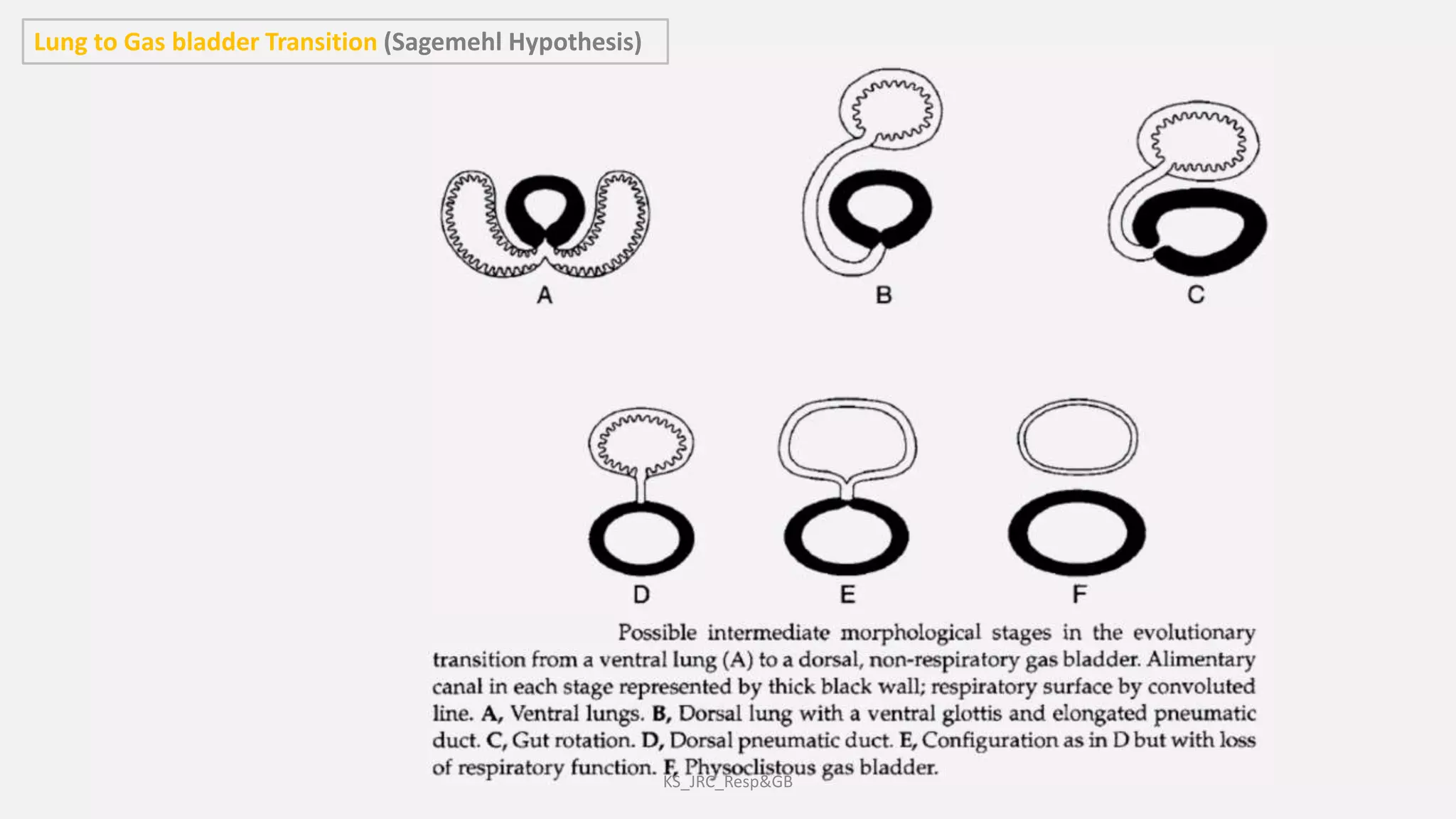
Lung to Gas bladder Transition (Sagemehl Hypothesis)
KS_JRC_Resp&GB
Graham et al. (19)
Evolution of Lung
KS_JRC_Resp&GB
Daniels et al. (2004)
Phylogeny of Lung
KS_JRC_Resp&GB
Evolution of gas bladders: Lungs, ventral in position, evolved in the common ancestor to actinopterygians and
sarcopterygians. Swim bladders in actinopterygians may have evolved independently, or they may have been
modified from earlier lungs. Some gas bladders are respiratory in function. Above the dendrogram outlining the
evolutionary rise of each group, there are sagittal (top) and cross-sectional (bottom) views of the lung and its
connection to the digestive tract. In Polypteriformes (Polypterus), paired lungs open through a common muscular
glottis into the right floor of the pharynx. The left lung is reduced, the right one long, but the epithelial lining of
both is smooth. Swim bladders of sturgeons originate from the stomach and those of primitive teleosts from the
esophagus, suggesting that these nonrespiratory gas bladders may be of independent origin in these two groups.
Dashed arrows indicate points where the respiratory function of the gas bladder is lost
Evolution of Gas Bladders
KS_JRC_Resp&GB
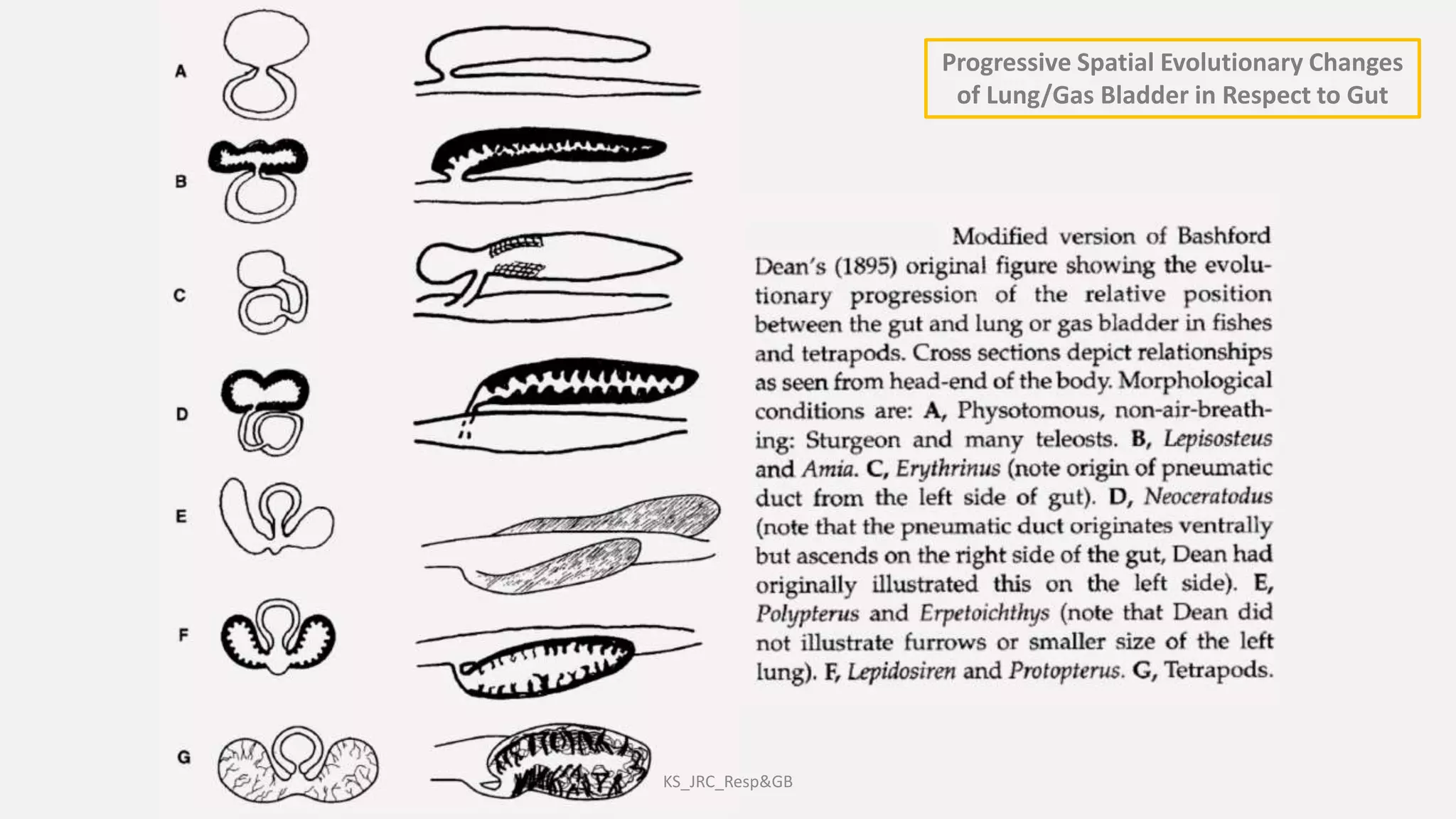
Progressive Spatial Evolutionary Changes
of Lung/Gas Bladder in Respect to Gut
KS_JRC_Resp&GB
KS_JRC_Resp&GB
References
KS_JRC_Resp&GB
KS_JRC_Resp&GB

Respiratory system & gas bladder

  • 1.
    Respiratory System &Gas Bladder Krishnendu Sinha Assistant Professor Department of Zoology Jhargram Raj College KS_JRC_Resp&GB
  • 2.
  • 3.
    Myxine sp. (Hagfish) •In lampreys and hagfishes the respiratory mechanisms are completely different based on their ecological niche KS_JRC_Resp&GB
  • 4.
    Single pump inLamprey (Tidal ventilation) Ventilation in the adult lamprey: (a) Longitudinal section. Because the adult lamprey’s mouth often is attached to prey, water must alternatively enter as well as exit via pharyngeal slits. Thus, gill ventilation in the lamprey, unlike most fishes, is tidal. (b) (b) Frontal section of three gill arches. Double arrows indicate tidal flow of water: black, inflow; gray, outflow. (After Vertyebrates, Kardong, 6ed) KS_JRC_Resp&GB
  • 5.
  • 6.
    (After Comparative Physiologyof Vertebrate Respiration, Huges, 1965 KS_JRC_Resp&GB
  • 7.
    (c) Counter-current; (d)concurrent KS_JRC_Resp&GB
  • 8.
    (c) Counter-current; (d)concurrent (After Respiratory Physiology of Vertebrates, Nilsson, 2010 KS_JRC_Resp&GB
  • 9.
  • 10.
    The operation ofa double-pumping mechanism and the consequent continuous flow across the gills make the terms inspiration and expiration not entirely suitable. These are applicable to tidal ventilation but for fish a subdivision of each respiratory cycle into four parts is preferable KS_JRC_Resp&GB
  • 11.
    KS_JRC_Resp&GB Ventilation of InternalGills: Cartilaginous fishes
  • 12.
    Shark gill (a) Theinterbranchial septum has banks of lamellae supported by gill rays and a medial branchial arch (b) Structural units include a hemibranch and a holobranch as well as a functional respiratory unit (After Vertyebrates, Kardong, 6ed)KS_JRC_Resp&GB
  • 13.
  • 14.
  • 15.
     Lungfishes arosein the Devonian period  They are closely related to the group of fishes (Crossopterygii) which gave rise to the first land vertebrates  In common with crossopterygian fishes they possess internal nostrils which can be seen in the three living genera of lungfishes  These are found in the three southern continents and are Neoceratodus (Australia), Protopterus (Africa), and Lepidosiren (South America) KS_JRC_Resp&GB
  • 16.
     Lungfishes arosein the Devonian period  They are closely related to the group of fishes (Crossopterygii) which gave rise to the first land vertebrates  In common with crossopterygian fishes they possess internal nostrils which can be seen in the three living genera of lungfishes  These are found in the three southern continents and are Neoceratodus (Australia), Protopterus (Africa), and Lepidosiren (South America) KS_JRC_Resp&GB
  • 17.
     Only Neoceratodusis able to survive if it is not allowed to come to the surface and only this genus has well- developed gill filaments  The branchial arches of Lepidosiren pass through the gill arches with few capillaries and the blood does not come into close contact with water  In Neoceratodus the branchial arches break up into fine capillaries in the gills. It normally breathes under water with the mouth slightly open and a current produced by slow movements of the two opercula  This Australian lungfish rarely comes to the surface, but the other two genera regularly (e.g. every 15-30 minutes in Protopterus) come to the surface and gulp air through the mouth In fact only  Protopterus makes a mud cocoon although Lepidosiren is also able to aestivate, but Neoceratodus cannot survive out of water for long periods  Protopterus may survive as long as 3-5 years in such a state  Within the cocoon the O2 consumption falls by 50% during the first week and finally after several months to only 10% of its initial level  Awakening from this remarkable state of dormancy is readily induced by the threat of asphyxiation.KS_JRC_Resp&GB
  • 18.
  • 19.
    Swim Bladder Structure • Twolayers, tunica externa and tunica interna, are usually distinguished • The outer layer is often highly extensible and consists of a trellis of elastic fibers • The tunica interna has no elastic fibres but contains collagen and smooth muscle • In most swimbladders, two distinct vascularized regions are recognized, one of which is ventral and called the gas gland. Dorsally and posteriorly is found the oval, so called because of its shape when viewed from inside the bladder KS_JRC_Resp&GB
  • 20.
    Structure • Two layers,tunica externa and tunica interna, are usually distinguished • The outer layer is often highly extensible and consists of a trellis of elastic fibers • The tunica interna has no elastic fibres but contains collagen and smooth muscle • In most swimbladders, two distinct vascularized regions are recognized, one of which is ventral and called the gas gland. Dorsally and posteriorly is found the oval, so called because of its shape when viewed from inside the bladder Swim Bladder  Root Effect is the phenomenon where an increased proton or carbon dioxide concentration (lower pH) lowers hemoglobin's affinity and carrying capacity for oxygen  The Root effect is to be distinguished from the Bohr effect where only the affinity to oxygen is reduced. KS_JRC_Resp&GB
  • 21.
  • 22.
    Classification of (bony)fishes as per Young, 3rd edKS_JRC_Resp&GB
  • 23.
  • 24.
    Lung to Gasbladder Transition (Sagemehl Hypothesis) KS_JRC_Resp&GB
  • 25.
    Graham et al.(19) Evolution of Lung KS_JRC_Resp&GB
  • 26.
    Daniels et al.(2004) Phylogeny of Lung KS_JRC_Resp&GB
  • 27.
    Evolution of gasbladders: Lungs, ventral in position, evolved in the common ancestor to actinopterygians and sarcopterygians. Swim bladders in actinopterygians may have evolved independently, or they may have been modified from earlier lungs. Some gas bladders are respiratory in function. Above the dendrogram outlining the evolutionary rise of each group, there are sagittal (top) and cross-sectional (bottom) views of the lung and its connection to the digestive tract. In Polypteriformes (Polypterus), paired lungs open through a common muscular glottis into the right floor of the pharynx. The left lung is reduced, the right one long, but the epithelial lining of both is smooth. Swim bladders of sturgeons originate from the stomach and those of primitive teleosts from the esophagus, suggesting that these nonrespiratory gas bladders may be of independent origin in these two groups. Dashed arrows indicate points where the respiratory function of the gas bladder is lost Evolution of Gas Bladders KS_JRC_Resp&GB
  • 28.
    Progressive Spatial EvolutionaryChanges of Lung/Gas Bladder in Respect to Gut KS_JRC_Resp&GB
  • 29.
  • 30.
  • 31.