
AMENORRHEA
DEFINITION AND CLASSIFICATION
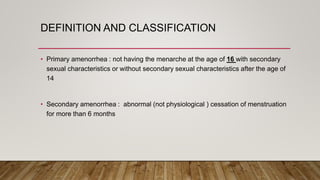
• Primary amenorrhea : not having the menarche at the age of 16 with secondary
sexual characteristics or without secondary sexual characteristics after the age of
14
• Secondary amenorrhea : abnormal (not physiological ) cessation of menstruation
for more than 6 months
CLASSIFICATION
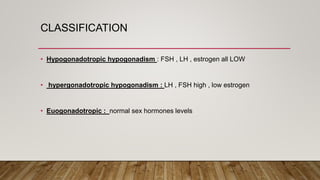
• Hypogonadotropic hypogonadism : FSH , LH , estrogen all LOW
• hypergonadotropic hypogonadism : LH , FSH high , low estrogen
• Euogonadotropic : normal sex hormones levels
HYPOGONADOTROPIC HYPOGONADISM
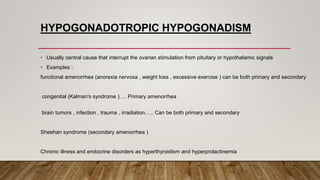
• Usually central cause that interrupt the ovarian stimulation from pituitary or hypothalamic signals
• Examples :
functional amenorrhea (anorexia nervosa , weight loss , excessive exercise ) can be both primary and secondary
congenital (Kalman's syndrome )…. Primary amenorrhea
brain tumors , infection , trauma , irradiation….. Can be both primary and secondary
Sheehan syndrome (secondary amenorrhea )
Chronic illness and endocrine disorders as hyperthyroidism and hyperprolactinemia
HYPOGONADOTROPIC HYPOGONADISM
Kalman's syndrome
1)Hypogonadotropic hypogonadism
2)Eunuchoidal features
3)Anosmia or hyposmia
4)Primary amenorrhea
• Caused by defect in synthesis and/or release of gonadorelin (LH
releasing hormone)
HYPOGONADOTROPIC HYPOGONADISM
Sheehan syndrome
• Causes secondary amenorrhea
• Pituitary infarction necrosis due to sever PPH
• Failure to lactate
• Loss of pubic and axillary hair
• Decreased : LH , FSH , GH , TSH
HYPOGONADOTROPIC HYPOGONADISM
Hyperprolactinemia
Causes secondary amenorrhea
• Prolactin inhibits GnRH release from the hypothalamus
• Most commonly due to pituitary adenoma
• Drugs that may cause hyperprolactinemia:
1) Phenothiazines
2) Methyldopa
3) Cimetidine
4) Butyrophenones
5) Antihistamines
HYPERGONADOTROPIC AMENORRHEA
• The cause if usually ovarian
• Commonly Lead to primary amenorrhea
• FSH , LH are high with low estrogen
Examples :
• gonadal dysgenesis (pure gonadal dysgenesis XY and turner syndrome XO )
• Gonadal agenesis
• Sawyer syndrome
• Premature ovarian failure (menopause before the age of 40 )
HYPERGONADOTROPIC AMENORRHEA
Turner syndrome
The most common cause of primary amenorrhea (gonadal dysgenesis )
• Chromosomal abnormalities ( 45XO female)
• Associated with streak ovarian tissue and primary amenorrhea.
• Presentation: primary amenorrhea associated with features of
Turner’s syndrome – short stature, webbed neck, increased carrying
angle at the elbow and sexual infantilism
Premature ovarian failure :
• Premature ovarian failure occurs in about 1% before the age of 40
• Premature ovarian failure may be due to:
Chemotherapy and radiotherapy.
Autoimmune disease following viral infection
galactosemia
Oophorectomy
Genetic
EUOGONADOTROPIC AMENORRHEA
• Levels of FSH , LH and estrogen are within normal
• Chronic anovulation and anatomical disorders
• Most common cause of secondary amenorrhea : chronic anovulation –PCOS
(after pregnancy excluded )
• Anatomical disorders as : imperforate hymen , transverse vaginal septum , MRKH
syndrome , absent vagina , absent cervix , cervical stenosis and asherman
syndrome , hysterectomy , endometrial ablation
EUOGONADOTROPIC AMENORRHEA
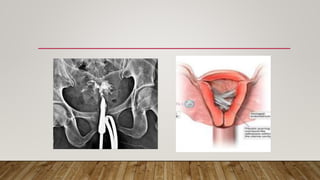
Asherman syndrome :
Intrauterine synechia (adhesions due to infections as endometritis , chorioamnionitis ,
excessive curettage
Diagnosed by history of primary amenorrhea with the above risk factors and
HYSTEROSCOPY
HSG and failure of sounding may suggest the diagnsosis
Treated by hysteroscopic hemolysis
MULLERIAN AGENESIS
Uterine agenesis –dysgenesis
Mayer-Rokitansky-Küster-Hauser syndrome
Normal female karyotype (xx) and phenotype (normal breast and normal pubic hair )
Normal hormone levels
Absent or rudimentary uterus
Absent or short vagina (vaginal dimple )
Diagnosed by MRI and laparoscopy
Treated by vaginal dilatation or vaginal construction surgery
OTHER AMENORRHEA'S
Physiological amenorrhea
As occur during pregnancy , menopause , before puberty and during lactation
AMENORRHEA WITH HIGH ANDROGEN LEVEL
• Androgen secreting ovarian or adrenal tumors
(Sertoli Leydig cell ovarian tumor and congenital adrenal hyperplasia )
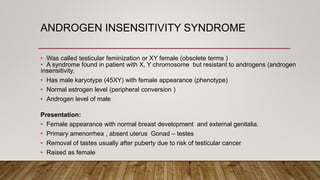
• Androgen insensitivity syndrome
ANDROGEN INSENSITIVITY SYNDROME
• Was called testicular feminization or XY female (obsolete terms )
• A syndrome found in patient with X, Y chromosome but resistant to androgens (androgen
insensitivity.
• Has male karyotype (45XY) with female appearance (phenotype)
• Normal estrogen level (peripheral conversion )
• Androgen level of male
Presentation:
• Female appearance with normal breast development and external genitalia.
• Primary amenorrhea , absent uterus Gonad – testes
• Removal of tastes usually after puberty due to risk of testicular cancer
• Raised as female
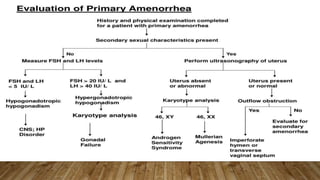
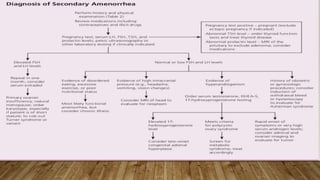
EVALUATION OF AMENORRHEA
• Primary ?
• Secondary ?
• Causes ?
L47 Amenorrhea
L47 Amenorrhea

L47 Amenorrhea

  • 1.
  • 2.
    DEFINITION AND CLASSIFICATION •Primary amenorrhea : not having the menarche at the age of 16 with secondary sexual characteristics or without secondary sexual characteristics after the age of 14 • Secondary amenorrhea : abnormal (not physiological ) cessation of menstruation for more than 6 months
  • 3.
    CLASSIFICATION • Hypogonadotropic hypogonadism: FSH , LH , estrogen all LOW • hypergonadotropic hypogonadism : LH , FSH high , low estrogen • Euogonadotropic : normal sex hormones levels
  • 4.
    HYPOGONADOTROPIC HYPOGONADISM • Usuallycentral cause that interrupt the ovarian stimulation from pituitary or hypothalamic signals • Examples : functional amenorrhea (anorexia nervosa , weight loss , excessive exercise ) can be both primary and secondary congenital (Kalman's syndrome )…. Primary amenorrhea brain tumors , infection , trauma , irradiation….. Can be both primary and secondary Sheehan syndrome (secondary amenorrhea ) Chronic illness and endocrine disorders as hyperthyroidism and hyperprolactinemia
  • 5.
    HYPOGONADOTROPIC HYPOGONADISM Kalman's syndrome 1)Hypogonadotropichypogonadism 2)Eunuchoidal features 3)Anosmia or hyposmia 4)Primary amenorrhea • Caused by defect in synthesis and/or release of gonadorelin (LH releasing hormone)
  • 6.
    HYPOGONADOTROPIC HYPOGONADISM Sheehan syndrome •Causes secondary amenorrhea • Pituitary infarction necrosis due to sever PPH • Failure to lactate • Loss of pubic and axillary hair • Decreased : LH , FSH , GH , TSH
  • 7.
    HYPOGONADOTROPIC HYPOGONADISM Hyperprolactinemia Causes secondaryamenorrhea • Prolactin inhibits GnRH release from the hypothalamus • Most commonly due to pituitary adenoma • Drugs that may cause hyperprolactinemia: 1) Phenothiazines 2) Methyldopa 3) Cimetidine 4) Butyrophenones 5) Antihistamines
  • 8.
    HYPERGONADOTROPIC AMENORRHEA • Thecause if usually ovarian • Commonly Lead to primary amenorrhea • FSH , LH are high with low estrogen Examples : • gonadal dysgenesis (pure gonadal dysgenesis XY and turner syndrome XO ) • Gonadal agenesis • Sawyer syndrome • Premature ovarian failure (menopause before the age of 40 )
  • 9.
    HYPERGONADOTROPIC AMENORRHEA Turner syndrome Themost common cause of primary amenorrhea (gonadal dysgenesis ) • Chromosomal abnormalities ( 45XO female) • Associated with streak ovarian tissue and primary amenorrhea. • Presentation: primary amenorrhea associated with features of Turner’s syndrome – short stature, webbed neck, increased carrying angle at the elbow and sexual infantilism
  • 10.
    Premature ovarian failure: • Premature ovarian failure occurs in about 1% before the age of 40 • Premature ovarian failure may be due to: Chemotherapy and radiotherapy. Autoimmune disease following viral infection galactosemia Oophorectomy Genetic
  • 11.
    EUOGONADOTROPIC AMENORRHEA • Levelsof FSH , LH and estrogen are within normal • Chronic anovulation and anatomical disorders • Most common cause of secondary amenorrhea : chronic anovulation –PCOS (after pregnancy excluded ) • Anatomical disorders as : imperforate hymen , transverse vaginal septum , MRKH syndrome , absent vagina , absent cervix , cervical stenosis and asherman syndrome , hysterectomy , endometrial ablation
  • 12.
    EUOGONADOTROPIC AMENORRHEA Asherman syndrome: Intrauterine synechia (adhesions due to infections as endometritis , chorioamnionitis , excessive curettage Diagnosed by history of primary amenorrhea with the above risk factors and HYSTEROSCOPY HSG and failure of sounding may suggest the diagnsosis Treated by hysteroscopic hemolysis
  • 14.
    MULLERIAN AGENESIS Uterine agenesis–dysgenesis Mayer-Rokitansky-Küster-Hauser syndrome Normal female karyotype (xx) and phenotype (normal breast and normal pubic hair ) Normal hormone levels Absent or rudimentary uterus Absent or short vagina (vaginal dimple ) Diagnosed by MRI and laparoscopy Treated by vaginal dilatation or vaginal construction surgery
  • 15.
    OTHER AMENORRHEA'S Physiological amenorrhea Asoccur during pregnancy , menopause , before puberty and during lactation
  • 16.
    AMENORRHEA WITH HIGHANDROGEN LEVEL • Androgen secreting ovarian or adrenal tumors (Sertoli Leydig cell ovarian tumor and congenital adrenal hyperplasia ) • Androgen insensitivity syndrome
  • 17.
    ANDROGEN INSENSITIVITY SYNDROME •Was called testicular feminization or XY female (obsolete terms ) • A syndrome found in patient with X, Y chromosome but resistant to androgens (androgen insensitivity. • Has male karyotype (45XY) with female appearance (phenotype) • Normal estrogen level (peripheral conversion ) • Androgen level of male Presentation: • Female appearance with normal breast development and external genitalia. • Primary amenorrhea , absent uterus Gonad – testes • Removal of tastes usually after puberty due to risk of testicular cancer • Raised as female
  • 18.
    EVALUATION OF AMENORRHEA •Primary ? • Secondary ? • Causes ?