Uterus sparing techniques for
Prolapse for young
DR Rajesh Gajbhiye
Consultant Gynecologist & Lap Surgeon
Mauli Women’s Hospital.
Nagpur
Introduction
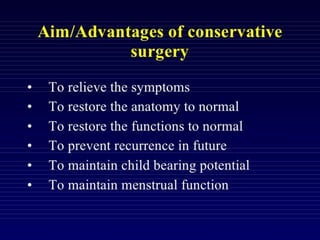
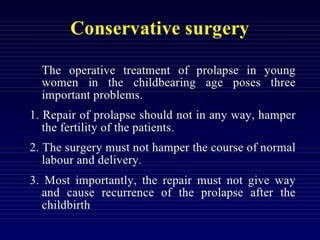
 Conservative surgeries- young
nulliparous women where menstrual
and reproductive function in desired.
 Vaginal hysterctomy with repair.
 Advent of minimal invasive surgery
 Resuspend
 Uterine conserving re-suspension
surgery
 Augmenting weak connective tissue
 Stronger apical support
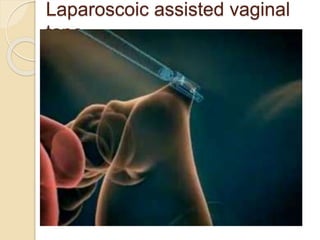
Laparoscoic assisted vaginal
tape
Complications
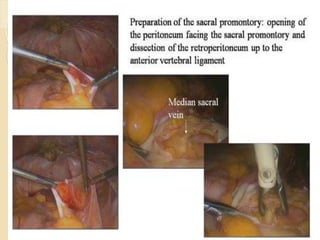
 Presacral bleeding. Hence a vascular
sacral plexus is a relative
contraindication for this surgery.
 Sigmoid colon and sigmoid mesocolon
injury hence short sigmoid
mesocolon is relative contraindication
for this surgery.
 Geintofemoral nerve irritation,
damage to ureter, recto-vaginal fascia,
recurrence, osteomyelitis and bowel
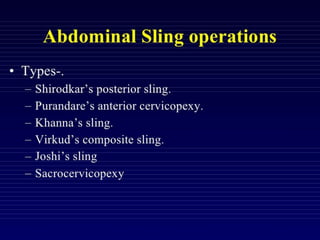
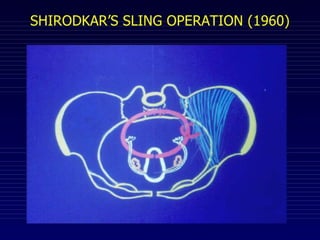
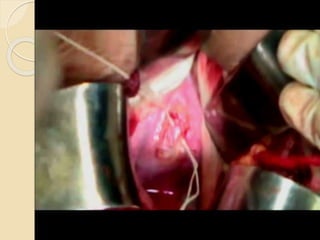
 Reproductive performance following Shirodkar's
abdominal sling operation.
Allahbadia GN1, Ambiye VR.
 Over a period of 4 years from January 1986 to
December 1989, 79 cases in whom Shirodkar's
abdominal sling operation carried out, were studied. All
the patients were admitted either in active labour or as
cases of abortions or for the treatment of infertility. The
incidence of full term normal vaginal delivery in this
study was 69.56% and the incidence of caesarean
section was only 2.9%. There was one case of posterior
wall rupture following previous Shirodkar's sling
operation. The recurrence rate of prolapse was only
8.69%
 Evaluation of Shirodkar’s Sling
Surgery for Conservative
Management of Uterovaginal
Descent During Child Bearing Age
Group
Suchitra Narayan Pandit, Vaman Babu Ghodake,
Vijay Chandrakant Pawar
 Observations: One thousand three hundred and
eighty patients having uterovaginal descent were
admitted at L.T.M. General Hospital, Sion, Mumbai,
from Jan ‘03 - Dec ‘04. 139 patients underwent
conservative surgery. Sixty four (46.67%) patients
were in the child-bearing age group and underwent
Shirodkar’s sling surgery. Twenty four patients
(41.37%) conceived post surgery. Nineteen patients
delivered normally. Only three patients required
L.S.C.S. for obstetric indications.
 Conclusion: Shirodkar’s Sling operation plays an
important role in the conservative management of
prolapse in the child bearing age group. It does not
affect fertility and course of normal labour in fact it
improves it by maintaining the pelvic anatomy.
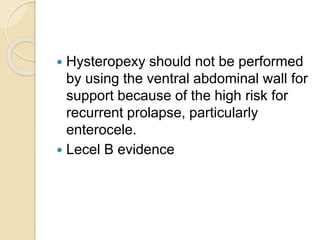
 Hysteropexy should not be performed
by using the ventral abdominal wall for
support because of the high risk for
recurrent prolapse, particularly
enterocele.
 Lecel B evidence
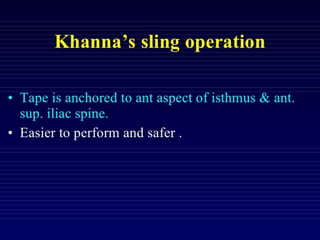
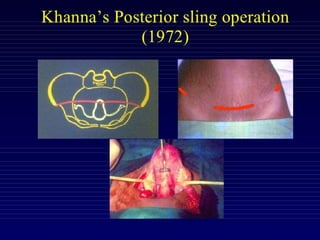
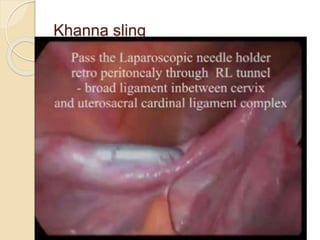
Khanna sling
 The present study demonstrates the
long-term safety and effectiveness of
pectineal ligament suspension for
vaginal vault prolapse by the open and
the laparoscopic routes.
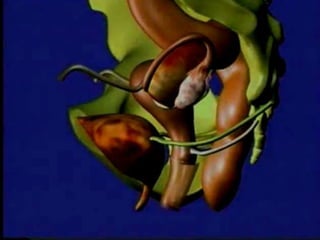
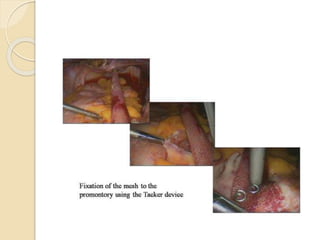
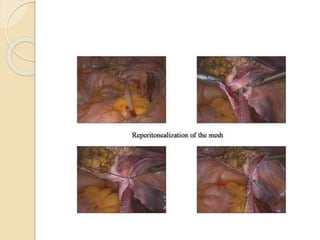
Sacrohysteropexy
 -Open
-Laparoscopic
-Robotic
 Advantages-
◦ Effective correction of descent
◦ Anteversion
◦ No compression on rectum or ureter.
◦ Improved quality of life and sexual
function
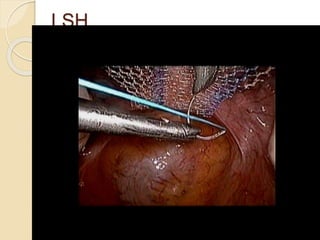
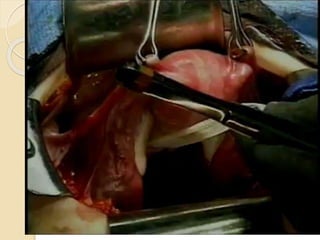
LSH
LSC
 Int Urogynecol J. 2014 Jan;25(1):131-8. doi:
10.1007/s00192-013-2209-5. Epub 2013 Nov 6.
 Laparoscopic hysteropexy: 1- to 4-
year follow-up of women
postoperatively.
 Rahmanou P1, White B, Price N,
Jackson S.
 Laparoscopic hysteropexy is a safe
and effective treatment.
 High patient satisfaction and low rates
of apical prolapse recurrence.
 Longer term follow-up and randomized
controlled studies are required.
 Younger patients are best treated with
procedures with better efficacy like
sacral colpopexy to prevent
recurrence.
 Risk of mesh extrusion and other mesh-related
complications after laparoscopic sacral
colpopexy with or without concurrent
laparoscopic-assisted vaginal hysterectomy:
experience of 402 patients.
Stepanian AA1, Miklos JR, Moore RD, Mattox TF
 J Minim Invasive Gynecol. 2008 Mar-Apr;15(2):188-96. doi:
10.1016/j.jmig.2007.11.006.
 Risk of mesh extrusion or other mesh-related
complications after laparoscopic sacral
colpopexy using soft macroporous Y-shaped
polypropylene mesh is about 1% .
 No significant increase in risk of mesh-
related complications was observed in
patients receiving concurrent hysterectomy
when compared with patients who had a
previous hysterectomy.
 The sample size of almost 2000 patients was
needed to detect a statistically significant
difference in rate of mesh-extrusion in this
study.
 Gutman and Maher reviewed the
literature on sacral colpopexy and
uterine prolapse in 2012 and in meta-
analysis found 339 cases of sacral
colpopexy with hysterectomy and 129
cases of sacral hysteropexy.
 While the success rate was over 90% in
each group the rate of mesh exposures
was more than five times higher after
sacral colpopexy and hysterectomy
as compared to hysteropexy (8.5%
versus 1.5%).
Sacral colpopexy: long-term mesh
complications requiring reoperation(s).
Arsene E1, Giraudet G, Lucot JP, Rubod C,
Cosson M.
Int Urogynecol J. 2015 Mar;26(3):353-8. doi: 10.1007/s00192-014-
2514-7. Epub 2014 Oct 17.
 excellent success rates, there are
risks of complications and reoperation
may be required. The purpose of this
study was to evaluate the extent of
complications following SC, requiring
reoperation(s), and to describe the
reoperations performed.
 Surgery for complications after SC.-27
 vaginal mesh exposures (VME)-19
 intravesical mesh -4(including one with
VME)
 ano-rectal dyschezia-1 one for
spondylodiscitis-1
 mesh infection,-1
 vaginal fistula communicating with a
collection in the ischio-coccygeal
muscle.-1.
 The median time between the initial
SC and the first reoperation was
3.9 ± 5.7 years
 This case series provides a
description of surgical interventions for
complications related to sacral
colpopexy. These complications may
be serious and occur years after the
initial surgery
 Cochrane Database Syst Rev. 2013
Apr 30;4:CD004014. doi:
10.1002/14651858.CD004014.pub5.
 Surgical management of pelvic
organ prolapse in women.
 Maher C1, Feiner B, Baessler K,
Schmid C
 Fifty-six randomised controlled trials
were identified evaluating 5954
women.
 Sacral colpopexy has superior
outcomes to a variety of vaginal
procedures including sacrospinous
colpopexy, uterosacral colpopexy and
transvaginal mesh.
 These benefits must be balanced
against a longer operating time, longer
time to return to activities of daily
living, and increased cost of the
abdominal approach
Shirodkar’s Extended Manchester Repair:
A Conservative Vaginal Surgery for Geital
Prolapse in Young Women and Reinforcement of
Weak Uterosacral Ligaments with Merselene Tape:
Retrospective and Prospective Study
Roohi Shaikh,Suman Sardesai
1nternational Journal of Recent Trends in Science A
nd Technology, ISSN 2277-2812 E-ISSN 2249-8109, Vol
ume 10, Issue 2, 2014 pp 263-266

Conclusion:
Shirodkar’s Extended Manchester
Repair has a definite place in the
treatment of genital prolapse
especially during the
reproductive age, where child-bearing
function has to be preserved
 Two randomized trials in women with
stage II or higher POP that compared
transvaginal sacrospinous
hysteropexy with vaginal hysterectomy
(with uterosacral or sacrospinous
ligament suspension of the vaginal
vault) yielded consistent results: the
rate of prolapse recurrence after 9 to
12 months was higher in women who
underwent hysteropexy in both trials.
Conclusions
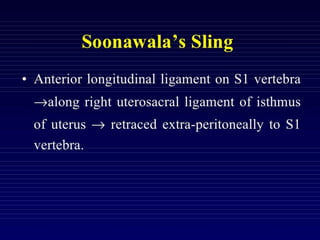
 Consensus is growing that the uterus
can be preserved at the time of pelvic
reconstructive surgery in appropriately
selected women who desire it.
 Surgeons should be ready to respond
to the wishes of female patients who
want to preserve vaginal function and
the uterus.
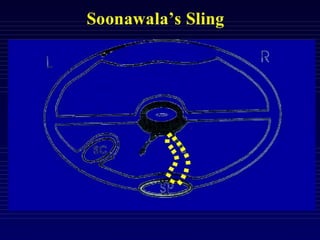
conclusions
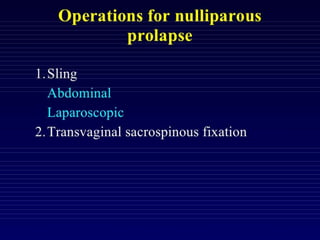
 In nulliparous prolapse, shirodkars
sling the operation of choice. If not
comfortable then Khanna sling, joshi
sling
 Sacrohysteropexy is indicated in
young prolapse.
 It is better than vaginal SSF in terms
of recurrence and patient satisfaction.
 Mesh erosion compication is less as
compared to hysterectomy with SC.
 Thankyou

Uterus preserving surgeries for prolapse

  • 1.
    Uterus sparing techniquesfor Prolapse for young DR Rajesh Gajbhiye Consultant Gynecologist & Lap Surgeon Mauli Women’s Hospital. Nagpur
  • 2.
    Introduction  Conservative surgeries-young nulliparous women where menstrual and reproductive function in desired.  Vaginal hysterctomy with repair.  Advent of minimal invasive surgery  Resuspend  Uterine conserving re-suspension surgery  Augmenting weak connective tissue  Stronger apical support
  • 3.
  • 12.
    Complications  Presacral bleeding.Hence a vascular sacral plexus is a relative contraindication for this surgery.  Sigmoid colon and sigmoid mesocolon injury hence short sigmoid mesocolon is relative contraindication for this surgery.  Geintofemoral nerve irritation, damage to ureter, recto-vaginal fascia, recurrence, osteomyelitis and bowel
  • 13.
     Reproductive performancefollowing Shirodkar's abdominal sling operation. Allahbadia GN1, Ambiye VR.  Over a period of 4 years from January 1986 to December 1989, 79 cases in whom Shirodkar's abdominal sling operation carried out, were studied. All the patients were admitted either in active labour or as cases of abortions or for the treatment of infertility. The incidence of full term normal vaginal delivery in this study was 69.56% and the incidence of caesarean section was only 2.9%. There was one case of posterior wall rupture following previous Shirodkar's sling operation. The recurrence rate of prolapse was only 8.69%
  • 14.
     Evaluation ofShirodkar’s Sling Surgery for Conservative Management of Uterovaginal Descent During Child Bearing Age Group Suchitra Narayan Pandit, Vaman Babu Ghodake, Vijay Chandrakant Pawar
  • 15.
     Observations: Onethousand three hundred and eighty patients having uterovaginal descent were admitted at L.T.M. General Hospital, Sion, Mumbai, from Jan ‘03 - Dec ‘04. 139 patients underwent conservative surgery. Sixty four (46.67%) patients were in the child-bearing age group and underwent Shirodkar’s sling surgery. Twenty four patients (41.37%) conceived post surgery. Nineteen patients delivered normally. Only three patients required L.S.C.S. for obstetric indications.  Conclusion: Shirodkar’s Sling operation plays an important role in the conservative management of prolapse in the child bearing age group. It does not affect fertility and course of normal labour in fact it improves it by maintaining the pelvic anatomy.
  • 17.
     Hysteropexy shouldnot be performed by using the ventral abdominal wall for support because of the high risk for recurrent prolapse, particularly enterocele.  Lecel B evidence
  • 21.
  • 28.
     The presentstudy demonstrates the long-term safety and effectiveness of pectineal ligament suspension for vaginal vault prolapse by the open and the laparoscopic routes.
  • 38.
    Sacrohysteropexy  -Open -Laparoscopic -Robotic  Advantages- ◦Effective correction of descent ◦ Anteversion ◦ No compression on rectum or ureter. ◦ Improved quality of life and sexual function
  • 40.
  • 41.
    LSC  Int UrogynecolJ. 2014 Jan;25(1):131-8. doi: 10.1007/s00192-013-2209-5. Epub 2013 Nov 6.  Laparoscopic hysteropexy: 1- to 4- year follow-up of women postoperatively.  Rahmanou P1, White B, Price N, Jackson S.
  • 42.
     Laparoscopic hysteropexyis a safe and effective treatment.  High patient satisfaction and low rates of apical prolapse recurrence.  Longer term follow-up and randomized controlled studies are required.
  • 43.
     Younger patientsare best treated with procedures with better efficacy like sacral colpopexy to prevent recurrence.
  • 45.
     Risk ofmesh extrusion and other mesh-related complications after laparoscopic sacral colpopexy with or without concurrent laparoscopic-assisted vaginal hysterectomy: experience of 402 patients. Stepanian AA1, Miklos JR, Moore RD, Mattox TF  J Minim Invasive Gynecol. 2008 Mar-Apr;15(2):188-96. doi: 10.1016/j.jmig.2007.11.006.
  • 46.
     Risk ofmesh extrusion or other mesh-related complications after laparoscopic sacral colpopexy using soft macroporous Y-shaped polypropylene mesh is about 1% .  No significant increase in risk of mesh- related complications was observed in patients receiving concurrent hysterectomy when compared with patients who had a previous hysterectomy.  The sample size of almost 2000 patients was needed to detect a statistically significant difference in rate of mesh-extrusion in this study.
  • 47.
     Gutman andMaher reviewed the literature on sacral colpopexy and uterine prolapse in 2012 and in meta- analysis found 339 cases of sacral colpopexy with hysterectomy and 129 cases of sacral hysteropexy.  While the success rate was over 90% in each group the rate of mesh exposures was more than five times higher after sacral colpopexy and hysterectomy as compared to hysteropexy (8.5% versus 1.5%).
  • 48.
    Sacral colpopexy: long-termmesh complications requiring reoperation(s). Arsene E1, Giraudet G, Lucot JP, Rubod C, Cosson M. Int Urogynecol J. 2015 Mar;26(3):353-8. doi: 10.1007/s00192-014- 2514-7. Epub 2014 Oct 17.  excellent success rates, there are risks of complications and reoperation may be required. The purpose of this study was to evaluate the extent of complications following SC, requiring reoperation(s), and to describe the reoperations performed.
  • 49.
     Surgery forcomplications after SC.-27  vaginal mesh exposures (VME)-19  intravesical mesh -4(including one with VME)  ano-rectal dyschezia-1 one for spondylodiscitis-1  mesh infection,-1  vaginal fistula communicating with a collection in the ischio-coccygeal muscle.-1.
  • 50.
     The mediantime between the initial SC and the first reoperation was 3.9 ± 5.7 years  This case series provides a description of surgical interventions for complications related to sacral colpopexy. These complications may be serious and occur years after the initial surgery
  • 51.
     Cochrane DatabaseSyst Rev. 2013 Apr 30;4:CD004014. doi: 10.1002/14651858.CD004014.pub5.  Surgical management of pelvic organ prolapse in women.  Maher C1, Feiner B, Baessler K, Schmid C  Fifty-six randomised controlled trials were identified evaluating 5954 women.
  • 52.
     Sacral colpopexyhas superior outcomes to a variety of vaginal procedures including sacrospinous colpopexy, uterosacral colpopexy and transvaginal mesh.  These benefits must be balanced against a longer operating time, longer time to return to activities of daily living, and increased cost of the abdominal approach
  • 53.
    Shirodkar’s Extended ManchesterRepair: A Conservative Vaginal Surgery for Geital Prolapse in Young Women and Reinforcement of Weak Uterosacral Ligaments with Merselene Tape: Retrospective and Prospective Study Roohi Shaikh,Suman Sardesai 1nternational Journal of Recent Trends in Science A nd Technology, ISSN 2277-2812 E-ISSN 2249-8109, Vol ume 10, Issue 2, 2014 pp 263-266 
  • 54.
    Conclusion: Shirodkar’s Extended Manchester Repairhas a definite place in the treatment of genital prolapse especially during the reproductive age, where child-bearing function has to be preserved
  • 56.
     Two randomizedtrials in women with stage II or higher POP that compared transvaginal sacrospinous hysteropexy with vaginal hysterectomy (with uterosacral or sacrospinous ligament suspension of the vaginal vault) yielded consistent results: the rate of prolapse recurrence after 9 to 12 months was higher in women who underwent hysteropexy in both trials.
  • 57.
    Conclusions  Consensus isgrowing that the uterus can be preserved at the time of pelvic reconstructive surgery in appropriately selected women who desire it.  Surgeons should be ready to respond to the wishes of female patients who want to preserve vaginal function and the uterus.
  • 58.
    conclusions  In nulliparousprolapse, shirodkars sling the operation of choice. If not comfortable then Khanna sling, joshi sling  Sacrohysteropexy is indicated in young prolapse.  It is better than vaginal SSF in terms of recurrence and patient satisfaction.  Mesh erosion compication is less as compared to hysterectomy with SC.
  • 59.