JAI SHREE GANESHAH NAMAH Very Good Evening
We’ll Discuss What are we doing? What is questionnaire? What is the need of questionnaire? Importance of questionnaire. How should we design a questionnaire? Steps for a good questionnaire.
Marketing research:  The function that links an organization to its market through the  gathering of information (DATA) . This information allows for the identification and definition of market-driven opportunities and problems.  The information allows for the generation, refinement and evaluation of marketing actions. It allows for the monitoring of marketing performance and improved understanding of marketing as a business process. Data is a collection of facts or natural phenomena from which conclusions may be drawn
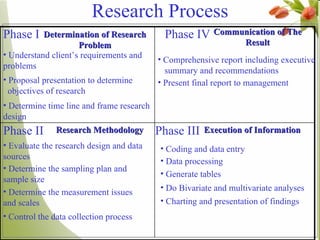
Research Process Phase I Determination of Research Problem Research Methodology Execution of Information Communication of The Result Phase IV Phase II Phase III Understand client’s requirements and problems Proposal presentation to determine  objectives of research Determine time line and frame research design Evaluate the research design and data sources Determine the sampling plan and sample size Determine the measurement issues and scales Control the data collection process Coding and data entry  Data processing Generate tables Do Bivariate and multivariate analyses Charting and presentation of findings Comprehensive report including executive  summary and recommendations Present final report to management
Structured Questionnaire FGDs In-depth interview Secondary data  Qualitative or Subjective Research Discussion Guide Audio Transcription Analysis Executive Summary Recommendations Final Report Formal rating  Procedure  to gather  information  Content  analysis  From exiting  Data sources Data Collection There are six ways to gather information, literature search, talking with  people, focus groups, personal interviews, telephone surveys, mail surveys
Basics of Questionnaire Design
Questionnaire design encompasses : How to write questions How to draft and organize a questionnaire
The Art of Asking Questions We must ask the right question Respondents must understand your  question Respondents must know the answer Respondents must be willing and  able to tell you the answer
Three Simple Rules for Writing a Good Questionnaire Think through your research questions and objectives  before  you write questions Prepare an analysis plan  before  you write questions Ask yourself, in relation to points #1 and #2 above, if each question on your list is necessary? Even if the data would be ‘interesting’ it has to ultimately be used in analysis to make the cut!
Types of Survey Questions 1) Those that ask about behaviors or facts Non-threatening behavior questions Threatening behavior questions Demographics 2) Those that ask about psychological states or attitudes 3) Those that ask about knowledge
What Is A Good Question? One that yields a truthful, accurate answer One that asks for one answer on one dimension One that accommodates all possible contingencies of response One that uses specific, simple language One that has mutually exclusive response options One that produces variability in response One that minimizes social desirability One that is pre-tested
Ask questions one at a time Bad question : In the past 6 months, what major appliances has your household purchased new from the store? Better question : Now I’m going to read a list of household appliances. As I read each one, please tell me whether or not your household has purchased this type of appliance new from the store during the past 6 months. How about… a refrigerator? a kitchen range or oven? a microwave?
Ask questions one at a time Bad Question: Compared to one year ago, are you paying more, less, or about the same for your auto and life insurance? Better Question : Compared to one year ago, are you now paying more, less, or about the same for … a. auto insurance? b. life insurance?
Specify  Specify who, what, when, where and how .  For example, whose income?  What’s included? Over what period of time? Example : “ In 2002, what was your total household income? Please count income from all members of your household, including wages.” Specify through cues for Example People drink beer in many places – for example, at home, at restaurants, at bars, sporting events, at friends’ homes, etc. During the past 30 days, did you drink any beer?
Use words with singular meanings Ambiguous: How would you compare how close you are to family in your current neighborhood to how close you were in your old neighborhood? Would you say your family is closer here, further here, or the same? More Clear: Compared to your last neighborhood, do you now live closer to your family, are you further from your family, or are you about the same distance?
How to draft and organize your questionnaire
Ordering the Questions Segment by topic Ask about related topics together Salient questions take precedence over less salient ones Ask recall backwards in time Use transitions when changing topics – give a sense of progress through the questionnaire Leave objectionable questions (e.g., income) for the end Put demographic questions at the end
How to Start the Questionnaire   Start with easy questions that all respondents can answer with little effort First questions should also be non-threatening Don’t start with knowledge or awareness questions First questions should be directly related to the topic as described in the introduction or advance/cover letter
Survey Intro/Cover Letter Introduction should indicate: who is conducting the survey the topics to be covered in the survey an assurance of confidentiality whether you offer how long it will take depends on mode, topic, population
Physical Format of the Self-Administered Questionnaire Careful formatting is necessary to decrease errors and increase motivation Respondent’s needs must  always  take priority, followed by interviewer and data processors
Physical Format Checklist Number all questions sequentially  Use large, clear type;  don’t crowd ‘ White space:’ Place more blank space between questions than between subcomponents of questions List answer categories vertically instead of horizontally Avoid double/triple ‘banking’ of response choices Be consistent with  direction  of response categories Be consistent with  placement  of response categories
Physical Format, Continued Don’t split questions across pages.  If necessary (e.g., question requires 1.5 pages), restate question and response categories on next page Put special instructions on questionnaire as needed, next to question Distinguish directions from questions Pre-code the questionnaire (vs. check boxes)
Questionnaire Design Steps 1.  Decide what information is needed 2. Search for existing questions 3. Draft new questions/revise existing ones 4. Sequence the questions 5. Get peer evaluation 6. Revise and test on self/co-workers 7. Think-aloud interviews 8. Revise/eliminate questions 9. Prepare interviewer instructions for pilot test
Questionnaire Design Steps   10. Pilot test (10-20 cases) 11. Revise eliminate questions based on respondent and interviewer comments 12. Pilot test again, if necessary 13. Prepare final interviewer instructions 14. Be prepared to modify questionnaires if interviewer training raises problems 15. After interviewing is complete, debrief  interviewers for potential problems 16. Use experience from one study for future planning
Decide to lead   Thank you

Questionnaire Vinay

  • 1.
    JAI SHREE GANESHAHNAMAH Very Good Evening
  • 2.
    We’ll Discuss Whatare we doing? What is questionnaire? What is the need of questionnaire? Importance of questionnaire. How should we design a questionnaire? Steps for a good questionnaire.
  • 3.
    Marketing research: The function that links an organization to its market through the gathering of information (DATA) . This information allows for the identification and definition of market-driven opportunities and problems. The information allows for the generation, refinement and evaluation of marketing actions. It allows for the monitoring of marketing performance and improved understanding of marketing as a business process. Data is a collection of facts or natural phenomena from which conclusions may be drawn
  • 4.
    Research Process PhaseI Determination of Research Problem Research Methodology Execution of Information Communication of The Result Phase IV Phase II Phase III Understand client’s requirements and problems Proposal presentation to determine objectives of research Determine time line and frame research design Evaluate the research design and data sources Determine the sampling plan and sample size Determine the measurement issues and scales Control the data collection process Coding and data entry Data processing Generate tables Do Bivariate and multivariate analyses Charting and presentation of findings Comprehensive report including executive summary and recommendations Present final report to management
  • 5.
    Structured Questionnaire FGDsIn-depth interview Secondary data Qualitative or Subjective Research Discussion Guide Audio Transcription Analysis Executive Summary Recommendations Final Report Formal rating Procedure to gather information Content analysis From exiting Data sources Data Collection There are six ways to gather information, literature search, talking with people, focus groups, personal interviews, telephone surveys, mail surveys
  • 6.
  • 7.
    Questionnaire design encompasses: How to write questions How to draft and organize a questionnaire
  • 8.
    The Art ofAsking Questions We must ask the right question Respondents must understand your question Respondents must know the answer Respondents must be willing and able to tell you the answer
  • 9.
    Three Simple Rulesfor Writing a Good Questionnaire Think through your research questions and objectives before you write questions Prepare an analysis plan before you write questions Ask yourself, in relation to points #1 and #2 above, if each question on your list is necessary? Even if the data would be ‘interesting’ it has to ultimately be used in analysis to make the cut!
  • 10.
    Types of SurveyQuestions 1) Those that ask about behaviors or facts Non-threatening behavior questions Threatening behavior questions Demographics 2) Those that ask about psychological states or attitudes 3) Those that ask about knowledge
  • 11.
    What Is AGood Question? One that yields a truthful, accurate answer One that asks for one answer on one dimension One that accommodates all possible contingencies of response One that uses specific, simple language One that has mutually exclusive response options One that produces variability in response One that minimizes social desirability One that is pre-tested
  • 12.
    Ask questions oneat a time Bad question : In the past 6 months, what major appliances has your household purchased new from the store? Better question : Now I’m going to read a list of household appliances. As I read each one, please tell me whether or not your household has purchased this type of appliance new from the store during the past 6 months. How about… a refrigerator? a kitchen range or oven? a microwave?
  • 13.
    Ask questions oneat a time Bad Question: Compared to one year ago, are you paying more, less, or about the same for your auto and life insurance? Better Question : Compared to one year ago, are you now paying more, less, or about the same for … a. auto insurance? b. life insurance?
  • 14.
    Specify  Specifywho, what, when, where and how . For example, whose income? What’s included? Over what period of time? Example : “ In 2002, what was your total household income? Please count income from all members of your household, including wages.” Specify through cues for Example People drink beer in many places – for example, at home, at restaurants, at bars, sporting events, at friends’ homes, etc. During the past 30 days, did you drink any beer?
  • 15.
    Use words withsingular meanings Ambiguous: How would you compare how close you are to family in your current neighborhood to how close you were in your old neighborhood? Would you say your family is closer here, further here, or the same? More Clear: Compared to your last neighborhood, do you now live closer to your family, are you further from your family, or are you about the same distance?
  • 16.
    How to draftand organize your questionnaire
  • 17.
    Ordering the QuestionsSegment by topic Ask about related topics together Salient questions take precedence over less salient ones Ask recall backwards in time Use transitions when changing topics – give a sense of progress through the questionnaire Leave objectionable questions (e.g., income) for the end Put demographic questions at the end
  • 18.
    How to Startthe Questionnaire Start with easy questions that all respondents can answer with little effort First questions should also be non-threatening Don’t start with knowledge or awareness questions First questions should be directly related to the topic as described in the introduction or advance/cover letter
  • 19.
    Survey Intro/Cover LetterIntroduction should indicate: who is conducting the survey the topics to be covered in the survey an assurance of confidentiality whether you offer how long it will take depends on mode, topic, population
  • 20.
    Physical Format ofthe Self-Administered Questionnaire Careful formatting is necessary to decrease errors and increase motivation Respondent’s needs must always take priority, followed by interviewer and data processors
  • 21.
    Physical Format ChecklistNumber all questions sequentially Use large, clear type; don’t crowd ‘ White space:’ Place more blank space between questions than between subcomponents of questions List answer categories vertically instead of horizontally Avoid double/triple ‘banking’ of response choices Be consistent with direction of response categories Be consistent with placement of response categories
  • 22.
    Physical Format, ContinuedDon’t split questions across pages. If necessary (e.g., question requires 1.5 pages), restate question and response categories on next page Put special instructions on questionnaire as needed, next to question Distinguish directions from questions Pre-code the questionnaire (vs. check boxes)
  • 23.
    Questionnaire Design Steps1. Decide what information is needed 2. Search for existing questions 3. Draft new questions/revise existing ones 4. Sequence the questions 5. Get peer evaluation 6. Revise and test on self/co-workers 7. Think-aloud interviews 8. Revise/eliminate questions 9. Prepare interviewer instructions for pilot test
  • 24.
    Questionnaire Design Steps 10. Pilot test (10-20 cases) 11. Revise eliminate questions based on respondent and interviewer comments 12. Pilot test again, if necessary 13. Prepare final interviewer instructions 14. Be prepared to modify questionnaires if interviewer training raises problems 15. After interviewing is complete, debrief interviewers for potential problems 16. Use experience from one study for future planning
  • 25.
    Decide to lead Thank you