1
Designing a survey questionnaire
Questionnaire Research Flow Chart
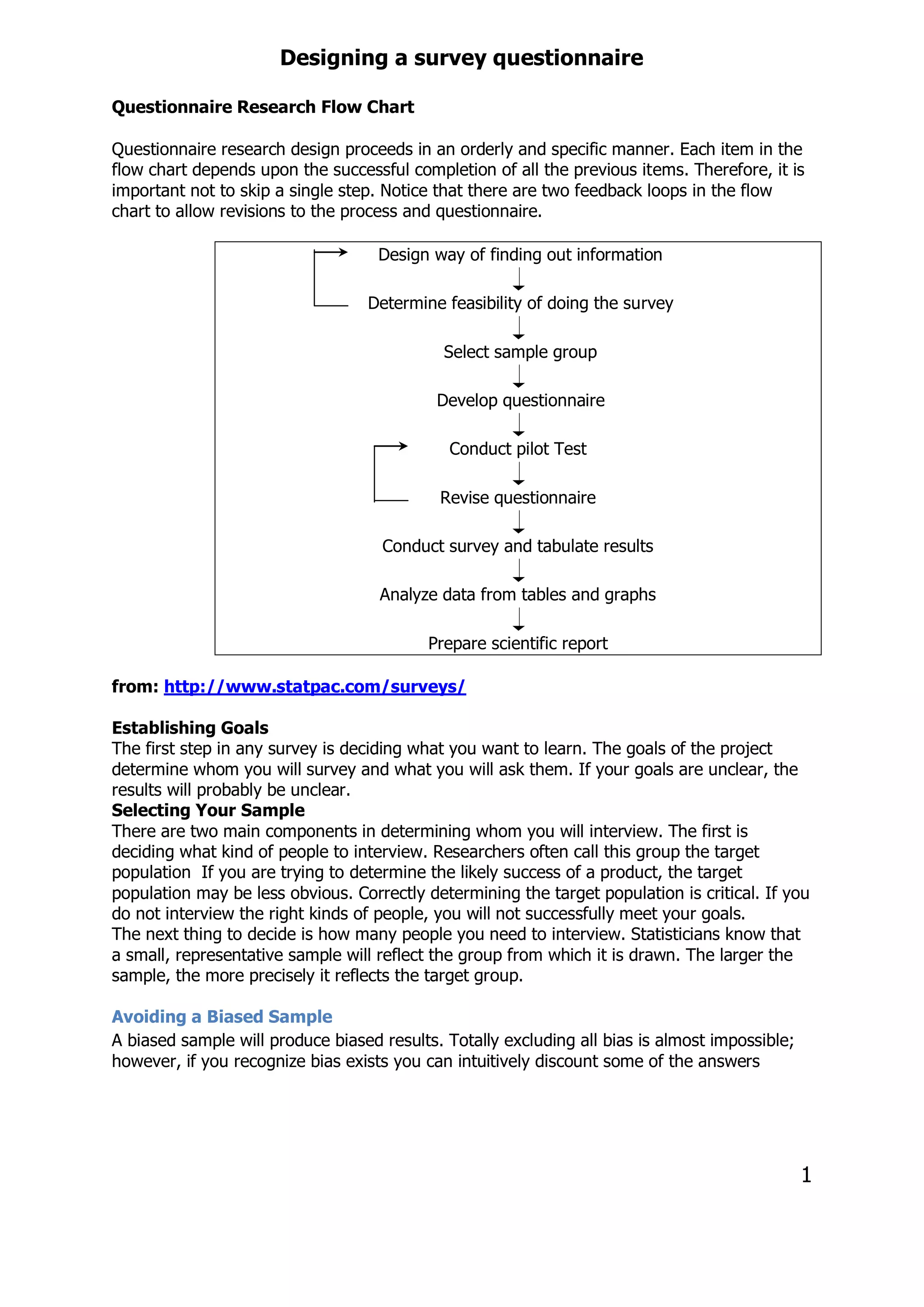
Questionnaire research design proceeds in an orderly and specific manner. Each item in the
flow chart depends upon the successful completion of all the previous items. Therefore, it is
important not to skip a single step. Notice that there are two feedback loops in the flow
chart to allow revisions to the process and questionnaire.
Design way of finding out information
Determine feasibility of doing the survey
Select sample group
Develop questionnaire
Conduct pilot Test
Revise questionnaire
Conduct survey and tabulate results
Analyze data from tables and graphs
Prepare scientific report
from: http://www.statpac.com/surveys/
Establishing Goals
The first step in any survey is deciding what you want to learn. The goals of the project
determine whom you will survey and what you will ask them. If your goals are unclear, the
results will probably be unclear.
Selecting Your Sample
There are two main components in determining whom you will interview. The first is
deciding what kind of people to interview. Researchers often call this group the target
population If you are trying to determine the likely success of a product, the target
population may be less obvious. Correctly determining the target population is critical. If you
do not interview the right kinds of people, you will not successfully meet your goals.
The next thing to decide is how many people you need to interview. Statisticians know that
a small, representative sample will reflect the group from which it is drawn. The larger the
sample, the more precisely it reflects the target group.
Avoiding a Biased Sample
A biased sample will produce biased results. Totally excluding all bias is almost impossible;
however, if you recognize bias exists you can intuitively discount some of the answers
2
Interviewing Methods
Once you have decided on your sample you must decide on your method of data collection.
Each method has advantages and disadvantages.
Personal Interviews
An interview is called personal when the Interviewer asks the questions face-to-face with
the Interviewee. Personal interviews can take place in the home, at a shopping mall, on the
street, outside a movie theatre or polling place, and so on.
Telephone Surveys
Surveying by telephone is the most popular interviewing method in the USA. This is made
possible by nearly universal coverage (96% of homes have a telephone).
Computer Direct Interviews
These are interviews in which the Interviewees enter their own answers directly into a
computer
Email Surveys
Email surveys are both very economical and very fast. More people have email than have
full Internet access. This makes email a better choice than a Web page survey for some
populations. email surveys are limited to simple questionnaires.
Internet/Intranet (Web Page) Surveys
Web surveys are rapidly gaining popularity. They have major speed, cost, and flexibility
advantages, but also significant sampling limitations. These limitations make software
selection especially important and restrict the groups you can study using this technique.
Questionnaire Design
General Considerations
1. The first rule is to design the questionnaire to fit the medium. People responding to
mail or Web surveys cannot easily ask “What exactly do you mean by that?” if they
do not understand a question. Personal questions are sometimes best handled by
mail or computer, where anonymity is most assured.
2. KISS - keep it short and simple.
3. Start with an introduction or welcome message. A good introduction or welcome
message will encourage people to complete your questionnaire. When practical, state
who you are and why you want the information in the survey.
4. Allow a “Don't Know” or “Not Applicable” response to all questions, except to those
in which you are certain that all respondents will have a clear answer
3
Question Types
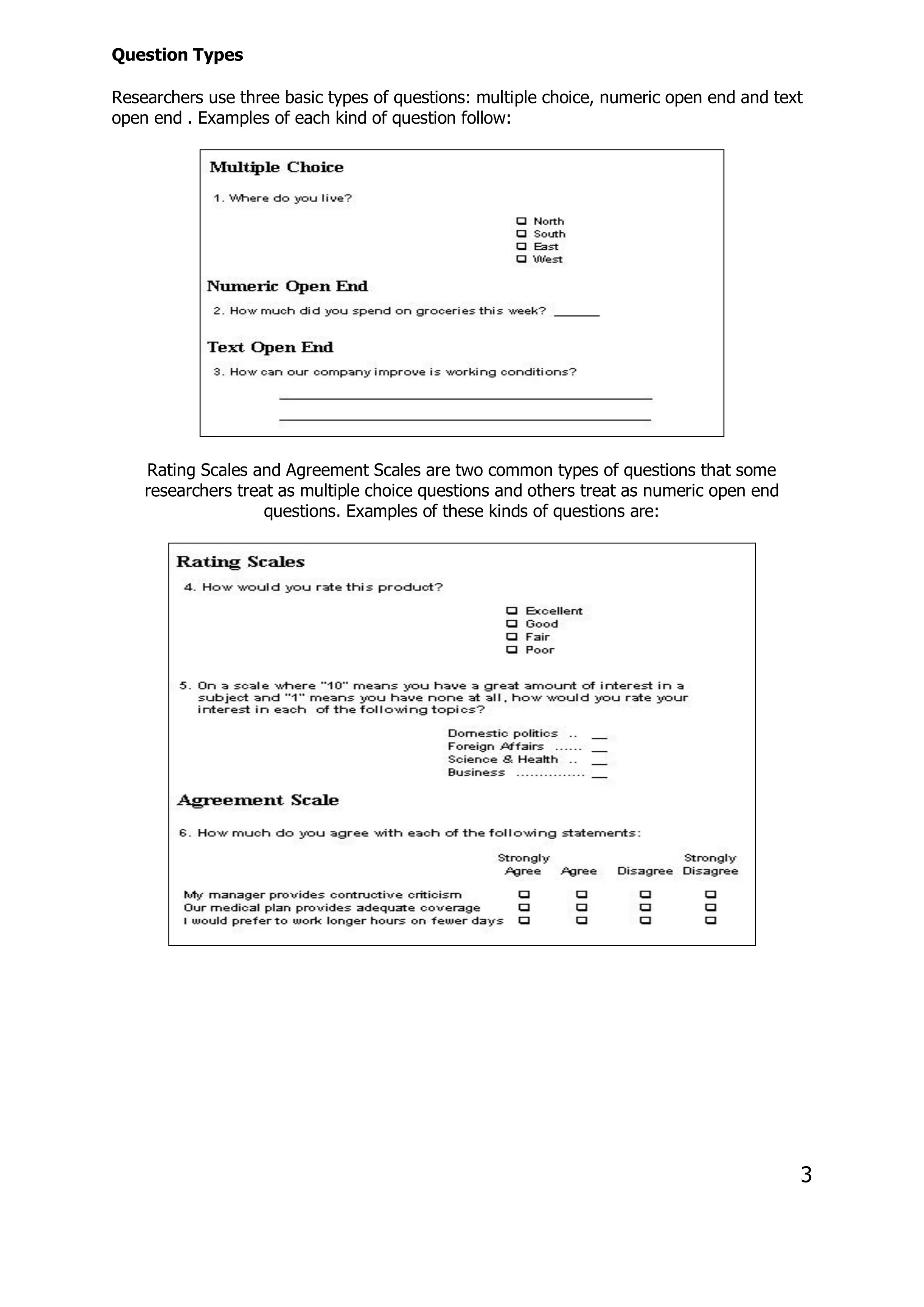
Researchers use three basic types of questions: multiple choice, numeric open end and text
open end . Examples of each kind of question follow:
Rating Scales and Agreement Scales are two common types of questions that some
researchers treat as multiple choice questions and others treat as numeric open end
questions. Examples of these kinds of questions are:
4
Question and Answer Choice Order
There are two broad issues to keep in mind when considering question and answer choice
order. One is how the question and answer choice order can encourage people to complete
your survey. The other issue is how the order of questions or the order of answer choices
could affect the results of your survey.
Ideally, the early questions in a survey should be easy and pleasant to answer. These kinds
of questions encourage people to continue the survey. Grouping together questions on the
same topic also makes the questionnaire easier to answer.
Whenever possible leave difficult or sensitive questions until near the end of your survey. If
people quit at that point anyway, at least they will have answered most of your questions.
Other General Tips
Keep the questionnaire as short as possible. More people will complete a shorter
questionnaire, regardless of the interviewing method. If a question is not necessary, do not
include it.
Start with a Title (e.g., Leisure Activities Survey). Always include a short introduction - who
you are and why you are doing the survey.
Reassure your respondent that his or her responses will not be revealed to your client, but
only combined with many others to learn about overall attitudes.
Include a cover letter with all mail surveys. The most effective cover letters and invitations
include the following elements: Ask the recipient to take the survey. Explain why taking it
will improve some aspect of the recipient's life (it will help improve a product, make an
organization better meet their needs, make their opinions heard). Appeal to the recipient's
sense of altruism ("please help"). Ask the recipient again to take the survey.
The overriding consideration in questionnaire design is to make sure your
questions can accurately tell you what you want to learn. The way you phrase a
question can change the answers you get. Try to make sure the wording does not
favor one answer choice over another.
Pre-test the Questionnaire
The last step in questionnaire design is to test a questionnaire with a small number of
interviews before conducting your main interviews. Ideally, you should test the survey on
the same kinds of people you will include in the main study. If that is not possible, at least
have a few people, other than the question writer, try the questionnaire. This kind of test
run can reveal unanticipated problems with question wording, instructions to skip questions,
etc. It can help you see if the interviewees understand your questions and give useful
answers.
If you change any questions after a pre-test, you should not combine the results from the
pre-test with the results of post-test interviews. Choosing sensible questions and
administering surveys with sensitivity and common sense will improve the quality of your
results dramatically.
More information available from: http://www.surveysystem.com/sdesign.htm#goals

Designing a survey questionnaire

  • 1.
    1 Designing a surveyquestionnaire Questionnaire Research Flow Chart Questionnaire research design proceeds in an orderly and specific manner. Each item in the flow chart depends upon the successful completion of all the previous items. Therefore, it is important not to skip a single step. Notice that there are two feedback loops in the flow chart to allow revisions to the process and questionnaire. Design way of finding out information Determine feasibility of doing the survey Select sample group Develop questionnaire Conduct pilot Test Revise questionnaire Conduct survey and tabulate results Analyze data from tables and graphs Prepare scientific report from: http://www.statpac.com/surveys/ Establishing Goals The first step in any survey is deciding what you want to learn. The goals of the project determine whom you will survey and what you will ask them. If your goals are unclear, the results will probably be unclear. Selecting Your Sample There are two main components in determining whom you will interview. The first is deciding what kind of people to interview. Researchers often call this group the target population If you are trying to determine the likely success of a product, the target population may be less obvious. Correctly determining the target population is critical. If you do not interview the right kinds of people, you will not successfully meet your goals. The next thing to decide is how many people you need to interview. Statisticians know that a small, representative sample will reflect the group from which it is drawn. The larger the sample, the more precisely it reflects the target group. Avoiding a Biased Sample A biased sample will produce biased results. Totally excluding all bias is almost impossible; however, if you recognize bias exists you can intuitively discount some of the answers
  • 2.
    2 Interviewing Methods Once youhave decided on your sample you must decide on your method of data collection. Each method has advantages and disadvantages. Personal Interviews An interview is called personal when the Interviewer asks the questions face-to-face with the Interviewee. Personal interviews can take place in the home, at a shopping mall, on the street, outside a movie theatre or polling place, and so on. Telephone Surveys Surveying by telephone is the most popular interviewing method in the USA. This is made possible by nearly universal coverage (96% of homes have a telephone). Computer Direct Interviews These are interviews in which the Interviewees enter their own answers directly into a computer Email Surveys Email surveys are both very economical and very fast. More people have email than have full Internet access. This makes email a better choice than a Web page survey for some populations. email surveys are limited to simple questionnaires. Internet/Intranet (Web Page) Surveys Web surveys are rapidly gaining popularity. They have major speed, cost, and flexibility advantages, but also significant sampling limitations. These limitations make software selection especially important and restrict the groups you can study using this technique. Questionnaire Design General Considerations 1. The first rule is to design the questionnaire to fit the medium. People responding to mail or Web surveys cannot easily ask “What exactly do you mean by that?” if they do not understand a question. Personal questions are sometimes best handled by mail or computer, where anonymity is most assured. 2. KISS - keep it short and simple. 3. Start with an introduction or welcome message. A good introduction or welcome message will encourage people to complete your questionnaire. When practical, state who you are and why you want the information in the survey. 4. Allow a “Don't Know” or “Not Applicable” response to all questions, except to those in which you are certain that all respondents will have a clear answer
  • 3.
    3 Question Types Researchers usethree basic types of questions: multiple choice, numeric open end and text open end . Examples of each kind of question follow: Rating Scales and Agreement Scales are two common types of questions that some researchers treat as multiple choice questions and others treat as numeric open end questions. Examples of these kinds of questions are:
  • 4.
    4 Question and AnswerChoice Order There are two broad issues to keep in mind when considering question and answer choice order. One is how the question and answer choice order can encourage people to complete your survey. The other issue is how the order of questions or the order of answer choices could affect the results of your survey. Ideally, the early questions in a survey should be easy and pleasant to answer. These kinds of questions encourage people to continue the survey. Grouping together questions on the same topic also makes the questionnaire easier to answer. Whenever possible leave difficult or sensitive questions until near the end of your survey. If people quit at that point anyway, at least they will have answered most of your questions. Other General Tips Keep the questionnaire as short as possible. More people will complete a shorter questionnaire, regardless of the interviewing method. If a question is not necessary, do not include it. Start with a Title (e.g., Leisure Activities Survey). Always include a short introduction - who you are and why you are doing the survey. Reassure your respondent that his or her responses will not be revealed to your client, but only combined with many others to learn about overall attitudes. Include a cover letter with all mail surveys. The most effective cover letters and invitations include the following elements: Ask the recipient to take the survey. Explain why taking it will improve some aspect of the recipient's life (it will help improve a product, make an organization better meet their needs, make their opinions heard). Appeal to the recipient's sense of altruism ("please help"). Ask the recipient again to take the survey. The overriding consideration in questionnaire design is to make sure your questions can accurately tell you what you want to learn. The way you phrase a question can change the answers you get. Try to make sure the wording does not favor one answer choice over another. Pre-test the Questionnaire The last step in questionnaire design is to test a questionnaire with a small number of interviews before conducting your main interviews. Ideally, you should test the survey on the same kinds of people you will include in the main study. If that is not possible, at least have a few people, other than the question writer, try the questionnaire. This kind of test run can reveal unanticipated problems with question wording, instructions to skip questions, etc. It can help you see if the interviewees understand your questions and give useful answers. If you change any questions after a pre-test, you should not combine the results from the pre-test with the results of post-test interviews. Choosing sensible questions and administering surveys with sensitivity and common sense will improve the quality of your results dramatically. More information available from: http://www.surveysystem.com/sdesign.htm#goals