Basic Safety Concepts in
       Nuclear Engineering
               Dr. Gernot Thuma, GRS

3rd International Disaster and Risk Conference (IDRC),
       30 May - 3 June 2010, Davos, Switzerland
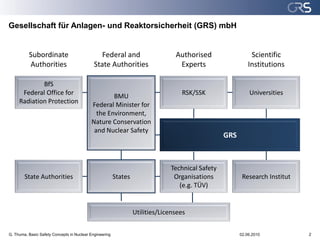
Gesellschaft für Anlagen- und Reaktorsicherheit (GRS) mbH


          Subordinate                           Federal and                      Authorised                  Scientific
          Authorities                        State Authorities                    Experts                   Institutions

             BfS
      Federal Office for                                                           RSK/SSK                  Universities
                                                   BMU
     Radiation Protection
                                           Federal Minister for
                                             the Environment,
                                           Nature Conservation
                                            and Nuclear Safety
                                                                                                  GRS


                                                                               Technical Safety
        State Authorities                                States                 Organisations            Research Institut
                                                                                  (e.g. TÜV)


                                                                  Utilities/Licensees


G. Thuma, Basic Safety Concepts in Nuclear Engineering                                                  02.06.2010           2
Outline

 Nuclear Energy Production
 Protection Goals (Nuclear Safety Goals)
 Safety Concepts
  • (Example for the Combined Effect of Safety Measures)
 Application to Conventional Industrial Facilities


G. Thuma, Basic Safety Concepts in Nuclear Engineering     02.06.2010   3
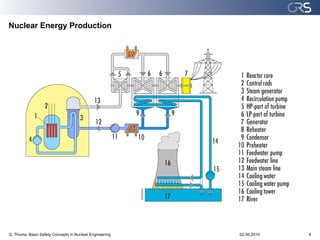
Nuclear Energy Production


G. Thuma, Basic Safety Concepts in Nuclear Engineering   02.06.2010   4
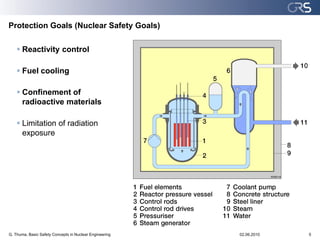
Protection Goals (Nuclear Safety Goals)

     Reactivity control

     Fuel cooling

     Confinement of
      radioactive materials

     Limitation of radiation
      exposure


G. Thuma, Basic Safety Concepts in Nuclear Engineering   02.06.2010   5
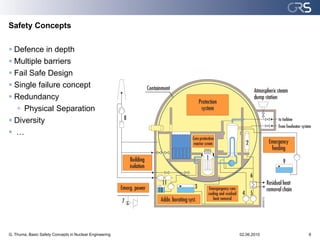
Safety Concepts

 Defence in depth
 Multiple barriers
 Fail Safe Design
 Single failure concept
 Redundancy
  + Physical Separation
 Diversity
 …


G. Thuma, Basic Safety Concepts in Nuclear Engineering   02.06.2010   6
Defence in Depth


The concept of defence in depth, as applied to all safety activities, whether
organizational, behavioural or design related, ensures that they are subject to
overlapping provisions, so that if a failure were to occur, it would be detected and
compensated for or corrected by appropriate measures […] Application of the
concept of defence in depth throughout design and operation provides a graded
protection against a wide variety of transients, anticipated operational
occurrences and accidents, including those resulting from equipment failure or
human action within the plant, and events that originate outside the plant.
                                               [IAEA Safety Requirements, NS-R-1, Safety of Nuclear Power Plants: Design]


G. Thuma, Basic Safety Concepts in Nuclear Engineering                                          02.06.2010              7
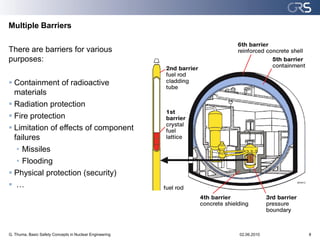
Multiple Barriers

There are barriers for various
purposes:

 Containment of radioactive
  materials
 Radiation protection
 Fire protection
 Limitation of effects of component
  failures
   • Missiles
   • Flooding
 Physical protection (security)
 …


G. Thuma, Basic Safety Concepts in Nuclear Engineering   02.06.2010   8
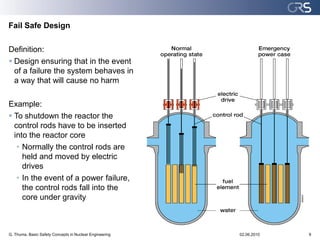
Fail Safe Design

Definition:
 Design ensuring that in the event
  of a failure the system behaves in
  a way that will cause no harm

Example:
 To shutdown the reactor the
  control rods have to be inserted
  into the reactor core
   • Normally the control rods are
     held and moved by electric
     drives
   • In the event of a power failure,
     the control rods fall into the
     core under gravity


G. Thuma, Basic Safety Concepts in Nuclear Engineering   02.06.2010   9
Single Failure Concept

Aim:
 Safety function available (100 %)

Assumption:
 Failure of a safety installation due to a random single failure
  with the most unfavourable effect
 Unavailability of a safety installation due to maintenance measures
  with the most unfavourable effect


Solutions:
 3 sub-systems á 100 %
 4 sub-systems á 50 %

Advantage of the 4 x 50 % solution:
 In some situations 50 % are enough to accomplish the task


G. Thuma, Basic Safety Concepts in Nuclear Engineering              02.06.2010   10
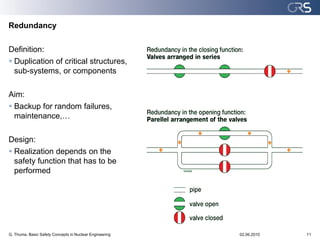
Redundancy

Definition:
 Duplication of critical structures,
  sub-systems, or components

Aim:
 Backup for random failures,
  maintenance,…

Design:
 Realization depends on the
  safety function that has to be
  performed


G. Thuma, Basic Safety Concepts in Nuclear Engineering   02.06.2010   11
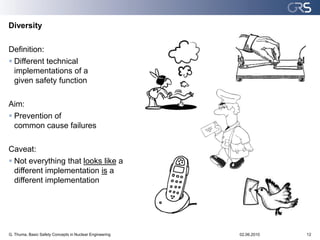
Diversity

Definition:
 Different technical
  implementations of a
  given safety function

Aim:
 Prevention of
  common cause failures

Caveat:
 Not everything that looks like a
  different implementation is a
  different implementation


G. Thuma, Basic Safety Concepts in Nuclear Engineering   02.06.2010   12
What else?

 Design basis accidents
    • 30 minutes criterion
           No operator action required during the first 30 minutes of an accident
 Internal and external hazards
 Appropriate instructions
    • Operating and maintenance instruction
      (normal operation and operational occurrences)
    • For incidents and accidents:
           Event sequence based workflow instruction
           (operational occurrences and design basis accidents)
           Protection goal oriented instructions (other accidents)
    • Internal accident management measures (severe accidents)
    • Off-site emergency response measures (severe accidents)
 Evaluation of the operating experience
 Systematic safety assessments (on a regular basis, e.g. every 10 years)
    • Deterministic safety assessments + probabilistic safety assessments


G. Thuma, Basic Safety Concepts in Nuclear Engineering                        02.06.2010   13
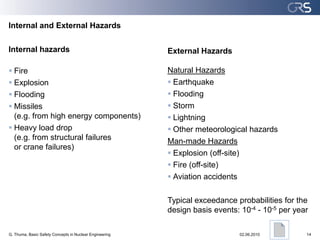
Internal and External Hazards

Internal hazards                                         External Hazards

 Fire                                                   Natural Hazards
 Explosion                                               Earthquake
 Flooding                                                Flooding
 Missiles                                                Storm
  (e.g. from high energy components)                      Lightning
 Heavy load drop                                         Other meteorological hazards
  (e.g. from structural failures                         Man-made Hazards
  or crane failures)
                                                          Explosion (off-site)
                                                          Fire (off-site)
                                                          Aviation accidents

                                                         Typical exceedance probabilities for the
                                                         design basis events: 10-4 - 10-5 per year

G. Thuma, Basic Safety Concepts in Nuclear Engineering                        02.06.2010         14
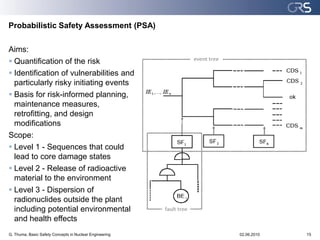
Probabilistic Safety Assessment (PSA)

Aims:
 Quantification of the risk
 Identification of vulnerabilities and
  particularly risky initiating events
 Basis for risk-informed planning,
  maintenance measures,
  retrofitting, and design
  modifications
Scope:
 Level 1 - Sequences that could
  lead to core damage states
 Level 2 - Release of radioactive
  material to the environment
 Level 3 - Dispersion of
  radionuclides outside the plant
  including potential environmental
  and health effects
G. Thuma, Basic Safety Concepts in Nuclear Engineering   02.06.2010   15
Summary of Safety Concepts

 Defence in Depth
 Multiple Barriers
 Fail Safe Design
 Single Failure Concept
 Redundancy
 Diversity
 Design basis accidents
 Internal and external hazards
 Appropriate instructions
 Evaluation of the operating experience
 Systematic safety assessments


G. Thuma, Basic Safety Concepts in Nuclear Engineering   02.06.2010   16
Application to Conventional Industrial Facilities

 Application of these safety concepts not limited to nuclear installations

 Adaptation requires only minor changes
  • Definition of suitable safety goals
  • Specification of a target safety level
    proportionate to the complexity and potential hazard of the installation

 Some safety concepts already applied to high-risk industrial facilities
  • But implementation in conventional industrial facilities not yet as common
    and stringent as in nuclear engineering

       Consequent application of these safety concepts
        to industrial facilities would significantly reduce
        the risk of industrial accidents with severe consequences
        for the public and the environment


G. Thuma, Basic Safety Concepts in Nuclear Engineering              02.06.2010   17
For further information please contact:


             Dr. Gernot Thuma

                           Gesellschaft für Anlagen- und Reaktorsicherheit (GRS) mbH
                           Schwertnergasse 1
                           50667 Köln
                           Germany

                           phone: +49-(0)221-2068-607
                           fax:   +49-(0)221-2068-10607
                           email: Gernot.Thuma@grs.de


G. Thuma, Basic Safety Concepts in Nuclear Engineering                    02.06.2010   18

Basic Safety Concepts in Nuclear Engineering

  • 1.
    Basic Safety Conceptsin Nuclear Engineering Dr. Gernot Thuma, GRS 3rd International Disaster and Risk Conference (IDRC), 30 May - 3 June 2010, Davos, Switzerland
  • 2.
    Gesellschaft für Anlagen-und Reaktorsicherheit (GRS) mbH Subordinate Federal and Authorised Scientific Authorities State Authorities Experts Institutions BfS Federal Office for RSK/SSK Universities BMU Radiation Protection Federal Minister for the Environment, Nature Conservation and Nuclear Safety GRS Technical Safety State Authorities States Organisations Research Institut (e.g. TÜV) Utilities/Licensees G. Thuma, Basic Safety Concepts in Nuclear Engineering 02.06.2010 2
  • 3.
    Outline  Nuclear EnergyProduction  Protection Goals (Nuclear Safety Goals)  Safety Concepts • (Example for the Combined Effect of Safety Measures)  Application to Conventional Industrial Facilities G. Thuma, Basic Safety Concepts in Nuclear Engineering 02.06.2010 3
  • 4.
    Nuclear Energy Production G.Thuma, Basic Safety Concepts in Nuclear Engineering 02.06.2010 4
  • 5.
    Protection Goals (NuclearSafety Goals)  Reactivity control  Fuel cooling  Confinement of radioactive materials  Limitation of radiation exposure G. Thuma, Basic Safety Concepts in Nuclear Engineering 02.06.2010 5
  • 6.
    Safety Concepts  Defencein depth  Multiple barriers  Fail Safe Design  Single failure concept  Redundancy + Physical Separation  Diversity  … G. Thuma, Basic Safety Concepts in Nuclear Engineering 02.06.2010 6
  • 7.
    Defence in Depth Theconcept of defence in depth, as applied to all safety activities, whether organizational, behavioural or design related, ensures that they are subject to overlapping provisions, so that if a failure were to occur, it would be detected and compensated for or corrected by appropriate measures […] Application of the concept of defence in depth throughout design and operation provides a graded protection against a wide variety of transients, anticipated operational occurrences and accidents, including those resulting from equipment failure or human action within the plant, and events that originate outside the plant. [IAEA Safety Requirements, NS-R-1, Safety of Nuclear Power Plants: Design] G. Thuma, Basic Safety Concepts in Nuclear Engineering 02.06.2010 7
  • 8.
    Multiple Barriers There arebarriers for various purposes:  Containment of radioactive materials  Radiation protection  Fire protection  Limitation of effects of component failures • Missiles • Flooding  Physical protection (security)  … G. Thuma, Basic Safety Concepts in Nuclear Engineering 02.06.2010 8
  • 9.
    Fail Safe Design Definition: Design ensuring that in the event of a failure the system behaves in a way that will cause no harm Example:  To shutdown the reactor the control rods have to be inserted into the reactor core • Normally the control rods are held and moved by electric drives • In the event of a power failure, the control rods fall into the core under gravity G. Thuma, Basic Safety Concepts in Nuclear Engineering 02.06.2010 9
  • 10.
    Single Failure Concept Aim: Safety function available (100 %) Assumption:  Failure of a safety installation due to a random single failure with the most unfavourable effect  Unavailability of a safety installation due to maintenance measures with the most unfavourable effect Solutions:  3 sub-systems á 100 %  4 sub-systems á 50 % Advantage of the 4 x 50 % solution:  In some situations 50 % are enough to accomplish the task G. Thuma, Basic Safety Concepts in Nuclear Engineering 02.06.2010 10
  • 11.
    Redundancy Definition:  Duplication ofcritical structures, sub-systems, or components Aim:  Backup for random failures, maintenance,… Design:  Realization depends on the safety function that has to be performed G. Thuma, Basic Safety Concepts in Nuclear Engineering 02.06.2010 11
  • 12.
    Diversity Definition:  Different technical implementations of a given safety function Aim:  Prevention of common cause failures Caveat:  Not everything that looks like a different implementation is a different implementation G. Thuma, Basic Safety Concepts in Nuclear Engineering 02.06.2010 12
  • 13.
    What else?  Designbasis accidents • 30 minutes criterion No operator action required during the first 30 minutes of an accident  Internal and external hazards  Appropriate instructions • Operating and maintenance instruction (normal operation and operational occurrences) • For incidents and accidents: Event sequence based workflow instruction (operational occurrences and design basis accidents) Protection goal oriented instructions (other accidents) • Internal accident management measures (severe accidents) • Off-site emergency response measures (severe accidents)  Evaluation of the operating experience  Systematic safety assessments (on a regular basis, e.g. every 10 years) • Deterministic safety assessments + probabilistic safety assessments G. Thuma, Basic Safety Concepts in Nuclear Engineering 02.06.2010 13
  • 14.
    Internal and ExternalHazards Internal hazards External Hazards  Fire Natural Hazards  Explosion  Earthquake  Flooding  Flooding  Missiles  Storm (e.g. from high energy components)  Lightning  Heavy load drop  Other meteorological hazards (e.g. from structural failures Man-made Hazards or crane failures)  Explosion (off-site)  Fire (off-site)  Aviation accidents Typical exceedance probabilities for the design basis events: 10-4 - 10-5 per year G. Thuma, Basic Safety Concepts in Nuclear Engineering 02.06.2010 14
  • 15.
    Probabilistic Safety Assessment(PSA) Aims:  Quantification of the risk  Identification of vulnerabilities and particularly risky initiating events  Basis for risk-informed planning, maintenance measures, retrofitting, and design modifications Scope:  Level 1 - Sequences that could lead to core damage states  Level 2 - Release of radioactive material to the environment  Level 3 - Dispersion of radionuclides outside the plant including potential environmental and health effects G. Thuma, Basic Safety Concepts in Nuclear Engineering 02.06.2010 15
  • 16.
    Summary of SafetyConcepts  Defence in Depth  Multiple Barriers  Fail Safe Design  Single Failure Concept  Redundancy  Diversity  Design basis accidents  Internal and external hazards  Appropriate instructions  Evaluation of the operating experience  Systematic safety assessments G. Thuma, Basic Safety Concepts in Nuclear Engineering 02.06.2010 16
  • 17.
    Application to ConventionalIndustrial Facilities  Application of these safety concepts not limited to nuclear installations  Adaptation requires only minor changes • Definition of suitable safety goals • Specification of a target safety level proportionate to the complexity and potential hazard of the installation  Some safety concepts already applied to high-risk industrial facilities • But implementation in conventional industrial facilities not yet as common and stringent as in nuclear engineering  Consequent application of these safety concepts to industrial facilities would significantly reduce the risk of industrial accidents with severe consequences for the public and the environment G. Thuma, Basic Safety Concepts in Nuclear Engineering 02.06.2010 17
  • 18.
    For further informationplease contact: Dr. Gernot Thuma Gesellschaft für Anlagen- und Reaktorsicherheit (GRS) mbH Schwertnergasse 1 50667 Köln Germany phone: +49-(0)221-2068-607 fax: +49-(0)221-2068-10607 email: Gernot.Thuma@grs.de G. Thuma, Basic Safety Concepts in Nuclear Engineering 02.06.2010 18