Electricity from Nuclear
Advantages of Nuclear Power
• Nuclear electricity is reliable and relatively cheap
(with an average generating cost of 2.9 cents
per kW/h) once the reactor is in place and
operating.
• Large reserves of Uranium in United States -
Fuel for nuclear power plants will not run out for
tens of thousands of years
• Nuclear power plants contribute no greenhouse
gasses and few atmospheric pollutants
Disadvantages of Nuclear Power
• Uranium is ultimately a nonrenewable resource.
• Nuclear power plants are extremely costly to
build.
• The slight possibility that nuclear power plants
can have catastrophic failures.
• Large environmental impact during the mining
and processing stages of uranium are numerous.
• Nuclear waste (Spent nuclear fuel) is extremely
hazardous and must be stored safely for
thousands of years.
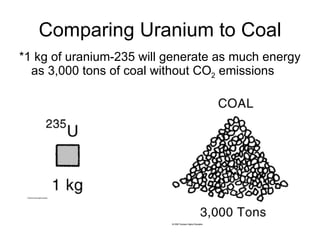
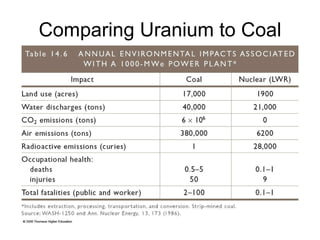
Comparing Uranium to Coal
*1 kg of uranium-235 will generate as much energy
as 3,000 tons of coal without CO2 emissions
Comparing Uranium to Coal
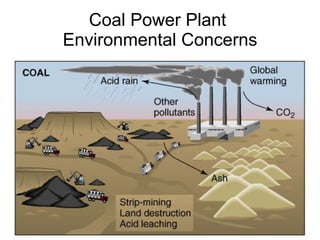
Coal Power Plant
Environmental Concerns
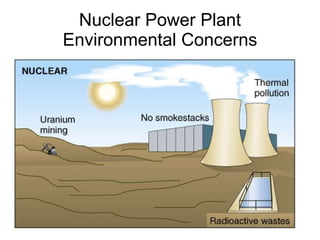
Nuclear Power Plant
Environmental Concerns
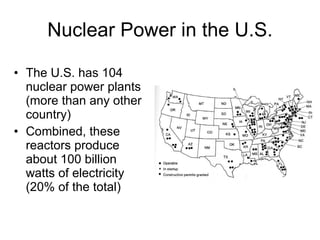
Nuclear Power in the U.S.
• The U.S. has 104
nuclear power plants
(more than any other
country)
• Combined, these
reactors produce
about 100 billion
watts of electricity
(20% of the total)
Nuclear Power in the U.S.
• No new reactors have been completed in
the U.S. since 1979.
• Why???
– High Operating Costs
– Liability Problems
– Wastes
– Health Concerns
– Terrorism
– Public Misconceptions
Illinois Nuclear Power
• Nuclear power typically accounts for nearly
one-half of Illinois electricity generation and
more than one-tenth of all the nuclear power
generated in the United States.
• With 11 operating reactors at six nuclear power
plants, Illinois ranks first among the States in
nuclear generation.
• The growth of the Illinois nuclear industry is due
largely to State government initiatives, which
began encouraging nuclear power development
in the 1950s
Illinois Nuclear Power
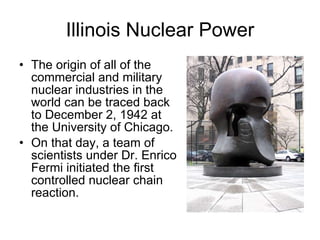
• The origin of all of the
commercial and military
nuclear industries in the
world can be traced back
to December 2, 1942 at
the University of Chicago.
• On that day, a team of
scientists under Dr. Enrico
Fermi initiated the first
controlled nuclear chain
reaction.
Illinois Nuclear Power
• There are 6 operating nuclear power plants in
Illinois: Braidwood, Byron, Clinton, Dresden,
LaSalle, and Quad Cities.
• With the sole exception of the single-unit Clinton
plant, each of these facilities has two reactors.
• The two reactors at Braidwood and both reactors
at Byron are pressurized light water reactors
(PWR).
• The reactors at the other facilities (Clinton,
Dresden, LaSalle, and Quad Cities are boiling
water reactors (BWR).
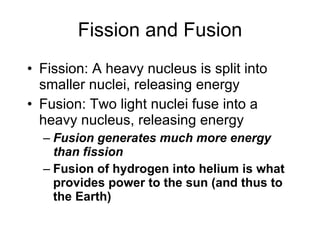
Fission and Fusion
• Fission: A heavy nucleus is split into
smaller nuclei, releasing energy
• Fusion: Two light nuclei fuse into a
heavy nucleus, releasing energy
– Fusion generates much more energy
than fission
– Fusion of hydrogen into helium is what
provides power to the sun (and thus to
the Earth)
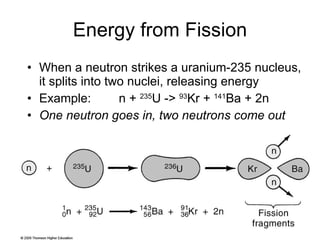
Energy from Fission
• When a neutron strikes a uranium-235 nucleus,
it splits into two nuclei, releasing energy
• Example: n + 235
U -> 93
Kr + 141
Ba + 2n
• One neutron goes in, two neutrons come out
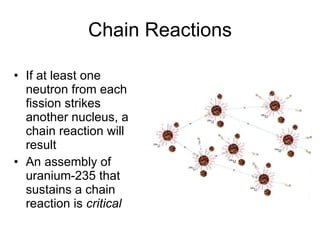
Chain Reactions
• If at least one
neutron from each
fission strikes
another nucleus, a
chain reaction will
result
• An assembly of
uranium-235 that
sustains a chain
reaction is critical
Power Plants and Bombs
• Natural uranium contains 99.3% uranium-238
and 0.7% uranium-235
• Only uranium-235 can create fission chain
reactions
– Nuclear power plants use uranium that has
been enriched to 3% uranium-235
– Nuclear bombs use uranium that has been
enriched to 95% uranium-235
• 3% enriched uranium can never explode!
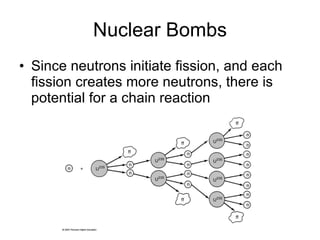
Nuclear Bombs
• Since neutrons initiate fission, and each
fission creates more neutrons, there is
potential for a chain reaction
Nuclear Bombs
• Have to have enough fissile material
around to intercept liberated neutrons
• Critical mass for 235
U is about 15 kg, for
239
Pu it’s about 5 kg
• Bomb is dirt-simple: separate two sub-
critical masses and just put them next to
each other when you want them to
explode!
– difficulty is in enriching natural uranium to
mostly 235
U
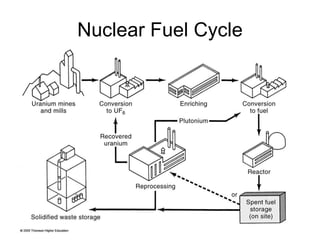
Nuclear Fuel Cycle
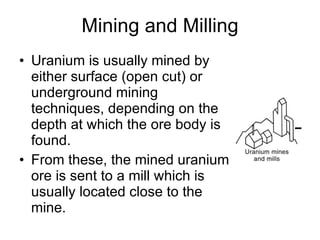
Mining and Milling
• Uranium is usually mined by
either surface (open cut) or
underground mining
techniques, depending on the
depth at which the ore body is
found.
• From these, the mined uranium
ore is sent to a mill which is
usually located close to the
mine.
Mining and Milling
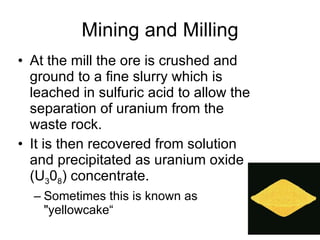
• At the mill the ore is crushed and
ground to a fine slurry which is
leached in sulfuric acid to allow the
separation of uranium from the
waste rock.
• It is then recovered from solution
and precipitated as uranium oxide
(U308) concentrate.
– Sometimes this is known as
"yellowcake“
Conversion
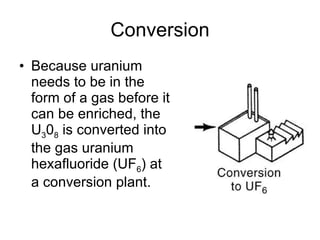
• Because uranium
needs to be in the
form of a gas before it
can be enriched, the
U308 is converted into
the gas uranium
hexafluoride (UF6) at
a conversion plant.
Enriching
• Need to enrich uranium to at least 3% U-235 for
a power plant
• Gaseous Diffusion Method
– UF6 (hexafluoride) gas heated
– U-238 is heavier than U-235
– Hexafluoride Gas can be separated into two streams
• Low velocity U-238
• High Velocity U-235
• Centrifuge Method
– Gas spun in centrifuge
– Lighter U-235 will separate from heavier U-238
Fuel Conversion
• Enriched Uranium transported to a fuel
fabrication plant where it is converted to
uranium dioxide (UO2) powder and
pressed into small pellets.
• These pellets are inserted into thin tubes,
usually of a zirconium alloy (zircalloy) or
stainless steel, to form fuel rods.
• The rods are then sealed and assembled
in clusters to form fuel assemblies for use
in the core of the nuclear reactor.
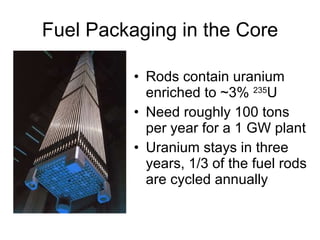
Fuel Packaging in the Core
• Rods contain uranium
enriched to ~3% 235
U
• Need roughly 100 tons
per year for a 1 GW plant
• Uranium stays in three
years, 1/3 of the fuel rods
are cycled annually
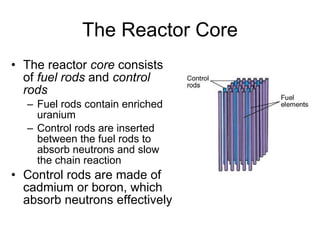
The Reactor Core
• The reactor core consists
of fuel rods and control
rods
– Fuel rods contain enriched
uranium
– Control rods are inserted
between the fuel rods to
absorb neutrons and slow
the chain reaction
• Control rods are made of
cadmium or boron, which
absorb neutrons effectively
Moderators
• Neutrons produced during fission in the core
are moving too fast to cause a chain reaction
– Note: This is not an issue with a bomb, where
fissile uranium is so tightly packed that fast moving
neutrons can still do the job.
• A moderator is required to slow down the
neutrons
• In Nuclear Power Plants water (light or
heavy) or graphite acts as the moderator
– Graphite increases efficiency but can be unstable
(Chernobyl)
Light vs. Heavy Water
• 99.99% of water molecules contain normal
hydrogen (i.e. with a single proton in the
nucleus)
• Water can be specially prepared so that the
molecules contain deuterium (i.e. hydrogen with
a proton and a neutron in the nucleus)
• Normal water is called light water while water
containing deuterium is called heavy water
• Heavy water is a much better moderator but is
very expensive to make
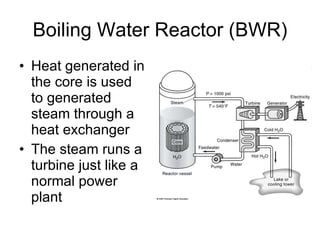
Boiling Water Reactor (BWR)
• Heat generated in
the core is used
to generated
steam through a
heat exchanger
• The steam runs a
turbine just like a
normal power
plant
Pressurized
Water
Reactor
(PWR)
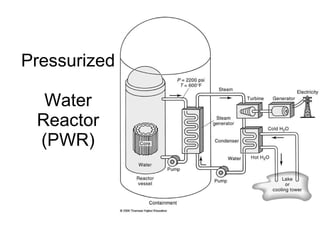
Pressurized Water Reactor (PWR)
• Water in the core heated top 315°C but is
not turned into steam due to high pressure
in the primary loop.
• Heat exchanger used to transfer heat into
secondary loop where water is turned to
steam to power turbine.
• Steam used to power turbine never comes
directly in contact with radioactive
materials.
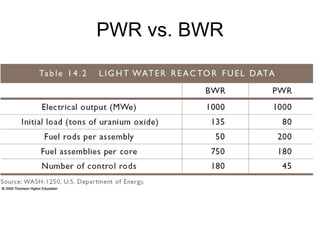
PWR vs. BWR
Spent Nuclear Storage
• Fuel rods must be replaced every 3 years.
• Spent Fuel Rods are temporarily stored in
special ponds which are usually located at
the reactor site.
• The water in the ponds serves the dual
purpose of acting as a barrier against
radiation and dispersing the heat from the
spent fuel.
Spent Fuel Rods Radiation
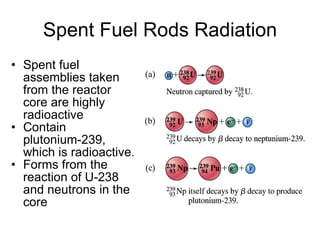
• Spent fuel
assemblies taken
from the reactor
core are highly
radioactive
• Contain
plutonium-239,
which is radioactive.
• Forms from the
reaction of U-238
and neutrons in the
core
Fate of Spent Fuel
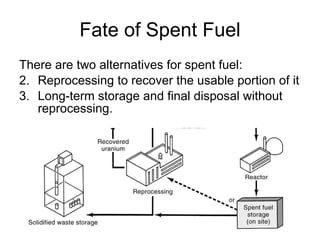
There are two alternatives for spent fuel:
2. Reprocessing to recover the usable portion of it
3. Long-term storage and final disposal without
reprocessing.
Uranium Reprocessing
• Spent fuel still contains approximately 96%
of its original uranium, of which the
fissionable U-235 content has been
reduced to less than 1%.
• About 3% of spent fuel comprises waste
products and the remaining 1% is plutonium
produced while the fuel was in the reactor
• Reprocessing extracts useable fissile U-238
and Plutonium from the spent fuel rods
Uranium Reprocessing
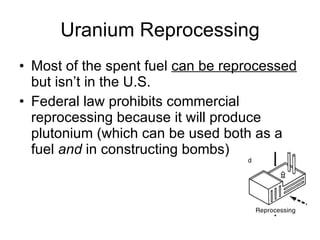
• Most of the spent fuel can be reprocessed
but isn’t in the U.S.
• Federal law prohibits commercial
reprocessing because it will produce
plutonium (which can be used both as a
fuel and in constructing bombs)
Nuclear Waste Disposal
• In the U.S., no high-level nuclear waste is ever
disposed of--it sits in specially designed pools
resembling large swimming pools (water cools the
fuel and acts as a radiation shield) or in specially
designed dry storage containers.
• Spent nuclear fuel must be isolated for thousands
of years
• After 10,000 years of radioactive decay, according
to EPA standards, the spent nuclear fuel will no
longer pose a threat to public health and
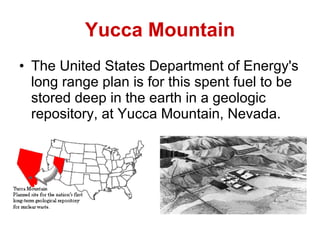
Yucca Mountain
• The United States Department of Energy's
long range plan is for this spent fuel to be
stored deep in the earth in a geologic
repository, at Yucca Mountain, Nevada.
Concerns about Yucca Mountain
• Possible health risks to those living near
Yucca Mountain and transportation routes
• Eventual corrosion of the metal barrels
containing the waste
• Located in an earthquake region and
contains many interconnected faults and
fractures
– These could move groundwater and any
escaping radioactive material through the
repository to the aquifer below and then to the
outside environment
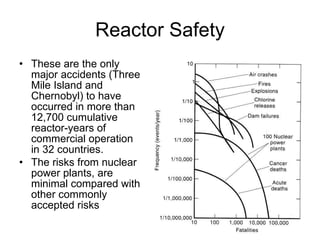
Reactor Safety
• These are the only
major accidents (Three
Mile Island and
Chernobyl) to have
occurred in more than
12,700 cumulative
reactor-years of
commercial operation
in 32 countries.
• The risks from nuclear
power plants, are
minimal compared with
other commonly
accepted risks
Breeder Reactor
• In a fission reactor, both uranium-235 and
plutonium-239 can be used as nuclear fuel
• Most of the uranium in a typical reactor is
uranium-238, which cannot be used as nuclear
fuel
• When a high-energy neutron collides with the
nucleus of uranium-238, plutonium-239 is
sometimes produced
• Could a nuclear reactor create more fuel while it
generates energy? Yes, this is a breeder
reactor
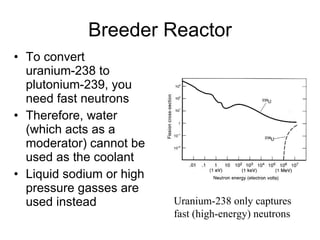
Breeder Reactor
• To convert
uranium-238 to
plutonium-239, you
need fast neutrons
• Therefore, water
(which acts as a
moderator) cannot be
used as the coolant
• Liquid sodium or high
pressure gasses are
used instead Uranium-238 only captures
fast (high-energy) neutrons
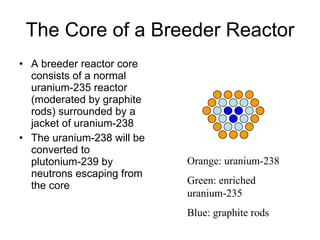
The Core of a Breeder Reactor
• A breeder reactor core
consists of a normal
uranium-235 reactor
(moderated by graphite
rods) surrounded by a
jacket of uranium-238
• The uranium-238 will be
converted to
plutonium-239 by
neutrons escaping from
the core
Orange: uranium-238
Green: enriched
uranium-235
Blue: graphite rods
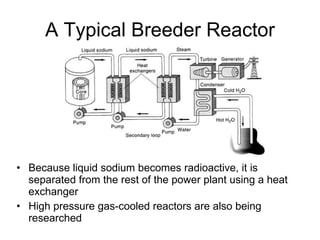
A Typical Breeder Reactor
• Because liquid sodium becomes radioactive, it is
separated from the rest of the power plant using a heat
exchanger
• High pressure gas-cooled reactors are also being
researched
Comments on Breeder Reactors
• Breeder reactors must be tightly controlled,
because plutonium-239 can be used to build
atomic weapons
• Liquid sodium is extremely reactive (and
dangerous) thus high-pressure gasses are
preferred as the coolant
• Only France and Japan are actively pursuing
breeder reactor technology
• Breeder reactors are Illegal in the united States
due to safety and terrorist concerns.

Nuclear Power

  • 1.
  • 2.
    Advantages of NuclearPower • Nuclear electricity is reliable and relatively cheap (with an average generating cost of 2.9 cents per kW/h) once the reactor is in place and operating. • Large reserves of Uranium in United States - Fuel for nuclear power plants will not run out for tens of thousands of years • Nuclear power plants contribute no greenhouse gasses and few atmospheric pollutants
  • 3.
    Disadvantages of NuclearPower • Uranium is ultimately a nonrenewable resource. • Nuclear power plants are extremely costly to build. • The slight possibility that nuclear power plants can have catastrophic failures. • Large environmental impact during the mining and processing stages of uranium are numerous. • Nuclear waste (Spent nuclear fuel) is extremely hazardous and must be stored safely for thousands of years.
  • 4.
    Comparing Uranium toCoal *1 kg of uranium-235 will generate as much energy as 3,000 tons of coal without CO2 emissions
  • 5.
  • 6.
  • 7.
  • 8.
    Nuclear Power inthe U.S. • The U.S. has 104 nuclear power plants (more than any other country) • Combined, these reactors produce about 100 billion watts of electricity (20% of the total)
  • 9.
    Nuclear Power inthe U.S. • No new reactors have been completed in the U.S. since 1979. • Why??? – High Operating Costs – Liability Problems – Wastes – Health Concerns – Terrorism – Public Misconceptions
  • 10.
    Illinois Nuclear Power •Nuclear power typically accounts for nearly one-half of Illinois electricity generation and more than one-tenth of all the nuclear power generated in the United States. • With 11 operating reactors at six nuclear power plants, Illinois ranks first among the States in nuclear generation. • The growth of the Illinois nuclear industry is due largely to State government initiatives, which began encouraging nuclear power development in the 1950s
  • 11.
    Illinois Nuclear Power •The origin of all of the commercial and military nuclear industries in the world can be traced back to December 2, 1942 at the University of Chicago. • On that day, a team of scientists under Dr. Enrico Fermi initiated the first controlled nuclear chain reaction.
  • 12.
    Illinois Nuclear Power •There are 6 operating nuclear power plants in Illinois: Braidwood, Byron, Clinton, Dresden, LaSalle, and Quad Cities. • With the sole exception of the single-unit Clinton plant, each of these facilities has two reactors. • The two reactors at Braidwood and both reactors at Byron are pressurized light water reactors (PWR). • The reactors at the other facilities (Clinton, Dresden, LaSalle, and Quad Cities are boiling water reactors (BWR).
  • 13.
    Fission and Fusion •Fission: A heavy nucleus is split into smaller nuclei, releasing energy • Fusion: Two light nuclei fuse into a heavy nucleus, releasing energy – Fusion generates much more energy than fission – Fusion of hydrogen into helium is what provides power to the sun (and thus to the Earth)
  • 14.
    Energy from Fission •When a neutron strikes a uranium-235 nucleus, it splits into two nuclei, releasing energy • Example: n + 235 U -> 93 Kr + 141 Ba + 2n • One neutron goes in, two neutrons come out
  • 15.
    Chain Reactions • Ifat least one neutron from each fission strikes another nucleus, a chain reaction will result • An assembly of uranium-235 that sustains a chain reaction is critical
  • 16.
    Power Plants andBombs • Natural uranium contains 99.3% uranium-238 and 0.7% uranium-235 • Only uranium-235 can create fission chain reactions – Nuclear power plants use uranium that has been enriched to 3% uranium-235 – Nuclear bombs use uranium that has been enriched to 95% uranium-235 • 3% enriched uranium can never explode!
  • 17.
    Nuclear Bombs • Sinceneutrons initiate fission, and each fission creates more neutrons, there is potential for a chain reaction
  • 18.
    Nuclear Bombs • Haveto have enough fissile material around to intercept liberated neutrons • Critical mass for 235 U is about 15 kg, for 239 Pu it’s about 5 kg • Bomb is dirt-simple: separate two sub- critical masses and just put them next to each other when you want them to explode! – difficulty is in enriching natural uranium to mostly 235 U
  • 19.
  • 20.
    Mining and Milling •Uranium is usually mined by either surface (open cut) or underground mining techniques, depending on the depth at which the ore body is found. • From these, the mined uranium ore is sent to a mill which is usually located close to the mine.
  • 21.
    Mining and Milling •At the mill the ore is crushed and ground to a fine slurry which is leached in sulfuric acid to allow the separation of uranium from the waste rock. • It is then recovered from solution and precipitated as uranium oxide (U308) concentrate. – Sometimes this is known as "yellowcake“
  • 22.
    Conversion • Because uranium needsto be in the form of a gas before it can be enriched, the U308 is converted into the gas uranium hexafluoride (UF6) at a conversion plant.
  • 23.
    Enriching • Need toenrich uranium to at least 3% U-235 for a power plant • Gaseous Diffusion Method – UF6 (hexafluoride) gas heated – U-238 is heavier than U-235 – Hexafluoride Gas can be separated into two streams • Low velocity U-238 • High Velocity U-235 • Centrifuge Method – Gas spun in centrifuge – Lighter U-235 will separate from heavier U-238
  • 24.
    Fuel Conversion • EnrichedUranium transported to a fuel fabrication plant where it is converted to uranium dioxide (UO2) powder and pressed into small pellets. • These pellets are inserted into thin tubes, usually of a zirconium alloy (zircalloy) or stainless steel, to form fuel rods. • The rods are then sealed and assembled in clusters to form fuel assemblies for use in the core of the nuclear reactor.
  • 25.
    Fuel Packaging inthe Core • Rods contain uranium enriched to ~3% 235 U • Need roughly 100 tons per year for a 1 GW plant • Uranium stays in three years, 1/3 of the fuel rods are cycled annually
  • 26.
    The Reactor Core •The reactor core consists of fuel rods and control rods – Fuel rods contain enriched uranium – Control rods are inserted between the fuel rods to absorb neutrons and slow the chain reaction • Control rods are made of cadmium or boron, which absorb neutrons effectively
  • 27.
    Moderators • Neutrons producedduring fission in the core are moving too fast to cause a chain reaction – Note: This is not an issue with a bomb, where fissile uranium is so tightly packed that fast moving neutrons can still do the job. • A moderator is required to slow down the neutrons • In Nuclear Power Plants water (light or heavy) or graphite acts as the moderator – Graphite increases efficiency but can be unstable (Chernobyl)
  • 28.
    Light vs. HeavyWater • 99.99% of water molecules contain normal hydrogen (i.e. with a single proton in the nucleus) • Water can be specially prepared so that the molecules contain deuterium (i.e. hydrogen with a proton and a neutron in the nucleus) • Normal water is called light water while water containing deuterium is called heavy water • Heavy water is a much better moderator but is very expensive to make
  • 29.
    Boiling Water Reactor(BWR) • Heat generated in the core is used to generated steam through a heat exchanger • The steam runs a turbine just like a normal power plant
  • 30.
  • 31.
    Pressurized Water Reactor(PWR) • Water in the core heated top 315°C but is not turned into steam due to high pressure in the primary loop. • Heat exchanger used to transfer heat into secondary loop where water is turned to steam to power turbine. • Steam used to power turbine never comes directly in contact with radioactive materials.
  • 32.
  • 33.
    Spent Nuclear Storage •Fuel rods must be replaced every 3 years. • Spent Fuel Rods are temporarily stored in special ponds which are usually located at the reactor site. • The water in the ponds serves the dual purpose of acting as a barrier against radiation and dispersing the heat from the spent fuel.
  • 34.
    Spent Fuel RodsRadiation • Spent fuel assemblies taken from the reactor core are highly radioactive • Contain plutonium-239, which is radioactive. • Forms from the reaction of U-238 and neutrons in the core
  • 35.
    Fate of SpentFuel There are two alternatives for spent fuel: 2. Reprocessing to recover the usable portion of it 3. Long-term storage and final disposal without reprocessing.
  • 36.
    Uranium Reprocessing • Spentfuel still contains approximately 96% of its original uranium, of which the fissionable U-235 content has been reduced to less than 1%. • About 3% of spent fuel comprises waste products and the remaining 1% is plutonium produced while the fuel was in the reactor • Reprocessing extracts useable fissile U-238 and Plutonium from the spent fuel rods
  • 37.
    Uranium Reprocessing • Mostof the spent fuel can be reprocessed but isn’t in the U.S. • Federal law prohibits commercial reprocessing because it will produce plutonium (which can be used both as a fuel and in constructing bombs)
  • 38.
    Nuclear Waste Disposal •In the U.S., no high-level nuclear waste is ever disposed of--it sits in specially designed pools resembling large swimming pools (water cools the fuel and acts as a radiation shield) or in specially designed dry storage containers. • Spent nuclear fuel must be isolated for thousands of years • After 10,000 years of radioactive decay, according to EPA standards, the spent nuclear fuel will no longer pose a threat to public health and
  • 39.
    Yucca Mountain • TheUnited States Department of Energy's long range plan is for this spent fuel to be stored deep in the earth in a geologic repository, at Yucca Mountain, Nevada.
  • 40.
    Concerns about YuccaMountain • Possible health risks to those living near Yucca Mountain and transportation routes • Eventual corrosion of the metal barrels containing the waste • Located in an earthquake region and contains many interconnected faults and fractures – These could move groundwater and any escaping radioactive material through the repository to the aquifer below and then to the outside environment
  • 41.
    Reactor Safety • Theseare the only major accidents (Three Mile Island and Chernobyl) to have occurred in more than 12,700 cumulative reactor-years of commercial operation in 32 countries. • The risks from nuclear power plants, are minimal compared with other commonly accepted risks
  • 42.
    Breeder Reactor • Ina fission reactor, both uranium-235 and plutonium-239 can be used as nuclear fuel • Most of the uranium in a typical reactor is uranium-238, which cannot be used as nuclear fuel • When a high-energy neutron collides with the nucleus of uranium-238, plutonium-239 is sometimes produced • Could a nuclear reactor create more fuel while it generates energy? Yes, this is a breeder reactor
  • 43.
    Breeder Reactor • Toconvert uranium-238 to plutonium-239, you need fast neutrons • Therefore, water (which acts as a moderator) cannot be used as the coolant • Liquid sodium or high pressure gasses are used instead Uranium-238 only captures fast (high-energy) neutrons
  • 44.
    The Core ofa Breeder Reactor • A breeder reactor core consists of a normal uranium-235 reactor (moderated by graphite rods) surrounded by a jacket of uranium-238 • The uranium-238 will be converted to plutonium-239 by neutrons escaping from the core Orange: uranium-238 Green: enriched uranium-235 Blue: graphite rods
  • 45.
    A Typical BreederReactor • Because liquid sodium becomes radioactive, it is separated from the rest of the power plant using a heat exchanger • High pressure gas-cooled reactors are also being researched
  • 46.
    Comments on BreederReactors • Breeder reactors must be tightly controlled, because plutonium-239 can be used to build atomic weapons • Liquid sodium is extremely reactive (and dangerous) thus high-pressure gasses are preferred as the coolant • Only France and Japan are actively pursuing breeder reactor technology • Breeder reactors are Illegal in the united States due to safety and terrorist concerns.