Energy Storage Technologies
learnings from other
countries
By Abhinav Bhaskar , Research Associate , The energy and
resources institute with inputs from Shreya Agarwal
Contents
 Why do we need energy storage ?
 Technical and economical savings from energy storage
 Types of storage based on application
 Different technologies
 Criteria for selection of energy storage technology
 Economical evaluation of storage technologies
 Thermal energy storage-LHES
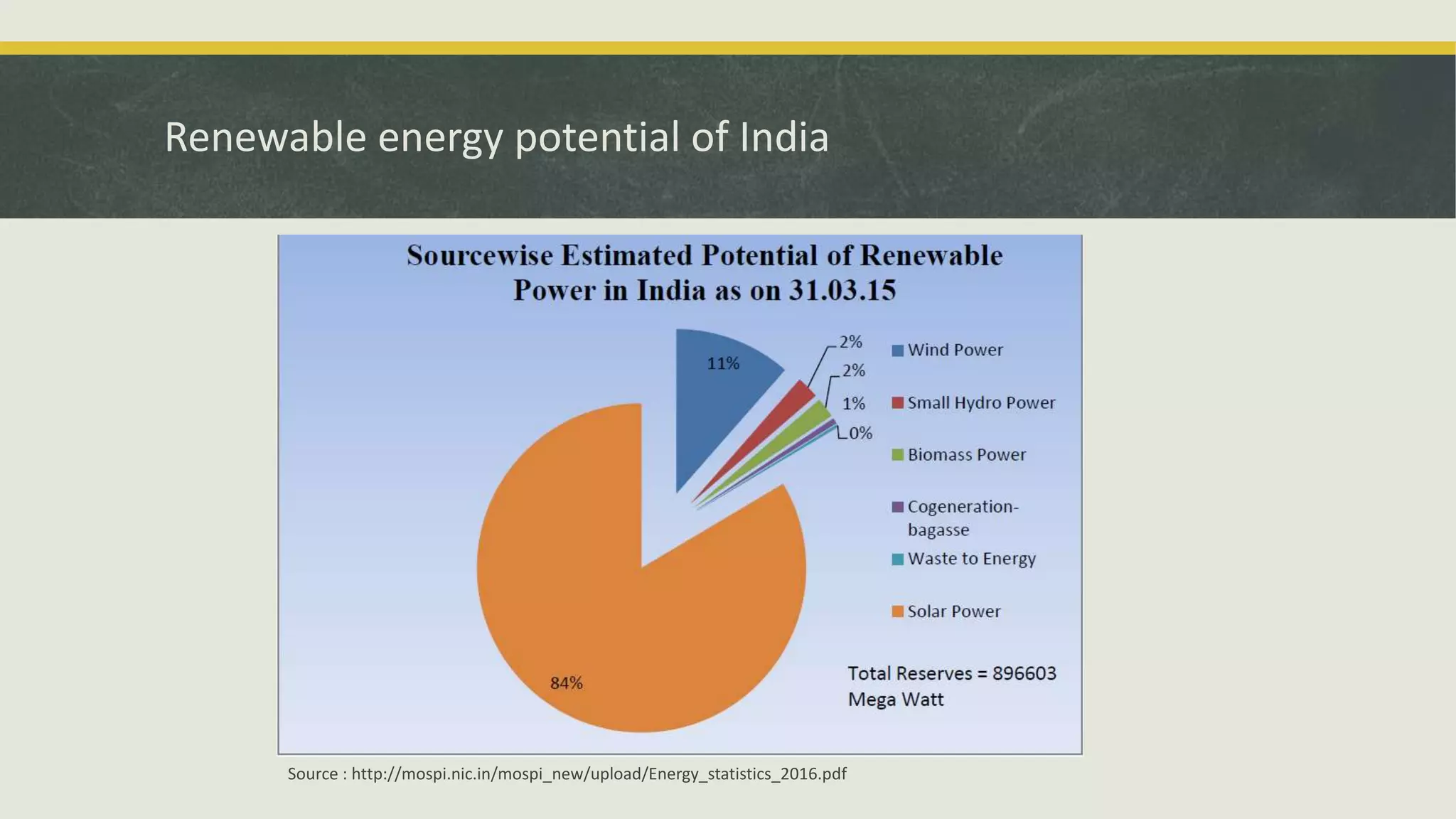
Renewable energy potential of India
Source : http://mospi.nic.in/mospi_new/upload/Energy_statistics_2016.pdf
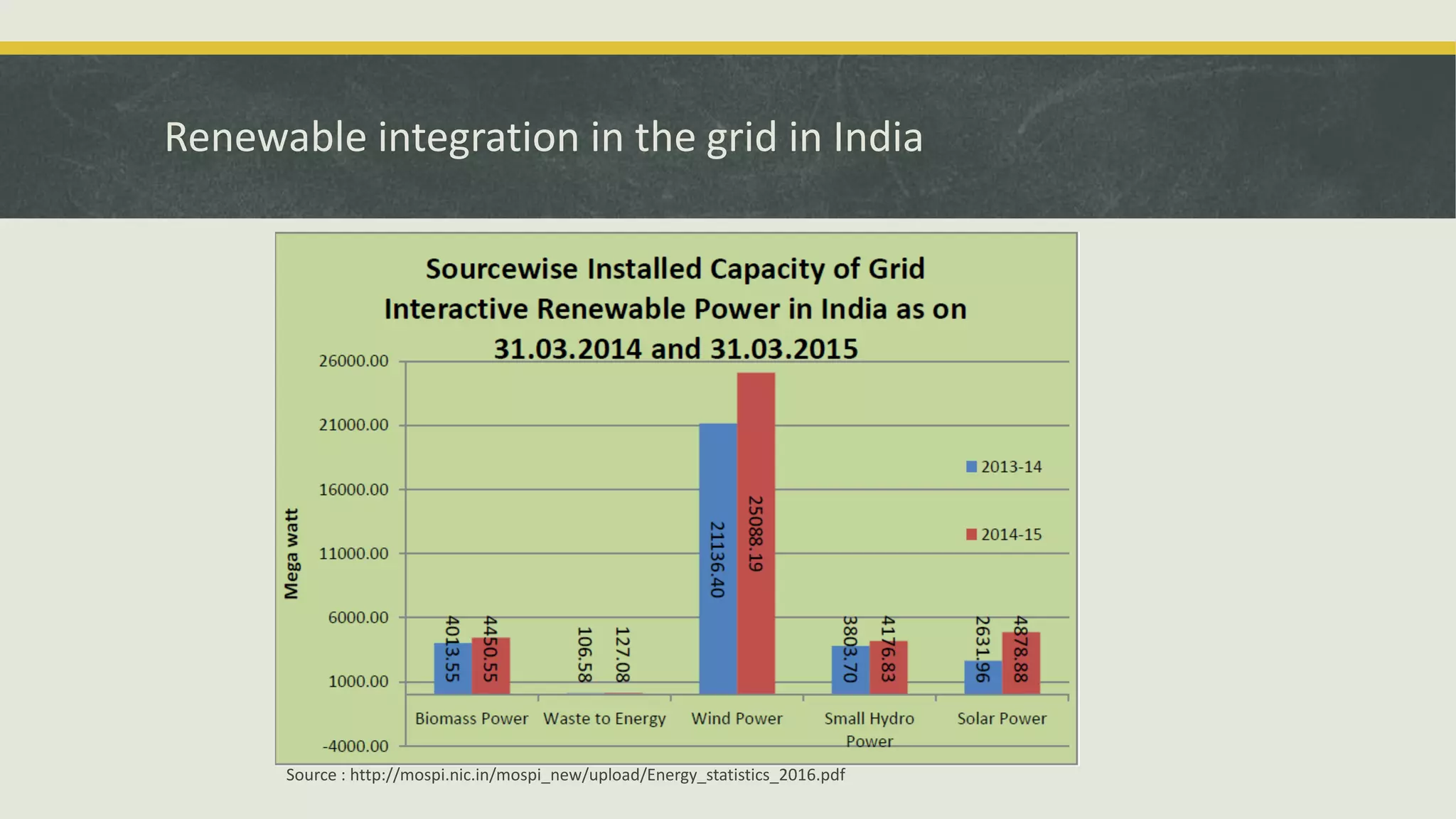
Renewable integration in the grid in India
Source : http://mospi.nic.in/mospi_new/upload/Energy_statistics_2016.pdf
Difficulties with renewable integration in the grid
 Decentralized electricity production and the introduction of variable , fluctuating
source increase the difficulty of stabilizing the power network, mainly due to
supply-demand imbalance.
 Unpredictable character of renewables requires that network provisioning and
usage regulations be established for optimal system operation.
 Peak supply and demand of the renewable energy technologies like solar energy
do not match and hence create a gap.
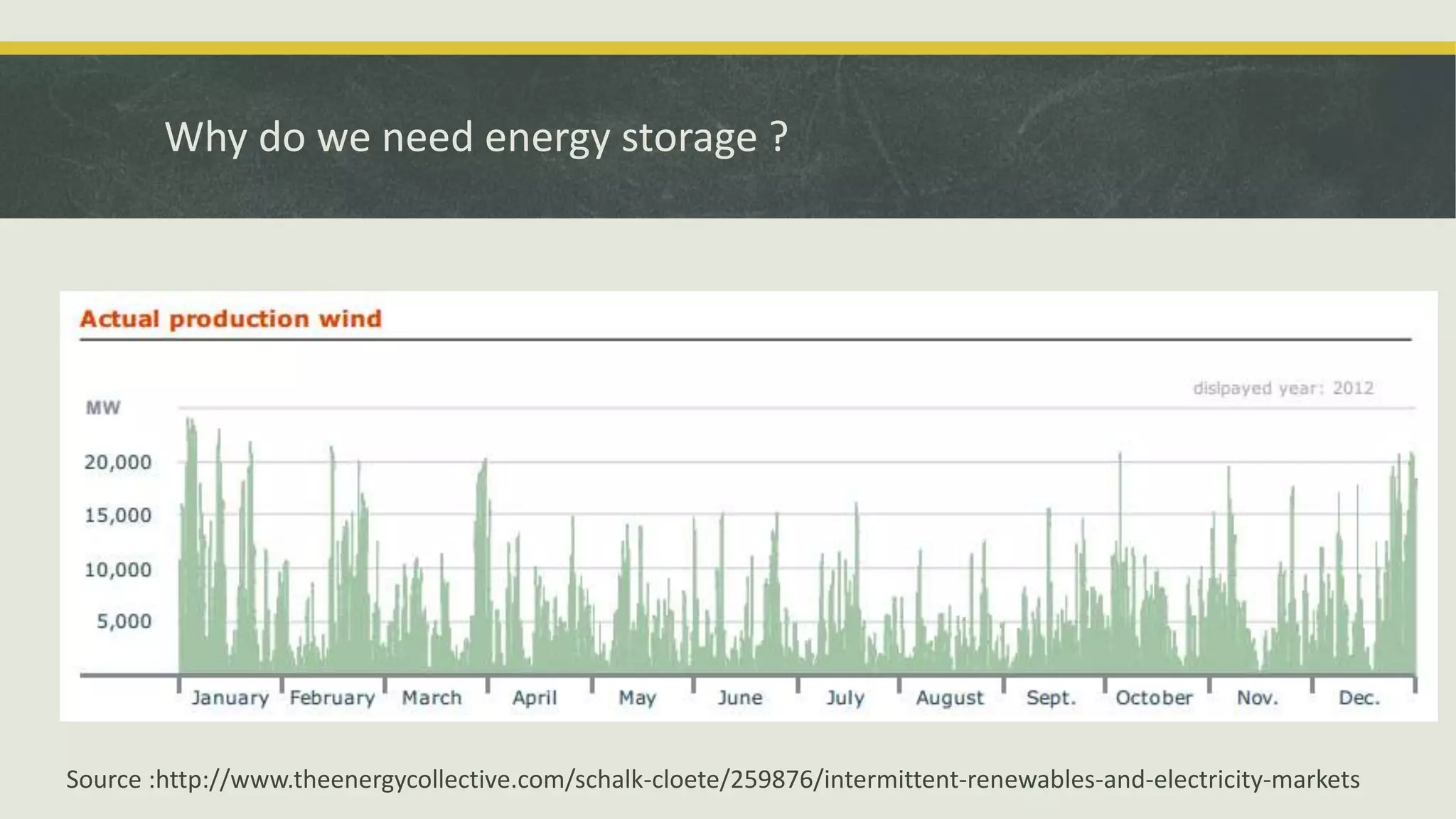
Why do we need energy storage ?
Source :http://www.theenergycollective.com/schalk-cloete/259876/intermittent-renewables-and-electricity-markets
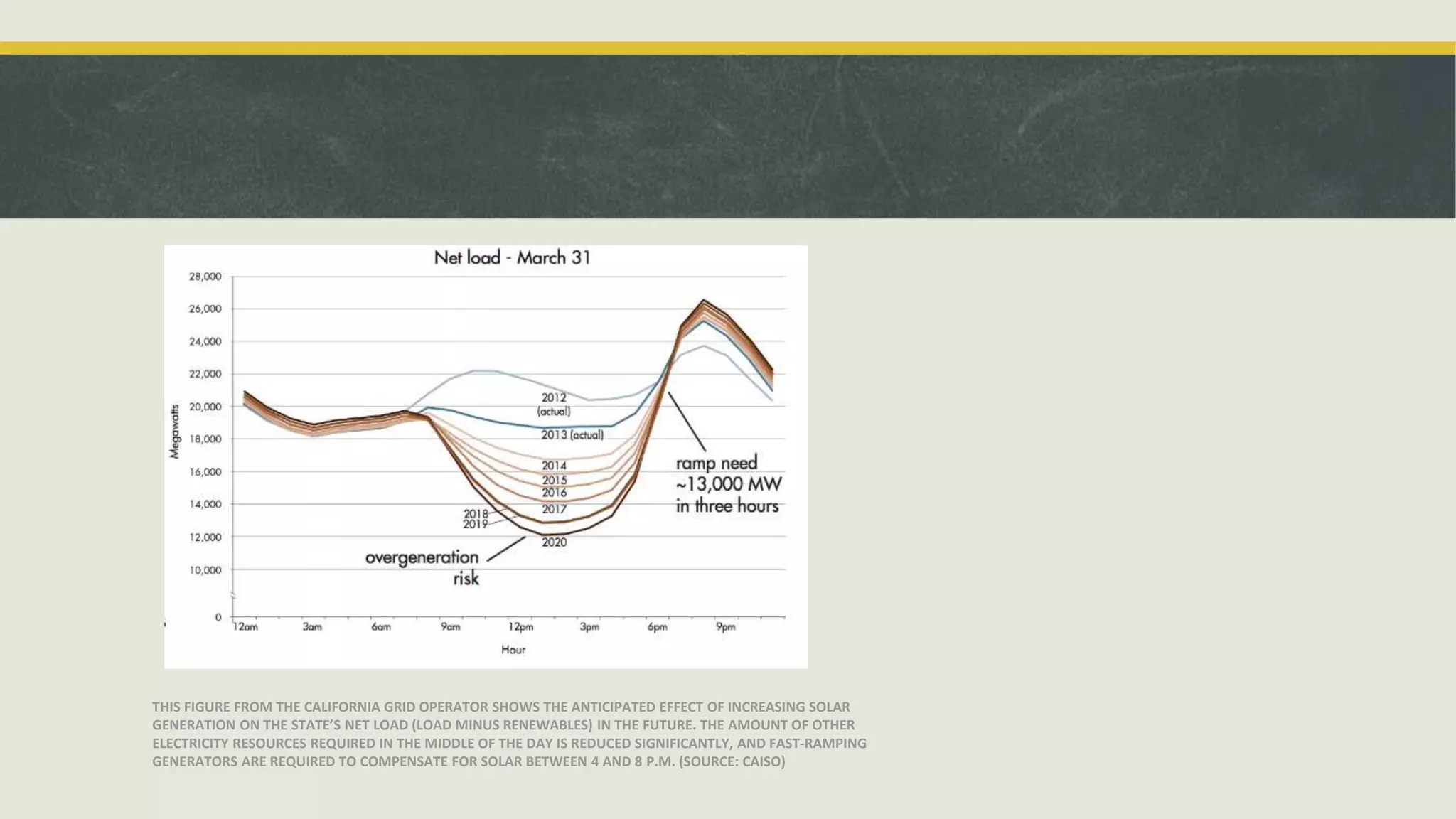
THIS FIGURE FROM THE CALIFORNIA GRID OPERATOR SHOWS THE ANTICIPATED EFFECT OF INCREASING SOLAR
GENERATION ON THE STATE’S NET LOAD (LOAD MINUS RENEWABLES) IN THE FUTURE. THE AMOUNT OF OTHER
ELECTRICITY RESOURCES REQUIRED IN THE MIDDLE OF THE DAY IS REDUCED SIGNIFICANTLY, AND FAST-RAMPING
GENERATORS ARE REQUIRED TO COMPENSATE FOR SOLAR BETWEEN 4 AND 8 P.M. (SOURCE: CAISO)
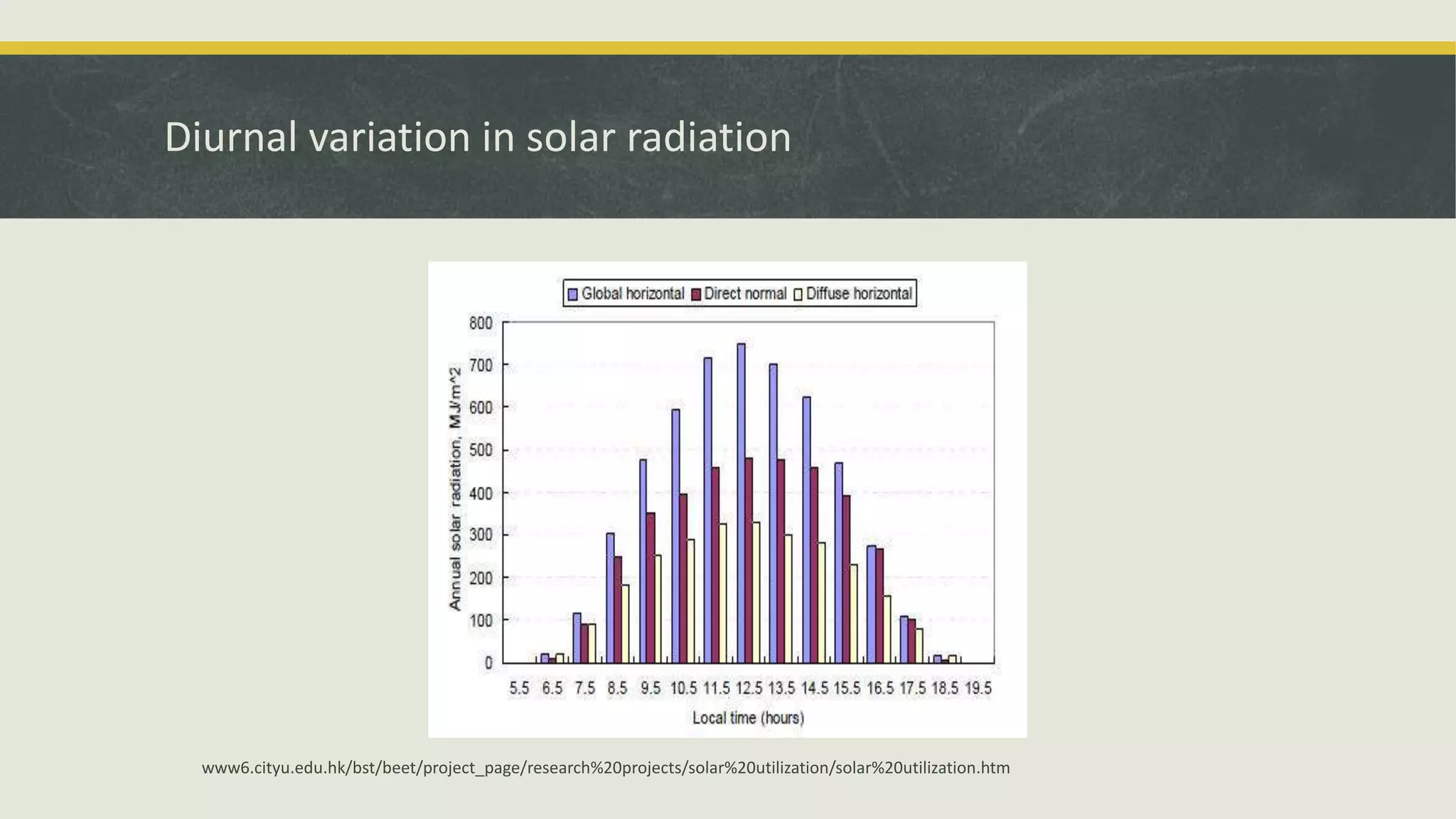
Diurnal variation in solar radiation
www6.cityu.edu.hk/bst/beet/project_page/research%20projects/solar%20utilization/solar%20utilization.htm
What is Energy storage ?
 Conversion of excess electricity into a different form of energy which can be
reconverted into electricity with minimum losses . This can be done to reduce
the gap in supply and demand of electricity. It can be applied to both
conventional sources of electricity and renewable energy sources .
 It increases the dispatch ability, makes power available on demand and by
reducing the gap between supply and demand reduces the need for newer
power plants.
Technical and economic advantages of energy storage
Energy transfer
 Conventional Energy production : Energy storage compensates for a temporary
loss of production, spike in the peak demand and to avoid penalties by fulfilling a
commercial agreement of pre-sold energy supply . The power level is
comparable to a that stipulated and the quantity of stored energy should be a
compromise between the desirable duration of backup power and the potential
penalties.
 Renewable energy production: Storage of electricity adds value to the supplied
current by making it more predictable. Cost of buffer storage should be
considered.
Network Savings
 Power networks are comprised of many generating units, various levels of
transmission and distribution lines and associated stations and sub-stations and a
great many consumers with wide ranging power requirements.
 End user demand in terms of ratio between peak and average levels often
reaches a value of 10. This leads of over dimensioning of transmission equipment
which are designed for peak load levels rather than average levels.
 Storage helps compensate a local supply for load variations making it possible to
operate transmission, sub-transmission and distribution networks with lighter
designs.
 Kinetic advantage
The flexibility of energy storage systems can help provide instant response to
demand and as a consequence, add flexibility to the network in terms of load
levelling. Network imbalance can be caused by a temporary production deficit,
which could possibly be predicted.
Electricity storage systems
 Low power application in isolated areas, essentially to feed transducers and
emergency terminals.
 Medium power applications in isolated areas (individual electrical systems , town
supply)
 Network connection application with peak levelling
 Power quality control applications
The first two categories are for small scale systems where the energy could be stored
as kinetic energy (flywheels) , chemical energy, compressed air, hydrogen (fuel cells) or
in super capacitors or super conductors
Categories 3 and 4 are for large scale systems where energy could be stored as
gravitational energy, thermal energy , chemical energy or compressed air (coupled with
natural gas )
Characteristics of energy storage systems
 Storage capacity : Quantity of available energy in the storage systems after
charging. Discharge is often incomplete. Wst is the energy stored while Wut is
the energy utilized.
 Available power : Defines the constitution and size of the motor-generator in
the stored energy conversion chain. Expressed as an average value, as well as
peak value often used to express the maximum power of charge or discharge.
 Power transmission rate: Time needed to extract the stored energy
 Efficiency: The ration between the Wut/ Wst . Should be based on the complete
cycle to account for the charging, no load and self discharge losses.
Characteristics of Energy storage
 Cycling capacity (durability) : Number of times the storage unit can release
energy level it was designed for after recharge. Expressed as the maximum
number of cycles (N).
 Autonomy : The maximum amount of time the system can continuously release
energy. Expressed as a= Wut/ Pd ( restorable power / maximum discharge
power).
 Costs : Investment costs of storage is factored out using the following formula
C=C1Wut + C2Pd . Operational costs are proportional to the investment costs , to the
tune of 40% of the investment costs
 Feasibility and adaptability to the generating source : Highly efficient storage
systems need to be closely adapted to the type of application and to the type of
production. Needs to be harmonized with the network.
 Self-discharge : Portion of stored energy dissipated during non-use time.
 Mass and volume density : Refers to the maximum amount of energy stored per
unit mass of the storage system.
 Environmental and operation safety
 Reliability
Different types of energy storage systems
 Pumped hydro energy storage (PHES )
 Compressed air energy storage ( CAES)
 Latent heat thermal energy storage (LHTES)
 High temperature thermal energy storage with turbine
 Kinetic energy storage system (Flywheels )
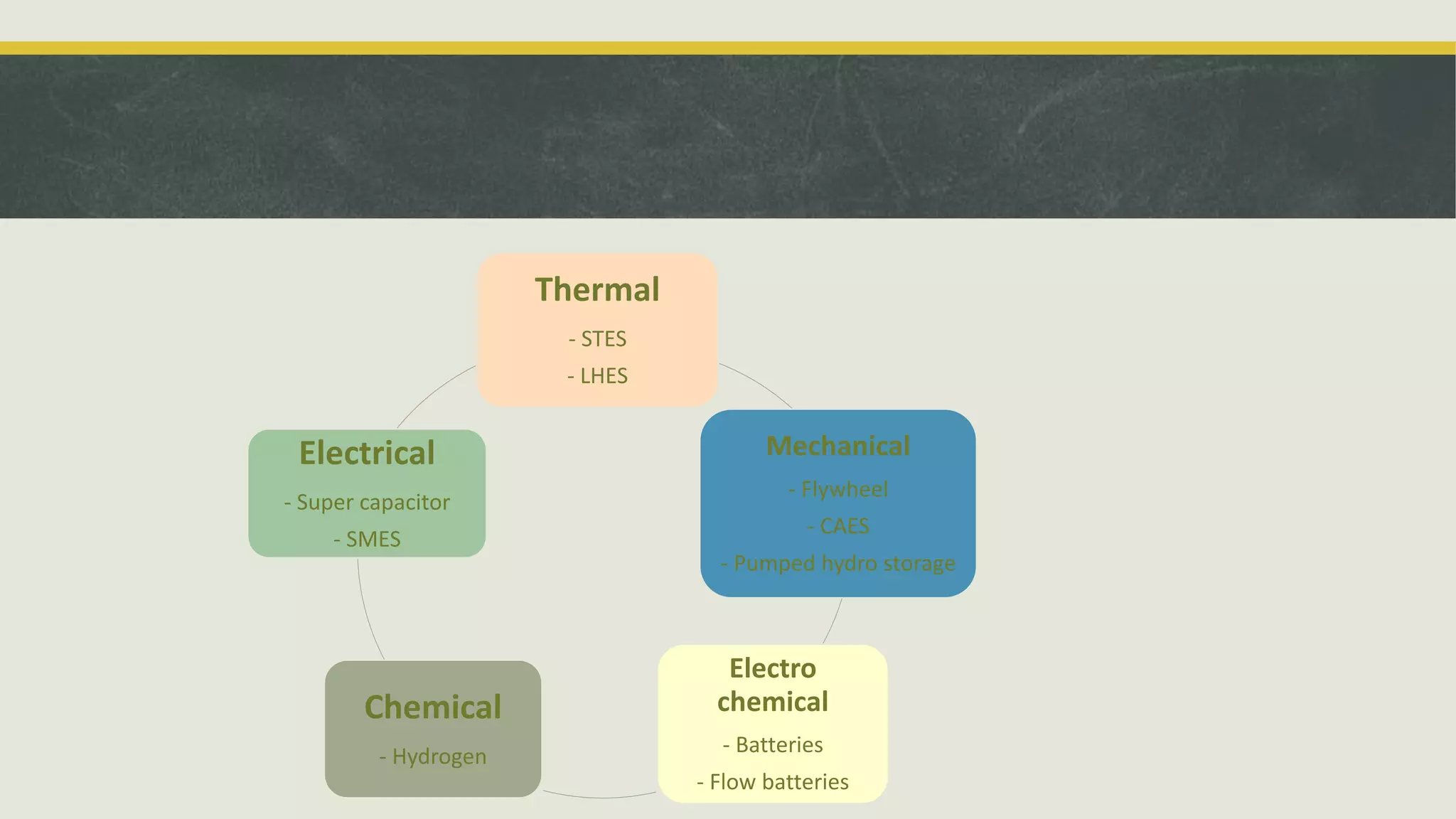
Thermal
- STES
- LHES
Mechanical
- Flywheel
- CAES
- Pumped hydro storage
Electro
chemical
- Batteries
- Flow batteries
Chemical
- Hydrogen
Electrical
- Super capacitor
- SMES
Pumped Hydro Energy Storage: Overview
 The most commercially
developed technology.
 PHS uses two reservoirs at
different heights to store energy
 As of 2012, 99% of the global
storage is in the form of PHS.1
 India’s estimated potential of
pumped hydro storage plants is
94GW across 56 sites.2
 Round trip efficiency: 70%-85% 3
1. Electric Power Research Institute (EPRI), USA
2. http://indiaenergy.gov.in/supply_larhydro.php
3. http://greeneconomypost.com/fifteen-grid-scale-energy-storage-solutions-watch-15924.htm#ixzz3zqwwIXOH
Pumped Hydro Energy Storage: Statistics
1. http://indiaenergy.gov.in/supply_larhydro.php
2. http://people.duke.edu/~cy42/PHS.pdf
3. Assessment of the Role of Energy Storage Technologies for Renewable Energy Deployment in India, Partnership to Advance Clean Energy - Deployment (PACE - D) Technical Assistance
Program, March 2014
Statistics
India’s Potential:
90GW across 56
sites1
Total global installed
142 GW across 40
countries 2
Capital cost of
electricity is 150-
700$/kWh3
High
environmental
Impact High capital
investment
required
Occupy large space
Long time for
construction
Pumped Hydro Energy Storage:
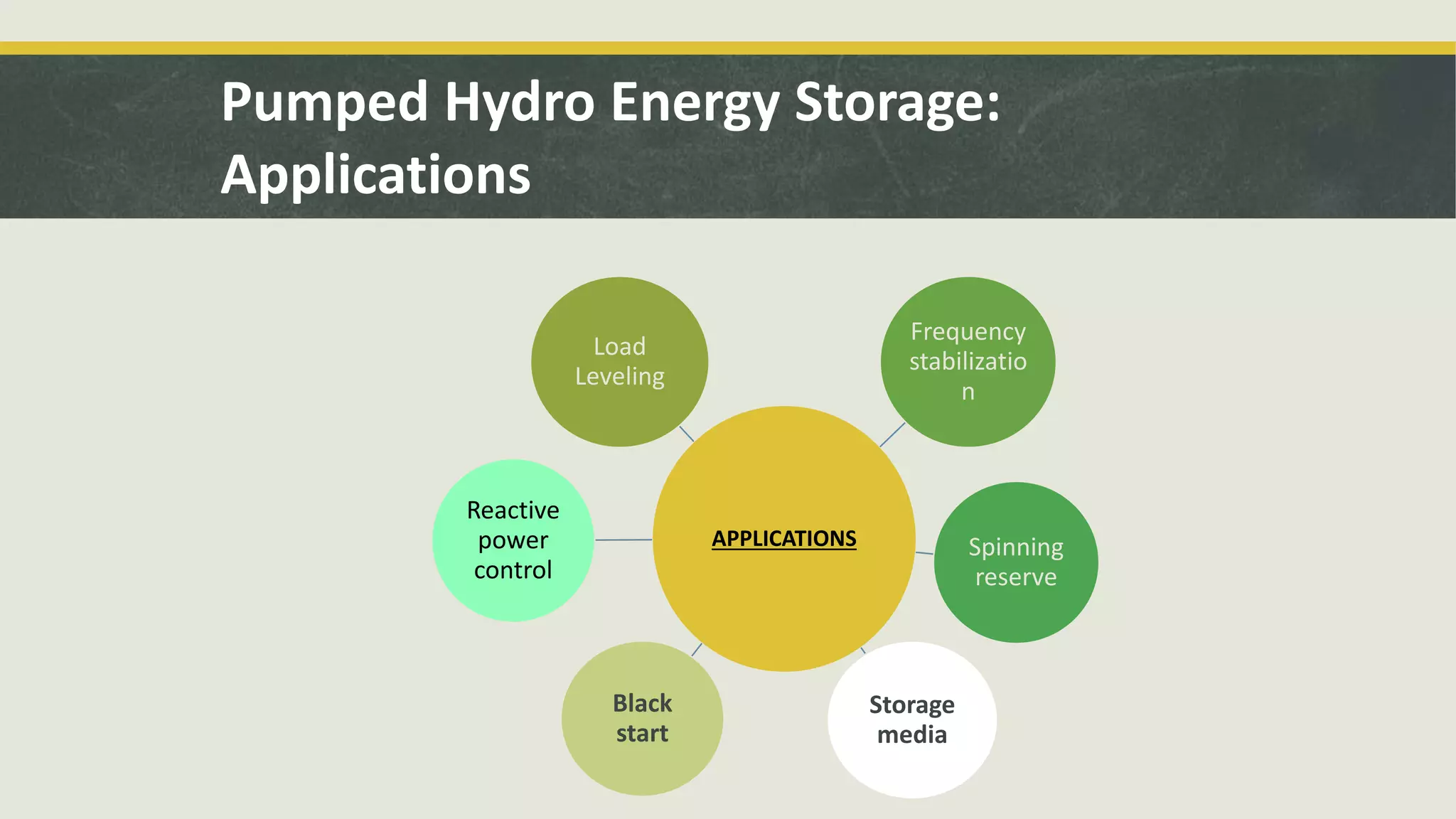
Applications
APPLICATIONS
Load
Leveling
Frequency
stabilizatio
n
Spinning
reserve
Storage
media
Reactive
power
control
Black
start
Pumped Hydro Energy Storage: Case
Studies
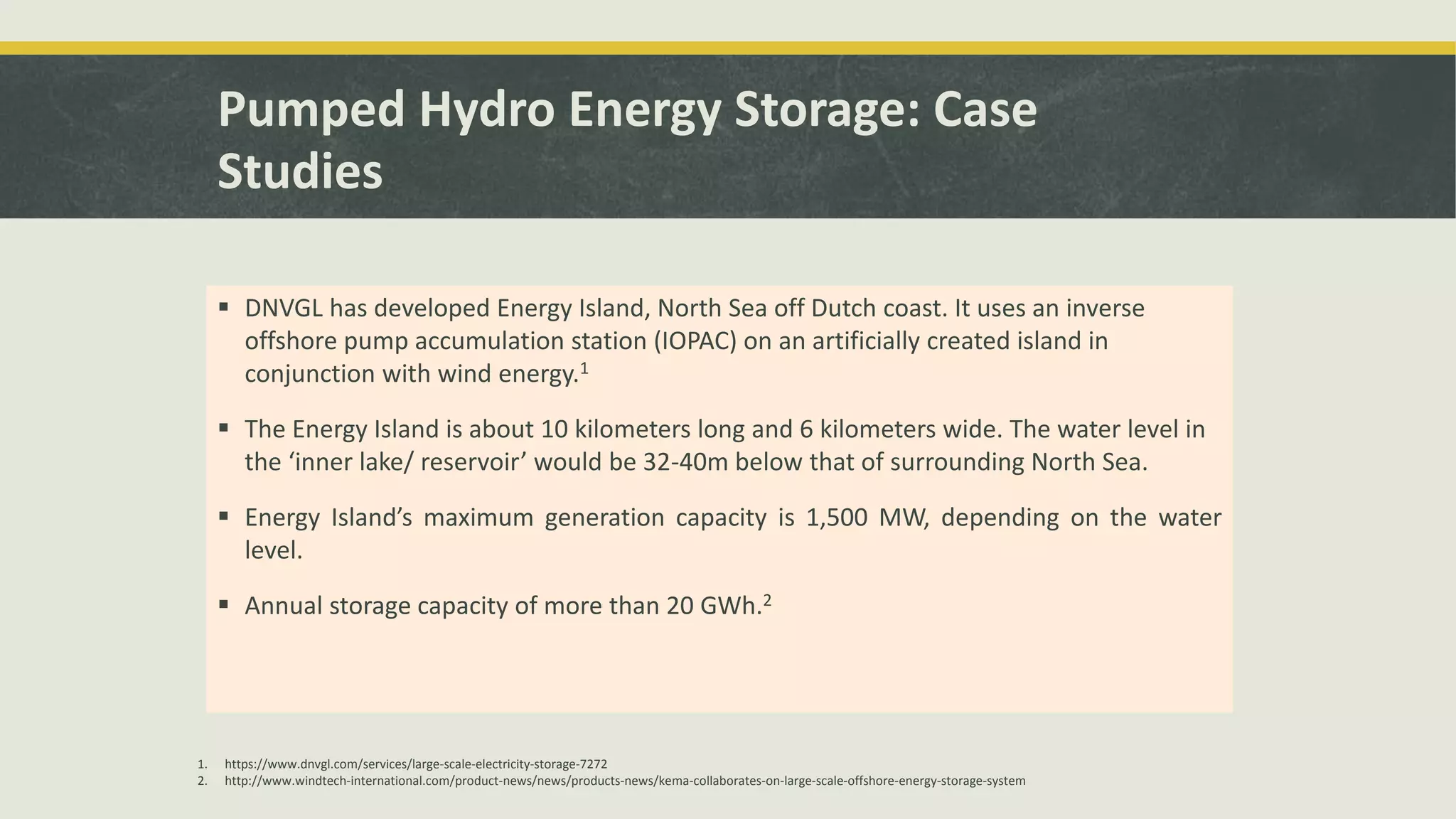
 DNVGL has developed Energy Island, North Sea off Dutch coast. It uses an inverse
offshore pump accumulation station (IOPAC) on an artificially created island in
conjunction with wind energy.1
 The Energy Island is about 10 kilometers long and 6 kilometers wide. The water level in
the ‘inner lake/ reservoir’ would be 32-40m below that of surrounding North Sea.
 Energy Island’s maximum generation capacity is 1,500 MW, depending on the water
level.
 Annual storage capacity of more than 20 GWh.2
1. https://www.dnvgl.com/services/large-scale-electricity-storage-7272
2. http://www.windtech-international.com/product-news/news/products-news/kema-collaborates-on-large-scale-offshore-energy-storage-system
Pumped Hydro Energy Storage:
Status
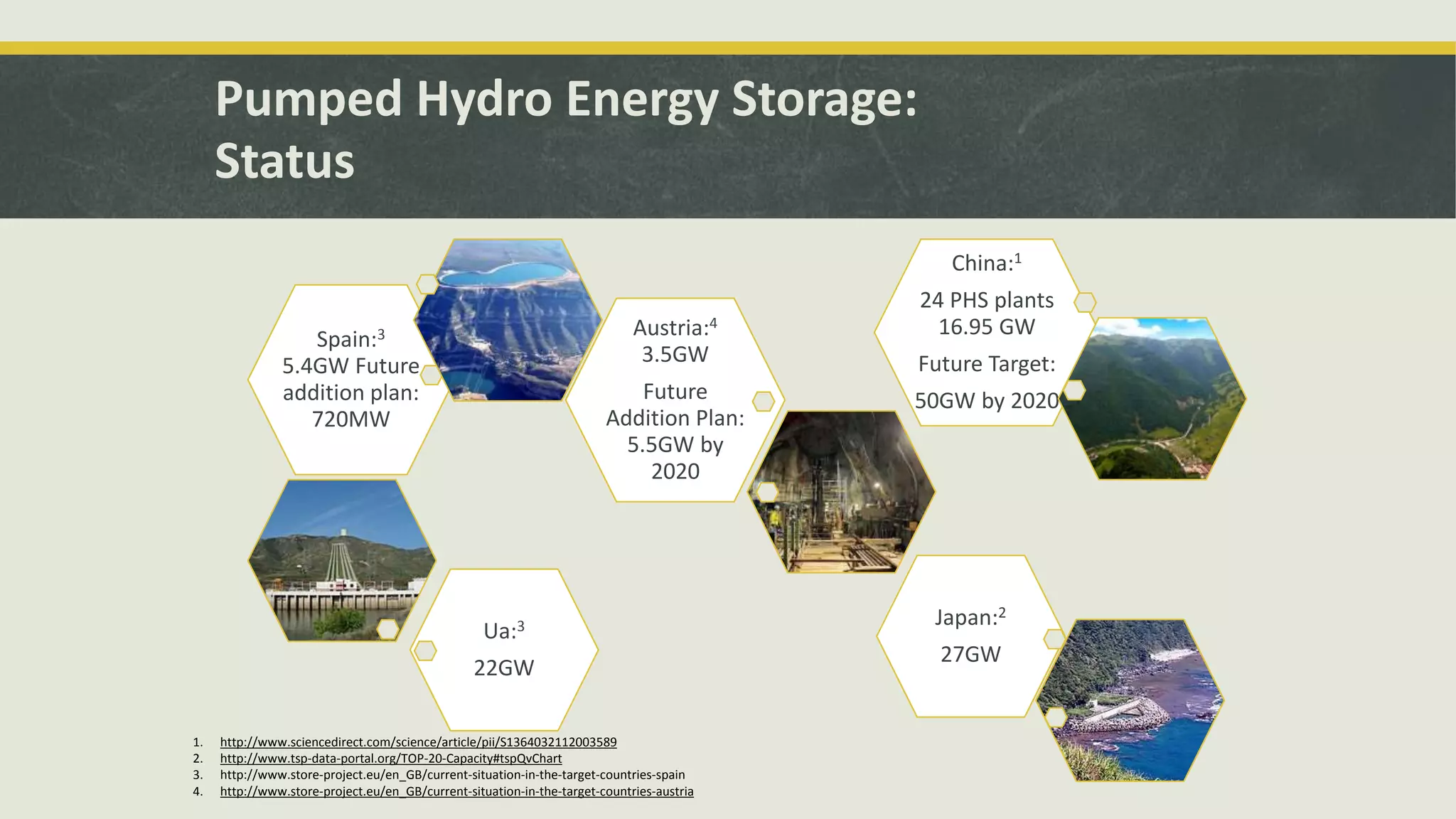
Ua:3
22GW
Austria:4
3.5GW
Future
Addition Plan:
5.5GW by
2020
Spain:3
5.4GW Future
addition plan:
720MW
Japan:2
27GW
China:1
24 PHS plants
16.95 GW
Future Target:
50GW by 2020
1. http://www.sciencedirect.com/science/article/pii/S1364032112003589
2. http://www.tsp-data-portal.org/TOP-20-Capacity#tspQvChart
3. http://www.store-project.eu/en_GB/current-situation-in-the-target-countries-spain
4. http://www.store-project.eu/en_GB/current-situation-in-the-target-countries-austria
https://www.google.co.in/url?sa=t&rct=j&q=&esrc=s&source=web&cd=1&ved=0ahUKEwiczqfTu-PPAhWBvY8KHQiCAlUQFggiMAA&url=http%3A%2F%2Fwww.store-project.eu%2Fdocuments%2Fresults%2Fen_GB%2Freport-summarizing-the-current-
status-role-and-costs-of-energy-storage-technologies&usg=AFQjCNFimpnwKCWOJoJi2Ctpfld542AbbQ&sig2=vumKfJOZKWVhCZ84MIPZ9w&cad=rjt
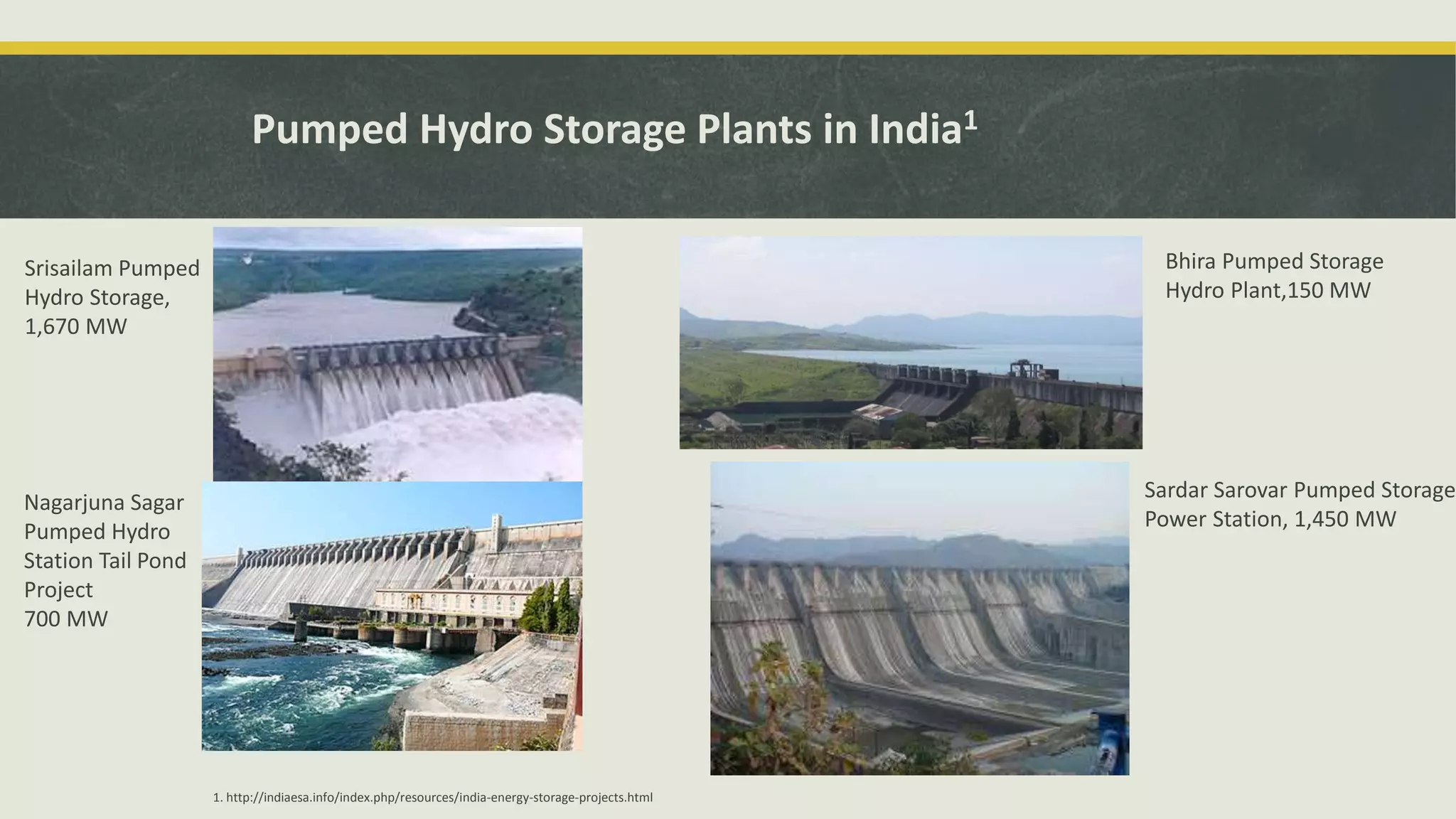
Pumped Hydro Storage Plants in India1
Srisailam Pumped
Hydro Storage,
1,670 MW
Sardar Sarovar Pumped Storage
Power Station, 1,450 MW
Nagarjuna Sagar
Pumped Hydro
Station Tail Pond
Project
700 MW
Bhira Pumped Storage
Hydro Plant,150 MW
1. http://indiaesa.info/index.php/resources/india-energy-storage-projects.html
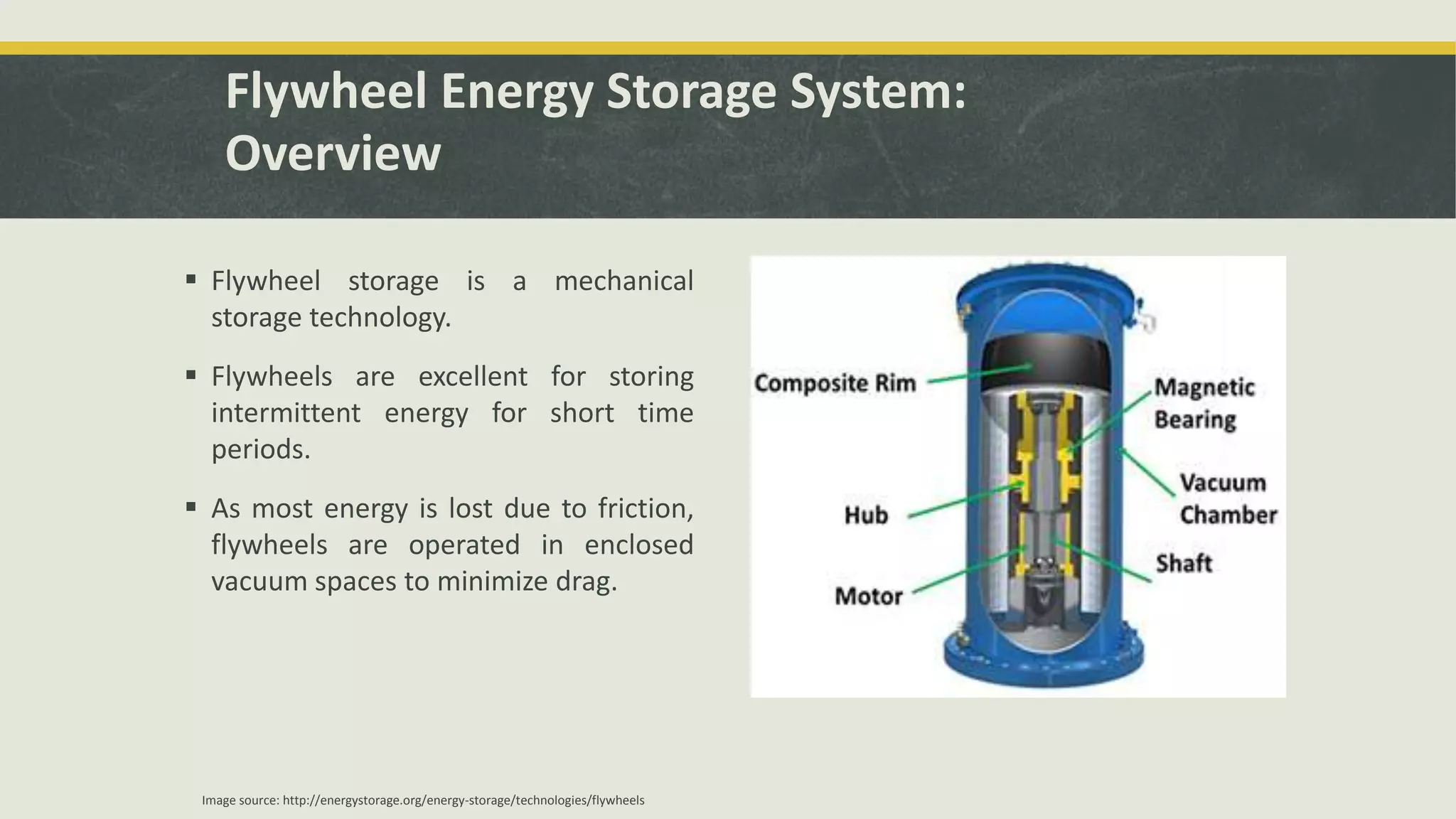
Flywheel Energy Storage System:
Overview
 Flywheel storage is a mechanical
storage technology.
 Flywheels are excellent for storing
intermittent energy for short time
periods.
 As most energy is lost due to friction,
flywheels are operated in enclosed
vacuum spaces to minimize drag.
Image source: http://energystorage.org/energy-storage/technologies/flywheels
Flywheel Energy Storage Systems:
Advantages & Disadvantages
Advantages
 Low maintenance.
 Long life (more than 20-25 years)
 Low environmental impact
 Excellent load following
characteristics
 No fuel, water or any resource
consumption.
Disadvantages
• Add weight to cars. Especially
problematic in racing cars
• High cost as compared to PHS and
batteries
• Cost: 1400$/kW1
• Cannot hold power for long
durations
1. Assessment of the Role of Energy Storage Technologies for Renewable Energy Deployment in India, Partnership to Advance Clean Energy - Deployment (PACE - D) Technical Assistance
Program, March 2014
Flywheel Energy Storage System:
Applications
Uninterruptible power supplies1
They consume less space than batteries. Preferred for use in
backup systems like UPS for data centers
Transport
Used in hybrid electric vehicle to increase fuel
efficiency. Such vehicles are called ‘flybrids’
Grid Energy Storage
Due to fast response, low environmental impact,
small footprint, these can be used for grid support
Wind Turbines
Can be used to store energy generated by wind
turbines during low demand periods
NASA applications
NASA developed flywheels for application as an
energy storage media
These are well suited for applications that require
high power, low energy and large number of
cycles
1. http://www.datacenterknowledge.com/archives/2007/06/26/flywheels-gain-as-alternative-to-batteries/
Ancillary services
They have very fast response and ramp rate: can
be used as back up power support/ spinning
reserve
Frequency regulation
Flywheel Energy Storage Systems: Case
studies
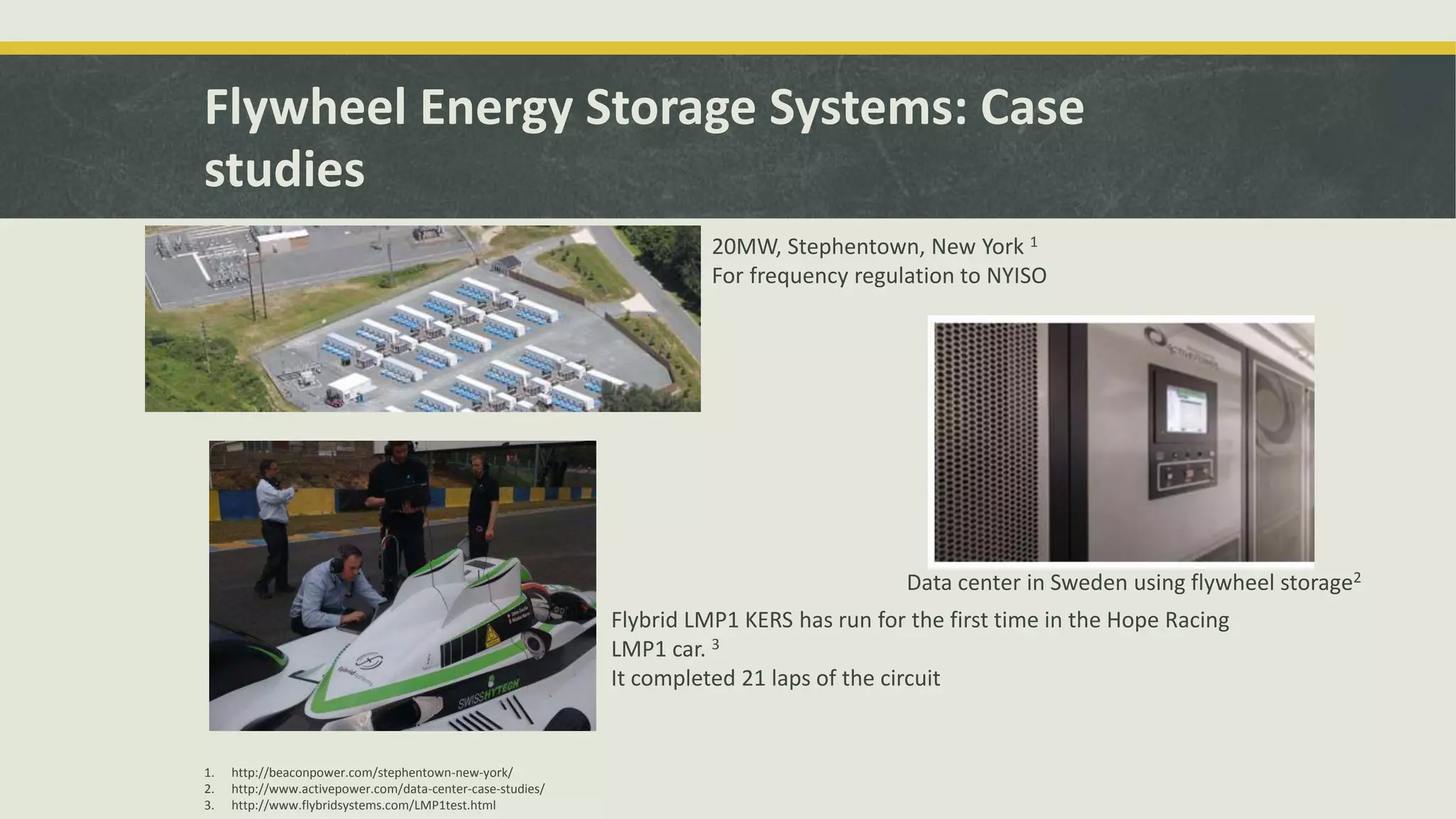
20MW, Stephentown, New York 1
For frequency regulation to NYISO
1. http://beaconpower.com/stephentown-new-york/
2. http://www.activepower.com/data-center-case-studies/
3. http://www.flybridsystems.com/LMP1test.html
Data center in Sweden using flywheel storage2
Flybrid LMP1 KERS has run for the first time in the Hope Racing
LMP1 car. 3
It completed 21 laps of the circuit
Compressed air energy storage
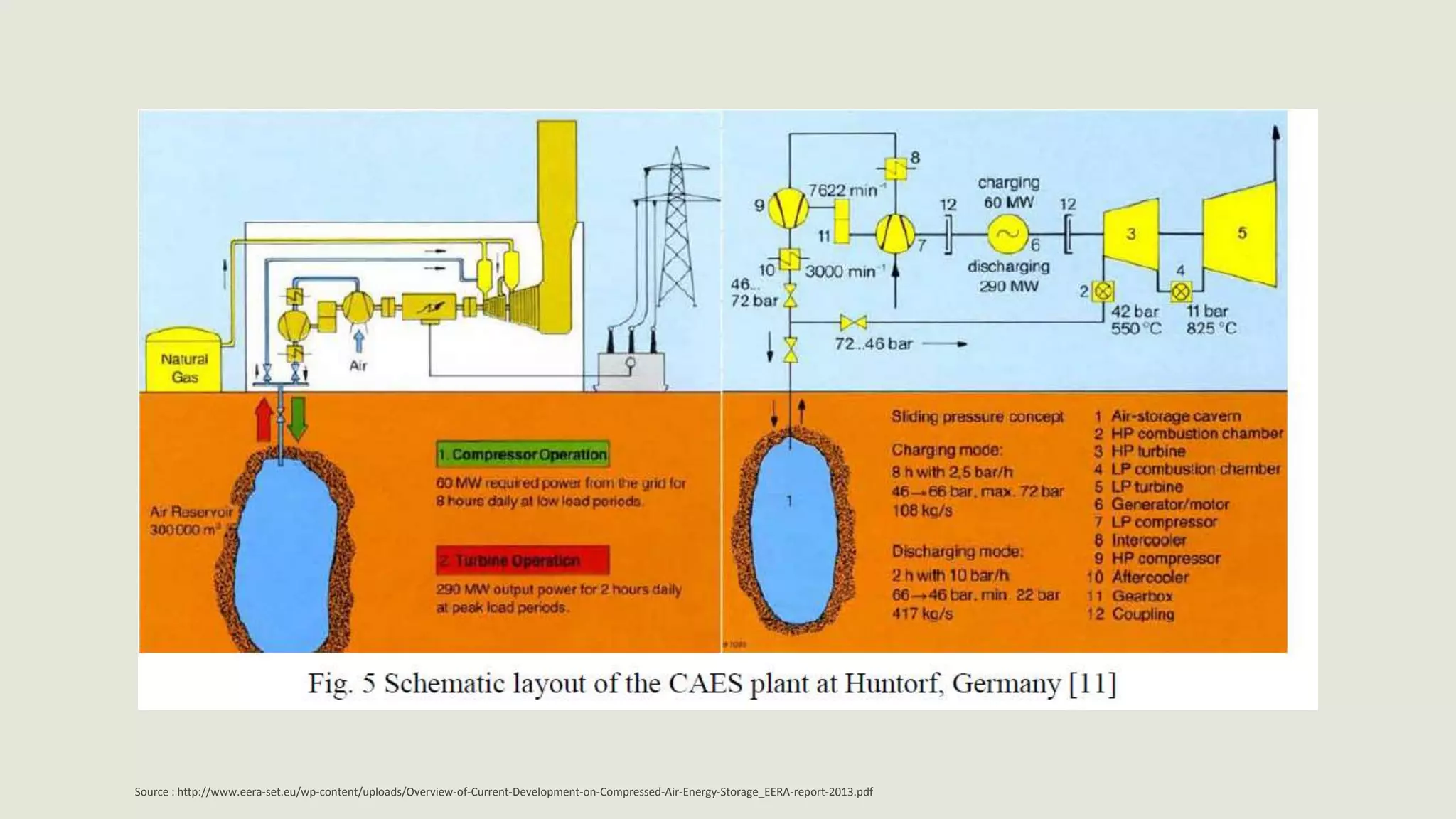
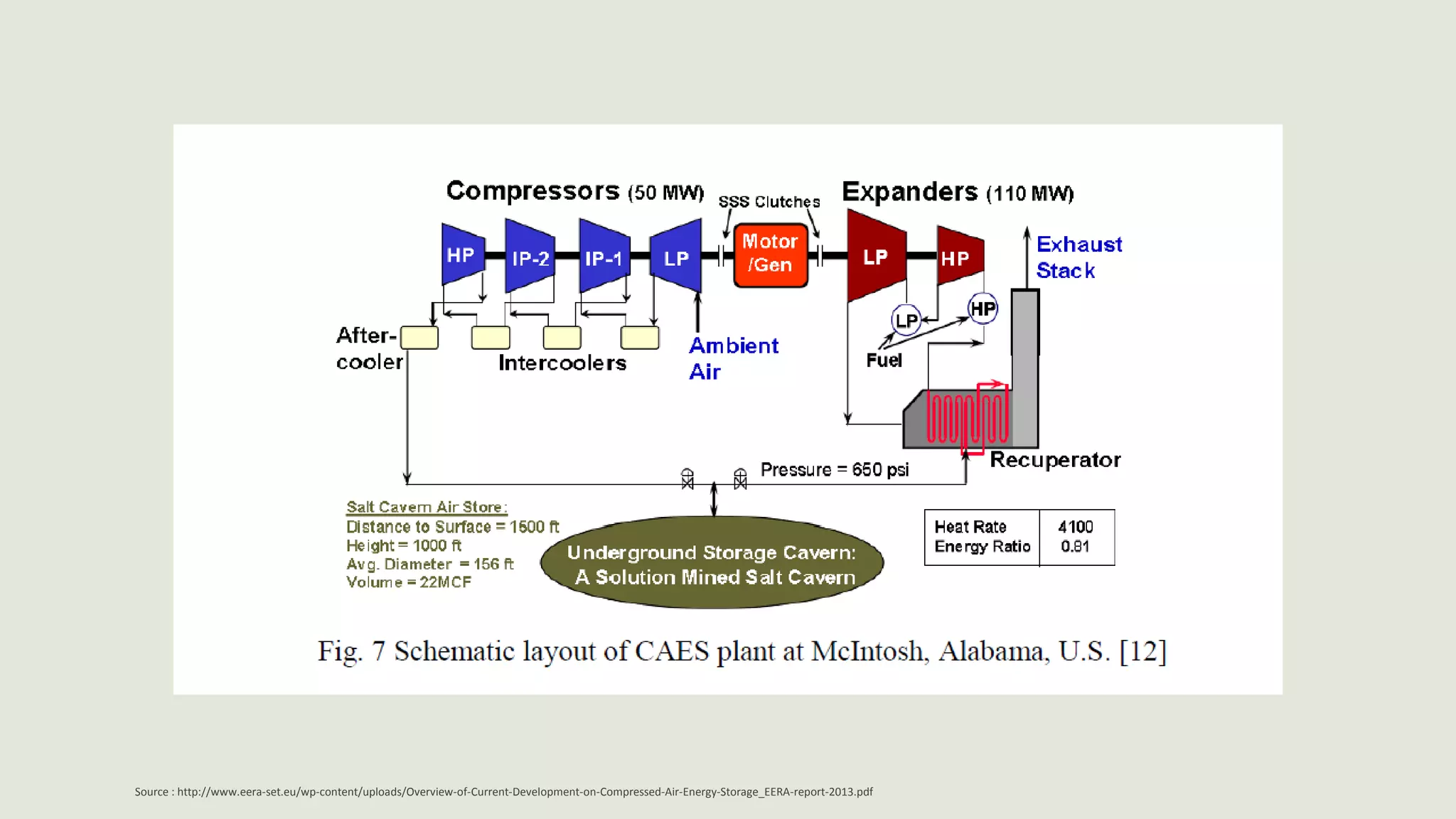
 The compression mode of a typical CAES plant is activated at the time when the low
demand presents.
 The surplus electricity is used to run a chain of compressors to inject the air into a
storage reservoir (normally an underground cavern for large-scale CAES), and the stored
compressed air is at a high pressure (typically 4.0-8.0 MPa) and the temperature of the
surrounding formation.
 Such a compression process can use intercoolers and after-coolers to reduce the working
temperature of the injected air thus to improve the compression efficiency and
minimising thermal stress on the storage volume walls .
 When the power generation cannot meet the demand, the expansion mode will be
engaged. The stored high pressure compressed air is released from the storage reservoir,
heated, and then expanded through a high-pressure turbine which can be a steam
turbine or a gas turbine .
Compressor train Expander/generator train
Fuel (e.g. natural gas, distillate)
CAES system
Intercoolers
Heat recuperator
PC PG
Air
Exhaust
Air
Storage
Aquifer,
salt cavern,
or hard mine
hS = Hours of
Storage (at PC)
PC = Compressor
power in
PG = Generator
power out
Source : https://www.google.co.in/url?sa=t&rct=j&q=&esrc=s&source=web&cd=4&ved=0ahUKEwi6473Er-
PPAhXBQI8KHe9VCVoQFgg0MAM&url=https%3A%2F%2Fcmi.princeton.edu%2Fnews%2Fppt%2Fcaes05.ppt&usg=AFQjCNHodvVRn5QSZCCk6XDPx70nGLwsqA&sig2=yXXAc9TTNTofKjgDuzhFLA&cad=rjt
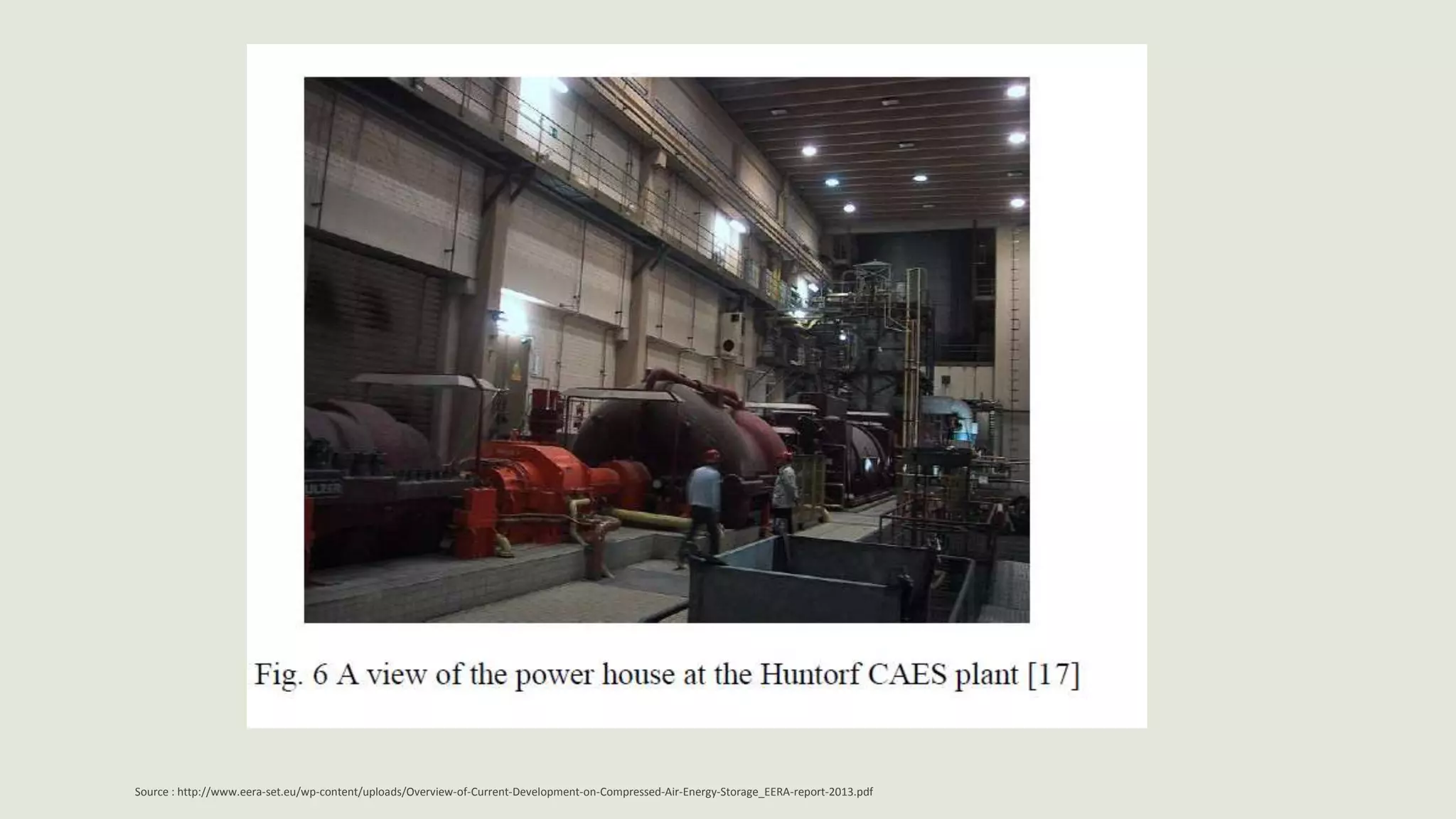
Source : http://www.eera-set.eu/wp-content/uploads/Overview-of-Current-Development-on-Compressed-Air-Energy-Storage_EERA-report-2013.pdf
Compressed air energy storage
Small scale CAES facilities
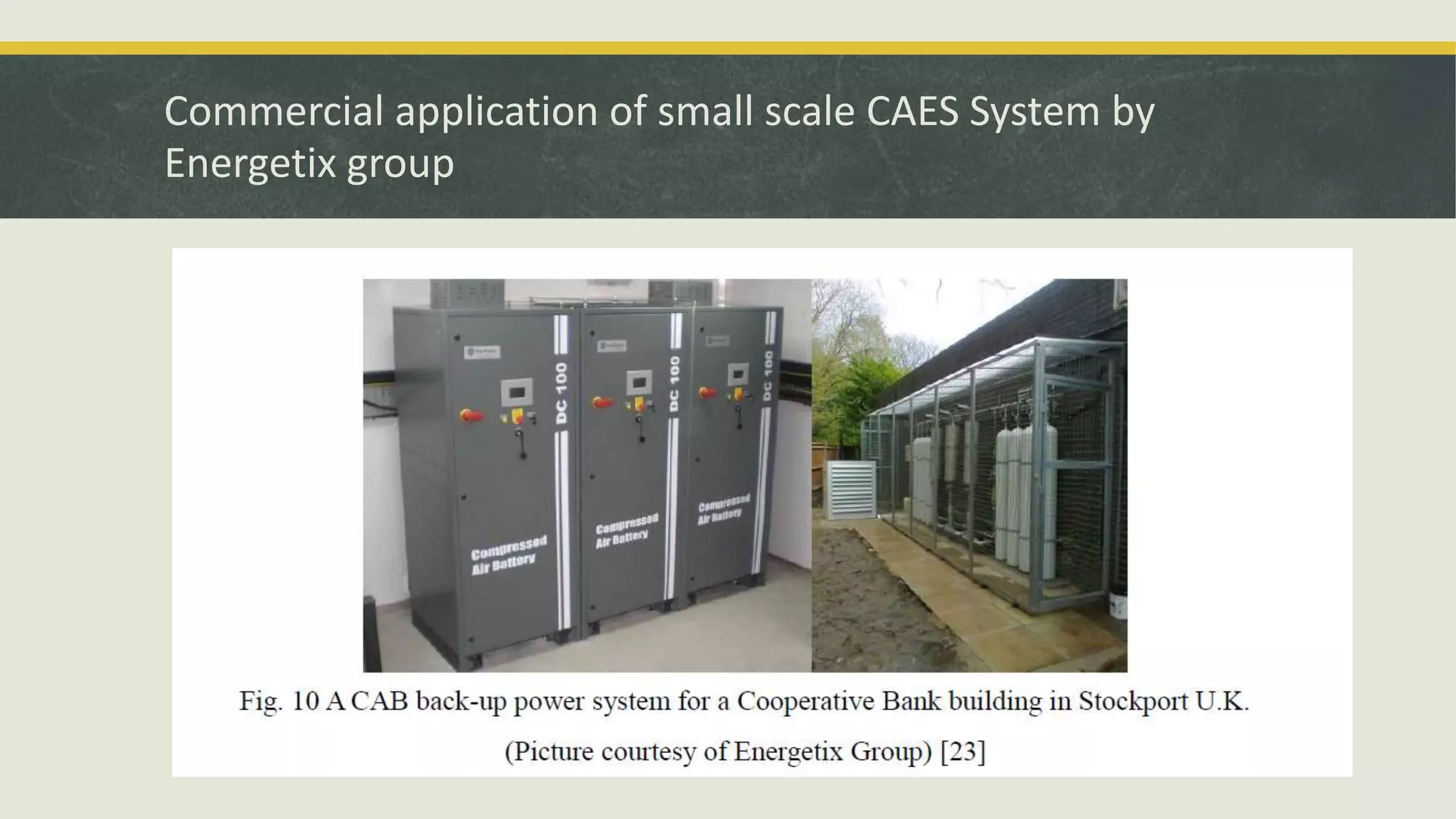
 Small-scale CAES is now attracting the developers’ attention and the associated
technologies are emerging. ACompressed Air Battery (CAB) systemisdevelopedby
aUK based company -Energetix Group,with a power rating range between 2 kW
and a few MW.
Commercial application of small scale CAES System by
Energetix group
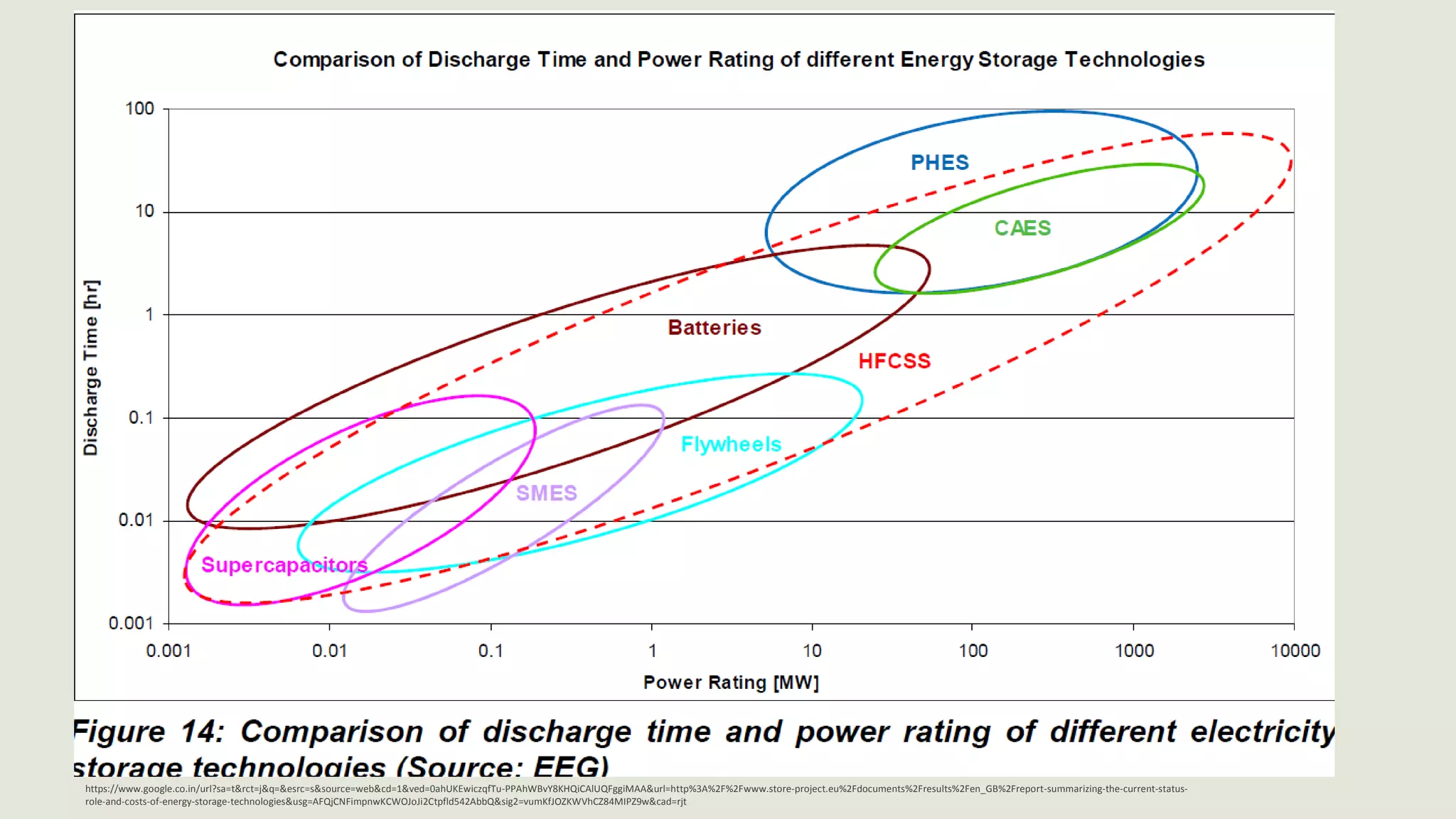
https://www.google.co.in/url?sa=t&rct=j&q=&esrc=s&source=web&cd=1&ved=0ahUKEwiczqfTu-PPAhWBvY8KHQiCAlUQFggiMAA&url=http%3A%2F%2Fwww.store-project.eu%2Fdocuments%2Fresults%2Fen_GB%2Freport-summarizing-the-current-
status-role-and-costs-of-energy-storage-technologies&usg=AFQjCNFimpnwKCWOJoJi2Ctpfld542AbbQ&sig2=vumKfJOZKWVhCZ84MIPZ9w&cad=rjt
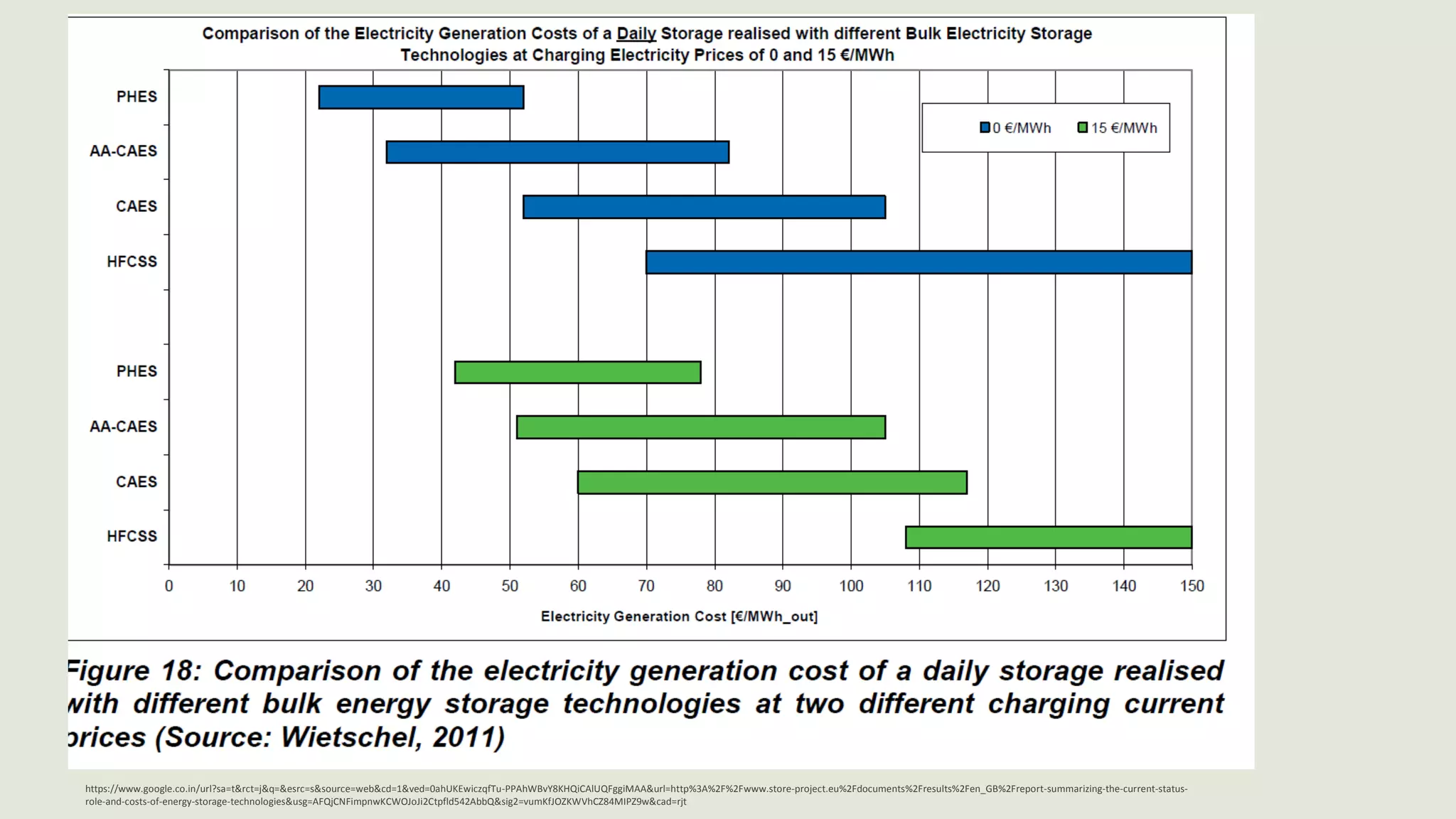
https://www.google.co.in/url?sa=t&rct=j&q=&esrc=s&source=web&cd=1&ved=0ahUKEwiczqfTu-PPAhWBvY8KHQiCAlUQFggiMAA&url=http%3A%2F%2Fwww.store-project.eu%2Fdocuments%2Fresults%2Fen_GB%2Freport-summarizing-the-current-status-
role-and-costs-of-energy-storage-technologies&usg=AFQjCNFimpnwKCWOJoJi2Ctpfld542AbbQ&sig2=vumKfJOZKWVhCZ84MIPZ9w&cad=rjt
https://www.google.co.in/url?sa=t&rct=j&q=&esrc=s&source=web&cd=1&ved=0ahUKEwiczqfTu-PPAhWBvY8KHQiCAlUQFggiMAA&url=http%3A%2F%2Fwww.store-project.eu%2Fdocuments%2Fresults%2Fen_GB%2Freport-summarizing-the-current-status-
role-and-costs-of-energy-storage-technologies&usg=AFQjCNFimpnwKCWOJoJi2Ctpfld542AbbQ&sig2=vumKfJOZKWVhCZ84MIPZ9w&cad=rjt
Useful links
 http://www.store-project.eu/
 http://energystorage.org/energy-storage/energy-storage-technologies
 http://energy.gov/oe/services/technology-development/energy-storage
 https://energy.mit.edu/area/power-distribution-energy-storage/
 http://indiaesa.info/
Thank you
Abhinav Bhaskar,
Research Associate,
Energy and Environment Technology Development Division
The Energy and Resources Institute (TERI)
Darbari Seth Block, India Habitat Centre
Lodhi Road, New Delhi 110 003, India
Cell: +917042180747
Ph (Direct): +91 11 2468 2100 Ext 2268


An introduction to energy storage technologies

  • 1.
    Energy Storage Technologies learningsfrom other countries By Abhinav Bhaskar , Research Associate , The energy and resources institute with inputs from Shreya Agarwal
  • 2.
    Contents  Why dowe need energy storage ?  Technical and economical savings from energy storage  Types of storage based on application  Different technologies  Criteria for selection of energy storage technology  Economical evaluation of storage technologies  Thermal energy storage-LHES
  • 3.
    Renewable energy potentialof India Source : http://mospi.nic.in/mospi_new/upload/Energy_statistics_2016.pdf
  • 4.
    Renewable integration inthe grid in India Source : http://mospi.nic.in/mospi_new/upload/Energy_statistics_2016.pdf
  • 5.
    Difficulties with renewableintegration in the grid  Decentralized electricity production and the introduction of variable , fluctuating source increase the difficulty of stabilizing the power network, mainly due to supply-demand imbalance.  Unpredictable character of renewables requires that network provisioning and usage regulations be established for optimal system operation.  Peak supply and demand of the renewable energy technologies like solar energy do not match and hence create a gap.
  • 6.
    Why do weneed energy storage ? Source :http://www.theenergycollective.com/schalk-cloete/259876/intermittent-renewables-and-electricity-markets
  • 7.
    THIS FIGURE FROMTHE CALIFORNIA GRID OPERATOR SHOWS THE ANTICIPATED EFFECT OF INCREASING SOLAR GENERATION ON THE STATE’S NET LOAD (LOAD MINUS RENEWABLES) IN THE FUTURE. THE AMOUNT OF OTHER ELECTRICITY RESOURCES REQUIRED IN THE MIDDLE OF THE DAY IS REDUCED SIGNIFICANTLY, AND FAST-RAMPING GENERATORS ARE REQUIRED TO COMPENSATE FOR SOLAR BETWEEN 4 AND 8 P.M. (SOURCE: CAISO)
  • 8.
    Diurnal variation insolar radiation www6.cityu.edu.hk/bst/beet/project_page/research%20projects/solar%20utilization/solar%20utilization.htm
  • 9.
    What is Energystorage ?  Conversion of excess electricity into a different form of energy which can be reconverted into electricity with minimum losses . This can be done to reduce the gap in supply and demand of electricity. It can be applied to both conventional sources of electricity and renewable energy sources .  It increases the dispatch ability, makes power available on demand and by reducing the gap between supply and demand reduces the need for newer power plants.
  • 10.
    Technical and economicadvantages of energy storage Energy transfer  Conventional Energy production : Energy storage compensates for a temporary loss of production, spike in the peak demand and to avoid penalties by fulfilling a commercial agreement of pre-sold energy supply . The power level is comparable to a that stipulated and the quantity of stored energy should be a compromise between the desirable duration of backup power and the potential penalties.  Renewable energy production: Storage of electricity adds value to the supplied current by making it more predictable. Cost of buffer storage should be considered.
  • 11.
    Network Savings  Powernetworks are comprised of many generating units, various levels of transmission and distribution lines and associated stations and sub-stations and a great many consumers with wide ranging power requirements.  End user demand in terms of ratio between peak and average levels often reaches a value of 10. This leads of over dimensioning of transmission equipment which are designed for peak load levels rather than average levels.  Storage helps compensate a local supply for load variations making it possible to operate transmission, sub-transmission and distribution networks with lighter designs.
  • 12.
     Kinetic advantage Theflexibility of energy storage systems can help provide instant response to demand and as a consequence, add flexibility to the network in terms of load levelling. Network imbalance can be caused by a temporary production deficit, which could possibly be predicted.
  • 13.
    Electricity storage systems Low power application in isolated areas, essentially to feed transducers and emergency terminals.  Medium power applications in isolated areas (individual electrical systems , town supply)  Network connection application with peak levelling  Power quality control applications The first two categories are for small scale systems where the energy could be stored as kinetic energy (flywheels) , chemical energy, compressed air, hydrogen (fuel cells) or in super capacitors or super conductors Categories 3 and 4 are for large scale systems where energy could be stored as gravitational energy, thermal energy , chemical energy or compressed air (coupled with natural gas )
  • 14.
    Characteristics of energystorage systems  Storage capacity : Quantity of available energy in the storage systems after charging. Discharge is often incomplete. Wst is the energy stored while Wut is the energy utilized.  Available power : Defines the constitution and size of the motor-generator in the stored energy conversion chain. Expressed as an average value, as well as peak value often used to express the maximum power of charge or discharge.  Power transmission rate: Time needed to extract the stored energy  Efficiency: The ration between the Wut/ Wst . Should be based on the complete cycle to account for the charging, no load and self discharge losses.
  • 15.
    Characteristics of Energystorage  Cycling capacity (durability) : Number of times the storage unit can release energy level it was designed for after recharge. Expressed as the maximum number of cycles (N).  Autonomy : The maximum amount of time the system can continuously release energy. Expressed as a= Wut/ Pd ( restorable power / maximum discharge power).  Costs : Investment costs of storage is factored out using the following formula C=C1Wut + C2Pd . Operational costs are proportional to the investment costs , to the tune of 40% of the investment costs
  • 16.
     Feasibility andadaptability to the generating source : Highly efficient storage systems need to be closely adapted to the type of application and to the type of production. Needs to be harmonized with the network.  Self-discharge : Portion of stored energy dissipated during non-use time.  Mass and volume density : Refers to the maximum amount of energy stored per unit mass of the storage system.  Environmental and operation safety  Reliability
  • 17.
    Different types ofenergy storage systems  Pumped hydro energy storage (PHES )  Compressed air energy storage ( CAES)  Latent heat thermal energy storage (LHTES)  High temperature thermal energy storage with turbine  Kinetic energy storage system (Flywheels )
  • 18.
    Thermal - STES - LHES Mechanical -Flywheel - CAES - Pumped hydro storage Electro chemical - Batteries - Flow batteries Chemical - Hydrogen Electrical - Super capacitor - SMES
  • 19.
    Pumped Hydro EnergyStorage: Overview  The most commercially developed technology.  PHS uses two reservoirs at different heights to store energy  As of 2012, 99% of the global storage is in the form of PHS.1  India’s estimated potential of pumped hydro storage plants is 94GW across 56 sites.2  Round trip efficiency: 70%-85% 3 1. Electric Power Research Institute (EPRI), USA 2. http://indiaenergy.gov.in/supply_larhydro.php 3. http://greeneconomypost.com/fifteen-grid-scale-energy-storage-solutions-watch-15924.htm#ixzz3zqwwIXOH
  • 20.
    Pumped Hydro EnergyStorage: Statistics 1. http://indiaenergy.gov.in/supply_larhydro.php 2. http://people.duke.edu/~cy42/PHS.pdf 3. Assessment of the Role of Energy Storage Technologies for Renewable Energy Deployment in India, Partnership to Advance Clean Energy - Deployment (PACE - D) Technical Assistance Program, March 2014 Statistics India’s Potential: 90GW across 56 sites1 Total global installed 142 GW across 40 countries 2 Capital cost of electricity is 150- 700$/kWh3 High environmental Impact High capital investment required Occupy large space Long time for construction
  • 21.
    Pumped Hydro EnergyStorage: Applications APPLICATIONS Load Leveling Frequency stabilizatio n Spinning reserve Storage media Reactive power control Black start
  • 22.
    Pumped Hydro EnergyStorage: Case Studies  DNVGL has developed Energy Island, North Sea off Dutch coast. It uses an inverse offshore pump accumulation station (IOPAC) on an artificially created island in conjunction with wind energy.1  The Energy Island is about 10 kilometers long and 6 kilometers wide. The water level in the ‘inner lake/ reservoir’ would be 32-40m below that of surrounding North Sea.  Energy Island’s maximum generation capacity is 1,500 MW, depending on the water level.  Annual storage capacity of more than 20 GWh.2 1. https://www.dnvgl.com/services/large-scale-electricity-storage-7272 2. http://www.windtech-international.com/product-news/news/products-news/kema-collaborates-on-large-scale-offshore-energy-storage-system
  • 23.
    Pumped Hydro EnergyStorage: Status Ua:3 22GW Austria:4 3.5GW Future Addition Plan: 5.5GW by 2020 Spain:3 5.4GW Future addition plan: 720MW Japan:2 27GW China:1 24 PHS plants 16.95 GW Future Target: 50GW by 2020 1. http://www.sciencedirect.com/science/article/pii/S1364032112003589 2. http://www.tsp-data-portal.org/TOP-20-Capacity#tspQvChart 3. http://www.store-project.eu/en_GB/current-situation-in-the-target-countries-spain 4. http://www.store-project.eu/en_GB/current-situation-in-the-target-countries-austria
  • 24.
  • 25.
    Pumped Hydro StoragePlants in India1 Srisailam Pumped Hydro Storage, 1,670 MW Sardar Sarovar Pumped Storage Power Station, 1,450 MW Nagarjuna Sagar Pumped Hydro Station Tail Pond Project 700 MW Bhira Pumped Storage Hydro Plant,150 MW 1. http://indiaesa.info/index.php/resources/india-energy-storage-projects.html
  • 26.
    Flywheel Energy StorageSystem: Overview  Flywheel storage is a mechanical storage technology.  Flywheels are excellent for storing intermittent energy for short time periods.  As most energy is lost due to friction, flywheels are operated in enclosed vacuum spaces to minimize drag. Image source: http://energystorage.org/energy-storage/technologies/flywheels
  • 27.
    Flywheel Energy StorageSystems: Advantages & Disadvantages Advantages  Low maintenance.  Long life (more than 20-25 years)  Low environmental impact  Excellent load following characteristics  No fuel, water or any resource consumption. Disadvantages • Add weight to cars. Especially problematic in racing cars • High cost as compared to PHS and batteries • Cost: 1400$/kW1 • Cannot hold power for long durations 1. Assessment of the Role of Energy Storage Technologies for Renewable Energy Deployment in India, Partnership to Advance Clean Energy - Deployment (PACE - D) Technical Assistance Program, March 2014
  • 28.
    Flywheel Energy StorageSystem: Applications Uninterruptible power supplies1 They consume less space than batteries. Preferred for use in backup systems like UPS for data centers Transport Used in hybrid electric vehicle to increase fuel efficiency. Such vehicles are called ‘flybrids’ Grid Energy Storage Due to fast response, low environmental impact, small footprint, these can be used for grid support Wind Turbines Can be used to store energy generated by wind turbines during low demand periods NASA applications NASA developed flywheels for application as an energy storage media These are well suited for applications that require high power, low energy and large number of cycles 1. http://www.datacenterknowledge.com/archives/2007/06/26/flywheels-gain-as-alternative-to-batteries/ Ancillary services They have very fast response and ramp rate: can be used as back up power support/ spinning reserve Frequency regulation
  • 29.
    Flywheel Energy StorageSystems: Case studies 20MW, Stephentown, New York 1 For frequency regulation to NYISO 1. http://beaconpower.com/stephentown-new-york/ 2. http://www.activepower.com/data-center-case-studies/ 3. http://www.flybridsystems.com/LMP1test.html Data center in Sweden using flywheel storage2 Flybrid LMP1 KERS has run for the first time in the Hope Racing LMP1 car. 3 It completed 21 laps of the circuit
  • 30.
    Compressed air energystorage  The compression mode of a typical CAES plant is activated at the time when the low demand presents.  The surplus electricity is used to run a chain of compressors to inject the air into a storage reservoir (normally an underground cavern for large-scale CAES), and the stored compressed air is at a high pressure (typically 4.0-8.0 MPa) and the temperature of the surrounding formation.  Such a compression process can use intercoolers and after-coolers to reduce the working temperature of the injected air thus to improve the compression efficiency and minimising thermal stress on the storage volume walls .  When the power generation cannot meet the demand, the expansion mode will be engaged. The stored high pressure compressed air is released from the storage reservoir, heated, and then expanded through a high-pressure turbine which can be a steam turbine or a gas turbine .
  • 31.
    Compressor train Expander/generatortrain Fuel (e.g. natural gas, distillate) CAES system Intercoolers Heat recuperator PC PG Air Exhaust Air Storage Aquifer, salt cavern, or hard mine hS = Hours of Storage (at PC) PC = Compressor power in PG = Generator power out Source : https://www.google.co.in/url?sa=t&rct=j&q=&esrc=s&source=web&cd=4&ved=0ahUKEwi6473Er- PPAhXBQI8KHe9VCVoQFgg0MAM&url=https%3A%2F%2Fcmi.princeton.edu%2Fnews%2Fppt%2Fcaes05.ppt&usg=AFQjCNHodvVRn5QSZCCk6XDPx70nGLwsqA&sig2=yXXAc9TTNTofKjgDuzhFLA&cad=rjt
  • 32.
  • 33.
  • 34.
  • 35.
  • 36.
  • 37.
    Small scale CAESfacilities  Small-scale CAES is now attracting the developers’ attention and the associated technologies are emerging. ACompressed Air Battery (CAB) systemisdevelopedby aUK based company -Energetix Group,with a power rating range between 2 kW and a few MW.
  • 38.
    Commercial application ofsmall scale CAES System by Energetix group
  • 39.
  • 40.
  • 41.
  • 42.
    Useful links  http://www.store-project.eu/ http://energystorage.org/energy-storage/energy-storage-technologies  http://energy.gov/oe/services/technology-development/energy-storage  https://energy.mit.edu/area/power-distribution-energy-storage/  http://indiaesa.info/
  • 43.
    Thank you Abhinav Bhaskar, ResearchAssociate, Energy and Environment Technology Development Division The Energy and Resources Institute (TERI) Darbari Seth Block, India Habitat Centre Lodhi Road, New Delhi 110 003, India Cell: +917042180747 Ph (Direct): +91 11 2468 2100 Ext 2268 

Editor's Notes

  • #20 During periods of low demand, water is pumped to the higher reservoir. And when energy is required water is allowed to flow to the lower reservoir and produce electricity in manner similar to hydro power stations.
  • #21 This cost is lower than what other technologies offer which is >500$/kWh As per another report by IEA, for a technology to become grid competitive it should be around 90-100$/kWh. Hence this is the only grid competitive technology
  • #22 Definitions of all This can function as an ancillary support and Spinning reserve: is a generator that is already online and can be ramped up to support demand increase Load Levelling: can be used as a demand side management tool by using power during periods of low demand to pump water and support generation during excess power demand. Frequency stabilization: due to variations in power demand and supply, frequency can go below or increase. PHS systems can be used to address excess power demand and reduce frequency deviations. Storage media Reactive power control for supporting power demand. Black start: it does not require another generator to bring it to power. Usually hydroelectric plants are termed as black start since they hardly need any initial boost of power and can put large chunks of power back online very quickly
  • #27 Flywheels can store electrical energy as rotational energy, which can be used to turn a turbine rotor to produce electricity when backup power is required.
  • #28 Besides bearing replacement every few years, these do not require any major replacement or repair and
  • #30 Stephentown, New York is the site of Beacon Power’s first 20 MW plant (40 MW overall range) and provides frequency regulation service to the NYISO. The facility includes 200 flywheels and is managed by Beacon Power. Initial commercial operation began in January, 2011 and full output was reached in June, 2011. In this market, Beacon flywheels perform between 3,000 and 5,000 full depth-of-discharge cycles a year. Although only 10% of the NYISO market regulation market capacity, the plant provides over 30% of the Area Control Error correction, doing so with over 95% accuracy. Data center in Sweden Hydro66 is a London-based colocation provider that owns and operates a 100 percent hydro-powered data center. The 11,000 square foot, 3.2 megawatt facility is located in Boden, Sweden, just 50 miles from the Arctic Circle, allowing for free-air cooling year- round. Challenge Powered entirely by energy from a nearby hydroelectric dam, Hydro66’s Boden facility offers ultra-green hosting services for eco-conscious customers. To align with its sustainable computing mission, the company committed itself to only deploying environmentally-friendly equipment, including the electrical infrastructure. Solution Hydro66 chose to deploy an Active Power CleanSource® 625 kVA UPS system to protect the facility’s IT infrastructure from electrical interruption. From the beginning, executives at Hydro66 knew they wanted to avoid conventional battery-based UPS systems because of the environmental issues associated with valve-regulated lead acid batteries. Active Power’s flywheel UPS was selected over competing products due to its battery-free design, high operating efficiencies and scalability. Result Since the installation in July 2015, the facility has experienced numerous power disturbances, but the data center has remained fully operational. As the facility adds capacity in the future, Hydro66 plans to deploy additional Active Power CleanSource UPS systems. he new Flybrid LMP1 KERS has run for the first time in the Hope Racing LMP1 car.  The car completed a short shakedown test at Magny Cours on the 21st April before moving to Le Mans for the only group test day to be held at the circuit before the 24 hour race in June. The car completed 21 laps of the famous circuit collecting valuable information in advance of the race proper.  electronic systems on the car including: the Bosch engine control unit, the Megaline gear shift system controller, the Flybrid KERS controller and the Cosworth supplied ACO data logger.