MEDITRONICS
By
Abhishek Mathew,
Reg. no. 311114114005,
Mechanical Engineering,
LICET.
Date: 03. 08. 2017.
1. Robotics in Medicine
Using robotics for medical applications- two decades ago - mainly in surgery,
diagnosis, and artificial limbs
Advantages of robotic surgery
• operate in a confined space
• minimally invasive
• Remote tele operated surgeries
• Virtual surgeries
Surgery
Modern surgical robotic systems
• Surgical manipulators
• Image acquisition device
• Computer software
The Zeus surgical system.
The da Vinci surgical system.
Robotic capsular endoscope
Diagnosis
Nano Robotics in Medicine
Rehabilitation Robotics
Rehabilitation robotics is a field of
research dedicated to understanding and
augmenting rehabilitation through the
application of robotic devices.
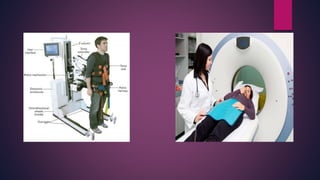
Robotics in Rehabilitation
The Lokomat is a driven gait orthosis with electromechanical
drives for hip and knee joint (2 degrees of freedom per leg).
Prosthetics and Orthotics
If you are missing an arm or leg, an
artificial limb can sometimes replace it with
a device called prosthesis
The branch of medicine that deals with the
provision and use of artificial devices such
as splints and braces. They supplement the
bodily functions.
Orthotics:
Prosthetics:
Phoenix exoskeleton- lightweight, low-cost and agile
EYESI, an ophthalmic virtual reality surgical training system
Surgical Training Simulators and Haptic Interface
2. Smart Instruments and Probes
A smart instrument has an embedded or external
controller (provided by imaging and/or sensing
data) to guide the operation either indirectly (by
providing the surgeon with enhanced information
on the anatomy or structure of the operating site)
or directly (by providing the controller with such
information for real-time adaptation to the
environment).
Pharmaceuticals
Block diagram of a smart surgical tool used in
computer-assisted surgery.
3. Navigation
Navigation systems are used in education
and training to provide 3D viewing and
virtual planning of instrumentation.
The tracking principle in navigation
systems is based on optically measuring
the positions of active (luminescent) or
passive (IR-reflective) markers that are
attached to the tracked object.29
4. Companionship or Palliative Care
Thank You

Meditronics

  • 1.
    MEDITRONICS By Abhishek Mathew, Reg. no.311114114005, Mechanical Engineering, LICET. Date: 03. 08. 2017.
  • 3.
  • 4.
    Using robotics formedical applications- two decades ago - mainly in surgery, diagnosis, and artificial limbs Advantages of robotic surgery • operate in a confined space • minimally invasive
  • 5.
    • Remote teleoperated surgeries • Virtual surgeries Surgery
  • 6.
    Modern surgical roboticsystems • Surgical manipulators • Image acquisition device • Computer software
  • 7.
  • 8.
    The da Vincisurgical system.
  • 9.
  • 10.
  • 11.
    Rehabilitation Robotics Rehabilitation roboticsis a field of research dedicated to understanding and augmenting rehabilitation through the application of robotic devices.
  • 12.
  • 13.
    The Lokomat isa driven gait orthosis with electromechanical drives for hip and knee joint (2 degrees of freedom per leg). Prosthetics and Orthotics
  • 14.
    If you aremissing an arm or leg, an artificial limb can sometimes replace it with a device called prosthesis The branch of medicine that deals with the provision and use of artificial devices such as splints and braces. They supplement the bodily functions. Orthotics: Prosthetics:
  • 16.
  • 17.
    EYESI, an ophthalmicvirtual reality surgical training system Surgical Training Simulators and Haptic Interface
  • 18.
    2. Smart Instrumentsand Probes A smart instrument has an embedded or external controller (provided by imaging and/or sensing data) to guide the operation either indirectly (by providing the surgeon with enhanced information on the anatomy or structure of the operating site) or directly (by providing the controller with such information for real-time adaptation to the environment).
  • 19.
  • 20.
    Block diagram ofa smart surgical tool used in computer-assisted surgery.
  • 21.
    3. Navigation Navigation systemsare used in education and training to provide 3D viewing and virtual planning of instrumentation. The tracking principle in navigation systems is based on optically measuring the positions of active (luminescent) or passive (IR-reflective) markers that are attached to the tracked object.29
  • 22.
    4. Companionship orPalliative Care
  • 23.

Editor's Notes

  • #3 Meditronics is the combination of medicine and mechatronics
  • #4 Remote tele operated surgeries
  • #5 The idea of using robotics for medical applications was originally conceived and implemented about two decades ago because advances in robotic technology were, by then, sufficiently advanced so as to make it an acceptable and feasible addendum to the field of medical science Robotic application in the medical field has been used mainly in three specific fields, namely, surgery, diagnosis, and artificial limbs.1 The advantages of robotic surgery are that it is possible to operate in a confined space and, because it is minimally invasive, the outcome is generally better.1 Today, robots are routinely used in heart, brain, spinal cord, throat, and knee surgeries in many hospitals throughout the United States.2
  • #7 In order that these procedures adhere to the strict standards required in all surgical procedures, modern surgical robotic systems are based on the interaction of appropriate hardware and proven software components. Surgical manipulators are the most important hardware components of surgical robotic systems and are responsible for holding, or precisely moving, the surgical instruments under computer control. The most common kinematic part of surgical manipulators is the remote center of motion (RCM) which is used to orient the surgical instrument and provide its rotational motion about a fixed point in space, usually located on the instrument. Another important hardware component is the image acquisition device, e.g., video, infrared, ultrasound, X-ray, and magnetic resonance imaging (MRI).9 Of equal importance is computer software since it provides a connection between the data acquired from medical images, sensors and databases, and the physical world of surgical actions.9 Software is used to plan and execute surgical interventions accurately and predictably, employing both real-time and presurgical information about the patient.10
  • #8 Currently, the Zeus and da Vinci robotic systems are the two most commonly used in current remote robot-assisted surgery. Zeus, developed in early 1990s by Computer Motion, is used in laparoscopic procedures such as general, cardiac, gynecologic, uro-logic, and pediatric surgeries. Each Zeus system consists of two physically separated parts: the “surgeon side” and the “patient side”. The surgeon-side console has a monitor for capturing the surgical process and contains two handles which the surgeons use to control the robotic arms and manipulate surgical instruments. The patient side part has three robotic arms controlled by the surgeon console. These robotic arms can be equipped with a variety of surgical instruments and either 3D video monitoring or imaging microsystems.11,12
  • #9 In 1999, the da Vinci Surgical System was introduced by Intuitive Surgical, Inc. to facilitate delicate and complex minimally invasive operations. The system is comprised of three components: a surgeon console, equipped with a 3D stereo viewer; a patient-side cart designed to hold up to four robotic arms; and a vision cart housing camera control boxes, light sources, and a synchronizer. The system offers the combination of seven total degrees of freedom: insertion, pitch and yaw in the arms and roll, grip, pitch and yaw in the wrists.13 
  • #10 Robotics in medicine is also used in diagnosis for which it is not only much more accurate but, just as in surgery, is equally minimally invasive.1 A good example of this is the robotic capsular endoscope that can be used for making a noninvasive diagnosis of the gastrointestinal tract. 3D guidance for image-guided therapy depends on the availability of 3D medical imaging modalities. Modern imaging methods such as MRI, CT, and PET generate 3D image sets as part of their standard protocols. Ultrasound has conventionally operated as a 2D modality, but methods have been developed to obtain 3D information from ultrasound.31 The most widespread use of 3D image guidance to date is neurosurgery.32,33 Endoscopic methods with image guidance, to avoid critical structures during the intervention, are also being used in ear, nose, and throat procedures.34 Cranio-facial surgery procedures using 3D image guidance include osteotomy, bone grafts, and implants. Orthopedic surgery applications include hip, spinal, and knee implants.
  • #11 It is hypothesized that in future the principal focus in medicine will shift from medical science to medical engineering in which the techniques provided from human molecular structural knowledge, gained in the twentieth and early twenty-first centuries, will enable humans to design and manufacture medically active microscopic machines.14 Within this sphere, nano robotics will mainly be applied in two major areas, namely surgery and constant patient monitoring.15 However, to fulfill such goals, the feasibility of fabrication and assembly of nano scale parts must first be established. These two capabilities had been demonstrated to a limited degree as early as 1998 through the use of different approaches such as biotechnology, supramolecular chemistry, and scanning probes.14 Developments in the field of bimolecular computing,16 have proved that processing logic tasks using bio-computers is now feasible and is the first step toward building future nano processors.17 However, unlike manufacturing larger robots, the greater forces inherent within this environment (turbulent fluid velocities and Brownian motion) are the dominant forces that must be considered.15 Also, there has been progress in building biosensors,18 and nano kinetic devices,19,20 which enables nano robotic operations and locomotion.
  • #14 Finally, robotics is used to help restore physical functions by providing patients with prosthetic legs, arms, and hands.1 An example of this is bilateral robotic orthosis called Lokomat® (Hocoma AG, Volketswil, Switzerland) shown in Fig. 8.1. This device is used in conjunction with a treadmill and a dynamic body weight support to control the patient’s leg movements in the sagittal plane.3–5 The Lokomat’s hip and knee joints are activated by linear back-drivable actuators connected to an exoskeleton structure. Passive foot lifters help ankle dorsiflexion during the swing phase. The patient’s legs, which are fixed to the exoskeleton by straps, are moved according to a position control strategy with predefined hip and knee joint trajectories.
  • #16 Assistive robots are those which help disabled people to carry out their daily activities and to provide them with a greater degree of autonomy. For example, robot manipulators assist individuals, who have little or no hand function, with essential tasks such as eating and drinking, or prosaic tasks such as opening a filing cabinet. Assistive robotics also includes mobility aides, such as wheelchairs and walkers with intelligent navigation and control systems, in order to help individuals with impaired lower-limb function.
  • #17 A prosthetic is a mechanical device used for substituting a missing part of the human body and prosthetic related robots are often used to restore lost mobility or manipulation functions. An orthotic is a mechanism that is aimed to assist or support a weak or ineffective joint, muscle, or limb and often comes in the form of an exoskeleton, a powered anthropomorphic suit worn by the patient.21 Sports- Oscar Pistorius Bionic legs/ Exoskeleton
  • #18 Training surgical residents adds significant cost to the annual budget of most medical-care institutions. A resident is also more likely to make a mistake than a more experienced surgeon which could result in economic, legal, and societal liability. It has been several decades since flight simulators were used to train airline and military pilots in a virtual reality environment,21 and it was this precedent that inspired using similar systems in medical applications. Residents are currently trained on different modalities: first on plastic models, next on animals, and finally on human patients. Using a virtual reality environment, however, enables residents, under differing and difficult simulated anatomical case scenarios, to become more proficient and to learn more easily, since any mistakes that are made will not result in any ethical or financial liability. A typical virtual reality surgical simulator consists of hardware and software. The input data, in some surgical simulators, are gathered only by sensors which show the position of the tools. In more advanced systems, a haptic interface is used which incorporates actuators in addition to position sensors. These actuators are able to generate the appropriate force feedback when the tools interact with the virtual medium. One commercially available surgical training system, which has been developed for ophthalmic surgery, is shown in Fig. 8.3. In this system, handheld instruments can move freely into a dedicated artificial eye and their interaction with the tissue and ocular structure is simulated and shown simultaneously. During the simulation, all essential microscopic and machine functions can be controlled by means of foot pedals.9