Engineering
Safety- and Security-Related
Requirements


Donald Firesmith
Software Engineering Institute
Carnegie Mellon University
Pittsburgh, PA 15213
18 June 2012
Half-Day Tutorial


                                 © 2012 Carnegie Mellon University
Tutorial Goals
To familiarize safety, security, and requirements engineers with the:
  • Common challenges they face
  • Common foundational concepts underlying each other’s disciplines
  • Useful reusable techniques from each other’s disciplines

  • Different types of safety- and security-related requirements

To provide safety, security, and requirements engineers with a common
consistent method for engineering these requirements and thereby:
  • Improve collaboration
  • Engineer better safety- and security-related requirements
  • Decrease the incidence of accidents and successful attacks due to poor
    safety- and security-related requirements


                                                           Engineering Safety- & Security-Related
                                                           Requirements                             2
                                                           Donald Firesmith, 18 June 2012
                                                           © 2012 Carnegie Mellon University
Intended Audiences
Primary audience:
 • Safety engineers
 • Security engineers
 • Requirements engineers

Secondary audience:
 • Project managers (acquisition, development, or sustainment)
 • Lead system engineers and system architects
 • System, software, and hardware engineers
 • Safety and security SMEs and consultants

 • Safety and security trainers and academic educators and researchers

 • Specialty engineers (e.g., human factors and reliability)
 • Any other stakeholders in safety and security

                                                           Engineering Safety- & Security-Related
                                                           Requirements                             3
                                                           Donald Firesmith, 18 June 2012
                                                           © 2012 Carnegie Mellon University
History
Work began in 2002
Presented as conference tutorials and in journal articles
   (see http://donald.firesmith.net/home/publications)
Taught at 5 NASA Centers (2008) and US Army ASSIP Program
Presented to nuclear engineers at:
•   System Engineering Challenges International Workshop in Russia
    (RuSEC 2010) in Moscow, Russia on 23 September 2010
•   Kärnteknik-2011 (Nuclear Technology 2011) Nordic Symposium in
    Stockholm Sweden on 8 December 2011
Free Open Source Tool began Fall 2011
http://donald.firesmith.net/home/safety-and-security-analysis-tool
Book to be published Winter 2012
                                                      Engineering Safety- & Security-Related
                                                      Requirements                             4
                                                      Donald Firesmith, 18 June 2012
                                                      © 2012 Carnegie Mellon University
Where We Are

Related Disciplines ◄
Challenges
Common Example
Free, Open-Source Tool
Requirements Engineering Overview
Safety and Security Engineering Overview
Safety- and Security-related Requirements
Collaborative Defensibility Engineering Method
Conclusion


                                                 Engineering Safety- & Security-Related
                                                 Requirements                             5
                                                 Donald Firesmith, 18 June 2012
                                                 © 2012 Carnegie Mellon University
Safety Engineering – Traditional Definition
Safety
    freedom from accidental harm to people, property, and the environment

Safety Engineering
    the process of ensuring that a system is safe to operate


Major Limitations:
    • No nontrivial system is free from hazards that can cause accidental harm.
    • It is always a matter of degree and risk management.
    • Not just harm, but also accidents, vulnerabilities, and hazards
    • In spite of best efforts, accidents can (and sometimes do) happen.
    • It is important to address not just the prevention of accidental harm (and
      accidents, vulnerabilities, hazards, and risks), but also detecting their
      existence/occurrence, and reacting properly.


                                                             Engineering Safety- & Security-Related
                                                             Requirements                             6
                                                             Donald Firesmith, 18 June 2012
                                                             © 2012 Carnegie Mellon University
Security Engineering – Traditional Definitions
Security (of information and services) is often defined in terms of specific
properties, whereby a system is secure when it exhibits these properties in
spite of attack:
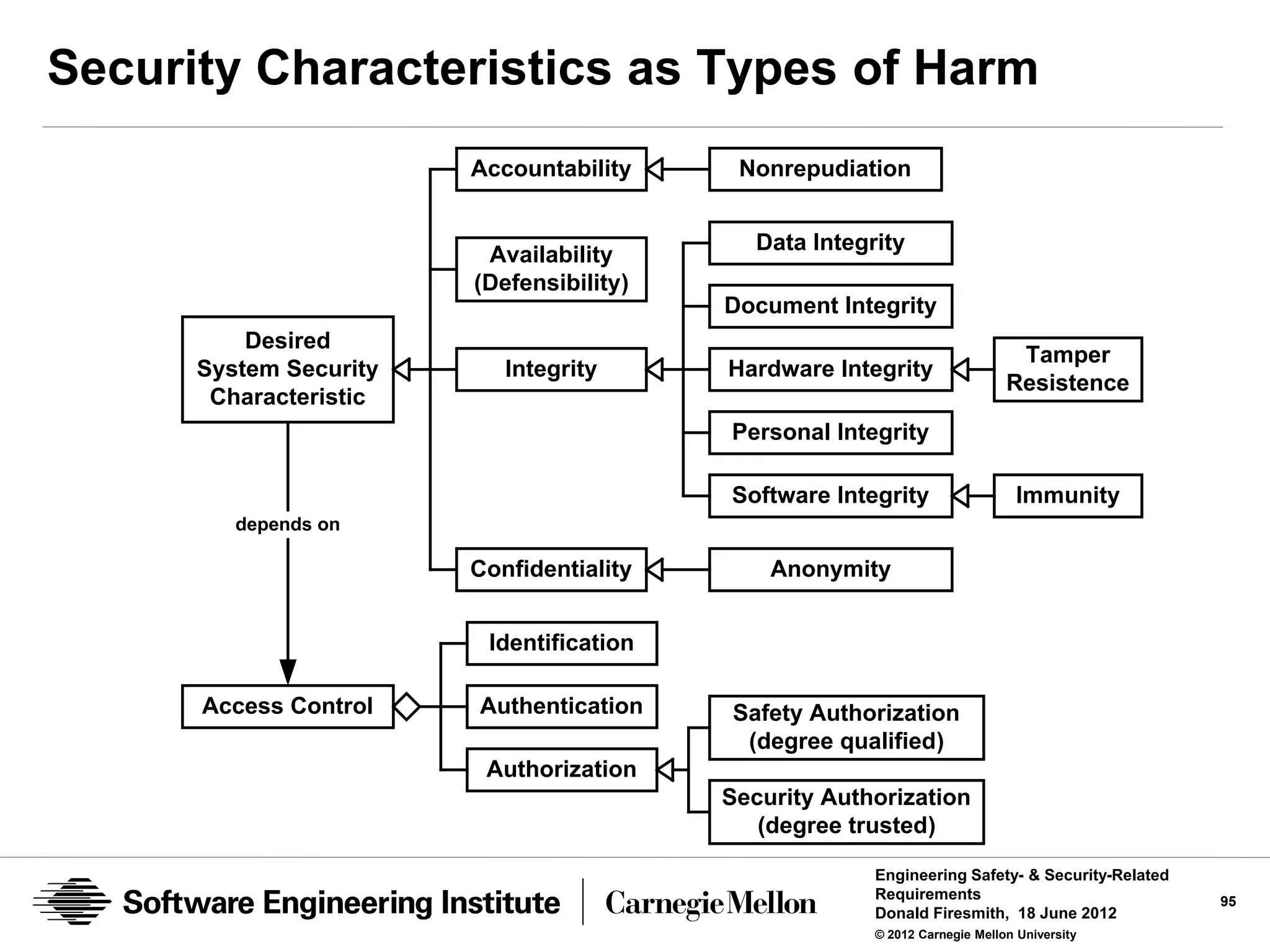
  •   Access Control (including identification, authentication, and authorization)
  •   Availability
  •   Confidentiality (including both privacy and anonymity)
  •   Integrity (including data and software)
  •   Non-repudiation (of transactions)

Security Engineering
      the process of ensuring that a system is sufficiently secure to operate

Major limitations:
  •   No nontrivial system is free from threats that can cause malicious harm.
  •   It is always a matter of degree and risk management.
  •   Not just harm, but also attacks, vulnerabilities, and threats
  •   In spite of best efforts, attacks can (and typically will) happen.
  •   It is important to address not just the prevention of malicious harm (and attacks,
      vulnerabilities, threats, and risks), but also detecting their existence/occurrence, and
      reacting properly.
                                                                      Engineering Safety- & Security-Related
                                                                      Requirements                             7
                                                                      Donald Firesmith, 18 June 2012
                                                                      © 2012 Carnegie Mellon University
Defensibility Engineering – New Definitions
Safety Engineering
 the systems engineering discipline concerned with lowering the risk of unintentional
 (i.e., accidental) unauthorized harm to defended assets to a level that is acceptable to
 the system’s stakeholders by preventing, detecting, and properly reacting to such harm,
 mishaps (i.e., accidents and safety incidents), system-internal vulnerabilities, system-
 external unintentional abusers, hazards, and safety risks
Security Engineering
 the systems engineering discipline concerned with lowering the risk of intentional (i.e.,
 malicious) unauthorized harm to defended assets to a level that is acceptable to the
 system’s stakeholders by preventing, detecting, and properly reacting to such harm,
 civilian misuses (i.e., attacks and security incidents), system-internal vulnerabilities,
 system-external intentional civilian abusers, threats, and security risks
Survivability Engineering
 the systems engineering discipline concerned with lowering the risk of intentional (i.e.,
 malicious) unauthorized harm to defended assets to a level that is acceptable to the
 system’s stakeholders by preventing, detecting, and properly reacting to such harm,
 military misuses (i.e., attacks and survivability incidents), system-internal vulnerabilities,
 system-external intentional military abusers, threats, and survivability risks
                                                                 Engineering Safety- & Security-Related
                                                                 Requirements                             8
                                                                 Donald Firesmith, 18 June 2012
                                                                 © 2012 Carnegie Mellon University
Safety/Security Similarities and Differences
Similarities:
  • Systems engineering rather than software engineering
  • Lower risks to acceptable levels:
    —   Never zero – never perfectly safe, secure, or survivable
  • Prevention, detection, and reaction:
    —   Unauthorized harm to defended assets
        (people, property, environment, services)
    —   Abuses (safety mishaps and security misuses)
    —   System-internal vulnerabilities
    —   System-external abusers (exploit vulnerabilities to cause harm)
    —   Dangers (safety hazards and security threats)
    —   Risks (safety and security)
Differences:
  • Unintentional (safety) vs. intentional (security and security)
  • Terminology
                                                             Engineering Safety- & Security-Related
                                                             Requirements                             9
                                                             Donald Firesmith, 18 June 2012
                                                             © 2012 Carnegie Mellon University
Requirements Engineering
    the engineering discipline within systems/software engineering concerned with
    identifying, analyzing, reusing, specifying, managing, verifying, and validating
    goals and requirements (including safety- and security-related requirements)


Safety- and security-related requirements are primarily system-level
requirements.


                                                           Engineering Safety- & Security-Related
                                                           Requirements                             10
                                                           Donald Firesmith, 18 June 2012
                                                           © 2012 Carnegie Mellon University
Where We Are
Related Disciplines

Challenges ◄
Common Example
Free, Open-Source Tool
Requirements Engineering Overview
Safety and Security Engineering Overview
Safety- and Security-related Requirements
Collaborative Defensibility Engineering Method
Conclusion


                                                 Engineering Safety- & Security-Related
                                                 Requirements                             11
                                                 Donald Firesmith, 18 June 2012
                                                 © 2012 Carnegie Mellon University
Challenges1
Requirements engineering, safety engineering, and security engineering
have different:
 • Communities
 • Disciplines with different training, books, journals, and conferences
 • Professions with different job titles

 • Foundational concepts and terminologies
 • Tasks, techniques, and work products

Some of these differences are unnecessary and represent detrimental
redundancies:
 • Underlying concepts and terminologies

 • Tasks and techniques
 • Work products (models and documents)


                                                           Engineering Safety- & Security-Related
                                                           Requirements                             12
                                                           Donald Firesmith, 18 June 2012
                                                           © 2012 Carnegie Mellon University
Challenges2
Safety and security engineering are:
  • Typically treated as secondary specialty engineering disciplines
  • Performed separately from, largely independently of, and lagging behind the
    primary engineering workflow:
    (requirements, architecture, design, implementation, integration, testing,
    deployment, sustainment)
Safety and security are too often tested into existing systems (reactively)
rather than adequately built into systems during development (proactively)


                                                           Engineering Safety- & Security-Related
                                                           Requirements                             13
                                                           Donald Firesmith, 18 June 2012
                                                           © 2012 Carnegie Mellon University
Challenges3
Separation of requirements engineering, safety engineering, and security
engineering causes:
 • Poor safety- and security-related requirements that are often:
    —   Vague, unverifiable, and infeasible capabilities or goals rather than true
        requirements
    —   Potentially inappropriate architectural and design constraints
    —   Inadequate to drive architecture, design, and implementation
    —   Specified and managed separately from all other requirements
    —   Relegated to “second class” “supplementary” specifications
    —   Often ignored by requirements engineers and architects
    —   Produced too late to drive architecture and testing
 • Safety and security are too often iterated and tested into existing systems
    (reactively) – “find and fix” – rather than adequately built into systems during
    development (proactively).
                                                              Engineering Safety- & Security-Related
                                                              Requirements                             14
                                                              Donald Firesmith, 18 June 2012
                                                              © 2012 Carnegie Mellon University
Challenges4
How much safety and security is enough?
 • Insufficient defensibility is dangerous.
 • Excessive defensibility wastes scarce project resources.
 • Current requirements lack practical and precise thresholds.

 • Defenses (safeguards and countermeasures) should be commensurate with
   risk.
   —   Goldilocks rule: not too little and not too big.
 • Without well-defined thresholds, how can:
   —   Architects perform engineering trade-offs?
   —   Testers set test completion criteria for the testing of safety- and security-
       related requirements?


                                                             Engineering Safety- & Security-Related
                                                             Requirements                             15
                                                             Donald Firesmith, 18 June 2012
                                                             © 2012 Carnegie Mellon University
Challenges5
Many mandated security “requirements” are actually constraints such as:
 • Security subsystems
 • Industry “best practices”

What about safety and security requirements for preventing, detecting, and
reacting to:
 • Harm to defended assets?
 • Abuses (safety mishaps and security misuses)?
 • Vulnerabilities?
 • Abusers (unintentional and intentional)?
 • Dangers (safety hazards and security threats)?
 • Risks (safety and security)?


                                                    Engineering Safety- & Security-Related
                                                    Requirements                             16
                                                    Donald Firesmith, 18 June 2012
                                                    © 2012 Carnegie Mellon University
Challenges6
Current separate methods for performing requirements, safety, and
security engineering are inefficient and ineffective.
Poor requirements are a primary cause of more than half of all project
failures (defined in terms of):
 • Major cost overruns
 • Major schedule overruns
 • Major functionality not delivered

 • Large number of defects delivered
 • Delivered systems that are never used

Poor requirements are a major “root cause” of many (or most) accidents
involving software-intensive systems.


                                                     Engineering Safety- & Security-Related
                                                     Requirements                             17
                                                     Donald Firesmith, 18 June 2012
                                                     © 2012 Carnegie Mellon University
Challenges7
Current state-of-the-practice cries out for improvement:
  • Better consistency between safety and security engineering
      —   More consistent concepts and terminology
      —   Reuse of techniques across disciplines
      —   Less unnecessary overlap and avoidance of redundant work
  • Better collaboration:
      —   Between safety and security engineering
      —   With requirements engineering
  • Easier certification and accreditation

  • Better safety- and security-related requirements
  • Fewer accidents and successful attacks that cause less harm to defended
    assets

                                                        Engineering Safety- & Security-Related
                                                        Requirements                             18
                                                        Donald Firesmith, 18 June 2012
                                                        © 2012 Carnegie Mellon University
Where We Are
Related Disciplines
Challenges

Common Example ◄
Free, Open-Source Tool
Requirements Engineering Overview
Safety and Security Engineering Overview
Safety- and Security-related Requirements
Collaborative Defensibility Engineering Method
Conclusion


                                                 Engineering Safety- & Security-Related
                                                 Requirements                             19
                                                 Donald Firesmith, 18 June 2012
                                                 © 2012 Carnegie Mellon University
Common Example use throughout Tutorial
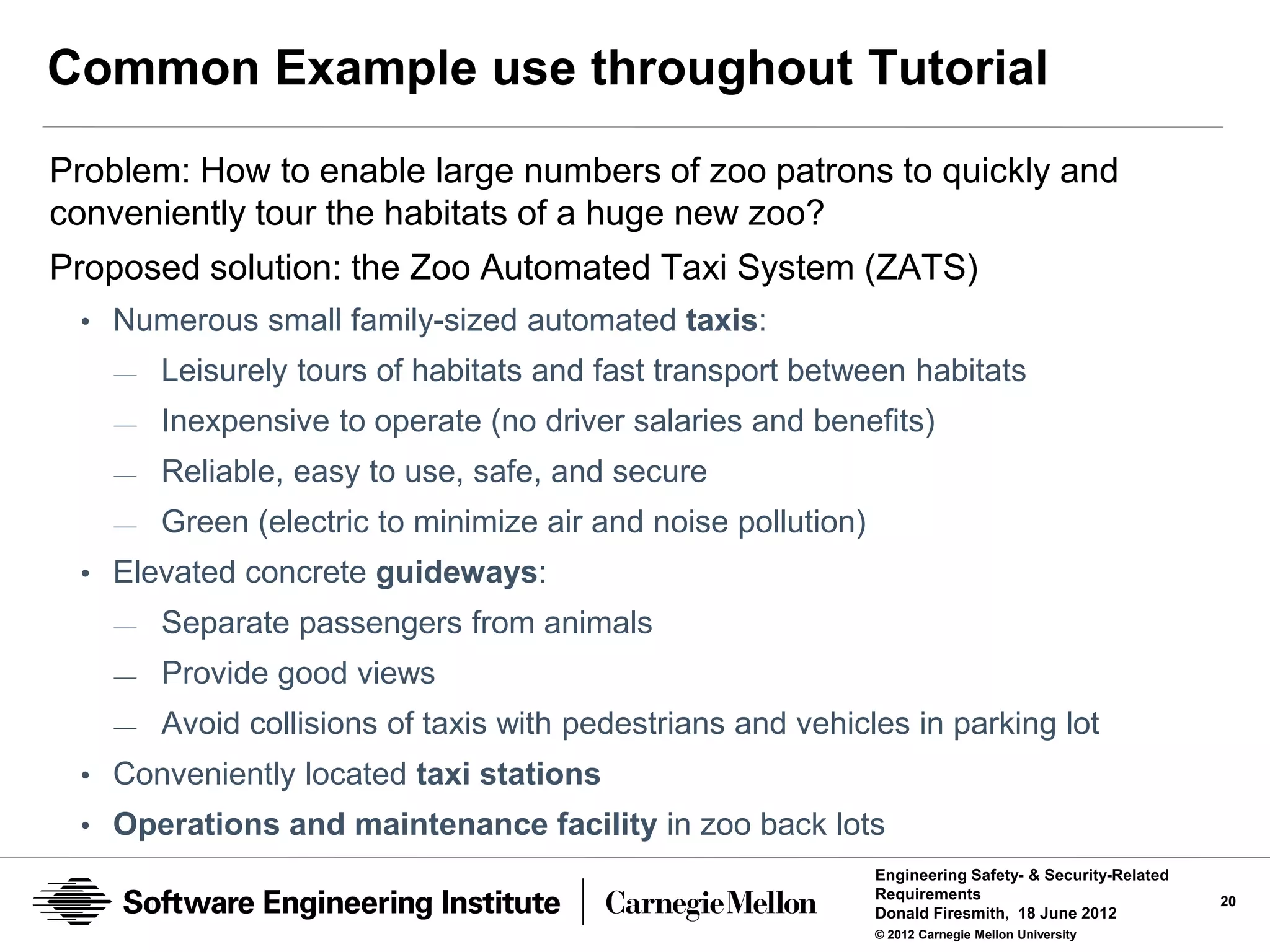
Problem: How to enable large numbers of zoo patrons to quickly and
conveniently tour the habitats of a huge new zoo?
Proposed solution: the Zoo Automated Taxi System (ZATS)
 • Numerous small family-sized automated taxis:
   —   Leisurely tours of habitats and fast transport between habitats
   —   Inexpensive to operate (no driver salaries and benefits)
   —   Reliable, easy to use, safe, and secure
   —   Green (electric to minimize air and noise pollution)
 • Elevated concrete guideways:
   —   Separate passengers from animals
   —   Provide good views
   —   Avoid collisions of taxis with pedestrians and vehicles in parking lot
 • Conveniently located taxi stations
 • Operations and maintenance facility in zoo back lots
                                                              Engineering Safety- & Security-Related
                                                              Requirements                             20
                                                              Donald Firesmith, 18 June 2012
                                                              © 2012 Carnegie Mellon University
Where We Are
Related Disciplines
Challenges
Common Example

Free, Open-Source Tool ◄
Requirements Engineering Overview
Safety and Security Engineering Overview
Safety- and Security-related Requirements
Collaborative Defensibility Engineering Method
Conclusion


                                                 Engineering Safety- & Security-Related
                                                 Requirements                             21
                                                 Donald Firesmith, 18 June 2012
                                                 © 2012 Carnegie Mellon University
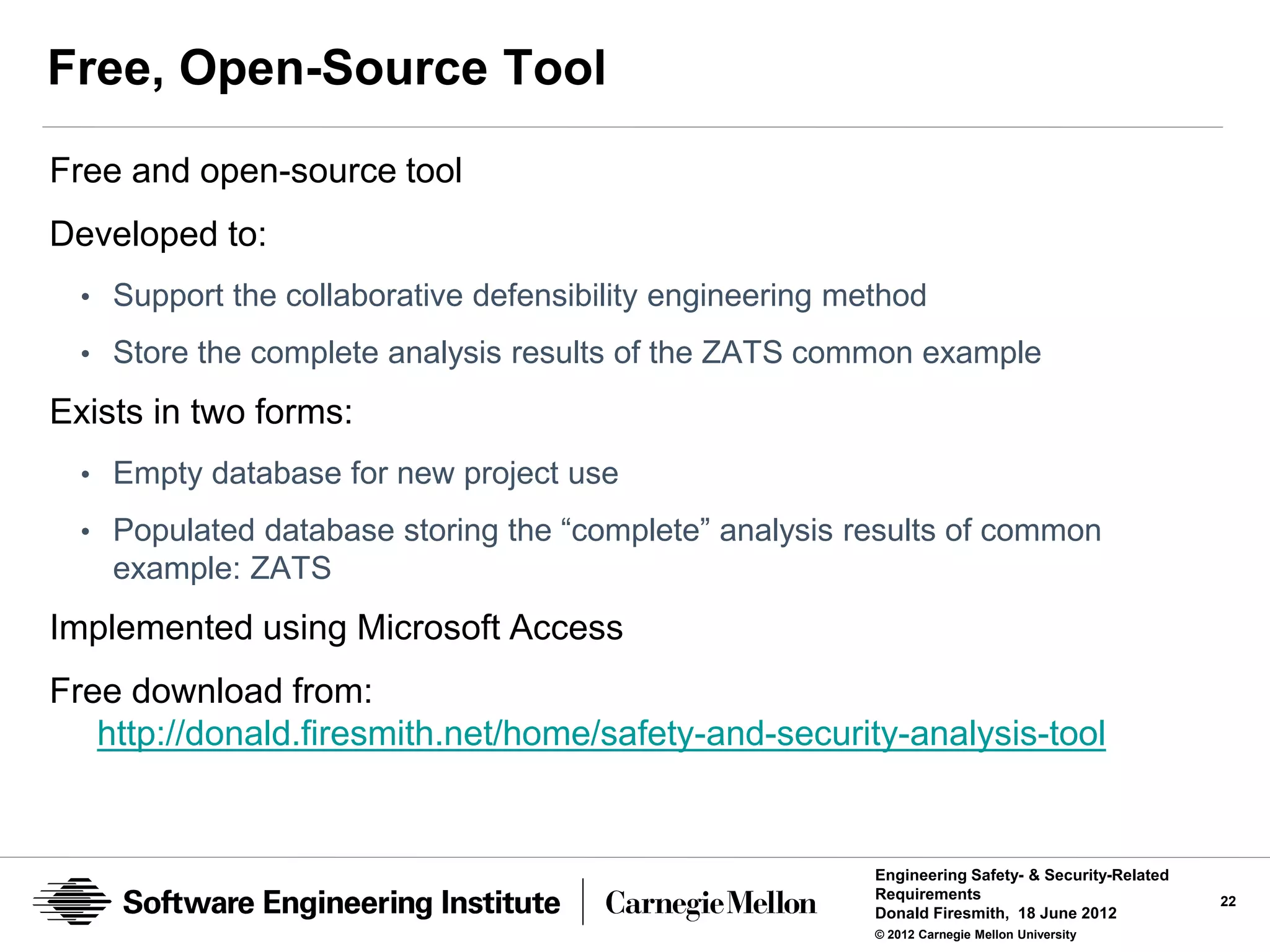
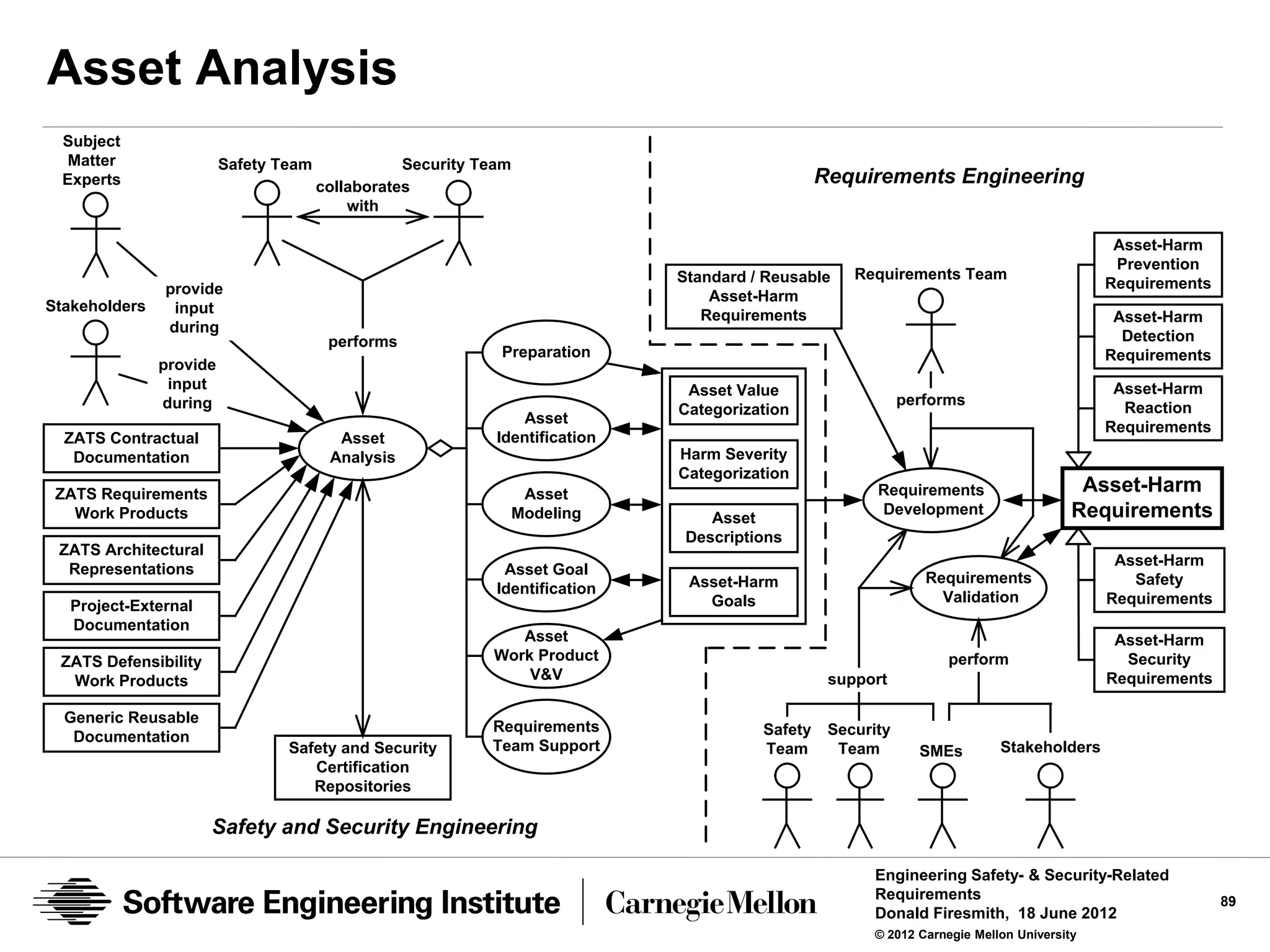
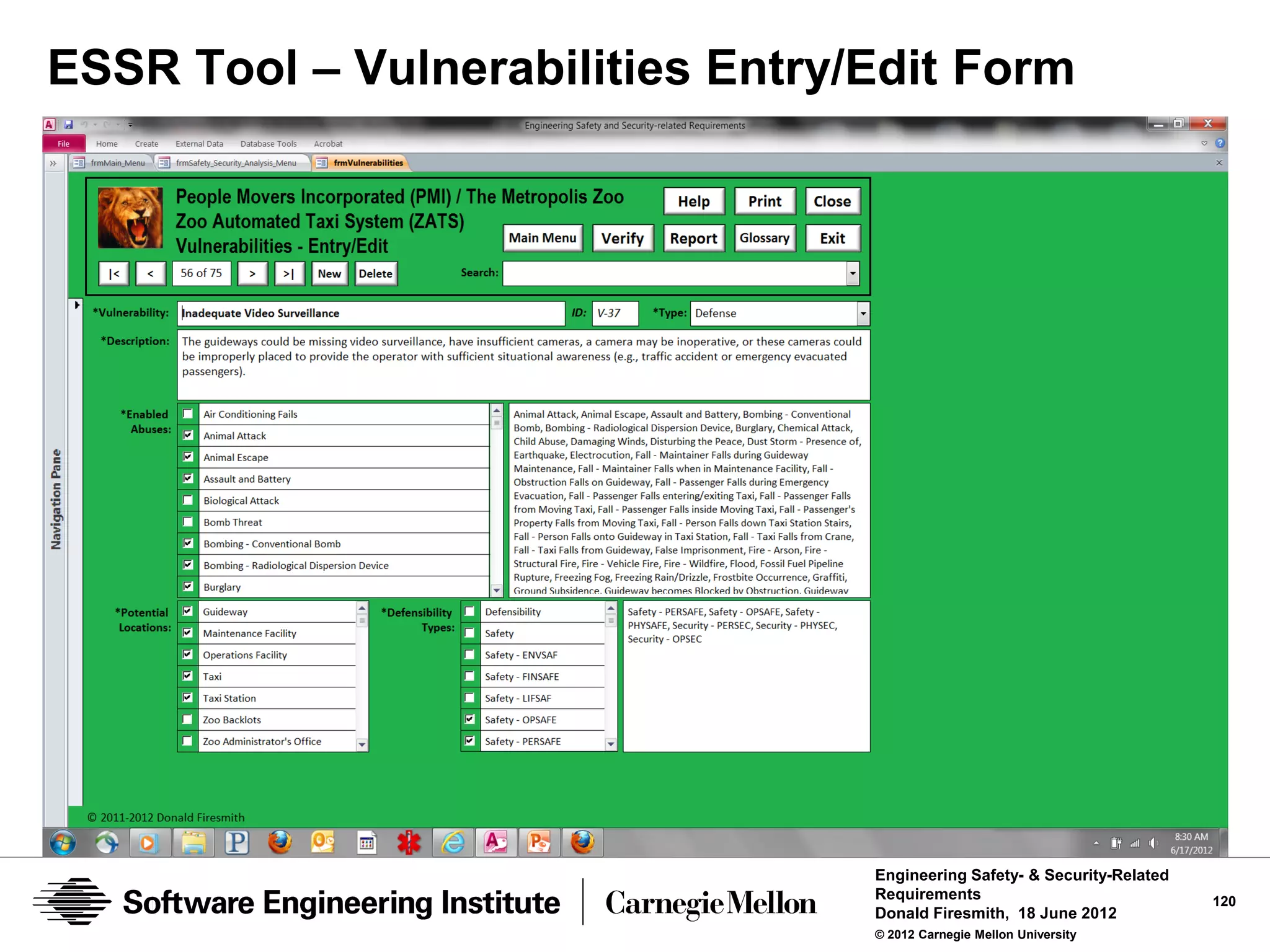
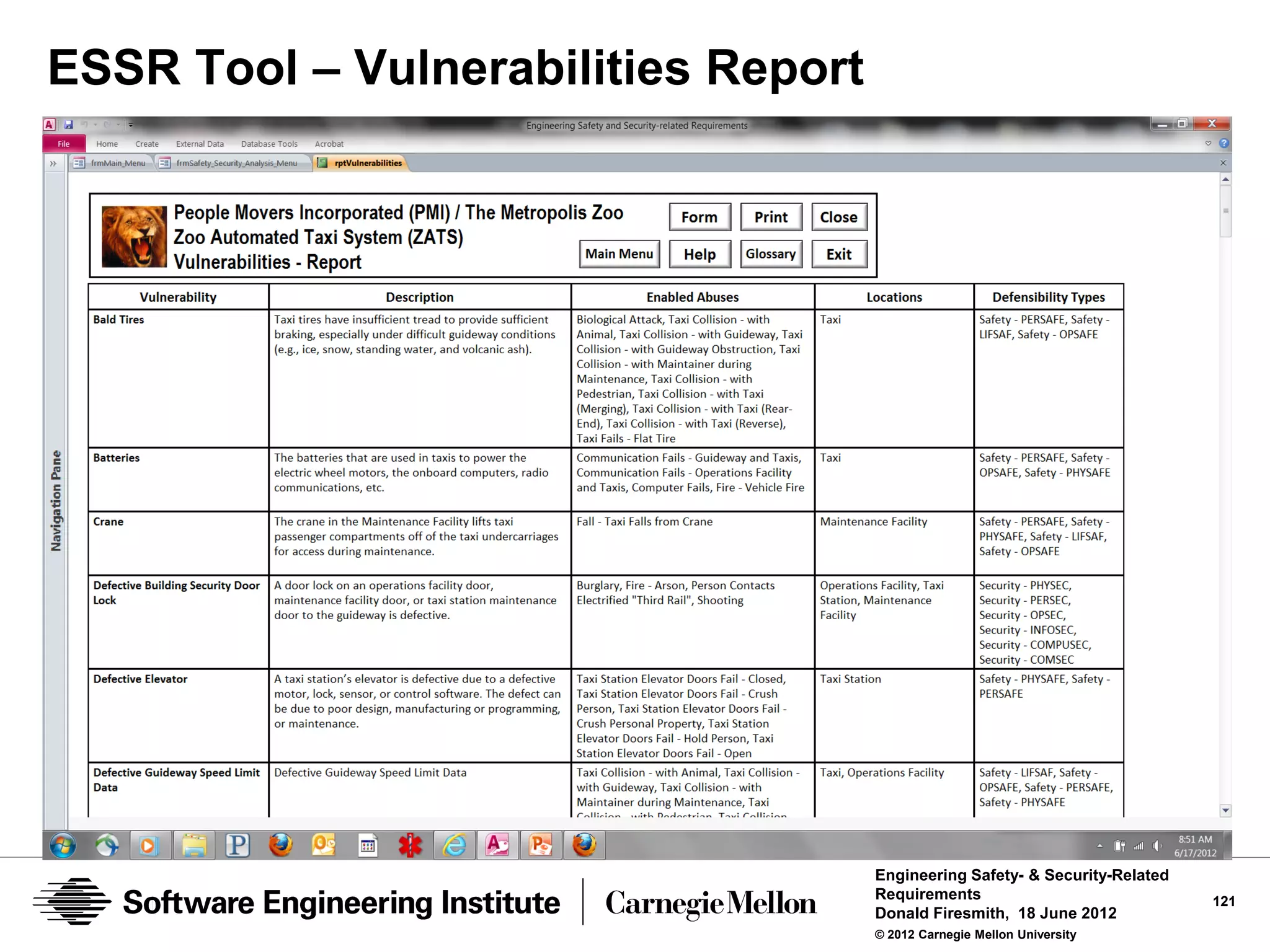
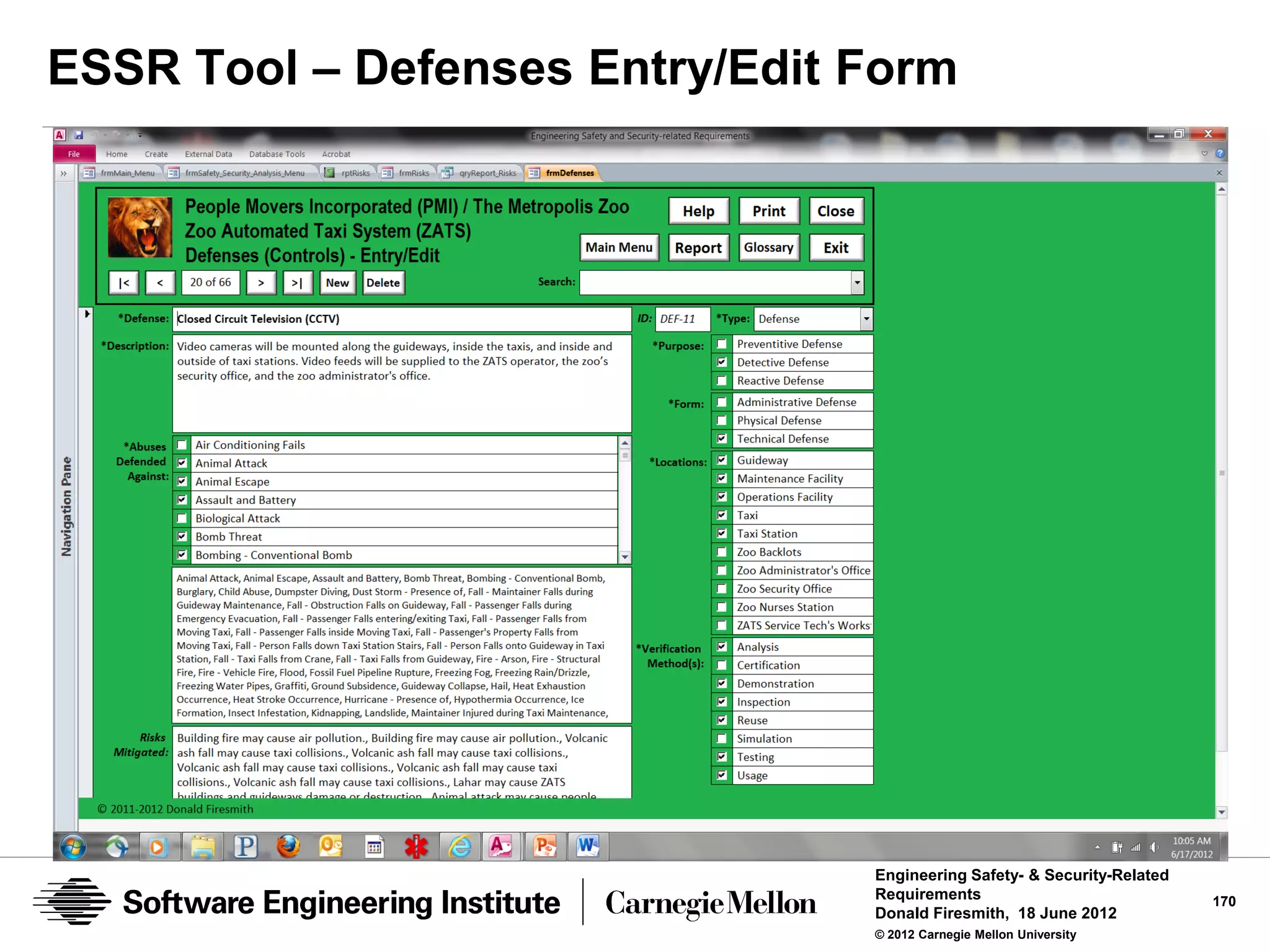
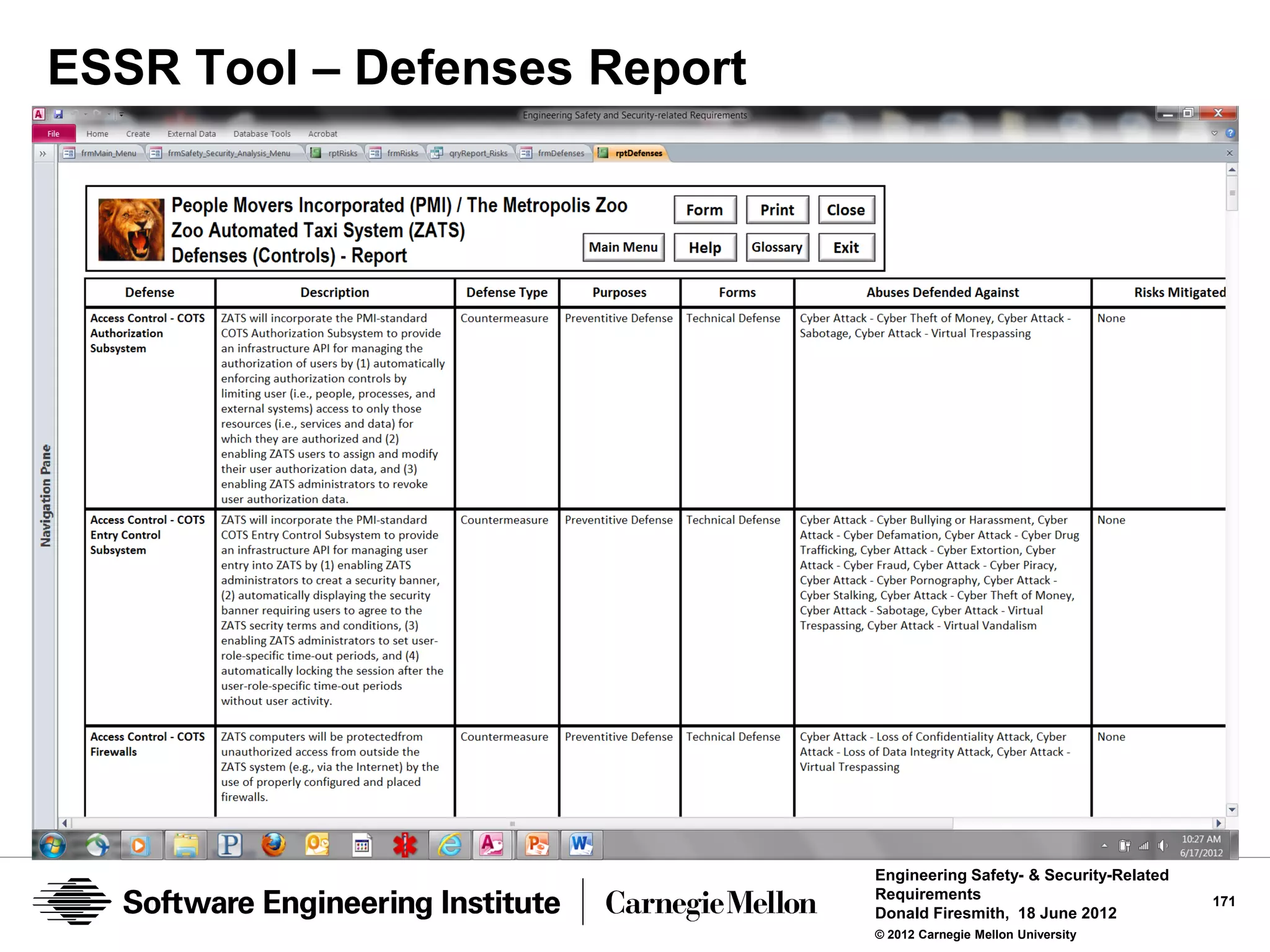
Free, Open-Source Tool
Free and open-source tool
Developed to:
  • Support the collaborative defensibility engineering method
  • Store the complete analysis results of the ZATS common example

Exists in two forms:
  • Empty database for new project use

  • Populated database storing the “complete” analysis results of common
    example: ZATS
Implemented using Microsoft Access
Free download from:
   http://donald.firesmith.net/home/safety-and-security-analysis-tool


                                                          Engineering Safety- & Security-Related
                                                          Requirements                             22
                                                          Donald Firesmith, 18 June 2012
                                                          © 2012 Carnegie Mellon University
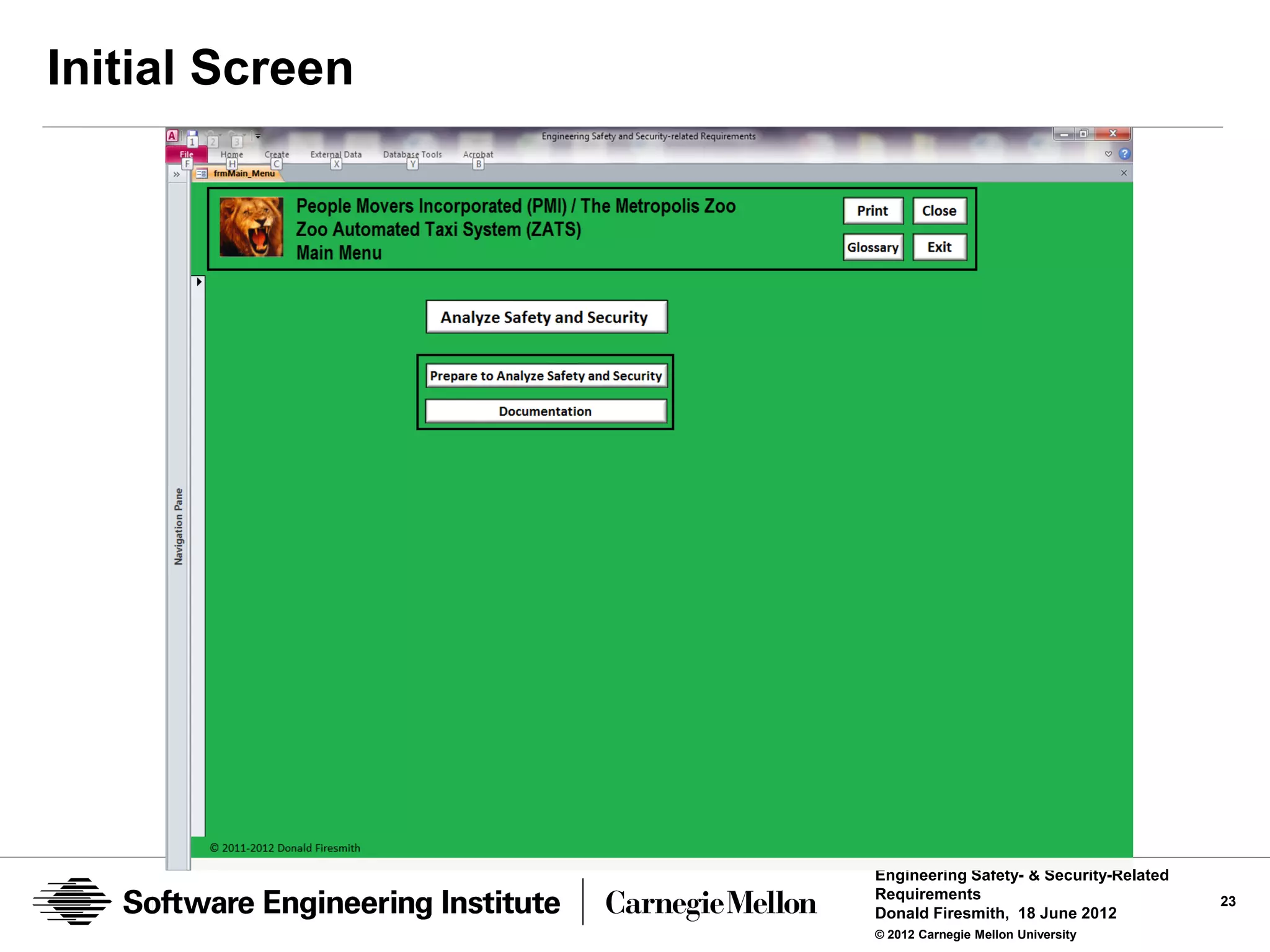
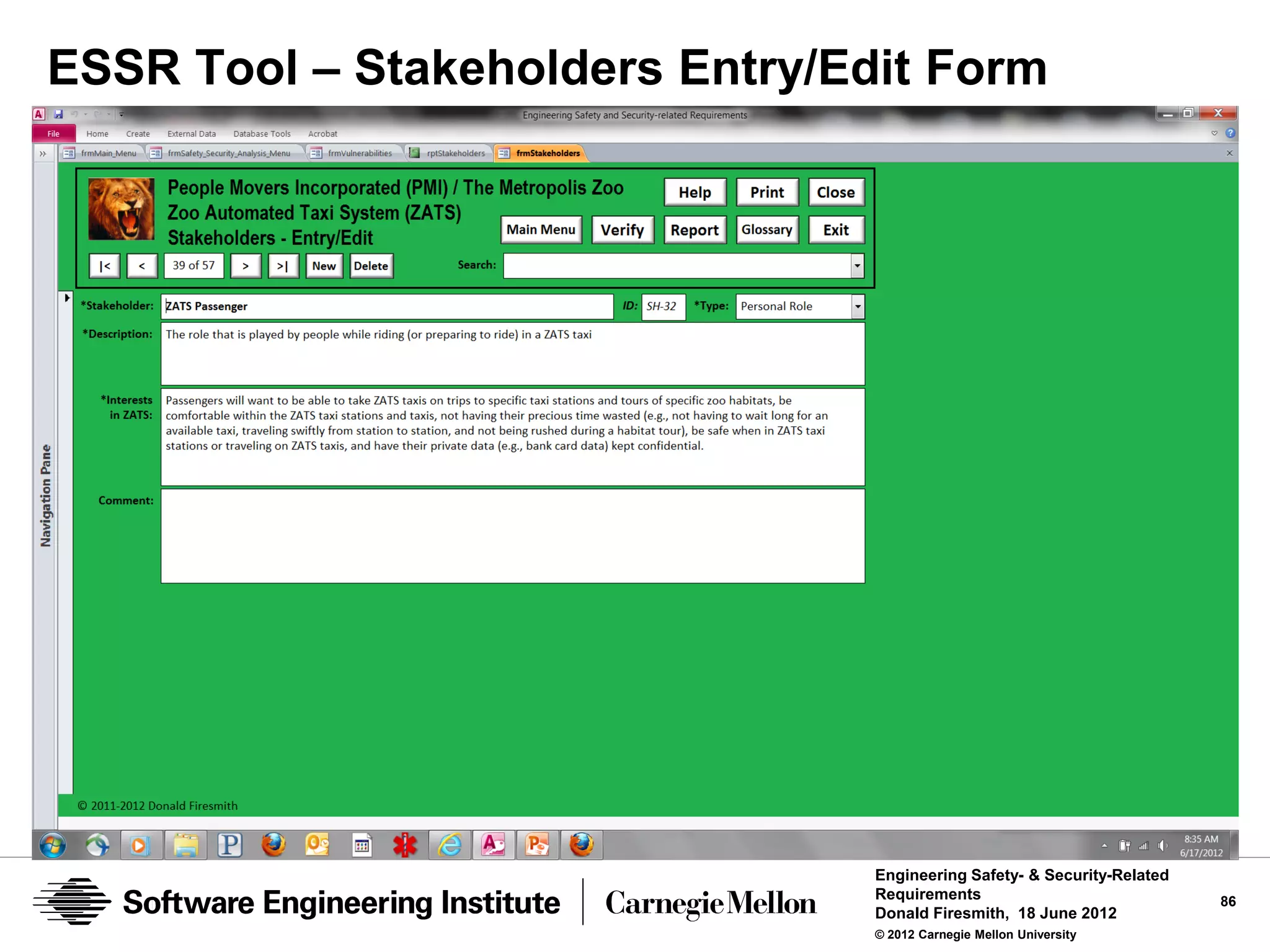
Initial Screen


                 Engineering Safety- & Security-Related
                 Requirements                             23
                 Donald Firesmith, 18 June 2012
                 © 2012 Carnegie Mellon University
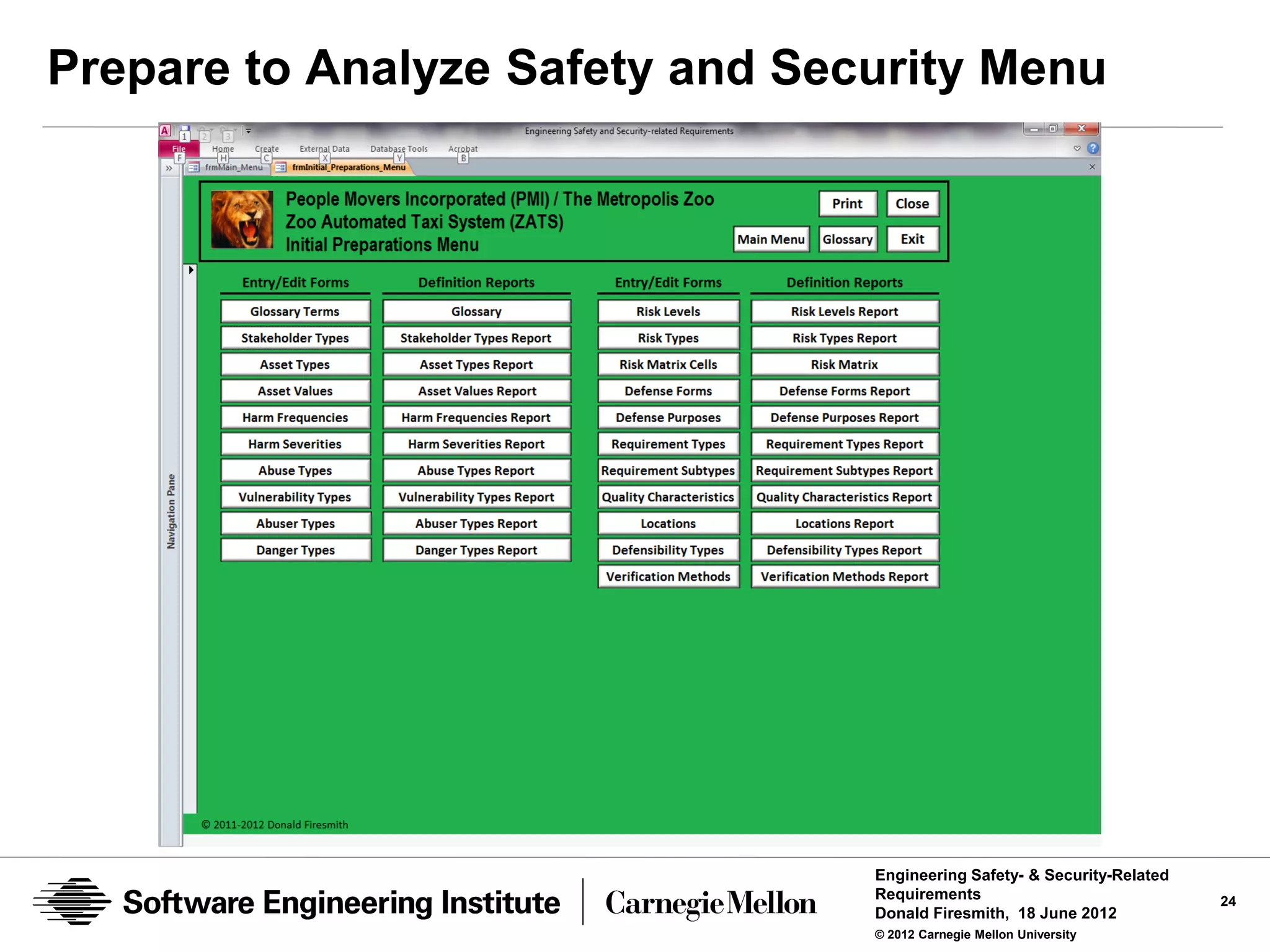
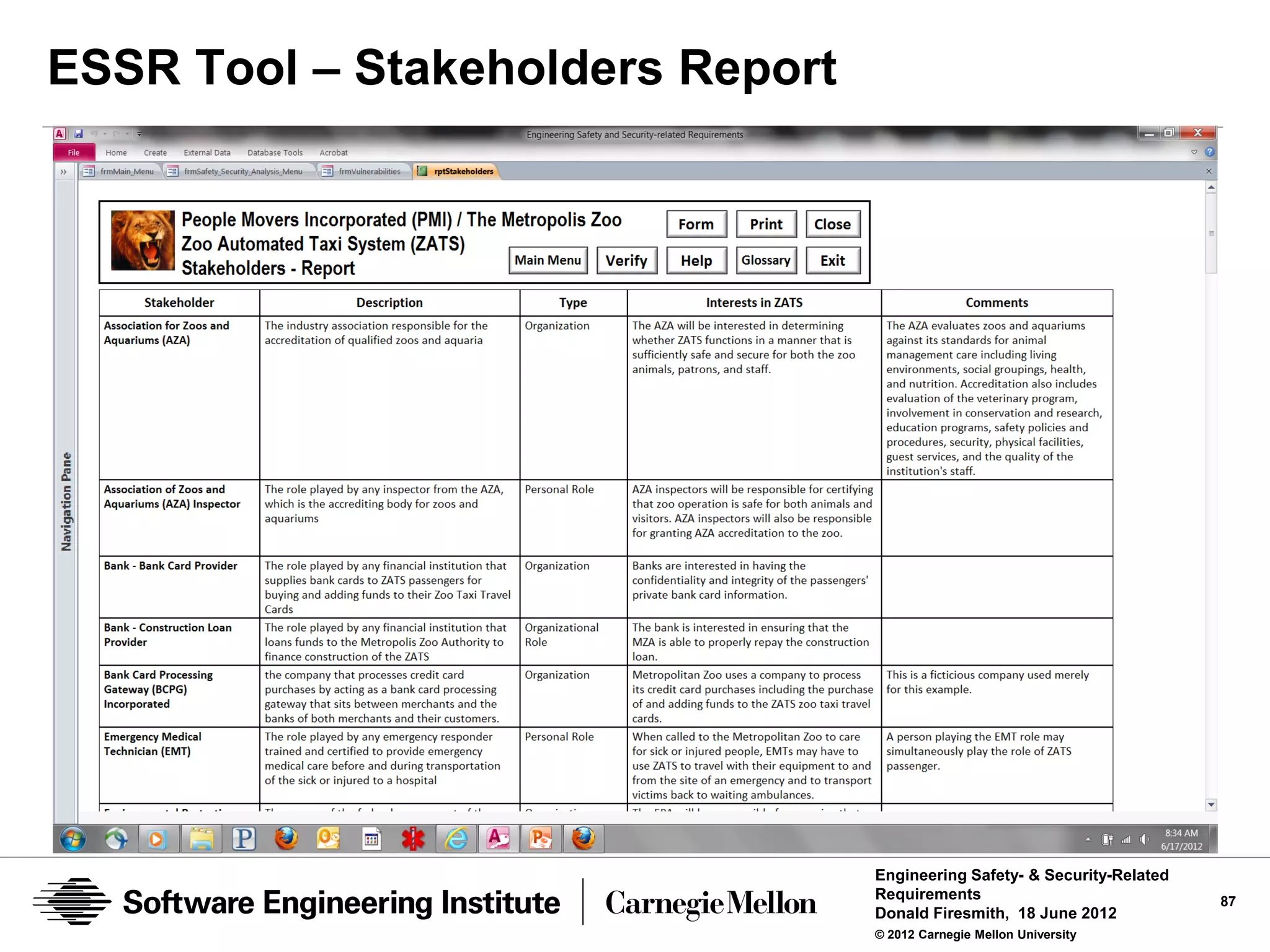
Prepare to Analyze Safety and Security Menu


                                 Engineering Safety- & Security-Related
                                 Requirements                             24
                                 Donald Firesmith, 18 June 2012
                                 © 2012 Carnegie Mellon University
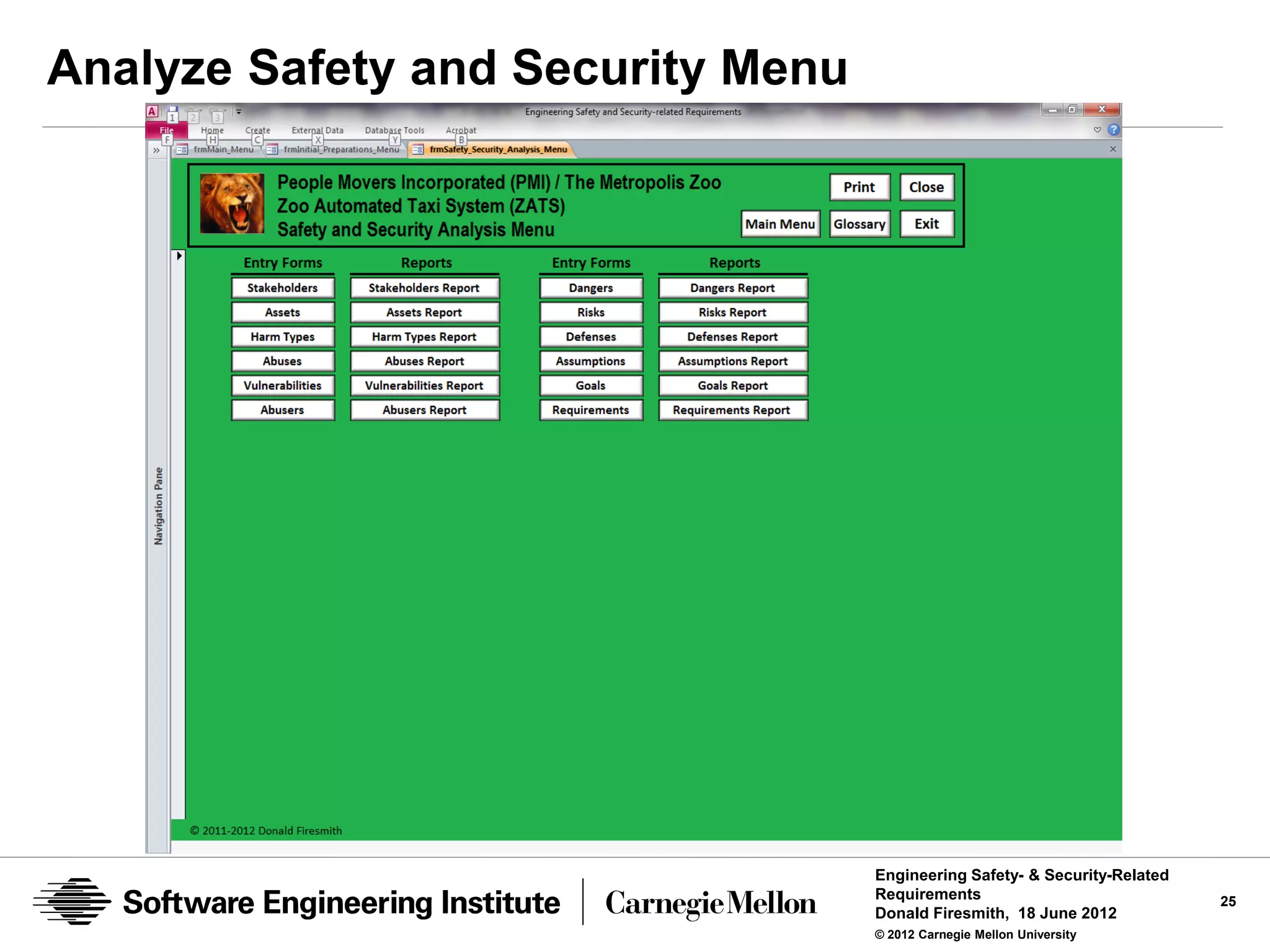
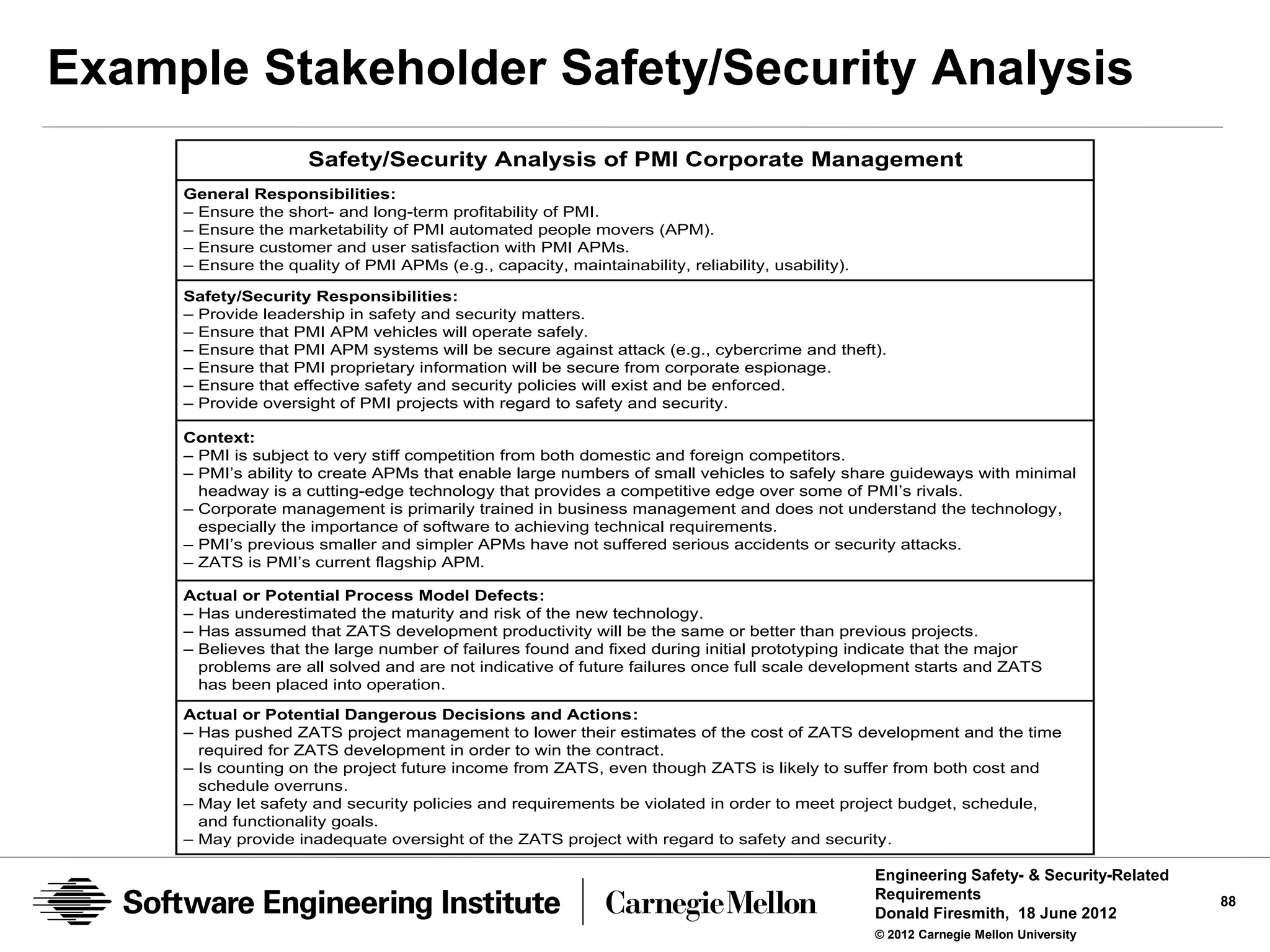
Analyze Safety and Security Menu


                                   Engineering Safety- & Security-Related
                                   Requirements                             25
                                   Donald Firesmith, 18 June 2012
                                   © 2012 Carnegie Mellon University
Where We Are
Related Disciplines
Challenges
Common Example
Free, Open-Source Tool

Requirements Engineering Overview ◄
Safety and Security Engineering Overview
Safety- and Security-related Requirements
Collaborative Defensibility Engineering Method
Conclusion


                                                 Engineering Safety- & Security-Related
                                                 Requirements                             26
                                                 Donald Firesmith, 18 June 2012
                                                 © 2012 Carnegie Mellon University
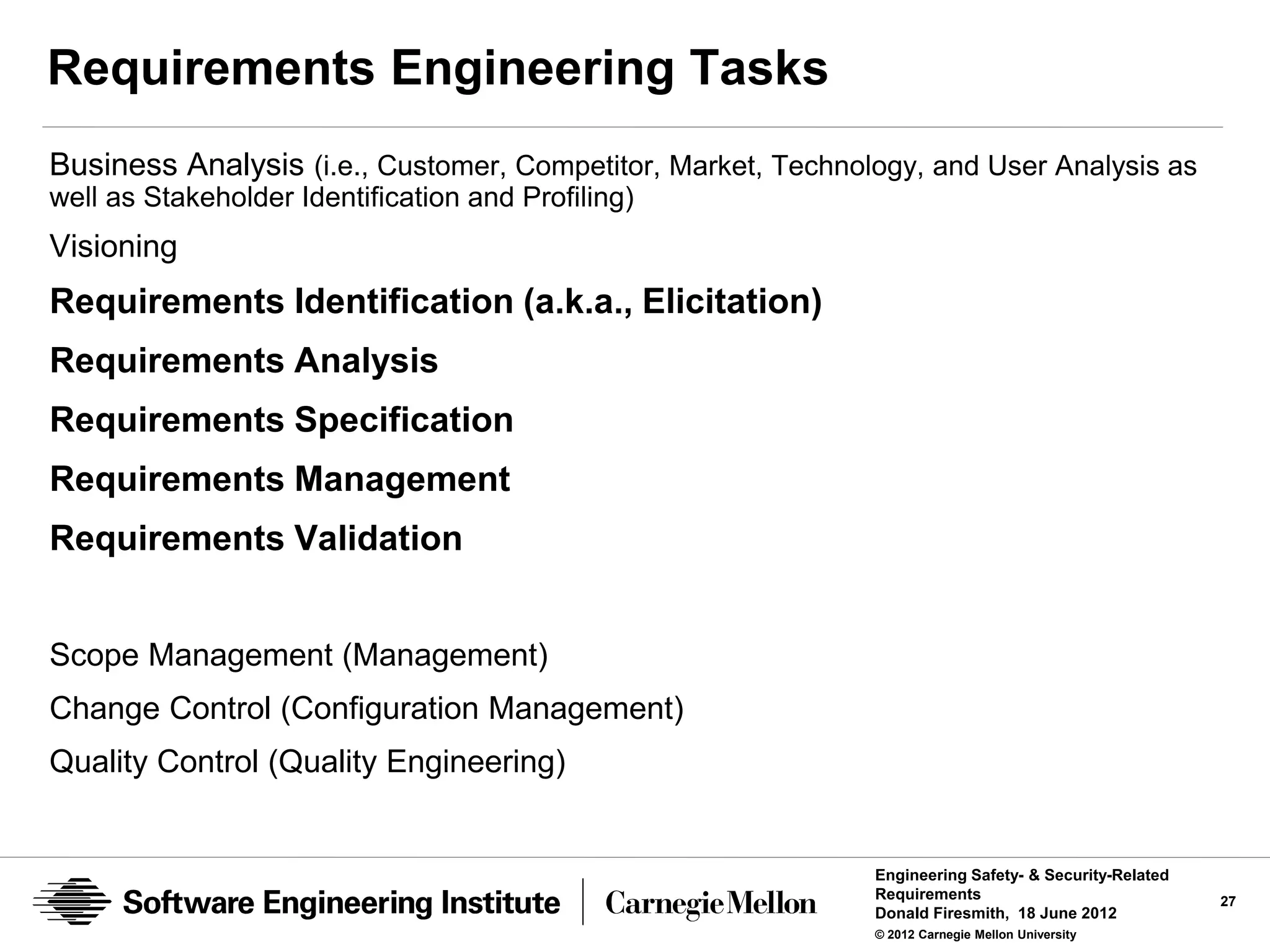
Requirements Engineering Tasks
Business Analysis (i.e., Customer, Competitor, Market, Technology, and User Analysis as
well as Stakeholder Identification and Profiling)
Visioning
Requirements Identification (a.k.a., Elicitation)
Requirements Analysis
Requirements Specification
Requirements Management
Requirements Validation


Scope Management (Management)
Change Control (Configuration Management)
Quality Control (Quality Engineering)

                                                              Engineering Safety- & Security-Related
                                                              Requirements                             27
                                                              Donald Firesmith, 18 June 2012
                                                              © 2012 Carnegie Mellon University
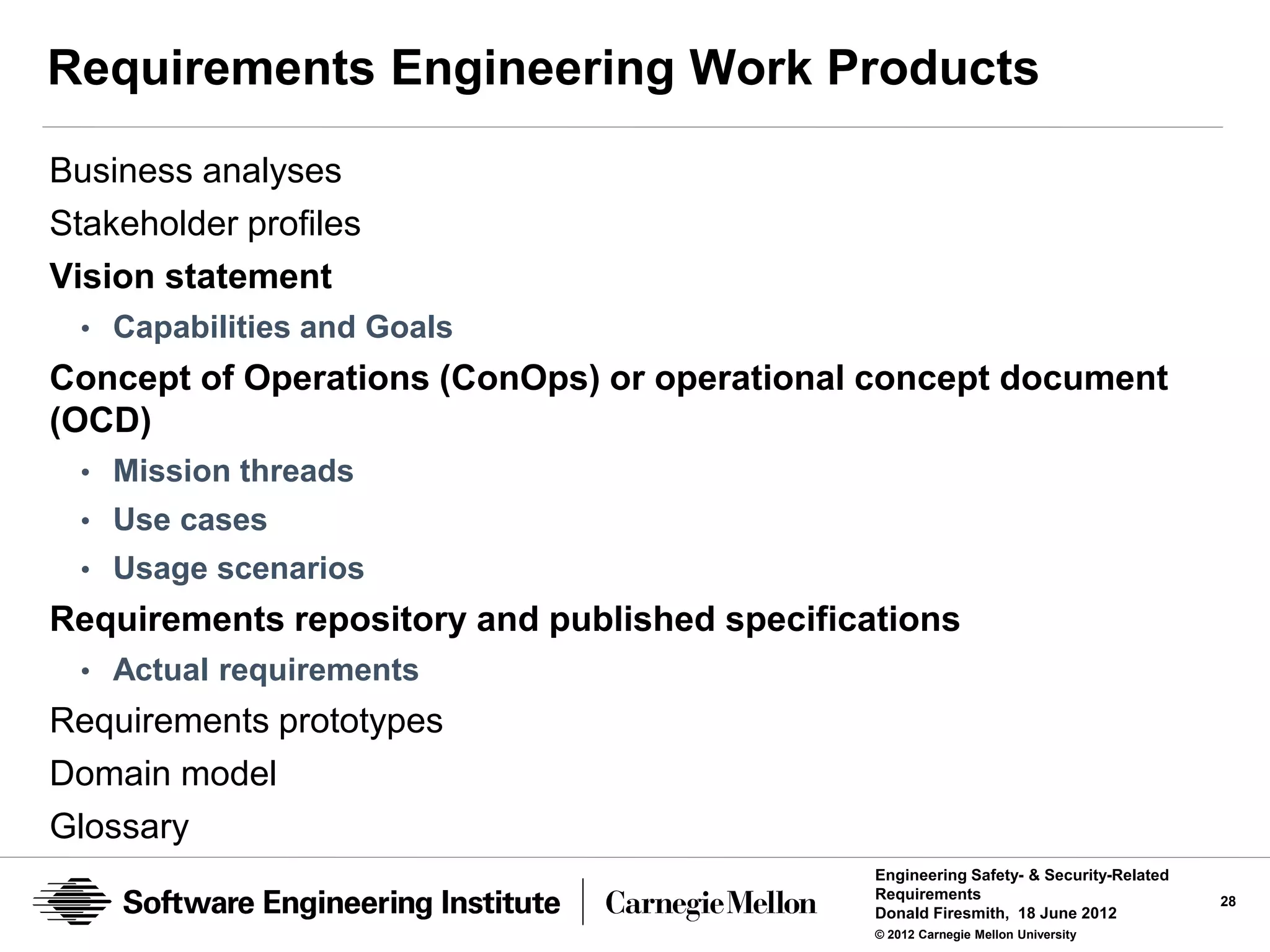
Requirements Engineering Work Products
Business analyses
Stakeholder profiles
Vision statement
 • Capabilities and Goals
Concept of Operations (ConOps) or operational concept document
(OCD)
 • Mission threads
 • Use cases
 • Usage scenarios
Requirements repository and published specifications
 • Actual requirements
Requirements prototypes
Domain model
Glossary
                                               Engineering Safety- & Security-Related
                                               Requirements                             28
                                               Donald Firesmith, 18 June 2012
                                               © 2012 Carnegie Mellon University
Difficulty of Requirements Engineering
“The hardest single part of building a software system is deciding precisely
what to build. No other part of the conceptual work is as difficult as
establishing the detailed technical requirements, including all the
interfaces to people, to machines, and to other software systems. No other
part of the work so cripples the resulting system if done wrong. No other
part is more difficult to rectify later.”

  Fred Brooks, No Silver Bullet, IEEE Computer, 1987


                                                       Engineering Safety- & Security-Related
                                                       Requirements                             29
                                                       Donald Firesmith, 18 June 2012
                                                       © 2012 Carnegie Mellon University
Goals
Goal
 an informally documented perceived need of a legitimate stakeholder
Goals are:
 • Not requirements.
 • Drive the identification and analysis of the requirements.

 • Typically ambiguous and/or unrealistic (i.e. impossible to guarantee).

Major problems with safety and security goals:
 • Ambiguous
 • Stated as absolutes
 • Not 100% feasible

 • Not verifiable

Typically documented in a vision statement.
                                                           Engineering Safety- & Security-Related
                                                           Requirements                             30
                                                           Donald Firesmith, 18 June 2012
                                                           © 2012 Carnegie Mellon University
Representative ZATS Goals
ZATS will take passengers on leisurely tours that provide excellent viewing
of the zoo habitats.
ZATS will take passengers rapidly to their desired taxi stations in the zoo
and its parking lot.
ZATS will prevent animals from reaching passengers in taxis and taxi
stations.
ZATS will never injure or kill a passenger.
ZATS will not cause air and noise pollution.
ZATS will be easy and intuitive for all of its passengers to use.
ZATS will allow passengers to use securely use bank cards to pay for
trips.


                                                       Engineering Safety- & Security-Related
                                                       Requirements                             31
                                                       Donald Firesmith, 18 June 2012
                                                       © 2012 Carnegie Mellon University
Use Case Models and Mission Threads
Usage Scenario
   a specific functionally cohesive sequence of interactions between user(s), the
   system, and potentially other actors that provides value to a stakeholder
Use Case
   a general way to perform a function
   a functionally cohesive class of usage scenarios
Use Case Path (a.k.a., flow and course)
   an equivalence set of usage scenarios that follow the same course through a
   use case
Mission Thread
   an end-to-end sequence of use case paths that together achieves one of the
   system’s missions


                                                         Engineering Safety- & Security-Related
                                                         Requirements                             32
                                                         Donald Firesmith, 18 June 2012
                                                         © 2012 Carnegie Mellon University
Use Case Models
Use case paths:
 • Can be either:
   —   Normal (Sunny Day or Happy Path)
   —   Exceptional (Rainy Day)
 • Should have their own preconditions, triggers, and postconditions
 • Are often documented with text, sequence diagrams, or activity diagrams

Use cases, use case paths, and usage scenarios:
 • Typically documented in a ConOps or operational concept document (OCD)
 • Drive the identification and analysis of the [primarily functional] requirements

 • Often include potential architectural and design information

Use cases are far more than merely use case diagrams.


                                                            Engineering Safety- & Security-Related
                                                            Requirements                             33
                                                            Donald Firesmith, 18 June 2012
                                                            © 2012 Carnegie Mellon University
Characteristics of Good Requirements

All Types of Requirements   Active Voice
Correct                     Configuration Controlled
                            Consistent (internally and with other requirements)
Cohesive (individual)
                            Differentiated from Non-requirements
Complete                    Externally observable
Concise                     Grammatically Correct and no Typos
Feasible                    Managed (in requirements repository)
Mandatory (necessary)       Prioritized (for scheduling implementation)
                            Properly Specified
Normal and Exceptional
                            Rationalized
Relevant                    Scheduled
Unique                      Stakeholder-centric
Unambiguous                 Situation-specific (to mode, state, and/or event)
Validatable                 Traced (to source and to architecture)
                            Uniquely identified
Verifiable
                            Usable by stakeholders
What or how well, not how   http://www.jot.fm/issues/issue_2003_07/column7
                                                   Engineering Safety- & Security-Related
                                                   Requirements                             34
                                                   Donald Firesmith, 18 June 2012
                                                   © 2012 Carnegie Mellon University
Poor Requirements Cause Accidents1
“For the 34 (safety) incidents analyzed, 44% had inadequate
specification as their primary cause.”
    Health and Safety Executive (HSE), Out of Control: Why Control Systems
    Go Wrong and How to Prevent Failure (2nd Edition), 1995

“Almost all accidents related to software components in the past 20
years can be traced to flaws in the requirements specifications, such as
unhandled cases.”
    Grady Lee, Jeffry Howard, and Patrick Anderson, “Safety-Critical
    Requirements Specification and Analysis using SpecTRM”, Safeware
    Engineering, 2002


                                                       Engineering Safety- & Security-Related
                                                       Requirements                             35
                                                       Donald Firesmith, 18 June 2012
                                                       © 2012 Carnegie Mellon University
Poor Requirements Cause Accidents2
“Erroneous specification is a major source of defects and subsequent
failure of safety-critical systems. Many failures occur in systems using
software that is perfect, it is just not the software that is needed
because the specification is defective.”
    John C. McKnight, “Software Challenges in Aviation Systems,”
    Proceedings of the 21st International Conference on Computer
    Safety, Reliability and Security, 2002
“Software-related accidents almost always are due to
misunderstandings about what the software should do.”
    Kathryn Anne Weiss, “An Analysis of Causation in Aerospace
    Accidents,” Proceedings of the 2001 Digital Avionics Systems
    Conference, updated 7 September 2004


                                                      Engineering Safety- & Security-Related
                                                      Requirements                             36
                                                      Donald Firesmith, 18 June 2012
                                                      © 2012 Carnegie Mellon University
Poor Requirements Cause Accidents3
“Software-related accidents are usually caused by flawed requirements.
Incomplete or wrong assumptions about the operation of the controlled
system can cause software related accidents, as can incomplete or wrong
assumptions about the required operation of the computer. Frequently,
omitted requirements leave unhandled controlled-system states and
environmental conditions.”
   Nancy G. Leveson, Safeware: System Safety and Computers, 2003

“Software-related accidents are almost all caused by flawed
requirements:
   •   Incomplete or wrong assumptions about the operation of the controlled
       system or required operation of the computer
   •   Unhandled controlled-system states and environmental conditions.”
   Nancy G. Leveson, A new Approach to Ensuring Safety in Software and
   Human Intensive Systems, July 2009


                                                        Engineering Safety- & Security-Related
                                                        Requirements                             37
                                                        Donald Firesmith, 18 June 2012
                                                        © 2012 Carnegie Mellon University
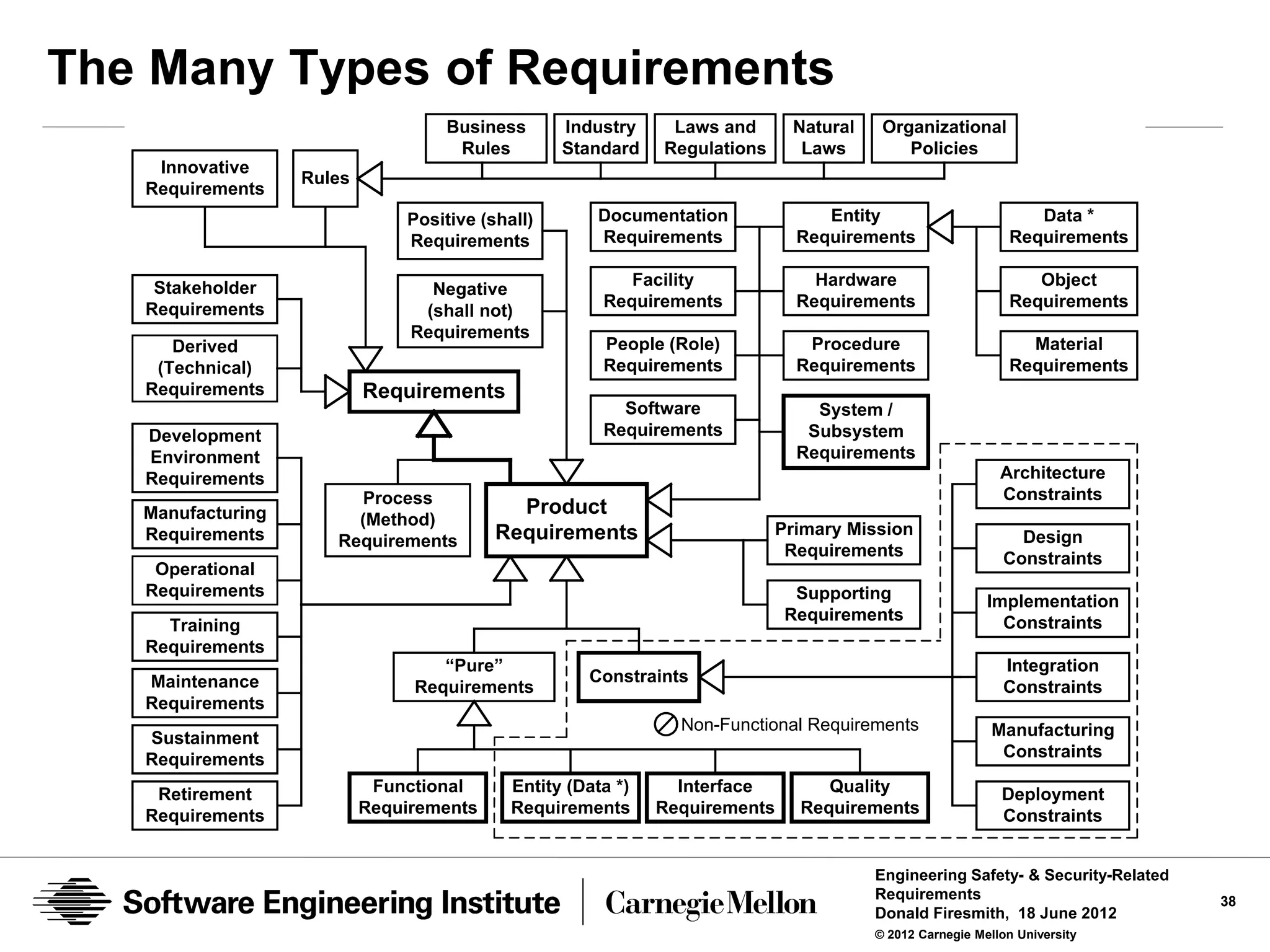
The Many Types of Requirements
                                   Business       Industry     Laws and      Natural    Organizational
                                    Rules         Standard    Regulations     Laws         Policies
    Innovative
                   Rules
   Requirements
                               Positive (shall)       Documentation              Entity                        Data *
                               Requirements           Requirements            Requirements                  Requirements

    Stakeholder                                           Facility              Hardware                       Object
                                  Negative
   Requirements                                        Requirements           Requirements                  Requirements
                                 (shall not)
                                Requirements
      Derived                                          People (Role)           Procedure                      Material
    (Technical)                                        Requirements           Requirements                  Requirements
   Requirements            Requirements
                                                         Software               System /
   Development                                         Requirements            Subsystem
   Environment                                                                Requirements
   Requirements                                                                                            Architecture
                        Process                                                                            Constraints
   Manufacturing                            Product
                        (Method)
   Requirements                           Requirements                      Primary Mission                  Design
                      Requirements
                                                                             Requirements                  Constraints
    Operational
   Requirements                                                               Supporting                 Implementation
                                                                             Requirements                  Constraints
     Training
   Requirements
                                   “Pure”                                                                  Integration
   Maintenance                                       Constraints
                                Requirements                                                               Constraints
   Requirements
                                                                Non-Functional Requirements               Manufacturing
   Sustainment
   Requirements                                                                                            Constraints

    Retirement              Functional      Entity (Data *)     Interface        Quality                   Deployment
   Requirements            Requirements     Requirements      Requirements    Requirements                 Constraints


                                                                                       Engineering Safety- & Security-Related
                                                                                       Requirements                             38
                                                                                       Donald Firesmith, 18 June 2012
                                                                                       © 2012 Carnegie Mellon University
Product Requirements
A product requirement is a requirement for a product (e.g., system,
subsystem, software application, or component).
 • A functional requirement is a product requirement than specifies a
   mandatory function (i.e., behavior) of the product.
 • A data requirement is a product requirement that specifies mandatory [types
   of] data that must be manipulated by the product.
 • An interface requirement is a product requirement that specifies a mandatory
   interface with (or within) the product.
 • A quality requirement is a product requirement that specifies a mandatory
   amount of a type of product quality (characteristic or attribute).
 • A constraint is a property of the product (e.g., architecture or design decision)
   that would ordinarily not be a requirement but which is being mandated as if it
   were a normal requirement


                                                            Engineering Safety- & Security-Related
                                                            Requirements                             39
                                                            Donald Firesmith, 18 June 2012
                                                            © 2012 Carnegie Mellon University
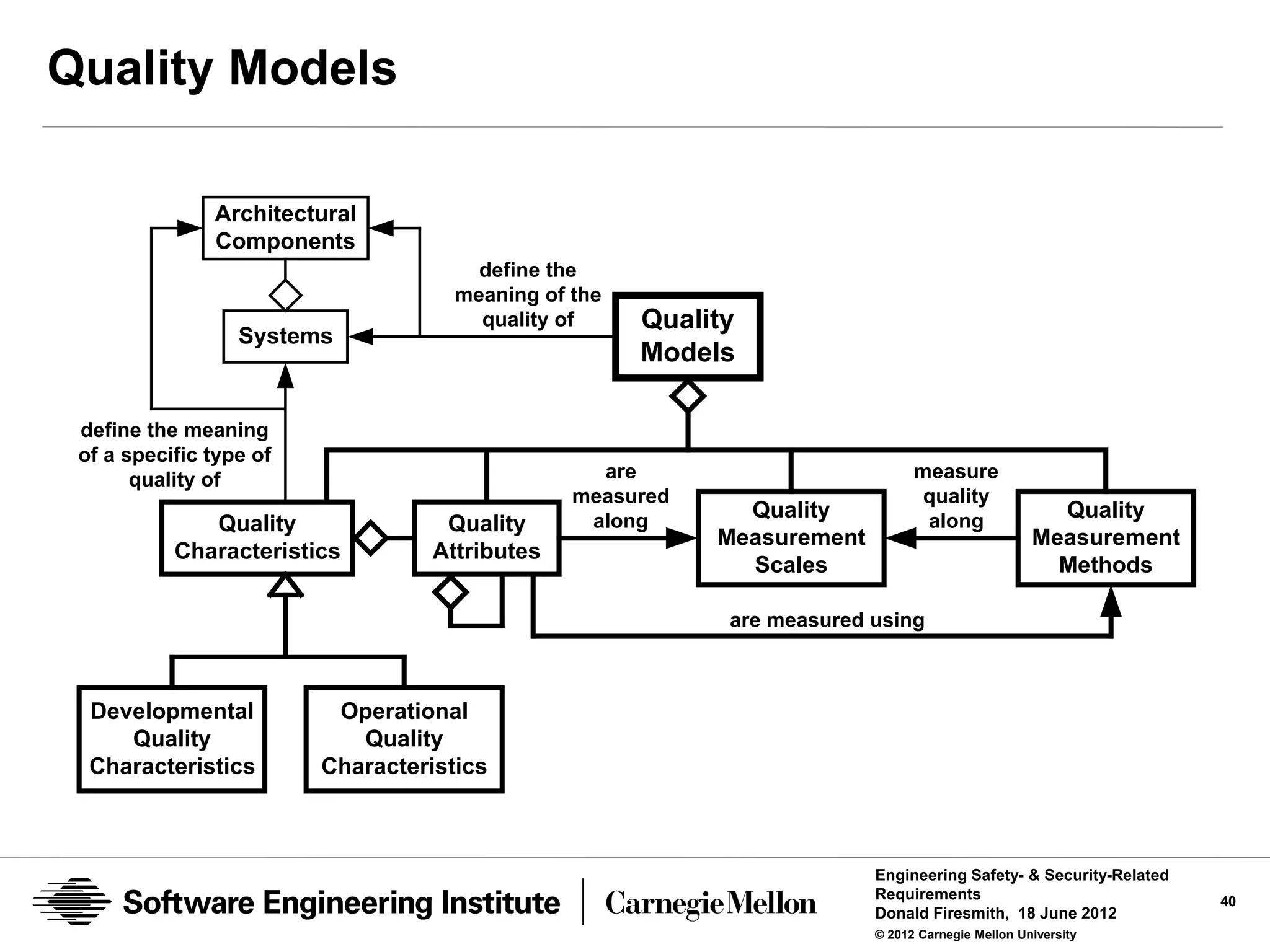
Quality Models

               Architectural
               Components
                                       define the
                                     meaning of the
                                       quality of     Quality
                  Systems
                                                      Models

 define the meaning
 of a specific type of
       quality of                                 are                          measure
                                                measured                        quality
                                                 along
                                                             Quality            along
                                                                                                    Quality
              Quality               Quality
                                                           Measurement                            Measurement
           Characteristics         Attributes
                                                             Scales                                 Methods

                                                            are measured using


  Developmental           Operational
     Quality                Quality
  Characteristics        Characteristics


                                                                         Engineering Safety- & Security-Related
                                                                         Requirements                             40
                                                                         Donald Firesmith, 18 June 2012
                                                                         © 2012 Carnegie Mellon University
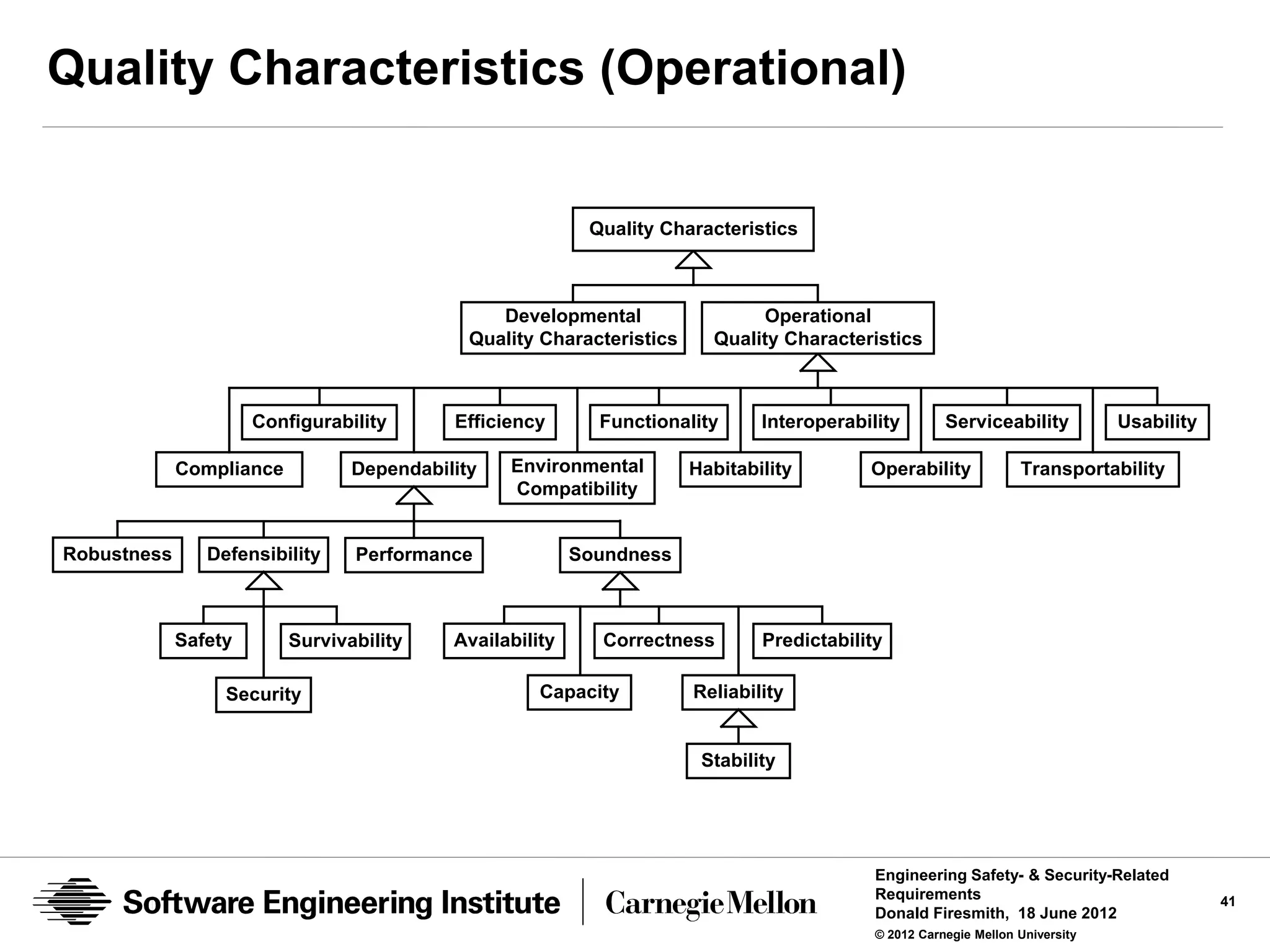
Quality Characteristics (Operational)


                                                           Quality Characteristics


                                                Developmental                 Operational
                                             Quality Characteristics     Quality Characteristics


                      Configurability      Efficiency       Functionality      Interoperability        Serviceability           Usability

             Compliance          Dependability   Environmental         Habitability        Operability             Transportability
                                                 Compatibility


Robustness      Defensibility    Performance              Soundness


             Safety       Survivability    Availability      Correctness       Predictability

                  Security                           Capacity          Reliability


                                                                        Stability


                                                                                            Engineering Safety- & Security-Related
                                                                                            Requirements                                    41
                                                                                            Donald Firesmith, 18 June 2012
                                                                                            © 2012 Carnegie Mellon University
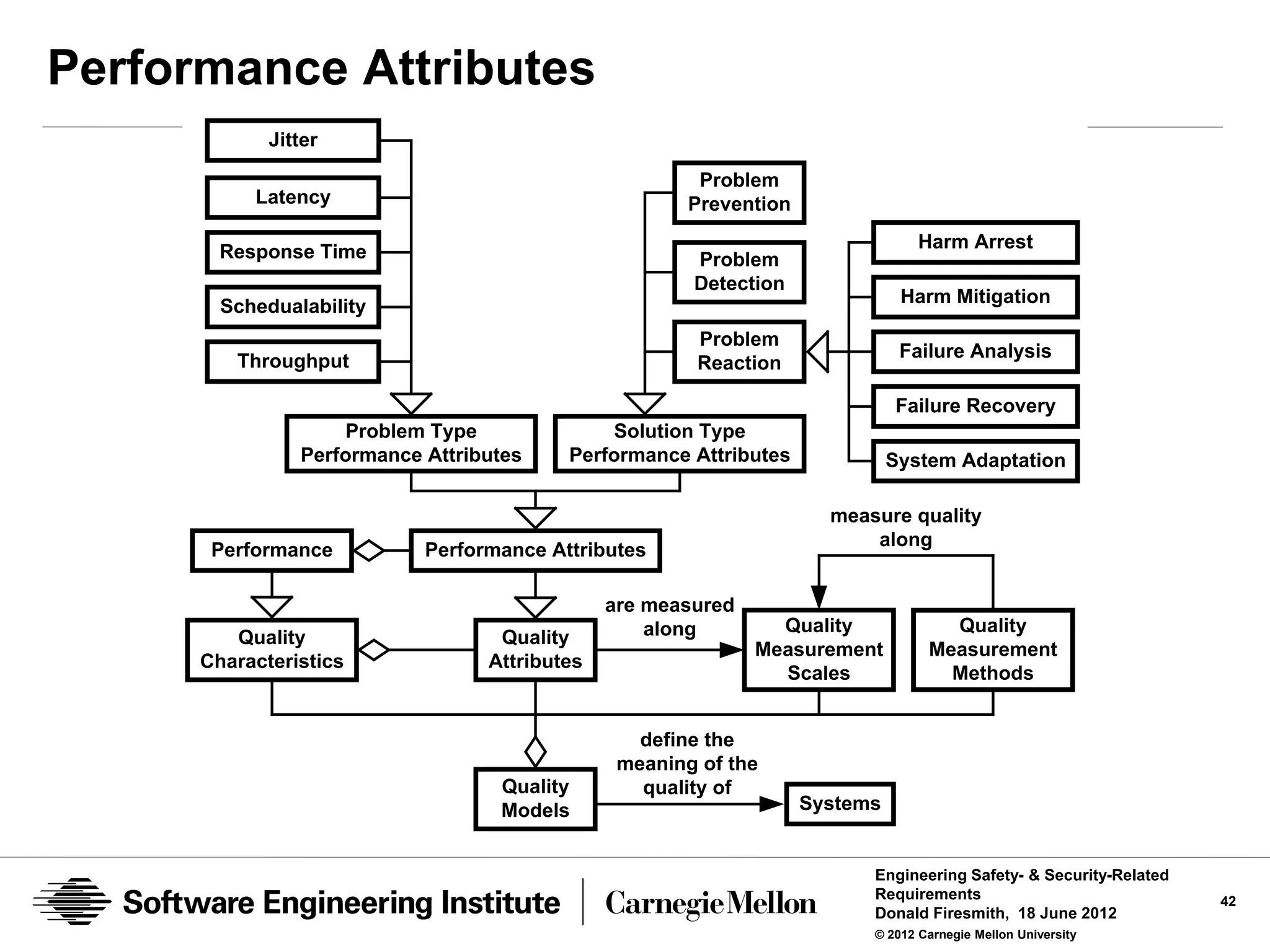
Performance Attributes
             Jitter

                                                        Problem
           Latency                                     Prevention
                                                                                 Harm Arrest
        Response Time                                  Problem
                                                       Detection
        Schedualability                                                        Harm Mitigation

                                                       Problem
                                                                               Failure Analysis
         Throughput                                    Reaction

                                                                              Failure Recovery
                    Problem Type              Solution Type
                Performance Attributes    Performance Attributes              System Adaptation

                                                                      measure quality
                                                                          along
       Performance          Performance Attributes

                                               are measured
                                                   along        Quality             Quality
         Quality                   Quality
                                                              Measurement         Measurement
      Characteristics             Attributes
                                                                Scales              Methods


                                                  define the
                                                meaning of the
                                   Quality        quality of
                                   Models                           Systems


                                                                          Engineering Safety- & Security-Related
                                                                          Requirements                             42
                                                                          Donald Firesmith, 18 June 2012
                                                                          © 2012 Carnegie Mellon University
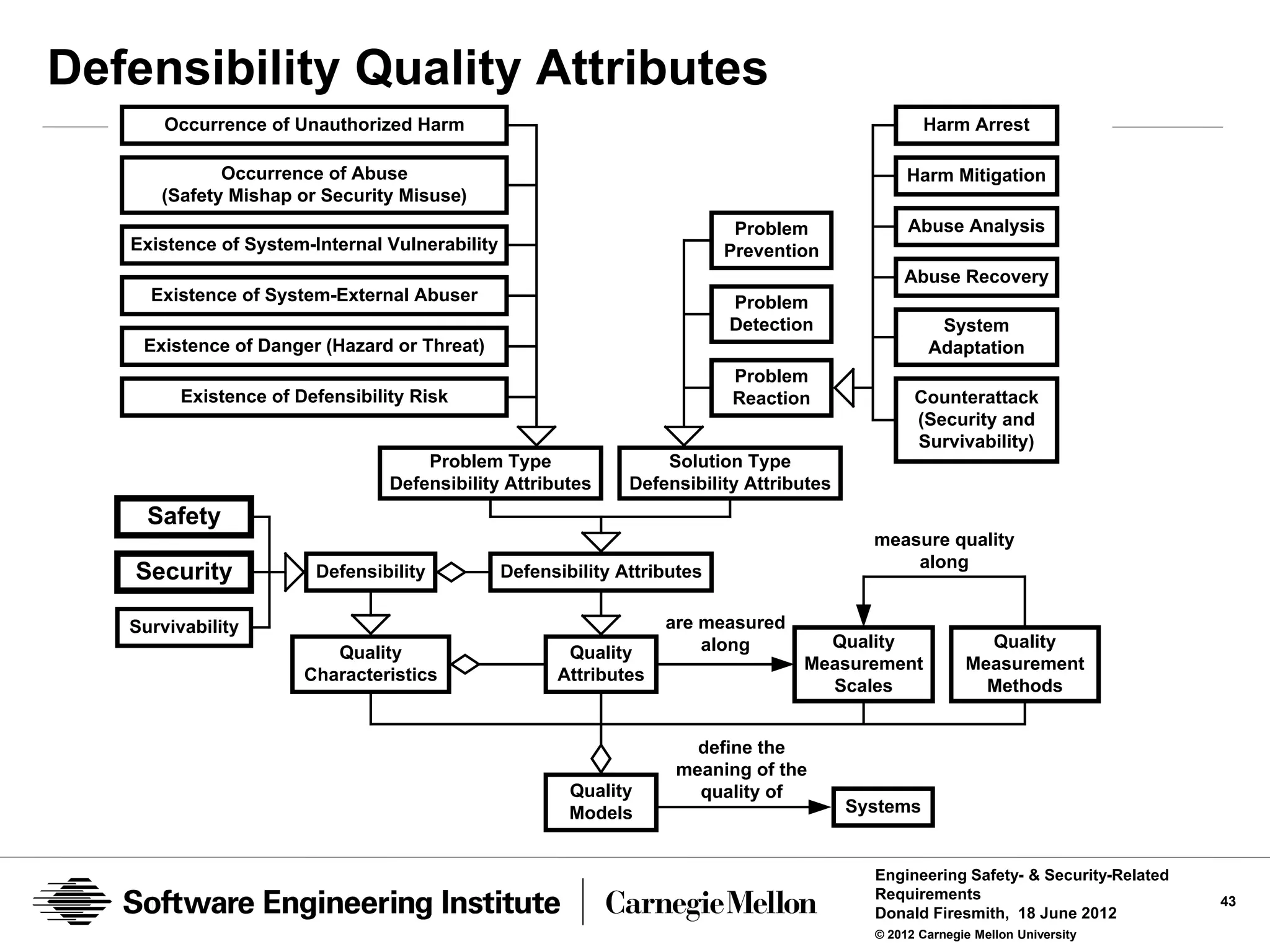
Defensibility Quality Attributes
       Occurrence of Unauthorized Harm                                                              Harm Arrest

             Occurrence of Abuse                                                                 Harm Mitigation
      (Safety Mishap or Security Misuse)
                                                                            Problem              Abuse Analysis
   Existence of System-Internal Vulnerability                              Prevention
                                                                                                Abuse Recovery
     Existence of System-External Abuser                                   Problem
                                                                           Detection                 System
    Existence of Danger (Hazard or Threat)                                                          Adaptation
                                                                           Problem
         Existence of Defensibility Risk                                   Reaction               Counterattack
                                                                                                  (Security and
                                                                                                  Survivability)
                                     Problem Type                  Solution Type
                                 Defensibility Attributes      Defensibility Attributes
     Safety
                                                                                            measure quality
                                                                                                along
   Security             Defensibility           Defensibility Attributes


   Survivability                                                   are measured
                                                                       along         Quality                Quality
                          Quality                      Quality
                                                                                   Measurement            Measurement
                       Characteristics                Attributes
                                                                                     Scales                 Methods


                                                                      define the
                                                                    meaning of the
                                                        Quality       quality of
                                                        Models                            Systems


                                                                                            Engineering Safety- & Security-Related
                                                                                            Requirements                             43
                                                                                            Donald Firesmith, 18 June 2012
                                                                                            © 2012 Carnegie Mellon University
Different Types of Defensibility Requirements


                                                         Problem Type Quality Attributes
  Defensibility
Quality Attributes                   Harm to                                                                             Defensibility
                                                     Abuse       Abuser     Vulnerability         Danger
                                  Valuable Asset                                                                             Risk

                                    Prevent         Prevent      Prevent      Prevent            Prevent                   Prevent
                     Prevention    Occurrence      Occurrence   Existence   Existence of        Existence                 Existence
Quality Attributes
 Solution Type


                                    of Harm         of Abuse    of Abuser   Vulnerability       of Danger                  of Risk
                                     Detect          Detect       Detect       Detect             Detect                   Detect
                     Detection     Occurrence      Occurrence   Existence   Existence of        Existence                 Existence
                                    of Harm         of Abuse    of Abuser   Vulnerability       of Danger                  of Risk
                                    React to        React to     React to     React to           React to                  React to
                     Reaction      Occurrence      Occurrence   Existence   Existence of        Existence                 Existence
                                    of Harm         of Abuse    of Abuser   Vulnerability       of Danger                  of Risk


                                                                                     Engineering Safety- & Security-Related
                                                                                     Requirements                                     44
                                                                                     Donald Firesmith, 18 June 2012
                                                                                     © 2012 Carnegie Mellon University
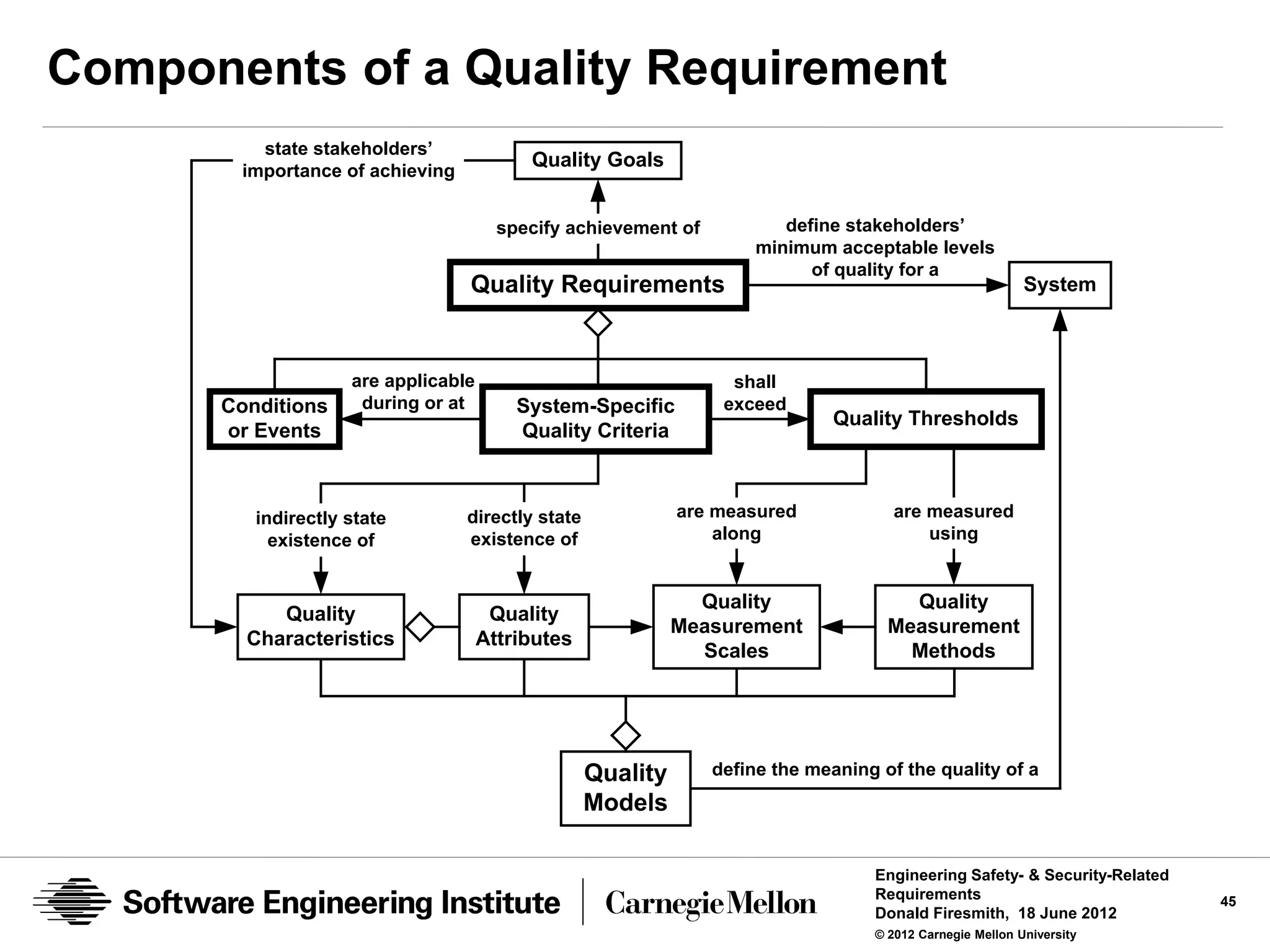
Components of a Quality Requirement
         state stakeholders’
                                          Quality Goals
       importance of achieving


                                       specify achievement of           define stakeholders’
                                                                     minimum acceptable levels
                                                                           of quality for a
                                 Quality Requirements                                                     System


                    are applicable                                shall
      Conditions     during or at        System-Specific         exceed
                                                                              Quality Thresholds
      or Events                          Quality Criteria


         indirectly state        directly state             are measured             are measured
           existence of          existence of                   along                    using


                                                              Quality                 Quality
           Quality                    Quality
                                                            Measurement             Measurement
        Characteristics              Attributes
                                                              Scales                  Methods


                                                  Quality       define the meaning of the quality of a
                                                  Models

                                                                                  Engineering Safety- & Security-Related
                                                                                  Requirements                             45
                                                                                  Donald Firesmith, 18 June 2012
                                                                                  © 2012 Carnegie Mellon University
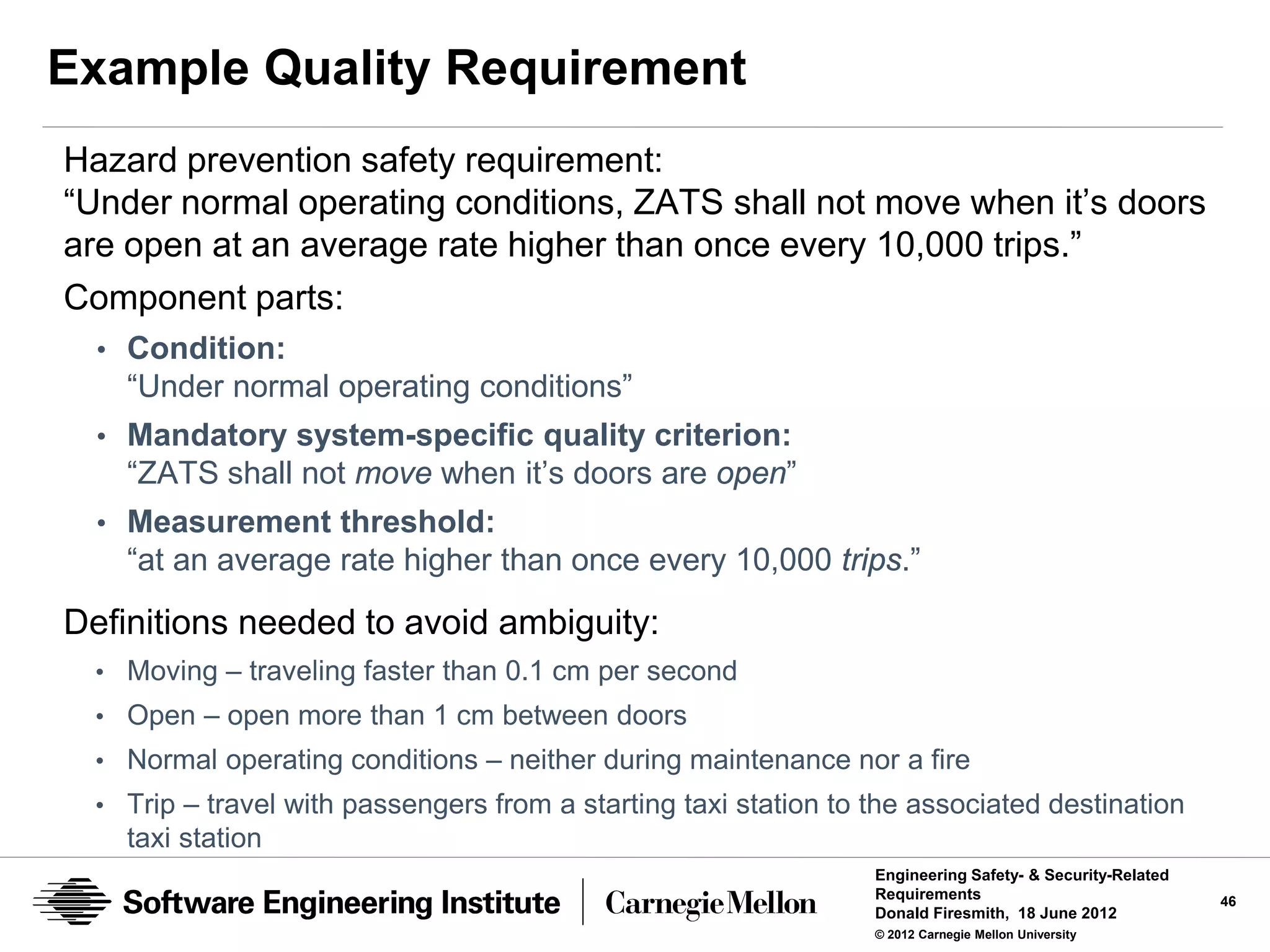
Example Quality Requirement
Hazard prevention safety requirement:
“Under normal operating conditions, ZATS shall not move when it’s doors
are open at an average rate higher than once every 10,000 trips.”
Component parts:
  • Condition:
    “Under normal operating conditions”
  • Mandatory system-specific quality criterion:
    “ZATS shall not move when it’s doors are open”
  • Measurement threshold:
    “at an average rate higher than once every 10,000 trips.”

Definitions needed to avoid ambiguity:
  • Moving – traveling faster than 0.1 cm per second
  • Open – open more than 1 cm between doors
  • Normal operating conditions – neither during maintenance nor a fire
  • Trip – travel with passengers from a starting taxi station to the associated destination
    taxi station
                                                                  Engineering Safety- & Security-Related
                                                                  Requirements                             46
                                                                  Donald Firesmith, 18 June 2012
                                                                  © 2012 Carnegie Mellon University
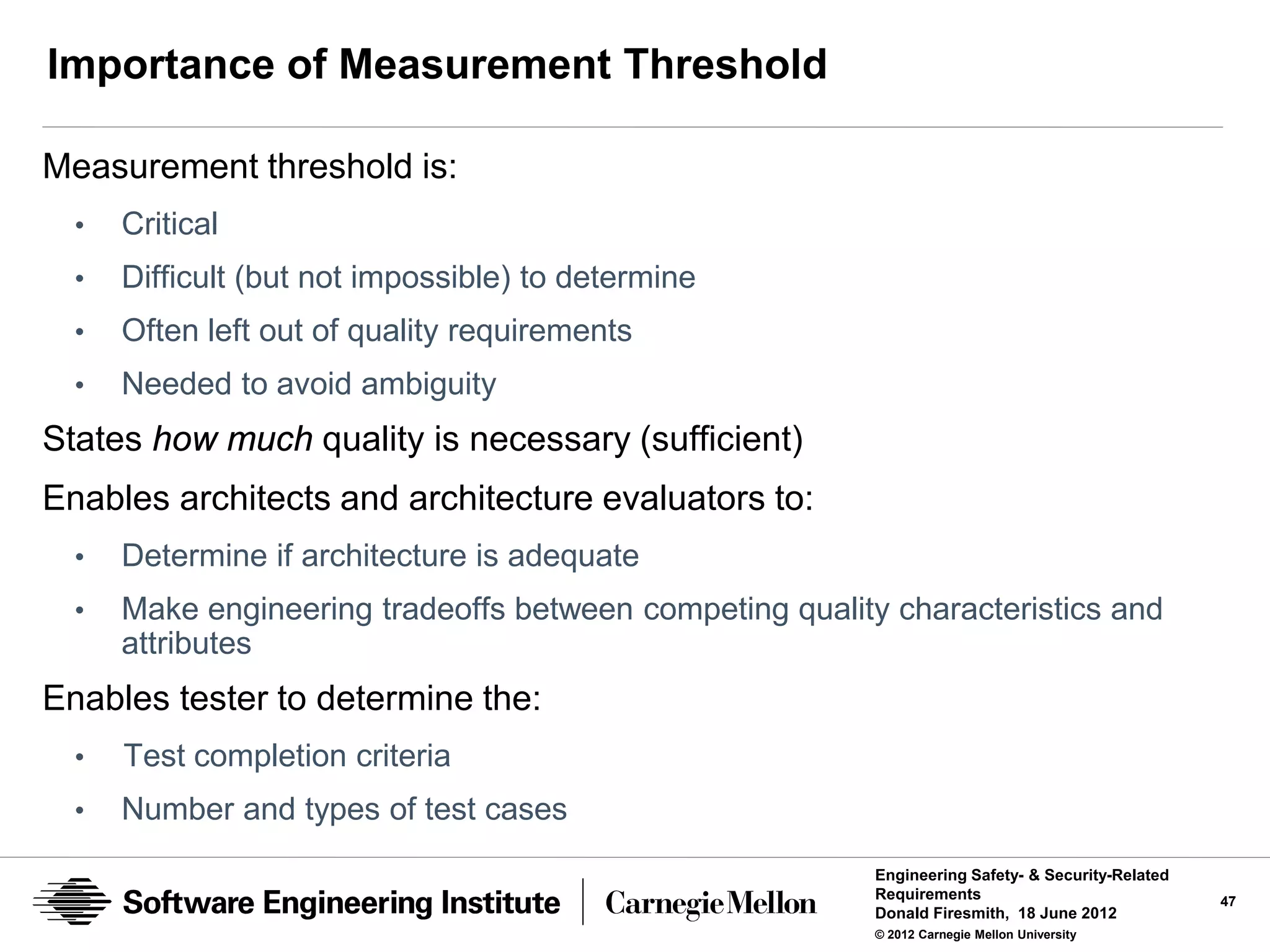
Importance of Measurement Threshold

Measurement threshold is:
  •   Critical
  •   Difficult (but not impossible) to determine
  •   Often left out of quality requirements
  •   Needed to avoid ambiguity
States how much quality is necessary (sufficient)
Enables architects and architecture evaluators to:
  •   Determine if architecture is adequate
  •   Make engineering tradeoffs between competing quality characteristics and
      attributes
Enables tester to determine the:
  •   Test completion criteria
  •   Number and types of test cases
                                                          Engineering Safety- & Security-Related
                                                          Requirements                             47
                                                          Donald Firesmith, 18 June 2012
                                                          © 2012 Carnegie Mellon University
Where We Are
Related Disciplines
Challenges
Common Example
Free, Open-Source Tool
Requirements Engineering Overview

Safety and Security Engineering Overview ◄
Safety- and Security-related Requirements
Collaborative Defensibility Engineering Method
Conclusion


                                                 Engineering Safety- & Security-Related
                                                 Requirements                             48
                                                 Donald Firesmith, 18 June 2012
                                                 © 2012 Carnegie Mellon University
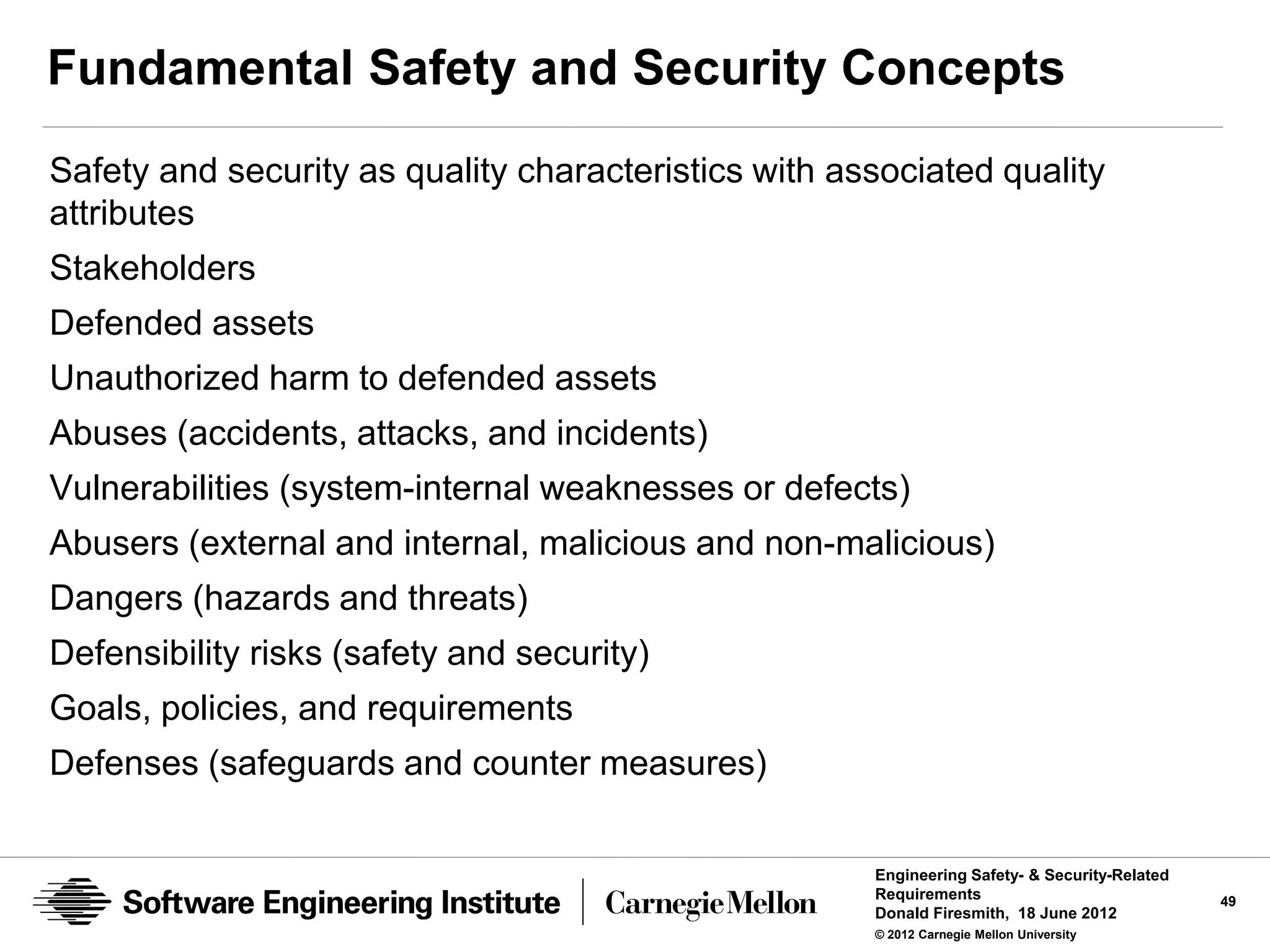
Fundamental Safety and Security Concepts
Safety and security as quality characteristics with associated quality
attributes
Stakeholders
Defended assets
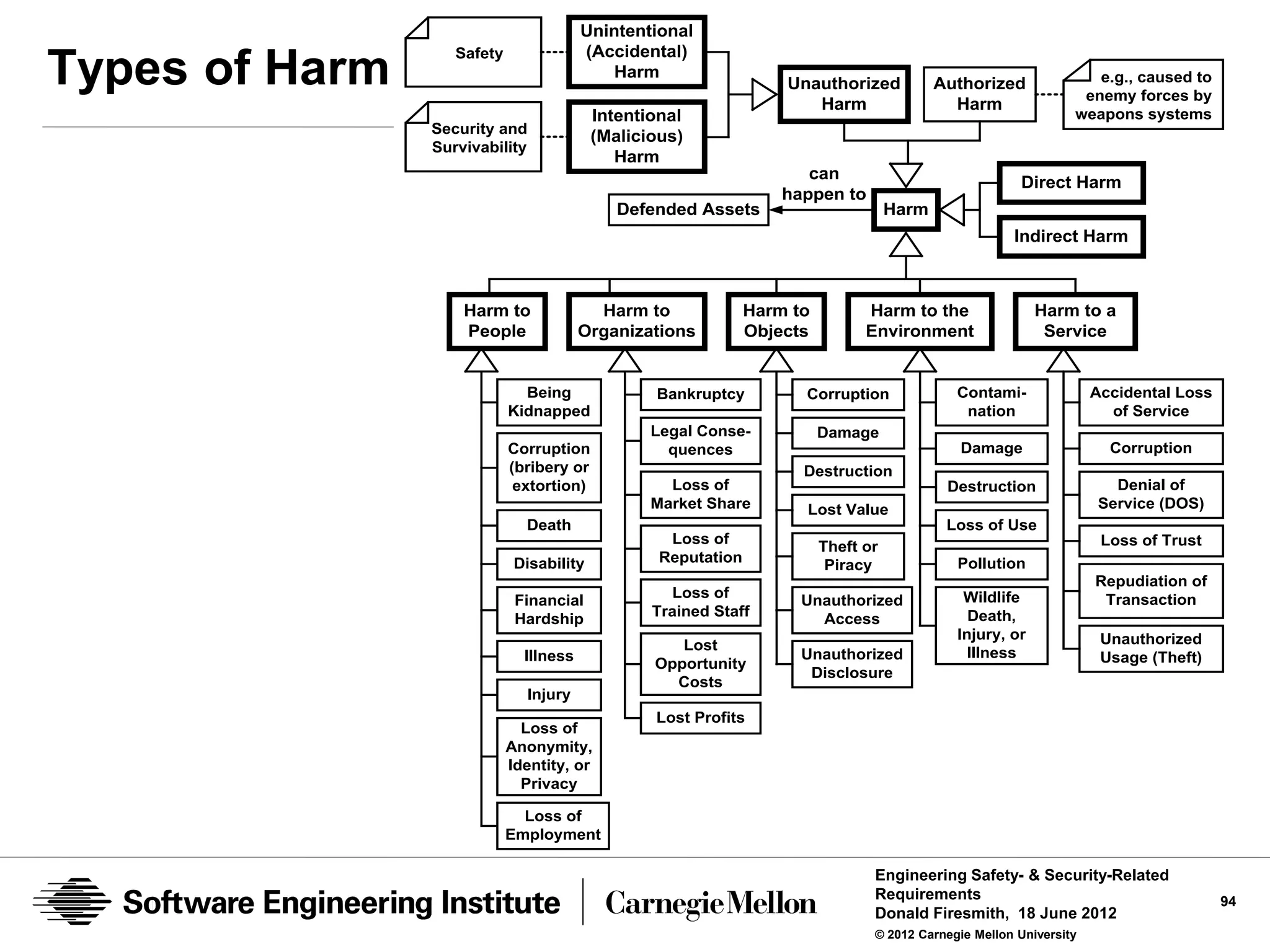
Unauthorized harm to defended assets
Abuses (accidents, attacks, and incidents)
Vulnerabilities (system-internal weaknesses or defects)
Abusers (external and internal, malicious and non-malicious)
Dangers (hazards and threats)
Defensibility risks (safety and security)
Goals, policies, and requirements
Defenses (safeguards and counter measures)

                                                      Engineering Safety- & Security-Related
                                                      Requirements                             49
                                                      Donald Firesmith, 18 June 2012
                                                      © 2012 Carnegie Mellon University
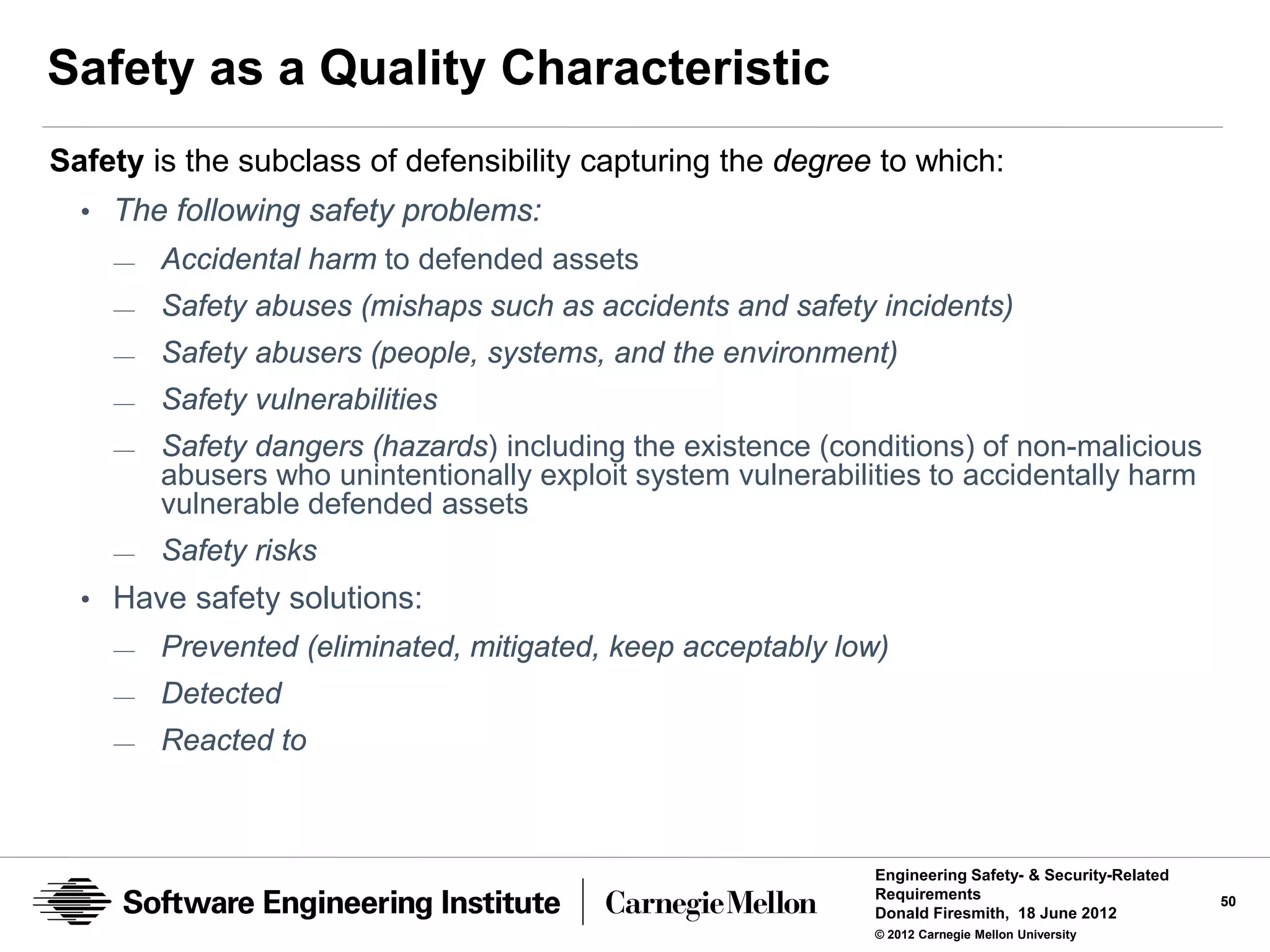
Safety as a Quality Characteristic
Safety is the subclass of defensibility capturing the degree to which:
  • The following safety problems:
    —   Accidental harm to defended assets
    —   Safety abuses (mishaps such as accidents and safety incidents)
    —   Safety abusers (people, systems, and the environment)
    —   Safety vulnerabilities
    —   Safety dangers (hazards) including the existence (conditions) of non-malicious
        abusers who unintentionally exploit system vulnerabilities to accidentally harm
        vulnerable defended assets
    —   Safety risks
  • Have safety solutions:
    —   Prevented (eliminated, mitigated, keep acceptably low)
    —   Detected
    —   Reacted to


                                                              Engineering Safety- & Security-Related
                                                              Requirements                             50
                                                              Donald Firesmith, 18 June 2012
                                                              © 2012 Carnegie Mellon University
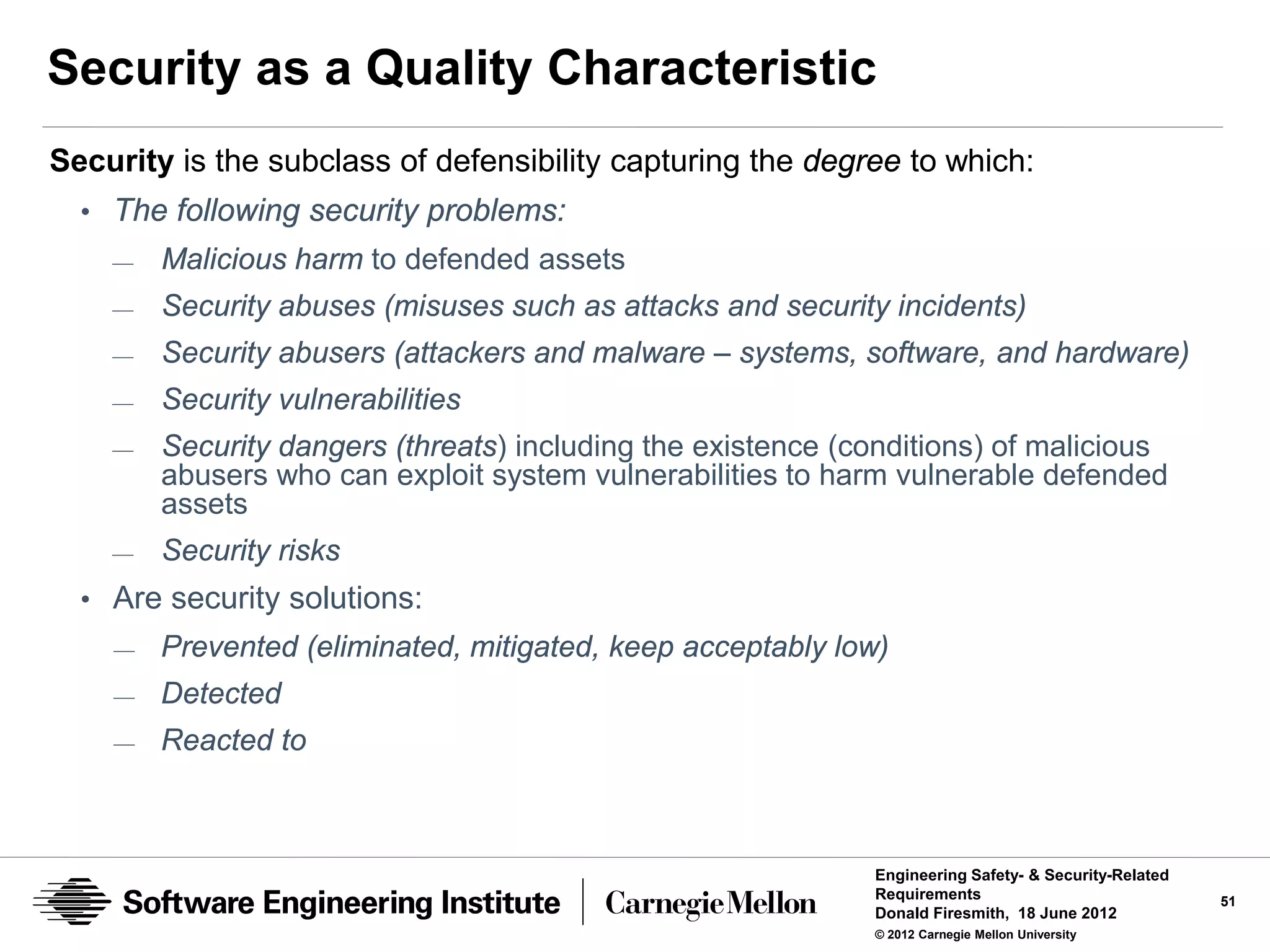
Security as a Quality Characteristic
Security is the subclass of defensibility capturing the degree to which:
  • The following security problems:
    —   Malicious harm to defended assets
    —   Security abuses (misuses such as attacks and security incidents)
    —   Security abusers (attackers and malware – systems, software, and hardware)
    —   Security vulnerabilities
    —   Security dangers (threats) including the existence (conditions) of malicious
        abusers who can exploit system vulnerabilities to harm vulnerable defended
        assets
    —   Security risks
  • Are security solutions:
    —   Prevented (eliminated, mitigated, keep acceptably low)
    —   Detected
    —   Reacted to


                                                             Engineering Safety- & Security-Related
                                                             Requirements                             51
                                                             Donald Firesmith, 18 June 2012
                                                             © 2012 Carnegie Mellon University
Where We Are
Three Disciplines
Challenges
Common Example
Free, Open-Source Tool
Requirements Engineering Overview
Safety and Security Engineering Overview

Safety- and Security-related Requirements ◄
Collaborative Defensibility Engineering Method
Conclusion


                                                 Engineering Safety- & Security-Related
                                                 Requirements                             52
                                                 Donald Firesmith, 18 June 2012
                                                 © 2012 Carnegie Mellon University
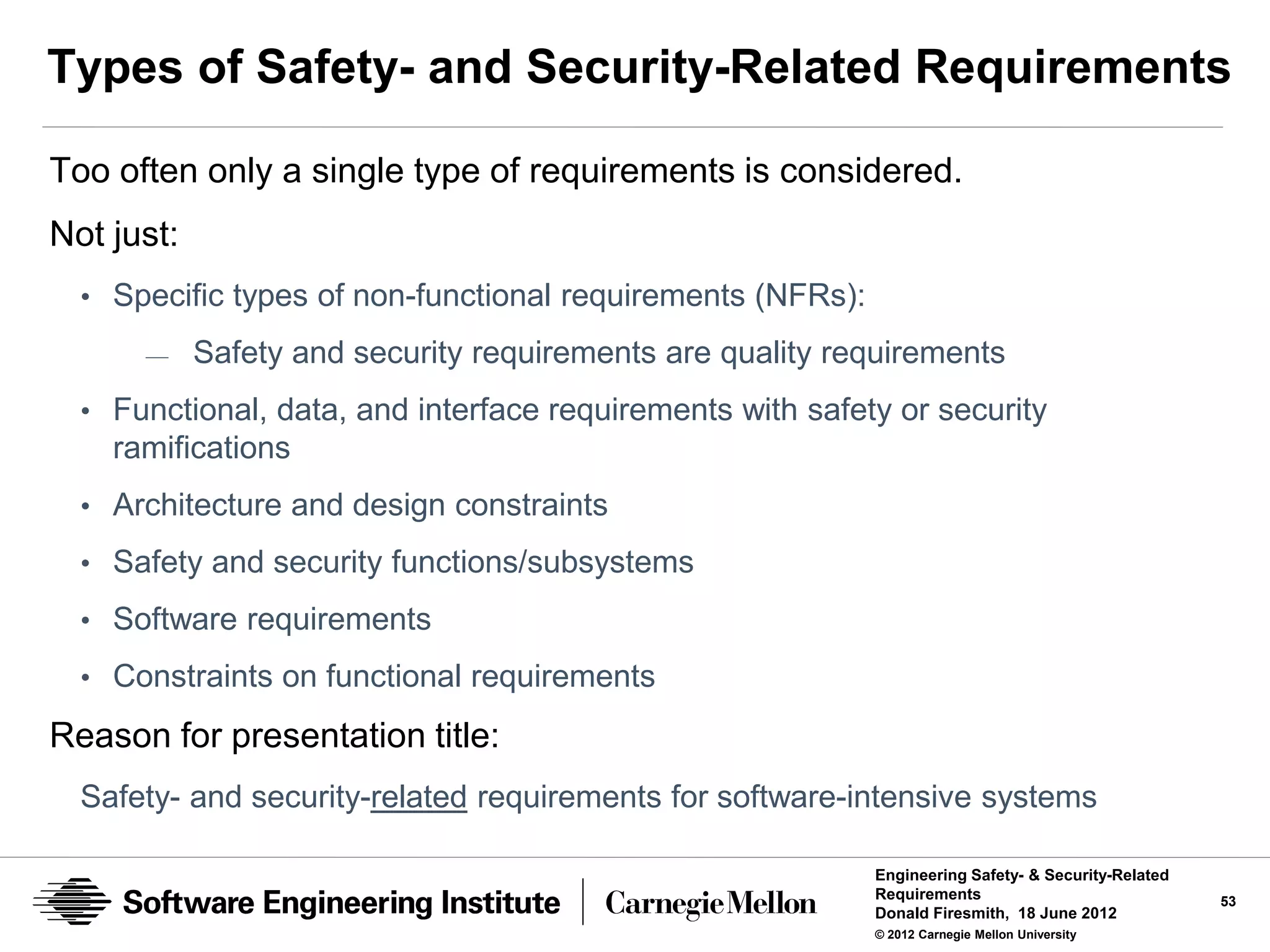
Types of Safety- and Security-Related Requirements

Too often only a single type of requirements is considered.
Not just:
  • Specific types of non-functional requirements (NFRs):
      —     Safety and security requirements are quality requirements
  • Functional, data, and interface requirements with safety or security
    ramifications
  • Architecture and design constraints

  • Safety and security functions/subsystems
  • Software requirements
  • Constraints on functional requirements

Reason for presentation title:
  Safety- and security-related requirements for software-intensive systems

                                                            Engineering Safety- & Security-Related
                                                            Requirements                             53
                                                            Donald Firesmith, 18 June 2012
                                                            © 2012 Carnegie Mellon University
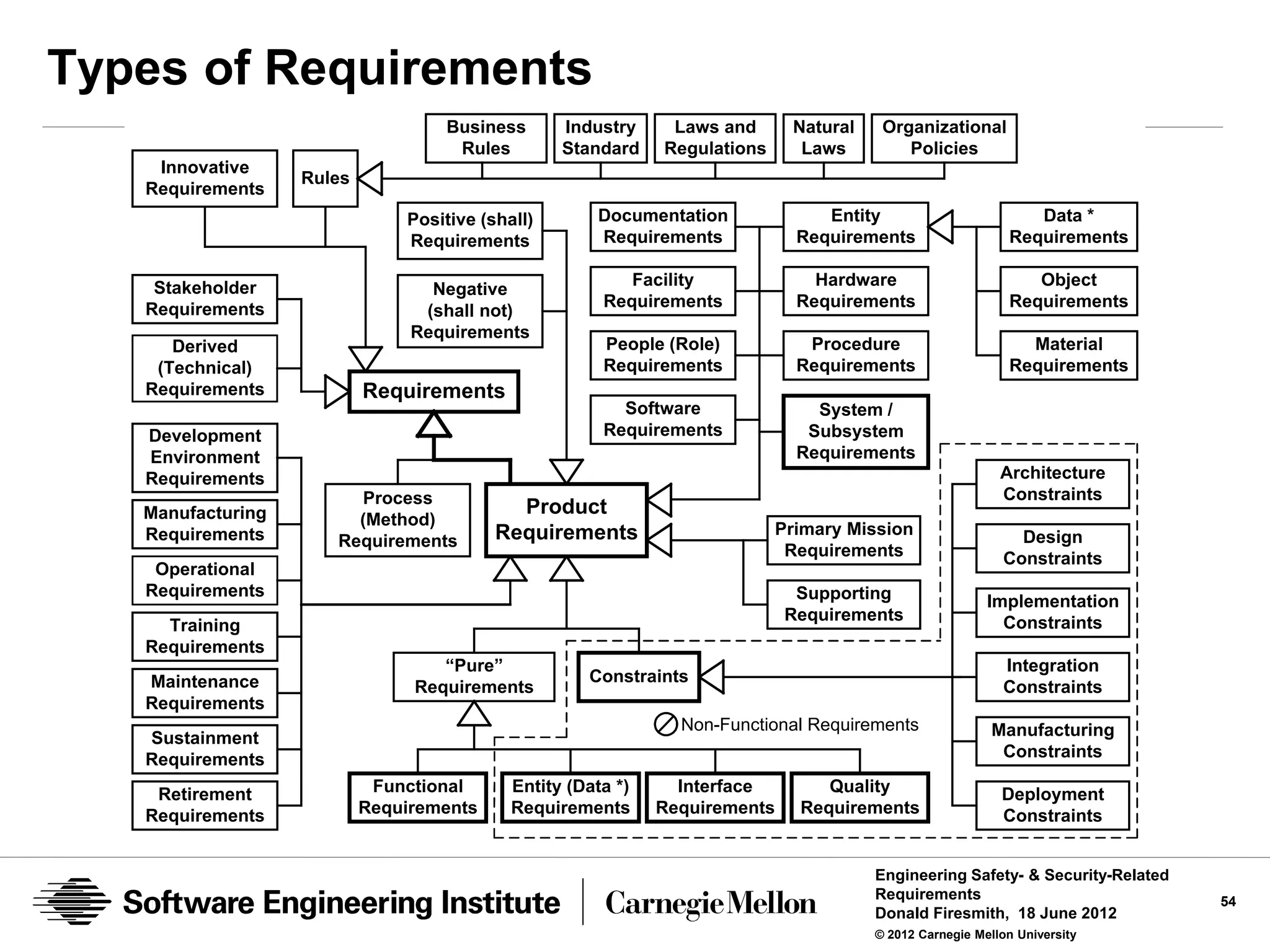
Types of Requirements
                                   Business       Industry     Laws and      Natural    Organizational
                                    Rules         Standard    Regulations     Laws         Policies
    Innovative
                   Rules
   Requirements
                               Positive (shall)       Documentation              Entity                        Data *
                               Requirements           Requirements            Requirements                  Requirements

    Stakeholder                                           Facility              Hardware                       Object
                                  Negative
   Requirements                                        Requirements           Requirements                  Requirements
                                 (shall not)
                                Requirements
      Derived                                          People (Role)           Procedure                      Material
    (Technical)                                        Requirements           Requirements                  Requirements
   Requirements            Requirements
                                                         Software               System /
   Development                                         Requirements            Subsystem
   Environment                                                                Requirements
   Requirements                                                                                            Architecture
                        Process                                                                            Constraints
   Manufacturing                            Product
                        (Method)
   Requirements                           Requirements                      Primary Mission                  Design
                      Requirements
                                                                             Requirements                  Constraints
    Operational
   Requirements                                                               Supporting                 Implementation
                                                                             Requirements                  Constraints
     Training
   Requirements
                                   “Pure”                                                                  Integration
   Maintenance                                       Constraints
                                Requirements                                                               Constraints
   Requirements
                                                                Non-Functional Requirements               Manufacturing
   Sustainment
   Requirements                                                                                            Constraints

    Retirement              Functional      Entity (Data *)     Interface        Quality                   Deployment
   Requirements            Requirements     Requirements      Requirements    Requirements                 Constraints


                                                                                       Engineering Safety- & Security-Related
                                                                                       Requirements                             54
                                                                                       Donald Firesmith, 18 June 2012
                                                                                       © 2012 Carnegie Mellon University
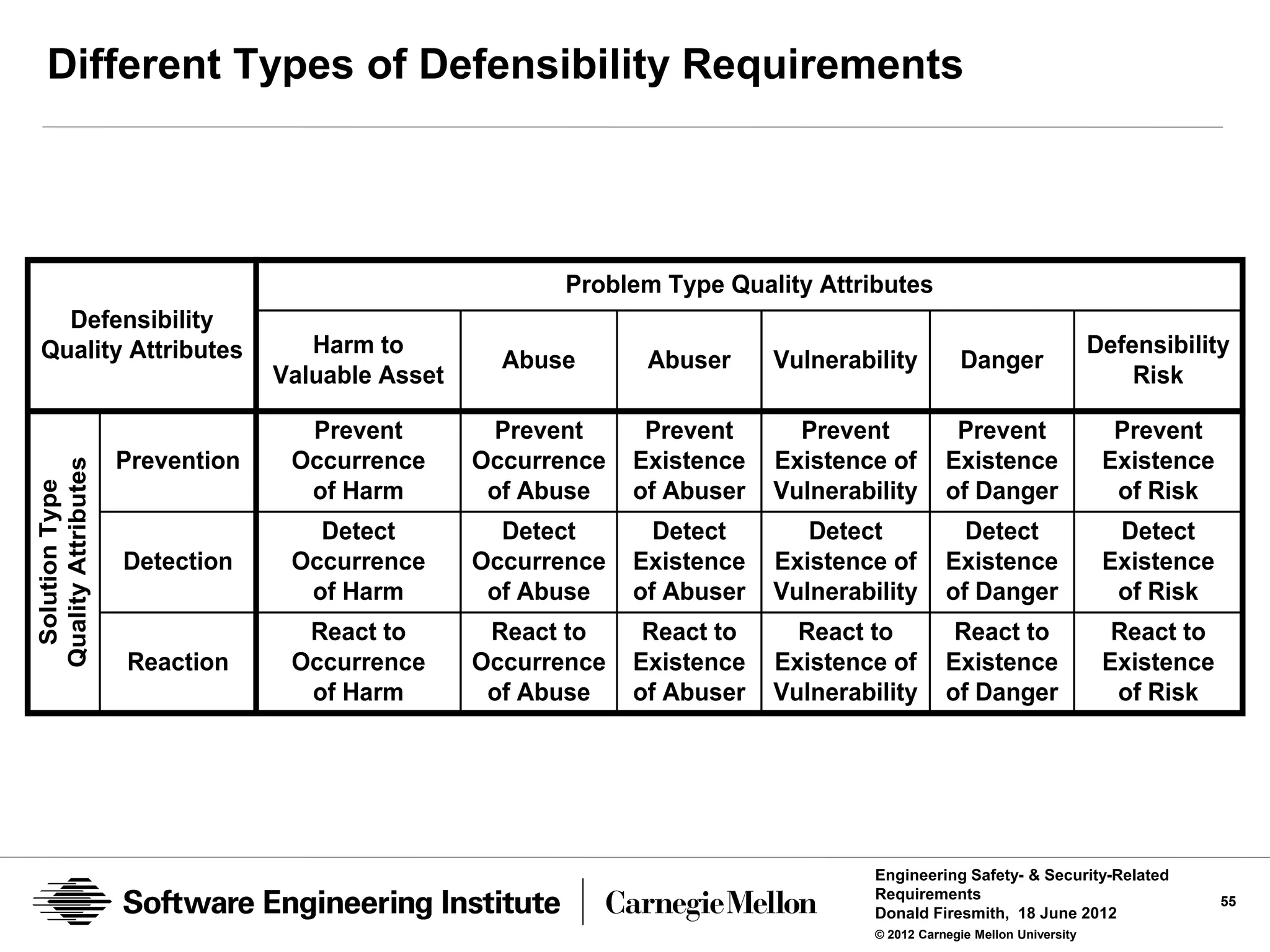
Different Types of Defensibility Requirements


                                                         Problem Type Quality Attributes
  Defensibility
Quality Attributes                   Harm to                                                                             Defensibility
                                                     Abuse       Abuser     Vulnerability         Danger
                                  Valuable Asset                                                                             Risk

                                    Prevent         Prevent      Prevent      Prevent            Prevent                   Prevent
                     Prevention    Occurrence      Occurrence   Existence   Existence of        Existence                 Existence
Quality Attributes
 Solution Type


                                    of Harm         of Abuse    of Abuser   Vulnerability       of Danger                  of Risk
                                     Detect          Detect       Detect       Detect             Detect                   Detect
                     Detection     Occurrence      Occurrence   Existence   Existence of        Existence                 Existence
                                    of Harm         of Abuse    of Abuser   Vulnerability       of Danger                  of Risk
                                    React to        React to     React to     React to           React to                  React to
                     Reaction      Occurrence      Occurrence   Existence   Existence of        Existence                 Existence
                                    of Harm         of Abuse    of Abuser   Vulnerability       of Danger                  of Risk


                                                                                     Engineering Safety- & Security-Related
                                                                                     Requirements                                     55
                                                                                     Donald Firesmith, 18 June 2012
                                                                                     © 2012 Carnegie Mellon University
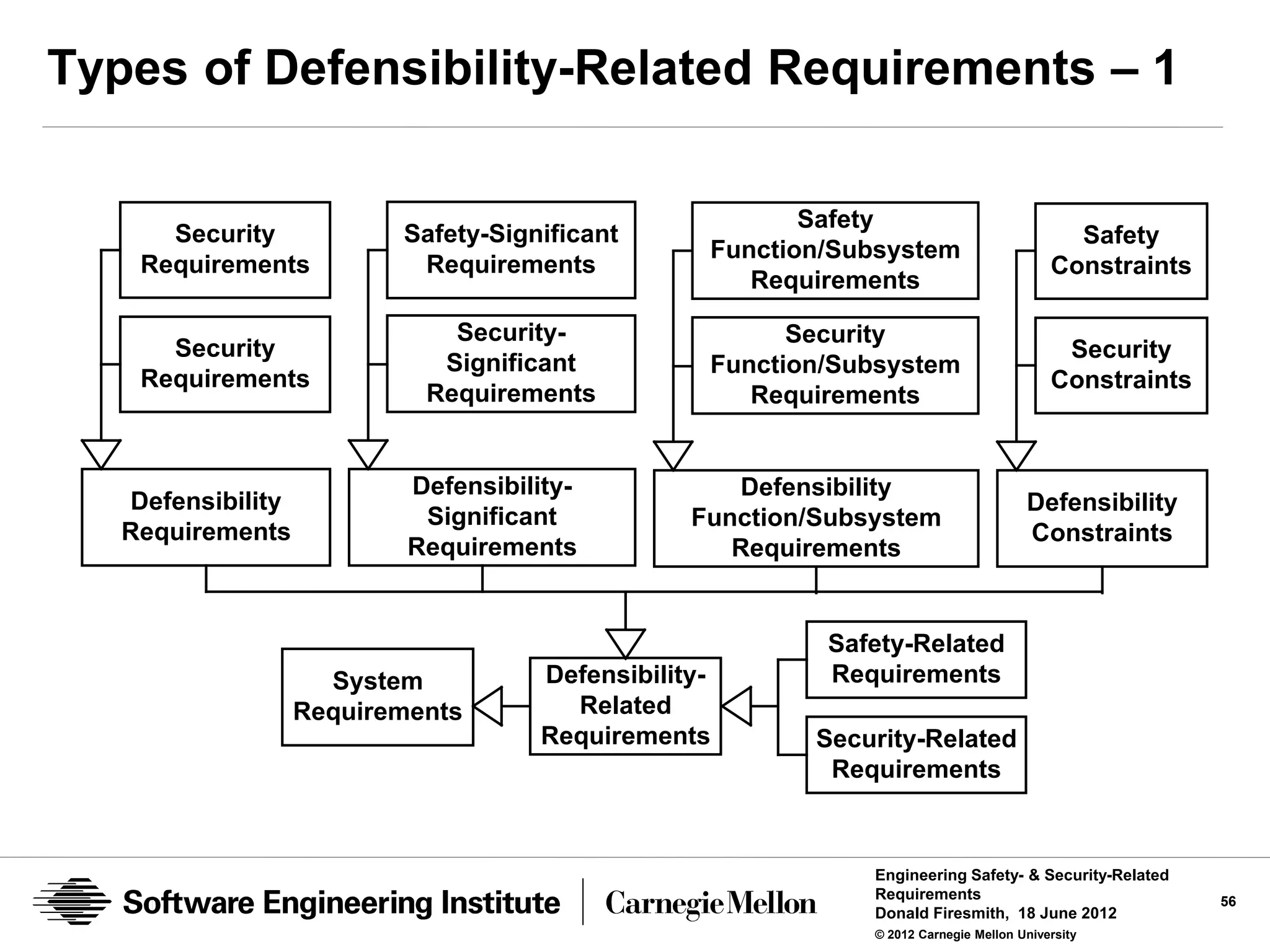
Types of Defensibility-Related Requirements – 1

                                                          Safety
      Security            Safety-Significant                                                 Safety
                                                   Function/Subsystem
    Requirements           Requirements                                                    Constraints
                                                      Requirements

                              Security-                  Security
      Security                                                                              Security
                             Significant           Function/Subsystem
    Requirements                                                                           Constraints
                            Requirements              Requirements


                           Defensibility-            Defensibility
   Defensibility                                                                       Defensibility
                            Significant           Function/Subsystem
   Requirements                                                                        Constraints
                           Requirements              Requirements


                                                           Safety-Related
                     System           Defensibility-       Requirements
                   Requirements         Related
                                      Requirements        Security-Related
                                                           Requirements


                                                               Engineering Safety- & Security-Related
                                                               Requirements                              56
                                                               Donald Firesmith, 18 June 2012
                                                               © 2012 Carnegie Mellon University
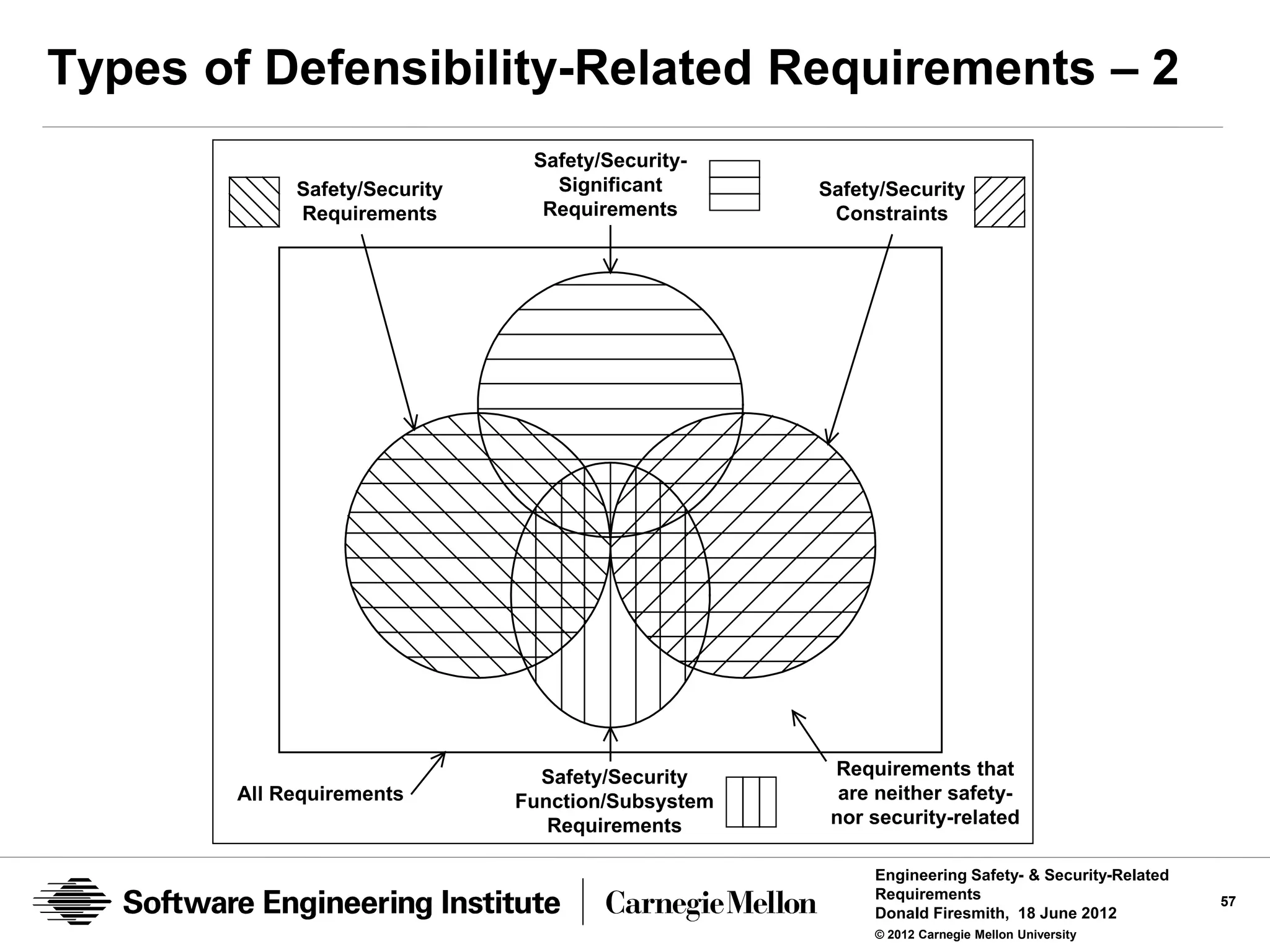
Types of Defensibility-Related Requirements – 2
                               Safety/Security-
            Safety/Security      Significant       Safety/Security
            Requirements        Requirements        Constraints


                                Safety/Security     Requirements that
       All Requirements       Function/Subsystem     are neither safety-
                                 Requirements       nor security-related

                                                        Engineering Safety- & Security-Related
                                                        Requirements                             57
                                                        Donald Firesmith, 18 June 2012
                                                        © 2012 Carnegie Mellon University
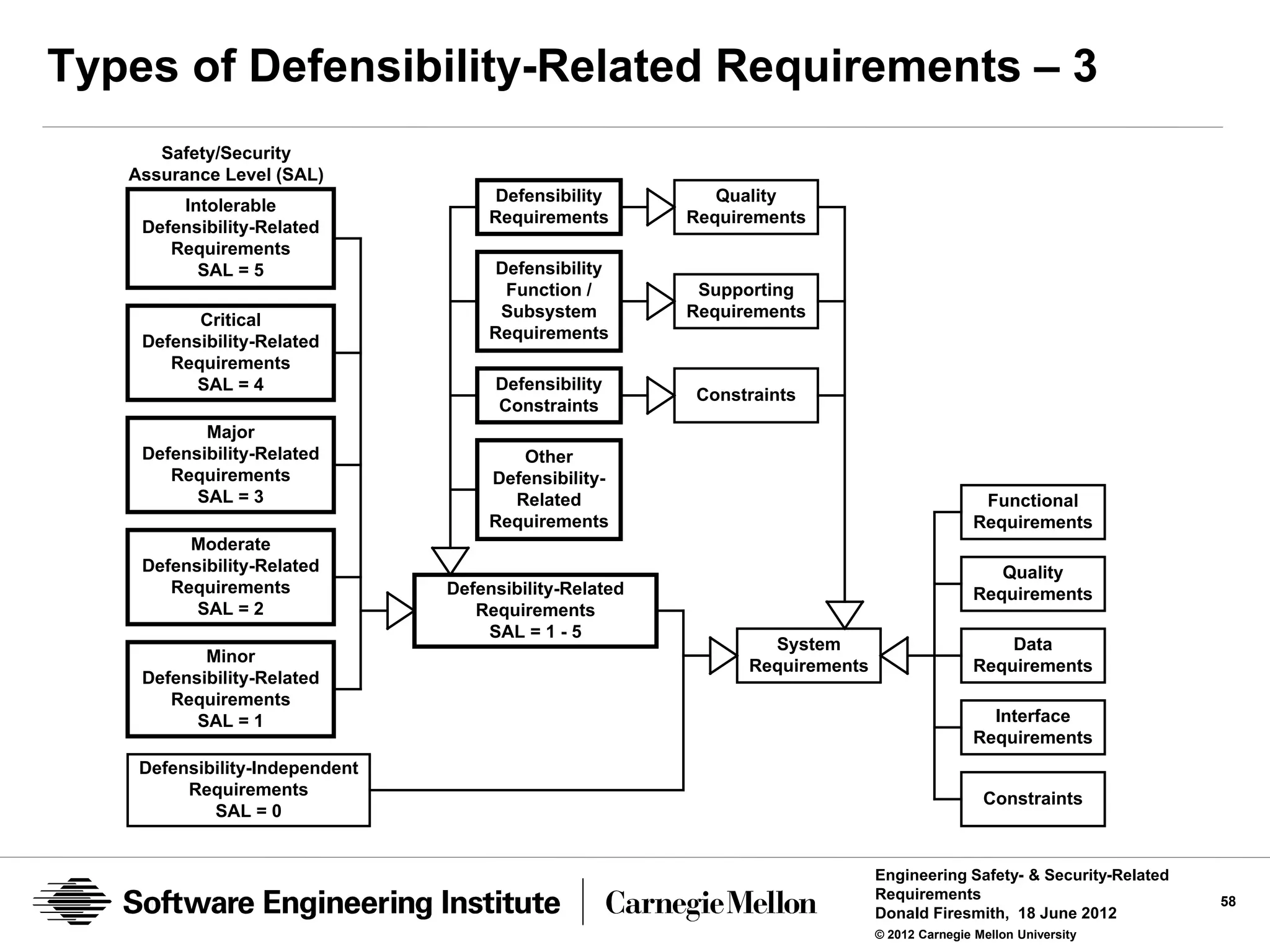
Types of Defensibility-Related Requirements – 3
      Safety/Security
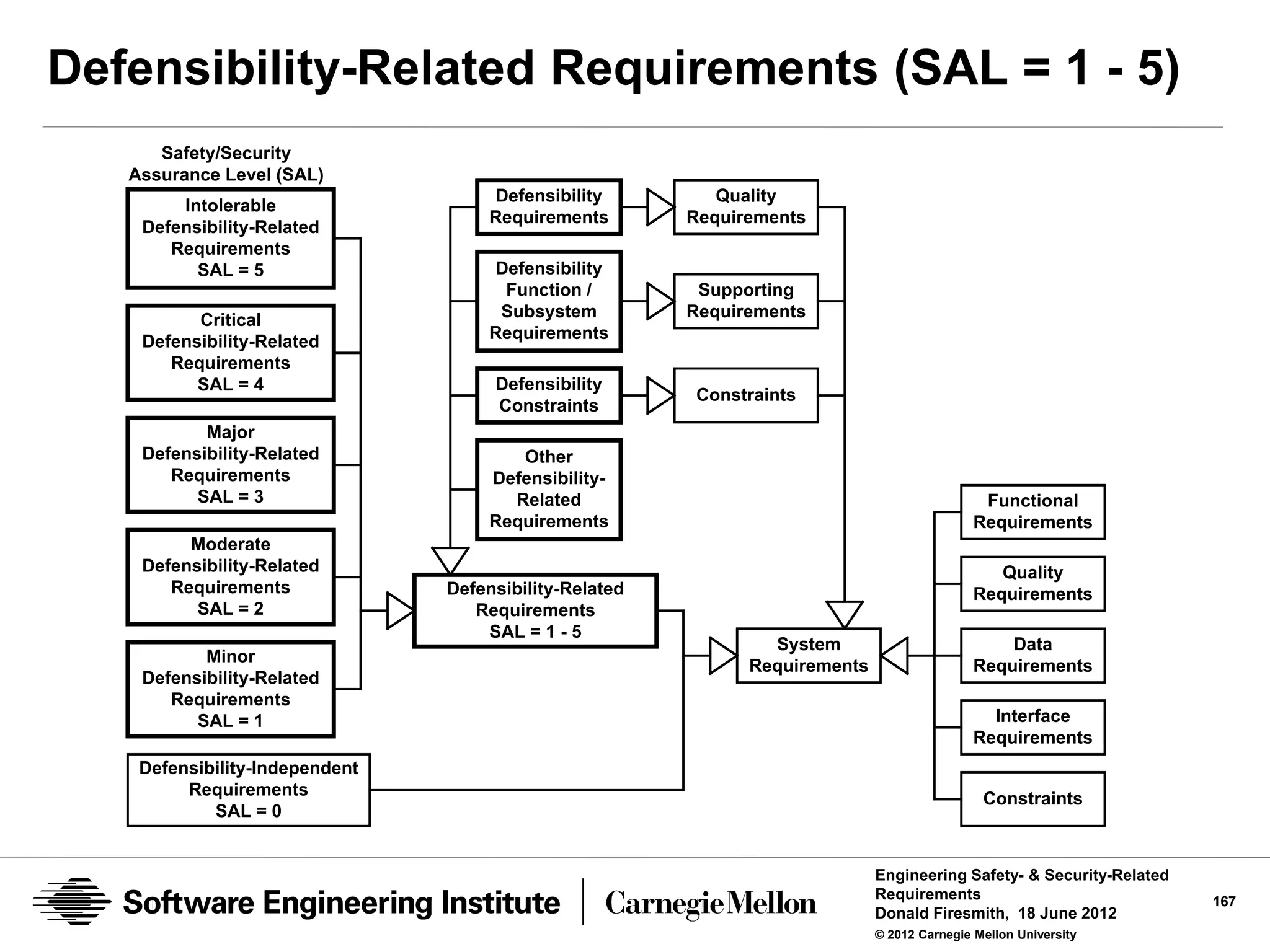
   Assurance Level (SAL)
                                     Defensibility         Quality
        Intolerable
                                     Requirements       Requirements
    Defensibility-Related
       Requirements
          SAL = 5                    Defensibility
                                      Function /         Supporting
          Critical                    Subsystem         Requirements
    Defensibility-Related            Requirements
       Requirements
          SAL = 4                    Defensibility
                                                        Constraints
                                     Constraints
           Major
    Defensibility-Related               Other
       Requirements                  Defensibility-
          SAL = 3                      Related                                                Functional
                                     Requirements                                            Requirements
         Moderate
    Defensibility-Related                                                                       Quality
       Requirements             Defensibility-Related                                        Requirements
          SAL = 2                  Requirements
                                    SAL = 1 - 5
                                                                System                           Data
           Minor
                                                              Requirements                   Requirements
    Defensibility-Related
       Requirements
          SAL = 1                                                                              Interface
                                                                                             Requirements
    Defensibility-Independent
         Requirements
                                                                                              Constraints
            SAL = 0


                                                                             Engineering Safety- & Security-Related
                                                                             Requirements                             58
                                                                             Donald Firesmith, 18 June 2012
                                                                             © 2012 Carnegie Mellon University
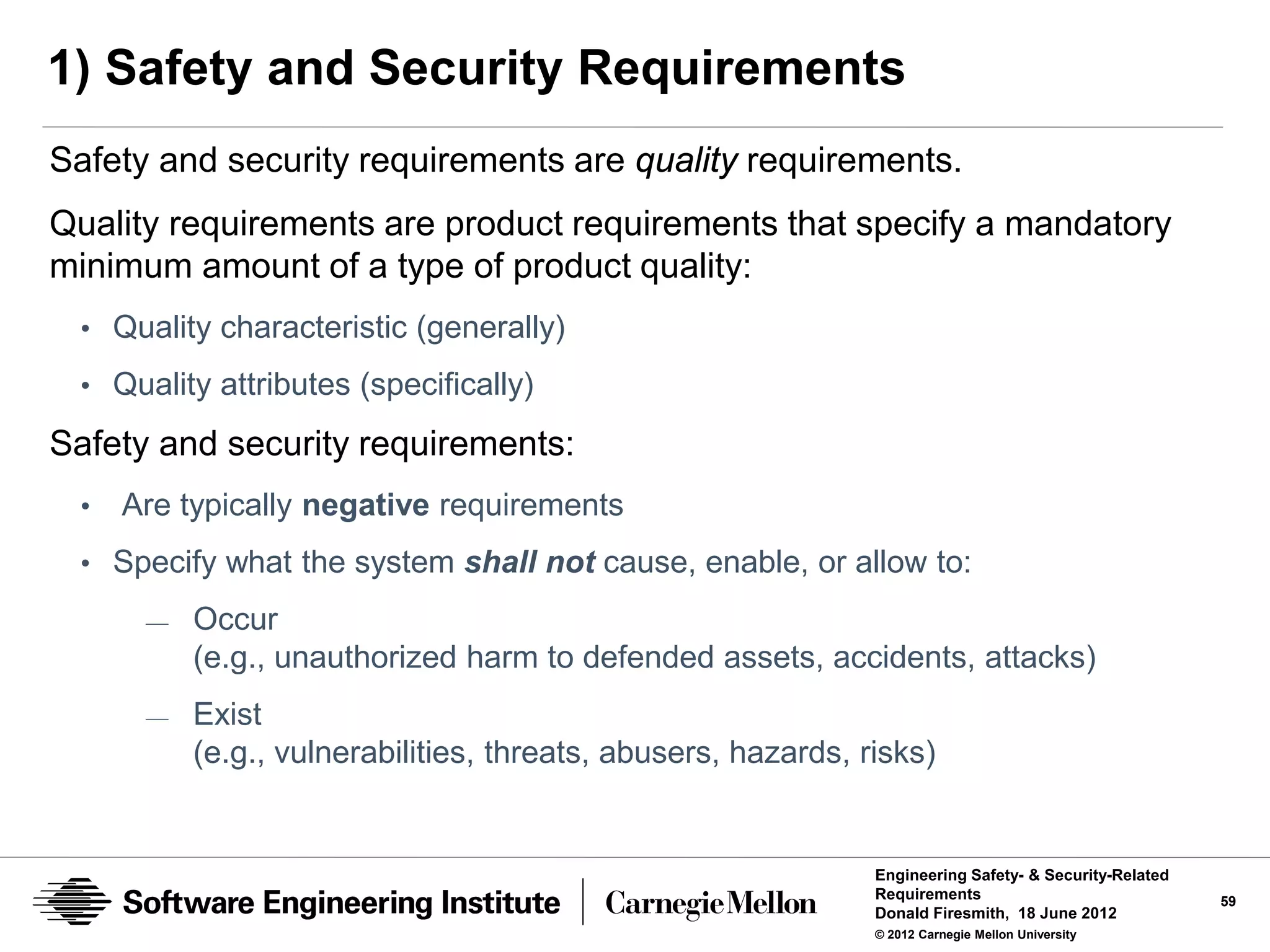
1) Safety and Security Requirements
Safety and security requirements are quality requirements.
Quality requirements are product requirements that specify a mandatory
minimum amount of a type of product quality:
 • Quality characteristic (generally)
 • Quality attributes (specifically)

Safety and security requirements:
 •   Are typically negative requirements
 • Specify what the system shall not cause, enable, or allow to:
      —   Occur
          (e.g., unauthorized harm to defended assets, accidents, attacks)
      —   Exist
          (e.g., vulnerabilities, threats, abusers, hazards, risks)


                                                              Engineering Safety- & Security-Related
                                                              Requirements                             59
                                                              Donald Firesmith, 18 June 2012
                                                              © 2012 Carnegie Mellon University
Safety and Security Requirements
Quality requirements should be:
  • Scalar (how well or how much)
  • Based on a quality model defining the specific types of quality and how their
    measurement scales
  • Stored in requirements repositories and specified in requirements
    specifications, NOT just in:
    —   Secondary specifications
    —   Safety/security documents
Quality requirements are critically important drivers of the architecture and
testing.


                                                           Engineering Safety- & Security-Related
                                                           Requirements                             60
                                                           Donald Firesmith, 18 June 2012
                                                           © 2012 Carnegie Mellon University
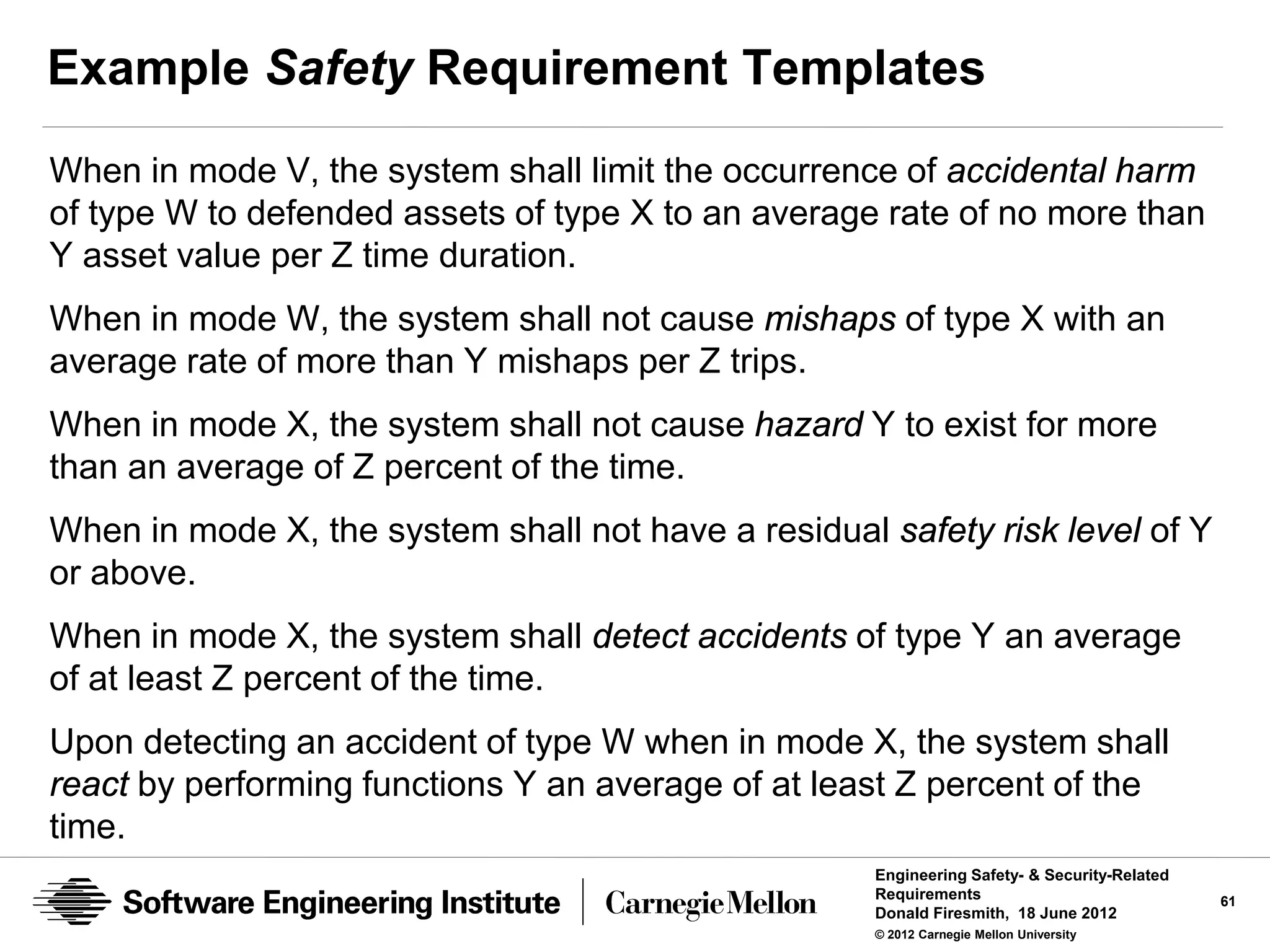
Example Safety Requirement Templates
When in mode V, the system shall limit the occurrence of accidental harm
of type W to defended assets of type X to an average rate of no more than
Y asset value per Z time duration.
When in mode W, the system shall not cause mishaps of type X with an
average rate of more than Y mishaps per Z trips.
When in mode X, the system shall not cause hazard Y to exist for more
than an average of Z percent of the time.
When in mode X, the system shall not have a residual safety risk level of Y
or above.
When in mode X, the system shall detect accidents of type Y an average
of at least Z percent of the time.
Upon detecting an accident of type W when in mode X, the system shall
react by performing functions Y an average of at least Z percent of the
time.
                                                     Engineering Safety- & Security-Related
                                                     Requirements                             61
                                                     Donald Firesmith, 18 June 2012
                                                     © 2012 Carnegie Mellon University
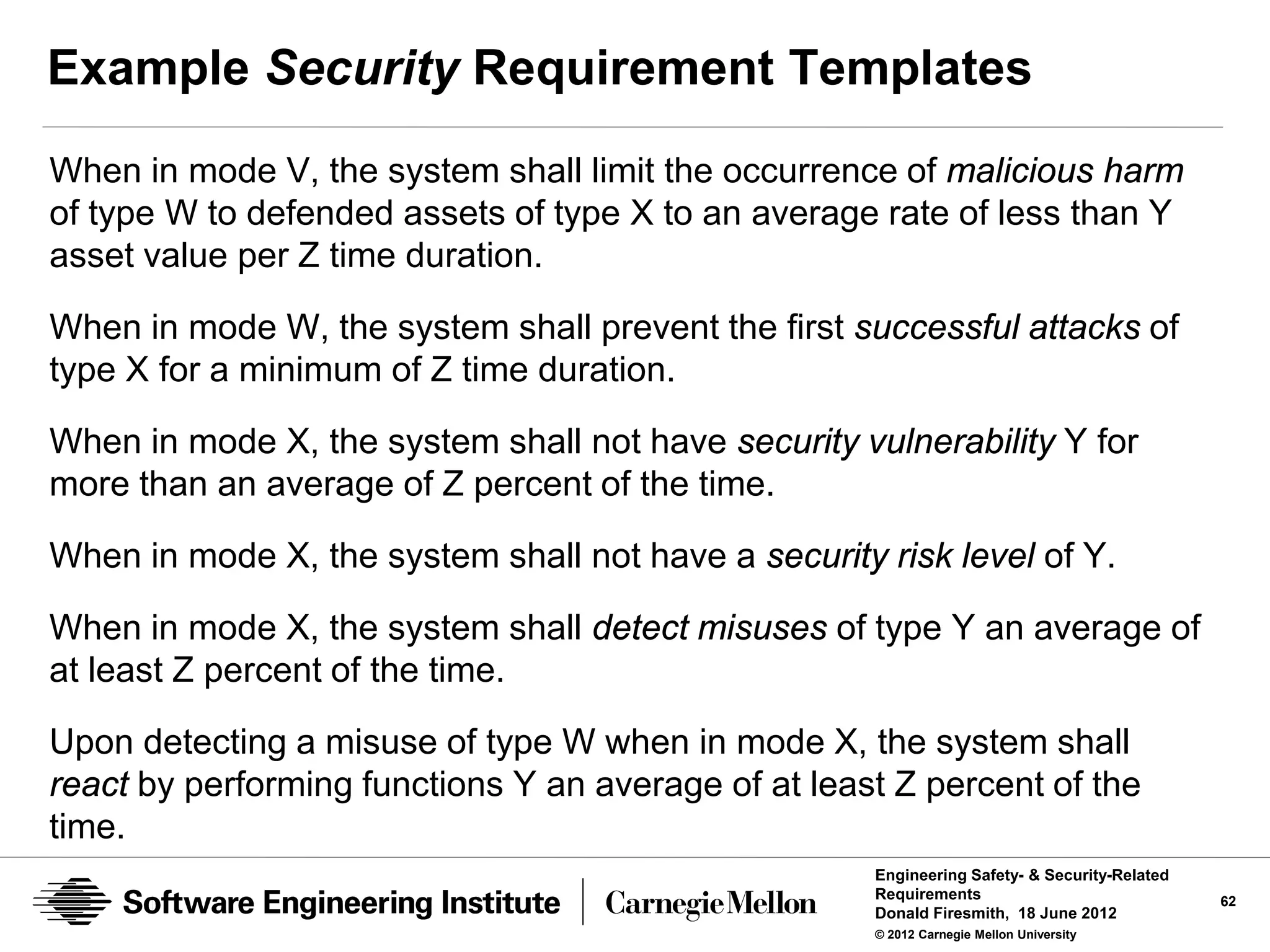
Example Security Requirement Templates
When in mode V, the system shall limit the occurrence of malicious harm
of type W to defended assets of type X to an average rate of less than Y
asset value per Z time duration.

When in mode W, the system shall prevent the first successful attacks of
type X for a minimum of Z time duration.

When in mode X, the system shall not have security vulnerability Y for
more than an average of Z percent of the time.

When in mode X, the system shall not have a security risk level of Y.

When in mode X, the system shall detect misuses of type Y an average of
at least Z percent of the time.

Upon detecting a misuse of type W when in mode X, the system shall
react by performing functions Y an average of at least Z percent of the
time.
                                                     Engineering Safety- & Security-Related
                                                     Requirements                             62
                                                     Donald Firesmith, 18 June 2012
                                                     © 2012 Carnegie Mellon University
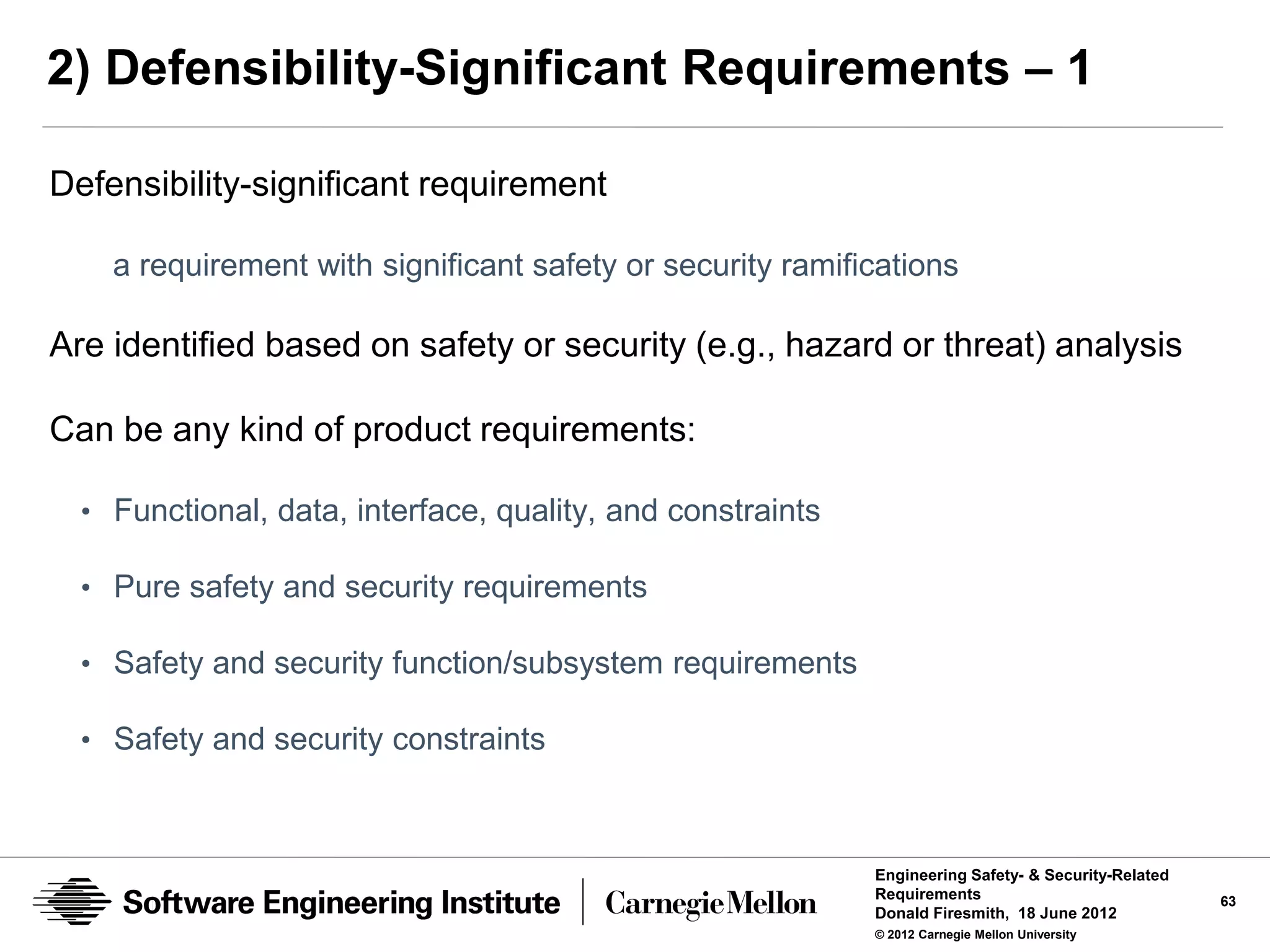
2) Defensibility-Significant Requirements – 1

Defensibility-significant requirement

    a requirement with significant safety or security ramifications

Are identified based on safety or security (e.g., hazard or threat) analysis

Can be any kind of product requirements:

  • Functional, data, interface, quality, and constraints

  • Pure safety and security requirements

  • Safety and security function/subsystem requirements

  • Safety and security constraints


                                                            Engineering Safety- & Security-Related
                                                            Requirements                             63
                                                            Donald Firesmith, 18 June 2012
                                                            © 2012 Carnegie Mellon University
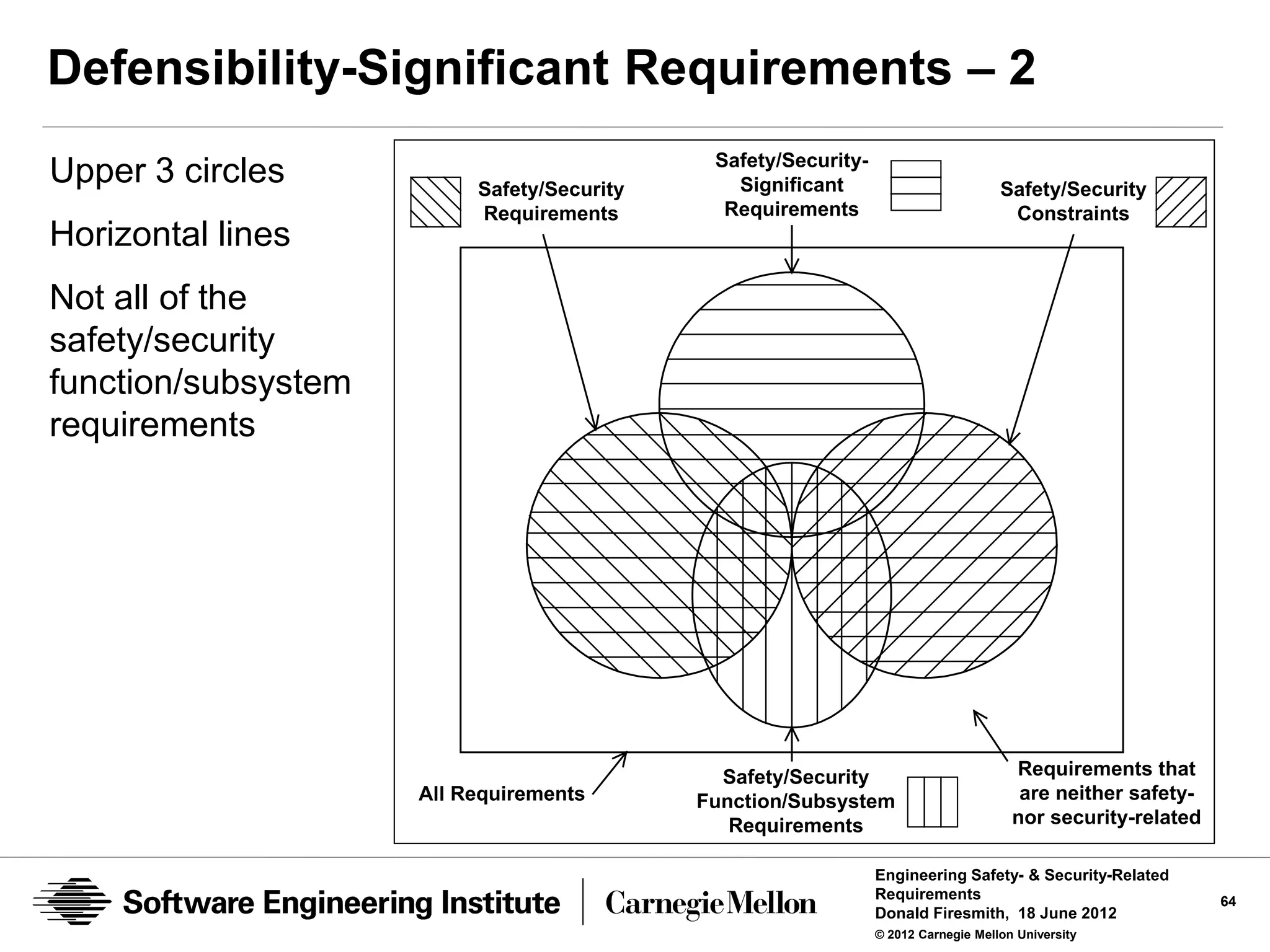
Defensibility-Significant Requirements – 2
                                             Safety/Security-
Upper 3 circles           Safety/Security      Significant                          Safety/Security
                          Requirements        Requirements                           Constraints
Horizontal lines
Not all of the
safety/security
function/subsystem
requirements


                                              Safety/Security                         Requirements that
                     All Requirements       Function/Subsystem                         are neither safety-
                                               Requirements                           nor security-related

                                                                Engineering Safety- & Security-Related
                                                                Requirements                                 64
                                                                Donald Firesmith, 18 June 2012
                                                                © 2012 Carnegie Mellon University
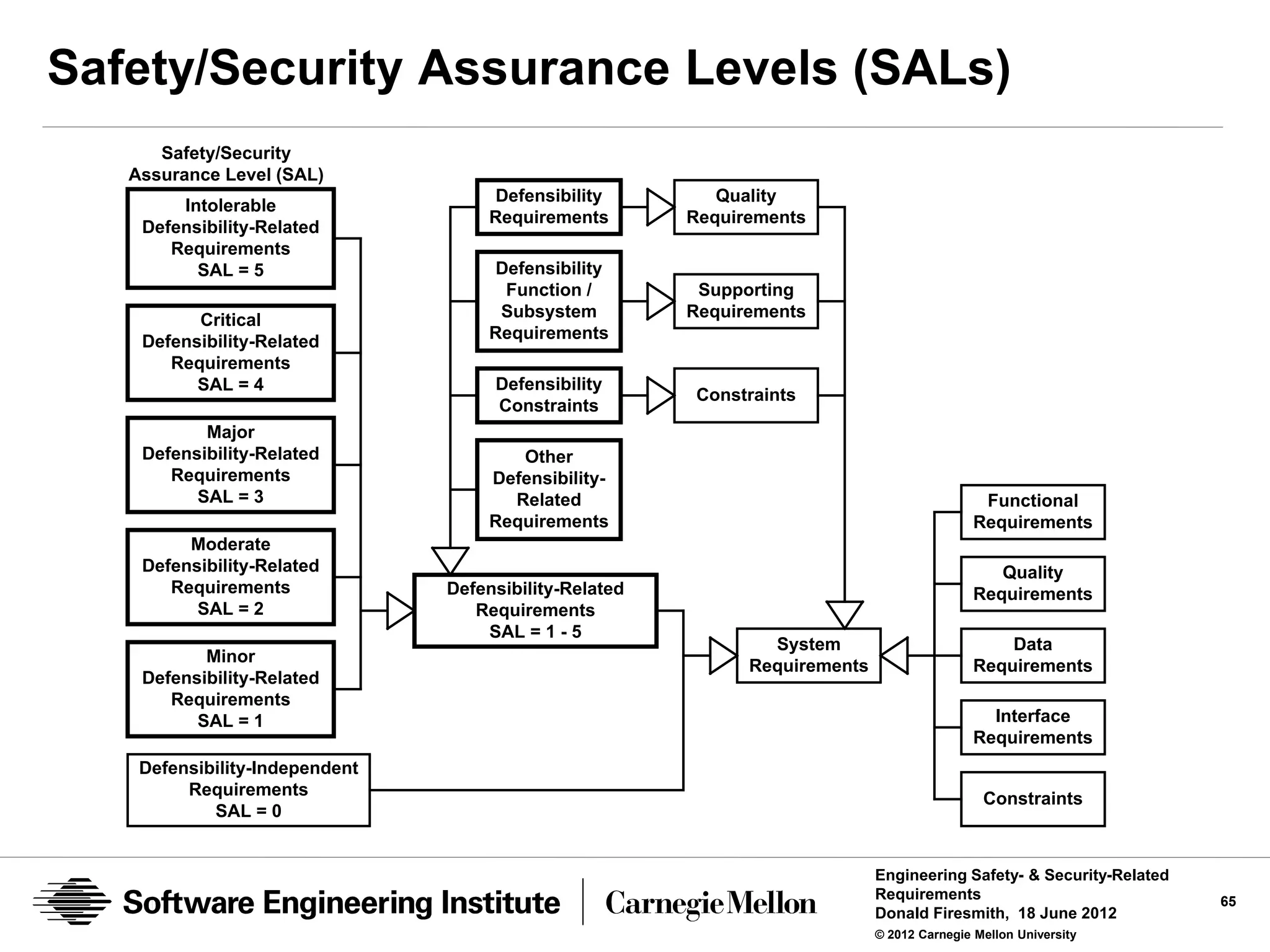
Safety/Security Assurance Levels (SALs)
      Safety/Security
   Assurance Level (SAL)
                                     Defensibility         Quality
        Intolerable
                                     Requirements       Requirements
    Defensibility-Related
       Requirements
          SAL = 5                    Defensibility
                                      Function /         Supporting
          Critical                    Subsystem         Requirements
    Defensibility-Related            Requirements
       Requirements
          SAL = 4                    Defensibility
                                                        Constraints
                                     Constraints
           Major
    Defensibility-Related               Other
       Requirements                  Defensibility-
          SAL = 3                      Related                                                Functional
                                     Requirements                                            Requirements
         Moderate
    Defensibility-Related                                                                       Quality
       Requirements             Defensibility-Related                                        Requirements
          SAL = 2                  Requirements
                                    SAL = 1 - 5
                                                                System                           Data
           Minor
                                                              Requirements                   Requirements
    Defensibility-Related
       Requirements
          SAL = 1                                                                              Interface
                                                                                             Requirements
    Defensibility-Independent
         Requirements
                                                                                              Constraints
            SAL = 0


                                                                             Engineering Safety- & Security-Related
                                                                             Requirements                             65
                                                                             Donald Firesmith, 18 June 2012
                                                                             © 2012 Carnegie Mellon University
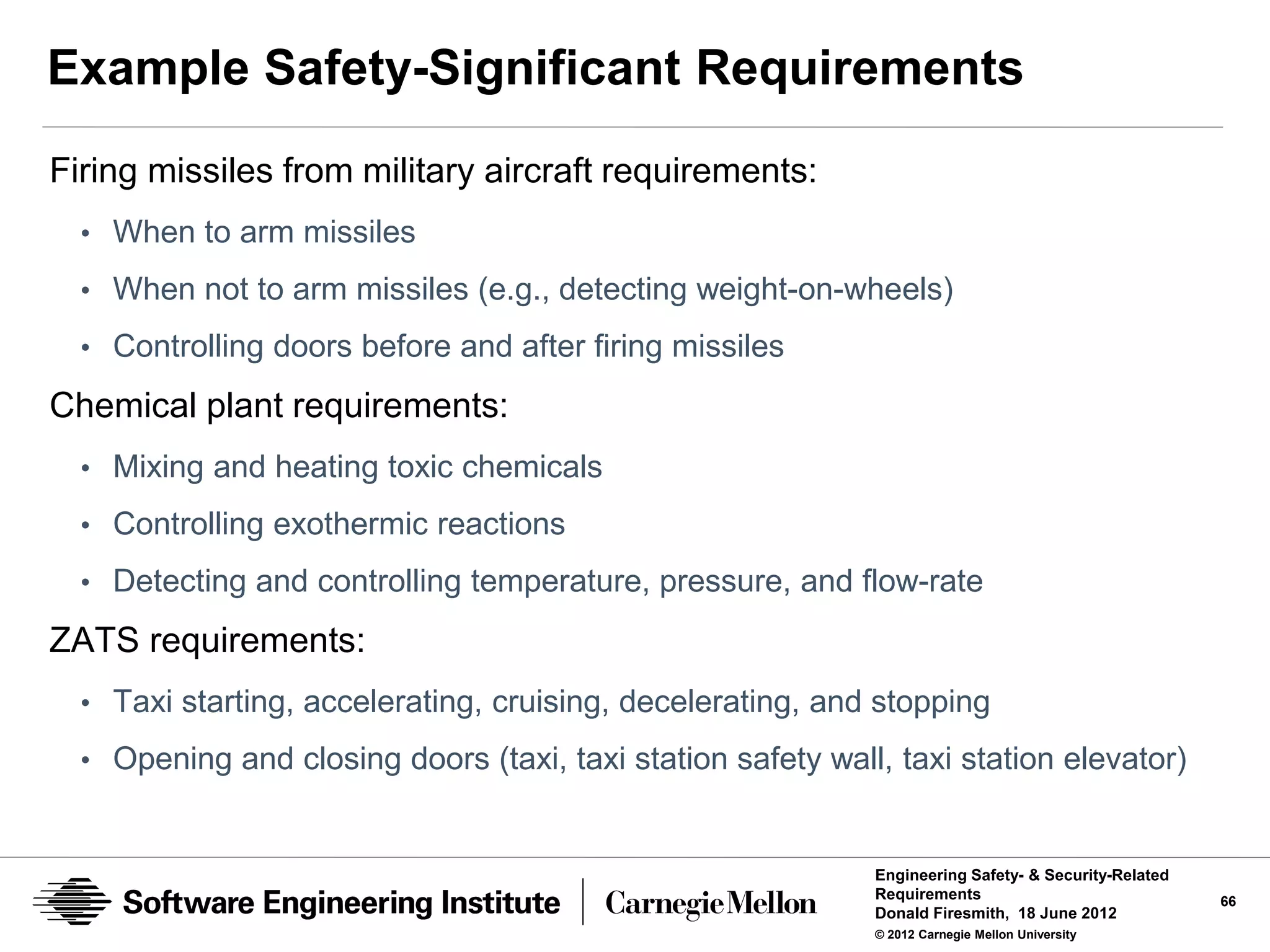
Example Safety-Significant Requirements
Firing missiles from military aircraft requirements:
  • When to arm missiles
  • When not to arm missiles (e.g., detecting weight-on-wheels)
  • Controlling doors before and after firing missiles

Chemical plant requirements:
  • Mixing and heating toxic chemicals
  • Controlling exothermic reactions
  • Detecting and controlling temperature, pressure, and flow-rate

ZATS requirements:
  • Taxi starting, accelerating, cruising, decelerating, and stopping

  • Opening and closing doors (taxi, taxi station safety wall, taxi station elevator)


                                                             Engineering Safety- & Security-Related
                                                             Requirements                             66
                                                             Donald Firesmith, 18 June 2012
                                                             © 2012 Carnegie Mellon University
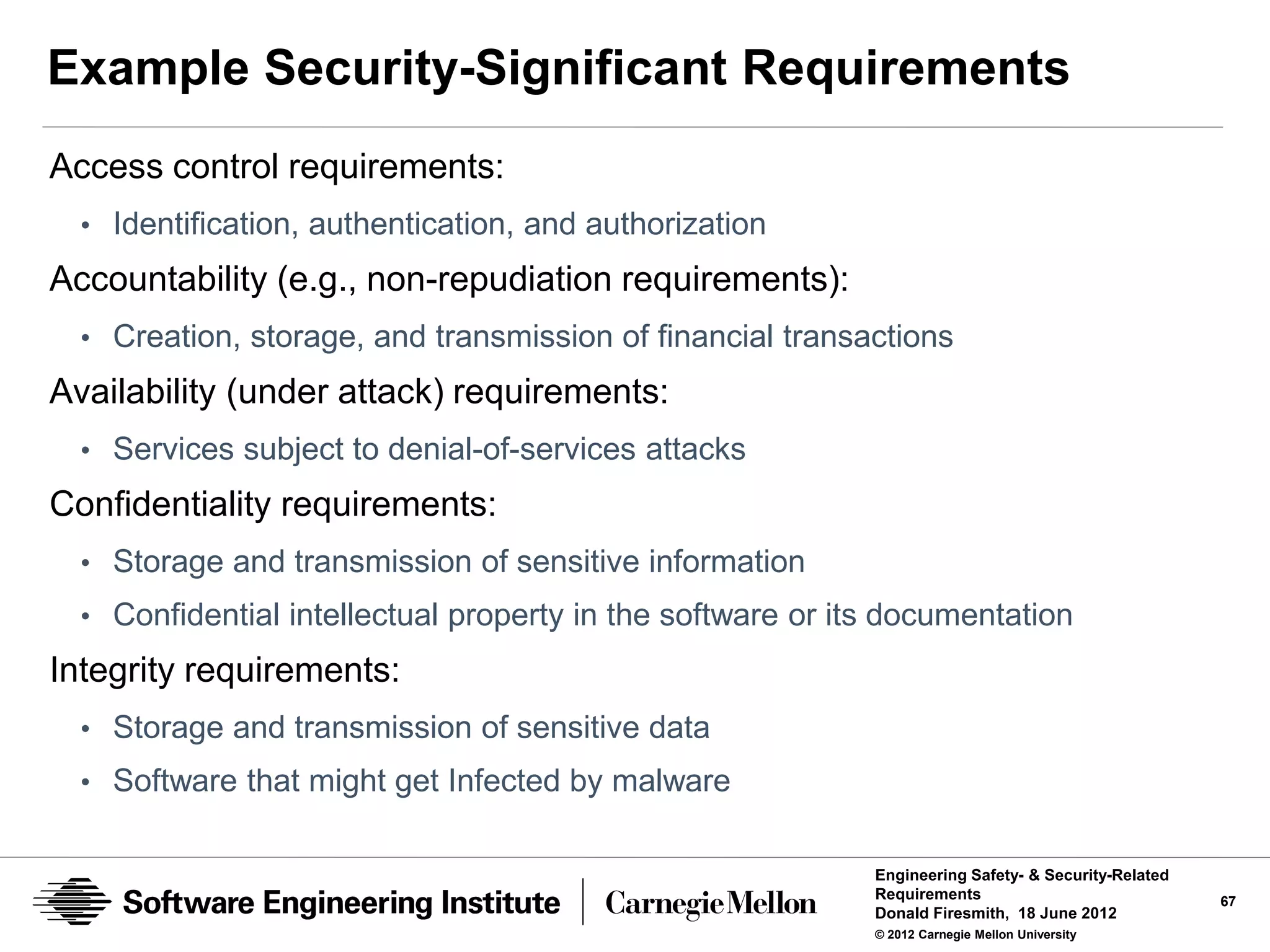
Example Security-Significant Requirements
Access control requirements:
  • Identification, authentication, and authorization
Accountability (e.g., non-repudiation requirements):
  • Creation, storage, and transmission of financial transactions
Availability (under attack) requirements:
  • Services subject to denial-of-services attacks
Confidentiality requirements:
  • Storage and transmission of sensitive information
  • Confidential intellectual property in the software or its documentation
Integrity requirements:
  • Storage and transmission of sensitive data
  • Software that might get Infected by malware


                                                            Engineering Safety- & Security-Related
                                                            Requirements                             67
                                                            Donald Firesmith, 18 June 2012
                                                            © 2012 Carnegie Mellon University
3) Defensibility Function/Subsystem Rqmts – 1
Defensibility function/subsystem requirements are requirements for
functions or subfunctions that exist strictly to improve defensibility (as
opposed to support the primary mission requirements).
  • Safety function/subsystem requirements are requirements for safety
    functions or subsystems.
  • Security function/subsystem requirements are requirements for security
    functions or subsystems.


                                                      Engineering Safety- & Security-Related
                                                      Requirements                             68
                                                      Donald Firesmith, 18 June 2012
                                                      © 2012 Carnegie Mellon University
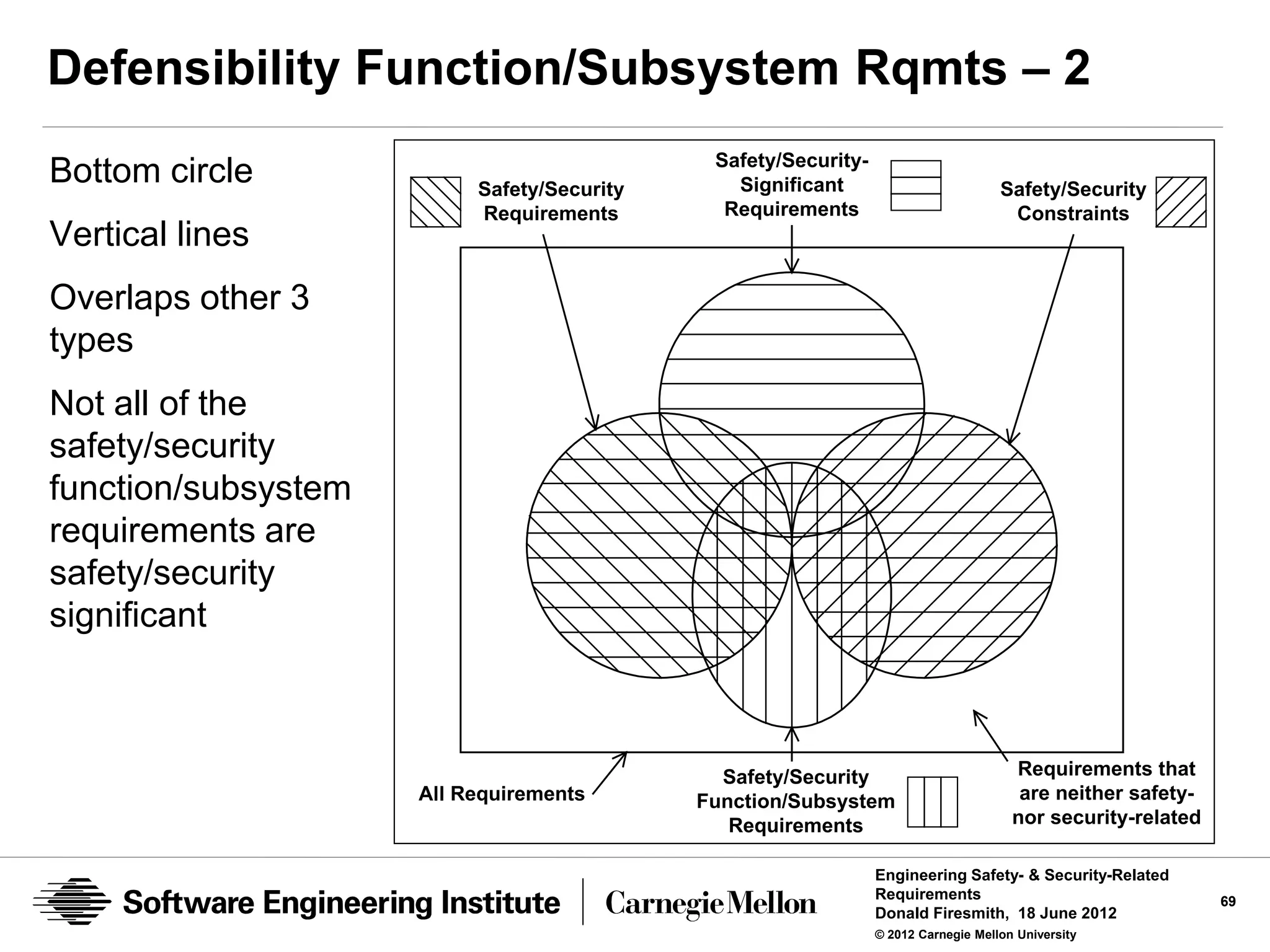
Defensibility Function/Subsystem Rqmts – 2
                                             Safety/Security-
Bottom circle             Safety/Security      Significant                          Safety/Security
                          Requirements        Requirements                           Constraints
Vertical lines
Overlaps other 3
types
Not all of the
safety/security
function/subsystem
requirements are
safety/security
significant


                                              Safety/Security                         Requirements that
                     All Requirements       Function/Subsystem                         are neither safety-
                                               Requirements                           nor security-related

                                                                Engineering Safety- & Security-Related
                                                                Requirements                                 69
                                                                Donald Firesmith, 18 June 2012
                                                                © 2012 Carnegie Mellon University
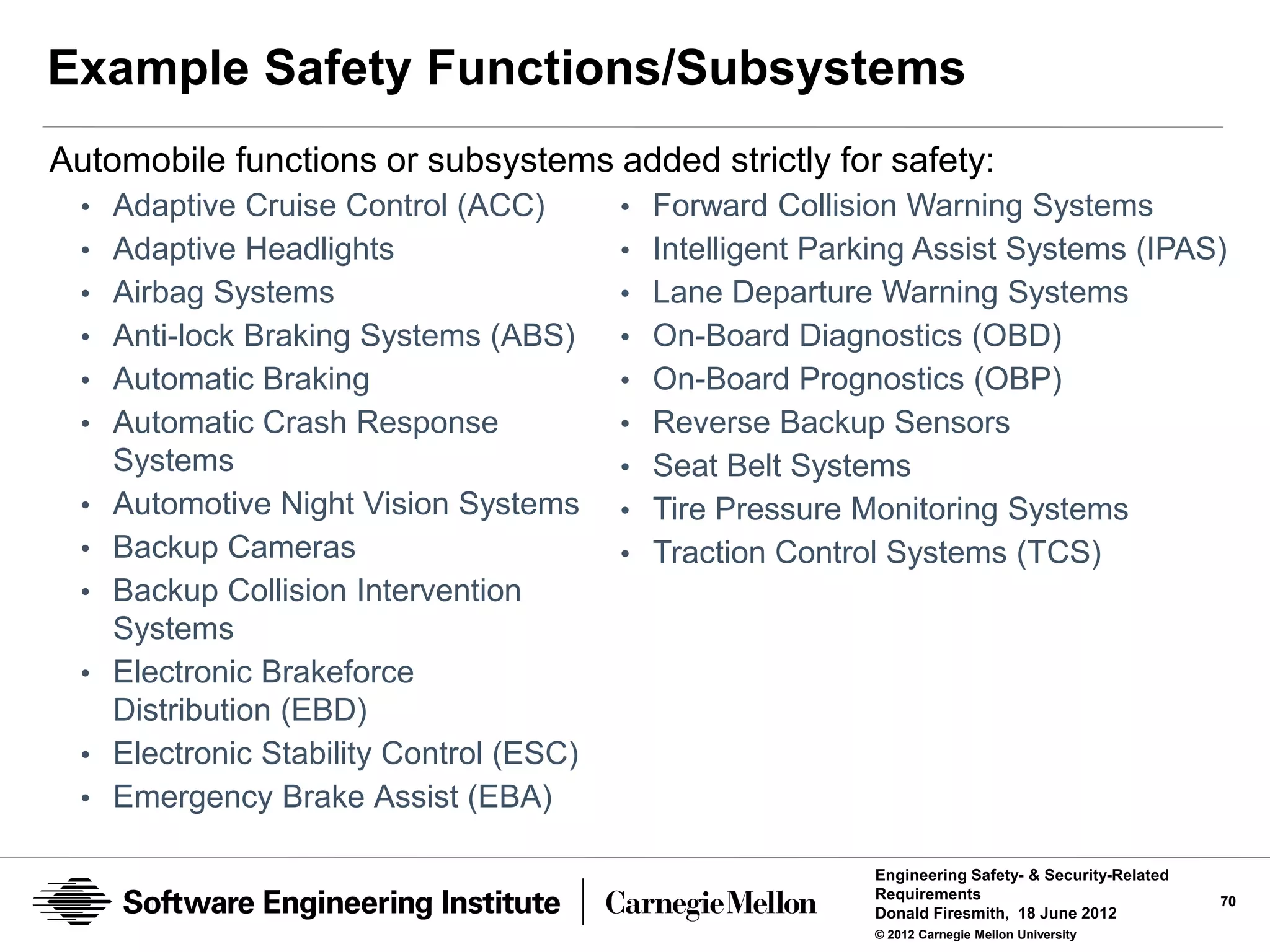
Example Safety Functions/Subsystems
Automobile functions or subsystems added strictly for safety:
 • Adaptive Cruise Control (ACC)          • Forward Collision Warning Systems
 • Adaptive Headlights                    • Intelligent Parking Assist Systems (IPAS)
 • Airbag Systems                         • Lane Departure Warning Systems
 • Anti-lock Braking Systems (ABS)        • On-Board Diagnostics (OBD)
 • Automatic Braking                      • On-Board Prognostics (OBP)
 • Automatic Crash Response               • Reverse Backup Sensors
     Systems                              • Seat Belt Systems
 •   Automotive Night Vision Systems      • Tire Pressure Monitoring Systems
 •   Backup Cameras                       • Traction Control Systems (TCS)
 •   Backup Collision Intervention
     Systems
 •   Electronic Brakeforce
     Distribution (EBD)
 •   Electronic Stability Control (ESC)
 •   Emergency Brake Assist (EBA)

                                                            Engineering Safety- & Security-Related
                                                            Requirements                             70
                                                            Donald Firesmith, 18 June 2012
                                                            © 2012 Carnegie Mellon University
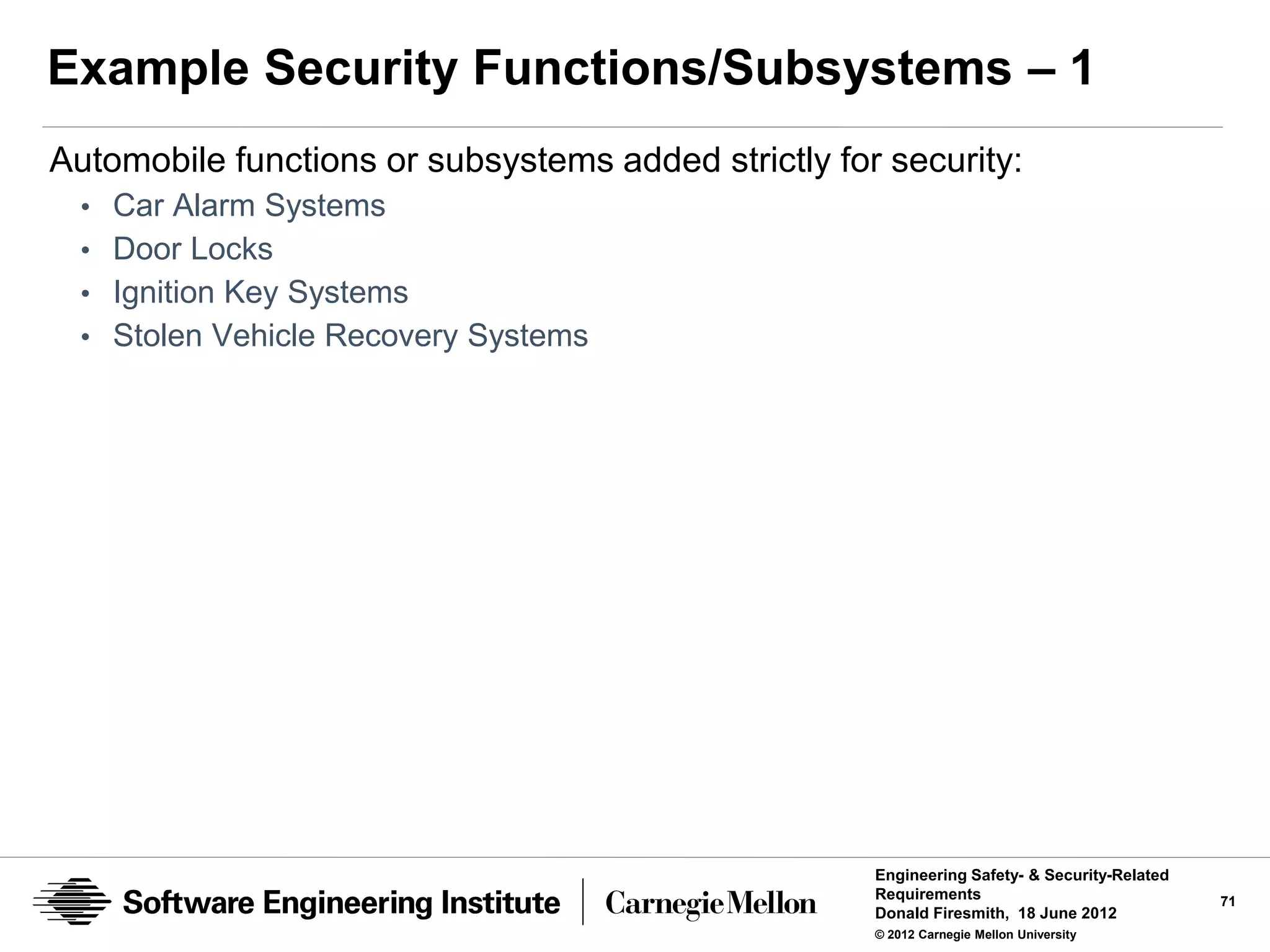
Example Security Functions/Subsystems – 1
Automobile functions or subsystems added strictly for security:
 • Car Alarm Systems
 • Door Locks
 • Ignition Key Systems
 • Stolen Vehicle Recovery Systems


                                                     Engineering Safety- & Security-Related
                                                     Requirements                             71
                                                     Donald Firesmith, 18 June 2012
                                                     © 2012 Carnegie Mellon University
Example Security Functions/Subsystems – 2
Functions or subsystems strictly added for security:
  • Access control
  • Antivirus / antispyware / antispam / antiphishing subsystems
  • Encryption/decryption subsystem

  • Firewalls
  • Intrusion detection subsystem (IDS) / intrusion prevention subsystem (IPS)


All requirements for such functions/subsystems are security-related.
Look in the Common Criteria (ISO/IEC 15408) for many generic reusable
security function requirements.


                                                          Engineering Safety- & Security-Related
                                                          Requirements                             72
                                                          Donald Firesmith, 18 June 2012
                                                          © 2012 Carnegie Mellon University
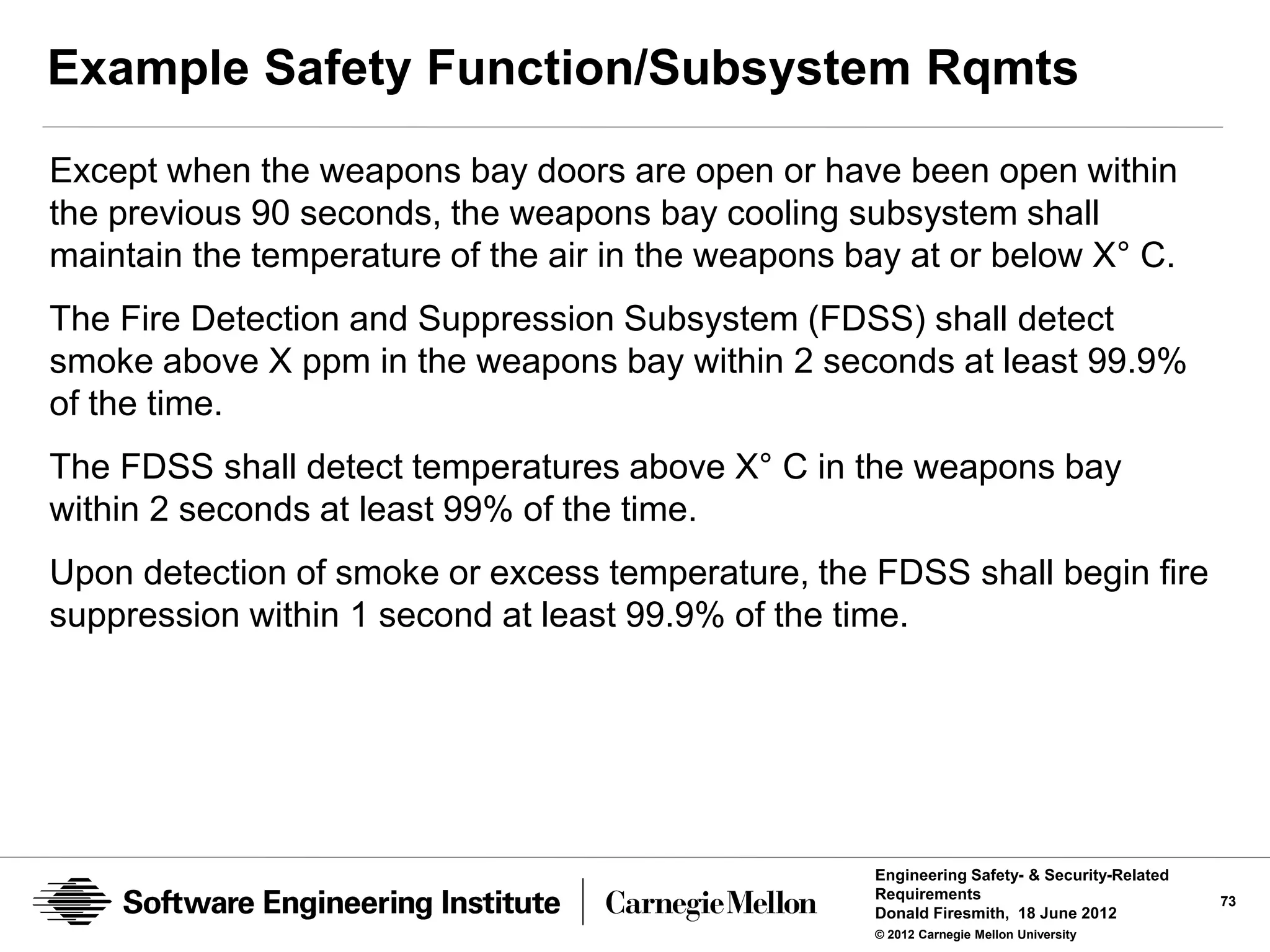
Example Safety Function/Subsystem Rqmts
Except when the weapons bay doors are open or have been open within
the previous 90 seconds, the weapons bay cooling subsystem shall
maintain the temperature of the air in the weapons bay at or below X° C.
The Fire Detection and Suppression Subsystem (FDSS) shall detect
smoke above X ppm in the weapons bay within 2 seconds at least 99.9%
of the time.
The FDSS shall detect temperatures above X° C in the weapons bay
within 2 seconds at least 99% of the time.
Upon detection of smoke or excess temperature, the FDSS shall begin fire
suppression within 1 second at least 99.9% of the time.


                                                    Engineering Safety- & Security-Related
                                                    Requirements                             73
                                                    Donald Firesmith, 18 June 2012
                                                    © 2012 Carnegie Mellon University
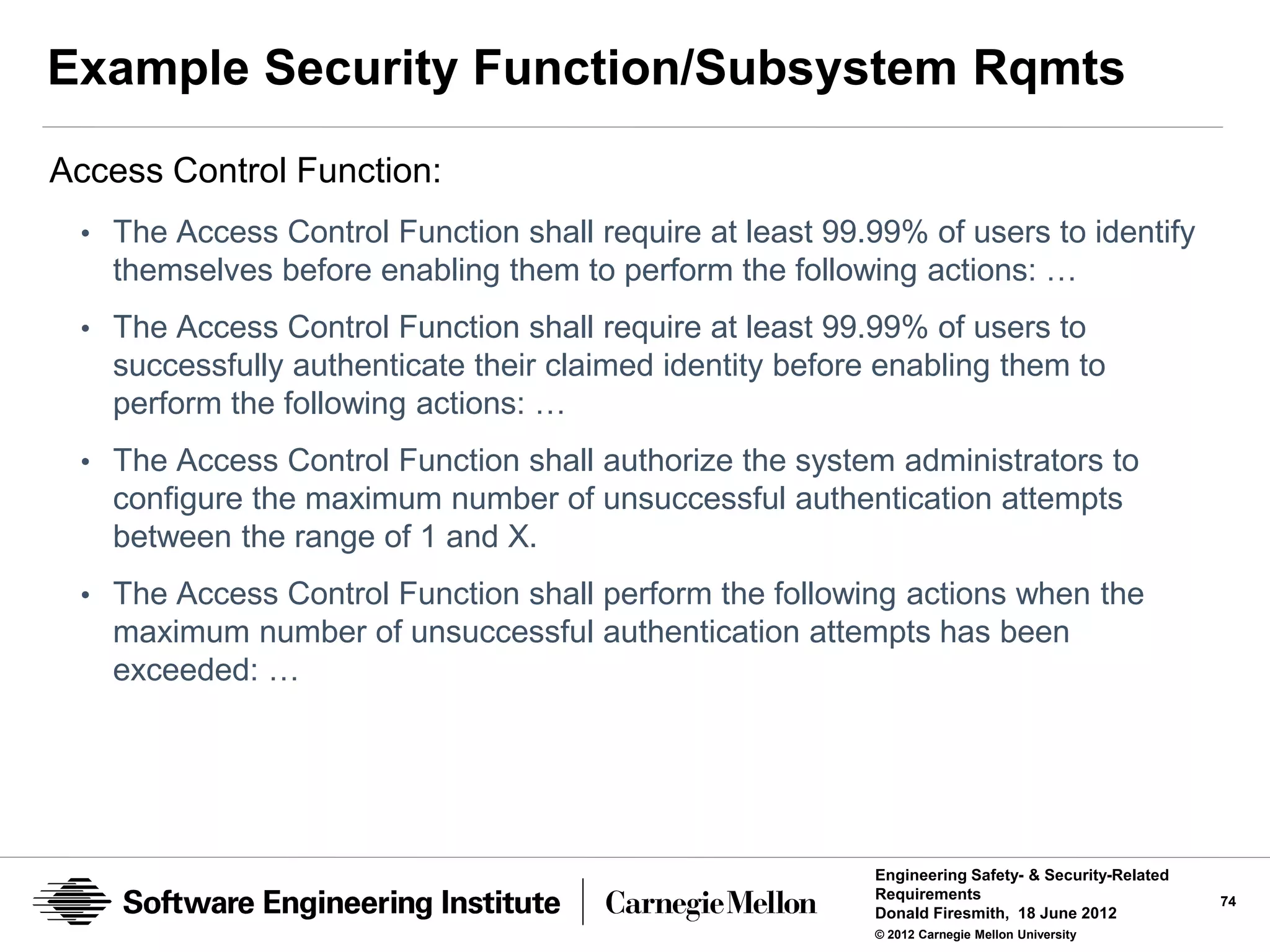
Example Security Function/Subsystem Rqmts
Access Control Function:
 • The Access Control Function shall require at least 99.99% of users to identify
   themselves before enabling them to perform the following actions: …
 • The Access Control Function shall require at least 99.99% of users to
   successfully authenticate their claimed identity before enabling them to
   perform the following actions: …
 • The Access Control Function shall authorize the system administrators to
   configure the maximum number of unsuccessful authentication attempts
   between the range of 1 and X.
 • The Access Control Function shall perform the following actions when the
   maximum number of unsuccessful authentication attempts has been
   exceeded: …


                                                          Engineering Safety- & Security-Related
                                                          Requirements                             74
                                                          Donald Firesmith, 18 June 2012
                                                          © 2012 Carnegie Mellon University
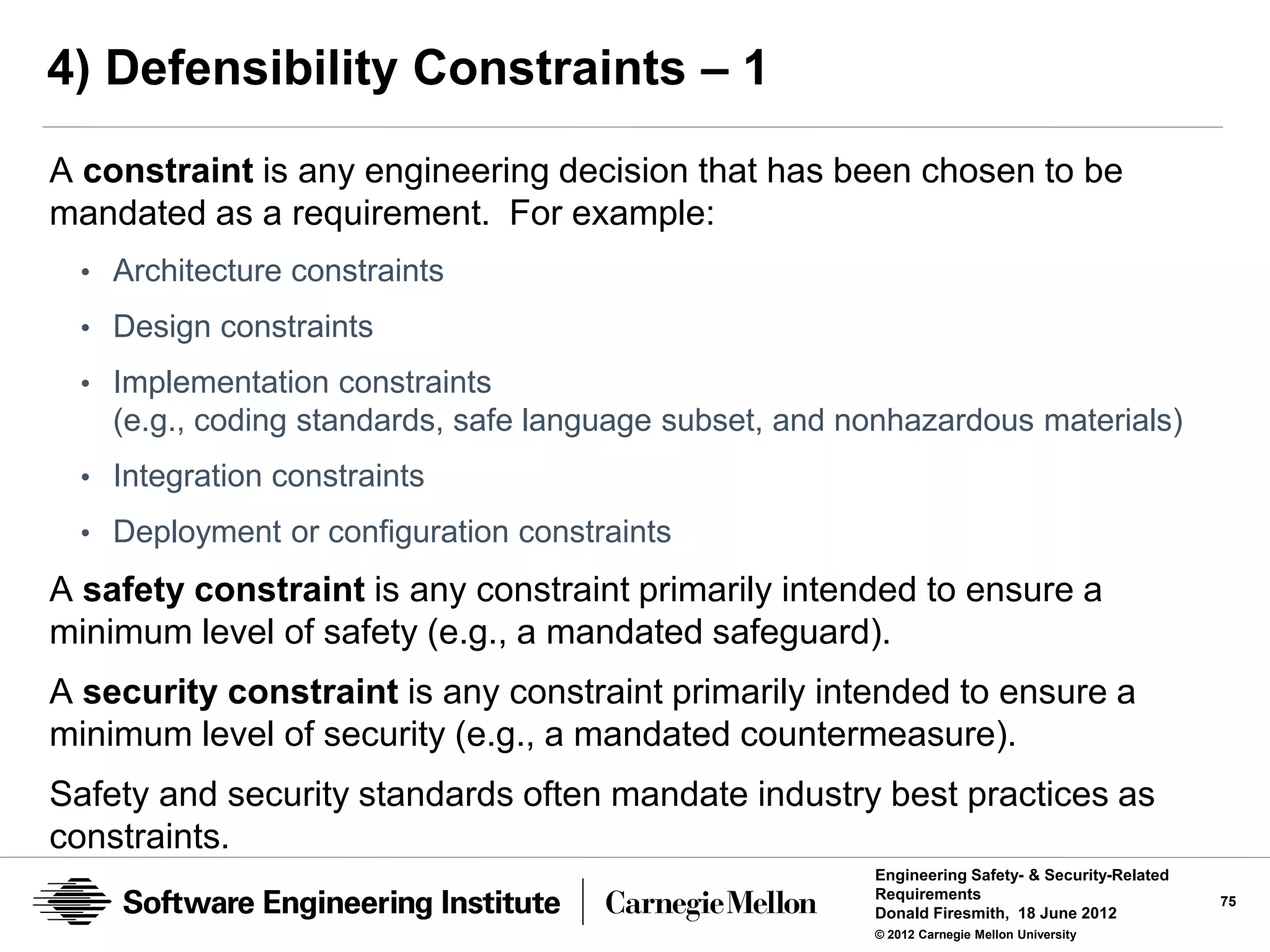
4) Defensibility Constraints – 1
A constraint is any engineering decision that has been chosen to be
mandated as a requirement. For example:
 • Architecture constraints
 • Design constraints
 • Implementation constraints
    (e.g., coding standards, safe language subset, and nonhazardous materials)
 • Integration constraints
 • Deployment or configuration constraints

A safety constraint is any constraint primarily intended to ensure a
minimum level of safety (e.g., a mandated safeguard).
A security constraint is any constraint primarily intended to ensure a
minimum level of security (e.g., a mandated countermeasure).
Safety and security standards often mandate industry best practices as
constraints.
                                                        Engineering Safety- & Security-Related
                                                        Requirements                             75
                                                        Donald Firesmith, 18 June 2012
                                                        © 2012 Carnegie Mellon University
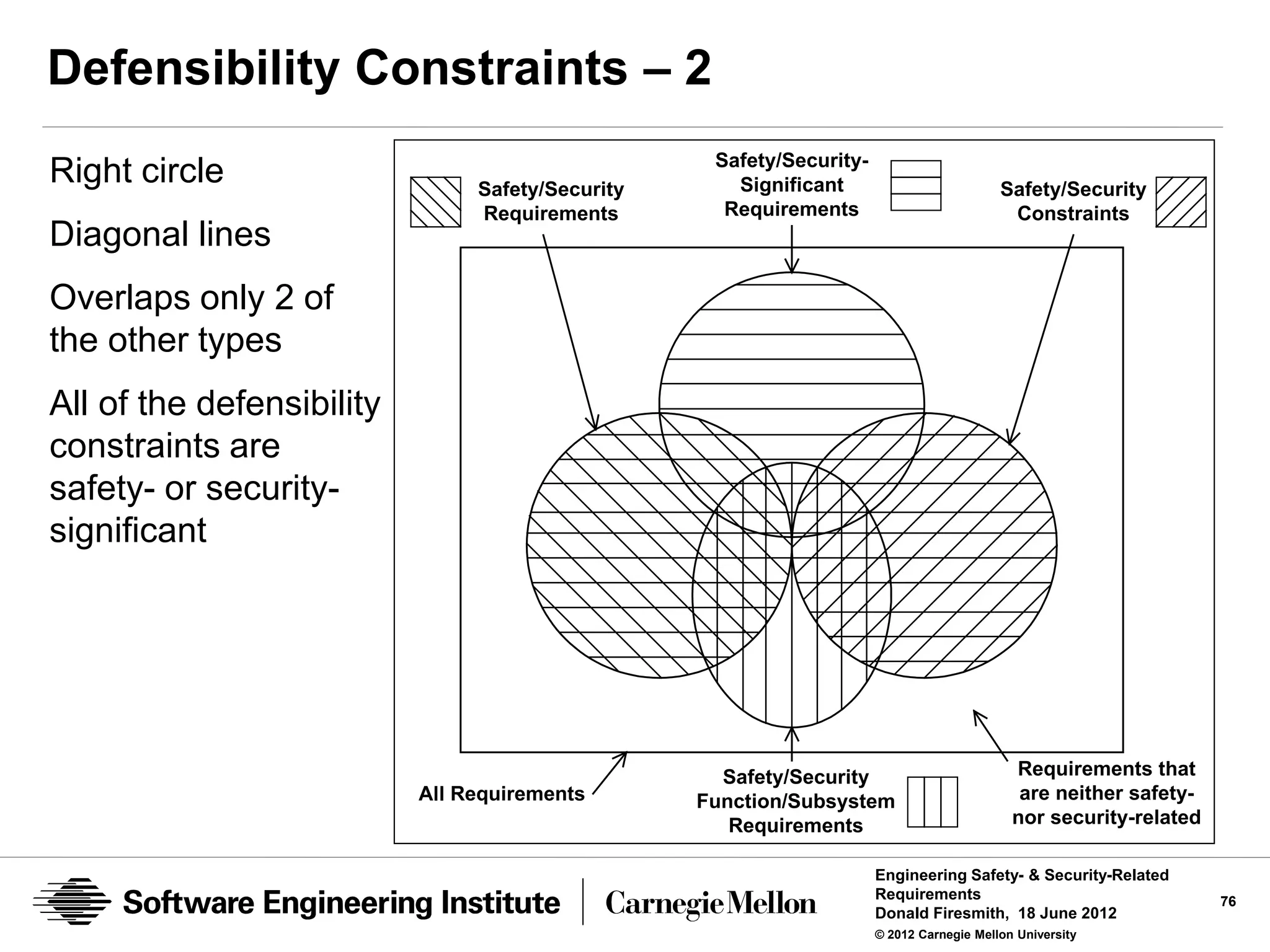
Defensibility Constraints – 2
                                                   Safety/Security-
Right circle                    Safety/Security      Significant                          Safety/Security
                                Requirements        Requirements                           Constraints
Diagonal lines
Overlaps only 2 of
the other types
All of the defensibility
constraints are
safety- or security-
significant


                                                    Safety/Security                         Requirements that
                           All Requirements       Function/Subsystem                         are neither safety-
                                                     Requirements                           nor security-related

                                                                      Engineering Safety- & Security-Related
                                                                      Requirements                                 76
                                                                      Donald Firesmith, 18 June 2012
                                                                      © 2012 Carnegie Mellon University
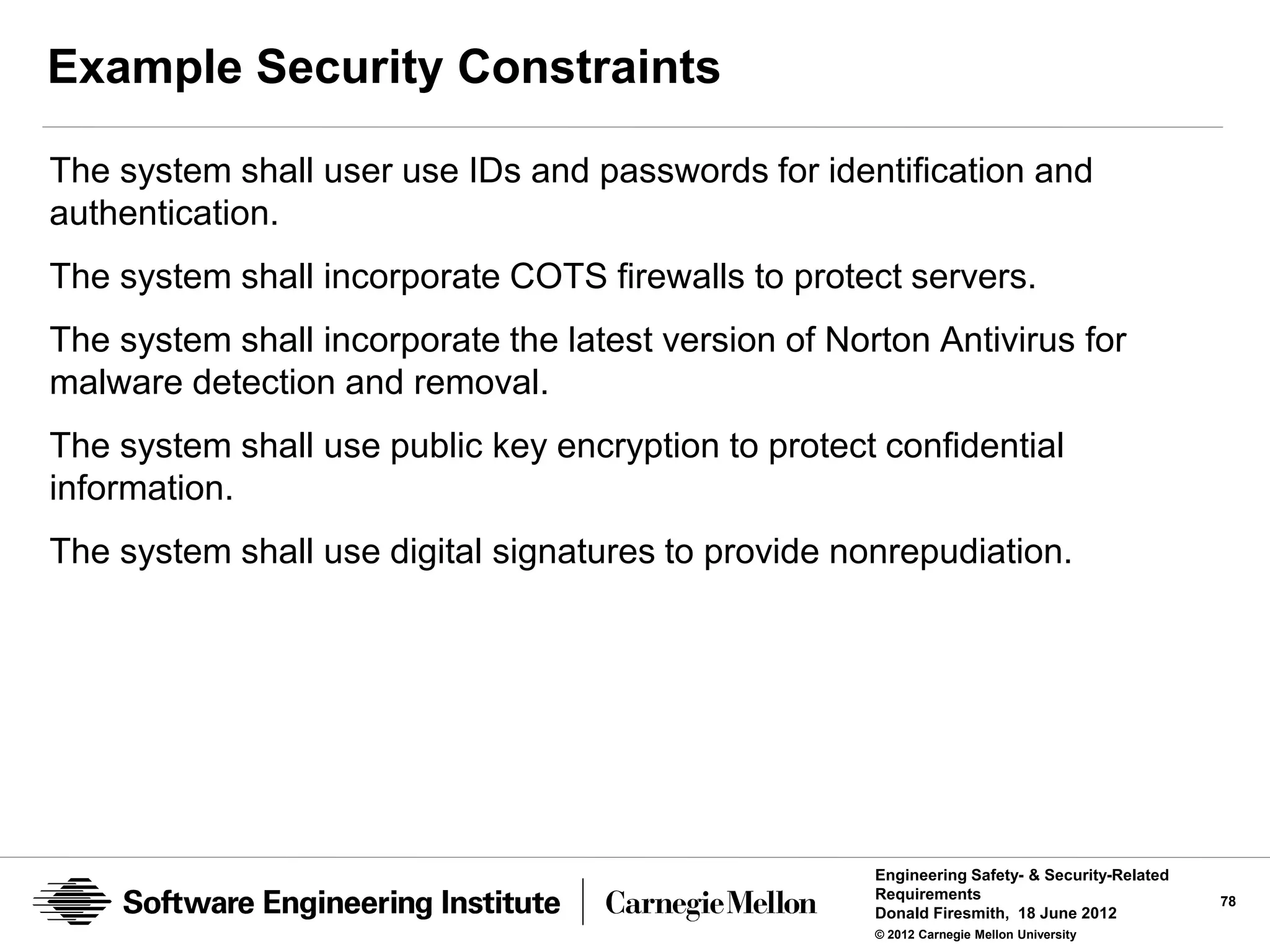
Example Safety Constraints

The system shall use hardware interlocks to prevent users from physically
coming into contact with moving parts.
The system shall not have a single point of failure that can cause an
accident unless the associated risk is acceptable to authoritative
stakeholders.
The system shall use a safe subset of C++.
The system shall not contain any of the hazardous materials in Table X in
concentrations in excess of those listed in the table:
  • Biologically Hazardous Materials (e.g., infectious agents or toxins)
  • Chemically Hazardous Materials (e.g., carcinogens, corrosives, heptatoxins,
    irritants, mutagens, nephratoxins, neurotoxins, poisons, or teratogens)
  • Physically Hazardous Materials (e.g., combustible chemicals, compressed
    gases, explosives, flammable chemicals, oxidizers, or pyrophorics)


                                                           Engineering Safety- & Security-Related
                                                           Requirements                             77
                                                           Donald Firesmith, 18 June 2012
                                                           © 2012 Carnegie Mellon University
Example Security Constraints

The system shall user use IDs and passwords for identification and
authentication.
The system shall incorporate COTS firewalls to protect servers.
The system shall incorporate the latest version of Norton Antivirus for
malware detection and removal.
The system shall use public key encryption to protect confidential
information.
The system shall use digital signatures to provide nonrepudiation.


                                                      Engineering Safety- & Security-Related
                                                      Requirements                             78
                                                      Donald Firesmith, 18 June 2012
                                                      © 2012 Carnegie Mellon University
Where We Are
Related Disciplines
Challenges
Common Example
Free, Open-Source Tool
Requirements Engineering Overview
Safety and Security Engineering Overview
Safety- and Security-related Requirements

Collaborative Defensibility Engineering Method ◄
Conclusion


                                            Engineering Safety- & Security-Related
                                            Requirements                             79
                                            Donald Firesmith, 18 June 2012
                                            © 2012 Carnegie Mellon University
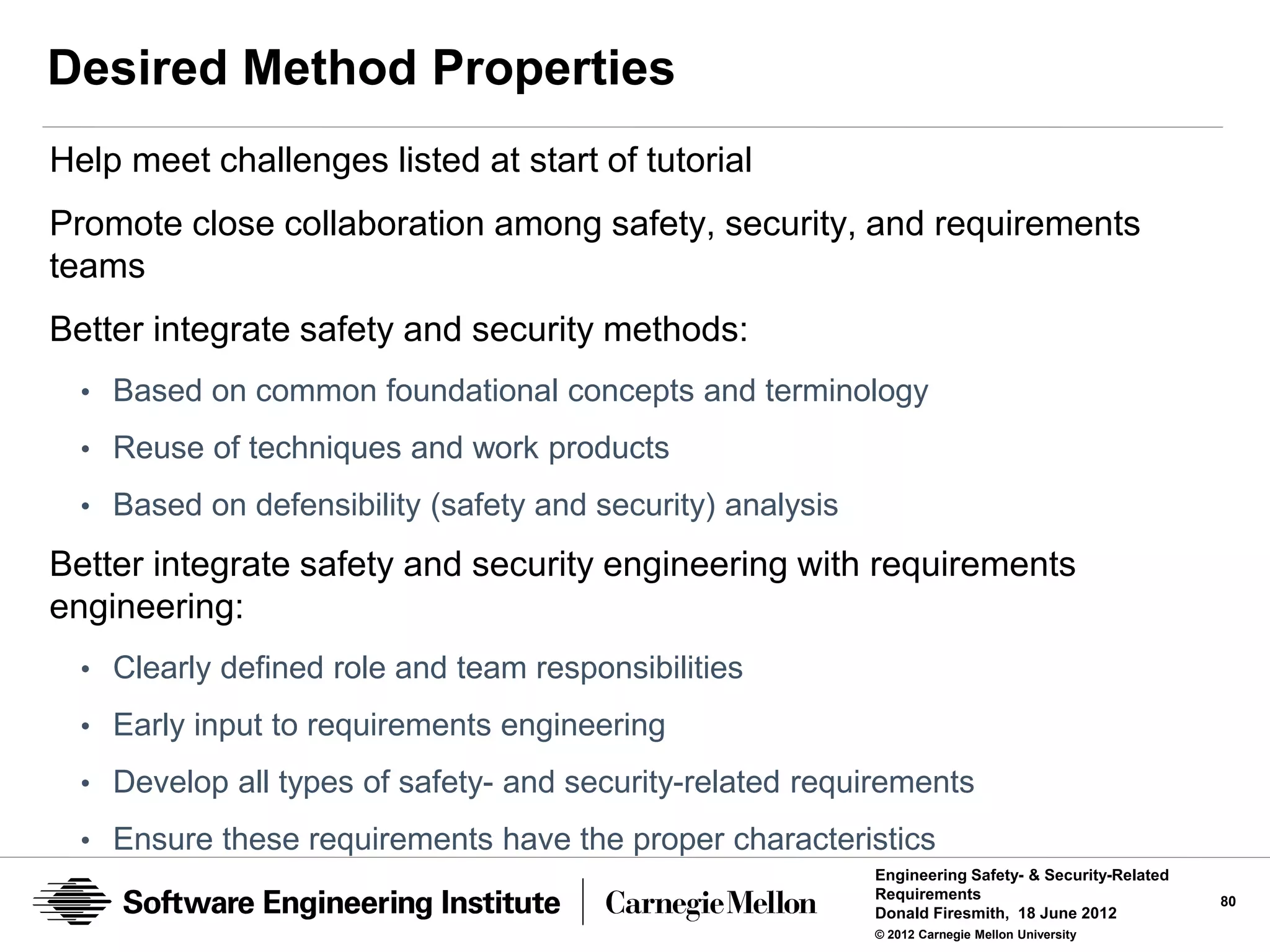
Desired Method Properties
Help meet challenges listed at start of tutorial
Promote close collaboration among safety, security, and requirements
teams
Better integrate safety and security methods:
  • Based on common foundational concepts and terminology
  • Reuse of techniques and work products
  • Based on defensibility (safety and security) analysis

Better integrate safety and security engineering with requirements
engineering:
  • Clearly defined role and team responsibilities
  • Early input to requirements engineering
  • Develop all types of safety- and security-related requirements

  • Ensure these requirements have the proper characteristics
                                                            Engineering Safety- & Security-Related
                                                            Requirements                             80
                                                            Donald Firesmith, 18 June 2012
                                                            © 2012 Carnegie Mellon University
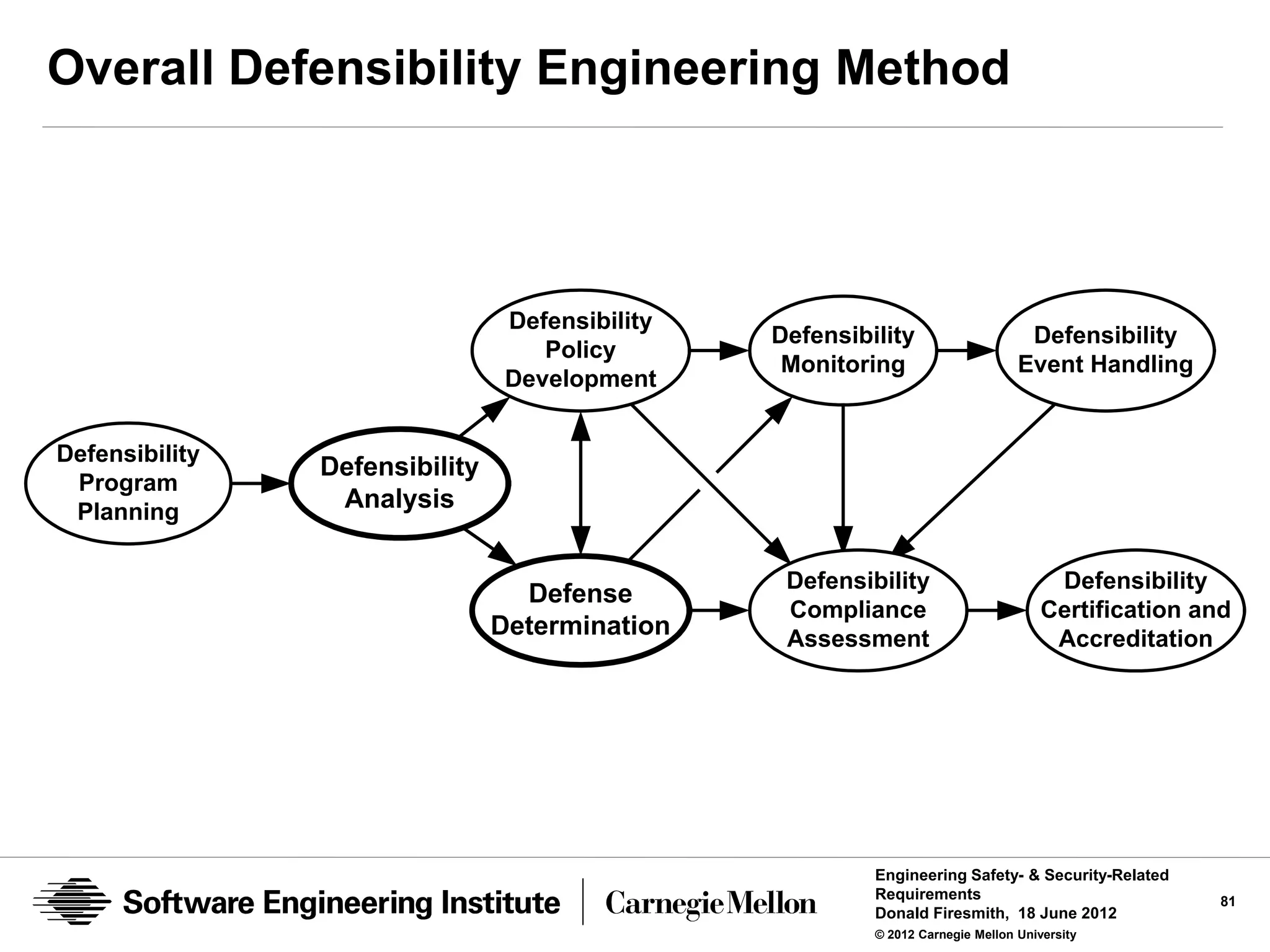
Overall Defensibility Engineering Method


                                 Defensibility
                                                 Defensibility                    Defensibility
                                    Policy
                                                  Monitoring                     Event Handling
                                 Development


Defensibility
                Defensibility
 Program
 Planning
                 Analysis


                                                  Defensibility                       Defensibility
                                  Defense
                                                  Compliance                         Certification and
                                Determination     Assessment                          Accreditation


                                                          Engineering Safety- & Security-Related
                                                          Requirements                               81
                                                          Donald Firesmith, 18 June 2012
                                                          © 2012 Carnegie Mellon University
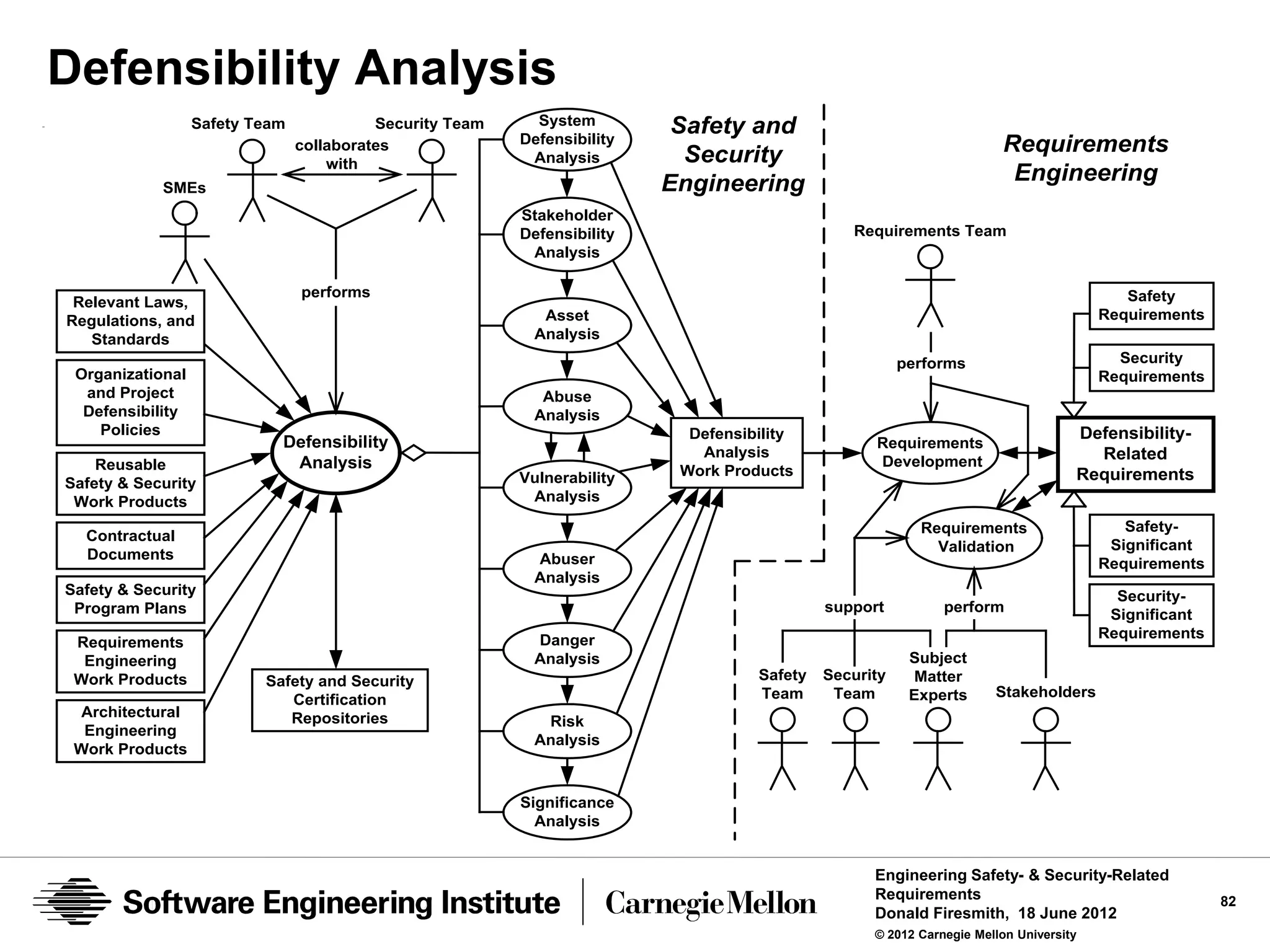
Defensibility Analysis
                                                            System
                  Safety Team             Security Team
                                                          Defensibility
                                                                           Safety and
                                collaborates
                                                           Analysis         Security                                   Requirements
                                    with
                                                                          Engineering                                   Engineering
            SMEs
                                                          Stakeholder
                                                          Defensibility                         Requirements Team
                                                           Analysis

                                performs                                                                                                  Safety
 Relevant Laws,
Regulations, and                                             Asset                                                                     Requirements
   Standards                                                Analysis
                                                                                                        performs                         Security
 Organizational                                                                                                                        Requirements
  and Project                                                Abuse
  Defensibility                                             Analysis
    Policies                                                                Defensibility                                          Defensibility-
                            Defensibility                                                          Requirements
                                                                             Analysis                                                Related
    Reusable                 Analysis                                                              Development
                                                          Vulnerability    Work Products                                           Requirements
Safety & Security
 Work Products                                             Analysis

                                                                                                          Requirements                    Safety-
  Contractual
                                                                                                            Validation                  Significant
  Documents                                                 Abuser                                                                     Requirements
                                                            Analysis
Safety & Security                                                                                                                        Security-
 Program Plans                                                                               support          perform                   Significant
                                                            Danger                                                                     Requirements
 Requirements
  Engineering                                               Analysis                                     Subject
 Work Products            Safety and Security                                       Safety   Security     Matter
                                                                                    Team      Team       Experts      Stakeholders
                             Certification
  Architectural              Repositories                    Risk
  Engineering
                                                            Analysis
 Work Products


                                                          Significance
                                                            Analysis


                                                                                                   Engineering Safety- & Security-Related
                                                                                                   Requirements                                       82
                                                                                                   Donald Firesmith, 18 June 2012
                                                                                                   © 2012 Carnegie Mellon University
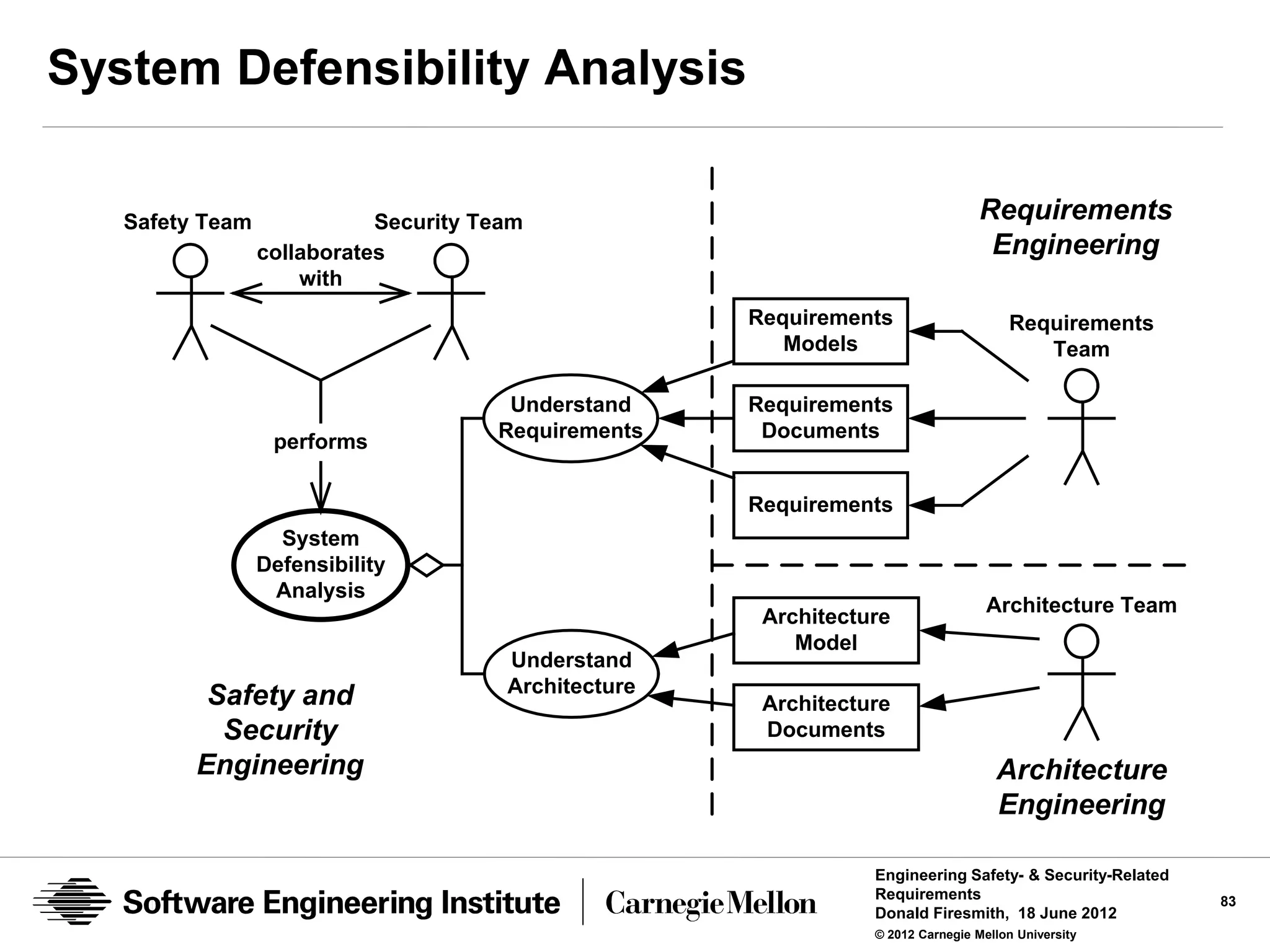
System Defensibility Analysis

   Safety Team              Security Team                                         Requirements
                 collaborates                                                      Engineering
                     with
                                                      Requirements                    Requirements
                                                         Models                          Team

                                       Understand     Requirements
                                      Requirements     Documents
                  performs

                                                      Requirements
                   System
                 Defensibility
                  Analysis
                                                                                   Architecture Team
                                                       Architecture
                                                          Model
                                       Understand
                                       Architecture
          Safety and                                   Architecture
           Security                                    Documents
         Engineering                                                                Architecture
                                                                                    Engineering

                                                                 Engineering Safety- & Security-Related
                                                                 Requirements                             83
                                                                 Donald Firesmith, 18 June 2012
                                                                 © 2012 Carnegie Mellon University
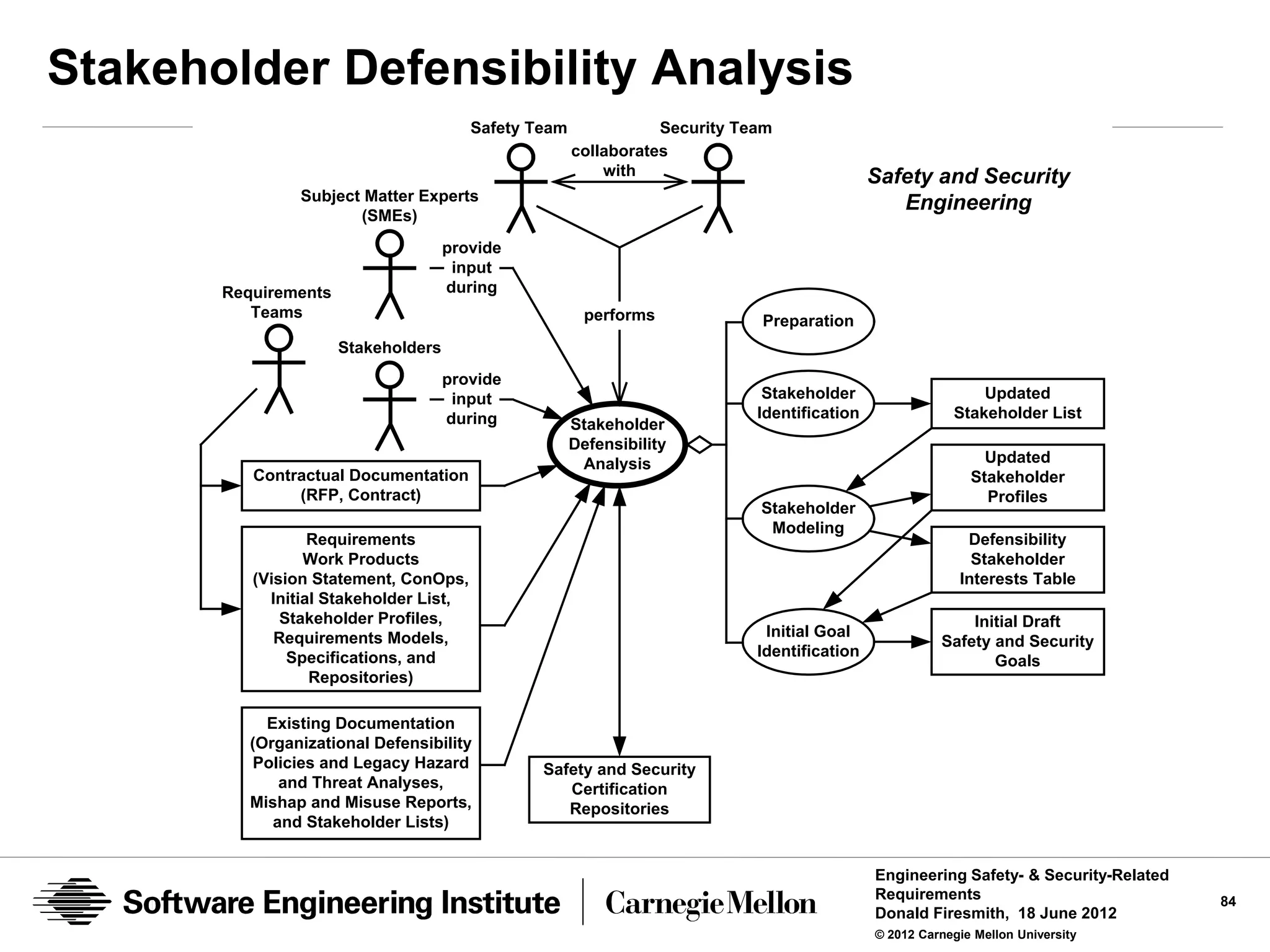
Stakeholder Defensibility Analysis
                                        Safety Team              Security Team
                                                      collaborates
                                                          with                               Safety and Security
                Subject Matter Experts
                                                                                                Engineering
                       (SMEs)
                                     provide
                                      input
       Requirements                  during
          Teams                                         performs            Preparation
                      Stakeholders
                                     provide
                                      input                                  Stakeholder                     Updated
                                     during                                 Identification               Stakeholder List
                                                      Stakeholder
                                                      Defensibility
                                                       Analysis                                               Updated
          Contractual Documentation                                                                         Stakeholder
               (RFP, Contract)                                                                                Profiles
                                                                            Stakeholder
                                                                             Modeling
                  Requirements                                                                             Defensibility
                 Work Products                                                                              Stakeholder
          (Vision Statement, ConOps,                                                                      Interests Table
            Initial Stakeholder List,
              Stakeholder Profiles,                                                                        Initial Draft
             Requirements Models,                                            Initial Goal
                                                                                                       Safety and Security
               Specifications, and                                          Identification
                                                                                                              Goals
                  Repositories)

            Existing Documentation
          (Organizational Defensibility
          Policies and Legacy Hazard            Safety and Security
              and Threat Analyses,                 Certification
          Mishap and Misuse Reports,               Repositories
             and Stakeholder Lists)


                                                                                             Engineering Safety- & Security-Related
                                                                                             Requirements                             84
                                                                                             Donald Firesmith, 18 June 2012
                                                                                             © 2012 Carnegie Mellon University
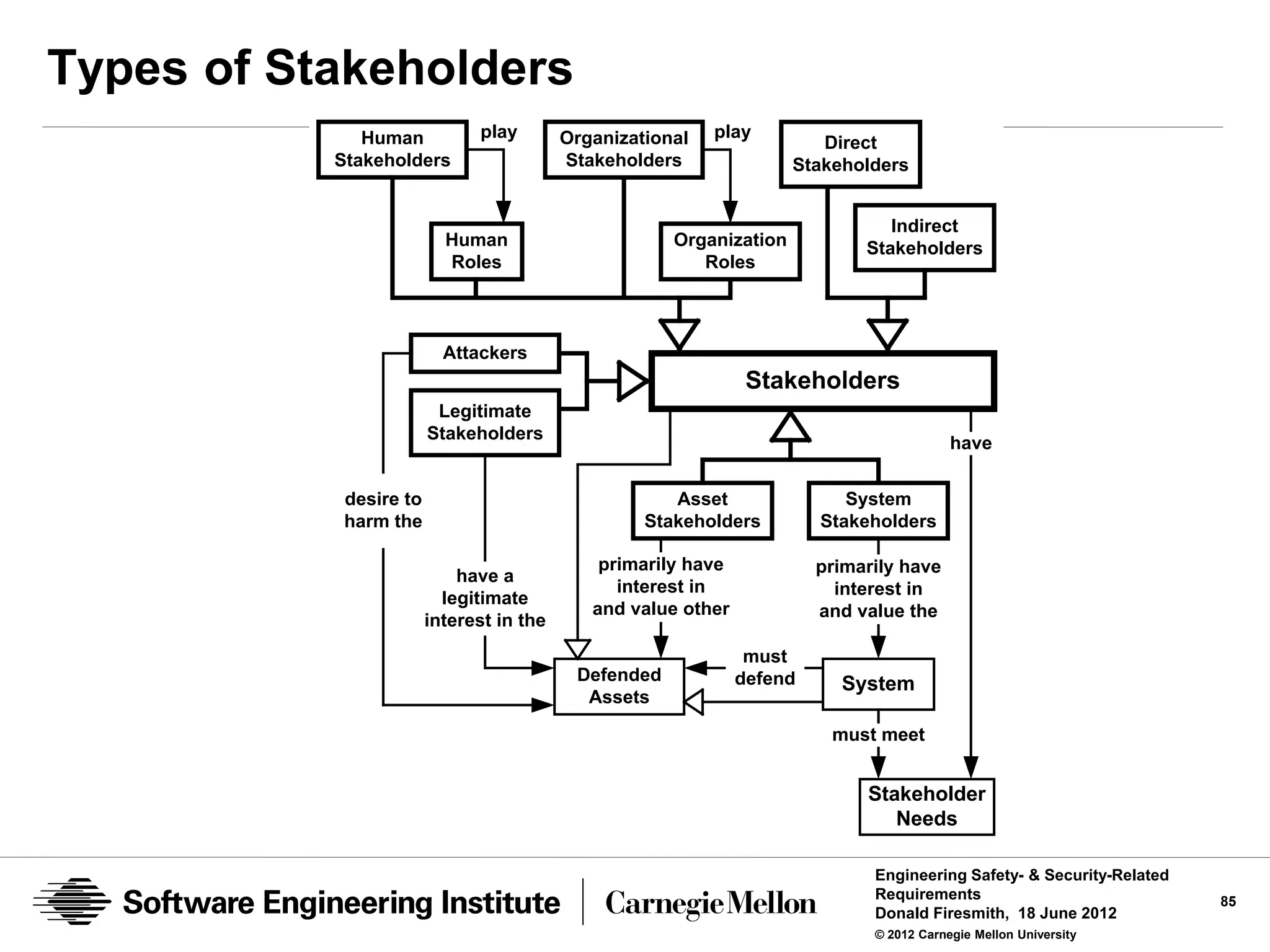
Types of Stakeholders
              Human           play        Organizational   play
                                                                        Direct
           Stakeholders                   Stakeholders               Stakeholders


                                                                                Indirect
                          Human                       Organization           Stakeholders
                          Roles                          Roles


                          Attackers
                                                                Stakeholders
                         Legitimate
                        Stakeholders
                                                                                          have


            desire to                                 Asset                System
            harm the                               Stakeholders         Stakeholders

                                              primarily have            primarily have
                            have a
                                                interest in               interest in
                          legitimate
                                             and value other            and value the
                        interest in the
                                                                must
                                           Defended            defend     System
                                            Assets

                                                                         must meet


                                                                             Stakeholder
                                                                                Needs

                                                                              Engineering Safety- & Security-Related
                                                                              Requirements                             85
                                                                              Donald Firesmith, 18 June 2012
                                                                              © 2012 Carnegie Mellon University
ESSR Tool – Stakeholders Entry/Edit Form


                                 Engineering Safety- & Security-Related
                                 Requirements                             86
                                 Donald Firesmith, 18 June 2012
                                 © 2012 Carnegie Mellon University
ESSR Tool – Stakeholders Report


                                  Engineering Safety- & Security-Related
                                  Requirements                             87
                                  Donald Firesmith, 18 June 2012
                                  © 2012 Carnegie Mellon University
Example Stakeholder Safety/Security Analysis
                      Safety/Security Analysis of PMI Corporate Management
     General Responsibilities:
     – Ensure the short- and long-term profitability of PMI.
     – Ensure the marketability of PMI automated people movers (APM).
     – Ensure customer and user satisfaction with PMI APMs.
     – Ensure the quality of PMI APMs (e.g., capacity, maintainability, reliability, usability).

     Safety/Security Responsibilities:
     – Provide leadership in safety and security matters.
     – Ensure that PMI APM vehicles will operate safely.
     – Ensure that PMI APM systems will be secure against attack (e.g., cybercrime and theft).
     – Ensure that PMI proprietary information will be secure from corporate espionage.
     – Ensure that effective safety and security policies will exist and be enforced.
     – Provide oversight of PMI projects with regard to safety and security.

     Context:
     – PMI is subject to very stiff competition from both domestic and foreign competitors.
     – PMI’s ability to create APMs that enable large numbers of small vehicles to safely share guideways with minimal
       headway is a cutting-edge technology that provides a competitive edge over some of PMI’s rivals.
     – Corporate management is primarily trained in business management and does not understand the technology,
       especially the importance of software to achieving technical requirements.
     – PMI’s previous smaller and simpler APMs have not suffered serious accidents or security attacks.
     – ZATS is PMI’s current flagship APM.

     Actual or Potential Process Model Defects:
     – Has underestimated the maturity and risk of the new technology.
     – Has assumed that ZATS development productivity will be the same or better than previous projects.
     – Believes that the large number of failures found and fixed during initial prototyping indicate that the major
       problems are all solved and are not indicative of future failures once full scale development starts and ZATS
       has been placed into operation.

     Actual or Potential Dangerous Decisions and Actions:
     – Has pushed ZATS project management to lower their estimates of the cost of ZATS development and the time
       required for ZATS development in order to win the contract.
     – Is counting on the project future income from ZATS, even though ZATS is likely to suffer from both cost and
       schedule overruns.
     – May let safety and security policies and requirements be violated in order to meet project budget, schedule,
       and functionality goals.
     – May provide inadequate oversight of the ZATS project with regard to safety and security.

                                                                                                   Engineering Safety- & Security-Related
                                                                                                   Requirements                             88
                                                                                                   Donald Firesmith, 18 June 2012
                                                                                                   © 2012 Carnegie Mellon University
Asset Analysis
  Subject
   Matter                Safety Team              Security Team
  Experts                              collaborates
                                                                                                 Requirements Engineering
                                           with

                                                                                                                                             Asset-Harm
                                                                                                                                             Prevention
                                                                              Standard / Reusable    Requirements Team
               provide                                                                                                                      Requirements
                                                                                  Asset-Harm
Stakeholders    input                                                            Requirements                                                Asset-Harm
               during
                                        performs                                                                                              Detection
                                                             Preparation                                                                    Requirements
               provide
                input                                                          Asset Value                                                   Asset-Harm
               during                                                                                        performs                         Reaction
                                                                              Categorization
                                                                Asset
                                                                                                                                            Requirements
  ZATS Contractual                       Asset               Identification
   Documentation                        Analysis                              Harm Severity
                                                                              Categorization
 ZATS Requirements                                                 Asset                                Requirements                     Asset-Harm
   Work Products                                                  Modeling        Asset
                                                                                                        Development                     Requirements
                                                                               Descriptions
 ZATS Architectural
                                                                                                                                             Asset-Harm
  Representations                                             Asset Goal
                                                                               Asset-Harm                       Requirements                   Safety
                                                             Identification
                                                                                 Goals                            Validation                Requirements
  Project-External
  Documentation
                                                               Asset                                                                         Asset-Harm
 ZATS Defensibility                                         Work Product                                            perform                   Security
  Work Products                                                 V&V                               support                                   Requirements

  Generic Reusable
                                                            Requirements                Safety    Security
   Documentation
                                 Safety and Security        Team Support                Team       Team        SMEs         Stakeholders
                                    Certification
                                    Repositories

                      Safety and Security Engineering

                                                                                                        Engineering Safety- & Security-Related
                                                                                                        Requirements                                       89
                                                                                                        Donald Firesmith, 18 June 2012
                                                                                                        © 2012 Carnegie Mellon University
Types of Defended Assets
        Ownerless
         Objects                                                                        value
                                                         Unauthorized
     Privately Owned                                        Harm                                              Stakeholders
                                        Intangible
         Objects
                                         Objects
                                                         can happen to                                           have an
     Publically Owned                     Physical
          Objects                                                                                             interest in the
                                          Objects
                                                                                           must defend
    Inanimate
     Objects
                                                             Defended                                             System
    Living
                             Objects
                                                              Assets
    Objects

                                                                                                           Atmosphere
                                              play
                Roles                                                 Things
                                                                                                            Biosphere

                                                                                                        Electromagnetic
                         Roles Played          play                                                        Spectrum
                                                         People                Environment
                          By People
                                                                                                          Hydrosphere

                        Roles Played By        play                                                        Lithosphere
                                                      Organizations             Services
                         Organizations
                                                                                                           Outer Space
                                                        Prime Contractor
                Customer           Developer
                                                         Subcontractors
                Maintainer         Operator
                                                        Supplier / Vendor
                  Owner           Regulator

                 Sustainer             User

                                                                                                Engineering Safety- & Security-Related
                                                                                                Requirements                             90
                                                                                                Donald Firesmith, 18 June 2012
                                                                                                © 2012 Carnegie Mellon University
Representative ZATS Assets
People:
  •    Passengers - people who are riding ZATS taxis
Organizations:
 • Metropolitan Zoo Authority (MZA) - the organization that operates the
      Metropolitan Zoo and acquires ZATS
Property:
 • ZATS line replaceable units (LRUs) - ZATS architectural components (data,
      hardware, software, subsystem) that can be repaired or replaced by the
      maintainer after ZATS has been placed in operation
Environment:
  •    Atmosphere - the layer of gas surrounding the earth that is retained by gravity
       and subject to both air and noise pollution
Service:
 • Taxi service - transportation by ZATS taxis of passengers and their personal
      property around the zoo

                                                             Engineering Safety- & Security-Related
                                                             Requirements                             91
                                                             Donald Firesmith, 18 June 2012
                                                             © 2012 Carnegie Mellon University
ESSR Tool – Defended Assets Entry/Edit Form


                                Engineering Safety- & Security-Related
                                Requirements                             92
                                Donald Firesmith, 18 June 2012
                                © 2012 Carnegie Mellon University
ESSR Tool – Defended Assets Report


                               Engineering Safety- & Security-Related
                               Requirements                             93
                               Donald Firesmith, 18 June 2012
                               © 2012 Carnegie Mellon University
Unintentional
                   Safety                (Accidental)
Types of Harm                                Harm
                                                                   Unauthorized            Authorized              e.g., caused to
                                                                                                                 enemy forces by
                                                                      Harm                   Harm
                                          Intentional                                                           weapons systems
                Security and
                                          (Malicious)
                Survivability
                                             Harm
                                                                      can
                                                                                                       Direct Harm
                                                                   happen to
                                             Defended Assets                        Harm
                                                                                                      Indirect Harm


                    Harm to                Harm to             Harm to         Harm to the                Harm to a
                    People               Organizations         Objects         Environment                 Service


                              Being              Bankruptcy          Corruption              Contami-               Accidental Loss
                            Kidnapped                                                         nation                  of Service
                                                 Legal Conse-            Damage
                            Corruption             quences                                    Damage                  Corruption
                            (bribery or                              Destruction
                             extortion)            Loss of                                  Destruction               Denial of
                                                 Market Share        Lost Value                                     Service (DOS)
                              Death                                                         Loss of Use
                                                   Loss of                                                           Loss of Trust
                                                                         Theft or
                             Disability           Reputation                                 Pollution
                                                                          Piracy
                                                                                                                    Repudiation of
                             Financial             Loss of           Unauthorized             Wildlife               Transaction
                             Hardship            Trained Staff         Access                  Death,
                                                                                             Injury, or              Unauthorized
                                                    Lost                                       Illness
                              Illness                                Unauthorized                                    Usage (Theft)
                                                 Opportunity
                                                                      Disclosure
                                                   Costs
                                Injury
                                                 Lost Profits
                              Loss of
                            Anonymity,
                            Identity, or
                              Privacy

                              Loss of
                            Employment

                                                                                Engineering Safety- & Security-Related
                                                                                Requirements                                          94
                                                                                Donald Firesmith, 18 June 2012
                                                                                © 2012 Carnegie Mellon University
Security Characteristics as Types of Harm
                        Accountability     Nonrepudiation


                                             Data Integrity
                         Availability
                        (Defensibility)
                                          Document Integrity
          Desired
                                                                              Tamper
      System Security      Integrity      Hardware Integrity
                                                                             Resistence
       Characteristic
                                          Personal Integrity

                                          Software Integrity                   Immunity
         depends on

                        Confidentiality       Anonymity


                         Identification

      Access Control    Authentication    Safety Authorization
                                           (degree qualified)
                         Authorization
                                          Security Authorization
                                             (degree trusted)

                                                        Engineering Safety- & Security-Related
                                                        Requirements                             95
                                                        Donald Firesmith, 18 June 2012
                                                        © 2012 Carnegie Mellon University
Harm Severity
Harm severity is an appropriate categorization of the amount of harm:
  • Potential harm
  • Actual harm
  • Maximum credible harm

Harm severity categories can be standardized (ISO, military, industry-
wide) or endeavor-specific.
Harm severity categories need to be:
  • Clearly identified.
  • Appropriately and unambiguously defined.

Note that some standards confuse harm severity with hazard “severity”
(i.e., categorization of hazard based on the severity of harm that its
accidents can cause)

                                                     Engineering Safety- & Security-Related
                                                     Requirements                             96
                                                     Donald Firesmith, 18 June 2012
                                                     © 2012 Carnegie Mellon University
Representative Harm to a ZATS Defended Asset
Person:
 • Death
 • Injury – minor, major, and disability (physical and psychological)
 • Occupational illness (maintainer)
 • Loss of money – various amounts
 • Lost of confidentiality of sensitive information (passenger identity theft)
 • Loss of reputation (managers, developers)


                                                       Engineering Safety- & Security-Related
                                                       Requirements                             97
                                                       Donald Firesmith, 18 June 2012
                                                       © 2012 Carnegie Mellon University
ESSR Tool – Defended Asset Types Report


                               Engineering Safety- & Security-Related
                               Requirements                             98
                               Donald Firesmith, 18 June 2012
                               © 2012 Carnegie Mellon University
The ZATS Harm Severity Categories

Catastrophic:
   Potential ZATS lifespan harm that is unacceptable to authoritative
   stakeholders (loss of priceless defended asset)
Major:
   Potential five-year harm that is only acceptable to authoritative stakeholders
   after major actions have been taken to lower its risk (loss of extremely
   defended asset)
Minor:
   Potential yearly harm that is acceptable to authoritative stakeholders after
   minor action has been taken to lower its risk (loss of moderate or low value
   asset)
Negligible:
   Potential yearly harm that is acceptable to authoritative stakeholders but that
   does not justify any action to lower its risk (loss of inconsequential asset)
                                                          Engineering Safety- & Security-Related
                                                          Requirements                             99
                                                          Donald Firesmith, 18 June 2012
                                                          © 2012 Carnegie Mellon University
The ZATS Harm Likelihood Categories

Frequent:
   An average of once or more times every month
Probable:
   Less than an average of once every month (but more than occasional)
Occasional:
   Less than an average of once every year (but more than remote)
Remote:
   Less than an average of once every 5 years (but more than implausible)
Implausible:
   Less than a 10% chance of happening during the entire ZATS 30 year
   planned lifespan


                                                       Engineering Safety- & Security-Related
                                                       Requirements                             100
                                                       Donald Firesmith, 18 June 2012
                                                       © 2012 Carnegie Mellon University
Representative ZATS
Asset-Harm Safety and Security Goals
Asset-Harm Prevention Safety Goal:
 • ZATS will not accidentally kill or injure its passengers.
Asset-Harm Detection Security Goal:
 • ZATS will detect infection of its data and software files by malware.
Asset-Harm Reaction Security Goal:
 • On detecting malware infection, ZATS will quarantine the infected file
   and notify the operator and maintainer.


                                                      Engineering Safety- & Security-Related
                                                      Requirements                             101
                                                      Donald Firesmith, 18 June 2012
                                                      © 2012 Carnegie Mellon University
Representative ZATS
Asset-Harm Safety and Security Requirements
Asset-Harm Prevention Safety Requirement:
 • Passenger death prevention:
   ZATS shall ensure that the expected frequency with which it
   accidentally kills a passenger does not exceed 0.1 passenger during
   the projected 30 year system lifespan.
Asset-Harm Detection Security Requirement:
 • Malware detection:
   ZATS shall detect infection of its data and software files by at least
   99% of known malware.
Asset-Harm Reaction Security Requirement:
 • Malware reaction:
   On detecting malware infection, ZATS shall quarantine the infected
   file and notify the operator and maintainer at least 99.9% of the time.


                                                     Engineering Safety- & Security-Related
                                                     Requirements                             102
                                                     Donald Firesmith, 18 June 2012
                                                     © 2012 Carnegie Mellon University
Abuse (Misuse and Mishap) Analysis
   Subject
                                                                              Safety and
    Matter                  Safety Team           Security Team                                  Requirements
   Experts
                                       collaborates                            Security
                                                                                                  Engineering
                                           with
                                                                             Engineering                                                        Abuse
                                                                                                                                              Prevention
                                                                                                 Requirements Team
                                                                                                                                             Requirements
                  provide
                   input                                                                                                                        Abuse
 Stakeholders     during                                      Preparation                                                                      Detection
                                                                                                                                             Requirements
                                         perform
                provide                                                                                                                         Abuse
                 input                                                                                   performs
                                                                Abuse              Abuse                                                       Reaction
                during                                       Identification        Profiles                                                  Requirements
                                         Abuse
Requirements & Architecture
                                        Analysis
Work Products:                                                     Abuse          Graphical         Requirements                        Abuse
- RFP and Contract
- ConOps
                                                                  Modeling         Models           Development                      Requirements
- Rqmts Repository
- Architecture                                                                                                                               Abuse (Mishap)
                                                              Abuse Goal           Abuse                     Requirements                        Safety
Project-Specific                                             Identification        Goals                       Validation                     Requirements
Work Products:
- Asset Profiles
                                                                Abuse                                                                        Abuse (Misuse)
- Asset Value Categorization
                                                             Work Product                     support            perform                        Security
- Harm Severity Categorization
                                                                 V&V                                                                          Requirements
Generic Reusable                                                                                           Subject
Work Products:                                                                      Safety    Security     Matter
- Abuse Lists & Tables                                       Requirements           Team       Team        Experts       Stakeholders
- Abuse Cases & Trees                                        Team Support
- Abuse Goals
- Enterprise and Reference           Safety and Security
  Architectures                         Certification
                                        Repositories


                                                                                                         Engineering Safety- & Security-Related
                                                                                                         Requirements                                         103
                                                                                                         Donald Firesmith, 18 June 2012
                                                                                                         © 2012 Carnegie Mellon University
Abuses (Mishaps and Misuses)
Abuse (defensibility)
   a series (or network) of one or more unwanted events that cause (or
   can cause) unauthorized harm to one or more defended assets
Mishap (safety)
   an accidental abuse
Misuse (security or survivability)
   a intentional (malicious) abuse


                                                   Engineering Safety- & Security-Related
                                                   Requirements                             104
                                                   Donald Firesmith, 18 June 2012
                                                   © 2012 Carnegie Mellon University
Types of Abuses
                                                       is a
                                                    network of   Defensibility
                                Abuses                             Events


              Mishaps                                  Misuses


                                        Security                      Survivability
                                        Misuses                         Misuses


                      Safety      Civilian      Security    Enemy Military      Survivability
        Accidents
                    Incidents     Attacks      Incidents       Attacks           Incidents


                                 Successful     Probes      Successful
                                  Civilian                 Enemy Military
                                  Attacks                     Attacks


                                   cause


                                Unauthorized       can occur to Defended
                                   Harm                          Assets

                                                                             Engineering Safety- & Security-Related
                                                                             Requirements                             105
                                                                             Donald Firesmith, 18 June 2012
                                                                             © 2012 Carnegie Mellon University
Importance of Accidents (Safety)
Accidents can have expensive and potentially fatal repercussions:
  • Ariane 5 maiden launch
    —   Reuse of Ariane 4 software not matching Ariane 5 specification
  • Mars Climate Orbiter ($125 million)
    —   English vs. Metric units mismatch
  • Mars Polar Lander
    —   Missing requirement concerning touchdown sensor behavior
  • Patriot Missile Battery misses SCUD missile
    —   Missing availability (uptime) requirement
  • Sheffield sinking during Falkland War
    —   Radar misidentifies incoming Argentinean missile as “friendly”
  • Therac–25 Radiation Therapy Machine
    —   Timing of rare input sequence results in race condition and extreme
        radiation doses
                                                           Engineering Safety- & Security-Related
                                                           Requirements                             106
                                                           Donald Firesmith, 18 June 2012
                                                           © 2012 Carnegie Mellon University
Importance of Attacks (Security)
Largest unauthorized disclosure of confidential information:
  150,000,000 customer records on 17 March 2012, Shanghai Roadway D&B
  Marketing Services Co. Ltd
Predator and Reaper unauthorized disclosure of confidential video feeds
  In 2009, Iraqi insurgents were able to intercept the unencrypted video feeds from
  Predator and Reaper drones.
  No security requirements to protect sensitive video feed information during
  transmission.
Stuxnet (cyber warfare)
  In 2010, the computer worm infected the supervisory control and data acquisition
  (SCADA) software on the programmable logic controllers (PLCs) that controlled
  Iran’s uranium enrichment centrifuges. Stuxnet commanded excessive rotational
  speeds while displaying fake normal sensor data to the operators.
  No security requirements to address malware, to check for valid speed inputs, or
  to ensure the integrity of sensor values.

                                                           Engineering Safety- & Security-Related
                                                           Requirements                             107
                                                           Donald Firesmith, 18 June 2012
                                                           © 2012 Carnegie Mellon University
Example ZATS Security Abuse (Attack) Tree

                                             Steal ZATS                                             Legend
   Industrial                  wants to                             Attack
      Spy         Attacker                   Intellectual
                                                                     Goal                     Instantiation (is a)
                                              Property
                                                                                              Inheritance (is a kind of)
                                                                   achieves
                             performs        Industrial                                       Aggregation (is part of)
                                                                    Attack
                                             Espionage                                        Association
  Nation State
      Spy

                      Insider         Dumpster          Internet     Plant     Physical         Social
                    Recruitment        Diving           Access       Spy       Access         Engineering


                                          Domain Name                                     Control Facility
  Current or     Blackmail                                         Break-in
                                          Determination                                      Access
   Former
  Employee        Bribery                                      Impersonation
                                          ZATS Firewall                                    Maintenance
                 Extortion                   Exploit                                      Facility Access
                                                                        PMI
                                           Web Server                 Employee
                   Janitor                                                                  Taxi Access
                                            Exploit
                 Recruitment                                           Safety /
                                                                       Security                Zoo
                                          Control Server
                  Maintainer                                          Accreditor          Administration
                                             Exploit
                 Recruitment                                                              Office Access
                                                                        Safety
                  Operator                                            Inspector
                 Recruitment

                                                                                     Engineering Safety- & Security-Related
                                                                                     Requirements                             108
                                                                                     Donald Firesmith, 18 June 2012
                                                                                     © 2012 Carnegie Mellon University
Representative ZATS Safety Abuse (Mishap) Tree
                                  Cave
                                 or Mine


                       Ocean
                                              Building       Electrical      Fire and Smoke          Structural        Water           Wind
                                              Collapse       Damage              Damage               Damage          Damage          Damage
          Hurricane

                                  River
Snow
Storm                                                               Destroy or Damage
                                                      “wants” to
                                           Natural                    Maintenance /                       Mishap                               Legend
                       Storm               Disaster                 Operations Facility                   “Goal”
                                                                     and Taxi Stations                                                Instantiation (is a)
          Thunder
                                                                                                          achieves                    Inheritance (is a kind of)
           Storm
                                  Sun                    performs           Abuse of                                                  Association
                                                                                                          Mishap
                                                                          ZATS Building

Tornado               Tectonic
                       Fault

                                            Cave in /                             Flying          Heavy      High Voltage             Storm             Wild
                                                            Earthquake
                                            Sinkhole                              Debris          Snow       Spike (EMP)              Surge             Fire
                                 Volcano
                                                      Coastal                                         High                  Lightning           Volcanic
                                                                          Flood            Hail
                                                      Erosion                                         Winds                   Strike            Ash Fall


                                                                                                           Engineering Safety- & Security-Related
                                                                                                           Requirements                                        109
                                                                                                           Donald Firesmith, 18 June 2012
                                                                                                           © 2012 Carnegie Mellon University
Example ZATS Abuse (Misuse) Cases
                              Steal from
                         Travel Card Vending     threatens
                               Machine                           Buy
                                                              Travel Card
                           Steal from Bank                                             Passenger
              Steal          Card Server
            Bank Card                                        Add Funds to
              Data           Steal from
                              Network                         Travel Card
                                                threatens

                             Steal from
                                                threatens
                             Passenger
                                                               Ride Taxi
    Thief                    Steal from
                            Passengers           threatens

                             Steal from
                          Vending Machine       threatens
            Steal Cash
                           Steal from                          Service
                                             threatens                                 Maintainer
                           Maintainers                         Vending
                                                               Machine
                         Steal from Safe       threatens

                         Steal Equipment       threatens
                                                             Service Taxis
            Steal ZATS     Steal Tools         threatens                                Controller
             Property
                         Steal Hardware        threatens
                                                             Control ZATS
                         Steal Software
                                               threatens

                                                                  Engineering Safety- & Security-Related
                                                                  Requirements                             110
                                                                  Donald Firesmith, 18 June 2012
                                                                  © 2012 Carnegie Mellon University
Representative Potential Types of
ZATS Safety Abuses (Mishaps)
Accident:
 • Rear-end Collision
   One taxi rear-ends another taxi causing damage to one or both of the taxis.
Safety Incidents:
 • Bumping Bumpers
   One taxi lightly bumps into another taxi without causing damage to one or both
   taxis.
 • Inadequate Headway (tailgating)
   The distance between two adjacent taxis becomes less than the minimum safe
   braking distance.

   Starting to tailgate (event) is an safety incident (near miss), whereas
   Tailgating (condition) is a hazard.


                                                           Engineering Safety- & Security-Related
                                                           Requirements                             111
                                                           Donald Firesmith, 18 June 2012
                                                           © 2012 Carnegie Mellon University
Representative Potential Types of
ZATS Security Abuses (Misuses)
Successful attacks:
 • Arson of Taxi Station
   An arsonists starts a fire in a taxi station.
 • Denial of Service (DoS)
   A cybercriminal uses signal jamming to mount a successful DoS attack against
   the ZATS taxis.
Security Incidents:
 • Unsuccessful Malware Infection
   Software malware (e.g., worms and viruses) fails to infect a ZATS computer
   (e.g., because of the existence of properly installed antivirus software with
   current virus definitions).
 • Undetected Probe
   A cybercriminal’s attempt to identify computer vulnerabilities (e.g., open ports)
   goes undetected.

                                                           Engineering Safety- & Security-Related
                                                           Requirements                             112
                                                           Donald Firesmith, 18 June 2012
                                                           © 2012 Carnegie Mellon University
Representative ZATS Abuse (Mishap and Misuse)
Requirements
Mishap prevention requirement:
 Taxi collisions: Under normal operating conditions, ZATS shall ensure that the
 rate of major collisions between taxis* is less than X per [Y trips | time unit].
 * Terms must be properly defined. For example, a major taxi collision could be defined as
   one with a relative speed of at least 10 mph. It could also be defined in terms of cost
   but…


Misuse prevention requirement:
 Denial of service: ZATS shall detect Internet launched denial of service
 attacks within 2 minutes at least 99% of the time.


                                                               Engineering Safety- & Security-Related
                                                               Requirements                             113
                                                               Donald Firesmith, 18 June 2012
                                                               © 2012 Carnegie Mellon University
ESSR Tool – Abuses Entry/Edit Form


                                Engineering Safety- & Security-Related
                                Requirements                             114
                                Donald Firesmith, 18 June 2012
                                © 2012 Carnegie Mellon University
ESSR Tool – Abuses Report


                            Engineering Safety- & Security-Related
                            Requirements                             115
                            Donald Firesmith, 18 June 2012
                            © 2012 Carnegie Mellon University
Vulnerability Analysis
    Architects,
  Designers, and                                                          Safety and                       Requirements Team
                                                                                                                                           Requirements
  Implementers              Safety Team                Security Team       Security
                                       collaborates
                                                                                                                                            Engineering
                                                                         Engineering      Generic / Reusable
                                           with                                             Vulnerability
                                                                                            Requirements                                               Safety
                                                                                           and Constraints                                          Vulnerability
                                                                       Preparation                                                                  Requirements
                                                                                                                   performs
 Quality Engineers,                                                                                                                                   Security
                         provide
   Testers, and           input                                                                                                                     Vulnerability
   Maintainers                           performs                  Vulnerability       Vulnerability
                         during                                                                                                                     Requirements
                                                                   Identification         Table
                       provide                                                         Vulnerability
                        input                                                                                                                    Vulnerability
                                                                                        and Abuse
                       during                                                             Table                                                  Requirements
                                       Vulnerability               Vulnerability                                 Requirements
                                        Analysis                    Modeling                                     Development
    Concept of                                                                         Vulnerability
Operations (ConOps)                                                                    and Defense                                               Vulnerability
                                                                                          Table
                                                                                                                                                 Constraints
  Requirements,                                                    Vulnerability                                    Requirements
  Glossaries, and                                                                      Vulnerability                  Validation
                                                                       Goal
  Domain Models                                                                           Goals                                                        Safety
                                                                   Identification
                                                                                                                                                    Vulnerability
System Architectural                                                                                                                                Constraints
                                                                                                       support          perform
  Representations

    Abuse Table                     Safety and Security                                                                                               Security
                                                                                                                 Subject                            Vulnerability
                                       Certification                                     Safety   Security
   Abuse Cases                                                                                                   Matter                             Constraints
                                        Repository                                       Team      Team                       Stakeholders
                                                                                                                 Experts
   Abuse Trees


                                                                                                             Engineering Safety- & Security-Related
                                                                                                             Requirements                                     116
                                                                                                             Donald Firesmith, 18 June 2012
                                                                                                             © 2012 Carnegie Mellon University
Vulnerabilities
Vulnerability
    a potential or actual system-internal weakness or defect in the system that
    enables or causes:
    —    A danger (hazard or threat) to exist.
    —    An abuse (mishap or misuse) to occur.
Ways to identify vulnerabilities include:
  • Analyze historical data
  • Identify and analyze plausible “defects”:
    —   Requirements defects
        (missing, ambiguous, incomplete, or incorrect requirements)
    —   Component internal defects (component fails to meet its requirements)
    —   Component interaction defects (components meet individual requirements)
  • Consider human issues beyond “user error”:
    —   Human limitations, financial and schedule pressures, psychology, etc.
                                                           Engineering Safety- & Security-Related
                                                           Requirements                             117
                                                           Donald Firesmith, 18 June 2012
                                                           © 2012 Carnegie Mellon University
Types of Vulnerabilities
                    Data              Missing                                                  Management
                Vulnerabilities     Component                                                 Vulnerabilities
                                   Vulnerabilities
                   Energy                                        Safety                       Requirements
                Vulnerabilities     Component-               Vulnerabilities                  Vulnerabilities
                 Ergonomic            Internal                                                Architectural
                Vulnerabilities    Vulnerabilities              Security                      Vulnerabilities
                                                             Vulnerabilities
                   Facility         Component                                                    Design
  Defective     Vulnerabilities     Interaction               Survivability                   Vulnerabilities
  Materials                        Vulnerabilities           Vulnerabilities
                  Hardware                                                                   Implementation
  Hazardous     Vulnerabilities                                                               Vulnerabilities
  Biologicals      Material                                                                    Integration
                Vulnerabilities             Vulnerabilities                                   Vulnerabilities
  Hazardous
  Chemicals      Procedural                                                                   Manufacturing
  Hazardous     Vulnerabilities                                                               Vulnerabilities
   Physical       Software               Actual            Potential                          Configuration
   Materials    Vulnerabilities      Vulnerabilities     Vulnerabilities                      Vulnerabilities
                 Subsystem                                                                     Maintenance
                Vulnerabilities                                                               Vulnerabilities
                                     Known               Unknown
                                  Vulnerabilities      Vulnerabilities

                                                                   Engineering Safety- & Security-Related
                                                                   Requirements                                 118
                                                                   Donald Firesmith, 18 June 2012
                                                                   © 2012 Carnegie Mellon University
Representative ZATS Vulnerabilities
(Potential or Actual)
Defensibility vulnerability:
  • Lack of or defective fire detection and suppression system in the ZATS
    buildings
Safety vulnerability:
  • Defect (accidentally incorporated) in the software of the LIDAR proximity
    detection subsystem
Security vulnerability:
  • Lack of or defect in the encryption/decryption software

  • Incorporation of a backdoor, logic bomb, time bomb, or Trojan horse


                                                              Engineering Safety- & Security-Related
                                                              Requirements                             119
                                                              Donald Firesmith, 18 June 2012
                                                              © 2012 Carnegie Mellon University
ESSR Tool – Vulnerabilities Entry/Edit Form


                                  Engineering Safety- & Security-Related
                                  Requirements                             120
                                  Donald Firesmith, 18 June 2012
                                  © 2012 Carnegie Mellon University
ESSR Tool – Vulnerabilities Report


                                     Engineering Safety- & Security-Related
                                     Requirements                             121
                                     Donald Firesmith, 18 June 2012
                                     © 2012 Carnegie Mellon University
Ways to Identify Vulnerabilities
Analyze historical data:
  • Published lists of commonly occurring vulnerabilities and vulnerability types
Brainstorm plausible “defects”:
  • Requirements defects
    (missing, ambiguous, incomplete, or incorrect requirements)
  • Component internal defects (component fails to meet its requirements)
  • Component interaction defects (components meet individual requirements)
Consider human issues beyond “user error”:
  • Human limitations, financial and schedule pressures, psychology, etc.


                                                           Engineering Safety- & Security-Related
                                                           Requirements                             122
                                                           Donald Firesmith, 18 June 2012
                                                           © 2012 Carnegie Mellon University
Representative
ZATS Safety Vulnerability Requirements
Vulnerability:
  Taxi Doors Cannot Lock: A ZATS taxi cannot lock its closed doors when
  moving.
Vulnerability prevention requirement:
  Lock Taxi Doors: When its doors are closed, each ZATS taxi shall be able to
  lock and unlock its doors with a success rate of at least 99.99%.
Vulnerability detection requirement:
  Detection of Unlocked Taxi Doors: When it is moving and its doors are
  closed, each ZATS taxi shall be able to determine if its doors are unlocked at
  least 99.99% of the time.
Vulnerability reaction requirement:
  Reaction to Unlocked Taxi Doors: If any ZATS taxi is moving and detects
  that its doors are not locked, then the taxi shall :
  • Notify the ZATS operator within 5 seconds at least 99.99% of the time
  • Warn the taxi passengers to stay away from the doors until the taxi has
    berthed at the next taxi station within 1 second at least 99.99% of the time
                                                           Engineering Safety- & Security-Related
                                                           Requirements                             123
                                                           Donald Firesmith, 18 June 2012
                                                           © 2012 Carnegie Mellon University
Representative
ZATS Security Vulnerability Requirements
Vulnerability:
  Server Infected with Malware: A ZATS server is infected with malware.
Vulnerability prevention requirement:
  Malware Infection Prevention: ZATS servers shall not be infected with known
  malware at least 99.99% of the time.
Vulnerability detection requirement:
  Malware Infection Detection: Each ZATS shall detect when it is infected with
  known malware at least 99.99% of the time.
Security vulnerability reaction requirement:
  Malware Infection Reaction : When a ZATS server detects that it is infected by
  malware, it shall:
  • Delete the malware at least 95% of the time
  • Quarantine any malware it could not remove at least 99% of the time
  • Notify the ZATS operator of the infection and the status (i.e., malware deleted,
    malware quarantined, or malware unaffected) at least 99% of the time

                                                           Engineering Safety- & Security-Related
                                                           Requirements                             124
                                                           Donald Firesmith, 18 June 2012
                                                           © 2012 Carnegie Mellon University
Abuser Analysis
Subject Matter             Safety Team              Security Team                                  Requirements Team
   Experts
                                         collaborates
                                                                                Generic / Reusable
                                             with                                                                                               Abuser
                                                                                 Abuser-Related
                                                                                  Requirements                                                Protection
                                                                                                                                             Requirements

                 provide                                       Preparation        Abuser                                                        Abuser
Stakeholders      input                                                            Table                                                       Detection
                 during
                                                                                                                                             Requirements
                                          performs                                Abuser
                                                                  Abuser                                  performs
                 provide                                                          Profiles
                                                               Identification                                                                   Abuser
                  input                                                                                                                        Reaction
                 during                                                            Asset
                                                                                  Abuser                                                     Requirements
 Project Documentation                   Abuser                                    Table                 Requirements
(RFP, Contract, ConOps)                  Analysis                    Abuser                              Development                       Abuser-
                                                                                  Abuser
                                                                    Modeling                                                               Related
                                                                                Abuse Asset
  Generic / Reusable                                                            Harm Table                                               Requirements
    Abuser Lists                                                                                              Requirements
                                                                                  Abuser-                       Validation
                                                               Abuser Goal                                                                      Safety
  Generic / Reusable                                                              Related
                                                               Development                                                                      Abuser
   Abuser Profiles                                                                 Goals
                                                                                                                                             Requirements
                                                                                                                 perform
                                                                                                support
  Generic / Reusable               Safety and Security                                                                                         Security
 Abuser-Related Goals                 Certification                                                                                             Abuser
                                      Repositories                                                        Subject                            Requirements
                                                                                     Safety   Security    Matter
                                                                                     Team      Team       Experts      Stakeholders


                                Safety and Security                                                                                      Requirements
                                   Engineering                                                                                            Engineering


                                                                                                     Engineering Safety- & Security-Related
                                                                                                     Requirements                                       125
                                                                                                     Donald Firesmith, 18 June 2012
                                                                                                     © 2012 Carnegie Mellon University
Types of Abusers
                                                  Foreign         Disgruntled
                                                Intelligence      Dishonest       Script     Professional           Malicious
                                                 Agencies         Employees      Kiddies      Criminals             Hackers

                                                        Phishers &         Botnet       Industrial
                                                                                                         Hactivists          Terrorists
                                                        Spammers          Operators       Spies


          Hazardous       Hazardous        Hazardous                                                                        Zombies
           Materials    Parts of Nature     Systems                  create                       Malware
                                                                    and use                                                  Zombie
                                                                                                  Systems
                                                                                                                             Armies
   Hazardous     Hazardous         Hazardous                                                  Hardware
                                                      Attackers            Malware
    Energies      Objects           People                                                    Malware                         Adware
                                                                                              Software                     Logic Bombs
                                                                                              Malware
                                                                                                                         Malvertisements
                 can        Unintentional Abusers               Intentional Abusers       can
                                                                                                                           Ransomware
                cause              (Safety)                          (Security)          cause
                                                                                                                             Root Kits

                         Direct                                                    Actual                                   Scareware
                        Abusers                                                   Abusers
                                                                                                                              Spyware
                                                   Abusers                                                                 Time Bombs
                                                                                 Potential
                        Indirect
                        Abusers                                                  Abusers                                  Trojan Horses
                                                    can cause
                                                                      can
                                can harm                             exploit                                                   Worms
                                                     Abuses                     Vulnerabilities
                                                                                                                              Viruses
                                     can harm                          can
                                                                      enable
                        Defended
                         Assets
                                            Safety             Security
                                            Abuses             Abuses

                                                                                                   Engineering Safety- & Security-Related
                                                                                                   Requirements                             126
                                                                                                   Donald Firesmith, 18 June 2012
                                                                                                   © 2012 Carnegie Mellon University
Abuser Profiles
Abuser Profile
    a description of a specific type of abuser, typically including:
      • Means including tools, training, expertise, support, and time
      • Motive including both desired harm and risk aversion (for attackers)
      • Opportunity including access to system and defended assets

      • External influences such as project cost and schedule pressures,
        personal financial pressures
      • Abuser weaknesses such as human mental and physical limitations,
        untreated addictions and mental illness
Profiles are highly reusable.
Profiles more commonly used for attackers than non-malicious abusers,
but are useful for both.

                                                           Engineering Safety- & Security-Related
                                                           Requirements                             127
                                                           Donald Firesmith, 18 June 2012
                                                           © 2012 Carnegie Mellon University
Representative Potential ZATS Abusers
Accidental human abuser:
 • Maintainers (who make mistakes if inattentive, careless, or fatigued)
Accidental external system abuser:
 • Electrical power grid (which may provides current or voltage spikes and
   surges, sustained overvoltage or undervoltage, complete power loss, random
   noise, or electromagnetic interference)
Accidental environmental abuser:
 • Storm (which may provide high winds, hail, heavy snow, ice, etc.)
Attacker (malicious human abuser):
 • Industrial spy (who may steal proprietary data)
Malware (malicious nonhuman abuser):
 • Adware, ransomware, scareware, spyware, virus, or worm


                                                          Engineering Safety- & Security-Related
                                                          Requirements                             128
                                                          Donald Firesmith, 18 June 2012
                                                          © 2012 Carnegie Mellon University
ESSR Tool – Abusers Entry/Edit Form


                                Engineering Safety- & Security-Related
                                Requirements                             129
                                Donald Firesmith, 18 June 2012
                                © 2012 Carnegie Mellon University
ESSR Tool – Abusers Report


                             Engineering Safety- & Security-Related
                             Requirements                             130
                             Donald Firesmith, 18 June 2012
                             © 2012 Carnegie Mellon University
Representative ZATS Abuser Requirements

Safety abuser prevention requirement:
    ZATS shall ensure that its operations and maintenance facility is beyond reach
    of the nearby river, even in the event of 100 year floods.
Security abuser prevention requirement:
   ZATS shall prevent attackers of type X with profile Y from successfully
   causing the loss of confidentiality and integrity of sensitive information Z
   by preventing attacks lasting no more than 8 total hours at least 99% of
   the time.


                                                         Engineering Safety- & Security-Related
                                                         Requirements                             131
                                                         Donald Firesmith, 18 June 2012
                                                         © 2012 Carnegie Mellon University
Danger Analysis
                  Safety Team              Security Team
                                collaborates
  Subject Matter                    with
                                                                    Safety and Security   Requirements
     Experts                                                           Engineering         Engineering           Requirements Team
                                                                                                                                                 Danger
                                                                                                                                               Protection
                                                                                                                                              Requirements
                                                Preparation
                                                                                           Generic / Reusable
                                                                                           Hazard and Threat                                     Danger
                   provide                                                     Danger        Requirements
   Stakeholders                                   Danger                       (Hazard                                                          Detection
                    input
                                               Identification                 & Threat)                                                       Requirements
                   during                                                                                              performs
                                  performs                                       List
                provide                                          Danger                                                                          Danger
                 input                                           Profiling                                                                      Reaction
                                                                               Danger
                during                                                                                                                        Requirements
                                                                  Task         Profiles
System Safety and                                                Analysis                                     Requirements
                               Danger
     Security                                                                                                 Development
                               Analysis                                                                                                      Danger
 Documentation
                                                                  Cause        Danger                                                     Requirements
                                                                 Analysis     Cause &
Generic / Reusable                                                             Effects
                                                Danger                                                              Requirements
  Danger Lists                                                                Diagrams
                                               Modeling           Root                                                Validation
                                                                 Cause(s)                                                                     Safety Hazard
Generic / Reusable                                               Analysis                                                                     Requirements
 Danger Profiles                                                                                                       perform
                                                                               FMECA
                                                                                                     support
                                                                 Common        Tables                                                           Security
 Generic / Reusable                                               Cause
                                                                                                                                                 Threat
Danger Probabilities                                             Analysis                                      Subject                        Requirements
                                                                               HAZOP      Safety   Security     Matter
                                                                 Danger        Tables     Team      Team       Experts       Stakeholders
                              Safety and                          Effects
                               Security                          Analysis
                             Certification       Danger Goal                   Danger                                                     Requirements
                             Repositories       Identification                 Goals                                                       Engineering


                                                                                                      Engineering Safety- & Security-Related
                                                                                                      Requirements                                       132
                                                                                                      Donald Firesmith, 18 June 2012
                                                                                                      © 2012 Carnegie Mellon University
Components of Dangers
                               are simultaneous
                                and co-located
                               combinations of
                                  dangerous
           Dangers                                         Conditions


          increase the             Existence             Existence of
          probability of           of Abusers          Defended Assets

                                              Existence of                Other
                            can              Vulnerabilities            Conditions
                           cause
             Abuses                 Abusers

           can cause


          Unauthorized                       Vulnerabilities
             Harm
                                      can       exist in
          can happen to              abuse
                                                System

            Defended
             Assets                 must defend

                                                                          Engineering Safety- & Security-Related
                                                                          Requirements                             133
                                                                          Donald Firesmith, 18 June 2012
                                                                          © 2012 Carnegie Mellon University
Types of Dangers

                 Acoustic      Business
                 Hazards       Hazards
 Biological                                                                                   Malware
  Hazards                    Computational     Security    Survivability
                Chemical
                Hazards        Hazards         Threats       Threats
  Electrical
  Hazards                    Environmental                                                Computational
                   Fire        Hazards                                                      Threats
                 Hazards
Gravitational                  Human          Hazards     Threats
  Hazards                      Hazards
                 Kinetic                                                                       Human
                 Hazards                                                                       Threats
  Material                     Physical
  Hazards                      Hazards            Dangers
                Mechanical
                 Hazards      Procedural
  Radiation                                                                                   Attackers
  Hazards                      Hazards
                 Thermal
                 Hazards                      Actual      Potential
Miscellaneous                                Dangers      Dangers
   Hazards


                                                          Engineering Safety- & Security-Related
                                                          Requirements                                    134
                                                          Donald Firesmith, 18 June 2012
                                                          © 2012 Carnegie Mellon University
Dangers
Danger
    a potential or actual situation that increases the likelihood of one or more
    related abuses
Hazard
    a danger that increases the likelihood of mishaps (safety)
Threat
    a danger that increases the likelihood of misuses (security)
A danger consists of one or more conditions concerning the existence of:
 • Vulnerable defended assets that can be harmed by abuses
 • System-internal vulnerabilities or other system-internal conditions, states, or
    modes
 • System-external abusers or other system-external conditions, states, or
    modes
Dangers are sets of concurrent conditions, whereas abuses are networks
of events.
                                                            Engineering Safety- & Security-Related
                                                            Requirements                             135
                                                            Donald Firesmith, 18 June 2012
                                                            © 2012 Carnegie Mellon University
Identifying Dangers (Hazards and Threats)
Several approaches exist that can be used to identify dangers:
 • Abuse-Based Identification – Consider each identified abuse to identify the
    associated dangers that increase the probability of the abuse occurring.
 • Abuser-Based Identification – Consider each identified abuser to identify the
    associated dangers that include the existence of the abuser as a component
    condition. This is especially useful for identifying security threats based on
    generic types of attackers and malware.
 • Asset-Based Identification – Consider each defended asset to identify the
    dangerous conditions that can lead to that asset being harmed.
 • Task-Based Identification – Consider each task performed by a “user” of the
    system to identify the relevant dangers that can exist. Observe the users while
    performing their tasks.
 • Use-Case-Based Identification – Consider each use case and use case flow
    to identify the associated dangers.
 • Vulnerability-Based Identification – Consider each vulnerability to identify
    the associated dangers.
                                                           Engineering Safety- & Security-Related
                                                           Requirements                             136
                                                           Donald Firesmith, 18 June 2012
                                                           © 2012 Carnegie Mellon University
Traditional Hazard Analysis (Safety)1

As used in the safety community, hazard analysis usually
implies the analysis of assets, harm, incidents, hazards, and
risks.
Hazard analysis often occurs multiple times before various
milestones:
 • Preliminary Hazard Analysis (PHA)

 • System Hazard Analysis (SHA)

Hazard analysis should probably be performed continuously.


                                             Engineering Safety- & Security-Related
                                             Requirements                             137
                                             Donald Firesmith, 18 June 2012
                                             © 2012 Carnegie Mellon University
Traditional Hazard Analysis (Safety)2
Traditional hazard analysis techniques:
  • Come from reliability analysis
  • Concentrate on individual component failures
  • Do not address all (or even most) safety concerns
  • Are inadequate for software and “human error”
Traditional techniques borrowed from reliability include:
  • Event Tree Analysis (ETA)
  • Fault Tree Analysis (FTA)
  • Hazard Cause and Effect Analysis (HCEA)
  • Failure Mode Effects Criticality Analysis (FMECA)


                                                        Engineering Safety- & Security-Related
                                                        Requirements                             138
                                                        Donald Firesmith, 18 June 2012
                                                        © 2012 Carnegie Mellon University
Example ZATS Hazard, Events, Harm, and Assets
                            Door          Passenger
     Taxi Starts       Unexpectedly    Falls Out of Taxi         Passenger          Passenger Hits Head
      Moving           Starts Opening      (accident         Lands On Guideway         on Guideway
   (normal event)    (hazardous event)      trigger)            (harm event)           (harm event)


                                                      Passenger is          Passenger is            Passenger is Dead
                    Passenger is Okay
                                                    Falling (abnormal    Rolling and Injured           (abnormal
                    (normal condition)
                                                        condition)      (abnormal condition)           condition)

             Taxi is Moving                                     Taxi is Moving
           (normal condition)                      (abnormal condition when taxi door is open)

               Taxi Door
                                                               Taxi Door is Open
               is Closed
                                                    (abnormal condition when taxi is moving)
           (normal condition)

            Taxi Cabin Contains one Passenger                          Taxi Cabin is Empty
                    (normal condition)               (abnormal condition during habitat tour or passenger trip)

                    Taxi Control Software (SW) is Defective (failure causes door to open inappropriately)
                                                       (vulnerability)


                                Passenger is in
                                Moving Taxi with              Passenger is Killed
                                 Open Door and             Falling From Moving Taxi
                                  Defective SW                     (accident)
                                    (hazard)

                                                            Time

                                                                                      Engineering Safety- & Security-Related
                                                                                      Requirements                             139
                                                                                      Donald Firesmith, 18 June 2012
                                                                                      © 2012 Carnegie Mellon University
Example Fault Tree                                          Passenger falls out
                                                             of open door of
                                                               moving taxi


                                                                                  Passenger inattentive
                                                                                   and near taxi door


                                       Door opens on                               Train starts moving
                                        moving taxi                                  with open door


                                                               Warning is                                                Taxi
            Taxi door is                 Door motor            ineffective        Taxi door fails to close             starts to
             unlocked                  opens taxi door
                                                                                                                        move

                                                                   A


        Taxi                                                                                                     Taxi
      door lock        Taxi     Taxi door          Taxi                      Taxi door             Taxi          motor         Taxi
        fails        computer   motor fails      computer                    motor fails         computer        fails       computer
      unlocked         fails      open             fails                       open                fails          on           fails


                                                     Taxi door            Taxi door
                                                    sensor fails         lock sensor
                                                      closed             fails locked
                                                                                                  Engineering Safety- & Security-Related
                                                                                                  Requirements                             140
                                                                                                  Donald Firesmith, 18 June 2012
                                                                                                  © 2012 Carnegie Mellon University
Example Event Tree


                    Taxi      Door       Taxi
                                                   Taxi     Taxi
                   Speed     Position    Door
                                                  Brakes   Speaker
                   Sensor    Sensor      Motor
                                         closes
                                          door
                                                                     Passenger is protected.
                              detects                      issues
                             open door            stops    warning
                                                   taxi              Passenger may fall out of stopped taxi.
                                                            fails
                                                                     Passenger likely to fall out of stopped taxi.
                   detects                fails
                   motion                                  issues
 Passenger is                                              warning
                                                   fails             Passenger may fall out of stopped taxi.
near open door
on a moving taxi                                            fails
                                                                     Passenger likely to fall out of stopped taxi.
                               fails
                                                                     Passenger likely to fall out of stopped taxi.
                    fails
                                                                     Passenger likely to fall out of stopped taxi.


                                                                          Engineering Safety- & Security-Related
                                                                          Requirements                             141
                                                                          Donald Firesmith, 18 June 2012
                                                                          © 2012 Carnegie Mellon University
Example ZATS FMECA Table
Component         Failure             Failure                Failure            Failure    Failure  Criticality                 Safety
 that fail         Mode               Cause                  Effect             Severity Likelihood  (Risk)                    Controls

                                                                                                                             Hardware
                No data, Bad                               Excessive
                                                                                                                            redundancy,
                data (0, last Hardware failure,          acceleration or
Accelerometer                                                                                                              High-reliability
                   value,      loss of electrical         deceleration           Minor       Low         Moderate
(Taxi sensor)                                                                                                                   COTS
                 maximum      power, wiring fails      causing passenger
                                                                                                                          component, SW
                   value)                                    injury
                                                                                                                           fault tolerance

                                                       Taxi not controllable                                                  Hardware
                                  CPU, electrical         (e.g., braking,                                                   redundancy,
                   Loss of
                                   power (loss or        power, steering),                                                 High-reliability
  Computer         function
                                 spike), hard drive,     collision between                                                      COTS
  Hardware      (complete or                                                    Severe    Moderate         Critical
                                  motherboard, or       taxis, collision with                                               components,
   (Taxi)       intermittent),
                                    RAM failure,             guideway,                                                      temperature
                  bad data
                                 high temperature         unexpected or                                                      sensor, SW
                                                       emergency braking                                                   fault tolerance

                                                                                                                          SEAL 1 applied
                    Loss of                            Taxi not controllable                                               (e.g., SW fault
                   function       CPU, electrical         (e.g., braking,                                                 tolerance, real-
                (complete or       power (loss or        power, steering),                                                 time operating
  Computer
                intermittent),   spike), hard drive,     collision between                                                  system, safe
  Software                                                                      Severe      High           Critical
                  incorrect       motherboard, or       taxis, collision with                                                 language
   (Taxi)
                function, bad       RAM failure,             guideway,                                                     subset, formal
                  timing of      high temperature         unexpected or                                                   specification of
                   function                            emergency braking                                                  core functions,
                                                                                                                                 etc.)

                                                                                                Engineering Safety- & Security-Related
                                                                                                Requirements                                  142
                                                                                                Donald Firesmith, 18 June 2012
                                                                                                © 2012 Carnegie Mellon University
Hazard Analysis (Safety) – A Relook1
Safety and reliability are not the same:
  • Unreliable systems can be safe (failsafe systems – failures do not cause harm)
  • Reliable systems can be unsafe (poor requirements lead to accidents)
 Reliability-based safety analysis assumes:
  • Accidents are due to the independent failures of individual components
  • Defective components fail to meet their requirements
However, most accidents are due to:
  • Poor (missing, ambiguous, incomplete, or incorrect) requirements
  • Component interaction defects, whereby the individual components meet their
    requirements and are thus reliable
  • Software, that glues complex components together
  • Human causes of accidents beyond “user” errors:
    —   Management and developer rather than operator (e.g., pilot) errors
    —   Unavoidable human limitations, financial and schedule pressures,
        psychology, sociology, etc.
                                                            Engineering Safety- & Security-Related
                                                            Requirements                             143
                                                            Donald Firesmith, 18 June 2012
                                                            © 2012 Carnegie Mellon University
Hazard Analysis (Safety) – A Relook2
Modern Hazard Analysis:
 • Add requirements defects to component defects.
 • Add component interaction failures to individual component failures.
 • View safety and security as emergent system characteristics arising from the
   interaction among system components and the system’s environment rather
   than the characteristics of individual system components in isolation.
 • Emphasize software and humans over hardware.
Danger Analysis:
 • Emphasize safe and secure interfaces.
 • View safety and security not as a reliability problem but rather as a problem of
   controlling dangers by enforcing safety- and security-related requirements.
 • Address indirect and systemic causes of accidents and successful attacks.


                                                           Engineering Safety- & Security-Related
                                                           Requirements                             144
                                                           Donald Firesmith, 18 June 2012
                                                           © 2012 Carnegie Mellon University
Representative ZATS Hazard - Overspeed

Primary Condition:
 • Taxi exceeds the speed limit.
Existence of one or more Vulnerable Assets:
 • Guideways
 • One or more passengers
 • Passenger property
 • Taxis
 • Taxi stations
Existence of one or more system Vulnerabilities:
 • Defective speed sensor
 • Defective power braking system
 • Defective taxi processor
 • Defective associated software
Existence of one or more Non-malicious Abusers:
 • None (taxi speed is automatically controlled by the taxi)
                                                          Engineering Safety- & Security-Related
                                                          Requirements                             145
                                                          Donald Firesmith, 18 June 2012
                                                          © 2012 Carnegie Mellon University
Representative ZATS Hazard Requirements -
Overspeed
Overspeed Requirements:
 • ZATS taxis shall not exceed the speed limit by more than one mile an hour
   more than 0.001 % of the time.
 • ZATS taxis shall not exceed the speed limit by more than five miles an hour
   more than 0.0001 % of the time.
 • ZATS taxis shall not exceed the speed limit by more than one mile an hour for
   durations longer than 10 seconds more than 0.0001 % of the time.


                                                        Engineering Safety- & Security-Related
                                                        Requirements                             146
                                                        Donald Firesmith, 18 June 2012
                                                        © 2012 Carnegie Mellon University
Representative ZATS Threat
(Bank Card Confidentiality)
Primary Condition:
 • Travel Card Vending Machine computer connected to Internet via Operations
   Facility Server
Existence of one or more Vulnerable Assets:
 • Passengers’ bank card information
Existence of one or more system Vulnerabilities:
 • Lack of encryption during transmission
 • Lack of encryption during storage
 • Weak encryption
 • Lack of firewalls or firewalls improperly configured
Existence of one or more Malicious Abusers:
 • Cyber-thief:
   —   Means: Expertise plus relevant hacking tools
   —   Motive: Greed
   —   Opportunity: Computer access to the Internet
                                                          Engineering Safety- & Security-Related
                                                          Requirements                             147
                                                          Donald Firesmith, 18 June 2012
                                                          © 2012 Carnegie Mellon University
Representative ZATS Threat Requirements

Threat Requirements:
 • ZATS shall encrypt all passenger bank card information while stored within
   ZATS.
 • ZATS shall not store passenger bank card information in the travel card
   vending machines.
 • ZATS shall encrypt all passenger’s bank card information sent to the bank
   card processing gateway.
   Rationale: to make the bank card information unusable by cyberthieves if
   accessed.


                                                        Engineering Safety- & Security-Related
                                                        Requirements                             148
                                                        Donald Firesmith, 18 June 2012
                                                        © 2012 Carnegie Mellon University
ESSR Tool – Dangers Entry/Edit Form


                                Engineering Safety- & Security-Related
                                Requirements                             149
                                Donald Firesmith, 18 June 2012
                                © 2012 Carnegie Mellon University
ESSR Tool – Dangers Report


                             Engineering Safety- & Security-Related
                             Requirements                             150
                             Donald Firesmith, 18 June 2012
                             © 2012 Carnegie Mellon University
Defensibility Risk Analysis
                   Safety Team           Security Team                                                     Requirements Team
                                                                 Safety and                                                                        Risk
                              collaborates                                      Requirements
  Subject                         with                            Security                                                                      Protection
   Matter                                                                        Engineering                                                   Requirements
                                                                Engineering
  Experts

                                                                                   Standard / Reusable                                         Risk Detection
                                                                                    Defensibility Risk                                         Requirements
                                                                                      Requirements                performs
                                  performs                Preparation
                   provide                                                                                                                     Risk Reaction
Stakeholders        input                                                                                                                      Requirements
                   during                                    Risk              Risk
               provide                                   Identification        Lists                   Requirements
                input              Risk                                                                Development
                                  Analysis                                      Risk                                                       Risk-Related
               during                                       Risk                                                                           Requirements
                                                                              Definition
                                                           Modeling            Tables
Generic / Reusable                                                                                            Requirements
   Risk Tables                                                                                                  Validation
                                                           Risk Goal      Defensibility                                                         Safety Risk
                                                         Identification    Risk Goals                                                          Requirements
   Abuse Table
                                                                                                                  perform
                                                                                              support
   Abuse Trees                                                                                                                                 Security Risk
                                                                                                                                               Requirements
                                                                                                         Subject
  Abuse Cases                                                                      Safety   Security     Matter
                                                                                   Team      Team        Experts        Stakeholders
 Danger Profiles
                             Safety and Security
Danger Cause and                Certification
Effects Diagrams                Repositories


                                                                                                       Engineering Safety- & Security-Related
                                                                                                       Requirements                                       151
                                                                                                       Donald Firesmith, 18 June 2012
                                                                                                       © 2012 Carnegie Mellon University
Defensibility Risks
Risk
   the expected or maximum credible amount of unauthorized harm
Traditionally calculated as the product of the:
   • probability that harm will occur

   • the amount or severity of the harm
Defensibility Risks
   the expected or maximum credible amount of unauthorized harm that
   can occur
   • To [a type of] defended assets
   • Due to a specific [type] of abuse
   • Due to the existence of [a type of] vulnerability, abuser, or danger

                                                     Engineering Safety- & Security-Related
                                                     Requirements                             152
                                                     Donald Firesmith, 18 June 2012
                                                     © 2012 Carnegie Mellon University
Estimating Safety and Security Risk
Safety Risk
 the expected or maximum credible amount of unintentional
 unauthorized harm
 • Probability accident occurs x harm severity
 • Probability hazard exists x conditional probability accident occurs given
   hazard exists x harm severity
Security Risk
 the expected or maximum credible amount of intentional
 unauthorized harm
 • Probability attack occurs x conditional probability/rate attack is
   successful x harm severity
 • Probability threat exists x conditional probability attack occurs given
   threat exists x conditional probability attack is successful x harm severity

                                                      Engineering Safety- & Security-Related
                                                      Requirements                             153
                                                      Donald Firesmith, 18 June 2012
                                                      © 2012 Carnegie Mellon University
are due to                   Defensibility

Defensibility Risks                                          can be estimated in
                                                                                     Risks
                                                                                                       are estimated
                                                                  terms of                              in terms of

                                                               Harm                                          Harm
Expected amount of harm                        are the      Likelihoods                                    Severities
                                            likelihoods
to defended assets                              of the                 can be estimated
                                          occurrences of                  in terms of
                               Dangers
Maximum credible amount                          Danger                            Harm Event
                                                                                   Conditional
of harm to defended                            Likelihoods
                                                                                   Likelihoods
                             increase the
assets                       probability of


Determining harm                         Hazard          Threat            Accident            Successful
                                                                                                  Attack
                                       Likelihoods    Likelihoods         Likelihoods
likelihoods very difficult                                                                     Likelihoods

with software                                 are the conditional
                                          likelihoods given danger
                                               of occurrence of
                                Abuses


                              can cause
                                                                  categorize amount of
                             Unauthorized
                                Harm                       correspond to the “expected” amount of

                             can happen to


                               Defended
                                Assets

                                                                       Engineering Safety- & Security-Related
                                                                       Requirements                                     154
                                                                       Donald Firesmith, 18 June 2012
                                                                       © 2012 Carnegie Mellon University
The ZATS Safety Risk Matrix

Safety risk matrix defines safety risk as a function of:
  • Harm severity
  • Frequency of harm occurrence, abuse occurrence or danger existence


                              ZATS Safety/Security Risk Matrix

                                    Frequency of Harm / Abuse / Danger

    Harm Severity   Frequent       Probable      Occasional      Remote                  Implausible

    Catastrophic    Intolerable    Intolerable   Intolerable       High                      Medium

       Critical     Intolerable    Intolerable      High         Medium                      Medium

        Major          High           High        Medium         Medium                          Low

        Minor          High         Medium          Low          Negigible                 Negligible

      Negligible     Medium           Low        Negligible      Negligible                Negligible


                                                                  Engineering Safety- & Security-Related
                                                                  Requirements                             155
                                                                  Donald Firesmith, 18 June 2012
                                                                  © 2012 Carnegie Mellon University
ESSR Tool – Risks Entry/Edit Form


                                    Engineering Safety- & Security-Related
                                    Requirements                             156
                                    Donald Firesmith, 18 June 2012
                                    © 2012 Carnegie Mellon University
Representative ZATS Defensibility Risk Goals and
Requirements
Defensibility Risk Goal
 • The risk of fires in ZATS buildings will be acceptable to zoo
   management and the Metropolitan Zoo Authority.
Defensibility Risk Requirement
 • The risk of fires in ZATS buildings shall be less than or equal to the
   fire risk to other zoo buildings.


                                                     Engineering Safety- & Security-Related
                                                     Requirements                             157
                                                     Donald Firesmith, 18 June 2012
                                                     © 2012 Carnegie Mellon University
Defensibility Significance Analysis
                              Safety Team            Security Team                                           Requirements Team
                                         collaborates
        Subject                              with
         Matter                                                                        Requirements
        Experts                                                                         Engineering
                                                                     Preparation                                    performs
                         provide           performs                     SAL
                          input                                       Category
     Stakeholders        during                                       Definition
                                                                                                                 Requirements
                                                                                         Requirements            Identification
                         provide                                    SAL                   Repository
                          input          Significance           Categorization
                         during            Analysis
                                                                                                                 Requirements
                                                                       SEAL
                                                                                                                   Analysis
   Safety and Security                                                Category
          Goals                                                       Definition

  Standard Reusable                                                    SEAL                 Architecture                   Architecture
  Safety and Security                                                Allocation            Representations                 Verification
                                       Safety and Security
 Assurance Level (SAL)
                                          Certification
      Definitions
                                          Repositories                                                                        perform
                                                                                        produces
    Standard Reusable
   Safety and Security                                           collaborate
   Evidence Assurance                                                                                                   Subject
                                                                    in the         Architecture                                      Safety   Security
 Level (SEAL) Definitions                                                                                               Matter
                                                                performance           Team                                           Team      Team
                                                                                                   Stakeholders         Experts
                                                                      of
                                    Safety and
                                     Security         Architecture
                                   Engineering        Engineering


                                                                                                        Engineering Safety- & Security-Related
                                                                                                        Requirements                                     158
                                                                                                        Donald Firesmith, 18 June 2012
                                                                                                        © 2012 Carnegie Mellon University
Safety/Security Assurance Levels (SALs)
Safety/Security Assurance Level (SAL)
     a category of requirements based on their defensibility (i.e.,
     safety/security) relevance.
SALs are used to categorize the safety/security relevance of the
subsystems to which they are allocated.
SALs can be determined for:
  • Individual requirements.
  • Groups of related requirements (e.g., features or functions)
 SALs should be clearly and unambiguously defined.


                                                            Engineering Safety- & Security-Related
                                                            Requirements                             159
                                                            Donald Firesmith, 18 June 2012
                                                            © 2012 Carnegie Mellon University
Five Ways to Categorize SALs
There are five ways to categorize defensibility relevance (in decreasing
order of goodness):
  1. Risk – Increased risk increases SAL
     (best but labor intensive)
  2. Harm severity – increased harm severity increases SAL
     (good but not quite as labor intensive as risk)
  3. Ad hoc – intuitively assigned based on experience of requirements, safety,
     or security engineer
     (usually adequate and low labor)
  4. Degree of software control – Increased degree of software control
     increases SAL
     (NOT recommended)
  5. Degree of software control x harm severity – analogous to risk
     (NOT recommended)


                                                         Engineering Safety- & Security-Related
                                                         Requirements                             160
                                                         Donald Firesmith, 18 June 2012
                                                         © 2012 Carnegie Mellon University
SAL in terms of Software Degree of Control
                      categorize
                                              SAL


                             is a function            is a function
                                   of                       of
        Defensibility           Software               Harm
        Requirements        Degrees of Control        Severity

           specify the      is software’s control   categorizes
       required amounts      over occurrence of      amount of
         of defensibility
         needed by the
                                   System           Unauthorized
                                                       Harm

                                                    may occur to


                                                      Valuable
                                                       Assets

                                                          Engineering Safety- & Security-Related
                                                          Requirements                             161
                                                          Donald Firesmith, 18 June 2012
                                                          © 2012 Carnegie Mellon University
Common Categories of Degrees of Software Control

Autonomous Time-Critical: Software completely controls time-critical potentially
    dangerous system behavior, whereby there is no time for a human user/operator to
    override the software and either eliminate the danger or prevent the abuse. For example,
    software failure can directly lead to the existence of the danger or the occurrence of the
    abuse.
Autonomous Allowing Intervention: Software completely controls potentially dangerous
    system behavior, but there is sufficient time for either a safety/security system or a human
    user/operator to override the software and either eliminate the danger or prevent the
    abuse. The software warns the user/operator that immediate action is required.
Information Generated: Software generates information that a human user/operator uses
    to make a decision with safety or security ramifications. Immediate user/operator action is
    not required.
Autonomous Requiring Human Completion: Software primarily controls potentially
    dangerous system behavior, but a human user/operator must issue a command before
    the behavior is completed.
No Defensibility Significance: Software either controls system behavior or provides
    information that has negligible safety or security significance. Adequate safeguards or
    countermeasures exist and have been successfully verified so that any residual safety or
    security risks are acceptable.

                                                                  Engineering Safety- & Security-Related
                                                                  Requirements                             162
                                                                  Donald Firesmith, 18 June 2012
                                                                  © 2012 Carnegie Mellon University
SAL Definition Table – Degrees of Software Control


   ZATS Safety/Security Assurance Level                              Harm Severity
          (SAL) Definition Table                      Catastrophic   Major                 Minor             Negligible
             Autonomous Time-Critical                   SAL = 3      SAL = 3             SAL = 2              SAL = 1
SW Control
Degrees of


             Autonomous Allowing Human Intervention     SAL = 3      SAL = 3             SAL = 2              SAL = 1
             Defensibility Information Generated        SAL = 3      SAL = 2             SAL = 1              SAL = 0
             Autonomous Requiring Human Completion      SAL = 2      SAL = 1             SAL = 1              SAL = 0
             No Defensibility Significance              SAL = 1      SAL = 0             SAL = 0              SAL = 0


                                                                         Engineering Safety- & Security-Related
                                                                         Requirements                                   163
                                                                         Donald Firesmith, 18 June 2012
                                                                         © 2012 Carnegie Mellon University
SEALs
Safety/security evidence assurance level (SEAL)
   a category of architectural components based on the highest SAL of the
   allocated and derived requirements they implement
SEALs categorize architectural components to which defensibility-related
requirements are allocated.
SEALs define increasingly strict associated development methods needed
to assure fulfillment of the highest associated SAL requirement.
SEALs should be clearly and unambiguously defined.


                                                       Engineering Safety- & Security-Related
                                                       Requirements                             164
                                                       Donald Firesmith, 18 June 2012
                                                       © 2012 Carnegie Mellon University
SAL versus SEAL
                                    Categorized
                      Categorized   Architectural
                     Requirements   Components
                       SAL = 0      Component 1
                          R1         SEAL = 0
                                     SAL = {0}
      Requirements        R3

                          R7
          R1                        Component 2
                          R11         SEAL = 1
          R2
                          R13        SAL = {0,1}
          R3

          R4           SAL = 1
                                    Component 3
          R5              R2         SEAL = 2
          R6              R5        SAL = {0,1,2}

          R7              R12

          R8              R15
                                    Component 4
                                     SEAL = 2
          R9                        SAL = {0,1,2}
                       SAL = 2
          R10             R4
          R11             R6
                                    Component 5
                                                              Refactored
                                     SEAL = 3
          R12             R9                                 Architectural
                                    SAL = {1,2,3}
                                                             Components
          R13             R10
          R14
                                                            Component 7
          R15          SAL = 3                                SEAL 2
                          R14                                SAL = {2}
          R16                       Component 6
                          R16        SEAL = 4
          R17                                               Component 8
                          R17
                                    SAL = {2,3,4}
          R18                                                 SEAL 3
                          R18                                SAL = {2,3}


                       SAL = 4
                          R8


                                                    Engineering Safety- & Security-Related
                                                    Requirements                             165
                                                    Donald Firesmith, 18 June 2012
                                                    © 2012 Carnegie Mellon University
Safety/Security Evidence Assurance Level (SEAL)

High SEALs require more rigorous development method
(including better requirements and architecture engineering):
   • Formal specification of requirements
   • Fagan inspections of requirements
   • Quality assessments of the architecture
Often SEALs only apply to design, coding, and testing:
   • Design inspections
   • Formal derivation of code and proof of correctness
   • Model-Based Development (MBD) of software from models
   • Safe subset of programming language
   • Extra testing (test types and test completion criteria)
Because of the added cost and schedule, architects often attempt to
minimize the scope of components having high SEALs.

                                                    Engineering Safety- & Security-Related
                                                    Requirements                             166
                                                    Donald Firesmith, 18 June 2012
                                                    © 2012 Carnegie Mellon University
Defensibility-Related Requirements (SAL = 1 - 5)
      Safety/Security
   Assurance Level (SAL)
                                     Defensibility         Quality
        Intolerable
                                     Requirements       Requirements
    Defensibility-Related
       Requirements
          SAL = 5                    Defensibility
                                      Function /         Supporting
          Critical                    Subsystem         Requirements
    Defensibility-Related            Requirements
       Requirements
          SAL = 4                    Defensibility
                                                        Constraints
                                     Constraints
           Major
    Defensibility-Related               Other
       Requirements                  Defensibility-
          SAL = 3                      Related                                                Functional
                                     Requirements                                            Requirements
         Moderate
    Defensibility-Related                                                                       Quality
       Requirements             Defensibility-Related                                        Requirements
          SAL = 2                  Requirements
                                    SAL = 1 - 5
                                                                System                           Data
           Minor
                                                              Requirements                   Requirements
    Defensibility-Related
       Requirements
          SAL = 1                                                                              Interface
                                                                                             Requirements
    Defensibility-Independent
         Requirements
                                                                                              Constraints
            SAL = 0


                                                                             Engineering Safety- & Security-Related
                                                                             Requirements                             167
                                                                             Donald Firesmith, 18 June 2012
                                                                             © 2012 Carnegie Mellon University
Defense Determination
                           collaborate with
              SMEs
                                                           Safety and Security                                              Requirements
                      Safety Security Architecture            Engineering                                                    Engineering
                      Team Team          Team
                                                                                          Requirements Team
                                                                                                                                           Safety
  Defensibility                                       Existing                                                                           Subsystem /
   Laws and                                           Defenses                                                                            Function
  Regulations                                         Analysis         Existing                                                         Requirements
 Relevant Safety                                                       Defenses
                                                                        Table                                                              Security
  and Security                                         Defense
                                                                                                                                         Subsystem /
     Policies              performs                     Needs                                   performs                                  Function
                                                       Analysis
 Requirements                                                                                                                           Requirements
Engineering Work                                                        Defense
    Products                                           Defense                                                                     Defensibility-
                                                     Gap Analysis        Goals                Requirements
                          Defense                                                                                                    Related
Safety & Security                                                                             Development
                        Determination                                  Potential                                                   Requirements
   Assurance                                                           Defenses
                                                       Potential
  Level (SAL)                                                           Table
                                                       Defense
   Allocations                                                                                               Requirements
                                                     Identification                                                                        Safety
                                                                        Defense                                Validation
  Architecture                                                                                                                           Constraints
                                                                      Vendor Trade
  Engineering                                          Potential        Studies
 Work Products                                         Defense                                                                            Security
                                                      Evaluation        Defense               support           perform                  Constraints
                           Safety and
Defense Analysis                                                        Product
                            Security
 Work Products                                                         Evaluation
                          Certification               Defense                                              Subject
                                                                        Reports
                          Repositories                Selection                      Safety   Security      Matter
 Documentation
                                                                      Architecture   Team      Team        Experts       Stakeholders
   of Existing
                     Authoritative Stakeholders                        Represen-
    Defenses
                                                      Residual          tations
 Catalogues of                            perform      Risks          Updated with
   Standard                                          Acceptance        Defenses
   Defenses

                                                                                               Engineering Safety- & Security-Related
                                                                                               Requirements                                      168
                                                                                               Donald Firesmith, 18 June 2012
                                                                                               © 2012 Carnegie Mellon University
Types of Defenses

                                 Safety       Security       Survivability

         Active                                                                         Operational
        Defenses                increase                 increase                        Defenses

         Passive              Safeguards          Countermeasures                        Technical
        Defenses                                                                         Defenses


                       Defenses (a.k.a., Controls)

                   prevent or                                help to                        mandate the
                                            eliminate                                      use of specific
                   lessen the                                meet the
                                            or lower
                 frequency of
       prevent or                                    Defensibility-related                   Defensibility
                                eliminate
       lessen the                                       Requirements                         Constraints
       severity of
                                           Defensibility
                     Abuses                   Risks

      Unauthorized
                              Vulnerabilities
         Harm


                                                                             Engineering Safety- & Security-Related
                                                                             Requirements                             169
                                                                             Donald Firesmith, 18 June 2012
                                                                             © 2012 Carnegie Mellon University
ESSR Tool – Defenses Entry/Edit Form


                                Engineering Safety- & Security-Related
                                Requirements                             170
                                Donald Firesmith, 18 June 2012
                                © 2012 Carnegie Mellon University
ESSR Tool – Defenses Report


                              Engineering Safety- & Security-Related
                              Requirements                             171
                              Donald Firesmith, 18 June 2012
                              © 2012 Carnegie Mellon University
Representative ZATS Safety Constraints
Each ZATS taxi shall contain a taxi door subsystem consisting of two
doors, two door position sensors, two door locks, two door lock sensors,
one door motor, and associated computer hardware and software.
ZATS guideways shall be constructed from pre-stressed reinforced
concrete that can support at least 150% of the maximum expected loading.
 Rationale: This constraint practically prevents the risk of guideway collapse due
 to credible excessive loading.
The bottom of ZATS guideways shall be a minimum of 17 feet above
ground level.
 Rationale: Elevation of the guideways provides patrons with good visibility of the
 animals in their habitats, safely separates zoo patrons from the animals,
 eliminates the possibility of taxis running down patrons on zoo walkways, and
 eliminates the possibility of collision between taxis and patrons’ vehicles in the
 parking lots. The minimum height of the bottom of the guideway was also chosen
 to exceed the American Zoological Association (AZA) recommendation of 16
 feet.
                                                           Engineering Safety- & Security-Related
                                                           Requirements                             172
                                                           Donald Firesmith, 18 June 2012
                                                           © 2012 Carnegie Mellon University
Representative ZATS Security Constraints
ZATS shall use a COTS public key encryption/decryption product to
protect sensitive data.
  Rationale: Encryption and decryption is the most effective countermeasure for
  ensuring the confidentiality of sensitive data. Using a COTS product is best in
  terms of cost and schedule, and COTS products tend to use public key
  encryption.
ZATS shall use of a COTS antivirus product to prevent server infection by
malware.
  Rationale: ZATS servers are threatened by the existence of software malware
  (e.g., viruses, worms, and Trojans). COTS antivirus products maintain current
  definitions of such malware and are of higher quality and much less expensive
  than developing and maintaining such a subsystem in-house.


                                                           Engineering Safety- & Security-Related
                                                           Requirements                             173
                                                           Donald Firesmith, 18 June 2012
                                                           © 2012 Carnegie Mellon University
Where We Are
Related Disciplines
Challenges
Common Example
Free, Open-Source Tool
Requirements Engineering Overview
Safety and Security Engineering Overview
Safety- and Security-related Requirements
Collaborative Defensibility Engineering Method

Conclusion ◄


                                                 Engineering Safety- & Security-Related
                                                 Requirements                             174
                                                 Donald Firesmith, 18 June 2012
                                                 © 2012 Carnegie Mellon University
Conclusion1
Engineering safety- and security-related requirements requires appropriate:
  • Concepts
  • Methods
  • Techniques and tools

  • Expertise

There are four types of safety- and security-related requirements:
  • Safety and security quality requirements
  • Safety- and security-significant requirements
  • Safety and security function/subsystem requirements

  • Safety and security constraints

These different types of requirements need to be identified, analyzed, and
specified differently.

                                                          Engineering Safety- & Security-Related
                                                          Requirements                             175
                                                          Donald Firesmith, 18 June 2012
                                                          © 2012 Carnegie Mellon University
Conclusion2
Processes for requirements engineering, safety engineering, and security
engineering need to be:
 • Properly interwoven.
 • Consistent with each other.
 • Performed collaboratively and in parallel (i.e., overlapping in time).


                                                            Engineering Safety- & Security-Related
                                                            Requirements                             176
                                                            Donald Firesmith, 18 June 2012
                                                            © 2012 Carnegie Mellon University
Recommendations
Ensure close collaboration among safety, security, and requirements
teams.
Better integrate safety and security methods:
  • Concepts and terminology
  • Techniques and work products
  • Provide cross training
Better integrate defensibility methods with requirements method:
  • Early during development cycle (build safety/security in)
  • Clearly define team responsibilities
  • Provide cross training
Develop all types of safety- and security-related requirements.
Ensure that these requirements have the proper characteristics.


                                                           Engineering Safety- & Security-Related
                                                           Requirements                             177
                                                           Donald Firesmith, 18 June 2012
                                                           © 2012 Carnegie Mellon University
For More Information
This tutorial is taken from Engineering Safety- and Security-related
Requirements, which will be published in Summer 2011 by Auerbach.

Donald Firesmith                    U.S. Mail:
Senior Member of the Tech. Staff    Software Engineering Institute
Acquisition Support Program         Customer Relations
Telephone: +1 412-268-6874          4500 Fifth Avenue
Email: dgf@sei.cmu.edu              Pittsburgh, PA 15213-2612
                                    USA

World Wide Web:                     Customer Relations
www.sei.cmu.edu                     Email: customer-relations@sei.cmu.edu
www.sei.cmu.edu/contact.html        SEI Phone: +1 412-268-5800
                                    SEI Fax:    +1 412-268-6257


                                                     Engineering Safety- & Security-Related
                                                     Requirements                             178
                                                     Donald Firesmith, 18 June 2012
                                                     © 2012 Carnegie Mellon University
This work was created in the performance of Federal Government Contract Number
FA8721-05-C-0003 with Carnegie Mellon University for the operation of the Software
Engineering Institute, a federally funded research and development center. The
Government of the United States has a royalty-free government-purpose license to use,
duplicate, or disclose the work, in whole or in part and in any manner, and to have or
permit others to do so, for government purposes pursuant to the copyright license under
the clause at 252.227-7013.
This Presentation may be reproduced in its entirety, without modification, and freely
distributed in written or electronic form without requesting formal permission. Permission
is required for any other use. Requests for permission should be directed to the Software
Engineering Institute at permission@sei.cmu.edu.
NO WARRANTY
THIS MATERIAL OF CARNEGIE MELLON UNIVERSITY AND ITS SOFTWARE
ENGINEERING INSTITUTE IS FURNISHED ON AN “AS-IS" BASIS. CARNEGIE
MELLON UNIVERSITY MAKES NO WARRANTIES OF ANY KIND, EITHER EXPRESSED
OR IMPLIED, AS TO ANY MATTER INCLUDING, BUT NOT LIMITED TO, WARRANTY
OF FITNESS FOR PURPOSE OR MERCHANTABILITY, EXCLUSIVITY, OR RESULTS
OBTAINED FROM USE OF THE MATERIAL. CARNEGIE MELLON UNIVERSITY DOES
NOT MAKE ANY WARRANTY OF ANY KIND WITH RESPECT TO FREEDOM FROM
PATENT, TRADEMARK, OR COPYRIGHT INFRINGEMENT.
                                                                Engineering Safety- & Security-Related
                                                                Requirements                             179
                                                                Donald Firesmith, 18 June 2012
                                                                © 2012 Carnegie Mellon University

Engineering Safety and Security-Related Requirements

  • 1.
    Engineering Safety- and Security-Related Requirements DonaldFiresmith Software Engineering Institute Carnegie Mellon University Pittsburgh, PA 15213 18 June 2012 Half-Day Tutorial © 2012 Carnegie Mellon University
  • 2.
    Tutorial Goals To familiarizesafety, security, and requirements engineers with the: • Common challenges they face • Common foundational concepts underlying each other’s disciplines • Useful reusable techniques from each other’s disciplines • Different types of safety- and security-related requirements To provide safety, security, and requirements engineers with a common consistent method for engineering these requirements and thereby: • Improve collaboration • Engineer better safety- and security-related requirements • Decrease the incidence of accidents and successful attacks due to poor safety- and security-related requirements Engineering Safety- & Security-Related Requirements 2 Donald Firesmith, 18 June 2012 © 2012 Carnegie Mellon University
  • 3.
    Intended Audiences Primary audience: • Safety engineers • Security engineers • Requirements engineers Secondary audience: • Project managers (acquisition, development, or sustainment) • Lead system engineers and system architects • System, software, and hardware engineers • Safety and security SMEs and consultants • Safety and security trainers and academic educators and researchers • Specialty engineers (e.g., human factors and reliability) • Any other stakeholders in safety and security Engineering Safety- & Security-Related Requirements 3 Donald Firesmith, 18 June 2012 © 2012 Carnegie Mellon University
  • 4.
    History Work began in2002 Presented as conference tutorials and in journal articles (see http://donald.firesmith.net/home/publications) Taught at 5 NASA Centers (2008) and US Army ASSIP Program Presented to nuclear engineers at: • System Engineering Challenges International Workshop in Russia (RuSEC 2010) in Moscow, Russia on 23 September 2010 • Kärnteknik-2011 (Nuclear Technology 2011) Nordic Symposium in Stockholm Sweden on 8 December 2011 Free Open Source Tool began Fall 2011 http://donald.firesmith.net/home/safety-and-security-analysis-tool Book to be published Winter 2012 Engineering Safety- & Security-Related Requirements 4 Donald Firesmith, 18 June 2012 © 2012 Carnegie Mellon University
  • 5.
    Where We Are RelatedDisciplines ◄ Challenges Common Example Free, Open-Source Tool Requirements Engineering Overview Safety and Security Engineering Overview Safety- and Security-related Requirements Collaborative Defensibility Engineering Method Conclusion Engineering Safety- & Security-Related Requirements 5 Donald Firesmith, 18 June 2012 © 2012 Carnegie Mellon University
  • 6.
    Safety Engineering –Traditional Definition Safety freedom from accidental harm to people, property, and the environment Safety Engineering the process of ensuring that a system is safe to operate Major Limitations: • No nontrivial system is free from hazards that can cause accidental harm. • It is always a matter of degree and risk management. • Not just harm, but also accidents, vulnerabilities, and hazards • In spite of best efforts, accidents can (and sometimes do) happen. • It is important to address not just the prevention of accidental harm (and accidents, vulnerabilities, hazards, and risks), but also detecting their existence/occurrence, and reacting properly. Engineering Safety- & Security-Related Requirements 6 Donald Firesmith, 18 June 2012 © 2012 Carnegie Mellon University
  • 7.
    Security Engineering –Traditional Definitions Security (of information and services) is often defined in terms of specific properties, whereby a system is secure when it exhibits these properties in spite of attack: • Access Control (including identification, authentication, and authorization) • Availability • Confidentiality (including both privacy and anonymity) • Integrity (including data and software) • Non-repudiation (of transactions) Security Engineering the process of ensuring that a system is sufficiently secure to operate Major limitations: • No nontrivial system is free from threats that can cause malicious harm. • It is always a matter of degree and risk management. • Not just harm, but also attacks, vulnerabilities, and threats • In spite of best efforts, attacks can (and typically will) happen. • It is important to address not just the prevention of malicious harm (and attacks, vulnerabilities, threats, and risks), but also detecting their existence/occurrence, and reacting properly. Engineering Safety- & Security-Related Requirements 7 Donald Firesmith, 18 June 2012 © 2012 Carnegie Mellon University
  • 8.
    Defensibility Engineering –New Definitions Safety Engineering the systems engineering discipline concerned with lowering the risk of unintentional (i.e., accidental) unauthorized harm to defended assets to a level that is acceptable to the system’s stakeholders by preventing, detecting, and properly reacting to such harm, mishaps (i.e., accidents and safety incidents), system-internal vulnerabilities, system- external unintentional abusers, hazards, and safety risks Security Engineering the systems engineering discipline concerned with lowering the risk of intentional (i.e., malicious) unauthorized harm to defended assets to a level that is acceptable to the system’s stakeholders by preventing, detecting, and properly reacting to such harm, civilian misuses (i.e., attacks and security incidents), system-internal vulnerabilities, system-external intentional civilian abusers, threats, and security risks Survivability Engineering the systems engineering discipline concerned with lowering the risk of intentional (i.e., malicious) unauthorized harm to defended assets to a level that is acceptable to the system’s stakeholders by preventing, detecting, and properly reacting to such harm, military misuses (i.e., attacks and survivability incidents), system-internal vulnerabilities, system-external intentional military abusers, threats, and survivability risks Engineering Safety- & Security-Related Requirements 8 Donald Firesmith, 18 June 2012 © 2012 Carnegie Mellon University
  • 9.
    Safety/Security Similarities andDifferences Similarities: • Systems engineering rather than software engineering • Lower risks to acceptable levels: — Never zero – never perfectly safe, secure, or survivable • Prevention, detection, and reaction: — Unauthorized harm to defended assets (people, property, environment, services) — Abuses (safety mishaps and security misuses) — System-internal vulnerabilities — System-external abusers (exploit vulnerabilities to cause harm) — Dangers (safety hazards and security threats) — Risks (safety and security) Differences: • Unintentional (safety) vs. intentional (security and security) • Terminology Engineering Safety- & Security-Related Requirements 9 Donald Firesmith, 18 June 2012 © 2012 Carnegie Mellon University
  • 10.
    Requirements Engineering Requirements Engineering the engineering discipline within systems/software engineering concerned with identifying, analyzing, reusing, specifying, managing, verifying, and validating goals and requirements (including safety- and security-related requirements) Safety- and security-related requirements are primarily system-level requirements. Engineering Safety- & Security-Related Requirements 10 Donald Firesmith, 18 June 2012 © 2012 Carnegie Mellon University
  • 11.
    Where We Are RelatedDisciplines Challenges ◄ Common Example Free, Open-Source Tool Requirements Engineering Overview Safety and Security Engineering Overview Safety- and Security-related Requirements Collaborative Defensibility Engineering Method Conclusion Engineering Safety- & Security-Related Requirements 11 Donald Firesmith, 18 June 2012 © 2012 Carnegie Mellon University
  • 12.
    Challenges1 Requirements engineering, safetyengineering, and security engineering have different: • Communities • Disciplines with different training, books, journals, and conferences • Professions with different job titles • Foundational concepts and terminologies • Tasks, techniques, and work products Some of these differences are unnecessary and represent detrimental redundancies: • Underlying concepts and terminologies • Tasks and techniques • Work products (models and documents) Engineering Safety- & Security-Related Requirements 12 Donald Firesmith, 18 June 2012 © 2012 Carnegie Mellon University
  • 13.
    Challenges2 Safety and securityengineering are: • Typically treated as secondary specialty engineering disciplines • Performed separately from, largely independently of, and lagging behind the primary engineering workflow: (requirements, architecture, design, implementation, integration, testing, deployment, sustainment) Safety and security are too often tested into existing systems (reactively) rather than adequately built into systems during development (proactively) Engineering Safety- & Security-Related Requirements 13 Donald Firesmith, 18 June 2012 © 2012 Carnegie Mellon University
  • 14.
    Challenges3 Separation of requirementsengineering, safety engineering, and security engineering causes: • Poor safety- and security-related requirements that are often: — Vague, unverifiable, and infeasible capabilities or goals rather than true requirements — Potentially inappropriate architectural and design constraints — Inadequate to drive architecture, design, and implementation — Specified and managed separately from all other requirements — Relegated to “second class” “supplementary” specifications — Often ignored by requirements engineers and architects — Produced too late to drive architecture and testing • Safety and security are too often iterated and tested into existing systems (reactively) – “find and fix” – rather than adequately built into systems during development (proactively). Engineering Safety- & Security-Related Requirements 14 Donald Firesmith, 18 June 2012 © 2012 Carnegie Mellon University
  • 15.
    Challenges4 How much safetyand security is enough? • Insufficient defensibility is dangerous. • Excessive defensibility wastes scarce project resources. • Current requirements lack practical and precise thresholds. • Defenses (safeguards and countermeasures) should be commensurate with risk. — Goldilocks rule: not too little and not too big. • Without well-defined thresholds, how can: — Architects perform engineering trade-offs? — Testers set test completion criteria for the testing of safety- and security- related requirements? Engineering Safety- & Security-Related Requirements 15 Donald Firesmith, 18 June 2012 © 2012 Carnegie Mellon University
  • 16.
    Challenges5 Many mandated security“requirements” are actually constraints such as: • Security subsystems • Industry “best practices” What about safety and security requirements for preventing, detecting, and reacting to: • Harm to defended assets? • Abuses (safety mishaps and security misuses)? • Vulnerabilities? • Abusers (unintentional and intentional)? • Dangers (safety hazards and security threats)? • Risks (safety and security)? Engineering Safety- & Security-Related Requirements 16 Donald Firesmith, 18 June 2012 © 2012 Carnegie Mellon University
  • 17.
    Challenges6 Current separate methodsfor performing requirements, safety, and security engineering are inefficient and ineffective. Poor requirements are a primary cause of more than half of all project failures (defined in terms of): • Major cost overruns • Major schedule overruns • Major functionality not delivered • Large number of defects delivered • Delivered systems that are never used Poor requirements are a major “root cause” of many (or most) accidents involving software-intensive systems. Engineering Safety- & Security-Related Requirements 17 Donald Firesmith, 18 June 2012 © 2012 Carnegie Mellon University
  • 18.
    Challenges7 Current state-of-the-practice criesout for improvement: • Better consistency between safety and security engineering — More consistent concepts and terminology — Reuse of techniques across disciplines — Less unnecessary overlap and avoidance of redundant work • Better collaboration: — Between safety and security engineering — With requirements engineering • Easier certification and accreditation • Better safety- and security-related requirements • Fewer accidents and successful attacks that cause less harm to defended assets Engineering Safety- & Security-Related Requirements 18 Donald Firesmith, 18 June 2012 © 2012 Carnegie Mellon University
  • 19.
    Where We Are RelatedDisciplines Challenges Common Example ◄ Free, Open-Source Tool Requirements Engineering Overview Safety and Security Engineering Overview Safety- and Security-related Requirements Collaborative Defensibility Engineering Method Conclusion Engineering Safety- & Security-Related Requirements 19 Donald Firesmith, 18 June 2012 © 2012 Carnegie Mellon University
  • 20.
    Common Example usethroughout Tutorial Problem: How to enable large numbers of zoo patrons to quickly and conveniently tour the habitats of a huge new zoo? Proposed solution: the Zoo Automated Taxi System (ZATS) • Numerous small family-sized automated taxis: — Leisurely tours of habitats and fast transport between habitats — Inexpensive to operate (no driver salaries and benefits) — Reliable, easy to use, safe, and secure — Green (electric to minimize air and noise pollution) • Elevated concrete guideways: — Separate passengers from animals — Provide good views — Avoid collisions of taxis with pedestrians and vehicles in parking lot • Conveniently located taxi stations • Operations and maintenance facility in zoo back lots Engineering Safety- & Security-Related Requirements 20 Donald Firesmith, 18 June 2012 © 2012 Carnegie Mellon University
  • 21.
    Where We Are RelatedDisciplines Challenges Common Example Free, Open-Source Tool ◄ Requirements Engineering Overview Safety and Security Engineering Overview Safety- and Security-related Requirements Collaborative Defensibility Engineering Method Conclusion Engineering Safety- & Security-Related Requirements 21 Donald Firesmith, 18 June 2012 © 2012 Carnegie Mellon University
  • 22.
    Free, Open-Source Tool Freeand open-source tool Developed to: • Support the collaborative defensibility engineering method • Store the complete analysis results of the ZATS common example Exists in two forms: • Empty database for new project use • Populated database storing the “complete” analysis results of common example: ZATS Implemented using Microsoft Access Free download from: http://donald.firesmith.net/home/safety-and-security-analysis-tool Engineering Safety- & Security-Related Requirements 22 Donald Firesmith, 18 June 2012 © 2012 Carnegie Mellon University
  • 23.
    Initial Screen Engineering Safety- & Security-Related Requirements 23 Donald Firesmith, 18 June 2012 © 2012 Carnegie Mellon University
  • 24.
    Prepare to AnalyzeSafety and Security Menu Engineering Safety- & Security-Related Requirements 24 Donald Firesmith, 18 June 2012 © 2012 Carnegie Mellon University
  • 25.
    Analyze Safety andSecurity Menu Engineering Safety- & Security-Related Requirements 25 Donald Firesmith, 18 June 2012 © 2012 Carnegie Mellon University
  • 26.
    Where We Are RelatedDisciplines Challenges Common Example Free, Open-Source Tool Requirements Engineering Overview ◄ Safety and Security Engineering Overview Safety- and Security-related Requirements Collaborative Defensibility Engineering Method Conclusion Engineering Safety- & Security-Related Requirements 26 Donald Firesmith, 18 June 2012 © 2012 Carnegie Mellon University
  • 27.
    Requirements Engineering Tasks BusinessAnalysis (i.e., Customer, Competitor, Market, Technology, and User Analysis as well as Stakeholder Identification and Profiling) Visioning Requirements Identification (a.k.a., Elicitation) Requirements Analysis Requirements Specification Requirements Management Requirements Validation Scope Management (Management) Change Control (Configuration Management) Quality Control (Quality Engineering) Engineering Safety- & Security-Related Requirements 27 Donald Firesmith, 18 June 2012 © 2012 Carnegie Mellon University
  • 28.
    Requirements Engineering WorkProducts Business analyses Stakeholder profiles Vision statement • Capabilities and Goals Concept of Operations (ConOps) or operational concept document (OCD) • Mission threads • Use cases • Usage scenarios Requirements repository and published specifications • Actual requirements Requirements prototypes Domain model Glossary Engineering Safety- & Security-Related Requirements 28 Donald Firesmith, 18 June 2012 © 2012 Carnegie Mellon University
  • 29.
    Difficulty of RequirementsEngineering “The hardest single part of building a software system is deciding precisely what to build. No other part of the conceptual work is as difficult as establishing the detailed technical requirements, including all the interfaces to people, to machines, and to other software systems. No other part of the work so cripples the resulting system if done wrong. No other part is more difficult to rectify later.” Fred Brooks, No Silver Bullet, IEEE Computer, 1987 Engineering Safety- & Security-Related Requirements 29 Donald Firesmith, 18 June 2012 © 2012 Carnegie Mellon University
  • 30.
    Goals Goal an informallydocumented perceived need of a legitimate stakeholder Goals are: • Not requirements. • Drive the identification and analysis of the requirements. • Typically ambiguous and/or unrealistic (i.e. impossible to guarantee). Major problems with safety and security goals: • Ambiguous • Stated as absolutes • Not 100% feasible • Not verifiable Typically documented in a vision statement. Engineering Safety- & Security-Related Requirements 30 Donald Firesmith, 18 June 2012 © 2012 Carnegie Mellon University
  • 31.
    Representative ZATS Goals ZATSwill take passengers on leisurely tours that provide excellent viewing of the zoo habitats. ZATS will take passengers rapidly to their desired taxi stations in the zoo and its parking lot. ZATS will prevent animals from reaching passengers in taxis and taxi stations. ZATS will never injure or kill a passenger. ZATS will not cause air and noise pollution. ZATS will be easy and intuitive for all of its passengers to use. ZATS will allow passengers to use securely use bank cards to pay for trips. Engineering Safety- & Security-Related Requirements 31 Donald Firesmith, 18 June 2012 © 2012 Carnegie Mellon University
  • 32.
    Use Case Modelsand Mission Threads Usage Scenario a specific functionally cohesive sequence of interactions between user(s), the system, and potentially other actors that provides value to a stakeholder Use Case a general way to perform a function a functionally cohesive class of usage scenarios Use Case Path (a.k.a., flow and course) an equivalence set of usage scenarios that follow the same course through a use case Mission Thread an end-to-end sequence of use case paths that together achieves one of the system’s missions Engineering Safety- & Security-Related Requirements 32 Donald Firesmith, 18 June 2012 © 2012 Carnegie Mellon University
  • 33.
    Use Case Models Usecase paths: • Can be either: — Normal (Sunny Day or Happy Path) — Exceptional (Rainy Day) • Should have their own preconditions, triggers, and postconditions • Are often documented with text, sequence diagrams, or activity diagrams Use cases, use case paths, and usage scenarios: • Typically documented in a ConOps or operational concept document (OCD) • Drive the identification and analysis of the [primarily functional] requirements • Often include potential architectural and design information Use cases are far more than merely use case diagrams. Engineering Safety- & Security-Related Requirements 33 Donald Firesmith, 18 June 2012 © 2012 Carnegie Mellon University
  • 34.
    Characteristics of GoodRequirements All Types of Requirements Active Voice Correct Configuration Controlled Consistent (internally and with other requirements) Cohesive (individual) Differentiated from Non-requirements Complete Externally observable Concise Grammatically Correct and no Typos Feasible Managed (in requirements repository) Mandatory (necessary) Prioritized (for scheduling implementation) Properly Specified Normal and Exceptional Rationalized Relevant Scheduled Unique Stakeholder-centric Unambiguous Situation-specific (to mode, state, and/or event) Validatable Traced (to source and to architecture) Uniquely identified Verifiable Usable by stakeholders What or how well, not how http://www.jot.fm/issues/issue_2003_07/column7 Engineering Safety- & Security-Related Requirements 34 Donald Firesmith, 18 June 2012 © 2012 Carnegie Mellon University
  • 35.
    Poor Requirements CauseAccidents1 “For the 34 (safety) incidents analyzed, 44% had inadequate specification as their primary cause.” Health and Safety Executive (HSE), Out of Control: Why Control Systems Go Wrong and How to Prevent Failure (2nd Edition), 1995 “Almost all accidents related to software components in the past 20 years can be traced to flaws in the requirements specifications, such as unhandled cases.” Grady Lee, Jeffry Howard, and Patrick Anderson, “Safety-Critical Requirements Specification and Analysis using SpecTRM”, Safeware Engineering, 2002 Engineering Safety- & Security-Related Requirements 35 Donald Firesmith, 18 June 2012 © 2012 Carnegie Mellon University
  • 36.
    Poor Requirements CauseAccidents2 “Erroneous specification is a major source of defects and subsequent failure of safety-critical systems. Many failures occur in systems using software that is perfect, it is just not the software that is needed because the specification is defective.” John C. McKnight, “Software Challenges in Aviation Systems,” Proceedings of the 21st International Conference on Computer Safety, Reliability and Security, 2002 “Software-related accidents almost always are due to misunderstandings about what the software should do.” Kathryn Anne Weiss, “An Analysis of Causation in Aerospace Accidents,” Proceedings of the 2001 Digital Avionics Systems Conference, updated 7 September 2004 Engineering Safety- & Security-Related Requirements 36 Donald Firesmith, 18 June 2012 © 2012 Carnegie Mellon University
  • 37.
    Poor Requirements CauseAccidents3 “Software-related accidents are usually caused by flawed requirements. Incomplete or wrong assumptions about the operation of the controlled system can cause software related accidents, as can incomplete or wrong assumptions about the required operation of the computer. Frequently, omitted requirements leave unhandled controlled-system states and environmental conditions.” Nancy G. Leveson, Safeware: System Safety and Computers, 2003 “Software-related accidents are almost all caused by flawed requirements: • Incomplete or wrong assumptions about the operation of the controlled system or required operation of the computer • Unhandled controlled-system states and environmental conditions.” Nancy G. Leveson, A new Approach to Ensuring Safety in Software and Human Intensive Systems, July 2009 Engineering Safety- & Security-Related Requirements 37 Donald Firesmith, 18 June 2012 © 2012 Carnegie Mellon University
  • 38.
    The Many Typesof Requirements Business Industry Laws and Natural Organizational Rules Standard Regulations Laws Policies Innovative Rules Requirements Positive (shall) Documentation Entity Data * Requirements Requirements Requirements Requirements Stakeholder Facility Hardware Object Negative Requirements Requirements Requirements Requirements (shall not) Requirements Derived People (Role) Procedure Material (Technical) Requirements Requirements Requirements Requirements Requirements Software System / Development Requirements Subsystem Environment Requirements Requirements Architecture Process Constraints Manufacturing Product (Method) Requirements Requirements Primary Mission Design Requirements Requirements Constraints Operational Requirements Supporting Implementation Requirements Constraints Training Requirements “Pure” Integration Maintenance Constraints Requirements Constraints Requirements Non-Functional Requirements Manufacturing Sustainment Requirements Constraints Retirement Functional Entity (Data *) Interface Quality Deployment Requirements Requirements Requirements Requirements Requirements Constraints Engineering Safety- & Security-Related Requirements 38 Donald Firesmith, 18 June 2012 © 2012 Carnegie Mellon University
  • 39.
    Product Requirements A productrequirement is a requirement for a product (e.g., system, subsystem, software application, or component). • A functional requirement is a product requirement than specifies a mandatory function (i.e., behavior) of the product. • A data requirement is a product requirement that specifies mandatory [types of] data that must be manipulated by the product. • An interface requirement is a product requirement that specifies a mandatory interface with (or within) the product. • A quality requirement is a product requirement that specifies a mandatory amount of a type of product quality (characteristic or attribute). • A constraint is a property of the product (e.g., architecture or design decision) that would ordinarily not be a requirement but which is being mandated as if it were a normal requirement Engineering Safety- & Security-Related Requirements 39 Donald Firesmith, 18 June 2012 © 2012 Carnegie Mellon University
  • 40.
    Quality Models Architectural Components define the meaning of the quality of Quality Systems Models define the meaning of a specific type of quality of are measure measured quality along Quality along Quality Quality Quality Measurement Measurement Characteristics Attributes Scales Methods are measured using Developmental Operational Quality Quality Characteristics Characteristics Engineering Safety- & Security-Related Requirements 40 Donald Firesmith, 18 June 2012 © 2012 Carnegie Mellon University
  • 41.
    Quality Characteristics (Operational) Quality Characteristics Developmental Operational Quality Characteristics Quality Characteristics Configurability Efficiency Functionality Interoperability Serviceability Usability Compliance Dependability Environmental Habitability Operability Transportability Compatibility Robustness Defensibility Performance Soundness Safety Survivability Availability Correctness Predictability Security Capacity Reliability Stability Engineering Safety- & Security-Related Requirements 41 Donald Firesmith, 18 June 2012 © 2012 Carnegie Mellon University
  • 42.
    Performance Attributes Jitter Problem Latency Prevention Harm Arrest Response Time Problem Detection Schedualability Harm Mitigation Problem Failure Analysis Throughput Reaction Failure Recovery Problem Type Solution Type Performance Attributes Performance Attributes System Adaptation measure quality along Performance Performance Attributes are measured along Quality Quality Quality Quality Measurement Measurement Characteristics Attributes Scales Methods define the meaning of the Quality quality of Models Systems Engineering Safety- & Security-Related Requirements 42 Donald Firesmith, 18 June 2012 © 2012 Carnegie Mellon University
  • 43.
    Defensibility Quality Attributes Occurrence of Unauthorized Harm Harm Arrest Occurrence of Abuse Harm Mitigation (Safety Mishap or Security Misuse) Problem Abuse Analysis Existence of System-Internal Vulnerability Prevention Abuse Recovery Existence of System-External Abuser Problem Detection System Existence of Danger (Hazard or Threat) Adaptation Problem Existence of Defensibility Risk Reaction Counterattack (Security and Survivability) Problem Type Solution Type Defensibility Attributes Defensibility Attributes Safety measure quality along Security Defensibility Defensibility Attributes Survivability are measured along Quality Quality Quality Quality Measurement Measurement Characteristics Attributes Scales Methods define the meaning of the Quality quality of Models Systems Engineering Safety- & Security-Related Requirements 43 Donald Firesmith, 18 June 2012 © 2012 Carnegie Mellon University
  • 44.
    Different Types ofDefensibility Requirements Problem Type Quality Attributes Defensibility Quality Attributes Harm to Defensibility Abuse Abuser Vulnerability Danger Valuable Asset Risk Prevent Prevent Prevent Prevent Prevent Prevent Prevention Occurrence Occurrence Existence Existence of Existence Existence Quality Attributes Solution Type of Harm of Abuse of Abuser Vulnerability of Danger of Risk Detect Detect Detect Detect Detect Detect Detection Occurrence Occurrence Existence Existence of Existence Existence of Harm of Abuse of Abuser Vulnerability of Danger of Risk React to React to React to React to React to React to Reaction Occurrence Occurrence Existence Existence of Existence Existence of Harm of Abuse of Abuser Vulnerability of Danger of Risk Engineering Safety- & Security-Related Requirements 44 Donald Firesmith, 18 June 2012 © 2012 Carnegie Mellon University
  • 45.
    Components of aQuality Requirement state stakeholders’ Quality Goals importance of achieving specify achievement of define stakeholders’ minimum acceptable levels of quality for a Quality Requirements System are applicable shall Conditions during or at System-Specific exceed Quality Thresholds or Events Quality Criteria indirectly state directly state are measured are measured existence of existence of along using Quality Quality Quality Quality Measurement Measurement Characteristics Attributes Scales Methods Quality define the meaning of the quality of a Models Engineering Safety- & Security-Related Requirements 45 Donald Firesmith, 18 June 2012 © 2012 Carnegie Mellon University
  • 46.
    Example Quality Requirement Hazardprevention safety requirement: “Under normal operating conditions, ZATS shall not move when it’s doors are open at an average rate higher than once every 10,000 trips.” Component parts: • Condition: “Under normal operating conditions” • Mandatory system-specific quality criterion: “ZATS shall not move when it’s doors are open” • Measurement threshold: “at an average rate higher than once every 10,000 trips.” Definitions needed to avoid ambiguity: • Moving – traveling faster than 0.1 cm per second • Open – open more than 1 cm between doors • Normal operating conditions – neither during maintenance nor a fire • Trip – travel with passengers from a starting taxi station to the associated destination taxi station Engineering Safety- & Security-Related Requirements 46 Donald Firesmith, 18 June 2012 © 2012 Carnegie Mellon University
  • 47.
    Importance of MeasurementThreshold Measurement threshold is: • Critical • Difficult (but not impossible) to determine • Often left out of quality requirements • Needed to avoid ambiguity States how much quality is necessary (sufficient) Enables architects and architecture evaluators to: • Determine if architecture is adequate • Make engineering tradeoffs between competing quality characteristics and attributes Enables tester to determine the: • Test completion criteria • Number and types of test cases Engineering Safety- & Security-Related Requirements 47 Donald Firesmith, 18 June 2012 © 2012 Carnegie Mellon University
  • 48.
    Where We Are RelatedDisciplines Challenges Common Example Free, Open-Source Tool Requirements Engineering Overview Safety and Security Engineering Overview ◄ Safety- and Security-related Requirements Collaborative Defensibility Engineering Method Conclusion Engineering Safety- & Security-Related Requirements 48 Donald Firesmith, 18 June 2012 © 2012 Carnegie Mellon University
  • 49.
    Fundamental Safety andSecurity Concepts Safety and security as quality characteristics with associated quality attributes Stakeholders Defended assets Unauthorized harm to defended assets Abuses (accidents, attacks, and incidents) Vulnerabilities (system-internal weaknesses or defects) Abusers (external and internal, malicious and non-malicious) Dangers (hazards and threats) Defensibility risks (safety and security) Goals, policies, and requirements Defenses (safeguards and counter measures) Engineering Safety- & Security-Related Requirements 49 Donald Firesmith, 18 June 2012 © 2012 Carnegie Mellon University
  • 50.
    Safety as aQuality Characteristic Safety is the subclass of defensibility capturing the degree to which: • The following safety problems: — Accidental harm to defended assets — Safety abuses (mishaps such as accidents and safety incidents) — Safety abusers (people, systems, and the environment) — Safety vulnerabilities — Safety dangers (hazards) including the existence (conditions) of non-malicious abusers who unintentionally exploit system vulnerabilities to accidentally harm vulnerable defended assets — Safety risks • Have safety solutions: — Prevented (eliminated, mitigated, keep acceptably low) — Detected — Reacted to Engineering Safety- & Security-Related Requirements 50 Donald Firesmith, 18 June 2012 © 2012 Carnegie Mellon University
  • 51.
    Security as aQuality Characteristic Security is the subclass of defensibility capturing the degree to which: • The following security problems: — Malicious harm to defended assets — Security abuses (misuses such as attacks and security incidents) — Security abusers (attackers and malware – systems, software, and hardware) — Security vulnerabilities — Security dangers (threats) including the existence (conditions) of malicious abusers who can exploit system vulnerabilities to harm vulnerable defended assets — Security risks • Are security solutions: — Prevented (eliminated, mitigated, keep acceptably low) — Detected — Reacted to Engineering Safety- & Security-Related Requirements 51 Donald Firesmith, 18 June 2012 © 2012 Carnegie Mellon University
  • 52.
    Where We Are ThreeDisciplines Challenges Common Example Free, Open-Source Tool Requirements Engineering Overview Safety and Security Engineering Overview Safety- and Security-related Requirements ◄ Collaborative Defensibility Engineering Method Conclusion Engineering Safety- & Security-Related Requirements 52 Donald Firesmith, 18 June 2012 © 2012 Carnegie Mellon University
  • 53.
    Types of Safety-and Security-Related Requirements Too often only a single type of requirements is considered. Not just: • Specific types of non-functional requirements (NFRs): — Safety and security requirements are quality requirements • Functional, data, and interface requirements with safety or security ramifications • Architecture and design constraints • Safety and security functions/subsystems • Software requirements • Constraints on functional requirements Reason for presentation title: Safety- and security-related requirements for software-intensive systems Engineering Safety- & Security-Related Requirements 53 Donald Firesmith, 18 June 2012 © 2012 Carnegie Mellon University
  • 54.
    Types of Requirements Business Industry Laws and Natural Organizational Rules Standard Regulations Laws Policies Innovative Rules Requirements Positive (shall) Documentation Entity Data * Requirements Requirements Requirements Requirements Stakeholder Facility Hardware Object Negative Requirements Requirements Requirements Requirements (shall not) Requirements Derived People (Role) Procedure Material (Technical) Requirements Requirements Requirements Requirements Requirements Software System / Development Requirements Subsystem Environment Requirements Requirements Architecture Process Constraints Manufacturing Product (Method) Requirements Requirements Primary Mission Design Requirements Requirements Constraints Operational Requirements Supporting Implementation Requirements Constraints Training Requirements “Pure” Integration Maintenance Constraints Requirements Constraints Requirements Non-Functional Requirements Manufacturing Sustainment Requirements Constraints Retirement Functional Entity (Data *) Interface Quality Deployment Requirements Requirements Requirements Requirements Requirements Constraints Engineering Safety- & Security-Related Requirements 54 Donald Firesmith, 18 June 2012 © 2012 Carnegie Mellon University
  • 55.
    Different Types ofDefensibility Requirements Problem Type Quality Attributes Defensibility Quality Attributes Harm to Defensibility Abuse Abuser Vulnerability Danger Valuable Asset Risk Prevent Prevent Prevent Prevent Prevent Prevent Prevention Occurrence Occurrence Existence Existence of Existence Existence Quality Attributes Solution Type of Harm of Abuse of Abuser Vulnerability of Danger of Risk Detect Detect Detect Detect Detect Detect Detection Occurrence Occurrence Existence Existence of Existence Existence of Harm of Abuse of Abuser Vulnerability of Danger of Risk React to React to React to React to React to React to Reaction Occurrence Occurrence Existence Existence of Existence Existence of Harm of Abuse of Abuser Vulnerability of Danger of Risk Engineering Safety- & Security-Related Requirements 55 Donald Firesmith, 18 June 2012 © 2012 Carnegie Mellon University
  • 56.
    Types of Defensibility-RelatedRequirements – 1 Safety Security Safety-Significant Safety Function/Subsystem Requirements Requirements Constraints Requirements Security- Security Security Security Significant Function/Subsystem Requirements Constraints Requirements Requirements Defensibility- Defensibility Defensibility Defensibility Significant Function/Subsystem Requirements Constraints Requirements Requirements Safety-Related System Defensibility- Requirements Requirements Related Requirements Security-Related Requirements Engineering Safety- & Security-Related Requirements 56 Donald Firesmith, 18 June 2012 © 2012 Carnegie Mellon University
  • 57.
    Types of Defensibility-RelatedRequirements – 2 Safety/Security- Safety/Security Significant Safety/Security Requirements Requirements Constraints Safety/Security Requirements that All Requirements Function/Subsystem are neither safety- Requirements nor security-related Engineering Safety- & Security-Related Requirements 57 Donald Firesmith, 18 June 2012 © 2012 Carnegie Mellon University
  • 58.
    Types of Defensibility-RelatedRequirements – 3 Safety/Security Assurance Level (SAL) Defensibility Quality Intolerable Requirements Requirements Defensibility-Related Requirements SAL = 5 Defensibility Function / Supporting Critical Subsystem Requirements Defensibility-Related Requirements Requirements SAL = 4 Defensibility Constraints Constraints Major Defensibility-Related Other Requirements Defensibility- SAL = 3 Related Functional Requirements Requirements Moderate Defensibility-Related Quality Requirements Defensibility-Related Requirements SAL = 2 Requirements SAL = 1 - 5 System Data Minor Requirements Requirements Defensibility-Related Requirements SAL = 1 Interface Requirements Defensibility-Independent Requirements Constraints SAL = 0 Engineering Safety- & Security-Related Requirements 58 Donald Firesmith, 18 June 2012 © 2012 Carnegie Mellon University
  • 59.
    1) Safety andSecurity Requirements Safety and security requirements are quality requirements. Quality requirements are product requirements that specify a mandatory minimum amount of a type of product quality: • Quality characteristic (generally) • Quality attributes (specifically) Safety and security requirements: • Are typically negative requirements • Specify what the system shall not cause, enable, or allow to: — Occur (e.g., unauthorized harm to defended assets, accidents, attacks) — Exist (e.g., vulnerabilities, threats, abusers, hazards, risks) Engineering Safety- & Security-Related Requirements 59 Donald Firesmith, 18 June 2012 © 2012 Carnegie Mellon University
  • 60.
    Safety and SecurityRequirements Quality requirements should be: • Scalar (how well or how much) • Based on a quality model defining the specific types of quality and how their measurement scales • Stored in requirements repositories and specified in requirements specifications, NOT just in: — Secondary specifications — Safety/security documents Quality requirements are critically important drivers of the architecture and testing. Engineering Safety- & Security-Related Requirements 60 Donald Firesmith, 18 June 2012 © 2012 Carnegie Mellon University
  • 61.
    Example Safety RequirementTemplates When in mode V, the system shall limit the occurrence of accidental harm of type W to defended assets of type X to an average rate of no more than Y asset value per Z time duration. When in mode W, the system shall not cause mishaps of type X with an average rate of more than Y mishaps per Z trips. When in mode X, the system shall not cause hazard Y to exist for more than an average of Z percent of the time. When in mode X, the system shall not have a residual safety risk level of Y or above. When in mode X, the system shall detect accidents of type Y an average of at least Z percent of the time. Upon detecting an accident of type W when in mode X, the system shall react by performing functions Y an average of at least Z percent of the time. Engineering Safety- & Security-Related Requirements 61 Donald Firesmith, 18 June 2012 © 2012 Carnegie Mellon University
  • 62.
    Example Security RequirementTemplates When in mode V, the system shall limit the occurrence of malicious harm of type W to defended assets of type X to an average rate of less than Y asset value per Z time duration. When in mode W, the system shall prevent the first successful attacks of type X for a minimum of Z time duration. When in mode X, the system shall not have security vulnerability Y for more than an average of Z percent of the time. When in mode X, the system shall not have a security risk level of Y. When in mode X, the system shall detect misuses of type Y an average of at least Z percent of the time. Upon detecting a misuse of type W when in mode X, the system shall react by performing functions Y an average of at least Z percent of the time. Engineering Safety- & Security-Related Requirements 62 Donald Firesmith, 18 June 2012 © 2012 Carnegie Mellon University
  • 63.
    2) Defensibility-Significant Requirements– 1 Defensibility-significant requirement a requirement with significant safety or security ramifications Are identified based on safety or security (e.g., hazard or threat) analysis Can be any kind of product requirements: • Functional, data, interface, quality, and constraints • Pure safety and security requirements • Safety and security function/subsystem requirements • Safety and security constraints Engineering Safety- & Security-Related Requirements 63 Donald Firesmith, 18 June 2012 © 2012 Carnegie Mellon University
  • 64.
    Defensibility-Significant Requirements –2 Safety/Security- Upper 3 circles Safety/Security Significant Safety/Security Requirements Requirements Constraints Horizontal lines Not all of the safety/security function/subsystem requirements Safety/Security Requirements that All Requirements Function/Subsystem are neither safety- Requirements nor security-related Engineering Safety- & Security-Related Requirements 64 Donald Firesmith, 18 June 2012 © 2012 Carnegie Mellon University
  • 65.
    Safety/Security Assurance Levels(SALs) Safety/Security Assurance Level (SAL) Defensibility Quality Intolerable Requirements Requirements Defensibility-Related Requirements SAL = 5 Defensibility Function / Supporting Critical Subsystem Requirements Defensibility-Related Requirements Requirements SAL = 4 Defensibility Constraints Constraints Major Defensibility-Related Other Requirements Defensibility- SAL = 3 Related Functional Requirements Requirements Moderate Defensibility-Related Quality Requirements Defensibility-Related Requirements SAL = 2 Requirements SAL = 1 - 5 System Data Minor Requirements Requirements Defensibility-Related Requirements SAL = 1 Interface Requirements Defensibility-Independent Requirements Constraints SAL = 0 Engineering Safety- & Security-Related Requirements 65 Donald Firesmith, 18 June 2012 © 2012 Carnegie Mellon University
  • 66.
    Example Safety-Significant Requirements Firingmissiles from military aircraft requirements: • When to arm missiles • When not to arm missiles (e.g., detecting weight-on-wheels) • Controlling doors before and after firing missiles Chemical plant requirements: • Mixing and heating toxic chemicals • Controlling exothermic reactions • Detecting and controlling temperature, pressure, and flow-rate ZATS requirements: • Taxi starting, accelerating, cruising, decelerating, and stopping • Opening and closing doors (taxi, taxi station safety wall, taxi station elevator) Engineering Safety- & Security-Related Requirements 66 Donald Firesmith, 18 June 2012 © 2012 Carnegie Mellon University
  • 67.
    Example Security-Significant Requirements Accesscontrol requirements: • Identification, authentication, and authorization Accountability (e.g., non-repudiation requirements): • Creation, storage, and transmission of financial transactions Availability (under attack) requirements: • Services subject to denial-of-services attacks Confidentiality requirements: • Storage and transmission of sensitive information • Confidential intellectual property in the software or its documentation Integrity requirements: • Storage and transmission of sensitive data • Software that might get Infected by malware Engineering Safety- & Security-Related Requirements 67 Donald Firesmith, 18 June 2012 © 2012 Carnegie Mellon University
  • 68.
    3) Defensibility Function/SubsystemRqmts – 1 Defensibility function/subsystem requirements are requirements for functions or subfunctions that exist strictly to improve defensibility (as opposed to support the primary mission requirements). • Safety function/subsystem requirements are requirements for safety functions or subsystems. • Security function/subsystem requirements are requirements for security functions or subsystems. Engineering Safety- & Security-Related Requirements 68 Donald Firesmith, 18 June 2012 © 2012 Carnegie Mellon University
  • 69.
    Defensibility Function/Subsystem Rqmts– 2 Safety/Security- Bottom circle Safety/Security Significant Safety/Security Requirements Requirements Constraints Vertical lines Overlaps other 3 types Not all of the safety/security function/subsystem requirements are safety/security significant Safety/Security Requirements that All Requirements Function/Subsystem are neither safety- Requirements nor security-related Engineering Safety- & Security-Related Requirements 69 Donald Firesmith, 18 June 2012 © 2012 Carnegie Mellon University
  • 70.
    Example Safety Functions/Subsystems Automobilefunctions or subsystems added strictly for safety: • Adaptive Cruise Control (ACC) • Forward Collision Warning Systems • Adaptive Headlights • Intelligent Parking Assist Systems (IPAS) • Airbag Systems • Lane Departure Warning Systems • Anti-lock Braking Systems (ABS) • On-Board Diagnostics (OBD) • Automatic Braking • On-Board Prognostics (OBP) • Automatic Crash Response • Reverse Backup Sensors Systems • Seat Belt Systems • Automotive Night Vision Systems • Tire Pressure Monitoring Systems • Backup Cameras • Traction Control Systems (TCS) • Backup Collision Intervention Systems • Electronic Brakeforce Distribution (EBD) • Electronic Stability Control (ESC) • Emergency Brake Assist (EBA) Engineering Safety- & Security-Related Requirements 70 Donald Firesmith, 18 June 2012 © 2012 Carnegie Mellon University
  • 71.
    Example Security Functions/Subsystems– 1 Automobile functions or subsystems added strictly for security: • Car Alarm Systems • Door Locks • Ignition Key Systems • Stolen Vehicle Recovery Systems Engineering Safety- & Security-Related Requirements 71 Donald Firesmith, 18 June 2012 © 2012 Carnegie Mellon University
  • 72.
    Example Security Functions/Subsystems– 2 Functions or subsystems strictly added for security: • Access control • Antivirus / antispyware / antispam / antiphishing subsystems • Encryption/decryption subsystem • Firewalls • Intrusion detection subsystem (IDS) / intrusion prevention subsystem (IPS) All requirements for such functions/subsystems are security-related. Look in the Common Criteria (ISO/IEC 15408) for many generic reusable security function requirements. Engineering Safety- & Security-Related Requirements 72 Donald Firesmith, 18 June 2012 © 2012 Carnegie Mellon University
  • 73.
    Example Safety Function/SubsystemRqmts Except when the weapons bay doors are open or have been open within the previous 90 seconds, the weapons bay cooling subsystem shall maintain the temperature of the air in the weapons bay at or below X° C. The Fire Detection and Suppression Subsystem (FDSS) shall detect smoke above X ppm in the weapons bay within 2 seconds at least 99.9% of the time. The FDSS shall detect temperatures above X° C in the weapons bay within 2 seconds at least 99% of the time. Upon detection of smoke or excess temperature, the FDSS shall begin fire suppression within 1 second at least 99.9% of the time. Engineering Safety- & Security-Related Requirements 73 Donald Firesmith, 18 June 2012 © 2012 Carnegie Mellon University
  • 74.
    Example Security Function/SubsystemRqmts Access Control Function: • The Access Control Function shall require at least 99.99% of users to identify themselves before enabling them to perform the following actions: … • The Access Control Function shall require at least 99.99% of users to successfully authenticate their claimed identity before enabling them to perform the following actions: … • The Access Control Function shall authorize the system administrators to configure the maximum number of unsuccessful authentication attempts between the range of 1 and X. • The Access Control Function shall perform the following actions when the maximum number of unsuccessful authentication attempts has been exceeded: … Engineering Safety- & Security-Related Requirements 74 Donald Firesmith, 18 June 2012 © 2012 Carnegie Mellon University
  • 75.
    4) Defensibility Constraints– 1 A constraint is any engineering decision that has been chosen to be mandated as a requirement. For example: • Architecture constraints • Design constraints • Implementation constraints (e.g., coding standards, safe language subset, and nonhazardous materials) • Integration constraints • Deployment or configuration constraints A safety constraint is any constraint primarily intended to ensure a minimum level of safety (e.g., a mandated safeguard). A security constraint is any constraint primarily intended to ensure a minimum level of security (e.g., a mandated countermeasure). Safety and security standards often mandate industry best practices as constraints. Engineering Safety- & Security-Related Requirements 75 Donald Firesmith, 18 June 2012 © 2012 Carnegie Mellon University
  • 76.
    Defensibility Constraints –2 Safety/Security- Right circle Safety/Security Significant Safety/Security Requirements Requirements Constraints Diagonal lines Overlaps only 2 of the other types All of the defensibility constraints are safety- or security- significant Safety/Security Requirements that All Requirements Function/Subsystem are neither safety- Requirements nor security-related Engineering Safety- & Security-Related Requirements 76 Donald Firesmith, 18 June 2012 © 2012 Carnegie Mellon University
  • 77.
    Example Safety Constraints Thesystem shall use hardware interlocks to prevent users from physically coming into contact with moving parts. The system shall not have a single point of failure that can cause an accident unless the associated risk is acceptable to authoritative stakeholders. The system shall use a safe subset of C++. The system shall not contain any of the hazardous materials in Table X in concentrations in excess of those listed in the table: • Biologically Hazardous Materials (e.g., infectious agents or toxins) • Chemically Hazardous Materials (e.g., carcinogens, corrosives, heptatoxins, irritants, mutagens, nephratoxins, neurotoxins, poisons, or teratogens) • Physically Hazardous Materials (e.g., combustible chemicals, compressed gases, explosives, flammable chemicals, oxidizers, or pyrophorics) Engineering Safety- & Security-Related Requirements 77 Donald Firesmith, 18 June 2012 © 2012 Carnegie Mellon University
  • 78.
    Example Security Constraints Thesystem shall user use IDs and passwords for identification and authentication. The system shall incorporate COTS firewalls to protect servers. The system shall incorporate the latest version of Norton Antivirus for malware detection and removal. The system shall use public key encryption to protect confidential information. The system shall use digital signatures to provide nonrepudiation. Engineering Safety- & Security-Related Requirements 78 Donald Firesmith, 18 June 2012 © 2012 Carnegie Mellon University
  • 79.
    Where We Are RelatedDisciplines Challenges Common Example Free, Open-Source Tool Requirements Engineering Overview Safety and Security Engineering Overview Safety- and Security-related Requirements Collaborative Defensibility Engineering Method ◄ Conclusion Engineering Safety- & Security-Related Requirements 79 Donald Firesmith, 18 June 2012 © 2012 Carnegie Mellon University
  • 80.
    Desired Method Properties Helpmeet challenges listed at start of tutorial Promote close collaboration among safety, security, and requirements teams Better integrate safety and security methods: • Based on common foundational concepts and terminology • Reuse of techniques and work products • Based on defensibility (safety and security) analysis Better integrate safety and security engineering with requirements engineering: • Clearly defined role and team responsibilities • Early input to requirements engineering • Develop all types of safety- and security-related requirements • Ensure these requirements have the proper characteristics Engineering Safety- & Security-Related Requirements 80 Donald Firesmith, 18 June 2012 © 2012 Carnegie Mellon University
  • 81.
    Overall Defensibility EngineeringMethod Defensibility Defensibility Defensibility Policy Monitoring Event Handling Development Defensibility Defensibility Program Planning Analysis Defensibility Defensibility Defense Compliance Certification and Determination Assessment Accreditation Engineering Safety- & Security-Related Requirements 81 Donald Firesmith, 18 June 2012 © 2012 Carnegie Mellon University
  • 82.
    Defensibility Analysis System Safety Team Security Team Defensibility Safety and collaborates Analysis Security Requirements with Engineering Engineering SMEs Stakeholder Defensibility Requirements Team Analysis performs Safety Relevant Laws, Regulations, and Asset Requirements Standards Analysis performs Security Organizational Requirements and Project Abuse Defensibility Analysis Policies Defensibility Defensibility- Defensibility Requirements Analysis Related Reusable Analysis Development Vulnerability Work Products Requirements Safety & Security Work Products Analysis Requirements Safety- Contractual Validation Significant Documents Abuser Requirements Analysis Safety & Security Security- Program Plans support perform Significant Danger Requirements Requirements Engineering Analysis Subject Work Products Safety and Security Safety Security Matter Team Team Experts Stakeholders Certification Architectural Repositories Risk Engineering Analysis Work Products Significance Analysis Engineering Safety- & Security-Related Requirements 82 Donald Firesmith, 18 June 2012 © 2012 Carnegie Mellon University
  • 83.
    System Defensibility Analysis Safety Team Security Team Requirements collaborates Engineering with Requirements Requirements Models Team Understand Requirements Requirements Documents performs Requirements System Defensibility Analysis Architecture Team Architecture Model Understand Architecture Safety and Architecture Security Documents Engineering Architecture Engineering Engineering Safety- & Security-Related Requirements 83 Donald Firesmith, 18 June 2012 © 2012 Carnegie Mellon University
  • 84.
    Stakeholder Defensibility Analysis Safety Team Security Team collaborates with Safety and Security Subject Matter Experts Engineering (SMEs) provide input Requirements during Teams performs Preparation Stakeholders provide input Stakeholder Updated during Identification Stakeholder List Stakeholder Defensibility Analysis Updated Contractual Documentation Stakeholder (RFP, Contract) Profiles Stakeholder Modeling Requirements Defensibility Work Products Stakeholder (Vision Statement, ConOps, Interests Table Initial Stakeholder List, Stakeholder Profiles, Initial Draft Requirements Models, Initial Goal Safety and Security Specifications, and Identification Goals Repositories) Existing Documentation (Organizational Defensibility Policies and Legacy Hazard Safety and Security and Threat Analyses, Certification Mishap and Misuse Reports, Repositories and Stakeholder Lists) Engineering Safety- & Security-Related Requirements 84 Donald Firesmith, 18 June 2012 © 2012 Carnegie Mellon University
  • 85.
    Types of Stakeholders Human play Organizational play Direct Stakeholders Stakeholders Stakeholders Indirect Human Organization Stakeholders Roles Roles Attackers Stakeholders Legitimate Stakeholders have desire to Asset System harm the Stakeholders Stakeholders primarily have primarily have have a interest in interest in legitimate and value other and value the interest in the must Defended defend System Assets must meet Stakeholder Needs Engineering Safety- & Security-Related Requirements 85 Donald Firesmith, 18 June 2012 © 2012 Carnegie Mellon University
  • 86.
    ESSR Tool –Stakeholders Entry/Edit Form Engineering Safety- & Security-Related Requirements 86 Donald Firesmith, 18 June 2012 © 2012 Carnegie Mellon University
  • 87.
    ESSR Tool –Stakeholders Report Engineering Safety- & Security-Related Requirements 87 Donald Firesmith, 18 June 2012 © 2012 Carnegie Mellon University
  • 88.
    Example Stakeholder Safety/SecurityAnalysis Safety/Security Analysis of PMI Corporate Management General Responsibilities: – Ensure the short- and long-term profitability of PMI. – Ensure the marketability of PMI automated people movers (APM). – Ensure customer and user satisfaction with PMI APMs. – Ensure the quality of PMI APMs (e.g., capacity, maintainability, reliability, usability). Safety/Security Responsibilities: – Provide leadership in safety and security matters. – Ensure that PMI APM vehicles will operate safely. – Ensure that PMI APM systems will be secure against attack (e.g., cybercrime and theft). – Ensure that PMI proprietary information will be secure from corporate espionage. – Ensure that effective safety and security policies will exist and be enforced. – Provide oversight of PMI projects with regard to safety and security. Context: – PMI is subject to very stiff competition from both domestic and foreign competitors. – PMI’s ability to create APMs that enable large numbers of small vehicles to safely share guideways with minimal headway is a cutting-edge technology that provides a competitive edge over some of PMI’s rivals. – Corporate management is primarily trained in business management and does not understand the technology, especially the importance of software to achieving technical requirements. – PMI’s previous smaller and simpler APMs have not suffered serious accidents or security attacks. – ZATS is PMI’s current flagship APM. Actual or Potential Process Model Defects: – Has underestimated the maturity and risk of the new technology. – Has assumed that ZATS development productivity will be the same or better than previous projects. – Believes that the large number of failures found and fixed during initial prototyping indicate that the major problems are all solved and are not indicative of future failures once full scale development starts and ZATS has been placed into operation. Actual or Potential Dangerous Decisions and Actions: – Has pushed ZATS project management to lower their estimates of the cost of ZATS development and the time required for ZATS development in order to win the contract. – Is counting on the project future income from ZATS, even though ZATS is likely to suffer from both cost and schedule overruns. – May let safety and security policies and requirements be violated in order to meet project budget, schedule, and functionality goals. – May provide inadequate oversight of the ZATS project with regard to safety and security. Engineering Safety- & Security-Related Requirements 88 Donald Firesmith, 18 June 2012 © 2012 Carnegie Mellon University
  • 89.
    Asset Analysis Subject Matter Safety Team Security Team Experts collaborates Requirements Engineering with Asset-Harm Prevention Standard / Reusable Requirements Team provide Requirements Asset-Harm Stakeholders input Requirements Asset-Harm during performs Detection Preparation Requirements provide input Asset Value Asset-Harm during performs Reaction Categorization Asset Requirements ZATS Contractual Asset Identification Documentation Analysis Harm Severity Categorization ZATS Requirements Asset Requirements Asset-Harm Work Products Modeling Asset Development Requirements Descriptions ZATS Architectural Asset-Harm Representations Asset Goal Asset-Harm Requirements Safety Identification Goals Validation Requirements Project-External Documentation Asset Asset-Harm ZATS Defensibility Work Product perform Security Work Products V&V support Requirements Generic Reusable Requirements Safety Security Documentation Safety and Security Team Support Team Team SMEs Stakeholders Certification Repositories Safety and Security Engineering Engineering Safety- & Security-Related Requirements 89 Donald Firesmith, 18 June 2012 © 2012 Carnegie Mellon University
  • 90.
    Types of DefendedAssets Ownerless Objects value Unauthorized Privately Owned Harm Stakeholders Intangible Objects Objects can happen to have an Publically Owned Physical Objects interest in the Objects must defend Inanimate Objects Defended System Living Objects Assets Objects Atmosphere play Roles Things Biosphere Electromagnetic Roles Played play Spectrum People Environment By People Hydrosphere Roles Played By play Lithosphere Organizations Services Organizations Outer Space Prime Contractor Customer Developer Subcontractors Maintainer Operator Supplier / Vendor Owner Regulator Sustainer User Engineering Safety- & Security-Related Requirements 90 Donald Firesmith, 18 June 2012 © 2012 Carnegie Mellon University
  • 91.
    Representative ZATS Assets People: • Passengers - people who are riding ZATS taxis Organizations: • Metropolitan Zoo Authority (MZA) - the organization that operates the Metropolitan Zoo and acquires ZATS Property: • ZATS line replaceable units (LRUs) - ZATS architectural components (data, hardware, software, subsystem) that can be repaired or replaced by the maintainer after ZATS has been placed in operation Environment: • Atmosphere - the layer of gas surrounding the earth that is retained by gravity and subject to both air and noise pollution Service: • Taxi service - transportation by ZATS taxis of passengers and their personal property around the zoo Engineering Safety- & Security-Related Requirements 91 Donald Firesmith, 18 June 2012 © 2012 Carnegie Mellon University
  • 92.
    ESSR Tool –Defended Assets Entry/Edit Form Engineering Safety- & Security-Related Requirements 92 Donald Firesmith, 18 June 2012 © 2012 Carnegie Mellon University
  • 93.
    ESSR Tool –Defended Assets Report Engineering Safety- & Security-Related Requirements 93 Donald Firesmith, 18 June 2012 © 2012 Carnegie Mellon University
  • 94.
    Unintentional Safety (Accidental) Types of Harm Harm Unauthorized Authorized e.g., caused to enemy forces by Harm Harm Intentional weapons systems Security and (Malicious) Survivability Harm can Direct Harm happen to Defended Assets Harm Indirect Harm Harm to Harm to Harm to Harm to the Harm to a People Organizations Objects Environment Service Being Bankruptcy Corruption Contami- Accidental Loss Kidnapped nation of Service Legal Conse- Damage Corruption quences Damage Corruption (bribery or Destruction extortion) Loss of Destruction Denial of Market Share Lost Value Service (DOS) Death Loss of Use Loss of Loss of Trust Theft or Disability Reputation Pollution Piracy Repudiation of Financial Loss of Unauthorized Wildlife Transaction Hardship Trained Staff Access Death, Injury, or Unauthorized Lost Illness Illness Unauthorized Usage (Theft) Opportunity Disclosure Costs Injury Lost Profits Loss of Anonymity, Identity, or Privacy Loss of Employment Engineering Safety- & Security-Related Requirements 94 Donald Firesmith, 18 June 2012 © 2012 Carnegie Mellon University
  • 95.
    Security Characteristics asTypes of Harm Accountability Nonrepudiation Data Integrity Availability (Defensibility) Document Integrity Desired Tamper System Security Integrity Hardware Integrity Resistence Characteristic Personal Integrity Software Integrity Immunity depends on Confidentiality Anonymity Identification Access Control Authentication Safety Authorization (degree qualified) Authorization Security Authorization (degree trusted) Engineering Safety- & Security-Related Requirements 95 Donald Firesmith, 18 June 2012 © 2012 Carnegie Mellon University
  • 96.
    Harm Severity Harm severityis an appropriate categorization of the amount of harm: • Potential harm • Actual harm • Maximum credible harm Harm severity categories can be standardized (ISO, military, industry- wide) or endeavor-specific. Harm severity categories need to be: • Clearly identified. • Appropriately and unambiguously defined. Note that some standards confuse harm severity with hazard “severity” (i.e., categorization of hazard based on the severity of harm that its accidents can cause) Engineering Safety- & Security-Related Requirements 96 Donald Firesmith, 18 June 2012 © 2012 Carnegie Mellon University
  • 97.
    Representative Harm toa ZATS Defended Asset Person: • Death • Injury – minor, major, and disability (physical and psychological) • Occupational illness (maintainer) • Loss of money – various amounts • Lost of confidentiality of sensitive information (passenger identity theft) • Loss of reputation (managers, developers) Engineering Safety- & Security-Related Requirements 97 Donald Firesmith, 18 June 2012 © 2012 Carnegie Mellon University
  • 98.
    ESSR Tool –Defended Asset Types Report Engineering Safety- & Security-Related Requirements 98 Donald Firesmith, 18 June 2012 © 2012 Carnegie Mellon University
  • 99.
    The ZATS HarmSeverity Categories Catastrophic: Potential ZATS lifespan harm that is unacceptable to authoritative stakeholders (loss of priceless defended asset) Major: Potential five-year harm that is only acceptable to authoritative stakeholders after major actions have been taken to lower its risk (loss of extremely defended asset) Minor: Potential yearly harm that is acceptable to authoritative stakeholders after minor action has been taken to lower its risk (loss of moderate or low value asset) Negligible: Potential yearly harm that is acceptable to authoritative stakeholders but that does not justify any action to lower its risk (loss of inconsequential asset) Engineering Safety- & Security-Related Requirements 99 Donald Firesmith, 18 June 2012 © 2012 Carnegie Mellon University
  • 100.
    The ZATS HarmLikelihood Categories Frequent: An average of once or more times every month Probable: Less than an average of once every month (but more than occasional) Occasional: Less than an average of once every year (but more than remote) Remote: Less than an average of once every 5 years (but more than implausible) Implausible: Less than a 10% chance of happening during the entire ZATS 30 year planned lifespan Engineering Safety- & Security-Related Requirements 100 Donald Firesmith, 18 June 2012 © 2012 Carnegie Mellon University
  • 101.
    Representative ZATS Asset-Harm Safetyand Security Goals Asset-Harm Prevention Safety Goal: • ZATS will not accidentally kill or injure its passengers. Asset-Harm Detection Security Goal: • ZATS will detect infection of its data and software files by malware. Asset-Harm Reaction Security Goal: • On detecting malware infection, ZATS will quarantine the infected file and notify the operator and maintainer. Engineering Safety- & Security-Related Requirements 101 Donald Firesmith, 18 June 2012 © 2012 Carnegie Mellon University
  • 102.
    Representative ZATS Asset-Harm Safetyand Security Requirements Asset-Harm Prevention Safety Requirement: • Passenger death prevention: ZATS shall ensure that the expected frequency with which it accidentally kills a passenger does not exceed 0.1 passenger during the projected 30 year system lifespan. Asset-Harm Detection Security Requirement: • Malware detection: ZATS shall detect infection of its data and software files by at least 99% of known malware. Asset-Harm Reaction Security Requirement: • Malware reaction: On detecting malware infection, ZATS shall quarantine the infected file and notify the operator and maintainer at least 99.9% of the time. Engineering Safety- & Security-Related Requirements 102 Donald Firesmith, 18 June 2012 © 2012 Carnegie Mellon University
  • 103.
    Abuse (Misuse andMishap) Analysis Subject Safety and Matter Safety Team Security Team Requirements Experts collaborates Security Engineering with Engineering Abuse Prevention Requirements Team Requirements provide input Abuse Stakeholders during Preparation Detection Requirements perform provide Abuse input performs Abuse Abuse Reaction during Identification Profiles Requirements Abuse Requirements & Architecture Analysis Work Products: Abuse Graphical Requirements Abuse - RFP and Contract - ConOps Modeling Models Development Requirements - Rqmts Repository - Architecture Abuse (Mishap) Abuse Goal Abuse Requirements Safety Project-Specific Identification Goals Validation Requirements Work Products: - Asset Profiles Abuse Abuse (Misuse) - Asset Value Categorization Work Product support perform Security - Harm Severity Categorization V&V Requirements Generic Reusable Subject Work Products: Safety Security Matter - Abuse Lists & Tables Requirements Team Team Experts Stakeholders - Abuse Cases & Trees Team Support - Abuse Goals - Enterprise and Reference Safety and Security Architectures Certification Repositories Engineering Safety- & Security-Related Requirements 103 Donald Firesmith, 18 June 2012 © 2012 Carnegie Mellon University
  • 104.
    Abuses (Mishaps andMisuses) Abuse (defensibility) a series (or network) of one or more unwanted events that cause (or can cause) unauthorized harm to one or more defended assets Mishap (safety) an accidental abuse Misuse (security or survivability) a intentional (malicious) abuse Engineering Safety- & Security-Related Requirements 104 Donald Firesmith, 18 June 2012 © 2012 Carnegie Mellon University
  • 105.
    Types of Abuses is a network of Defensibility Abuses Events Mishaps Misuses Security Survivability Misuses Misuses Safety Civilian Security Enemy Military Survivability Accidents Incidents Attacks Incidents Attacks Incidents Successful Probes Successful Civilian Enemy Military Attacks Attacks cause Unauthorized can occur to Defended Harm Assets Engineering Safety- & Security-Related Requirements 105 Donald Firesmith, 18 June 2012 © 2012 Carnegie Mellon University
  • 106.
    Importance of Accidents(Safety) Accidents can have expensive and potentially fatal repercussions: • Ariane 5 maiden launch — Reuse of Ariane 4 software not matching Ariane 5 specification • Mars Climate Orbiter ($125 million) — English vs. Metric units mismatch • Mars Polar Lander — Missing requirement concerning touchdown sensor behavior • Patriot Missile Battery misses SCUD missile — Missing availability (uptime) requirement • Sheffield sinking during Falkland War — Radar misidentifies incoming Argentinean missile as “friendly” • Therac–25 Radiation Therapy Machine — Timing of rare input sequence results in race condition and extreme radiation doses Engineering Safety- & Security-Related Requirements 106 Donald Firesmith, 18 June 2012 © 2012 Carnegie Mellon University
  • 107.
    Importance of Attacks(Security) Largest unauthorized disclosure of confidential information: 150,000,000 customer records on 17 March 2012, Shanghai Roadway D&B Marketing Services Co. Ltd Predator and Reaper unauthorized disclosure of confidential video feeds In 2009, Iraqi insurgents were able to intercept the unencrypted video feeds from Predator and Reaper drones. No security requirements to protect sensitive video feed information during transmission. Stuxnet (cyber warfare) In 2010, the computer worm infected the supervisory control and data acquisition (SCADA) software on the programmable logic controllers (PLCs) that controlled Iran’s uranium enrichment centrifuges. Stuxnet commanded excessive rotational speeds while displaying fake normal sensor data to the operators. No security requirements to address malware, to check for valid speed inputs, or to ensure the integrity of sensor values. Engineering Safety- & Security-Related Requirements 107 Donald Firesmith, 18 June 2012 © 2012 Carnegie Mellon University
  • 108.
    Example ZATS SecurityAbuse (Attack) Tree Steal ZATS Legend Industrial wants to Attack Spy Attacker Intellectual Goal Instantiation (is a) Property Inheritance (is a kind of) achieves performs Industrial Aggregation (is part of) Attack Espionage Association Nation State Spy Insider Dumpster Internet Plant Physical Social Recruitment Diving Access Spy Access Engineering Domain Name Control Facility Current or Blackmail Break-in Determination Access Former Employee Bribery Impersonation ZATS Firewall Maintenance Extortion Exploit Facility Access PMI Web Server Employee Janitor Taxi Access Exploit Recruitment Safety / Security Zoo Control Server Maintainer Accreditor Administration Exploit Recruitment Office Access Safety Operator Inspector Recruitment Engineering Safety- & Security-Related Requirements 108 Donald Firesmith, 18 June 2012 © 2012 Carnegie Mellon University
  • 109.
    Representative ZATS SafetyAbuse (Mishap) Tree Cave or Mine Ocean Building Electrical Fire and Smoke Structural Water Wind Collapse Damage Damage Damage Damage Damage Hurricane River Snow Storm Destroy or Damage “wants” to Natural Maintenance / Mishap Legend Storm Disaster Operations Facility “Goal” and Taxi Stations Instantiation (is a) Thunder achieves Inheritance (is a kind of) Storm Sun performs Abuse of Association Mishap ZATS Building Tornado Tectonic Fault Cave in / Flying Heavy High Voltage Storm Wild Earthquake Sinkhole Debris Snow Spike (EMP) Surge Fire Volcano Coastal High Lightning Volcanic Flood Hail Erosion Winds Strike Ash Fall Engineering Safety- & Security-Related Requirements 109 Donald Firesmith, 18 June 2012 © 2012 Carnegie Mellon University
  • 110.
    Example ZATS Abuse(Misuse) Cases Steal from Travel Card Vending threatens Machine Buy Travel Card Steal from Bank Passenger Steal Card Server Bank Card Add Funds to Data Steal from Network Travel Card threatens Steal from threatens Passenger Ride Taxi Thief Steal from Passengers threatens Steal from Vending Machine threatens Steal Cash Steal from Service threatens Maintainer Maintainers Vending Machine Steal from Safe threatens Steal Equipment threatens Service Taxis Steal ZATS Steal Tools threatens Controller Property Steal Hardware threatens Control ZATS Steal Software threatens Engineering Safety- & Security-Related Requirements 110 Donald Firesmith, 18 June 2012 © 2012 Carnegie Mellon University
  • 111.
    Representative Potential Typesof ZATS Safety Abuses (Mishaps) Accident: • Rear-end Collision One taxi rear-ends another taxi causing damage to one or both of the taxis. Safety Incidents: • Bumping Bumpers One taxi lightly bumps into another taxi without causing damage to one or both taxis. • Inadequate Headway (tailgating) The distance between two adjacent taxis becomes less than the minimum safe braking distance. Starting to tailgate (event) is an safety incident (near miss), whereas Tailgating (condition) is a hazard. Engineering Safety- & Security-Related Requirements 111 Donald Firesmith, 18 June 2012 © 2012 Carnegie Mellon University
  • 112.
    Representative Potential Typesof ZATS Security Abuses (Misuses) Successful attacks: • Arson of Taxi Station An arsonists starts a fire in a taxi station. • Denial of Service (DoS) A cybercriminal uses signal jamming to mount a successful DoS attack against the ZATS taxis. Security Incidents: • Unsuccessful Malware Infection Software malware (e.g., worms and viruses) fails to infect a ZATS computer (e.g., because of the existence of properly installed antivirus software with current virus definitions). • Undetected Probe A cybercriminal’s attempt to identify computer vulnerabilities (e.g., open ports) goes undetected. Engineering Safety- & Security-Related Requirements 112 Donald Firesmith, 18 June 2012 © 2012 Carnegie Mellon University
  • 113.
    Representative ZATS Abuse(Mishap and Misuse) Requirements Mishap prevention requirement: Taxi collisions: Under normal operating conditions, ZATS shall ensure that the rate of major collisions between taxis* is less than X per [Y trips | time unit]. * Terms must be properly defined. For example, a major taxi collision could be defined as one with a relative speed of at least 10 mph. It could also be defined in terms of cost but… Misuse prevention requirement: Denial of service: ZATS shall detect Internet launched denial of service attacks within 2 minutes at least 99% of the time. Engineering Safety- & Security-Related Requirements 113 Donald Firesmith, 18 June 2012 © 2012 Carnegie Mellon University
  • 114.
    ESSR Tool –Abuses Entry/Edit Form Engineering Safety- & Security-Related Requirements 114 Donald Firesmith, 18 June 2012 © 2012 Carnegie Mellon University
  • 115.
    ESSR Tool –Abuses Report Engineering Safety- & Security-Related Requirements 115 Donald Firesmith, 18 June 2012 © 2012 Carnegie Mellon University
  • 116.
    Vulnerability Analysis Architects, Designers, and Safety and Requirements Team Requirements Implementers Safety Team Security Team Security collaborates Engineering Engineering Generic / Reusable with Vulnerability Requirements Safety and Constraints Vulnerability Preparation Requirements performs Quality Engineers, Security provide Testers, and input Vulnerability Maintainers performs Vulnerability Vulnerability during Requirements Identification Table provide Vulnerability input Vulnerability and Abuse during Table Requirements Vulnerability Vulnerability Requirements Analysis Modeling Development Concept of Vulnerability Operations (ConOps) and Defense Vulnerability Table Constraints Requirements, Vulnerability Requirements Glossaries, and Vulnerability Validation Goal Domain Models Goals Safety Identification Vulnerability System Architectural Constraints support perform Representations Abuse Table Safety and Security Security Subject Vulnerability Certification Safety Security Abuse Cases Matter Constraints Repository Team Team Stakeholders Experts Abuse Trees Engineering Safety- & Security-Related Requirements 116 Donald Firesmith, 18 June 2012 © 2012 Carnegie Mellon University
  • 117.
    Vulnerabilities Vulnerability a potential or actual system-internal weakness or defect in the system that enables or causes: — A danger (hazard or threat) to exist. — An abuse (mishap or misuse) to occur. Ways to identify vulnerabilities include: • Analyze historical data • Identify and analyze plausible “defects”: — Requirements defects (missing, ambiguous, incomplete, or incorrect requirements) — Component internal defects (component fails to meet its requirements) — Component interaction defects (components meet individual requirements) • Consider human issues beyond “user error”: — Human limitations, financial and schedule pressures, psychology, etc. Engineering Safety- & Security-Related Requirements 117 Donald Firesmith, 18 June 2012 © 2012 Carnegie Mellon University
  • 118.
    Types of Vulnerabilities Data Missing Management Vulnerabilities Component Vulnerabilities Vulnerabilities Energy Safety Requirements Vulnerabilities Component- Vulnerabilities Vulnerabilities Ergonomic Internal Architectural Vulnerabilities Vulnerabilities Security Vulnerabilities Vulnerabilities Facility Component Design Defective Vulnerabilities Interaction Survivability Vulnerabilities Materials Vulnerabilities Vulnerabilities Hardware Implementation Hazardous Vulnerabilities Vulnerabilities Biologicals Material Integration Vulnerabilities Vulnerabilities Vulnerabilities Hazardous Chemicals Procedural Manufacturing Hazardous Vulnerabilities Vulnerabilities Physical Software Actual Potential Configuration Materials Vulnerabilities Vulnerabilities Vulnerabilities Vulnerabilities Subsystem Maintenance Vulnerabilities Vulnerabilities Known Unknown Vulnerabilities Vulnerabilities Engineering Safety- & Security-Related Requirements 118 Donald Firesmith, 18 June 2012 © 2012 Carnegie Mellon University
  • 119.
    Representative ZATS Vulnerabilities (Potentialor Actual) Defensibility vulnerability: • Lack of or defective fire detection and suppression system in the ZATS buildings Safety vulnerability: • Defect (accidentally incorporated) in the software of the LIDAR proximity detection subsystem Security vulnerability: • Lack of or defect in the encryption/decryption software • Incorporation of a backdoor, logic bomb, time bomb, or Trojan horse Engineering Safety- & Security-Related Requirements 119 Donald Firesmith, 18 June 2012 © 2012 Carnegie Mellon University
  • 120.
    ESSR Tool –Vulnerabilities Entry/Edit Form Engineering Safety- & Security-Related Requirements 120 Donald Firesmith, 18 June 2012 © 2012 Carnegie Mellon University
  • 121.
    ESSR Tool –Vulnerabilities Report Engineering Safety- & Security-Related Requirements 121 Donald Firesmith, 18 June 2012 © 2012 Carnegie Mellon University
  • 122.
    Ways to IdentifyVulnerabilities Analyze historical data: • Published lists of commonly occurring vulnerabilities and vulnerability types Brainstorm plausible “defects”: • Requirements defects (missing, ambiguous, incomplete, or incorrect requirements) • Component internal defects (component fails to meet its requirements) • Component interaction defects (components meet individual requirements) Consider human issues beyond “user error”: • Human limitations, financial and schedule pressures, psychology, etc. Engineering Safety- & Security-Related Requirements 122 Donald Firesmith, 18 June 2012 © 2012 Carnegie Mellon University
  • 123.
    Representative ZATS Safety VulnerabilityRequirements Vulnerability: Taxi Doors Cannot Lock: A ZATS taxi cannot lock its closed doors when moving. Vulnerability prevention requirement: Lock Taxi Doors: When its doors are closed, each ZATS taxi shall be able to lock and unlock its doors with a success rate of at least 99.99%. Vulnerability detection requirement: Detection of Unlocked Taxi Doors: When it is moving and its doors are closed, each ZATS taxi shall be able to determine if its doors are unlocked at least 99.99% of the time. Vulnerability reaction requirement: Reaction to Unlocked Taxi Doors: If any ZATS taxi is moving and detects that its doors are not locked, then the taxi shall : • Notify the ZATS operator within 5 seconds at least 99.99% of the time • Warn the taxi passengers to stay away from the doors until the taxi has berthed at the next taxi station within 1 second at least 99.99% of the time Engineering Safety- & Security-Related Requirements 123 Donald Firesmith, 18 June 2012 © 2012 Carnegie Mellon University
  • 124.
    Representative ZATS Security VulnerabilityRequirements Vulnerability: Server Infected with Malware: A ZATS server is infected with malware. Vulnerability prevention requirement: Malware Infection Prevention: ZATS servers shall not be infected with known malware at least 99.99% of the time. Vulnerability detection requirement: Malware Infection Detection: Each ZATS shall detect when it is infected with known malware at least 99.99% of the time. Security vulnerability reaction requirement: Malware Infection Reaction : When a ZATS server detects that it is infected by malware, it shall: • Delete the malware at least 95% of the time • Quarantine any malware it could not remove at least 99% of the time • Notify the ZATS operator of the infection and the status (i.e., malware deleted, malware quarantined, or malware unaffected) at least 99% of the time Engineering Safety- & Security-Related Requirements 124 Donald Firesmith, 18 June 2012 © 2012 Carnegie Mellon University
  • 125.
    Abuser Analysis Subject Matter Safety Team Security Team Requirements Team Experts collaborates Generic / Reusable with Abuser Abuser-Related Requirements Protection Requirements provide Preparation Abuser Abuser Stakeholders input Table Detection during Requirements performs Abuser Abuser performs provide Profiles Identification Abuser input Reaction during Asset Abuser Requirements Project Documentation Abuser Table Requirements (RFP, Contract, ConOps) Analysis Abuser Development Abuser- Abuser Modeling Related Abuse Asset Generic / Reusable Harm Table Requirements Abuser Lists Requirements Abuser- Validation Abuser Goal Safety Generic / Reusable Related Development Abuser Abuser Profiles Goals Requirements perform support Generic / Reusable Safety and Security Security Abuser-Related Goals Certification Abuser Repositories Subject Requirements Safety Security Matter Team Team Experts Stakeholders Safety and Security Requirements Engineering Engineering Engineering Safety- & Security-Related Requirements 125 Donald Firesmith, 18 June 2012 © 2012 Carnegie Mellon University
  • 126.
    Types of Abusers Foreign Disgruntled Intelligence Dishonest Script Professional Malicious Agencies Employees Kiddies Criminals Hackers Phishers & Botnet Industrial Hactivists Terrorists Spammers Operators Spies Hazardous Hazardous Hazardous Zombies Materials Parts of Nature Systems create Malware and use Zombie Systems Armies Hazardous Hazardous Hazardous Hardware Attackers Malware Energies Objects People Malware Adware Software Logic Bombs Malware Malvertisements can Unintentional Abusers Intentional Abusers can Ransomware cause (Safety) (Security) cause Root Kits Direct Actual Scareware Abusers Abusers Spyware Abusers Time Bombs Potential Indirect Abusers Abusers Trojan Horses can cause can can harm exploit Worms Abuses Vulnerabilities Viruses can harm can enable Defended Assets Safety Security Abuses Abuses Engineering Safety- & Security-Related Requirements 126 Donald Firesmith, 18 June 2012 © 2012 Carnegie Mellon University
  • 127.
    Abuser Profiles Abuser Profile a description of a specific type of abuser, typically including: • Means including tools, training, expertise, support, and time • Motive including both desired harm and risk aversion (for attackers) • Opportunity including access to system and defended assets • External influences such as project cost and schedule pressures, personal financial pressures • Abuser weaknesses such as human mental and physical limitations, untreated addictions and mental illness Profiles are highly reusable. Profiles more commonly used for attackers than non-malicious abusers, but are useful for both. Engineering Safety- & Security-Related Requirements 127 Donald Firesmith, 18 June 2012 © 2012 Carnegie Mellon University
  • 128.
    Representative Potential ZATSAbusers Accidental human abuser: • Maintainers (who make mistakes if inattentive, careless, or fatigued) Accidental external system abuser: • Electrical power grid (which may provides current or voltage spikes and surges, sustained overvoltage or undervoltage, complete power loss, random noise, or electromagnetic interference) Accidental environmental abuser: • Storm (which may provide high winds, hail, heavy snow, ice, etc.) Attacker (malicious human abuser): • Industrial spy (who may steal proprietary data) Malware (malicious nonhuman abuser): • Adware, ransomware, scareware, spyware, virus, or worm Engineering Safety- & Security-Related Requirements 128 Donald Firesmith, 18 June 2012 © 2012 Carnegie Mellon University
  • 129.
    ESSR Tool –Abusers Entry/Edit Form Engineering Safety- & Security-Related Requirements 129 Donald Firesmith, 18 June 2012 © 2012 Carnegie Mellon University
  • 130.
    ESSR Tool –Abusers Report Engineering Safety- & Security-Related Requirements 130 Donald Firesmith, 18 June 2012 © 2012 Carnegie Mellon University
  • 131.
    Representative ZATS AbuserRequirements Safety abuser prevention requirement: ZATS shall ensure that its operations and maintenance facility is beyond reach of the nearby river, even in the event of 100 year floods. Security abuser prevention requirement: ZATS shall prevent attackers of type X with profile Y from successfully causing the loss of confidentiality and integrity of sensitive information Z by preventing attacks lasting no more than 8 total hours at least 99% of the time. Engineering Safety- & Security-Related Requirements 131 Donald Firesmith, 18 June 2012 © 2012 Carnegie Mellon University
  • 132.
    Danger Analysis Safety Team Security Team collaborates Subject Matter with Safety and Security Requirements Experts Engineering Engineering Requirements Team Danger Protection Requirements Preparation Generic / Reusable Hazard and Threat Danger provide Danger Requirements Stakeholders Danger (Hazard Detection input Identification & Threat) Requirements during performs performs List provide Danger Danger input Profiling Reaction Danger during Requirements Task Profiles System Safety and Analysis Requirements Danger Security Development Analysis Danger Documentation Cause Danger Requirements Analysis Cause & Generic / Reusable Effects Danger Requirements Danger Lists Diagrams Modeling Root Validation Cause(s) Safety Hazard Generic / Reusable Analysis Requirements Danger Profiles perform FMECA support Common Tables Security Generic / Reusable Cause Threat Danger Probabilities Analysis Subject Requirements HAZOP Safety Security Matter Danger Tables Team Team Experts Stakeholders Safety and Effects Security Analysis Certification Danger Goal Danger Requirements Repositories Identification Goals Engineering Engineering Safety- & Security-Related Requirements 132 Donald Firesmith, 18 June 2012 © 2012 Carnegie Mellon University
  • 133.
    Components of Dangers are simultaneous and co-located combinations of dangerous Dangers Conditions increase the Existence Existence of probability of of Abusers Defended Assets Existence of Other can Vulnerabilities Conditions cause Abuses Abusers can cause Unauthorized Vulnerabilities Harm can exist in can happen to abuse System Defended Assets must defend Engineering Safety- & Security-Related Requirements 133 Donald Firesmith, 18 June 2012 © 2012 Carnegie Mellon University
  • 134.
    Types of Dangers Acoustic Business Hazards Hazards Biological Malware Hazards Computational Security Survivability Chemical Hazards Hazards Threats Threats Electrical Hazards Environmental Computational Fire Hazards Threats Hazards Gravitational Human Hazards Threats Hazards Hazards Kinetic Human Hazards Threats Material Physical Hazards Hazards Dangers Mechanical Hazards Procedural Radiation Attackers Hazards Hazards Thermal Hazards Actual Potential Miscellaneous Dangers Dangers Hazards Engineering Safety- & Security-Related Requirements 134 Donald Firesmith, 18 June 2012 © 2012 Carnegie Mellon University
  • 135.
    Dangers Danger a potential or actual situation that increases the likelihood of one or more related abuses Hazard a danger that increases the likelihood of mishaps (safety) Threat a danger that increases the likelihood of misuses (security) A danger consists of one or more conditions concerning the existence of: • Vulnerable defended assets that can be harmed by abuses • System-internal vulnerabilities or other system-internal conditions, states, or modes • System-external abusers or other system-external conditions, states, or modes Dangers are sets of concurrent conditions, whereas abuses are networks of events. Engineering Safety- & Security-Related Requirements 135 Donald Firesmith, 18 June 2012 © 2012 Carnegie Mellon University
  • 136.
    Identifying Dangers (Hazardsand Threats) Several approaches exist that can be used to identify dangers: • Abuse-Based Identification – Consider each identified abuse to identify the associated dangers that increase the probability of the abuse occurring. • Abuser-Based Identification – Consider each identified abuser to identify the associated dangers that include the existence of the abuser as a component condition. This is especially useful for identifying security threats based on generic types of attackers and malware. • Asset-Based Identification – Consider each defended asset to identify the dangerous conditions that can lead to that asset being harmed. • Task-Based Identification – Consider each task performed by a “user” of the system to identify the relevant dangers that can exist. Observe the users while performing their tasks. • Use-Case-Based Identification – Consider each use case and use case flow to identify the associated dangers. • Vulnerability-Based Identification – Consider each vulnerability to identify the associated dangers. Engineering Safety- & Security-Related Requirements 136 Donald Firesmith, 18 June 2012 © 2012 Carnegie Mellon University
  • 137.
    Traditional Hazard Analysis(Safety)1 As used in the safety community, hazard analysis usually implies the analysis of assets, harm, incidents, hazards, and risks. Hazard analysis often occurs multiple times before various milestones: • Preliminary Hazard Analysis (PHA) • System Hazard Analysis (SHA) Hazard analysis should probably be performed continuously. Engineering Safety- & Security-Related Requirements 137 Donald Firesmith, 18 June 2012 © 2012 Carnegie Mellon University
  • 138.
    Traditional Hazard Analysis(Safety)2 Traditional hazard analysis techniques: • Come from reliability analysis • Concentrate on individual component failures • Do not address all (or even most) safety concerns • Are inadequate for software and “human error” Traditional techniques borrowed from reliability include: • Event Tree Analysis (ETA) • Fault Tree Analysis (FTA) • Hazard Cause and Effect Analysis (HCEA) • Failure Mode Effects Criticality Analysis (FMECA) Engineering Safety- & Security-Related Requirements 138 Donald Firesmith, 18 June 2012 © 2012 Carnegie Mellon University
  • 139.
    Example ZATS Hazard,Events, Harm, and Assets Door Passenger Taxi Starts Unexpectedly Falls Out of Taxi Passenger Passenger Hits Head Moving Starts Opening (accident Lands On Guideway on Guideway (normal event) (hazardous event) trigger) (harm event) (harm event) Passenger is Passenger is Passenger is Dead Passenger is Okay Falling (abnormal Rolling and Injured (abnormal (normal condition) condition) (abnormal condition) condition) Taxi is Moving Taxi is Moving (normal condition) (abnormal condition when taxi door is open) Taxi Door Taxi Door is Open is Closed (abnormal condition when taxi is moving) (normal condition) Taxi Cabin Contains one Passenger Taxi Cabin is Empty (normal condition) (abnormal condition during habitat tour or passenger trip) Taxi Control Software (SW) is Defective (failure causes door to open inappropriately) (vulnerability) Passenger is in Moving Taxi with Passenger is Killed Open Door and Falling From Moving Taxi Defective SW (accident) (hazard) Time Engineering Safety- & Security-Related Requirements 139 Donald Firesmith, 18 June 2012 © 2012 Carnegie Mellon University
  • 140.
    Example Fault Tree Passenger falls out of open door of moving taxi Passenger inattentive and near taxi door Door opens on Train starts moving moving taxi with open door Warning is Taxi Taxi door is Door motor ineffective Taxi door fails to close starts to unlocked opens taxi door move A Taxi Taxi door lock Taxi Taxi door Taxi Taxi door Taxi motor Taxi fails computer motor fails computer motor fails computer fails computer unlocked fails open fails open fails on fails Taxi door Taxi door sensor fails lock sensor closed fails locked Engineering Safety- & Security-Related Requirements 140 Donald Firesmith, 18 June 2012 © 2012 Carnegie Mellon University
  • 141.
    Example Event Tree Taxi Door Taxi Taxi Taxi Speed Position Door Brakes Speaker Sensor Sensor Motor closes door Passenger is protected. detects issues open door stops warning taxi Passenger may fall out of stopped taxi. fails Passenger likely to fall out of stopped taxi. detects fails motion issues Passenger is warning fails Passenger may fall out of stopped taxi. near open door on a moving taxi fails Passenger likely to fall out of stopped taxi. fails Passenger likely to fall out of stopped taxi. fails Passenger likely to fall out of stopped taxi. Engineering Safety- & Security-Related Requirements 141 Donald Firesmith, 18 June 2012 © 2012 Carnegie Mellon University
  • 142.
    Example ZATS FMECATable Component Failure Failure Failure Failure Failure Criticality Safety that fail Mode Cause Effect Severity Likelihood (Risk) Controls Hardware No data, Bad Excessive redundancy, data (0, last Hardware failure, acceleration or Accelerometer High-reliability value, loss of electrical deceleration Minor Low Moderate (Taxi sensor) COTS maximum power, wiring fails causing passenger component, SW value) injury fault tolerance Taxi not controllable Hardware CPU, electrical (e.g., braking, redundancy, Loss of power (loss or power, steering), High-reliability Computer function spike), hard drive, collision between COTS Hardware (complete or Severe Moderate Critical motherboard, or taxis, collision with components, (Taxi) intermittent), RAM failure, guideway, temperature bad data high temperature unexpected or sensor, SW emergency braking fault tolerance SEAL 1 applied Loss of Taxi not controllable (e.g., SW fault function CPU, electrical (e.g., braking, tolerance, real- (complete or power (loss or power, steering), time operating Computer intermittent), spike), hard drive, collision between system, safe Software Severe High Critical incorrect motherboard, or taxis, collision with language (Taxi) function, bad RAM failure, guideway, subset, formal timing of high temperature unexpected or specification of function emergency braking core functions, etc.) Engineering Safety- & Security-Related Requirements 142 Donald Firesmith, 18 June 2012 © 2012 Carnegie Mellon University
  • 143.
    Hazard Analysis (Safety)– A Relook1 Safety and reliability are not the same: • Unreliable systems can be safe (failsafe systems – failures do not cause harm) • Reliable systems can be unsafe (poor requirements lead to accidents) Reliability-based safety analysis assumes: • Accidents are due to the independent failures of individual components • Defective components fail to meet their requirements However, most accidents are due to: • Poor (missing, ambiguous, incomplete, or incorrect) requirements • Component interaction defects, whereby the individual components meet their requirements and are thus reliable • Software, that glues complex components together • Human causes of accidents beyond “user” errors: — Management and developer rather than operator (e.g., pilot) errors — Unavoidable human limitations, financial and schedule pressures, psychology, sociology, etc. Engineering Safety- & Security-Related Requirements 143 Donald Firesmith, 18 June 2012 © 2012 Carnegie Mellon University
  • 144.
    Hazard Analysis (Safety)– A Relook2 Modern Hazard Analysis: • Add requirements defects to component defects. • Add component interaction failures to individual component failures. • View safety and security as emergent system characteristics arising from the interaction among system components and the system’s environment rather than the characteristics of individual system components in isolation. • Emphasize software and humans over hardware. Danger Analysis: • Emphasize safe and secure interfaces. • View safety and security not as a reliability problem but rather as a problem of controlling dangers by enforcing safety- and security-related requirements. • Address indirect and systemic causes of accidents and successful attacks. Engineering Safety- & Security-Related Requirements 144 Donald Firesmith, 18 June 2012 © 2012 Carnegie Mellon University
  • 145.
    Representative ZATS Hazard- Overspeed Primary Condition: • Taxi exceeds the speed limit. Existence of one or more Vulnerable Assets: • Guideways • One or more passengers • Passenger property • Taxis • Taxi stations Existence of one or more system Vulnerabilities: • Defective speed sensor • Defective power braking system • Defective taxi processor • Defective associated software Existence of one or more Non-malicious Abusers: • None (taxi speed is automatically controlled by the taxi) Engineering Safety- & Security-Related Requirements 145 Donald Firesmith, 18 June 2012 © 2012 Carnegie Mellon University
  • 146.
    Representative ZATS HazardRequirements - Overspeed Overspeed Requirements: • ZATS taxis shall not exceed the speed limit by more than one mile an hour more than 0.001 % of the time. • ZATS taxis shall not exceed the speed limit by more than five miles an hour more than 0.0001 % of the time. • ZATS taxis shall not exceed the speed limit by more than one mile an hour for durations longer than 10 seconds more than 0.0001 % of the time. Engineering Safety- & Security-Related Requirements 146 Donald Firesmith, 18 June 2012 © 2012 Carnegie Mellon University
  • 147.
    Representative ZATS Threat (BankCard Confidentiality) Primary Condition: • Travel Card Vending Machine computer connected to Internet via Operations Facility Server Existence of one or more Vulnerable Assets: • Passengers’ bank card information Existence of one or more system Vulnerabilities: • Lack of encryption during transmission • Lack of encryption during storage • Weak encryption • Lack of firewalls or firewalls improperly configured Existence of one or more Malicious Abusers: • Cyber-thief: — Means: Expertise plus relevant hacking tools — Motive: Greed — Opportunity: Computer access to the Internet Engineering Safety- & Security-Related Requirements 147 Donald Firesmith, 18 June 2012 © 2012 Carnegie Mellon University
  • 148.
    Representative ZATS ThreatRequirements Threat Requirements: • ZATS shall encrypt all passenger bank card information while stored within ZATS. • ZATS shall not store passenger bank card information in the travel card vending machines. • ZATS shall encrypt all passenger’s bank card information sent to the bank card processing gateway. Rationale: to make the bank card information unusable by cyberthieves if accessed. Engineering Safety- & Security-Related Requirements 148 Donald Firesmith, 18 June 2012 © 2012 Carnegie Mellon University
  • 149.
    ESSR Tool –Dangers Entry/Edit Form Engineering Safety- & Security-Related Requirements 149 Donald Firesmith, 18 June 2012 © 2012 Carnegie Mellon University
  • 150.
    ESSR Tool –Dangers Report Engineering Safety- & Security-Related Requirements 150 Donald Firesmith, 18 June 2012 © 2012 Carnegie Mellon University
  • 151.
    Defensibility Risk Analysis Safety Team Security Team Requirements Team Safety and Risk collaborates Requirements Subject with Security Protection Matter Engineering Requirements Engineering Experts Standard / Reusable Risk Detection Defensibility Risk Requirements Requirements performs performs Preparation provide Risk Reaction Stakeholders input Requirements during Risk Risk provide Identification Lists Requirements input Risk Development Analysis Risk Risk-Related during Risk Requirements Definition Modeling Tables Generic / Reusable Requirements Risk Tables Validation Risk Goal Defensibility Safety Risk Identification Risk Goals Requirements Abuse Table perform support Abuse Trees Security Risk Requirements Subject Abuse Cases Safety Security Matter Team Team Experts Stakeholders Danger Profiles Safety and Security Danger Cause and Certification Effects Diagrams Repositories Engineering Safety- & Security-Related Requirements 151 Donald Firesmith, 18 June 2012 © 2012 Carnegie Mellon University
  • 152.
    Defensibility Risks Risk the expected or maximum credible amount of unauthorized harm Traditionally calculated as the product of the: • probability that harm will occur • the amount or severity of the harm Defensibility Risks the expected or maximum credible amount of unauthorized harm that can occur • To [a type of] defended assets • Due to a specific [type] of abuse • Due to the existence of [a type of] vulnerability, abuser, or danger Engineering Safety- & Security-Related Requirements 152 Donald Firesmith, 18 June 2012 © 2012 Carnegie Mellon University
  • 153.
    Estimating Safety andSecurity Risk Safety Risk the expected or maximum credible amount of unintentional unauthorized harm • Probability accident occurs x harm severity • Probability hazard exists x conditional probability accident occurs given hazard exists x harm severity Security Risk the expected or maximum credible amount of intentional unauthorized harm • Probability attack occurs x conditional probability/rate attack is successful x harm severity • Probability threat exists x conditional probability attack occurs given threat exists x conditional probability attack is successful x harm severity Engineering Safety- & Security-Related Requirements 153 Donald Firesmith, 18 June 2012 © 2012 Carnegie Mellon University
  • 154.
    are due to Defensibility Defensibility Risks can be estimated in Risks are estimated terms of in terms of Harm Harm Expected amount of harm are the Likelihoods Severities likelihoods to defended assets of the can be estimated occurrences of in terms of Dangers Maximum credible amount Danger Harm Event Conditional of harm to defended Likelihoods Likelihoods increase the assets probability of Determining harm Hazard Threat Accident Successful Attack Likelihoods Likelihoods Likelihoods likelihoods very difficult Likelihoods with software are the conditional likelihoods given danger of occurrence of Abuses can cause categorize amount of Unauthorized Harm correspond to the “expected” amount of can happen to Defended Assets Engineering Safety- & Security-Related Requirements 154 Donald Firesmith, 18 June 2012 © 2012 Carnegie Mellon University
  • 155.
    The ZATS SafetyRisk Matrix Safety risk matrix defines safety risk as a function of: • Harm severity • Frequency of harm occurrence, abuse occurrence or danger existence ZATS Safety/Security Risk Matrix Frequency of Harm / Abuse / Danger Harm Severity Frequent Probable Occasional Remote Implausible Catastrophic Intolerable Intolerable Intolerable High Medium Critical Intolerable Intolerable High Medium Medium Major High High Medium Medium Low Minor High Medium Low Negigible Negligible Negligible Medium Low Negligible Negligible Negligible Engineering Safety- & Security-Related Requirements 155 Donald Firesmith, 18 June 2012 © 2012 Carnegie Mellon University
  • 156.
    ESSR Tool –Risks Entry/Edit Form Engineering Safety- & Security-Related Requirements 156 Donald Firesmith, 18 June 2012 © 2012 Carnegie Mellon University
  • 157.
    Representative ZATS DefensibilityRisk Goals and Requirements Defensibility Risk Goal • The risk of fires in ZATS buildings will be acceptable to zoo management and the Metropolitan Zoo Authority. Defensibility Risk Requirement • The risk of fires in ZATS buildings shall be less than or equal to the fire risk to other zoo buildings. Engineering Safety- & Security-Related Requirements 157 Donald Firesmith, 18 June 2012 © 2012 Carnegie Mellon University
  • 158.
    Defensibility Significance Analysis Safety Team Security Team Requirements Team collaborates Subject with Matter Requirements Experts Engineering Preparation performs provide performs SAL input Category Stakeholders during Definition Requirements Requirements Identification provide SAL Repository input Significance Categorization during Analysis Requirements SEAL Analysis Safety and Security Category Goals Definition Standard Reusable SEAL Architecture Architecture Safety and Security Allocation Representations Verification Safety and Security Assurance Level (SAL) Certification Definitions Repositories perform produces Standard Reusable Safety and Security collaborate Evidence Assurance Subject in the Architecture Safety Security Level (SEAL) Definitions Matter performance Team Team Team Stakeholders Experts of Safety and Security Architecture Engineering Engineering Engineering Safety- & Security-Related Requirements 158 Donald Firesmith, 18 June 2012 © 2012 Carnegie Mellon University
  • 159.
    Safety/Security Assurance Levels(SALs) Safety/Security Assurance Level (SAL) a category of requirements based on their defensibility (i.e., safety/security) relevance. SALs are used to categorize the safety/security relevance of the subsystems to which they are allocated. SALs can be determined for: • Individual requirements. • Groups of related requirements (e.g., features or functions) SALs should be clearly and unambiguously defined. Engineering Safety- & Security-Related Requirements 159 Donald Firesmith, 18 June 2012 © 2012 Carnegie Mellon University
  • 160.
    Five Ways toCategorize SALs There are five ways to categorize defensibility relevance (in decreasing order of goodness): 1. Risk – Increased risk increases SAL (best but labor intensive) 2. Harm severity – increased harm severity increases SAL (good but not quite as labor intensive as risk) 3. Ad hoc – intuitively assigned based on experience of requirements, safety, or security engineer (usually adequate and low labor) 4. Degree of software control – Increased degree of software control increases SAL (NOT recommended) 5. Degree of software control x harm severity – analogous to risk (NOT recommended) Engineering Safety- & Security-Related Requirements 160 Donald Firesmith, 18 June 2012 © 2012 Carnegie Mellon University
  • 161.
    SAL in termsof Software Degree of Control categorize SAL is a function is a function of of Defensibility Software Harm Requirements Degrees of Control Severity specify the is software’s control categorizes required amounts over occurrence of amount of of defensibility needed by the System Unauthorized Harm may occur to Valuable Assets Engineering Safety- & Security-Related Requirements 161 Donald Firesmith, 18 June 2012 © 2012 Carnegie Mellon University
  • 162.
    Common Categories ofDegrees of Software Control Autonomous Time-Critical: Software completely controls time-critical potentially dangerous system behavior, whereby there is no time for a human user/operator to override the software and either eliminate the danger or prevent the abuse. For example, software failure can directly lead to the existence of the danger or the occurrence of the abuse. Autonomous Allowing Intervention: Software completely controls potentially dangerous system behavior, but there is sufficient time for either a safety/security system or a human user/operator to override the software and either eliminate the danger or prevent the abuse. The software warns the user/operator that immediate action is required. Information Generated: Software generates information that a human user/operator uses to make a decision with safety or security ramifications. Immediate user/operator action is not required. Autonomous Requiring Human Completion: Software primarily controls potentially dangerous system behavior, but a human user/operator must issue a command before the behavior is completed. No Defensibility Significance: Software either controls system behavior or provides information that has negligible safety or security significance. Adequate safeguards or countermeasures exist and have been successfully verified so that any residual safety or security risks are acceptable. Engineering Safety- & Security-Related Requirements 162 Donald Firesmith, 18 June 2012 © 2012 Carnegie Mellon University
  • 163.
    SAL Definition Table– Degrees of Software Control ZATS Safety/Security Assurance Level Harm Severity (SAL) Definition Table Catastrophic Major Minor Negligible Autonomous Time-Critical SAL = 3 SAL = 3 SAL = 2 SAL = 1 SW Control Degrees of Autonomous Allowing Human Intervention SAL = 3 SAL = 3 SAL = 2 SAL = 1 Defensibility Information Generated SAL = 3 SAL = 2 SAL = 1 SAL = 0 Autonomous Requiring Human Completion SAL = 2 SAL = 1 SAL = 1 SAL = 0 No Defensibility Significance SAL = 1 SAL = 0 SAL = 0 SAL = 0 Engineering Safety- & Security-Related Requirements 163 Donald Firesmith, 18 June 2012 © 2012 Carnegie Mellon University
  • 164.
    SEALs Safety/security evidence assurancelevel (SEAL) a category of architectural components based on the highest SAL of the allocated and derived requirements they implement SEALs categorize architectural components to which defensibility-related requirements are allocated. SEALs define increasingly strict associated development methods needed to assure fulfillment of the highest associated SAL requirement. SEALs should be clearly and unambiguously defined. Engineering Safety- & Security-Related Requirements 164 Donald Firesmith, 18 June 2012 © 2012 Carnegie Mellon University
  • 165.
    SAL versus SEAL Categorized Categorized Architectural Requirements Components SAL = 0 Component 1 R1 SEAL = 0 SAL = {0} Requirements R3 R7 R1 Component 2 R11 SEAL = 1 R2 R13 SAL = {0,1} R3 R4 SAL = 1 Component 3 R5 R2 SEAL = 2 R6 R5 SAL = {0,1,2} R7 R12 R8 R15 Component 4 SEAL = 2 R9 SAL = {0,1,2} SAL = 2 R10 R4 R11 R6 Component 5 Refactored SEAL = 3 R12 R9 Architectural SAL = {1,2,3} Components R13 R10 R14 Component 7 R15 SAL = 3 SEAL 2 R14 SAL = {2} R16 Component 6 R16 SEAL = 4 R17 Component 8 R17 SAL = {2,3,4} R18 SEAL 3 R18 SAL = {2,3} SAL = 4 R8 Engineering Safety- & Security-Related Requirements 165 Donald Firesmith, 18 June 2012 © 2012 Carnegie Mellon University
  • 166.
    Safety/Security Evidence AssuranceLevel (SEAL) High SEALs require more rigorous development method (including better requirements and architecture engineering): • Formal specification of requirements • Fagan inspections of requirements • Quality assessments of the architecture Often SEALs only apply to design, coding, and testing: • Design inspections • Formal derivation of code and proof of correctness • Model-Based Development (MBD) of software from models • Safe subset of programming language • Extra testing (test types and test completion criteria) Because of the added cost and schedule, architects often attempt to minimize the scope of components having high SEALs. Engineering Safety- & Security-Related Requirements 166 Donald Firesmith, 18 June 2012 © 2012 Carnegie Mellon University
  • 167.
    Defensibility-Related Requirements (SAL= 1 - 5) Safety/Security Assurance Level (SAL) Defensibility Quality Intolerable Requirements Requirements Defensibility-Related Requirements SAL = 5 Defensibility Function / Supporting Critical Subsystem Requirements Defensibility-Related Requirements Requirements SAL = 4 Defensibility Constraints Constraints Major Defensibility-Related Other Requirements Defensibility- SAL = 3 Related Functional Requirements Requirements Moderate Defensibility-Related Quality Requirements Defensibility-Related Requirements SAL = 2 Requirements SAL = 1 - 5 System Data Minor Requirements Requirements Defensibility-Related Requirements SAL = 1 Interface Requirements Defensibility-Independent Requirements Constraints SAL = 0 Engineering Safety- & Security-Related Requirements 167 Donald Firesmith, 18 June 2012 © 2012 Carnegie Mellon University
  • 168.
    Defense Determination collaborate with SMEs Safety and Security Requirements Safety Security Architecture Engineering Engineering Team Team Team Requirements Team Safety Defensibility Existing Subsystem / Laws and Defenses Function Regulations Analysis Existing Requirements Relevant Safety Defenses Table Security and Security Defense Subsystem / Policies performs Needs performs Function Analysis Requirements Requirements Engineering Work Defense Products Defense Defensibility- Gap Analysis Goals Requirements Defense Related Safety & Security Development Determination Potential Requirements Assurance Defenses Potential Level (SAL) Table Defense Allocations Requirements Identification Safety Defense Validation Architecture Constraints Vendor Trade Engineering Potential Studies Work Products Defense Security Evaluation Defense support perform Constraints Safety and Defense Analysis Product Security Work Products Evaluation Certification Defense Subject Reports Repositories Selection Safety Security Matter Documentation Architecture Team Team Experts Stakeholders of Existing Authoritative Stakeholders Represen- Defenses Residual tations Catalogues of perform Risks Updated with Standard Acceptance Defenses Defenses Engineering Safety- & Security-Related Requirements 168 Donald Firesmith, 18 June 2012 © 2012 Carnegie Mellon University
  • 169.
    Types of Defenses Safety Security Survivability Active Operational Defenses increase increase Defenses Passive Safeguards Countermeasures Technical Defenses Defenses Defenses (a.k.a., Controls) prevent or help to mandate the eliminate use of specific lessen the meet the or lower frequency of prevent or Defensibility-related Defensibility eliminate lessen the Requirements Constraints severity of Defensibility Abuses Risks Unauthorized Vulnerabilities Harm Engineering Safety- & Security-Related Requirements 169 Donald Firesmith, 18 June 2012 © 2012 Carnegie Mellon University
  • 170.
    ESSR Tool –Defenses Entry/Edit Form Engineering Safety- & Security-Related Requirements 170 Donald Firesmith, 18 June 2012 © 2012 Carnegie Mellon University
  • 171.
    ESSR Tool –Defenses Report Engineering Safety- & Security-Related Requirements 171 Donald Firesmith, 18 June 2012 © 2012 Carnegie Mellon University
  • 172.
    Representative ZATS SafetyConstraints Each ZATS taxi shall contain a taxi door subsystem consisting of two doors, two door position sensors, two door locks, two door lock sensors, one door motor, and associated computer hardware and software. ZATS guideways shall be constructed from pre-stressed reinforced concrete that can support at least 150% of the maximum expected loading. Rationale: This constraint practically prevents the risk of guideway collapse due to credible excessive loading. The bottom of ZATS guideways shall be a minimum of 17 feet above ground level. Rationale: Elevation of the guideways provides patrons with good visibility of the animals in their habitats, safely separates zoo patrons from the animals, eliminates the possibility of taxis running down patrons on zoo walkways, and eliminates the possibility of collision between taxis and patrons’ vehicles in the parking lots. The minimum height of the bottom of the guideway was also chosen to exceed the American Zoological Association (AZA) recommendation of 16 feet. Engineering Safety- & Security-Related Requirements 172 Donald Firesmith, 18 June 2012 © 2012 Carnegie Mellon University
  • 173.
    Representative ZATS SecurityConstraints ZATS shall use a COTS public key encryption/decryption product to protect sensitive data. Rationale: Encryption and decryption is the most effective countermeasure for ensuring the confidentiality of sensitive data. Using a COTS product is best in terms of cost and schedule, and COTS products tend to use public key encryption. ZATS shall use of a COTS antivirus product to prevent server infection by malware. Rationale: ZATS servers are threatened by the existence of software malware (e.g., viruses, worms, and Trojans). COTS antivirus products maintain current definitions of such malware and are of higher quality and much less expensive than developing and maintaining such a subsystem in-house. Engineering Safety- & Security-Related Requirements 173 Donald Firesmith, 18 June 2012 © 2012 Carnegie Mellon University
  • 174.
    Where We Are RelatedDisciplines Challenges Common Example Free, Open-Source Tool Requirements Engineering Overview Safety and Security Engineering Overview Safety- and Security-related Requirements Collaborative Defensibility Engineering Method Conclusion ◄ Engineering Safety- & Security-Related Requirements 174 Donald Firesmith, 18 June 2012 © 2012 Carnegie Mellon University
  • 175.
    Conclusion1 Engineering safety- andsecurity-related requirements requires appropriate: • Concepts • Methods • Techniques and tools • Expertise There are four types of safety- and security-related requirements: • Safety and security quality requirements • Safety- and security-significant requirements • Safety and security function/subsystem requirements • Safety and security constraints These different types of requirements need to be identified, analyzed, and specified differently. Engineering Safety- & Security-Related Requirements 175 Donald Firesmith, 18 June 2012 © 2012 Carnegie Mellon University
  • 176.
    Conclusion2 Processes for requirementsengineering, safety engineering, and security engineering need to be: • Properly interwoven. • Consistent with each other. • Performed collaboratively and in parallel (i.e., overlapping in time). Engineering Safety- & Security-Related Requirements 176 Donald Firesmith, 18 June 2012 © 2012 Carnegie Mellon University
  • 177.
    Recommendations Ensure close collaborationamong safety, security, and requirements teams. Better integrate safety and security methods: • Concepts and terminology • Techniques and work products • Provide cross training Better integrate defensibility methods with requirements method: • Early during development cycle (build safety/security in) • Clearly define team responsibilities • Provide cross training Develop all types of safety- and security-related requirements. Ensure that these requirements have the proper characteristics. Engineering Safety- & Security-Related Requirements 177 Donald Firesmith, 18 June 2012 © 2012 Carnegie Mellon University
  • 178.
    For More Information Thistutorial is taken from Engineering Safety- and Security-related Requirements, which will be published in Summer 2011 by Auerbach. Donald Firesmith U.S. Mail: Senior Member of the Tech. Staff Software Engineering Institute Acquisition Support Program Customer Relations Telephone: +1 412-268-6874 4500 Fifth Avenue Email: dgf@sei.cmu.edu Pittsburgh, PA 15213-2612 USA World Wide Web: Customer Relations www.sei.cmu.edu Email: customer-relations@sei.cmu.edu www.sei.cmu.edu/contact.html SEI Phone: +1 412-268-5800 SEI Fax: +1 412-268-6257 Engineering Safety- & Security-Related Requirements 178 Donald Firesmith, 18 June 2012 © 2012 Carnegie Mellon University
  • 179.
    This work wascreated in the performance of Federal Government Contract Number FA8721-05-C-0003 with Carnegie Mellon University for the operation of the Software Engineering Institute, a federally funded research and development center. The Government of the United States has a royalty-free government-purpose license to use, duplicate, or disclose the work, in whole or in part and in any manner, and to have or permit others to do so, for government purposes pursuant to the copyright license under the clause at 252.227-7013. This Presentation may be reproduced in its entirety, without modification, and freely distributed in written or electronic form without requesting formal permission. Permission is required for any other use. Requests for permission should be directed to the Software Engineering Institute at permission@sei.cmu.edu. NO WARRANTY THIS MATERIAL OF CARNEGIE MELLON UNIVERSITY AND ITS SOFTWARE ENGINEERING INSTITUTE IS FURNISHED ON AN “AS-IS" BASIS. CARNEGIE MELLON UNIVERSITY MAKES NO WARRANTIES OF ANY KIND, EITHER EXPRESSED OR IMPLIED, AS TO ANY MATTER INCLUDING, BUT NOT LIMITED TO, WARRANTY OF FITNESS FOR PURPOSE OR MERCHANTABILITY, EXCLUSIVITY, OR RESULTS OBTAINED FROM USE OF THE MATERIAL. CARNEGIE MELLON UNIVERSITY DOES NOT MAKE ANY WARRANTY OF ANY KIND WITH RESPECT TO FREEDOM FROM PATENT, TRADEMARK, OR COPYRIGHT INFRINGEMENT. Engineering Safety- & Security-Related Requirements 179 Donald Firesmith, 18 June 2012 © 2012 Carnegie Mellon University