NAME :- AMAN RAJ 
TOPIC NAME :- VISCOSITY
VISCOSITY 
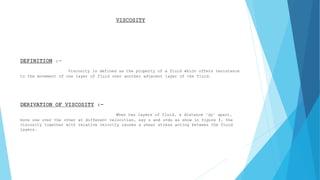
DEFINITION :- 
Viscosity is defined as the property of a fluid which offers resistance 
to the movement of one layer of fluid over another adjacent layer of the fluid. 
DERIVATION OF VISCOSITY :- 
When two layers of fluid, a distance ‘dy’ apart, 
move one over the other at different velocities, say u and u+du as show in figure 1, the 
viscosity together with relative velocity causes a shear stress acting between the fluid 
layers.
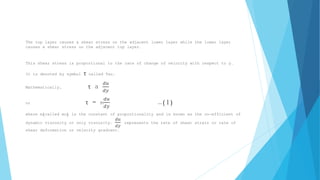
The top layer causes a shear stress on the adjacent lower layer while the lower layer 
causes a shear stress on the adjacent top layer. 
This shear stress is proportional to the rate of change of velocity with respect to y. 
It is denoted by symbol τ called Tau. 
Mathematically, τ a 푑푢 
푑푦 
or τ = m 
푑푢 
푑푦 
…(1) 
where m(called mu) is the constant of proportionality and is known as the co-efficient of 
dynamic viscosity or only viscosity. 
푑푢 
푑푦 
represents the rate of shear strain or rate of 
shear deformation or velocity gradient.
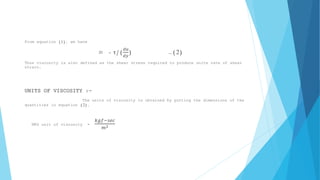
From equation (1), we have 
m = τ/(푑푢 
푑푦 
) …(2) 
Thus viscosity is also defined as the shear stress required to produce unite rate of shear 
strain. 
UNITS OF VISCOSITY :- 
The units of viscosity is obtained by putting the dimensions of the 
quantities in equation (2). 
MKS unit of viscosity = 
푘푔푓−푠푒푐 
푚2
CGS unit of viscosity = 
푑푦푛푒−푠푒푐 
푐푚2 
SI unit of viscosity = 
푁 푠 
푚2 
The unit of viscosity in CGS is also called Poise which is equal to 
푑푦푛푒−푠푒푐 
푐푚2 . 
KINEMATIC VISCOSITY :- 
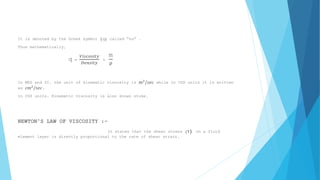
It is defined as the ratio between the dynamic viscosity and 
density of fluid.
It is denoted by the Greek symbol (q) called “nu” . 
Thus mathematically, 
q = 
푉푖푠푐표푠푖푡푦 
퐷푒푛푠푖푡푦 
= 
m 
ρ 
In MKS and SI, the unit of kinematic viscosity is 푚2/푠푒푐 while in CGS units it is written 
as c푚2/푠푒푐. 
In CGS units, Kinematic viscosity is also known stoke. 
NEWTON’S LAW OF VISCOSITY :- 
It states that the shear stress (τ) on a fluid 
element layer is directly proportional to the rate of shear strain.
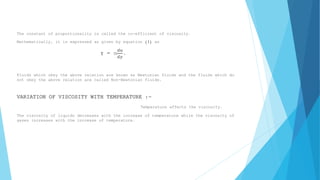
The constant of proportionality is called the co-efficient of viscosity. 
Mathematically, it is expressed as given by equation (1) as 
τ = m 
푑푢 
푑푦 
. 
Fluids which obey the above relation are known as Newtonian fluids and the fluids which do 
not obey the above relation are called Non-Newtonian fluids. 
VARIATION OF VISCOSITY WITH TEMPERATURE :- 
Temperature affects the viscosity. 
The viscosity of liquids decreases with the increase of temperature while the viscosity of 
gases increases with the increase of temperature.
This is due to reason that in liquids the cohesive forces predominates the molecular 
momentum transfer, due to closely packed molecules and with the increase in temperature, 
the cohesive forces decreases with the result of decreasing viscosity. 
But in case of gases the cohesive force are small and molecular momentum transfer 
predominates. 
With the increase in temperature, molecular momentum transfer increases and hence viscosity 
increases. 
TYPES OF FLUIDS :- 
The fluids may be classified into the following five types:-
1)Ideal Fluid – A fluid, which is incompressible and is having no viscosity, is known as an 
ideal fluid. 
Ideal fluid is only an imaginary fluid as all the fluids, which exist, have some 
viscosity. 
2) Real Fluid – A fluid, which possesses viscosity, is known as real fluid. All the fluids, 
in actual practice, are real fluids. 
3) Newtonian Fluid – A real fluid, in which the shear stress is directly, proportional to 
the rate of shear strain (or velocity gradient) is known as a Newtonian fluid. 
4) Non-Newtonian Fluid - A real fluid, in which the shear stress is not proportional to the 
rate of shear strain (or velocity gradient) is known as a Non-Newtonian fluid.
5) Ideal Plastic Fluid – A fluid, in which shear stress is more than the yield value and 
shear stress is proportional to the rate of shear strain (or velocity gradient), is known 
as ideal plastic fluid.

Viscosity

  • 1.
    NAME :- AMANRAJ TOPIC NAME :- VISCOSITY
  • 2.
    VISCOSITY DEFINITION :- Viscosity is defined as the property of a fluid which offers resistance to the movement of one layer of fluid over another adjacent layer of the fluid. DERIVATION OF VISCOSITY :- When two layers of fluid, a distance ‘dy’ apart, move one over the other at different velocities, say u and u+du as show in figure 1, the viscosity together with relative velocity causes a shear stress acting between the fluid layers.
  • 4.
    The top layercauses a shear stress on the adjacent lower layer while the lower layer causes a shear stress on the adjacent top layer. This shear stress is proportional to the rate of change of velocity with respect to y. It is denoted by symbol τ called Tau. Mathematically, τ a 푑푢 푑푦 or τ = m 푑푢 푑푦 …(1) where m(called mu) is the constant of proportionality and is known as the co-efficient of dynamic viscosity or only viscosity. 푑푢 푑푦 represents the rate of shear strain or rate of shear deformation or velocity gradient.
  • 5.
    From equation (1),we have m = τ/(푑푢 푑푦 ) …(2) Thus viscosity is also defined as the shear stress required to produce unite rate of shear strain. UNITS OF VISCOSITY :- The units of viscosity is obtained by putting the dimensions of the quantities in equation (2). MKS unit of viscosity = 푘푔푓−푠푒푐 푚2
  • 6.
    CGS unit ofviscosity = 푑푦푛푒−푠푒푐 푐푚2 SI unit of viscosity = 푁 푠 푚2 The unit of viscosity in CGS is also called Poise which is equal to 푑푦푛푒−푠푒푐 푐푚2 . KINEMATIC VISCOSITY :- It is defined as the ratio between the dynamic viscosity and density of fluid.
  • 7.
    It is denotedby the Greek symbol (q) called “nu” . Thus mathematically, q = 푉푖푠푐표푠푖푡푦 퐷푒푛푠푖푡푦 = m ρ In MKS and SI, the unit of kinematic viscosity is 푚2/푠푒푐 while in CGS units it is written as c푚2/푠푒푐. In CGS units, Kinematic viscosity is also known stoke. NEWTON’S LAW OF VISCOSITY :- It states that the shear stress (τ) on a fluid element layer is directly proportional to the rate of shear strain.
  • 8.
    The constant ofproportionality is called the co-efficient of viscosity. Mathematically, it is expressed as given by equation (1) as τ = m 푑푢 푑푦 . Fluids which obey the above relation are known as Newtonian fluids and the fluids which do not obey the above relation are called Non-Newtonian fluids. VARIATION OF VISCOSITY WITH TEMPERATURE :- Temperature affects the viscosity. The viscosity of liquids decreases with the increase of temperature while the viscosity of gases increases with the increase of temperature.
  • 9.
    This is dueto reason that in liquids the cohesive forces predominates the molecular momentum transfer, due to closely packed molecules and with the increase in temperature, the cohesive forces decreases with the result of decreasing viscosity. But in case of gases the cohesive force are small and molecular momentum transfer predominates. With the increase in temperature, molecular momentum transfer increases and hence viscosity increases. TYPES OF FLUIDS :- The fluids may be classified into the following five types:-
  • 11.
    1)Ideal Fluid –A fluid, which is incompressible and is having no viscosity, is known as an ideal fluid. Ideal fluid is only an imaginary fluid as all the fluids, which exist, have some viscosity. 2) Real Fluid – A fluid, which possesses viscosity, is known as real fluid. All the fluids, in actual practice, are real fluids. 3) Newtonian Fluid – A real fluid, in which the shear stress is directly, proportional to the rate of shear strain (or velocity gradient) is known as a Newtonian fluid. 4) Non-Newtonian Fluid - A real fluid, in which the shear stress is not proportional to the rate of shear strain (or velocity gradient) is known as a Non-Newtonian fluid.
  • 12.
    5) Ideal PlasticFluid – A fluid, in which shear stress is more than the yield value and shear stress is proportional to the rate of shear strain (or velocity gradient), is known as ideal plastic fluid.