By,
G.SHANMUGA PRIYA
Assistant Professor
Department of Physics
V.V.Vanniaperumal College for Women
Virudhunagar
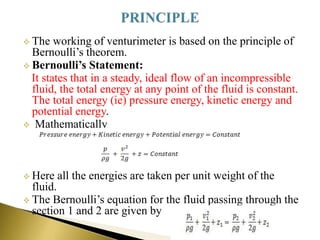
 The working of venturimeter is based on the principle of
Bernoulli’s theorem.
 Bernoulli’s Statement:
It states that in a steady, ideal flow of an incompressible
fluid, the total energy at any point of the fluid is constant.
The total energy (ie) pressure energy, kinetic energy and
potential energy.
 Mathematically
 Here all the energies are taken per unit weight of the
fluid.
 The Bernoulli’s equation for the fluid passing through the
section 1 and 2 are given by
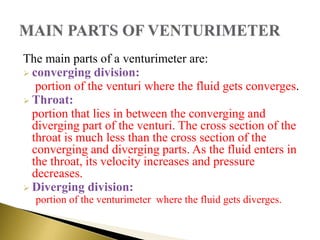
The main parts of a venturimeter are:
 converging division:
portion of the venturi where the fluid gets converges.
 Throat:
portion that lies in between the converging and
diverging part of the venturi. The cross section of the
throat is much less than the cross section of the
converging and diverging parts. As the fluid enters in
the throat, its velocity increases and pressure
decreases.
 Diverging division:
portion of the venturimeter where the fluid gets diverges.
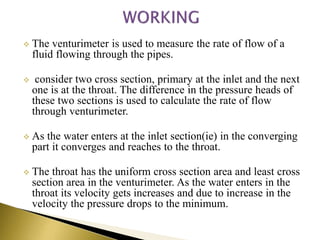
 The venturimeter is used to measure the rate of flow of a
fluid flowing through the pipes.
 consider two cross section, primary at the inlet and the next
one is at the throat. The difference in the pressure heads of
these two sections is used to calculate the rate of flow
through venturimeter.
 As the water enters at the inlet section(ie) in the converging
part it converges and reaches to the throat.
 The throat has the uniform cross section area and least cross
section area in the venturimeter. As the water enters in the
throat its velocity gets increases and due to increase in the
velocity the pressure drops to the minimum.
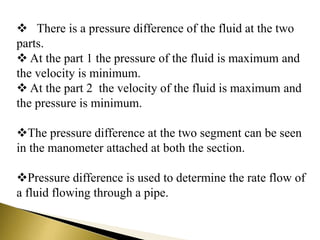
 There is a pressure difference of the fluid at the two
parts.
 At the part 1 the pressure of the fluid is maximum and
the velocity is minimum.
 At the part 2 the velocity of the fluid is maximum and
the pressure is minimum.
The pressure difference at the two segment can be seen
in the manometer attached at both the section.
Pressure difference is used to determine the rate flow of
a fluid flowing through a pipe.
 In the previous diagram , d1, p1, v1 & a1, are the
diameter at the inlet, pressure at the inlet, velocity at
the inlet and area at the cross part 1.
 d2, p2, v2 and a2 are the corresponding values at part
2.
 Applying Bernoulli’s equation at parts 1 and 2
Applying bernoulli’s equation at parts1 and 2
As the pipe is horizontal, so z1 = z2
Therefore
(p1 – p2)/ρg is the difference of pressure heads at section 1 and 2 and
it is equal to h. so
Now applying continuity equation at part 1 and 2
Substituting this value of h in equation (1), we get
Substituting this value of v1 in equation (2) and
solving, we get
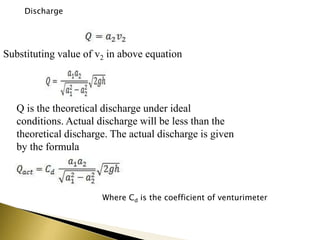
Substituting value of v2 in above equation
Q is the theoretical discharge under ideal
conditions. Actual discharge will be less than the
theoretical discharge. The actual discharge is given
by the formula
Where Cd is the coefficient of venturimeter
Discharge
venturi meter

venturi meter

  • 1.
    By, G.SHANMUGA PRIYA Assistant Professor Departmentof Physics V.V.Vanniaperumal College for Women Virudhunagar
  • 2.
     The workingof venturimeter is based on the principle of Bernoulli’s theorem.  Bernoulli’s Statement: It states that in a steady, ideal flow of an incompressible fluid, the total energy at any point of the fluid is constant. The total energy (ie) pressure energy, kinetic energy and potential energy.  Mathematically  Here all the energies are taken per unit weight of the fluid.  The Bernoulli’s equation for the fluid passing through the section 1 and 2 are given by
  • 3.
    The main partsof a venturimeter are:  converging division: portion of the venturi where the fluid gets converges.  Throat: portion that lies in between the converging and diverging part of the venturi. The cross section of the throat is much less than the cross section of the converging and diverging parts. As the fluid enters in the throat, its velocity increases and pressure decreases.  Diverging division: portion of the venturimeter where the fluid gets diverges.
  • 5.
     The venturimeteris used to measure the rate of flow of a fluid flowing through the pipes.  consider two cross section, primary at the inlet and the next one is at the throat. The difference in the pressure heads of these two sections is used to calculate the rate of flow through venturimeter.  As the water enters at the inlet section(ie) in the converging part it converges and reaches to the throat.  The throat has the uniform cross section area and least cross section area in the venturimeter. As the water enters in the throat its velocity gets increases and due to increase in the velocity the pressure drops to the minimum.
  • 6.
     There isa pressure difference of the fluid at the two parts.  At the part 1 the pressure of the fluid is maximum and the velocity is minimum.  At the part 2 the velocity of the fluid is maximum and the pressure is minimum. The pressure difference at the two segment can be seen in the manometer attached at both the section. Pressure difference is used to determine the rate flow of a fluid flowing through a pipe.
  • 8.
     In theprevious diagram , d1, p1, v1 & a1, are the diameter at the inlet, pressure at the inlet, velocity at the inlet and area at the cross part 1.  d2, p2, v2 and a2 are the corresponding values at part 2.  Applying Bernoulli’s equation at parts 1 and 2
  • 9.
    Applying bernoulli’s equationat parts1 and 2 As the pipe is horizontal, so z1 = z2 Therefore
  • 10.
    (p1 – p2)/ρgis the difference of pressure heads at section 1 and 2 and it is equal to h. so Now applying continuity equation at part 1 and 2 Substituting this value of h in equation (1), we get Substituting this value of v1 in equation (2) and solving, we get
  • 11.
    Substituting value ofv2 in above equation Q is the theoretical discharge under ideal conditions. Actual discharge will be less than the theoretical discharge. The actual discharge is given by the formula Where Cd is the coefficient of venturimeter Discharge