YARN TWIST
Prepared By
01:Zahidul Islam(228)
02:MD.Mynul Islam Palash(248)
03:Fahim Ruffsan(063)
04:Sojol Mollick(233)
05:Nazrul Islam(200)
YARN:
Yarn is a long continuous length of interlocked fibres, suitable for use in
the production of textiles, sewing, crocheting, knitting, weaving,
embroidery, and rope making.
TWIST: Twist is the spiral arrangement of the fibres around the axis of
the yarn. The twist binds the fibres together and also contributes to
the strength of the yarn. The amount of twist inserted in a yarn
defines the appearance and the strength of the yarn. The number of
twists is referred to as turns per inch.
DIFFERENT DEFINITIONS OF TWIST OF THE YARN
Yarn twist is defined as the spiral deposition of the components of a twist is
the measure of the spiral turns given to a yarn in order to hold the
constituent fibres or threads together – Skinkle.
When a strand is twisted the component fibres tend to take on a spiral
formation, the geometric perfection of which depends on their original
formation – Morton.
Twist may be defined as the rotation about the yarn axis of any line drawn
on the yarn which was originally, before twisting parallel to the yarn axis –
Wool Res
TYPES OF TWIST
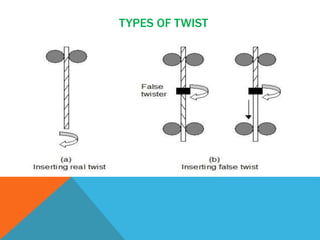
Real twist::
To insert a real twist into a length of yarn, one end of the yarn should be
rotated relative to the other end,Spun yarns usually have real twist, which
holds the fibres together in the yarn. as indicated in figure (a)
False twist:
When inserting false twist into a length of yarn, both ends of the yarn are
clamped, usually by rollers, and twist is inserted with a false twister between
the clamping points, as indicated in figure (b)
TYPES OF TWIST
EXPRESSION OF TWIST
Amount of twist expressed in –
1) Twist Per Inch(TPI)
2) Twist Per Meter(TPM)
3) Twist Per Centemeter(TPC)
FACTORS AFFECTING TWIST
The twist introduced in the yarn during spinning depends upon a number of
factors, such as follows:
1. The count of yarn to be spun
2. The quality of cotton used
3.The use to which the yarn is put- is the yarn meant to be used as warp yarn
or weft yarn, knitting yarn or any other yarn.
4.The fineness of the fibre being spun
5. The softness of the fabric into which the yarn is to be converted
YARN TWIST
In practice, yarn twist is described using three main parameters:
(a) twist direction
(b) twist factor or twist multiplier
And
(c) twist level (turns/unit length).
TWIST DIRECTION
S twist
When a twisted yarn is held vertically, the individual filaments are appearing
in this case as the diagonal in the letter "S". The same can apply if several
yarns have been twisted together: their combined twist can again appear as
the diagonal of the letter "S".
Fig: Direction of S twist
TWIST DIRECTION
Z twist
When a twisted yarn is held vertically, the individual filaments are appearing
in this case as the diagonal in the letter "Z". The same can apply if several
yarns have been twisted together: their combined twist can again appear as
the diagonal of the letter "Z".
Fig: Direction of Z twist
TWIST DIRECTION
TWIST FACTOR OR TWIST MULTIPLIER
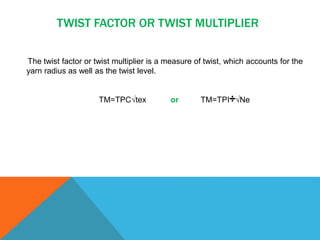
The twist factor or twist multiplier is a measure of twist, which accounts for the
yarn radius as well as the twist level.
TM=TPC√tex or TM=TPI÷√Ne
TWIST FACTOR OR TWIST MULTIPLIERS
Higher twist multipliers are used :
* to increase yarn tenacity and yarn elongation;
* to produce lean yarns with low hairiness;
* to improve spinning stability;
* to obtain a clean-cut fabric appearance
and
* to improve the shifting resistance of the yarns
TWIST FACTOR OR TWIST MULTIPLIERS
Lower twist multipliers are selected, presupposing adequate yarn tenacity :
* to achieve a soft hand in the final fabric;
* to produce bulky and more hairy yarns;
* to reduce a yarn‘s tendency to snarl
and
* increase output with the same rotor speed.
TWIST LEVEL
Twist level expressed in the number of turns per unit length.
hT = 1
Here , h = one turn of twist
T = twist level
FUNCTION OF TWIST IN YARN STRUCTURE
1) To increase the yarn strength in order to withstand the stress of
preparation and fabric manufacture.
2) The main function of twist is to give coherence to the yarn.
3) If the twist is low , the fibres can be made to slide past one another ,
but if it is large , the increasing tension would break the fibres.
EFFECTS OF TWIST ON YARN & FABRIC PROPERTIES
In the case of handle :
1) A fabric made from high-twist yarn will feel harder and also be
thinner.
2) A fabric produced from a low-twist yarn will have a soft handle. But
this fabric will be weak and have a low resistance to abrasion.
3) If the twist level is high , the diameter of yarn will decrease and thus
covering power is reduced.
EFFECTS OF TWIST ON YARN & FABRIC PROPERTIES
In the case of moisture absorption :
High twist holds the fibres tight thus restricting water to enter. On the
other hand low twist yarn is used where absorbency is required.
EFFECTS OF TWIST ON YARN & FABRIC PROPERTIES
In the case of wearing properties:
High level of twist helps to resist abrasion as the fibres can’t easily
pulled out of yarn. The same effect also helps to prevent pilling.
EFFECTS OF TWIST ON YARN & FABRIC PROPERTIES
In the case of aesthetic effects :
1) The level of twist in yarn alters its appearance both by changing the
thickness and light reflecting properties.
2) Different patterns can be produced in a fabric by using similar yarns but with
different twist levels.
FABRICS MADE BY APPLICATION OF DIFFERENT LEVEL OF
TWISTS
1) Georgette is made of highly twisted yarn(upto1000TPM) by weaving S and Z
twisted yarns alternately.
2) Chiffon is made in the same way but yarn is more twisted(up to 2000TPM).
3) Herringbone is made by using yarns of different types and levels of twists.
RELATION BETWEEN TWIST AND YARN STRENGTH
IMPORTANCE OF TWIST
1) The shape of yarn become round.
2) Increase tensile properties of yarn due to twist.
3) The inter-cohesion affinity of fibres increases due to twist and do not open
the fibres easily.
METHODS OF MEASURING YARN TWIST
1) Single untwist method
2) Fibre straightened method
3) Single twist-untwist method
4) Double twist-untwist method
5) Multiple twist –untwist method
TWIST MEASUREMENT OF PLIED YARNS:
1) Ordinary twist tester
2) Automatic twist tester
3) Take up twist tester(for plied yarns)
4) The quadrant twist tester
It is a fibre-
straightened
method.
ORDINARY TWIST TESTER :
STANDARD SAMPLE LENGTH:
#
For Cotton= 1" or 10"
#
For Jute= 10"
SEMI AUTOMATIC TWIST TESTER :
*It is automatically executed
*It’s system electrionically controlled
*It keeps uniform system on yarn
SEMI AUTOMATIC TWIST TESTER :
Yarn twist

Yarn twist

  • 2.
    YARN TWIST Prepared By 01:ZahidulIslam(228) 02:MD.Mynul Islam Palash(248) 03:Fahim Ruffsan(063) 04:Sojol Mollick(233) 05:Nazrul Islam(200)
  • 3.
    YARN: Yarn is along continuous length of interlocked fibres, suitable for use in the production of textiles, sewing, crocheting, knitting, weaving, embroidery, and rope making. TWIST: Twist is the spiral arrangement of the fibres around the axis of the yarn. The twist binds the fibres together and also contributes to the strength of the yarn. The amount of twist inserted in a yarn defines the appearance and the strength of the yarn. The number of twists is referred to as turns per inch.
  • 4.
    DIFFERENT DEFINITIONS OFTWIST OF THE YARN Yarn twist is defined as the spiral deposition of the components of a twist is the measure of the spiral turns given to a yarn in order to hold the constituent fibres or threads together – Skinkle. When a strand is twisted the component fibres tend to take on a spiral formation, the geometric perfection of which depends on their original formation – Morton. Twist may be defined as the rotation about the yarn axis of any line drawn on the yarn which was originally, before twisting parallel to the yarn axis – Wool Res
  • 5.
    TYPES OF TWIST Realtwist:: To insert a real twist into a length of yarn, one end of the yarn should be rotated relative to the other end,Spun yarns usually have real twist, which holds the fibres together in the yarn. as indicated in figure (a) False twist: When inserting false twist into a length of yarn, both ends of the yarn are clamped, usually by rollers, and twist is inserted with a false twister between the clamping points, as indicated in figure (b)
  • 6.
  • 7.
    EXPRESSION OF TWIST Amountof twist expressed in – 1) Twist Per Inch(TPI) 2) Twist Per Meter(TPM) 3) Twist Per Centemeter(TPC)
  • 8.
    FACTORS AFFECTING TWIST Thetwist introduced in the yarn during spinning depends upon a number of factors, such as follows: 1. The count of yarn to be spun 2. The quality of cotton used 3.The use to which the yarn is put- is the yarn meant to be used as warp yarn or weft yarn, knitting yarn or any other yarn. 4.The fineness of the fibre being spun 5. The softness of the fabric into which the yarn is to be converted
  • 9.
    YARN TWIST In practice,yarn twist is described using three main parameters: (a) twist direction (b) twist factor or twist multiplier And (c) twist level (turns/unit length).
  • 10.
    TWIST DIRECTION S twist Whena twisted yarn is held vertically, the individual filaments are appearing in this case as the diagonal in the letter "S". The same can apply if several yarns have been twisted together: their combined twist can again appear as the diagonal of the letter "S". Fig: Direction of S twist
  • 11.
    TWIST DIRECTION Z twist Whena twisted yarn is held vertically, the individual filaments are appearing in this case as the diagonal in the letter "Z". The same can apply if several yarns have been twisted together: their combined twist can again appear as the diagonal of the letter "Z". Fig: Direction of Z twist
  • 12.
  • 13.
    TWIST FACTOR ORTWIST MULTIPLIER The twist factor or twist multiplier is a measure of twist, which accounts for the yarn radius as well as the twist level. TM=TPC√tex or TM=TPI÷√Ne
  • 14.
    TWIST FACTOR ORTWIST MULTIPLIERS Higher twist multipliers are used : * to increase yarn tenacity and yarn elongation; * to produce lean yarns with low hairiness; * to improve spinning stability; * to obtain a clean-cut fabric appearance and * to improve the shifting resistance of the yarns
  • 15.
    TWIST FACTOR ORTWIST MULTIPLIERS Lower twist multipliers are selected, presupposing adequate yarn tenacity : * to achieve a soft hand in the final fabric; * to produce bulky and more hairy yarns; * to reduce a yarn‘s tendency to snarl and * increase output with the same rotor speed.
  • 16.
    TWIST LEVEL Twist levelexpressed in the number of turns per unit length. hT = 1 Here , h = one turn of twist T = twist level
  • 17.
    FUNCTION OF TWISTIN YARN STRUCTURE 1) To increase the yarn strength in order to withstand the stress of preparation and fabric manufacture. 2) The main function of twist is to give coherence to the yarn. 3) If the twist is low , the fibres can be made to slide past one another , but if it is large , the increasing tension would break the fibres.
  • 18.
    EFFECTS OF TWISTON YARN & FABRIC PROPERTIES In the case of handle : 1) A fabric made from high-twist yarn will feel harder and also be thinner. 2) A fabric produced from a low-twist yarn will have a soft handle. But this fabric will be weak and have a low resistance to abrasion. 3) If the twist level is high , the diameter of yarn will decrease and thus covering power is reduced.
  • 19.
    EFFECTS OF TWISTON YARN & FABRIC PROPERTIES In the case of moisture absorption : High twist holds the fibres tight thus restricting water to enter. On the other hand low twist yarn is used where absorbency is required.
  • 20.
    EFFECTS OF TWISTON YARN & FABRIC PROPERTIES In the case of wearing properties: High level of twist helps to resist abrasion as the fibres can’t easily pulled out of yarn. The same effect also helps to prevent pilling.
  • 21.
    EFFECTS OF TWISTON YARN & FABRIC PROPERTIES In the case of aesthetic effects : 1) The level of twist in yarn alters its appearance both by changing the thickness and light reflecting properties. 2) Different patterns can be produced in a fabric by using similar yarns but with different twist levels.
  • 22.
    FABRICS MADE BYAPPLICATION OF DIFFERENT LEVEL OF TWISTS 1) Georgette is made of highly twisted yarn(upto1000TPM) by weaving S and Z twisted yarns alternately. 2) Chiffon is made in the same way but yarn is more twisted(up to 2000TPM). 3) Herringbone is made by using yarns of different types and levels of twists.
  • 23.
    RELATION BETWEEN TWISTAND YARN STRENGTH
  • 24.
    IMPORTANCE OF TWIST 1)The shape of yarn become round. 2) Increase tensile properties of yarn due to twist. 3) The inter-cohesion affinity of fibres increases due to twist and do not open the fibres easily.
  • 25.
    METHODS OF MEASURINGYARN TWIST 1) Single untwist method 2) Fibre straightened method 3) Single twist-untwist method 4) Double twist-untwist method 5) Multiple twist –untwist method
  • 26.
    TWIST MEASUREMENT OFPLIED YARNS: 1) Ordinary twist tester 2) Automatic twist tester 3) Take up twist tester(for plied yarns) 4) The quadrant twist tester
  • 27.
    It is afibre- straightened method. ORDINARY TWIST TESTER :
  • 28.
    STANDARD SAMPLE LENGTH: # ForCotton= 1" or 10" # For Jute= 10"
  • 29.
    SEMI AUTOMATIC TWISTTESTER : *It is automatically executed *It’s system electrionically controlled *It keeps uniform system on yarn
  • 30.